Friday☕️


Trending:
- On November 13, 2025, international law enforcement agencies, including the FBI, announced the latest phase of Operation Endgame, a coordinated effort that dismantled three major cybercrime operations: the Rhadamanthys infostealer malware-as-a-service, the VenomRAT remote access trojan, and the Elysium malware network. Conducted between November 10 and 13, the operation involved seizing over 1,000 servers across 20 countries, disrupting access for cybercriminals and their customers who used these tools to steal sensitive data such as passwords, cryptocurrency wallets, and personal information from infected devices. The main suspect behind Rhadamanthys, arrested in Germany, had access to over 100,000 crypto wallets potentially worth millions, highlighting the scale of the threat posed by these platforms.
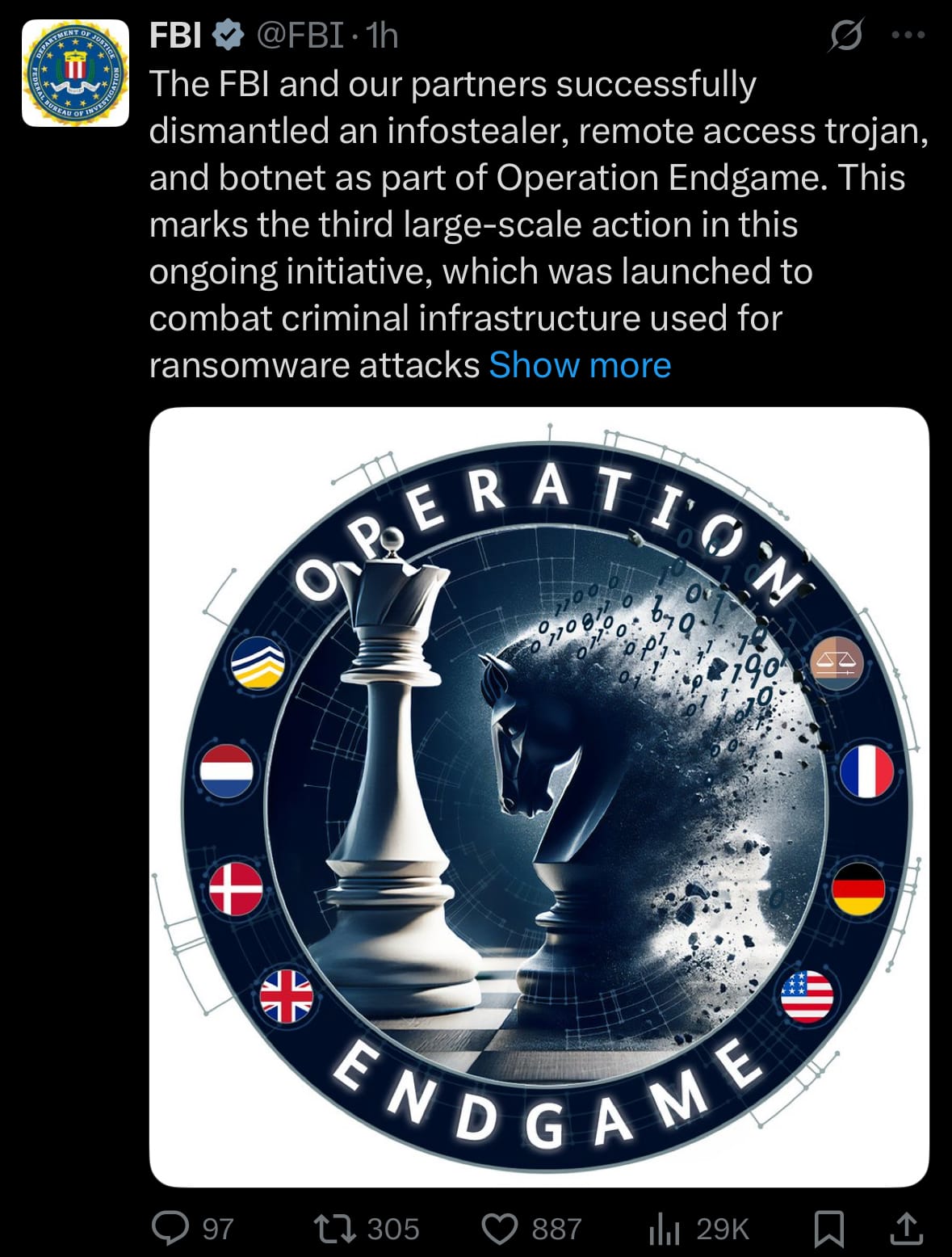
- This takedown builds on prior phases of Operation Endgame, which began in May 2024 targeting initial access brokers and botnets, and reflects a strategy to erode the infrastructure enabling ransomware and data theft globally. Impacts include temporary halts to ongoing attacks, with Rhadamanthys seeing a surge in use after previous disruptions like the Lumma takedown, though experts anticipate cybercriminals may adapt by shifting to alternative malware. The announcement emphasizes continued collaboration among agencies like Europol, the FBI, and partners in Europe and beyond to prevent regeneration of these networks, while urging victims to check for infections and secure their data.
Economics & Markets:
- Yesterday’s U.S. stock market:

- Yesterday’s commodity market:

- Yesterday’s crypto market:

Geopolitics & Military Activity:

Environment & Weather:

Cyber:


Space:
- On November 13, 2025, Blue Origin successfully conducted the second launch of its heavy-lift New Glenn rocket from Launch Complex 36 at Cape Canaveral Space Force Station in Florida, with liftoff occurring at 3:55 p.m. EST during a window from 2:57 p.m. to 4:25 p.m. The mission, designated NG-2, deployed NASA's twin ESCAPADE spacecraft—named Blue and Gold—into an initial Earth-Sun L2 trajectory, from which they will proceed to Mars orbit to study the planet's magnetosphere, plasma dynamics, and the solar wind's role in atmospheric erosion. Built by Rocket Lab under NASA's Small Innovative Missions for Planetary Exploration program, the probes represent Blue Origin's first major NASA payload, with the ascent phase proceeding flawlessly and the first stage separating as planned.


- The launch marked a key milestone as the New Glenn's reusable first stage achieved its inaugural landing on the recovery barge Jacklyn in the Atlantic Ocean, making Blue Origin the second company after SpaceX to demonstrate recoverable orbital-class rocket technology, potentially reducing costs and enabling higher launch cadences. This success enhances competition in the reusable launch market, supports NASA's goals for sustainable deep-space exploration, and underscores advancements in propulsion and landing systems, with no anomalies reported and full mission objectives met for the ESCAPADE deployment.
Science & Technology:
- On November 13, 2025, U.S. defense technology company Anduril Industries announced the development of its new Omen drone, a hybrid-electric vertical takeoff and landing (VTOL) unmanned aerial system designed for long-endurance missions such as intelligence, surveillance, reconnaissance, and electronic warfare. The announcement highlighted a collaboration with the United Arab Emirates' EDGE Group through a newly formed joint venture called the EDGE-Anduril Production Alliance, aimed at co-developing and manufacturing autonomous systems in the Middle East. The partnership includes establishing a 50,000-square-foot production facility in the UAE, with an initial order for 50 Omen units from an undisclosed UAE customer, marking Anduril's expansion into international defense markets amid growing demand for AI-integrated platforms.

- The Omen features a tail-sitter design that enables hovering for precise operations and high-speed forward flight reaching up to 200 knots with a range exceeding 500 nautical miles, powered by AI for autonomous decision-making and adaptability in contested environments. This collaboration reflects a strategic alignment between U.S. and UAE defense sectors to enhance capabilities against regional threats, while fostering technology transfer and local manufacturing.
Statistic:
- Largest public semiconductor companies by market capitalization:
- 🇺🇸 NVIDIA: $4.549T
- 🇺🇸 Broadcom: $1.605T
- 🇹🇼 TSMC: $1.463T
- 🇰🇷 Samsung: $454.75B
- 🇺🇸 AMD: $403.68B
- 🇳🇱 ASML: $395.85B
- 🇰🇷 SK Hynix: $287.51B
- 🇺🇸 Micron Technology: $265.96B
- 🇺🇸 Lam Research: $192.57B
- 🇺🇸 QUALCOMM: $186.88B
- 🇺🇸 Applied Materials: $177.83B
- 🇺🇸 Intel: $171.29B
- 🇺🇸 KLA: $152.64B
- 🇬🇧 Arm Holdings: $148.86B
- 🇺🇸 Texas Instruments: $147.40B
- 🇺🇸 Analog Devices: $116.85B
- 🇯🇵 Tokyo Electron: $100.67B
- 🇯🇵 Advantest: $97.37B
- 🇨🇳 SMIC: $93.05B
- 🇨🇳 Cambricon Technologies: $82.31B
- 🇺🇸 Marvell Technology: $75.45B
- 🇺🇸 Synopsys: $73.17B
- 🇹🇼 MediaTek: $63.88B
- 🇩🇪 Infineon: $54.27B
- 🇳🇱 NXP Semiconductors: $50.64B
History:
- Intelligence in war starts long before satellites and three-letter agencies; it starts the moment one tribe wonders, “Where is the other tribe, and what do they plan to do to us?” Early empires turned that instinct into systems. The Neo-Assyrians (around 900–600 BC) ran courier–spy networks across the Near East; the Persians under Darius I (522–486 BC) formalized the “King’s Eyes and Ears” to monitor satraps. In China, Sun Tzu’s Art of War (circa 500 BC) doesn’t treat spying as optional—he lists five categories of agents and warns that no campaign can succeed without them, which is basically an early doctrine of Human Intelligence (HUMINT). The Romans used exploratores and speculatores as scouts and covert operatives; medieval powers used informants, code-makers, and codebreakers; Mongol armies in the 1200s weaponized fast cavalry reconnaissance to “redraw” the mental map of Eurasia before their enemies even realized they were coming. By the 18th century, intelligence started to look modern. During the American Revolutionary War (1775–1783), George Washington personally ran the Culper Ring to gather Human Intelligence (HUMINT) in British-occupied New York, using codes, dead drops, and invisible ink; he said directly that “the necessity of procuring good intelligence is apparent and need not be further urged.” Napoleon’s dominance from 1799 to 1815 relied heavily on fast-moving cavalry scouts, cartography, and staff work: he turned information about roads, rivers, and enemy dispositions into rapid maneuvers like Austerlitz (1805), where superior understanding of terrain and timing shattered larger coalitions. By World War I (1914–1918), intelligence split into specialized branches: aerial photography redrew the battlefield from above, signals intelligence (SIGINT) intercepted radio and telegraph, and codebreaking began to systematically strip away the enemy’s secrecy. World War II (1939–1945) took that to an industrial scale: Britain’s Ultra codebreaking at Bletchley Park, the U.S. Office of Strategic Services (OSS, 1942), German Abwehr, Soviet GRU (1918 onwards), and Japanese networks all fused Human Intelligence (HUMINT), SIGINT, and deception (like Operation Fortitude before D-Day) to literally rewrite the “terrain”—not just where rivers and roads were, but where armies believed threats existed. After 1945, the map of global power was basically drawn by who had better intelligence organizations: CIA (1947), NSA (1952), Britain’s MI5 and MI6 (both roots in 1909), the U.S. Defense Intelligence Agency (DIA, 1961) for strictly military analysis, the KGB (1954) and GRU for the Soviet bloc, and Chinese military and party intelligence organs evolving into today’s constellation of People’s Liberation Army intelligence bureaus and security services.
- Modern intelligence is not just “spies and maps”—it is a whole-stack operating system for power. You now have Human Intelligence (HUMINT) networks, signals intelligence (SIGINT) on fiber and radio, imagery intelligence (IMINT) from satellites and drones, measurement and signatures intelligence (MASINT) for odd technical traces, open-source intelligence (OSINT) from public data, and full-blown cyber intelligence hunting in networks and code. Early space systems like the U.S. CORONA program (first successful film-return satellite in 1960) gave way to real-time electro-optical birds, synthetic-aperture radar (SAR) that sees through clouds and at night, and commercial mega-constellations that let any serious actor watch ports, troop movements, crops, and fires day-by-day. Agencies like the DIA, U.S. Cyber Command (2009), and China’s Strategic Support Force (2015) exist because the battlefield is now physical, digital, orbital, and cognitive all at once. The logic that rules all of this is brutal and simple: whoever best models reality wins. Intelligence “remaps” the terrain by replacing guesswork with structure—where the enemy is, what they can do, how fast they can move, what they believe is true, and where their blind spots are. Armies without superior intelligence don’t just fight worse; they walk into artillery, logistics failures, and ambushes until they are erased. Companies without superior market and technical intelligence get out-innovated, out-priced, and out-positioned until someone else eats their lunch. At a deeper level, intelligence is a primordial force of power because it’s the same thing evolution built into nervous systems and brains: gather data, compress it into models, and act to survive. Planetary or “Earth” intelligence is just the next phase—treating the entire planet as a dynamic, sensed system and running a real-time model of conflict, climate, finance, and infrastructure on top of it. In that frame, every empire, army, and company is just a temporary interface on a more fundamental substrate: the quality of its intelligence loop.
Image of the day:

Thanks for reading!
- EARTH INTELLIGENCE builds private intelligence systems for organizations — connecting their internal and external data with AI to create one interactive command center for real-time awareness, decision making, and predictions.
Earth is complicated, we make it simple.
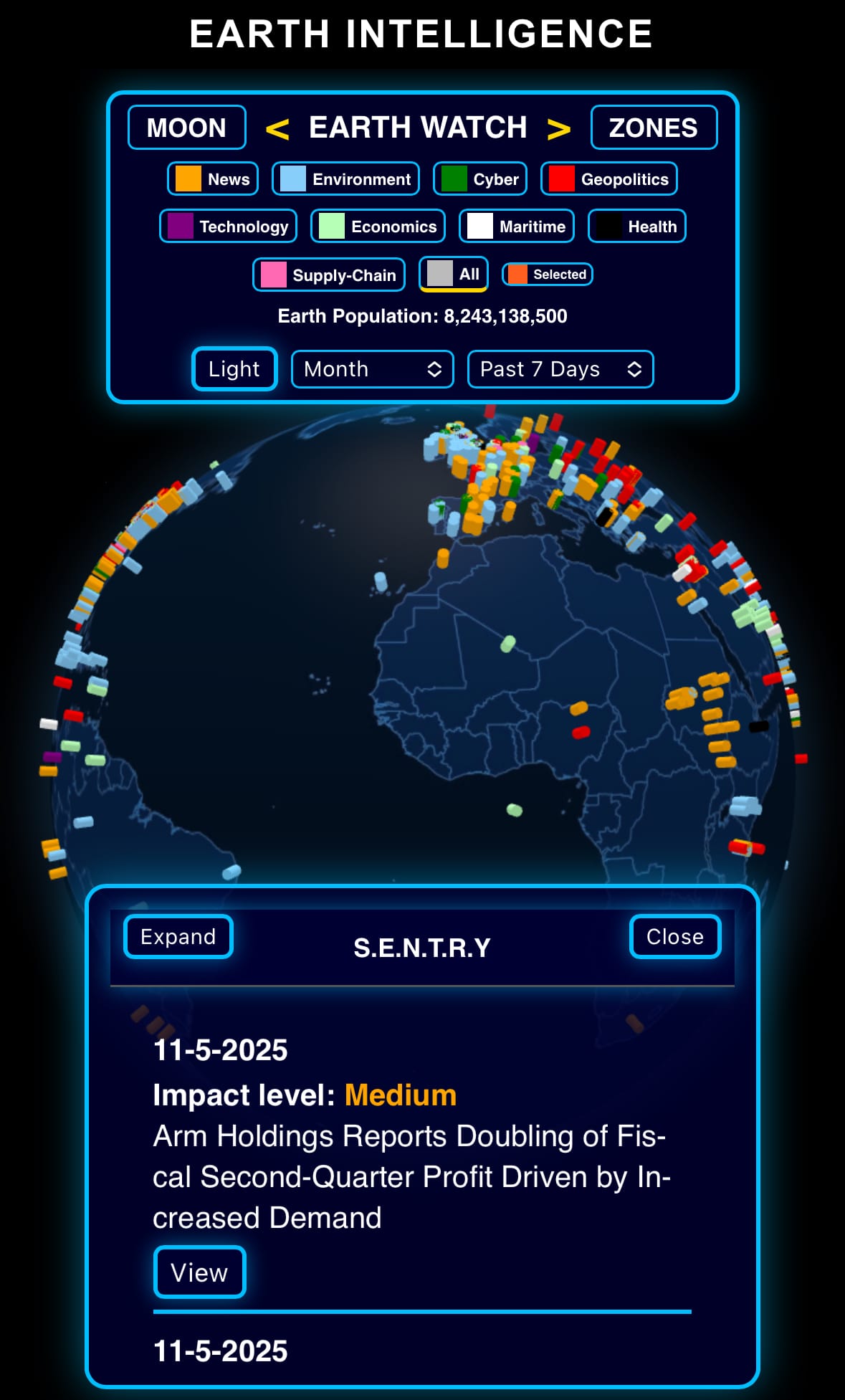
- Click below if you’d like to view our free EARTH WATCH globe:

Click below to view our previous newsletters:

Support/Suggestions Email:
earthintelligence@earthintel.news