Friday☕️


Economics & Markets:
- Yesterday’s U.S. stock market:

- Yesterday’s commodity market:

- Yesterday’s crypto market:

Geopolitics & Military Activity:
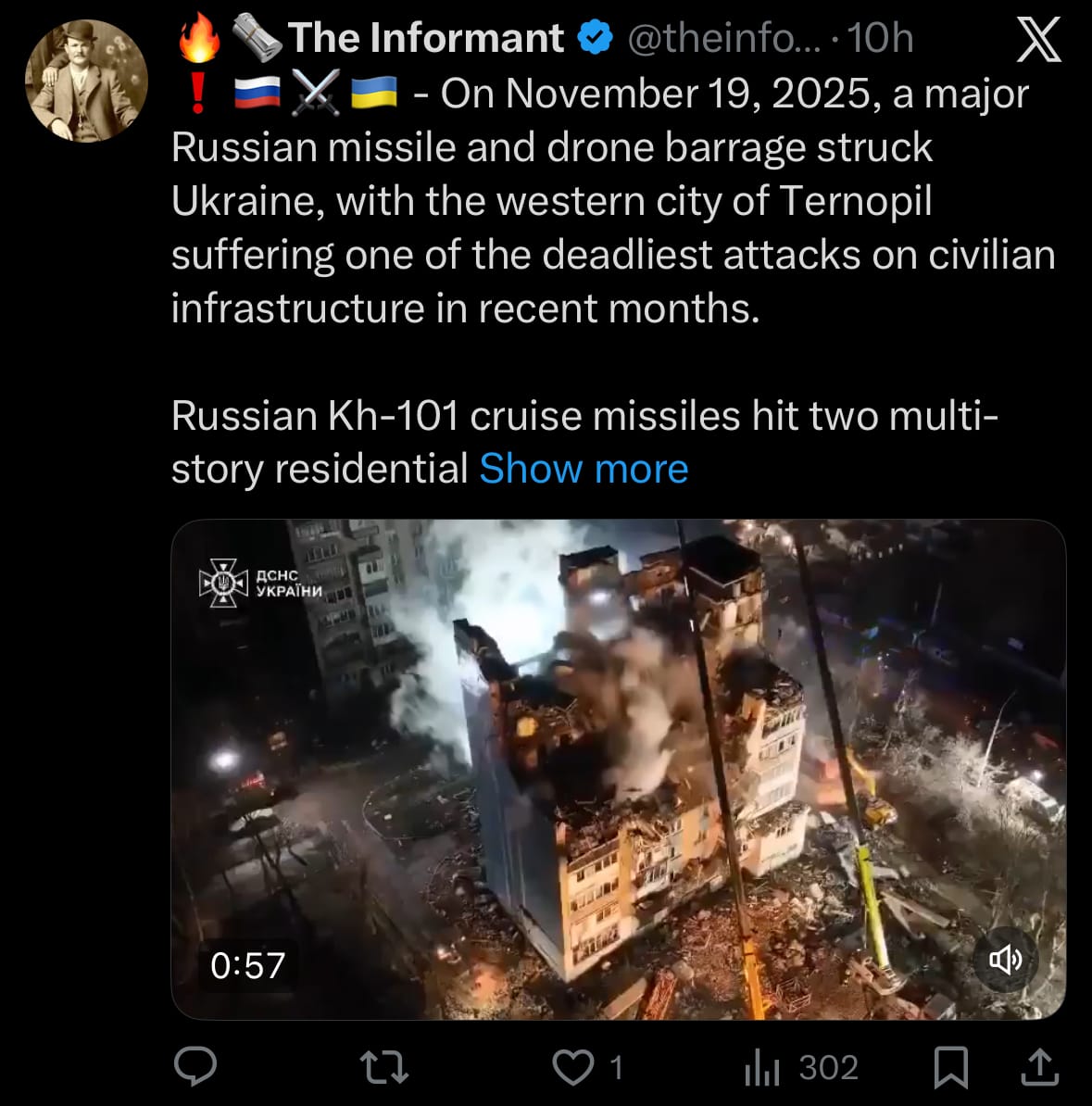
- On November 19, 2025, Russia launched a major missile and drone barrage against Ukraine, with the western city of Ternopil facing one of the deadliest strikes on civilian infrastructure in recent months. According to Ukrainian officials, Kh-101 cruise missiles struck two multi-story residential buildings, resulting in at least 26 civilian deaths, including three children, and injuring around 93 others. Rescue efforts extended into the following days, as approximately 22 people were initially reported missing under the rubble. The attack was part of a wider assault involving over 470 drones and 48 missiles targeting various regions, prompting international criticism for hitting civilian areas, while Russian officials have not commented specifically on the Ternopil incident.
- On November 20, 2025, Ukrainian President Volodymyr Zelenskyy met with U.S. Army Secretary Daniel Driscoll in Kyiv and expressed willingness to review and collaborate on a U.S.-developed peace plan aimed at ending the war with Russia. In a Telegram statement, Zelenskyy discussed options for achieving genuine peace through phased approaches and dialogue, noting that Ukrainian and U.S. teams would refine the plan's details, while emphasizing the need for peace and appreciating President Trump's efforts to restore security in Europe. The White House confirmed the plan's existence, with press secretary Caroline Leavitt dismissing reports of one-sided concessions favoring Russia and stating that envoys Steve Witkoff and Marco Rubio had consulted both sides. Although the full 28-point framework has not been officially released to Kyiv beyond broad outlines, media reports indicate it may include Ukrainian concessions such as withdrawing from the Donbas to create demilitarized zones, freezing lines in Zaporizhzhia and Kherson, halving armed forces, restricting long-range weapons, recognizing Russian as an official language, and banning foreign troops, in exchange for a ceasefire and unspecified security guarantees against future aggression.
Space:
- On November 20, 2025, Rocket Lab successfully launched its Electron rocket on the "Follow My Speed" mission from Launch Complex 1 in Mahia, New Zealand, marking the company's second orbital mission in under 48 hours and its 18th launch of the year. This rapid turnaround followed a previous launch from Virginia in the United States, demonstrating the company's ability to operate across hemispheres and achieve high-cadence operations. The mission deployed an undisclosed commercial satellite into low Earth orbit, contributing to Rocket Lab's record-breaking performance and positioning Electron as the most frequently flown orbital small launch vehicle globally, with a 100% success rate for all 2025 missions.
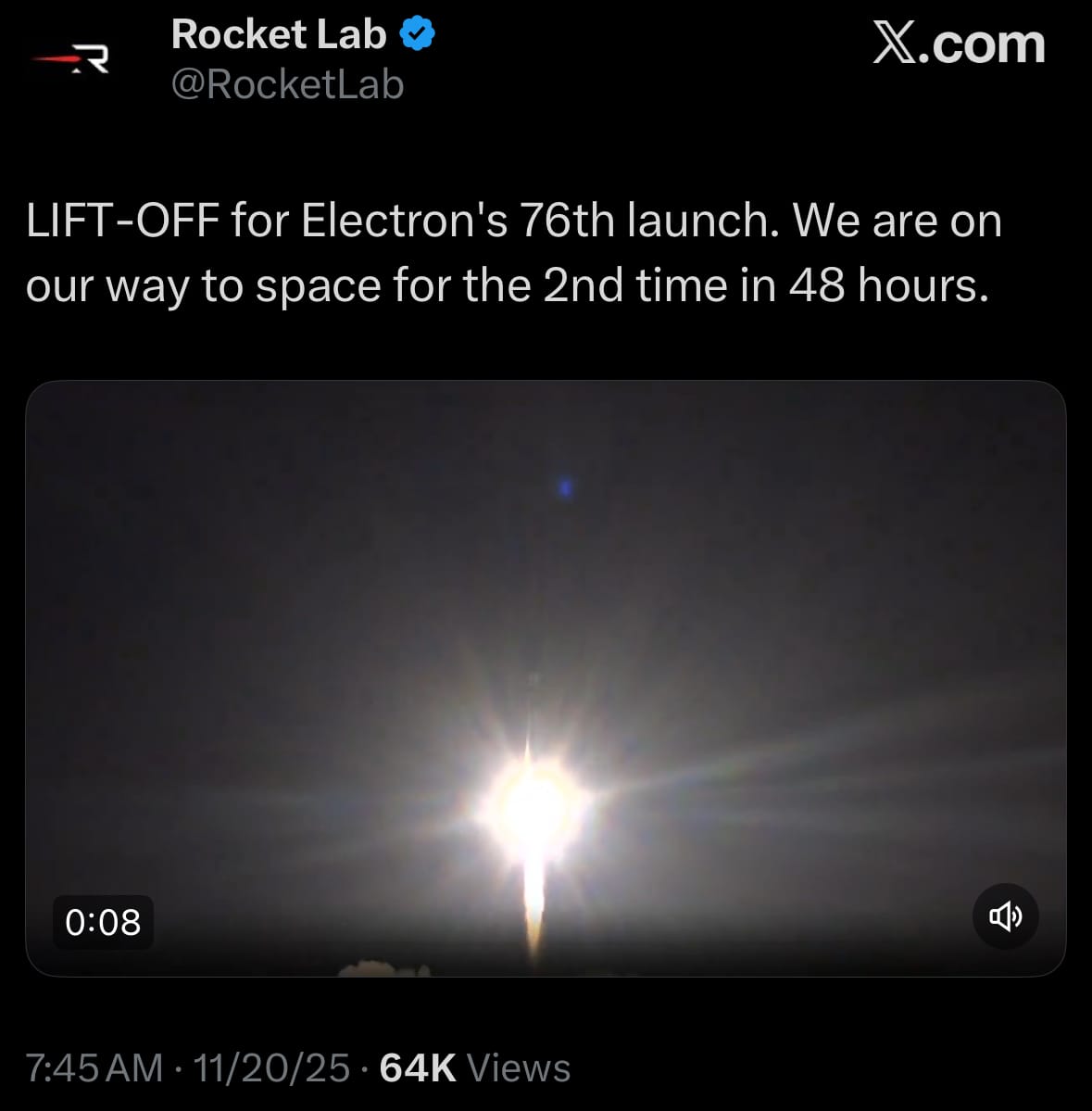
- The launch, which occurred at 12:43 UTC, represented the 76th overall flight for the Electron rocket and highlighted advancements in commercial production, experienced teams, and proven technology that enable such frequent operations. While the payload details remain confidential, the mission underscores Rocket Lab's growing role in providing responsive and reliable access to space for commercial customers.
Science & Technology:
- On November 20, 2025, IBM and Cisco announced a collaboration to develop the foundational elements of a distributed quantum computing network. This partnership combines IBM's advancements in quantum hardware and software with Cisco's networking capabilities to connect multiple large-scale, fault-tolerant quantum computers. The goal is to enable these systems to collaborate on complex computations that exceed the limits of standalone machines, potentially leading to a quantum internet. While the initiative targets initial practical applications in the early 2030s and more extensive connectivity by the late 2030s, it remains in the early research phase with no immediate commercial outcomes specified.
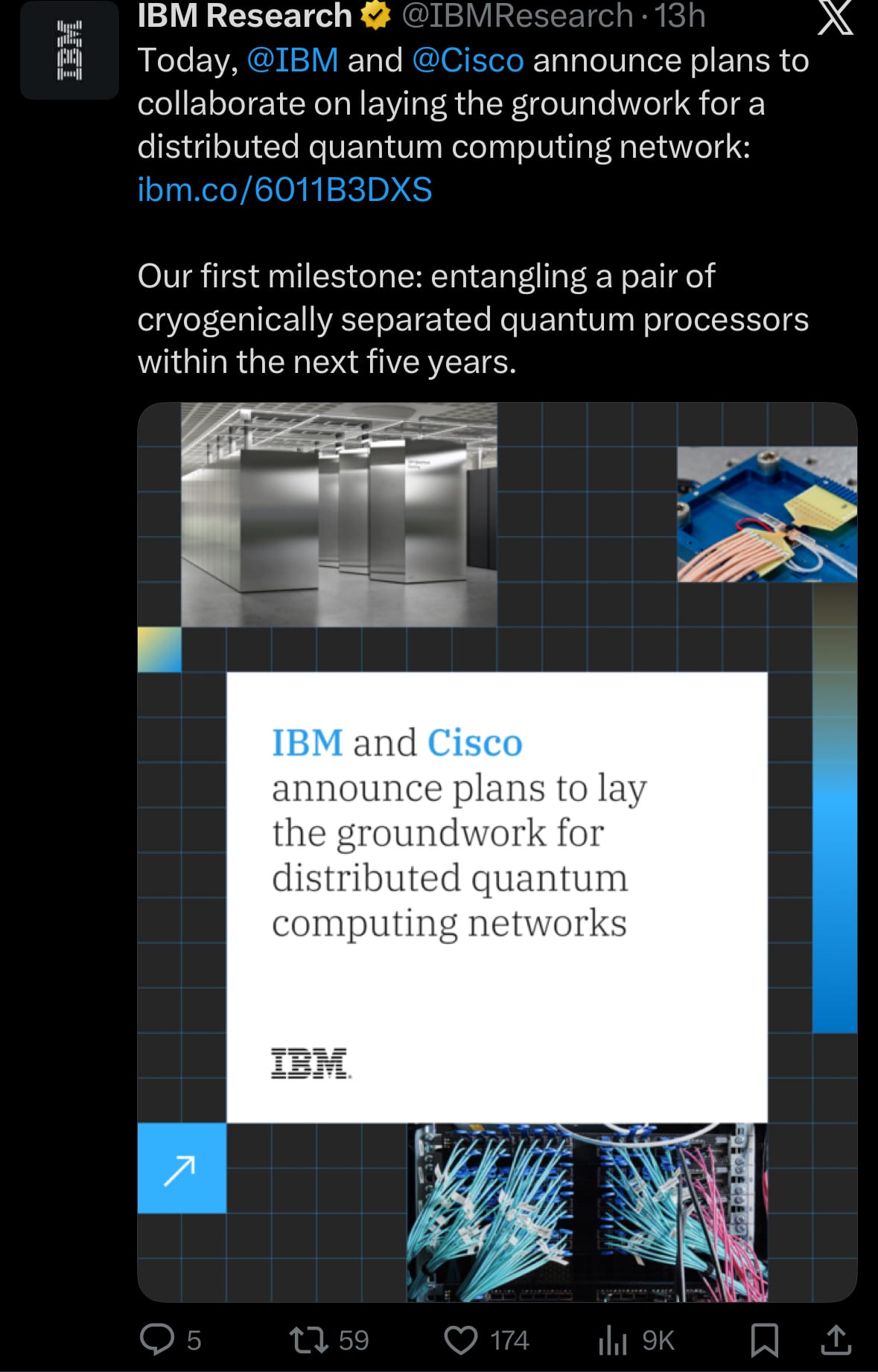
- The first milestone outlined in the collaboration is to achieve entanglement between two cryogenically separated quantum processors within the next five years, serving as a proof-of-concept for distributed quantum operations. This effort will involve developing specialized hardware like quantum networking units and transducers, as well as software for managing distributed algorithms across systems potentially handling tens to hundreds of thousands of qubits.

Statistic:
- Largest assets on Earth by market capitalization:
- 🥇Gold: $28.344T
- 🇺🇸 NVIDIA: $4.405T
- 🇺🇸 Apple: $3.951T
- 🇺🇸 Microsoft: $3.556T
- 🇺🇸 Alphabet (Google): $3.500T
- 🪙 Silver: $2.834T
- 🇺🇸 Amazon: $2.321T
- ₿ Bitcoin: $1.750T
- 🇸🇦 Saudi Aramco: $1.662T
- 🇺🇸 Broadcom: $1.637T
- 🇺🇸 Meta Platforms: $1.484T
- 🇹🇼 TSMC: $1.439T
- 🇺🇸 Tesla: $1.314T
- 🇺🇸 Berkshire Hathaway: $1.081T
- 🇺🇸 Eli Lilly: $935.26B
- 🇺🇸 Walmart: $854.78B
- 🇺🇸 JPMorgan Chase: $820.47B
- 🇺🇸 Vanguard S&P 500 ETF: $765.77B
- 🇨🇳 Tencent: $705.38B
- 🇺🇸 iShares Core S&P 500 ETF: $696.39B
- 🇺🇸 SPDR S&P 500 ETF: $672.15B
- 🇺🇸 Visa: $628.41B
- 🇺🇸 Oracle: $600.63B
- 🇺🇸 Vanguard Total Stock Market Index Fund ETF Shares: $537.40B
- 🇺🇸 Exxon Mobil: $498.88B
History:
- Aircraft carriers began as barely-controlled experiments glued onto the gun age. In the 1910s, navies tried mounting short wooden decks on existing cruisers and battleships so fragile biplanes could stagger into the air and then land back on shore or in the sea. The first true template for the modern carrier was Britain’s HMS Argus, commissioned in 1918 with a full-length, unobstructed flight deck and hangar below—essentially the first dedicated floating airfield. Not far behind came the British HMS Hermes and the U.S. Navy’s first carrier, USS Langley, commissioned in 1922 from a converted collier. Between the wars, Britain, Japan, and the United States turned carriers from toys into strategic weapons: Japan built fast strike carriers like Akagi and Kaga, the U.S. fielded Lexington and Yorktown classes, and Britain focused on armored flight decks to survive heavy attack. In the Second World War, carriers killed the battleship age in real time. At Taranto (1940) British carrier aircraft crippled the Italian fleet in harbor; at Pearl Harbor (1941) Japanese carrier air groups devastated the U.S. Pacific Fleet; at Coral Sea and Midway (1942) opposing fleets never saw each other with the naked eye—aircraft decided everything at ranges of hundreds of miles. After 1945, technology stacked up fast: Britain invented the angled flight deck and steam catapult in the 1950s so jets could launch and recover safely; the Soviet Union experimented with weird hybrid “aircraft-carrying cruisers” that mixed heavy missiles and short flight decks; France built Clemenceau and Foch; and India, Australia, Brazil, Spain, and Italy all ran smaller carriers or ex-British hulls tuned for regional operations. Nuclear propulsion entered the picture with the U.S. USS Enterprise in 1961, followed by the Nimitz-class supercarriers from 1975 onward, and France’s smaller but potent nuclear-powered Charles de Gaulle, commissioned in 2001. Meanwhile, modern carrier players emerged: the U.K. launched two large Queen Elizabeth–class carriers (2017 and 2019), India brought the Soviet-built INS Vikramaditya into service in 2013 and the domestically built INS Vikrant in 2022, Russia’s Admiral Kuznetsov entered service in 1991 and then spent much of its life in repair yards, and China finally stepped fully into the game with Liaoning (2012), Shandong (2019), and the catapult-equipped Fujian, commissioned in 2025.
- Today’s carrier balance is brutally simple: almost everyone runs conventional power; only the United States and France operate nuclear-powered aircraft carriers, and the United States does so at a scale no one else can even pretend to match. As of the mid-2025s, the U.S. Navy has 11 nuclear-powered supercarriers—ten Nimitz-class and the lead Gerald R. Ford-class—each around 100,000 tons, able to steam for decades without refueling and launch 60–70 aircraft at high tempo in almost any sea on Earth. France fields one nuclear carrier, Charles de Gaulle, which punches above its weight but is still a single national asset. Every other carrier on the planet is conventionally powered: China’s Liaoning, Shandong, and Fujian burn fossil fuels; Russia’s Kuznetsov famously runs on heavy fuel oil and often sails with a tug; India’s Vikramaditya and Vikrant, the U.K.’s two Queen Elizabeth–class carriers, Italy’s light carriers, Japan’s converted “helicopter destroyers,” and Spain’s and South Korea’s big-deck ships are all conventional as well. China is racing hard, experimenting with electromagnetic catapults on the conventionally powered Fujian and laying the groundwork for a future nuclear carrier, but it is still building the deep logistics, global basing, and multi-decade pilot and deck-crew ecosystem that make carriers truly dangerous. In total, the world has just over 50 aircraft and helicopter carriers in service, but the United States alone fields 11 nuclear supercarriers plus a separate fleet of large amphibious assault ships that can operate jets, giving it more large flight decks, more endurance, and more striking power at sea than everyone else combined. The story from improvised wooden ramps to nuclear-powered, 100,000-ton floating air forces ends with a stark reality: many countries operate carriers, a few have built impressive fleets, but only the United States turned aircraft carriers into a planetary-scale weapon system.
Image of the day:

Thanks for reading! Earth is complicated, we make it simple.
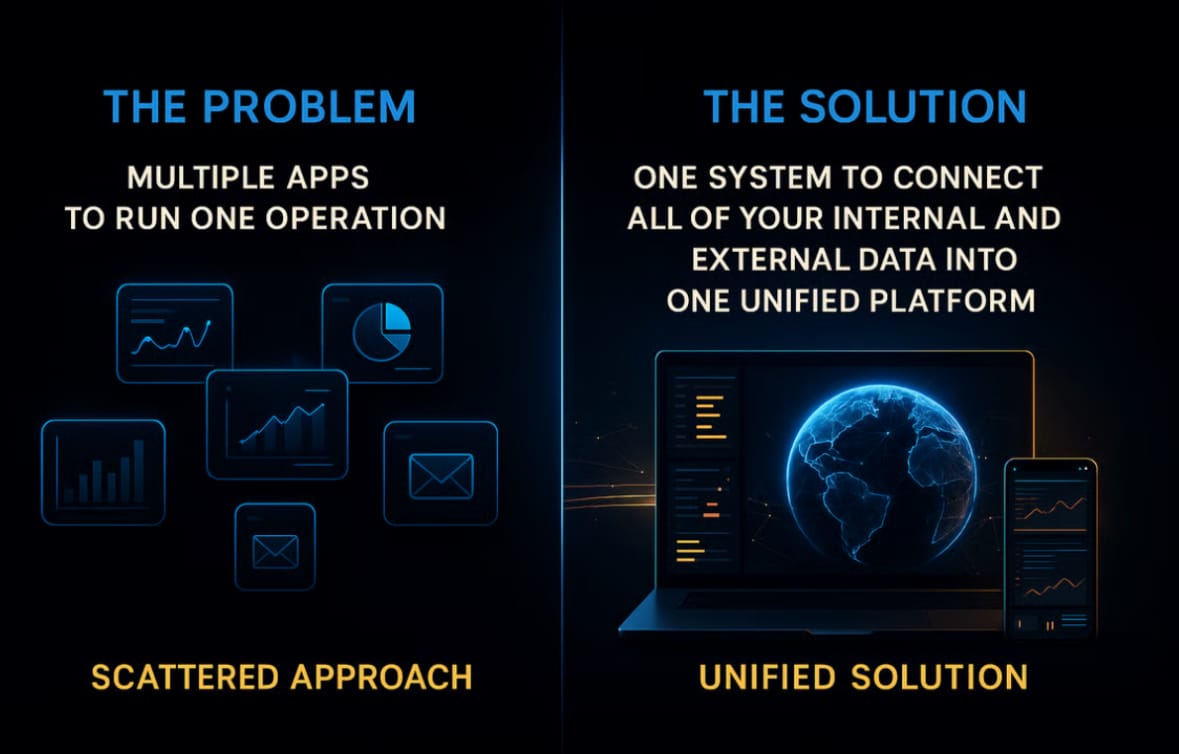

- Click below if you’d like to view our free EARTH WATCH globe:
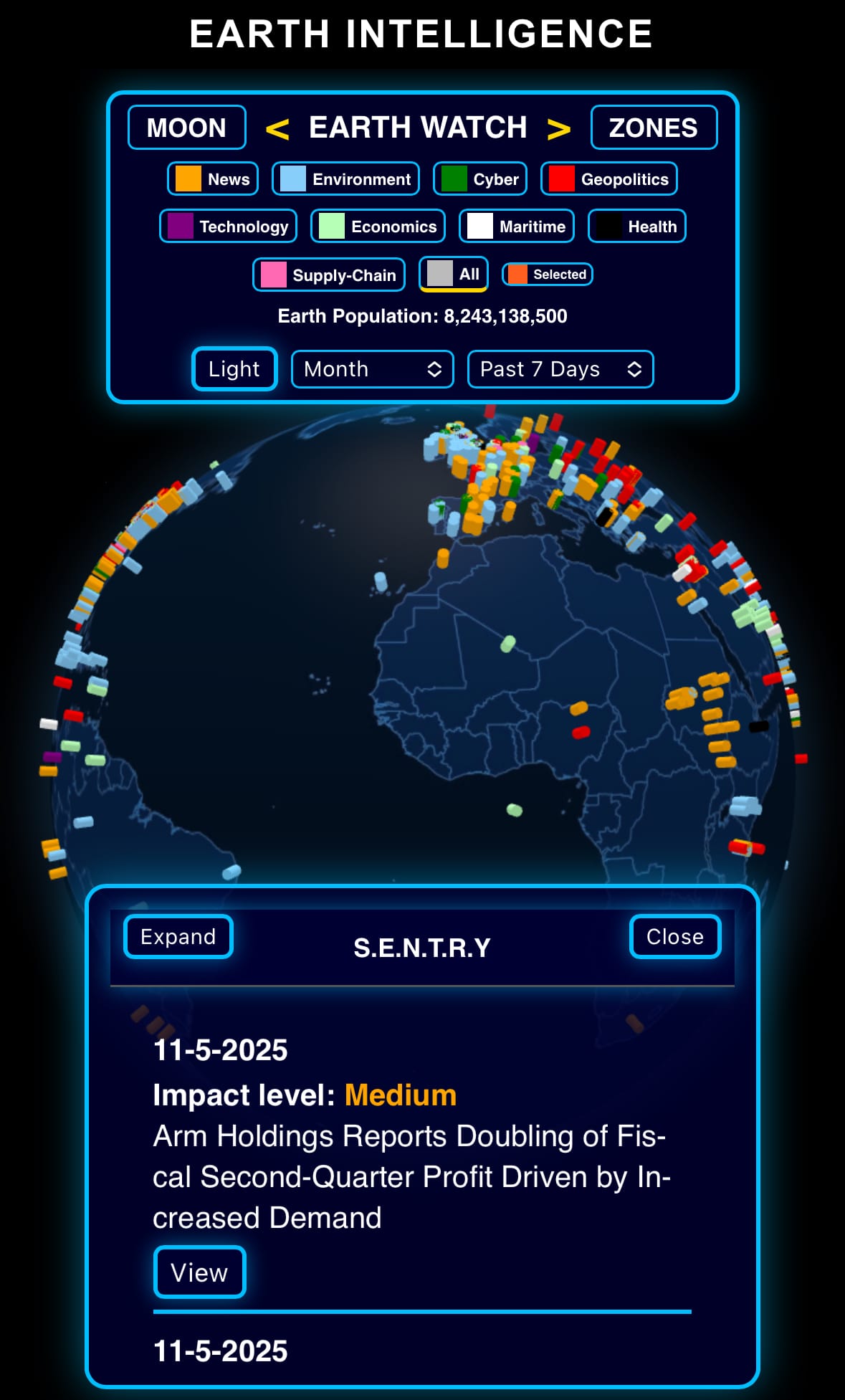
- Download our mobile app on the Apple App Store (Android coming soon):

Click below to view our previous newsletters:

Support/Suggestions Email:
earthintelligence@earthintel.news