Friday☕️

- On November 28, 2025, India issued an updated Notice to Airmen (NOTAM) extending a restricted danger zone off the coast of Visakhapatnam in the Bay of Bengal for a probable sea-launched missile test scheduled between December 1 and 4. The expanded zone, originating from the Eastern Naval Command—home to India's submarine fleet—now covers approximately 3,485 kilometers southeast into the Indian Ocean, up from an initial 1,695-kilometer area, as shared by open-source intelligence analysts and defense monitors. This maritime exclusion prohibits aircraft and vessels from entering the demarcated coordinates to ensure safety during the trial, with the Indian Ministry of Defence and Navy coordinating the notification through aviation and maritime authorities, though official details on the exact platform remain classified.
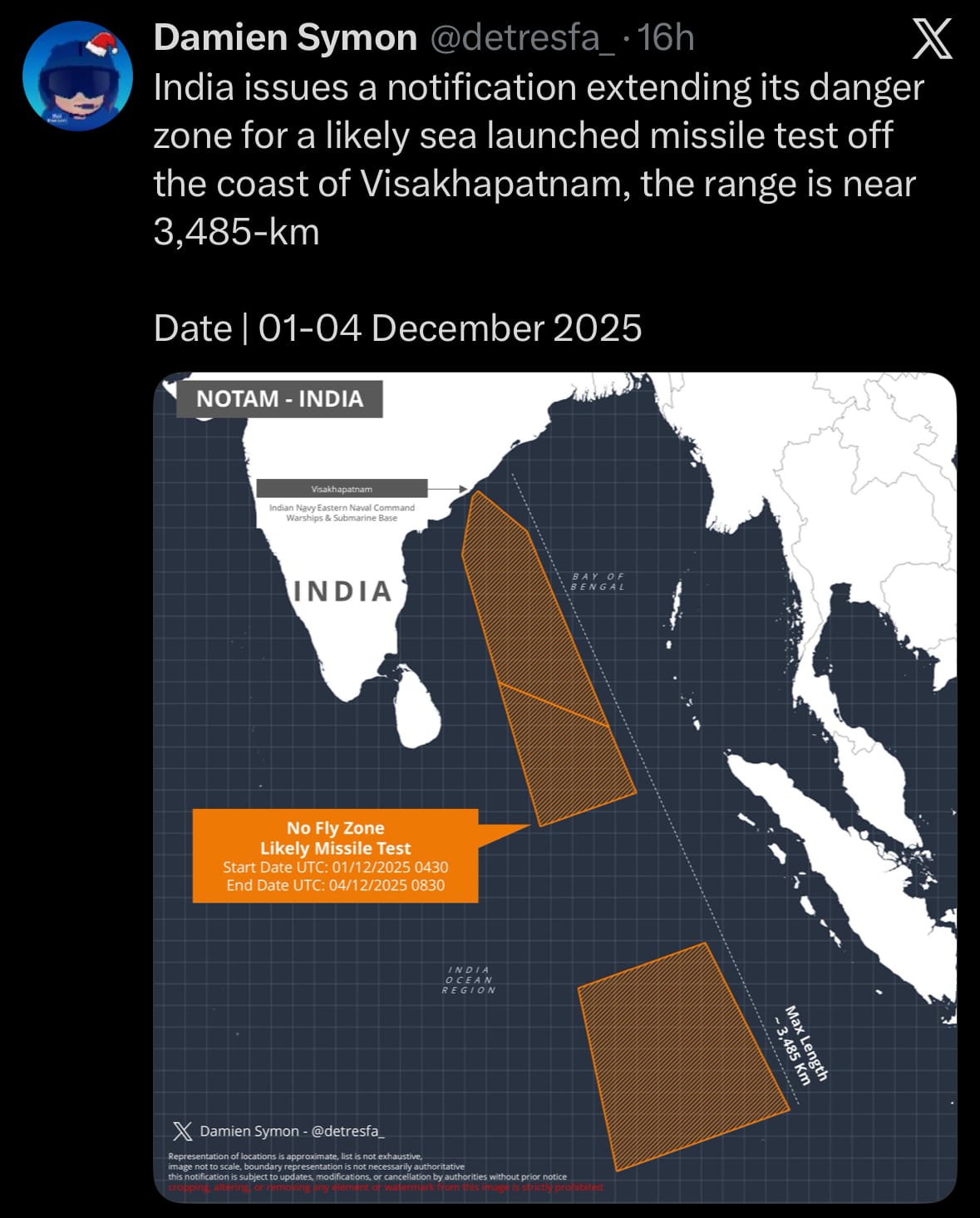
- The test is widely speculated to involve the K-4 submarine-launched ballistic missile (SLBM), a 3,500-kilometer-range nuclear-capable weapon developed by the Defence Research and Development Organisation for deployment from Arihant-class nuclear-powered ballistic missile submarines, enhancing India's second-strike deterrence amid Indo-Pacific tensions. Previous K-4 trials, including submerged launches from pontoons off Visakhapatnam, have validated its underwater ejection and booster ignition under high pressure, with this iteration potentially confirming integration on an operational SSBN like INS Arihant or Arighat. The timing aligns with India's accelerated strategic testing cadence following the Agni-Prime flight in September 2025, underscoring efforts to bolster credible minimum deterrence without confirming advanced variants like the longer-range K-5, which remains in early development.
Economics & Markets:
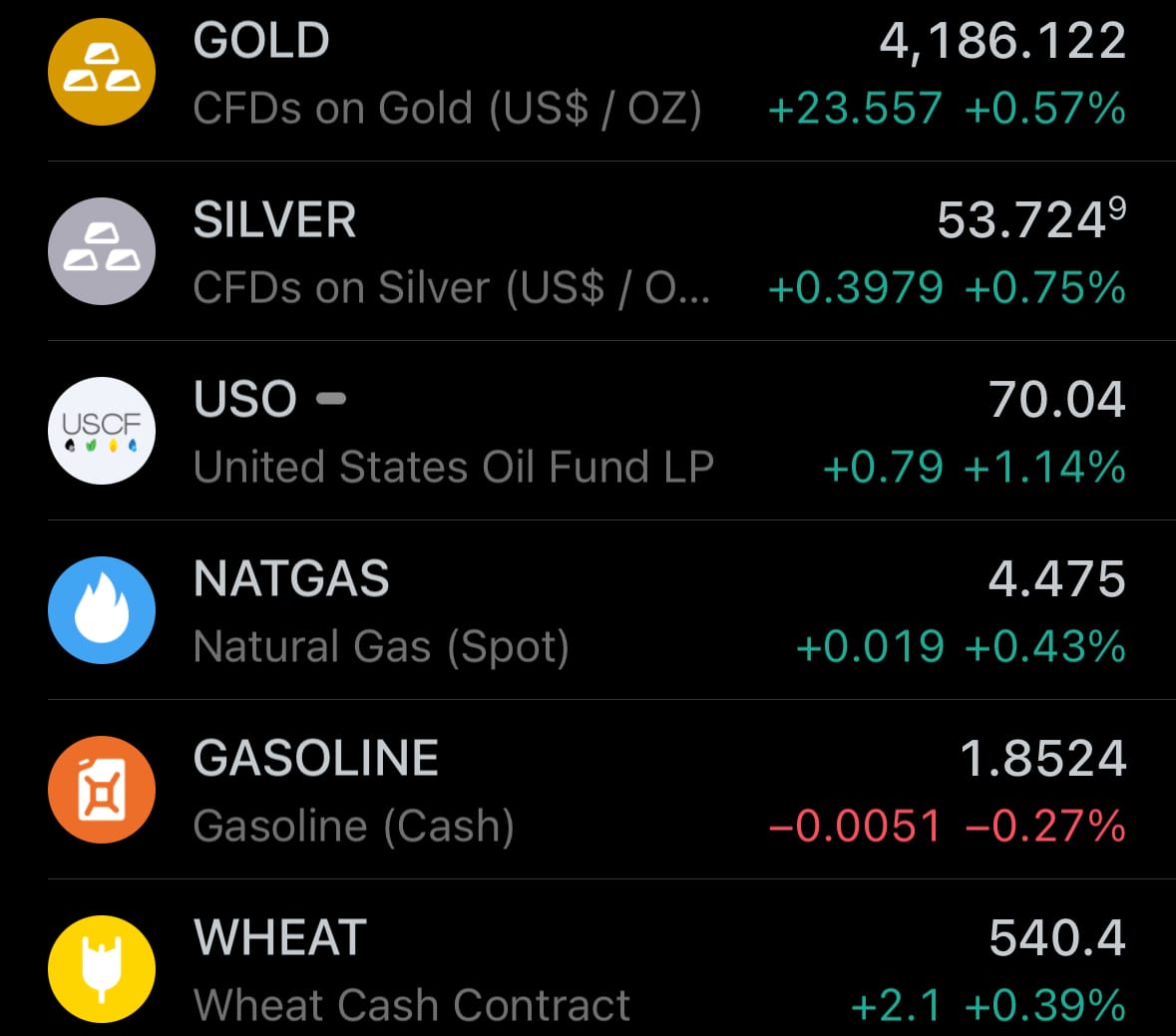
- Yesterday’s commodity market:
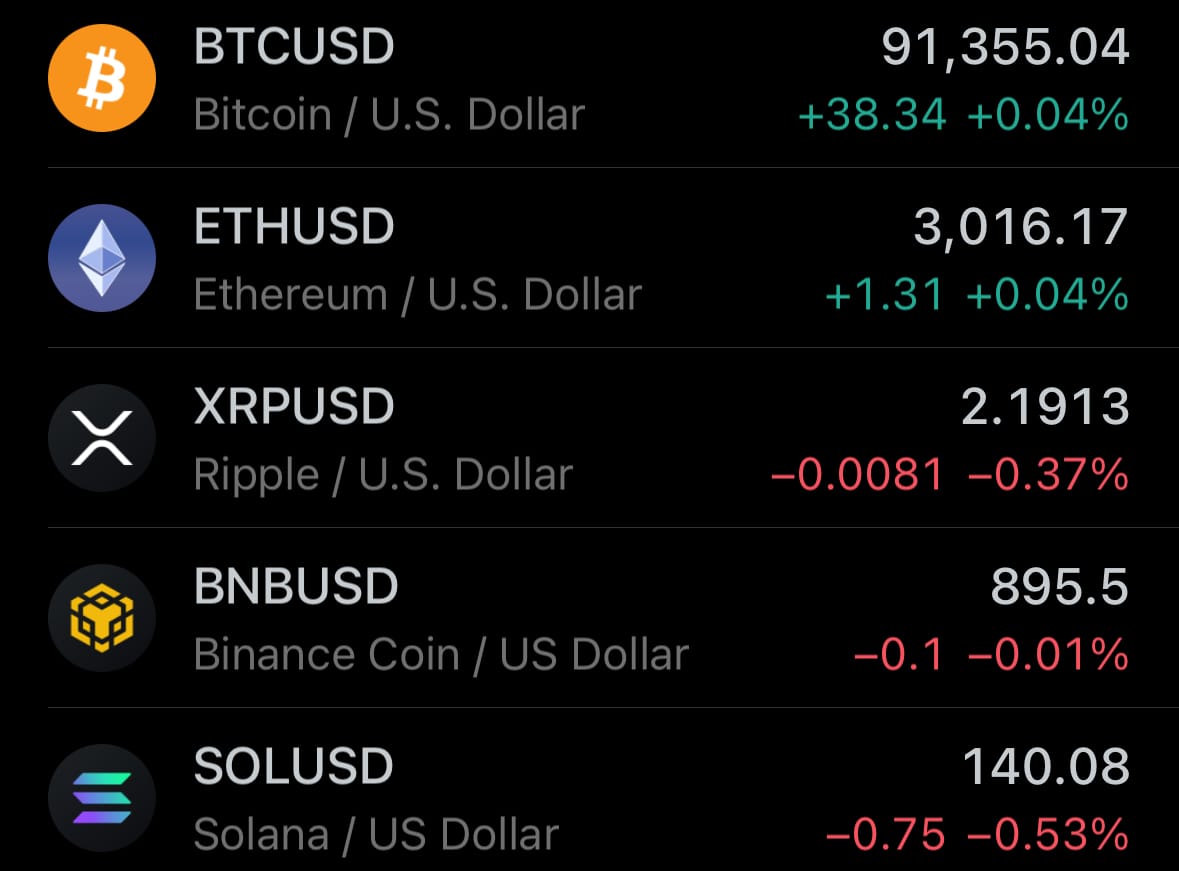
- Yesterday’s crypto market:
Environment & Weather:
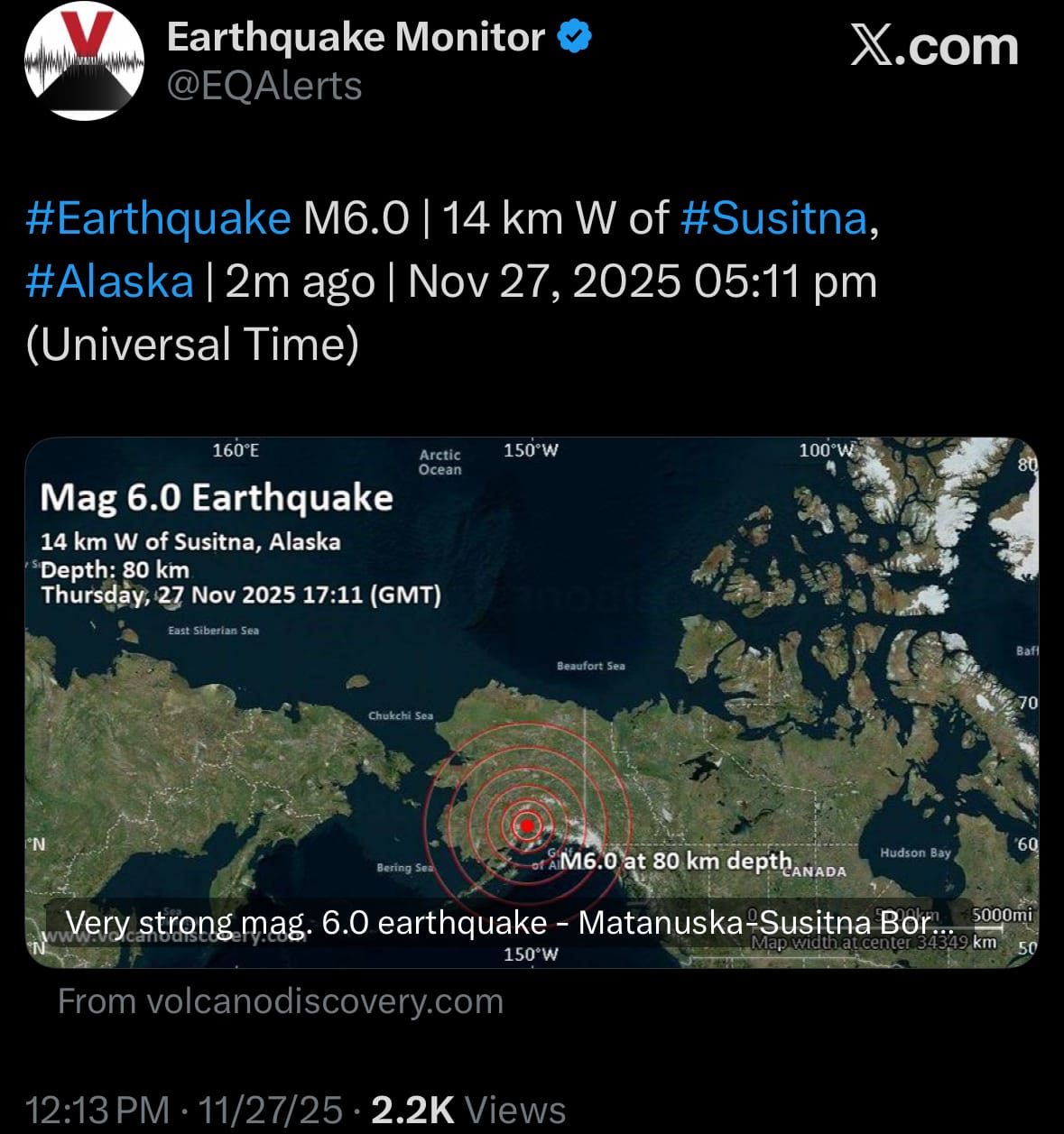
- On November 27, 2025, a magnitude 6.0 earthquake struck southern Alaska at 17:11 UTC, centered approximately 26 miles southwest of Willow and 35 miles northwest of Anchorage, at a depth of about 43 miles, according to the United States Geological Survey. The event, which occurred on the subducting Pacific tectonic plate beneath the North American plate, was felt across south-central Alaska and as far north as Fairbanks, 245 miles away, prompting residents to report items falling from shelves and walls, though no major structural damage or casualties were immediately reported.
- Elsewhere on November 27, 2025, a magnitude 6.6 earthquake hit near Sinabang in Indonesia's Aceh province at 04:56 UTC, at a shallow depth of 25 km, shaking coastal areas and prompting assessments for structural vulnerabilities in the region, though no immediate casualties were confirmed. Additional notable events included a magnitude 5.0 quake in Ilocos Norte, Philippines, at around 12:00 UTC, which caused light shaking but no reported damage, and a magnitude 5.2 in the South Pacific Ocean near the Kermadec Islands, along with a 5.2 in the Indian Ocean off India's Andaman Islands; these occurred amid over 500 global tremors that day, with no magnitude 7.0 or higher recorded, reflecting typical seismic activity in tectonically active zones like the Pacific Ring of Fire.
Space:
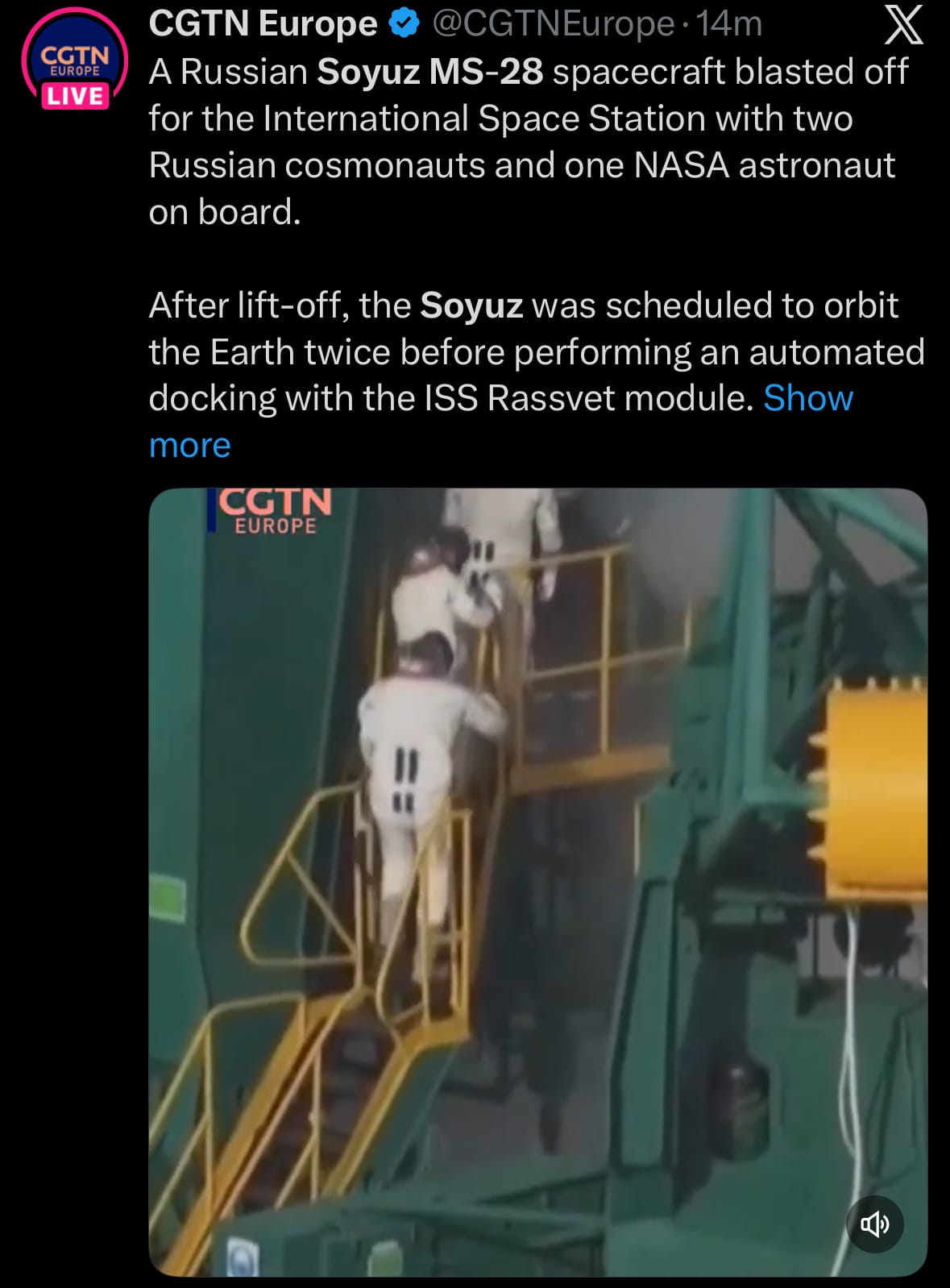
- On November 27, 2025, the Soyuz MS-28 spacecraft launched successfully at 9:27 UTC from Site 31/6 at the Baikonur Cosmodrome in Kazakhstan aboard a Soyuz-2.1a rocket, carrying NASA astronaut Christopher Williams and Roscosmos cosmonauts Sergey Kud-Sverchkov and Sergey Mikayev to the International Space Station. Kud-Sverchkov served as mission commander, with Mikayev as flight engineer and Williams as a mission specialist; all three underwent extensive training at the Gagarin Cosmonaut Training Center, including simulations and survival exercises. The ascent proceeded nominally through three stages and four strap-on boosters, placing the crewed vehicle into a low Earth orbit trajectory for a fast-track rendezvous, with the spacecraft docking autonomously to the ISS's Rassvet module at approximately 12:38 UTC after a two-orbit journey. Hatches opened shortly thereafter, allowing the trio to join the Expedition 73 crew for initial handover activities.
- The eight-month mission, part of the ongoing NASA-Roscosmos seat-swap agreement extended into 2025, will see the crew contribute to over 200 scientific experiments in microgravity, focusing on human health, biological research, and Earth observation, while maintaining station systems and preparing for future commercial crew rotations. This flight marks the 28th Soyuz mission to the ISS since 2000 and underscores continued international cooperation amid geopolitical tensions, with Williams' assignment highlighting NASA's reliance on Russian transport vehicles until the full operationalization of its own capabilities. The crew is scheduled to return in July 2026 aboard the same spacecraft, overlapping with Expedition 74 to ensure continuous habitation of the orbital laboratory.
Statistic:
- Largest public companies on Earth by market capitalization:
- 🇺🇸 NVIDIA: $4.381T
- 🇺🇸 Apple: $4.118T
- 🇺🇸 Alphabet (Google): $3.866T
- 🇺🇸 Microsoft: $3.608T
- 🇺🇸 Amazon: $2.449T
- 🇺🇸 Broadcom: $1.877T
- 🇺🇸 Meta Platforms: $1.597T
- 🇸🇦 Saudi Aramco: $1.587T
- 🇹🇼 TSMC: $1.503T
- 🇺🇸 Tesla: $1.418T
- 🇺🇸 Berkshire Hathaway: $1.102T
- 🇺🇸 Eli Lilly: $989.99B
- 🇺🇸 Walmart: $870.66B
- 🇺🇸 JPMorgan Chase: $845.93B
- 🇨🇳 Tencent: $721.20B
- 🇺🇸 Visa: $647.86B
- 🇺🇸 Oracle: $584.29B
- 🇺🇸 Johnson & Johnson: $500.07B
- 🇺🇸 Mastercard: $492.62B
- 🇺🇸 Exxon Mobil: $489.29B
History:
- SpaceX begins in 2002 as a small insurgent against an industry dominated by massive government agencies and aerospace giants. Its first rocket, Falcon 1, fails three times, surviving only because Elon Musk is willing to fund a fourth attempt. That final shot in 2008 becomes the first privately built, liquid-fueled rocket to reach orbit—an achievement that instantly flips SpaceX from a struggling startup into NASA’s newest partner. Falcon 9 follows in 2010 as a larger, modular booster designed from the start for reuse, and by 2012 the Dragon capsule becomes the first commercial spacecraft to deliver cargo to the International Space Station and return safely to Earth. On December 21, 2015, Falcon 9 lands its first stage after an orbital mission, turning what had always been disposable into a recoverable asset. Over the next decade SpaceX normalizes the impossible: boosters land on droneships at sea, rockets fly again and again, Falcon Heavy debuts as the most powerful operational rocket in the world, and in 2020 Crew Dragon returns human spaceflight to U.S. soil for the first time since the Shuttle. Through the early 2020s, Falcon 9 becomes the most reliable, highest-cadence orbital launch system ever created—flying dozens of missions per year with airline-like rhythm and shredding global launch costs. NASA remains a scientific powerhouse, but for everything from ISS cargo to astronaut transport, it now relies on SpaceX as its primary and most dependable launcher.
- The result is an inversion of the entire launch paradigm. By the mid-2020s, SpaceX is putting more mass into orbit than every other nation and company on Earth combined, largely due to the industrial-scale deployment of Starlink. With more than 8,000–10,000 satellites already in orbit and thousands more queued, Starlink becomes the largest and most powerful communications constellation ever built, enabling global broadband, battlefield connectivity, and the classified Starshield framework for U.S. defense payloads. Falcon 9 and Falcon Heavy dominate commercial launch, replacing the old economics of bespoke rockets with rapid-reuse logistics. Then comes Starship—a fully reusable super-heavy system designed for 100–150 tons to orbit, selected by NASA as the Artemis lunar lander and steadily maturing through repeated test flights. In a world once controlled by government space agencies, SpaceX becomes the central logistics provider for low Earth orbit, the largest satellite operator on the planet, and the single most capable payload-to-orbit system ever fielded. Other players—Blue Origin, ULA, national agencies—still matter, but in raw capability, cadence, cost structure, and technological momentum, SpaceX has outpaced every competitor, including the very agency that first funded its survival.
Image of the day:
Thanks for reading! Earth is complicated, we make it simple.
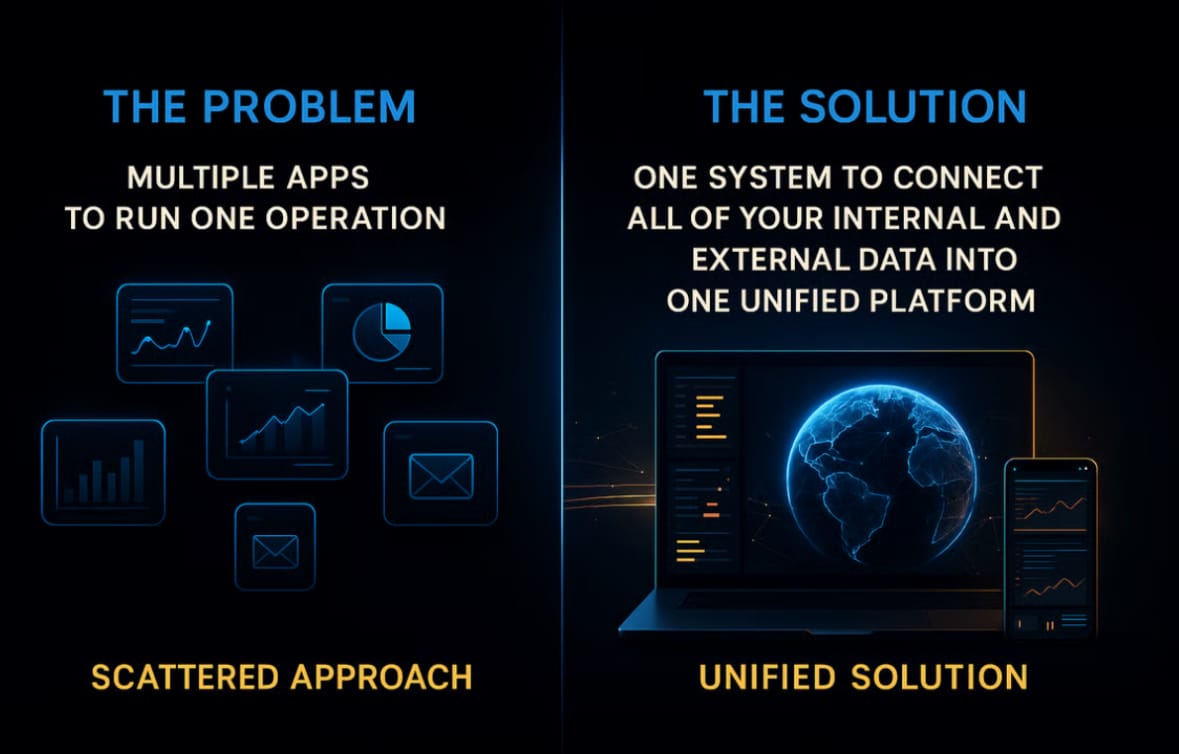

- Click below if you’d like to view our free EARTH WATCH globe:
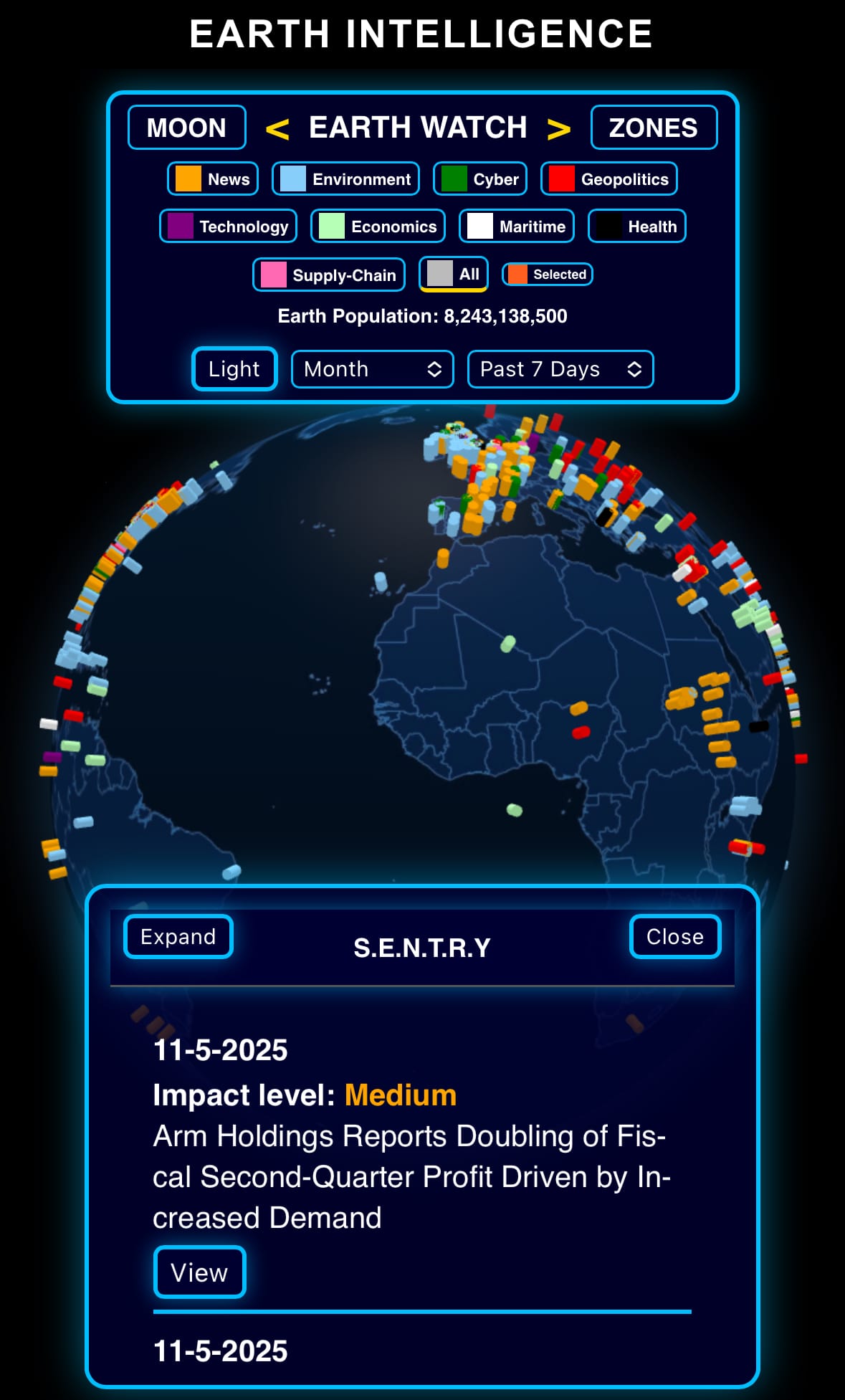
- Download our mobile app on the Apple App Store (Android coming soon):

Click below to view our previous newsletters:
Support/Suggestions Email:
earthintelligence@earthintel.news