Friday☕️


Trending:
- On December 4, 2025, U.S. Southern Command announced that Joint Task Force Southern Spear, at the direction of Secretary of Defense Pete Hegseth, conducted a lethal kinetic strike on a vessel in international waters of the Eastern Pacific Ocean. The operation targeted a boat operated by a Designated Terrorist Organization, with U.S. intelligence confirming it was carrying illicit narcotics and following a known narco-trafficking route off the coasts of Central and South America.

- The strike resulted in the deaths of all four male crew members, described by U.S. officials as "narco-terrorists," with no reported injuries to U.S. personnel or bystanders. This incident follows a similar operation on November 16 that killed three individuals on another vessel along the same route, bringing the total fatalities in the campaign to at least 86.
Economics & Markets:
- Yesterday’s U.S. stock market:

- Yesterday’s commodity market:

- Yesterday’s crypto market:

Geopolitics & Military Activity:
- On December 4, 2025, the Israel Defense Forces conducted a series of airstrikes targeting Hezbollah weapons depots in southern Lebanon, following evacuation warnings issued to residents of four villages: Jbaa, Mahrouna, Mjadel, and Baraachit. The strikes occurred one day after the first direct Israeli-Lebanese government talks in decades, focused on economic cooperation.

- The operations reflect Israel's ongoing campaign to prevent Hezbollah from rebuilding its arsenal, amid frustration with Beirut's disarmament efforts under the truce terms. Lebanese media reported smoke rising from strike sites, and the IDF emphasized that the action was limited to military targets without broader ground incursions. This follows a pattern of near-daily strikes since early November, with both sides accusing each other of ceasefire breaches; a second round of Israel-Lebanon talks remains scheduled, though tensions could impact progress.
Environment & Weather:
- On December 4, 2025, the year’s final supermoon, known as the Cold Moon, reached peak illumination at 6:14 p.m. ET (23:14 UTC). It appeared fully lit as it rose in the eastern sky shortly after sunset, coinciding with perigee at 221,806 miles (356,962 km) earlier that day, making it the closest and largest full moon of 2025. The moon appeared up to 14% larger and 30% brighter than a typical full moon and was visible worldwide with the naked eye, rising among the stars of Taurus.

- This Cold Moon was the third in a series of four consecutive supermoons that began with October’s Harvest Moon and continued with November’s Beaver Moon. The traditional name reflects the long, cold nights of December in the Northern Hemisphere. No eclipses or major meteor activity coincided with the event, and while coastal areas experienced slightly higher-than-normal tides due to the moon’s proximity, no significant tidal flooding was reported.
Cyber:

Space:
- On December 4, 2025, SpaceX successfully launched the Starlink Group 11-25 mission using a Falcon 9 rocket from Space Launch Complex 4E (SLC-4E) at Vandenberg Space Force Base in California. Liftoff occurred at 3:42 p.m. EST (2042 UTC) within a four-hour window, with the two-stage vehicle ascending on a southeasterly trajectory over the Pacific Ocean.
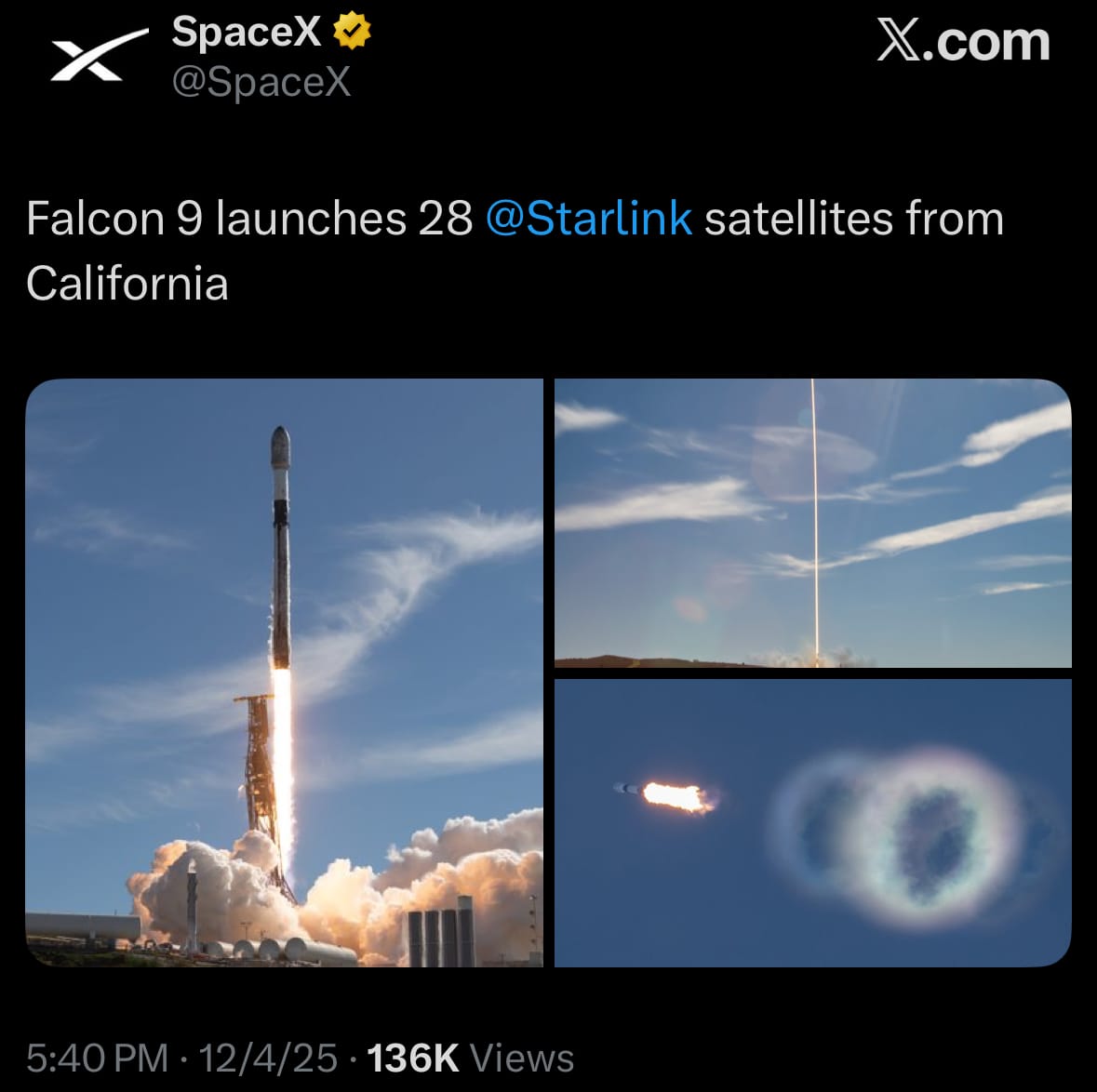
- This was SpaceX's 156th Falcon 9 mission of 2025 and the 111th dedicated to the Starlink constellation. The mission deployed 28 V2 Mini Starlink satellites into a sun-synchronous low Earth orbit at approximately 530 kilometers altitude, where they will maneuver to operational slots to enhance global broadband coverage, particularly in polar and underserved regions. Deployment was confirmed about 65 minutes post-liftoff, with no anomalies reported and favorable weather conditions contributing to the on-time execution.

Statistic:
- Largest semiconductor companies on Earth by market capitalization:
- 🇺🇸 NVIDIA: $4.464T
- 🇺🇸 Broadcom: $1.799T
- 🇹🇼 TSMC: $1.519T
- 🇰🇷 Samsung: $481.02B
- 🇳🇱 ASML: $430.87B
- 🇺🇸 AMD: $351.62B
- 🇺🇸 Micron Technology: $255.06B
- 🇰🇷 SK Hynix: $249.76B
- 🇺🇸 Applied Materials: $214.64B
- 🇺🇸 Lam Research: $198.09B
- 🇺🇸 Intel: $193.18B
- 🇺🇸 QUALCOMM: $188.12B
- 🇺🇸 Texas Instruments: $163.75B
- 🇺🇸 KLA: $159.08B
- 🇬🇧 Arm Holdings: $149.05B
- 🇺🇸 Analog Devices: $135.76B
- 🇯🇵 Tokyo Electron: $97.51B
- 🇯🇵 Advantest: $95.14B
- 🇺🇸 Synopsys: $88.37B
- 🇨🇳 SMIC: $86.38B
- 🇺🇸 Marvell Technology: $84.65B
- 🇨🇳 Cambricon Technologies: $81.64B
- 🇹🇼 MediaTek: $71.50B
- 🇳🇱 NXP Semiconductors: $57.01B
- 🇩🇪 Infineon: $55.35B
History:
- Helicopters begin as sketches in the minds of inventors long before the physics exists to make them real. As early as the 1400s, Leonardo da Vinci drew a helical “aerial screw” that captured the idea of vertical lift, though no materials or engines of his era could power such a machine. The first real steps came in the 18th and 19th centuries, when simple toy “rotor flyers” proved that spinning blades could lift an object. By the early 1900s, engineers in France, Russia, and the United States began experimenting with powered vertical flight, but early designs were unstable, underpowered, and impossible to control reliably. A major breakthrough came from Russian-American inventor Igor Sikorsky, who concluded after years of experimentation that only a single main rotor with a tail rotor would provide stable, controllable lift. In 1939, his VS-300 became the first practical helicopter design, establishing the configuration still used on most helicopters today. Shortly after, in 1942, Sikorsky’s R-4 became the world’s first mass-produced helicopter and the first to enter military service.
- Helicopters transformed aviation in the postwar era. Through the 1950s and 60s, improved engines, rotor designs, and lightweight materials made them indispensable in search-and-rescue, medical evacuation, and military operations—most dramatically in the Korean and Vietnam Wars, where helicopters moved troops, evacuated casualties, and provided aerial fire support. By the 1970s–1990s, advanced models like the Bell UH-1 Huey, AH-64 Apache, and Black Hawk expanded what vertical lift could do, adding armor, sensors, guided weapons, and sophisticated avionics. Civilian helicopters matured simultaneously, supporting offshore oil platforms, medical transport, police work, and disaster response. In the 21st century, helicopter technology continues to evolve through composite materials, digital flight-control systems, and hybrid designs. Tiltrotors like the V-22 Osprey combine helicopter lift with airplane speed, while next-generation aircraft such as the Sikorsky–Boeing Defiant X and Bell V-280 Valor push toward higher speeds and longer ranges. Autonomous and electric vertical-takeoff aircraft (eVTOLs) promise an entirely new category of urban and logistic transport. From da Vinci’s sketches to today’s high-speed, sensor-rich machines, the helicopter has become a core aviation platform—unique in its ability to hover, maneuver in tight spaces, and reach places no other aircraft can.
Image of the day:

Thanks for reading! Earth is complicated, we make it simple.


- Click below if you’d like to view our free EARTH WATCH globe:
- Download our mobile app on the Apple App Store (Android coming soon):

Click below to view our previous newsletters:

Support/Suggestions Email:
earthintelligence@earthintel.news