Friday☕️


Trending:
- As of January 8, 2026, protests in Iran entered their 15th consecutive day, with demonstrations reported in over 120 cities across 28 provinces, including major urban centers like Tehran, Mashhad, and Shiraz, as well as rural and Kurdish-majority areas in the west. Clashes intensified in several locations, such as Sanandaj and Mahabad, where security forces used tear gas and live ammunition, resulting in additional deaths (rights groups estimate the total toll at 35-45 protesters and security personnel killed since the start) and hundreds injured. Arrests surpassed 1,200, according to human rights monitors, with funerals for victims often sparking new rallies and chants demanding political change.
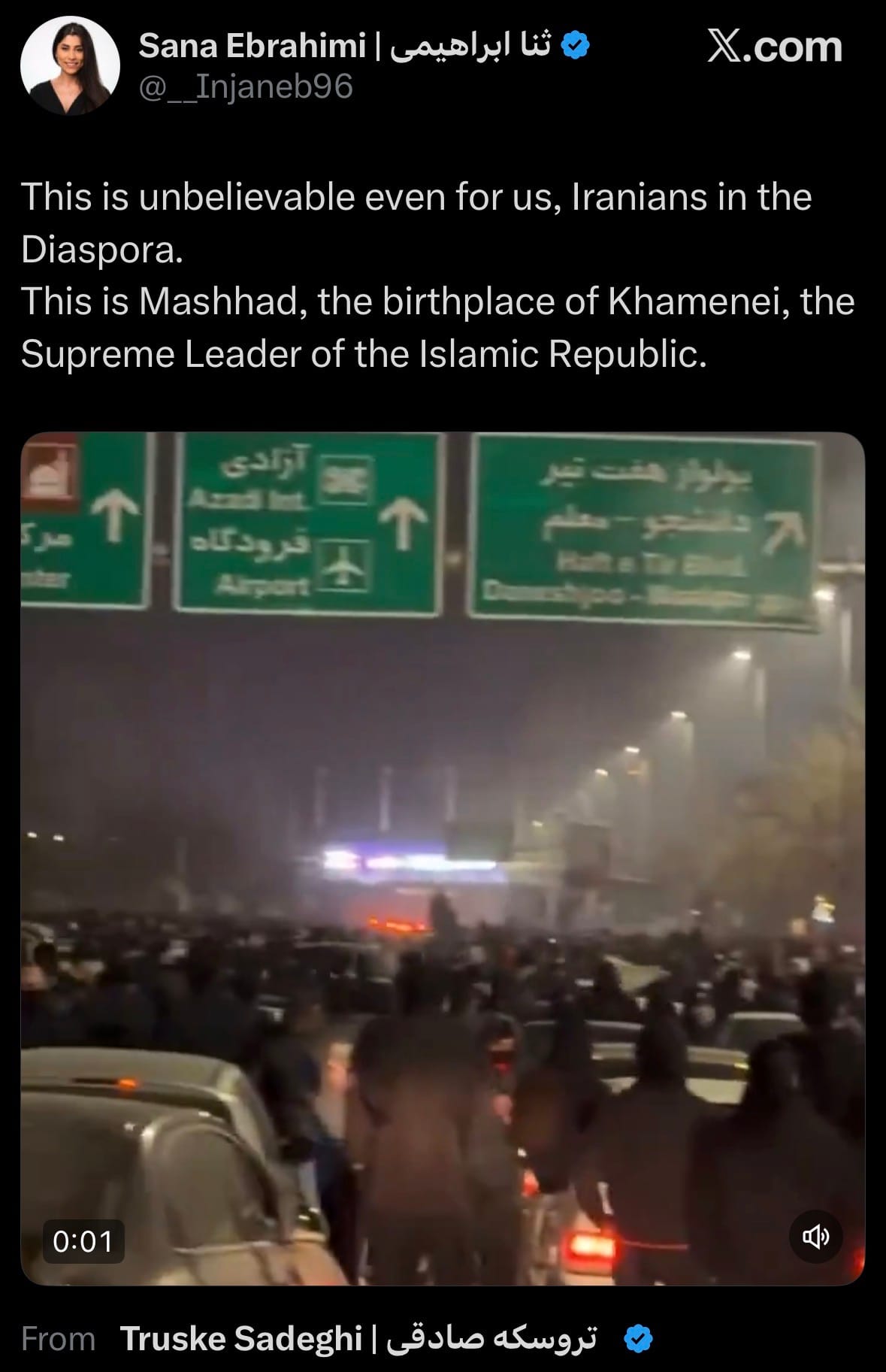
- The unrest, initially triggered by economic strikes over currency devaluation and inflation exceeding 40%, has expanded to include calls for regime reform or replacement, with some groups voicing support for exiled figures like Reza Pahlavi. Government responses include intensified security deployments, internet restrictions in affected regions, and statements from Supreme Leader Ali Khamenei labeling violent acts as foreign-instigated while acknowledging economic concerns. President Masoud Pezeshkian reiterated offers for dialogue, but protests persist. Economic impacts include disrupted bazaar operations and supply chains, while social effects involve school closures and heightened tensions in minority communities.
Economics & Markets:
- Yesterday’s U.S. stock market:

- Yesterday’s commodity market:

- Yesterday’s crypto market:

Geopolitics & Military Activity:
- On January 8-9, 2026, Russian forces launched a large-scale missile and drone attack on Kyiv, Ukraine, targeting energy infrastructure and causing widespread blackouts across the city. Footage captured power outages in central districts following strikes by Iskander-M ballistic missiles and Kalibr cruise missiles on key facilities, including the CHP-4, CHP-5, and CHP-6 power plants. A Geran-2 (Shahed-136) drone also struck a residential apartment building, resulting in civilian injuries and structural damage; Ukrainian emergency services reported at least two deaths and over 20 wounded from the overall barrage, with air raid sirens sounding for several hours.
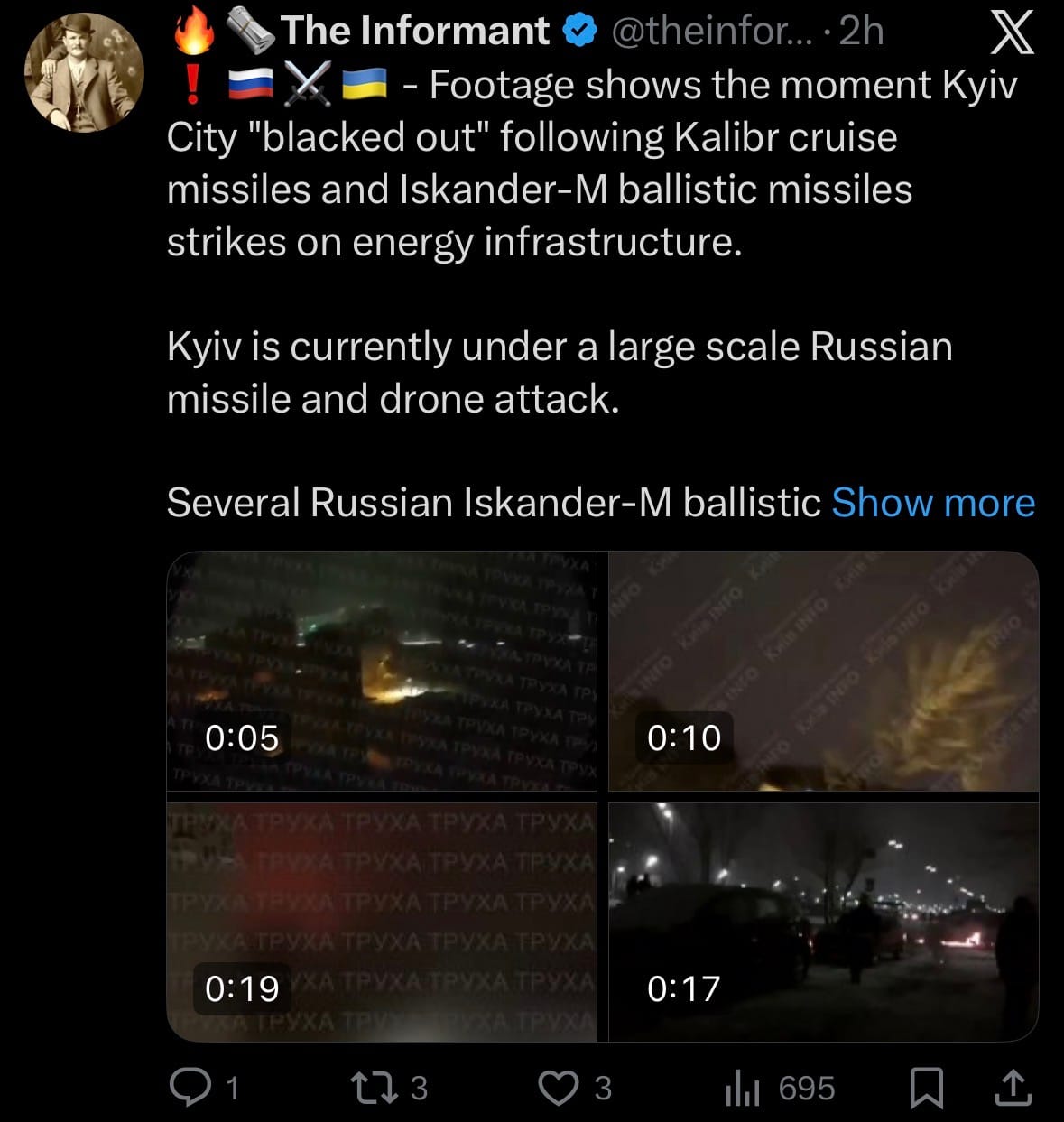
- The attack is part of Russia's ongoing campaign against Ukraine's energy grid amid the winter season, aiming to disrupt electricity and heating supplies in sub-zero temperatures. Ukrainian officials condemned the strikes as deliberate targeting of civilians and infrastructure, activating air defenses that intercepted some incoming threats; President Volodymyr Zelenskyy called for increased international support for anti-missile systems. No immediate Russian comment was available, though similar prior operations have been described by Moscow as responses to Ukrainian actions. This incident escalates the conflict's impact on civilian life, potentially worsening humanitarian conditions in Kyiv.
Business:
- On January 8, 2026, cybersecurity company CrowdStrike announced a definitive agreement to acquire SGNL, a startup focused on continuous, context-aware identity security and authorization management. The transaction is valued at approximately $740 million, mostly in cash with some stock, and is expected to close in CrowdStrike's fiscal first quarter of 2027, pending regulatory approvals. SGNL's technology will be integrated into CrowdStrike's Falcon platform to improve real-time access controls for human, non-human, and AI identities, targeting increasing threats in cloud and SaaS environments. This is CrowdStrike's most recent acquisition in its ongoing expansion into identity protection, following earlier purchases such as Flow Security in 2025.
- The deal combines SGNL's dynamic authorization capabilities with CrowdStrike's threat intelligence to enable proactive, risk-based access decisions. Industry observers see it as a strategic step for CrowdStrike to strengthen its offerings amid rising identity-related attacks, though the company's stock saw a slight decline following the announcement, influenced by general market conditions. SGNL's co-founder highlighted the acquisition as advancing efforts to modernize traditional identity and access management systems. Overall, the move reflects ongoing consolidation in the cybersecurity sector, potentially bolstering CrowdStrike's competitive stance against companies like Okta and CyberArk, while questions remain about integration details and regulatory review.
Earth Analysis:
- As of January 8, 2026, the global geopolitical landscape remains tense across four key zones: Eastern Europe (focused on the Ukraine-Russia war), the Middle East (with ongoing issues in Gaza, Lebanon, Yemen, Syria, and Iran), the Indo-Pacific (U.S.-China competition over Taiwan and maritime routes), and the Caribbean/Western Hemisphere (U.S. actions in Venezuela and emerging pressures in Mexico). The United States stands as the primary juggernaut, asserting dominance and applying pressure through military interventions, sanctions, and enforcement operations in multiple areas. Recent examples include the U.S. seizure of a Russian-flagged tanker escorted by a Russian nuclear submarine, which highlights Russia's current vulnerabilities—Moscow struggles to defend its assets amid the strains of the Ukraine conflict, economic sanctions, and overextended resources. In Eastern Europe, pressure builds from territorial disputes and stalled peace talks, while in the Caribbean, U.S. interventions like the capture of Venezuelan leadership underscore regional control. Additionally, under the Trump administration, discussions have intensified about potential military actions against drug cartels in Mexico, aiming to address cross-border threats through targeted strikes or operations.
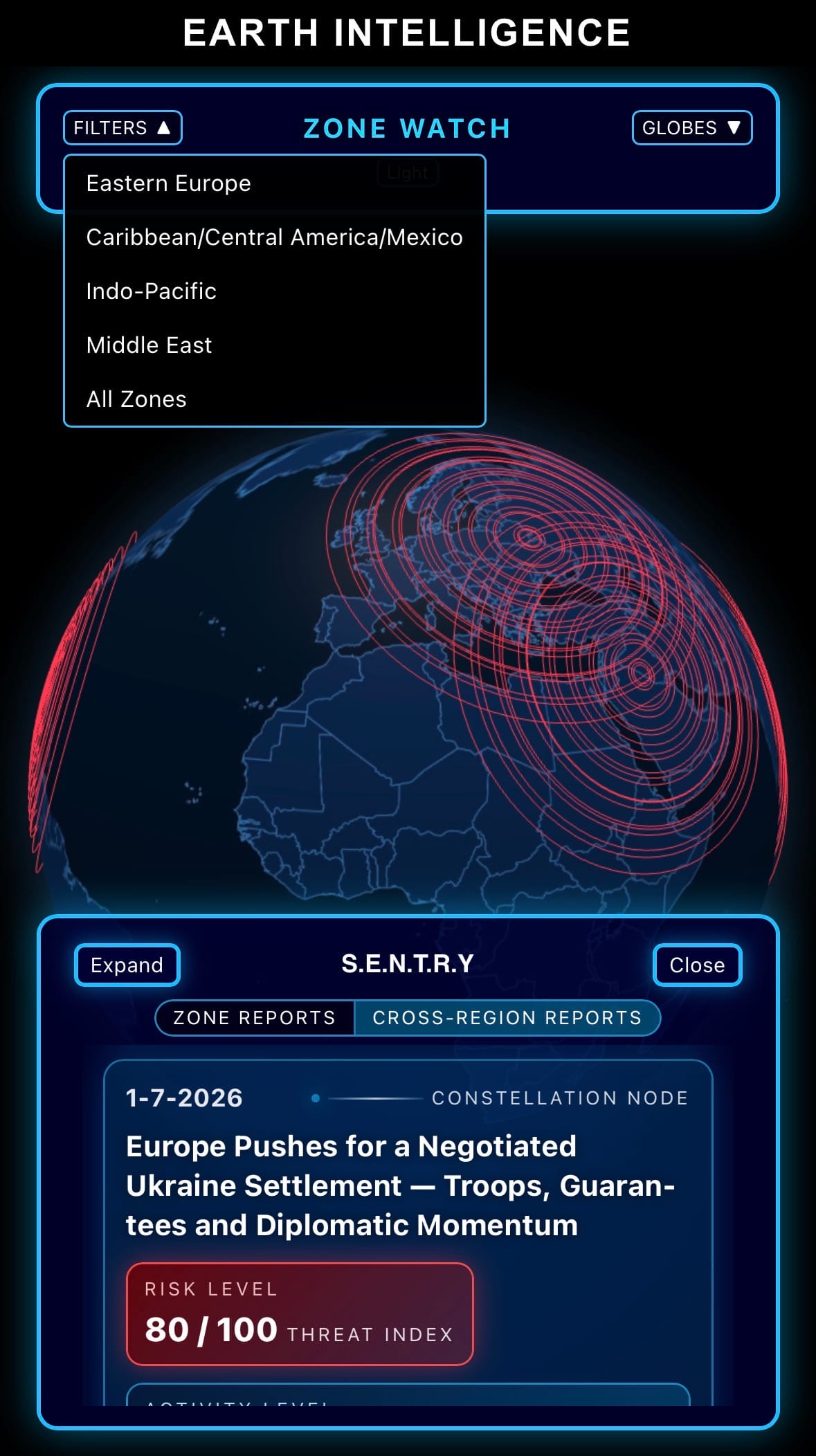
- In this fragmented global order, China positions itself as a watchful player and the only significant potential challenger to U.S. dominance, though it has yet to undertake major military actions on the world stage. Beijing's power projection is limited compared to the U.S., as China’s aircraft carriers are conventionally powered (unlike America's nuclear-powered fleet with unlimited range), restricting China’s operations largely to the Indo-Pacific region rather than extreme distances. China has supported Venezuela alongside Russia, including through missile defense systems and radar installations, but these have shown limitations in effectiveness during recent U.S. actions. While far from posing a broad major threat globally, China represents a direct challenge to Taiwan through frequent military exercises and displays of force, though without escalating to actual conflict. Overall, these dynamics illustrate a world of intersecting great-power rivalries and local crises, with risks of miscalculation potentially leading to broader escalations amid evolving alliances and international norms.
EARTH INTELLIGENCE:
- We’ve just launched a major update to the EARTH INTELLIGENCE mobile app on both Apple and Android, marking a significant leap forward in real-time global intelligence delivery. This release introduces S.E.N.T.R.Y., our AI intelligence engine, now available as an interactive chatbot that allows you to ask questions, explore global events, and search the web directly inside the platform. We’ve also launched Weather Intelligence, enabling you to save a home location and view real-time conditions, hourly forecasts, and multi-day outlooks for any location on Earth. In addition, Market Intelligence and the Reports interface have been upgraded for improved clarity, performance, and situational awareness, while our S.E.N.T.R.Y. Intelligence event collection system now refreshes global events every 20 minutes.
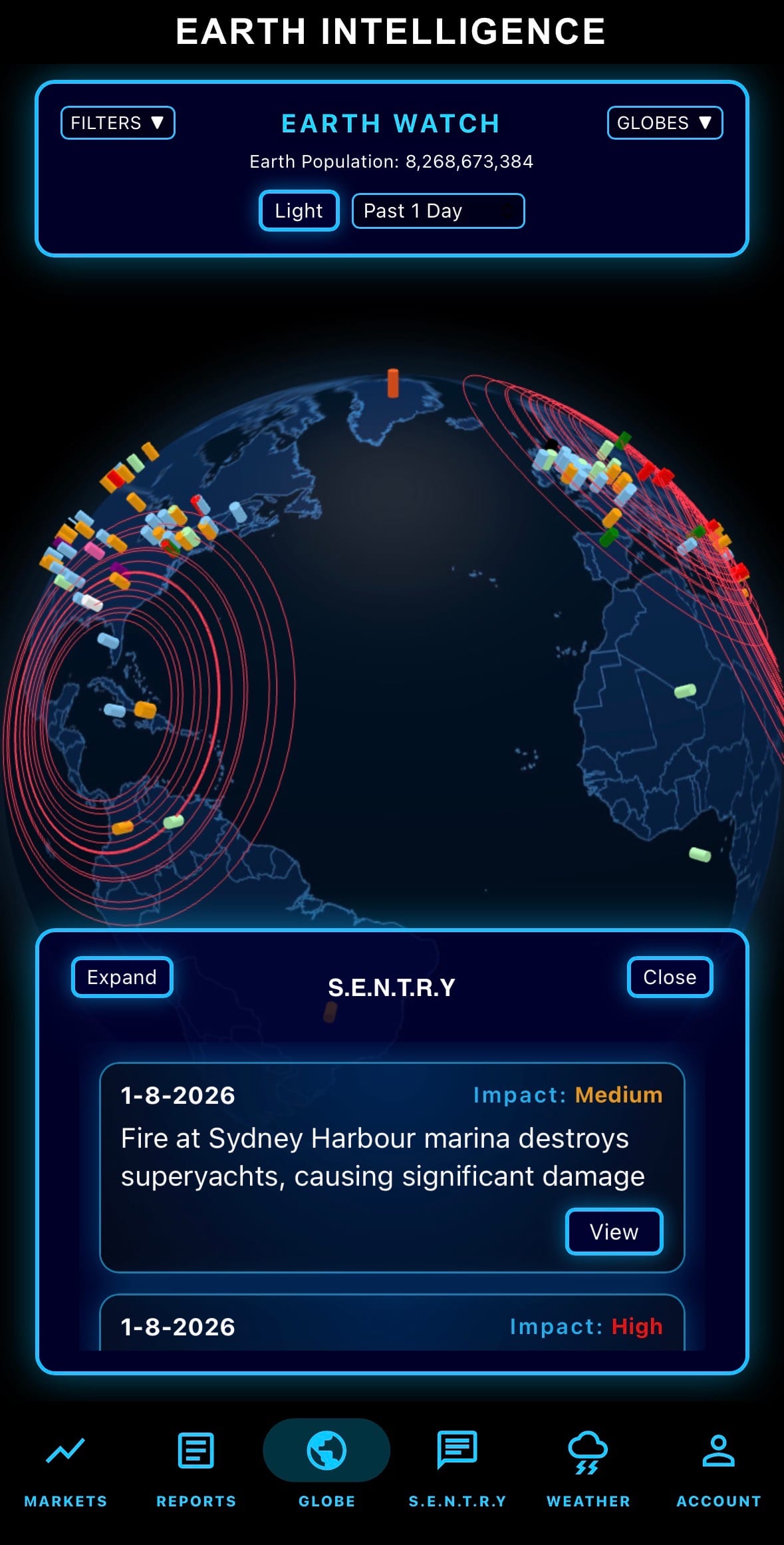

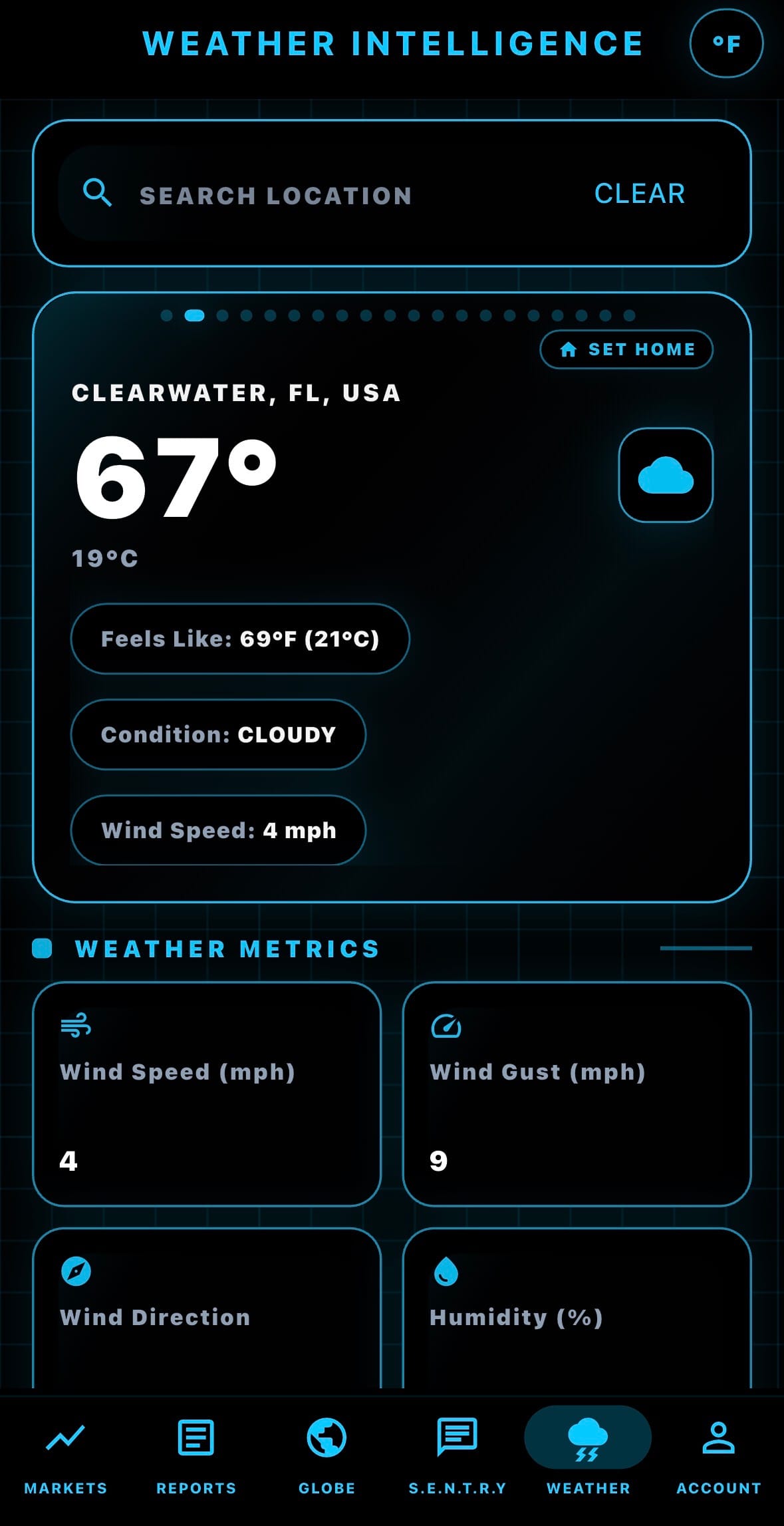
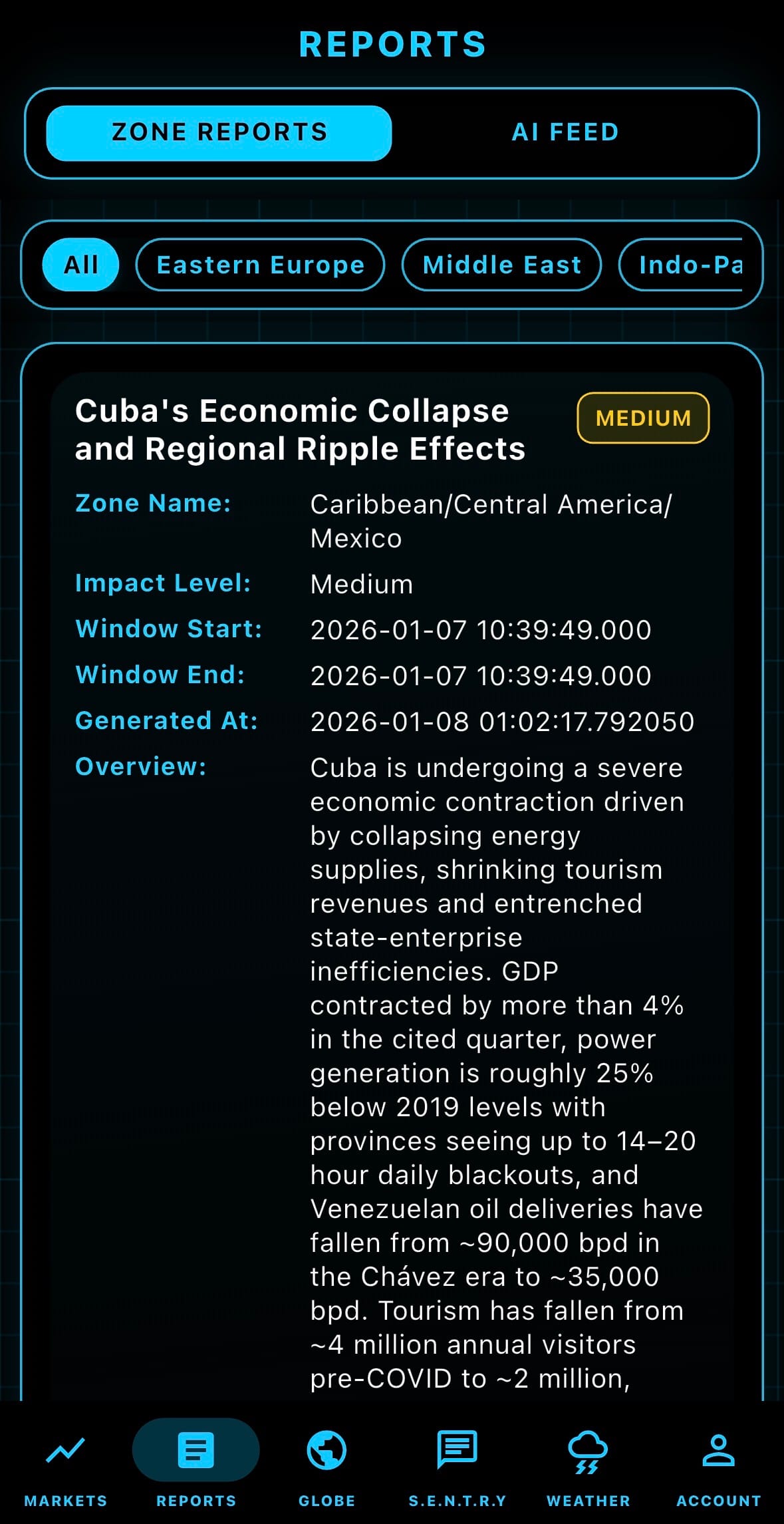
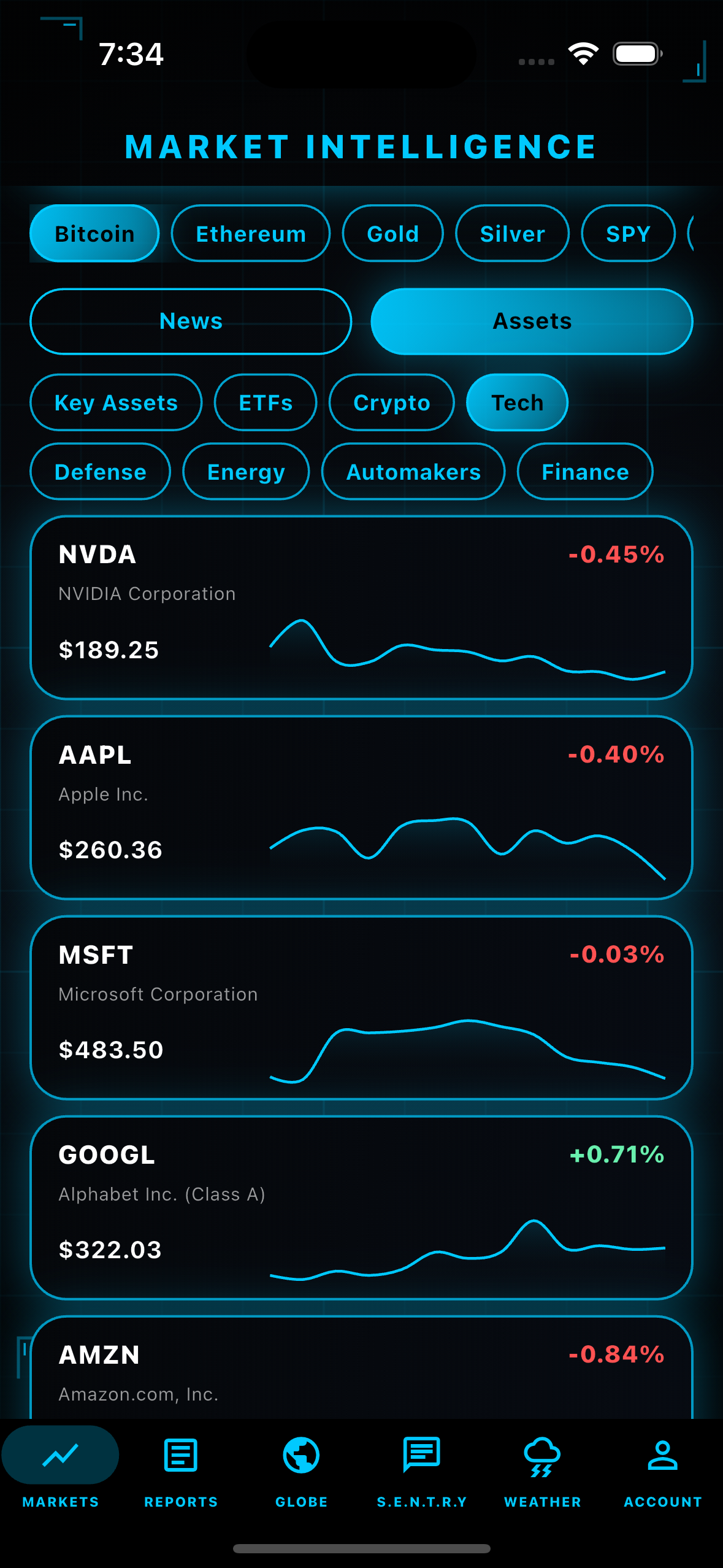

- Together, these updates position EARTH INTELLIGENCE as a planetary overwatch system—providing a unified, real-time view of global activity across events, weather systems, markets, and AI-driven analysis. Instead of fragmented news or disconnected dashboards, the platform delivers a clear operational picture of what’s happening, where it’s happening, and why it matters. You can download the latest version today by searching Earth Intel on both the Apple App Store and Google Play or by clicking the buttons below.
- Download our mobile app:


Statistic:
- Largest assets on Earth by market capitalization:
- Gold: $31.149T
- 🇺🇸 NVIDIA: $4.505T
- Silver: $4.329T
- 🇺🇸 Alphabet (Google): $3.935T
- 🇺🇸 Apple: $3.844T
- 🇺🇸 Microsoft: $3.553T
- 🇺🇸 Amazon: $2.632T
- Bitcoin: $1.823T
- 🇹🇼 TSMC: $1.649T
- 🇺🇸 Meta Platforms (Facebook): $1.628T
- 🇺🇸 Broadcom: $1.576T
- 🇸🇦 Saudi Aramco: $1.525T
- 🇺🇸 Tesla: $1.449T
- 🇺🇸 Berkshire Hathaway: $1.078T
- 🇺🇸 Eli Lilly: $972.82B
- 🇺🇸 JPMorgan Chase: $906.84B
- 🇺🇸 Walmart: $901.49B
- 🇺🇸 Vanguard S&P 500 ETF: $831.07B
- 🇺🇸 iShares Core S&P 500 ETF: $758.23B
- 🇨🇳 Tencent: $717.89B
- 🇺🇸 SPDR S&P 500 ETF: $715.14B
- 🇺🇸 Visa: $679.76B
- 🇰🇷 Samsung: $637.73B
- 🇺🇸 Vanguard Total Stock Market Index Fund ETF: $573.80B
- Platinum: $566.82B
- 🇺🇸 Oracle: $544.88B
History:
- Drones—unmanned aerial vehicles—are the product of a long obsession: keep the aircraft, remove the pilot, and you remove risk, cost, and human limits. Early roots show up as soon as radio control became plausible. In 1916–1918, the U.S. developed the Kettering Bug, a pre-programmed “aerial torpedo” meant to fly a set distance and crash into a target—primitive guidance, but the core concept of pilotless strike was there. In the interwar years, Britain advanced radio-controlled target aircraft for gunnery training, and by the late 1930s, the term “drone” itself is often linked to these pilotless target planes. World War II accelerated unmanned experimentation: Germany’s V-1 flying bomb (1944) wasn’t a “drone” in the modern sense, but it proved mass-produced pilotless weapons could deliver strategic impact. The Allies also pursued remote strike ideas and used unmanned aircraft for target practice and testing. After 1945, the Cold War gave drones a clear mission: reconnaissance without political fallout. The U.S. fielded systems like the Ryan Firebee family (operational use beginning in the 1960s), flying surveillance missions in Vietnam and elsewhere after manned shootdowns became strategically costly. Israel, forced by constant regional threats, became one of the most important drone innovators in the 1970s–1980s, using UAVs for real-time battlefield surveillance and deception—most famously in 1982 during operations in Lebanon, where drones helped expose and suppress Syrian air defenses. By the late 1980s and early 1990s, the necessary ingredients—lightweight sensors, GPS navigation, better data links, and more reliable autopilots—were finally mature enough to turn drones from niche tools into persistent airborne systems.
- The modern era begins in the 1990s and hardens after 2001, when drones became central instruments of surveillance and precision strike. The U.S. MQ-1 Predator entered service in the mid-1990s as a long-endurance intelligence platform with real-time video, and after 2001 it was armed, creating a new model of remote warfare. Its successor, the MQ-9 Reaper (first flown 2001, entering broader service in the mid-2000s), scaled the concept massively: longer range, higher altitude, heavier payloads, more weapons, and better sensors—turning drones into persistent strike aircraft and “hunter-killers” rather than just scouts. Alongside these, the U.S. developed higher-end surveillance platforms like the RQ-4 Global Hawk for long-range, high-altitude wide-area monitoring. Other countries built their own stacks. Israel fielded systems like the Heron and Hermes families that became global exports. China scaled rapidly with platforms like the Wing Loong and CH-series, selling to many states that could not access U.S. systems. Turkey became a defining player in the late 2010s with the Bayraktar TB2 and later larger platforms, demonstrating how relatively affordable drones paired with good tactics and targeting networks could reshape battlefield outcomes. Iran expanded its drone ecosystem with reconnaissance and loitering munitions, influencing proxy warfare dynamics. Meanwhile, drones shrank downward: cheap quadcopters became ubiquitous for frontline reconnaissance and artillery spotting, and “FPV” attack drones turned into improvised precision weapons in modern conflicts. Today the next step is autonomy and mass coordination: drone swarms—dozens, hundreds, potentially thousands of cooperating aircraft—where the unit of combat isn’t a single drone but a networked cloud. AI-enabled perception, decentralized coordination, and electronic-warfare resistance are pushing drones toward a future where they can search, classify, and engage targets with minimal guidance, saturating defenses through numbers and adaptation. The trajectory is clear: drones started as experimental pilotless aircraft, became persistent eyes in the sky, then became strike platforms like the Predator and Reaper, and are now evolving into distributed, algorithm-driven systems where scale, coordination, and speed of decision define dominance.
Image of the day:

Thanks for reading! Earth is complicated, we make it simple.
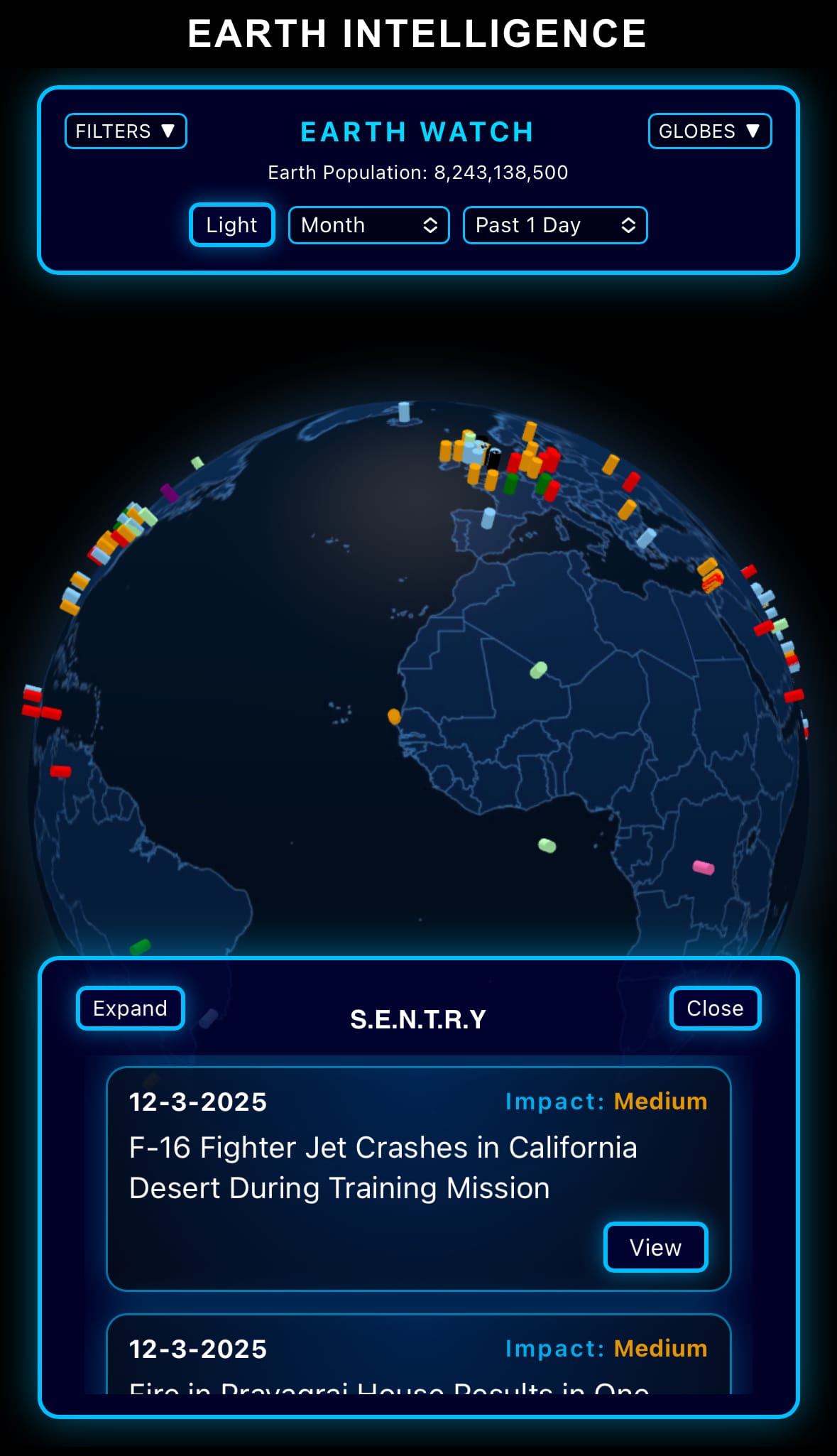
- Click below if you’d like to view our free EARTH WATCH globe:
- Download our mobile app:

Click below to view our previous newsletters:

Support/Suggestions Email:
earthintelligence@earthintel.news