Friday☕️


Economics & Markets:
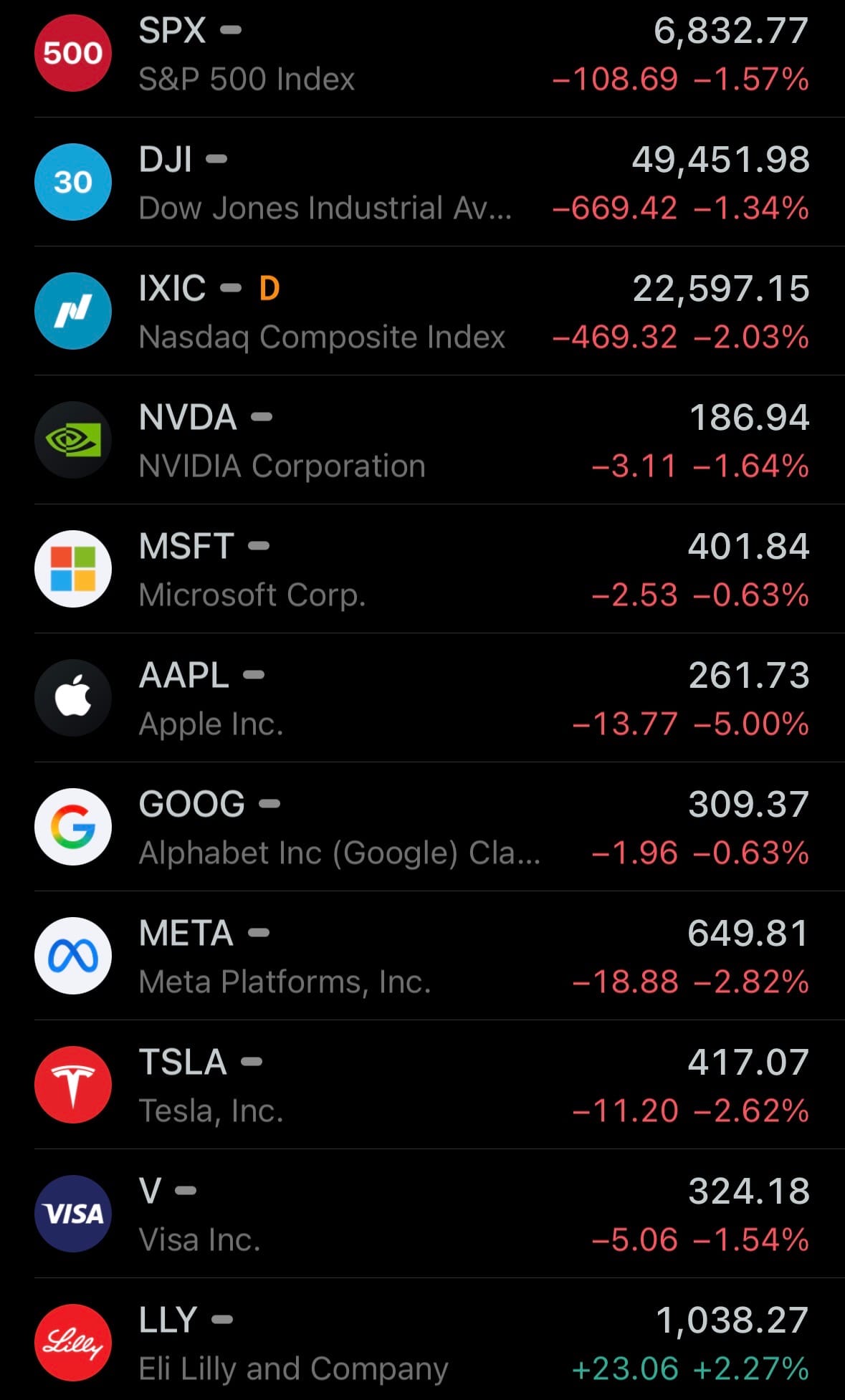
- Yesterday’s U.S. stock market:
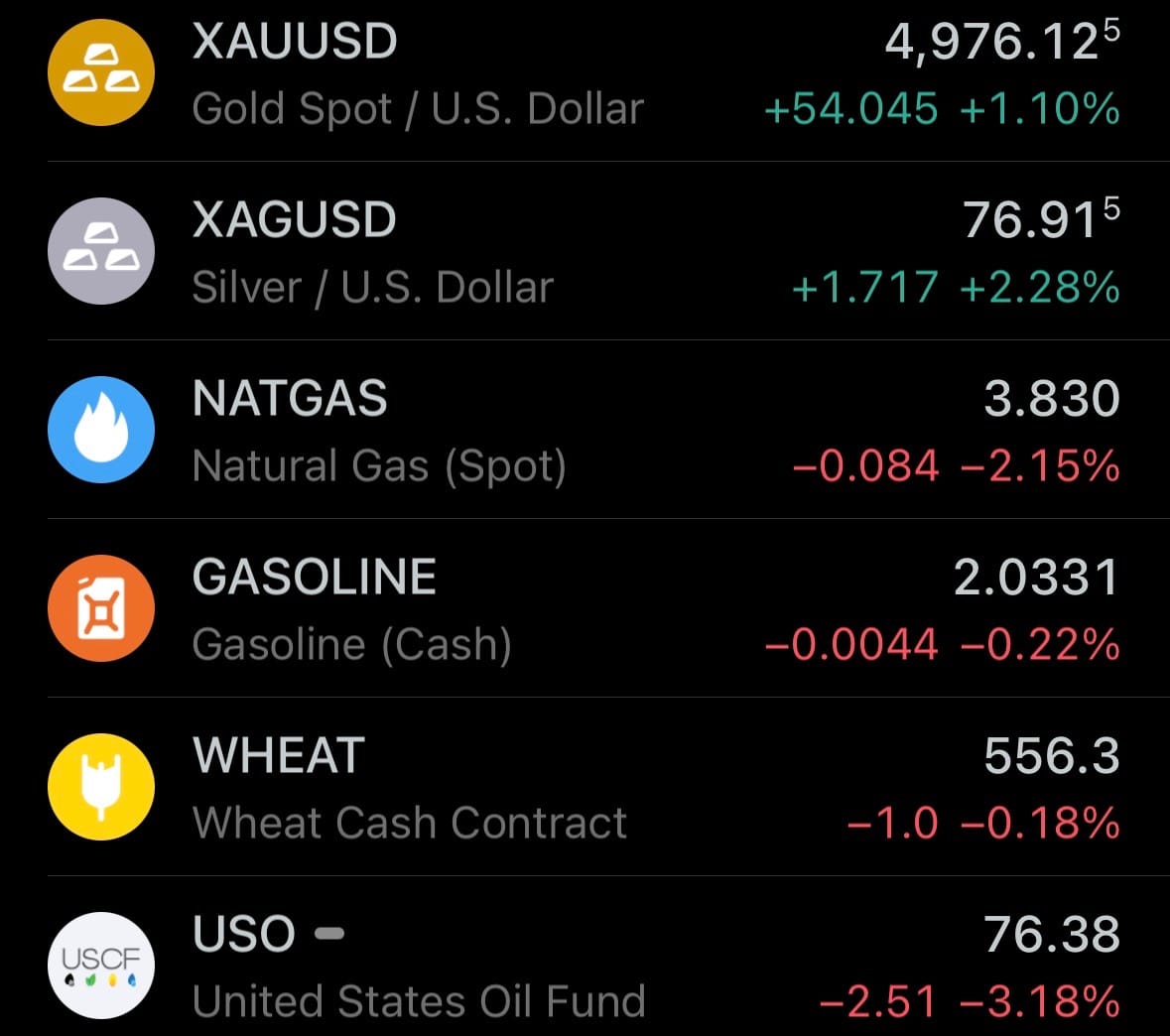
- Yesterday’s commodity market:
- Yesterday’s crypto market:

Geopolitics & Military Activity:
- On February 12, 2026, Ukrainian Liutyi kamikaze drones struck the Lukoil oil refinery in Ukhta, Komi Republic, Russia, starting a fire in its crude distillation and visbreaking units. This is the longest-range confirmed drone attack of the war, at 1,700–1,750 km from the Ukrainian border. The Liutyi is a propeller-driven one-way drone with up to 2,000 km range, 180–250 km/h top speed, 250–300 kg takeoff weight, and 50–75 kg warhead.
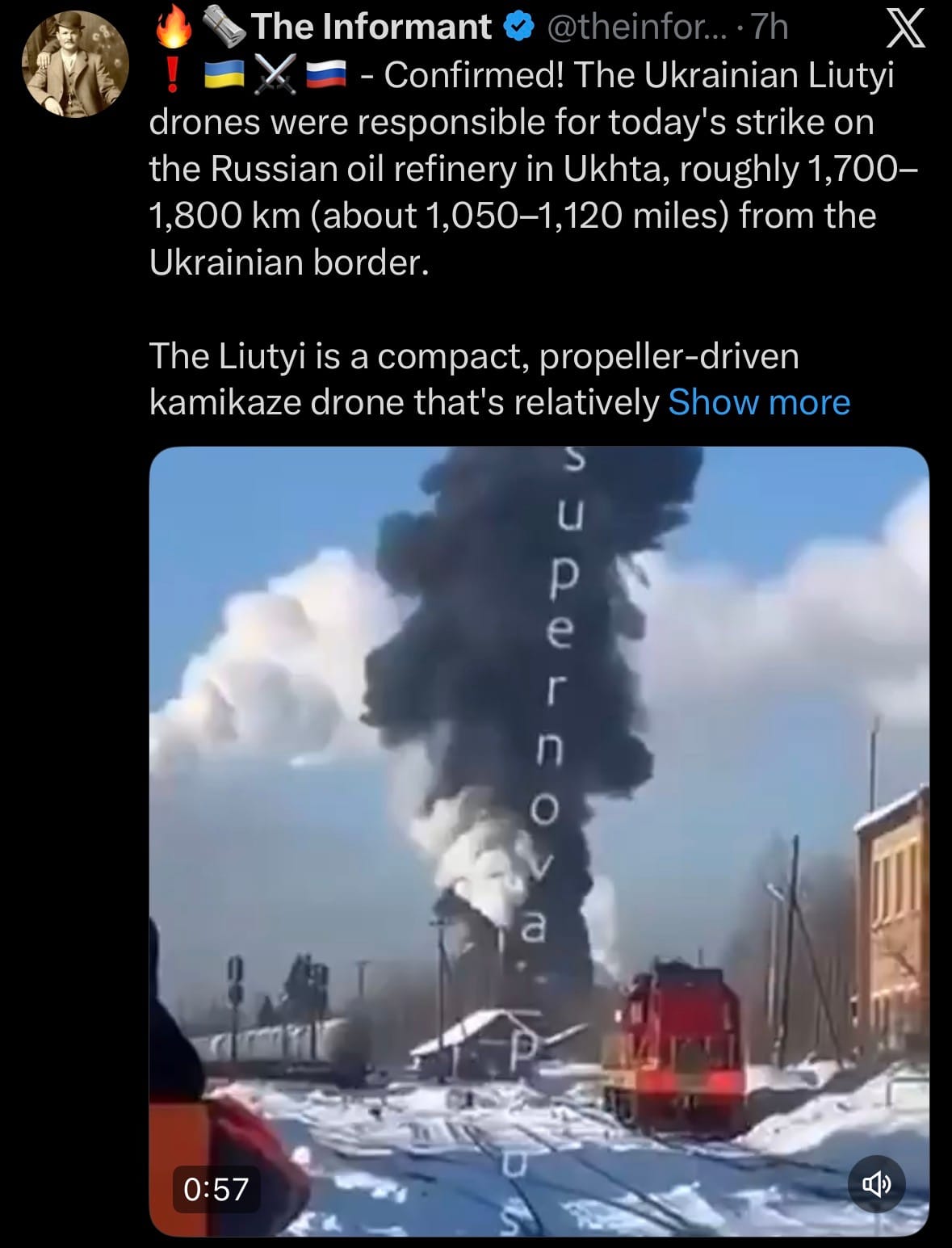
- Despite being slow, noisy, and non-stealthy, it likely succeeded via AI autonomous navigation (machine vision for terrain and obstacle avoidance), GPS-jamming resistance, low-altitude routes to dodge radar, and possible decoys or timing. Russian authorities confirmed the attack and fire but did not identify the drone; Ukrainian sources and local footage match the Liutyi. The refinery fuels Russian forces, and the strike continues Ukraine’s campaign against energy infrastructure to disrupt military supply lines.
Science & Technology
- On February 12, 2026, Google announced a major upgrade to Gemini 3 Deep Think, a reasoning-focused mode in their Gemini AI model, developed with input from scientists and researchers to better handle complex, real-world problems.
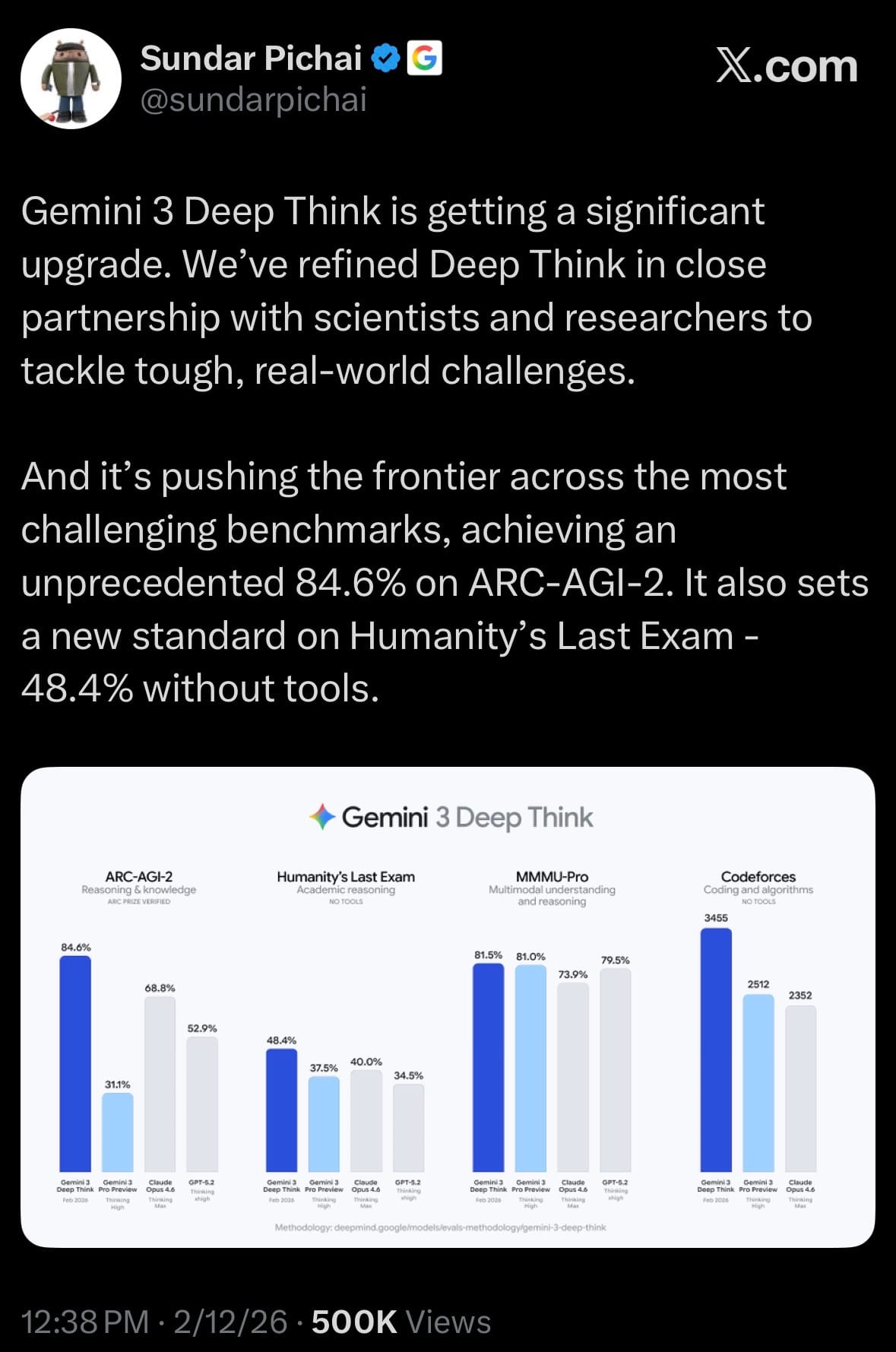
- The updated version now leads on some of the hardest AI benchmarks: it scores 84.6% on ARC-AGI-2 (a tough test of general intelligence and abstract reasoning, far ahead of previous models) and achieves 48.4% on Humanity’s Last Exam (a very difficult evaluation of advanced knowledge and problem-solving) when run without any external tools. This makes Gemini 3 Deep Think one of the strongest publicly available models for deep, tool-free reasoning on challenging tasks. The upgrade is rolling out now to Gemini users with access to the latest Gemini 3 features.
Space:
- On February 12, 2026, the U.S. Space Force launched the USSF-87 mission successfully using a United Launch Alliance Vulcan Centaur rocket from Cape Canaveral Space Force Station, Florida, at 4:22 a.m. EST. The rocket placed the GSSAP-7 and GSSAP-8 satellites—built by Northrop Grumman—directly into geosynchronous orbit (about 35,786 km altitude), along with secondary research and training payloads on a propulsive ESPA ring.
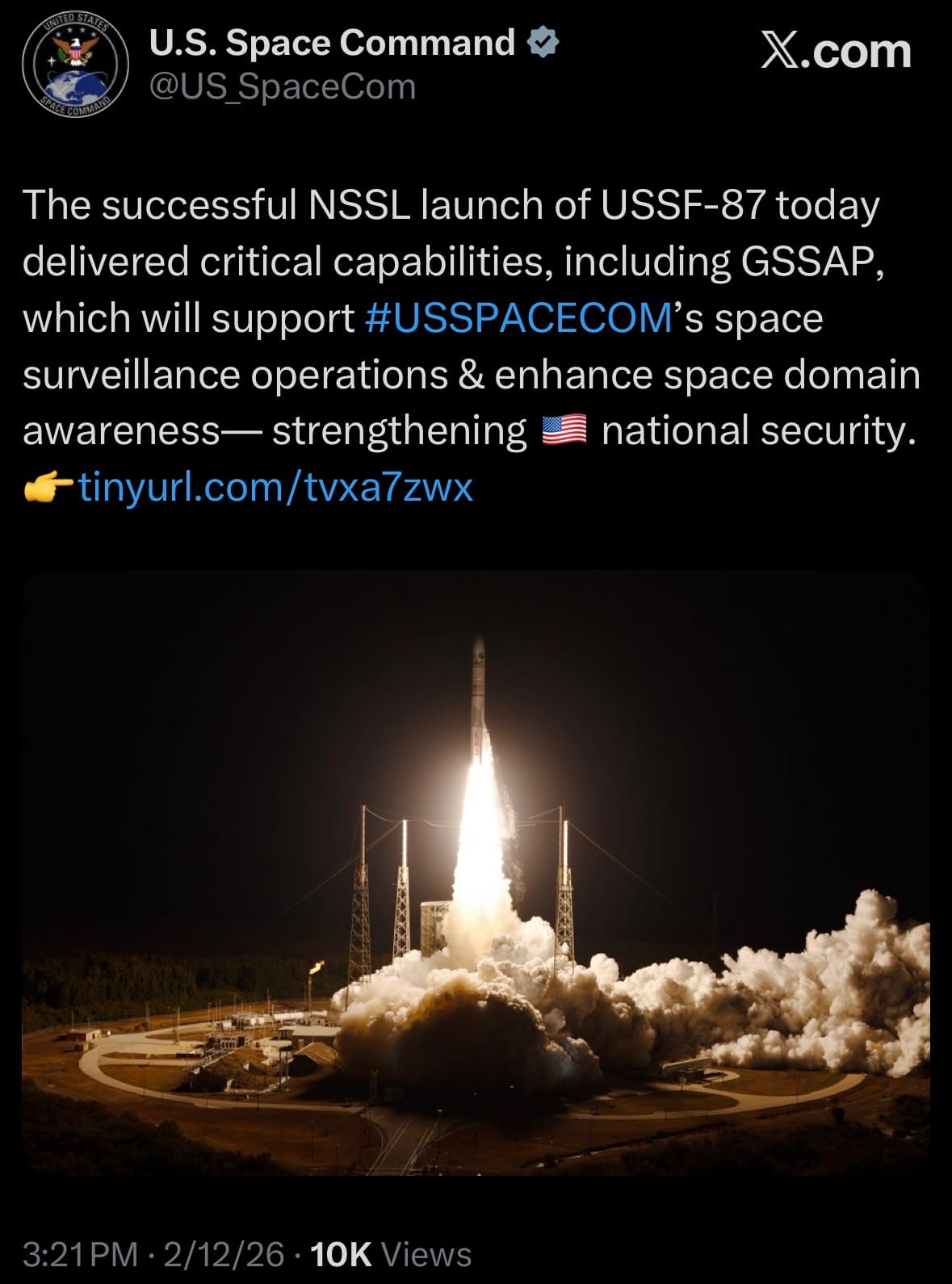
- These GSSAP satellites act as dedicated optical sensors in the U.S. Space Surveillance Network, providing high-resolution imaging to track and characterize objects in geosynchronous orbit; they support military intelligence by detecting foreign satellite maneuvers or anomalies, monitoring threats to U.S. space systems, contributing to missile defense through early detection of launches or hypersonic activities from high-altitude vantage points, and improving overall space domain awareness for U.S. Space Command.
Amazon Launch:
- On February 12, 2026, Arianespace successfully launched mission VA267—the first flight of the Ariane 64 configuration (four boosters, Europe’s most powerful Ariane 6 rocket variant)—from the Guiana Space Centre in Kourou, French Guiana, at 16:45 UTC (11:45 a.m. EST). After a 1-hour-54-minute mission, all 32 Amazon Leo satellites (LE-01 batch) were deployed into low Earth orbit at approximately 465 km altitude.
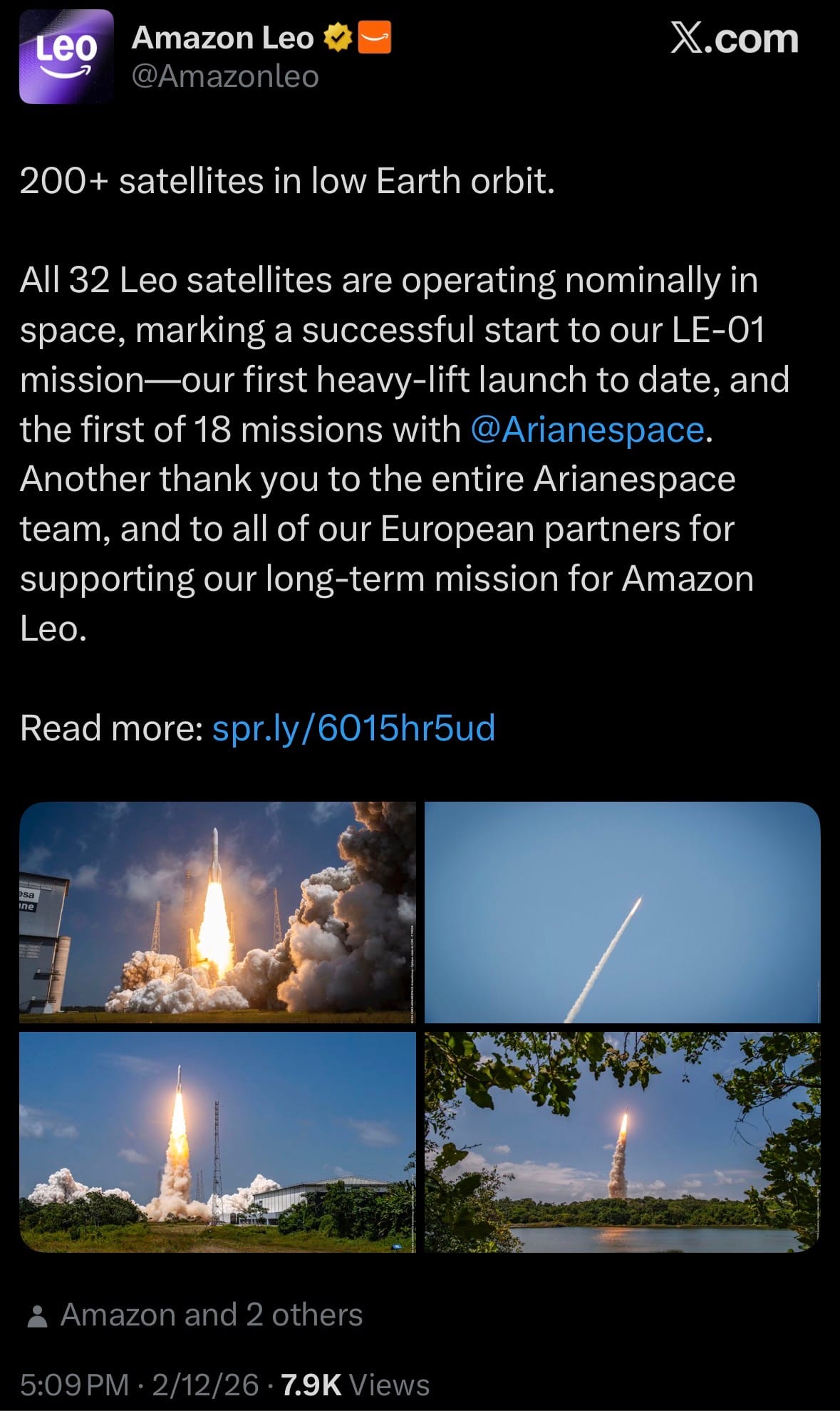
- This was the debut of Ariane 64, the first use of its 20-meter fairing, the first Ariane 6 commercial customer launch, and the first European rocket to place satellites for Amazon’s Leo constellation (formerly Project Kuiper). The mission starts a series of 18 contracted Ariane 6 launches to build Amazon’s low-Earth-orbit broadband network for underserved regions, pushing the constellation past 200 satellites in orbit.
Statistic:
- Largest assets on Earth by market capitalization:
- Gold: $34.787T
- 🇺🇸 NVIDIA: $4.551T
- Silver: $4.327T
- 🇺🇸 Apple: $3.846T
- 🇺🇸 Alphabet (Google): $3.742T
- 🇺🇸 Microsoft: $2.986T
- 🇺🇸 Amazon: $2.142T
- 🇹🇼 TSMC: $1.909T
- 🇸🇦 Saudi Aramco: $1.676T
- 🇺🇸 Meta Platforms: $1.643T
- 🇺🇸 Broadcom: $1.570T
- 🇺🇸 Tesla: $1.565T
- Bitcoin: $1.328T
- 🇺🇸 Berkshire Hathaway: $1.078T
- 🇺🇸 Walmart: $1.065T
- 🇺🇸 Eli Lilly: $930.76B
- 🇺🇸 Vanguard S&P 500 ETF (VOO): $848.96B
- 🇰🇷 Samsung: $839.04B
- 🇺🇸 JPMorgan Chase: $823.86B
- 🇺🇸 iShares Core S&P 500 ETF (IVV): $750.57B
- 🇺🇸 SPDR S&P 500 ETF (SPY): $694.20B
- 🇺🇸 Exxon Mobil: $632.27B
- 🇺🇸 Visa: $625.03B
- 🇨🇳 Tencent: $607.75B
- 🇺🇸 Johnson & Johnson: $589.19B
History:
- The history of intelligence agencies starts as soon as states exist, because power has always depended on what you can learn, hide, and manipulate. Ancient empires built early intelligence systems as a mix of scouts, informants, and administrative surveillance: Assyria and Persia used messenger networks and local reporting to keep provinces under control; Rome relied on frontier scouts, internal informers, and political surveillance to prevent revolt; Chinese dynasties developed deep bureaucratic reporting and internal security practices tied to stability and tax control. In India, treatises like the Arthashastra (c. 300 BC) described structured espionage and counterespionage—spies as instruments of statecraft, not improvisation. Medieval and early modern Europe made intelligence more formal through court networks, ciphered correspondence, and diplomatic reporting, while Venice and other maritime powers used merchant networks as sensors for trade and war. By the 16th–18th centuries, cryptography bureaus and “black chambers” (state mail-intercept offices) became common, making intelligence a permanent feature of governance. The 19th century then industrialized the entire problem: telegraphy, rail, mass conscription, and colonial competition demanded centralized services that could track threats across borders and inside populations. Britain and France professionalized imperial intelligence; Tsarist Russia relied on the Okhrana for internal security; and Germany developed increasingly sophisticated military intelligence structures. Modern intelligence agencies, as we recognize them—professional staffs, dedicated budgets, foreign stations, tradecraft schools, and counterintelligence—are essentially products of the industrial state.
- World War I and especially World War II turned intelligence into an outcome-deciding weapon, and the Cold War made it permanent. Modern signals intelligence (SIGINT) exploded with radio interception and codebreaking; covert action, sabotage, and deception became organized capabilities rather than ad-hoc missions. Britain’s intelligence system crystallized into MI5 (domestic security) and MI6 (foreign intelligence), while Bletchley Park’s codebreaking demonstrated how mathematics plus industrial organization could crack “unbreakable” systems. The United States built the OSS during WWII, then created the CIA in 1947, formalizing foreign intelligence and covert action as standing instruments of national power, alongside an enormous SIGINT apparatus (eventually centered in the NSA). The Soviet Union built a vast integrated system (KGB and GRU traditions) combining foreign espionage, internal security, influence operations, and proxy support—creating a global clandestine competition where the battlefield was often a government ministry, a weapons lab, a labor union, or a radio station rather than a trench line. Israel’s intelligence ecosystem formed under existential pressure: Mossad (foreign intelligence and special operations), Shin Bet (internal security), and Aman (military intelligence) evolved into a dense, highly operational set of services shaped by constant regional threats. Across Asia, China’s intelligence apparatus matured into a state-scale model built for long-term strategic competition—today centered around the Ministry of State Security and military intelligence elements—especially strong in counterintelligence, industrial/technology collection, and long-horizon influence. By the end of the 20th century, the playbook was standardized: HUMINT networks for access, SIGINT for scale, imagery and geospatial collection for targeting, covert action for deniable influence, and counterintelligence to keep your own house from being penetrated.
- Today, the top tier of intelligence power is defined less by mystique and more by the size of the ecosystem: collection reach, technical sophistication, operational discipline, and the ability to fuse information into decisions. The U.S. intelligence community is the largest and most technologically extensive on Earth, anchored by the CIA for foreign HUMINT and covert action, the NSA for SIGINT and cyber-scale interception, and defense intelligence elements that support military operations globally. Russia’s modern services—built from Soviet legacy—retain a reputation for aggressive clandestine operations, deep experience in counterintelligence, and influence tactics designed to create confusion and fracture cohesion rather than simply gather facts. China’s intelligence system has become a central player in the 21st century, emphasizing long-term technology acquisition, cyber-enabled espionage, diaspora/influence networks, and broad counterintelligence to protect state priorities; its strength is often described as strategic patience at scale. Israel’s Mossad is widely viewed as one of the most effective services per capita, known for high-intensity operational capability, regional penetration, and precision intelligence-action loops, while the U.K.’s MI6/GCHQ remain top-tier allies with deep SIGINT and global liaison reach. That said, ranking “top 3” is inherently slippery because agencies excel in different domains: the CIA/NSA ecosystem dominates global technical scale and expeditionary reach; Mossad is famous for operational sharpness and speed; and China and Russia operate vast, persistent intelligence competition models optimized for state survival and strategic advantage. Modern intelligence wars are continuous and multi-domain: cyber operations, economic and supply-chain intelligence, influence campaigns, counterterrorism, and covert disruption—all running in parallel. The result is a world where the most powerful conflicts are often decided quietly: through access to decision rooms, control of information flows, and the ability to act without attribution.
Image of the day:

Thanks for reading! Earth is complicated, we make it simple.
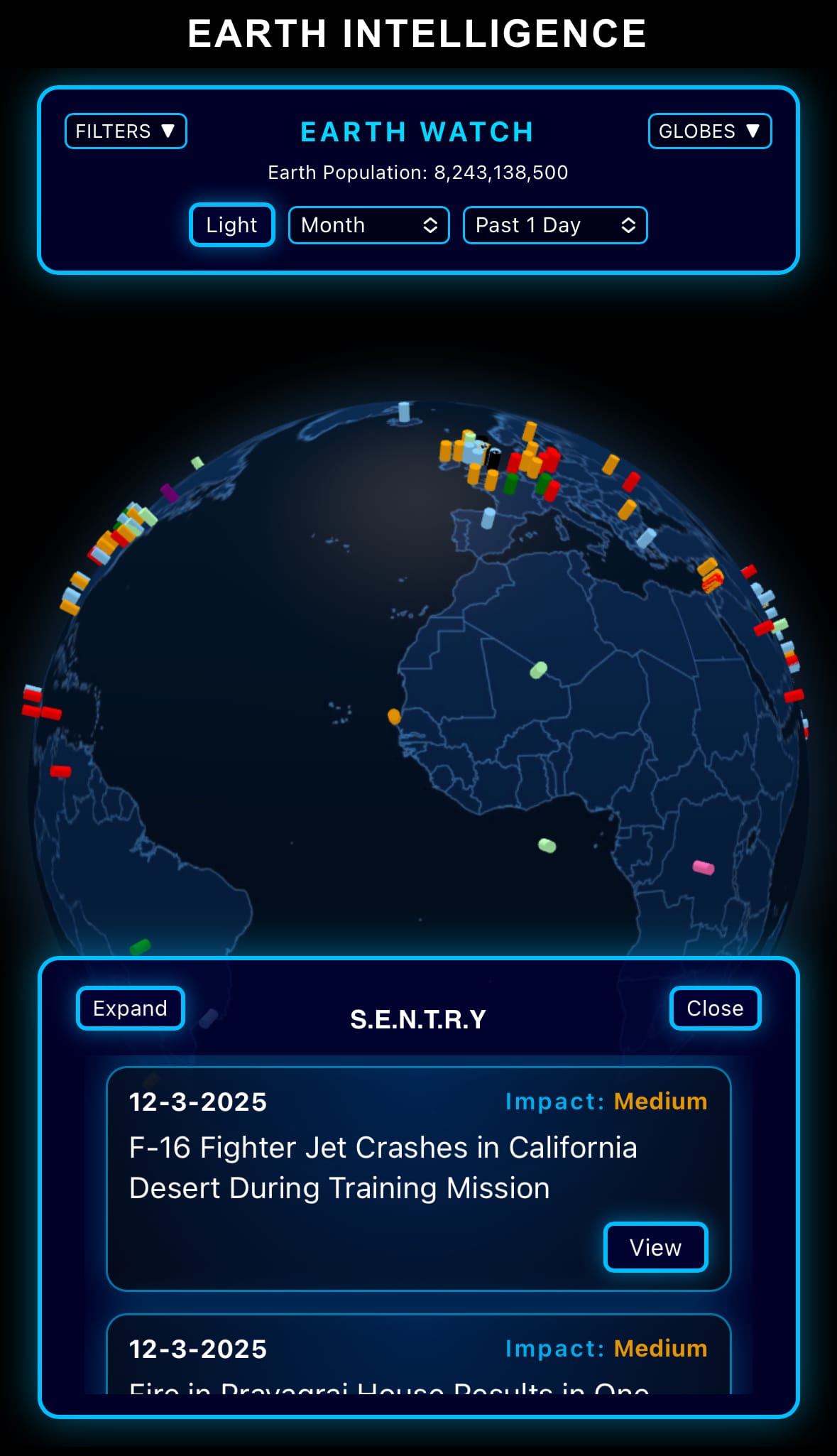
- Click below if you’d like to view our free EARTH WATCH globe:
- Download our mobile app:


Click below to view our previous newsletters:
Support/Suggestions Email:
earthintelligence@earthintel.news