Friday☕️

Trending:
- On February 19, 2026, Andrew Mountbatten-Windsor—formerly known as Prince Andrew—was arrested by Thames Valley Police on suspicion of misconduct in public office. The arrest occurred at his residence on the Sandringham estate in Norfolk, England, coinciding with his 66th birthday. Police are conducting searches at addresses in Berkshire and Norfolk as part of the ongoing investigation, and he remains in custody.
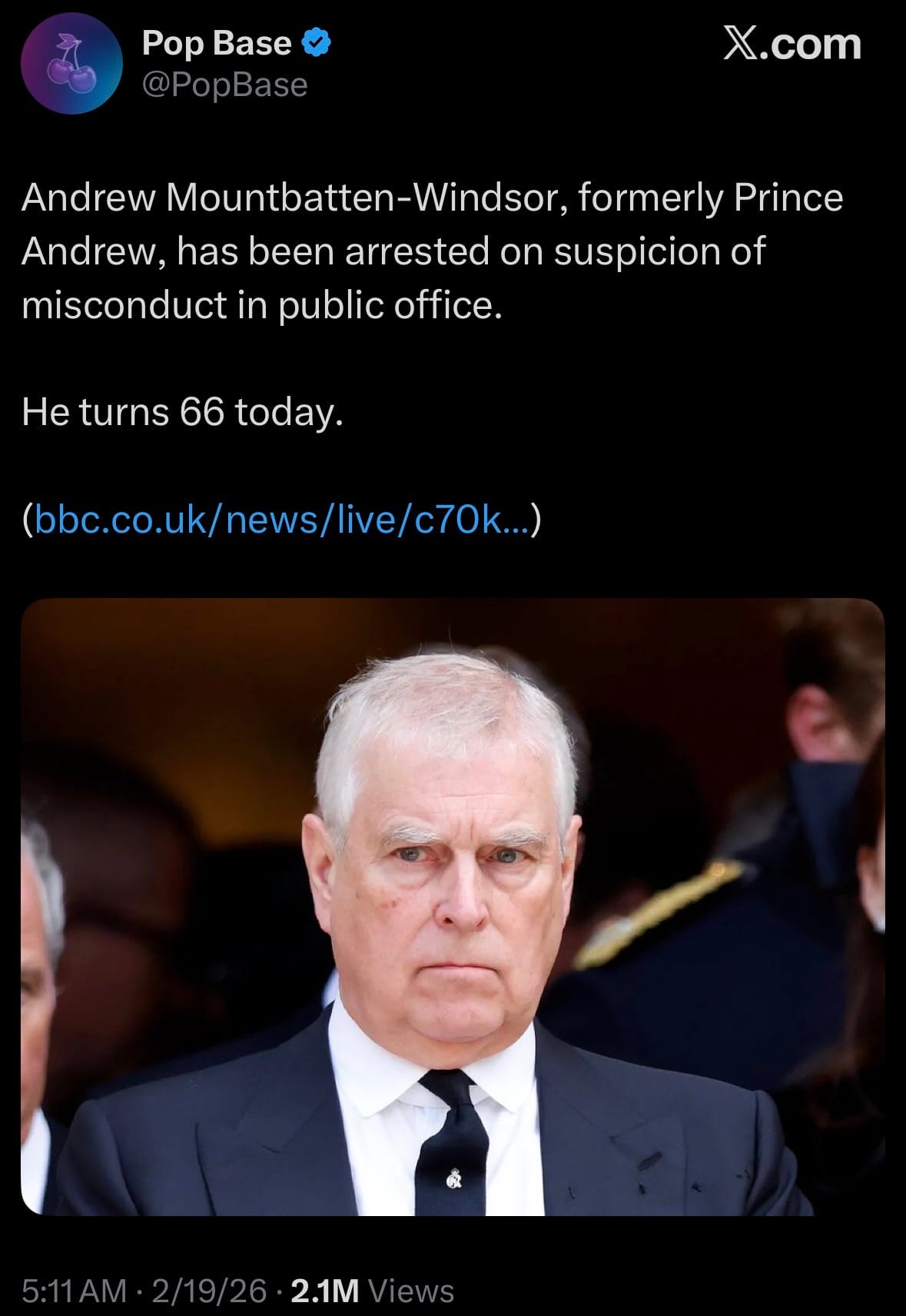

- The case stems from allegations that, during his tenure as a UK trade envoy prior to 2011, he shared confidential government information with the late Jeffrey Epstein, based on documents revealed in recent releases from Epstein-related files by the U.S. Justice Department. Thames Valley Police initiated the probe following a complaint, though they have not publicly detailed specific evidence or charges beyond the suspicion. King Charles III reportedly stated that the law must take its course, while Mountbatten-Windsor has previously denied wrongdoing in connection with Epstein.
Economics & Markets:
- Yesterday’s U.S. stock market:

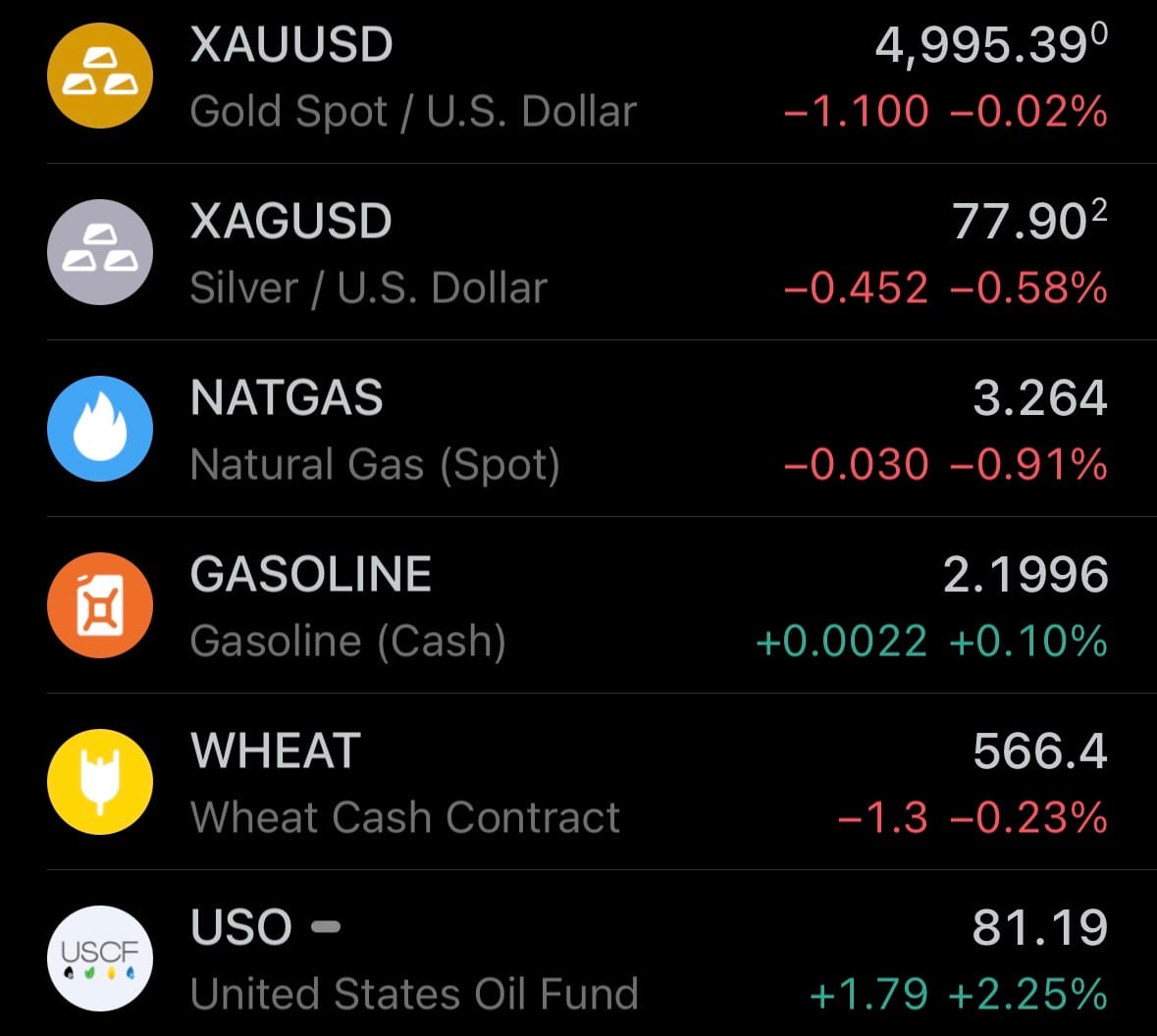
- Yesterday’s commodity market:
- Yesterday’s crypto market:

Geopolitics & Military Activity:
- As of February 19, 2026: Sudan's civil war between the Sudanese Armed Forces (SAF), led by General Abdel-Fattah al-Burhan, and the Rapid Support Forces (RSF), commanded by Mohamed Hamdan Dagalo (Hemedti), remains active since April 2023 with no resolution in sight. Fighting has intensified in western regions including Kordofan and Darfur, characterized by ground battles, artillery exchanges, and a sharp rise in drone and airstrikes targeting both military and civilian areas.
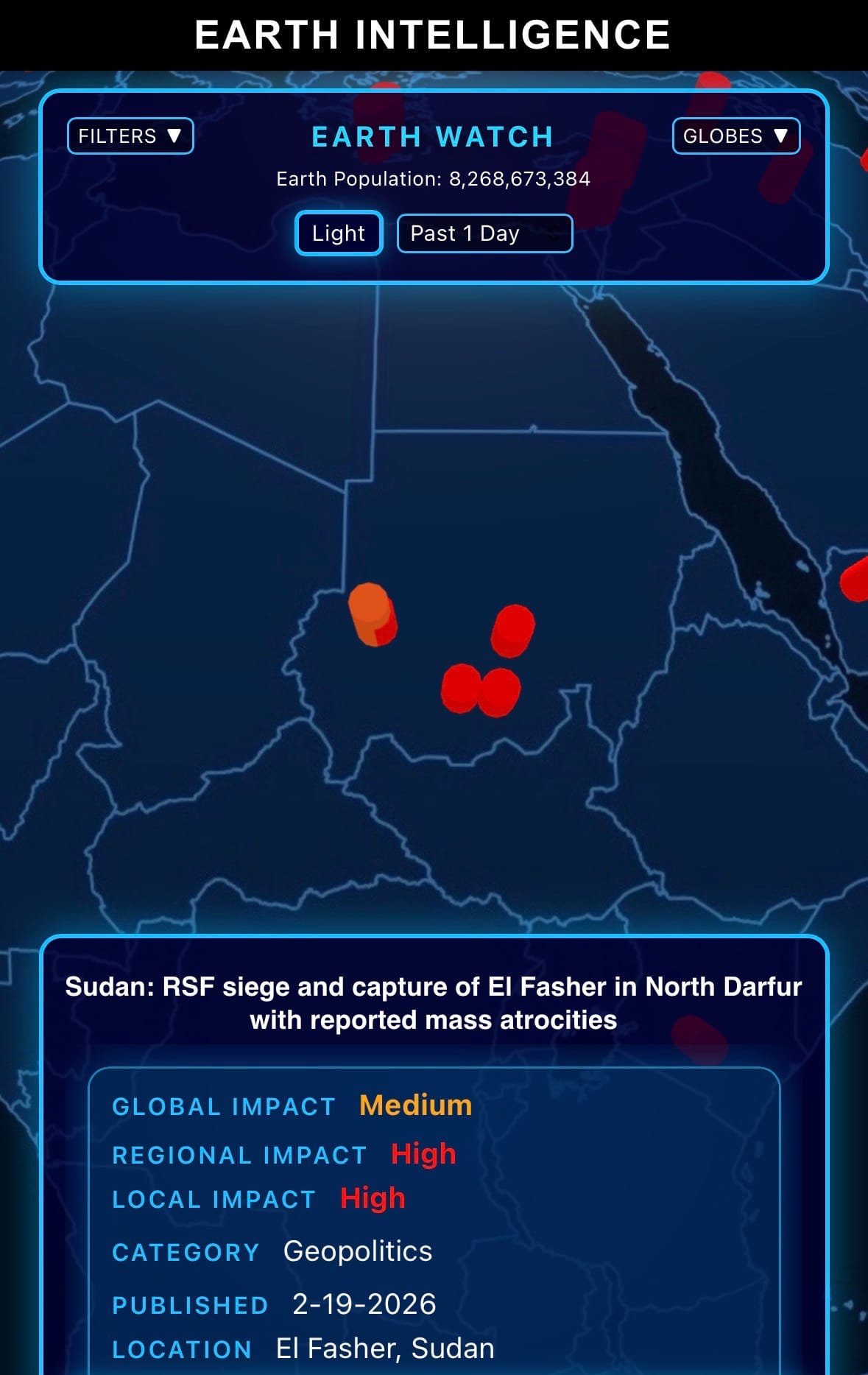
- On February 15–16, drone strikes killed at least 57 civilians across four states: alleged SAF attacks struck the Al Safiya market in Sudari, North Kordofan (28 killed, 13 injured) and an internally displaced persons shelter in Al Sunut, West Kordofan (26 killed, including 15 children, and 15 injured), while an alleged RSF strike hit Al-Mazmoun Hospital in Sennar state (at least 3 killed). These incidents are part of broader escalating drone warfare by both sides, which has repeatedly damaged markets, schools, hospitals, and aid facilities, with medical organizations like MSF treating hundreds of injuries from similar attacks in early February.
Defense & Security:
- On February 19, 2026, Anduril Industries announced it has received an additional $43.7 million in Defense Production Act (DPA) Title III funding from the U.S. Department of Defense to expand domestic solid rocket motor (SRM) production capacity. The award, originally granted on October 2, 2025, supports improvements at Anduril's SRM factory in McHenry, Mississippi—including expanded test fire infrastructure for complex motors, increased storage capacity, and acquisition of manufacturing-level production tooling—to boost efficiency and resiliency.
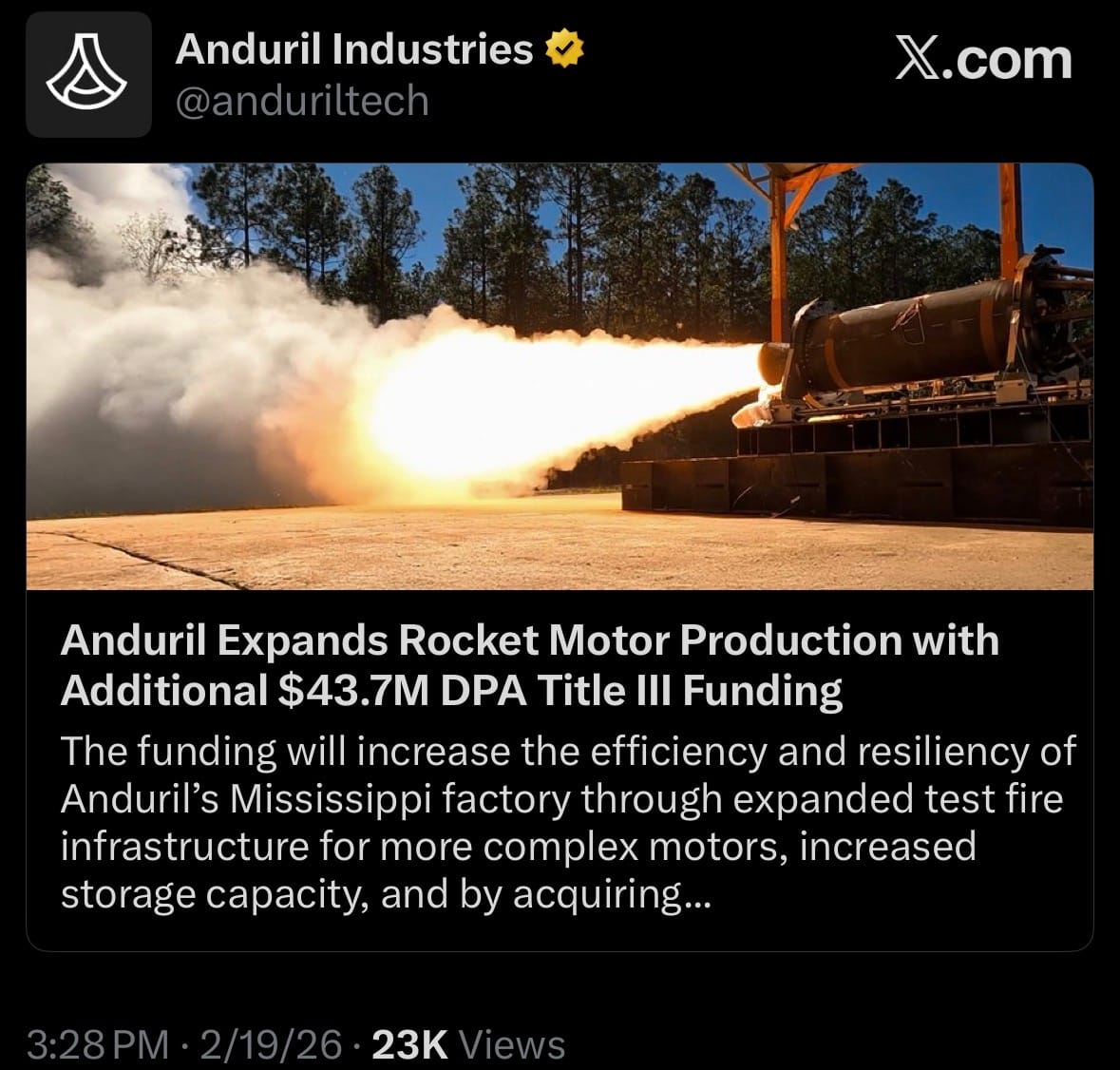
- This follows Anduril's prior $14.3 million DPA award in December 2024 and the opening of its full-rate SRM production facility in August 2025, backed by the company's $75 million private investment. The funding addresses urgent national security needs for scalable SRM supply, with Anduril securing a full-rate production contract with a European ally and selection by Saab to supply motors for the Ground Launched Small Diameter Bomb program.
Science & Technology:
- On February 19, 2026, Google Labs introduced "Photoshoot," the latest feature update for Pomelli, an AI-powered image generation tool. Photoshoot allows users to upload a single product image and generate high-quality, customized product shots tailored for marketing purposes, including varied backgrounds, lighting, angles, and styles.

- The feature is now available free of charge to users in the United States, Canada, Australia, and New Zealand. Google encourages immediate access via the Pomelli platform at labs.google/pomelli to begin creating professional-grade visuals.
Statistic:
- Largest assets on Earth by market capitalization:
- Gold: $34.849T
- 🇺🇸 NVIDIA: $4.574T
- Silver: $4.381T
- 🇺🇸 Apple: $3.829T
- 🇺🇸 Alphabet (Google): $3.672T
- 🇺🇸 Microsoft: $2.961T
- 🇺🇸 Amazon: $2.199T
- 🇹🇼 TSMC: $1.869T
- 🇸🇦 Saudi Aramco: $1.657T
- 🇺🇸 Meta Platforms: $1.631T
- 🇺🇸 Broadcom: $1.583T
- 🇺🇸 Tesla: $1.544T
- Bitcoin: $1.346T
- 🇺🇸 Berkshire Hathaway: $1.072T
- 🇺🇸 Walmart: $995.56B
- 🇺🇸 Eli Lilly: $965.26B
- 🇰🇷 Samsung: $871.80B
- 🇺🇸 Vanguard S&P 500 ETF: $853.08B
- 🇺🇸 JPMorgan Chase: $838.59B
- 🇺🇸 iShares Core S&P 500 ETF: $751.97B
- 🇺🇸 SPDR S&P 500 ETF: $699.25B
- 🇺🇸 Exxon Mobil: $636.66B
- 🇺🇸 Visa: $614.90B
- 🇨🇳 Tencent: $614.61B
- 🇺🇸 Johnson & Johnson: $595.02B
History:
- The power grid is one of the greatest and least appreciated inventions in human history: a planetary machine that turns raw energy into civilization, instantly, everywhere. Its story begins in the late 19th century, when electricity shifted from laboratory curiosity into industrial destiny. Thomas Edison built the first commercial power stations in the 1880s, pushing direct current (DC) systems designed for dense urban lighting. But DC could not travel far without massive losses, limiting electrification to small islands of power. Nikola Tesla, backed by George Westinghouse, championed alternating current (AC), which could be stepped up to high voltages for long-distance transmission and then stepped down for safe use. This “War of Currents” culminated in AC victory, symbolized by the Niagara Falls power project (1895–1896), one of the first major demonstrations of large-scale generation and transmission. The grid was born as an idea: not just power plants, but interconnected networks of generation, transmission, transformers, and distribution—electricity as a national circulatory system.
- The early 20th century turned electrification into state-scale infrastructure. Cities lit up first, then factories, then rural areas as governments realized electricity was economic power. In the United States, the Rural Electrification Administration (1935) extended power across the countryside, while Europe built nationalized or coordinated grids to support industrial growth. After World War II, grids expanded massively: coal plants, hydroelectric dams, and later nuclear reactors became baseload engines feeding growing demand. The grid evolved into a highly synchronized machine operating at constant frequency—50 or 60 Hz—where supply and demand must match in real time. This is the key: electricity is not stored easily at scale, so the grid is a continuous balancing act, a living system. By the mid-to-late 20th century, grids became continental: high-voltage transmission lines linked regions, utilities interconnected for reliability, and control centers emerged to manage load, stability, and emergency response. But the grid’s complexity also created vulnerability. Major blackouts—such as the 1965 Northeast blackout in the U.S. and Canada—revealed how cascading failures could ripple through interconnected systems like dominoes. The grid was powerful, but fragile: one disturbance, poorly contained, could darken entire nations.
- The modern era has transformed the power grid from an industrial machine into a contested digital battlespace. The rise of renewables introduced new challenges: solar and wind are variable, requiring smarter balancing, fast-response storage, and predictive control. Grids began integrating sensors, automation, and networked control systems—what we now call the “smart grid.” But digitization brought cyber exposure. The grid is now one of the most strategic targets on Earth because it underpins everything: water systems, hospitals, finance, communications, military bases, and industrial production. Cyberattacks like the 2015 Ukraine power grid attack demonstrated that modern adversaries can disrupt electricity through malware, not bombs. Today, the grid is evolving into an AI-managed organism: predictive load forecasting, automated fault isolation, drone-based line inspection, real-time energy markets, and battery farms stabilizing frequency in milliseconds. The future grid will be decentralized, sensor-rich, and algorithmically controlled—but also increasingly strategic, where energy security becomes national security. In the 21st century, power grids are no longer just infrastructure. They are the electrical nervous systems of modern states, and whoever can defend, disrupt, or dominate energy networks holds one of the deepest forms of control over civilization itself.
Image of the day:

Thanks for reading! Earth is complicated, we make it simple.
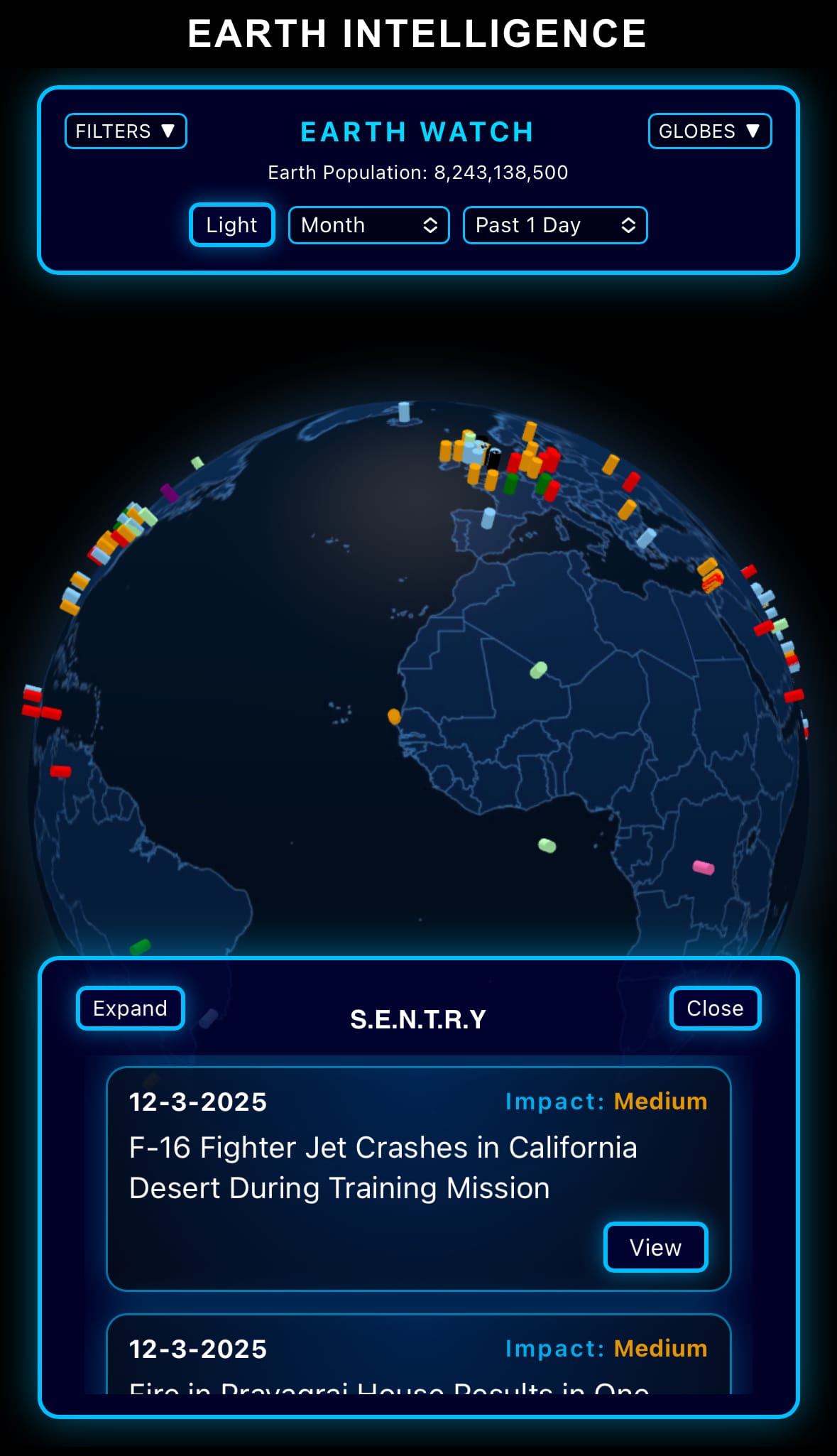
- Click below if you’d like to view our free EARTH WATCH globe:
- Download our mobile app:



Click below to view our previous newsletters:

Support/Suggestions Email:
earthintelligence@earthintel.news