Friday☕️


Trending:
- On February 26, 2026, fintech company Block (formerly Square, ticker XYZ), led by CEO Jack Dorsey, announced it is cutting nearly 40% of its workforce—over 4,000 employees—reducing headcount from more than 10,000 to just under 6,000. The layoffs are directly attributed to advances in AI and intelligence tools enabling smaller, flatter teams to achieve the same output, with Dorsey stating in a shareholder letter that this fundamentally changes how companies build and run, and he chose a single decisive cut over gradual reductions to preserve morale and trust.

- Despite strong Q4 2025 results (gross profit up 24% year-over-year) and no financial distress, the move sparked a massive positive market reaction: Block's stock surged 20–25% in after-hours trading as investors rewarded the efficiency gains and anticipated higher margins from the leaner structure.
Economics & Markets:
- Yesterday’s U.S. stock market:

- Yesterday’s commodity market:

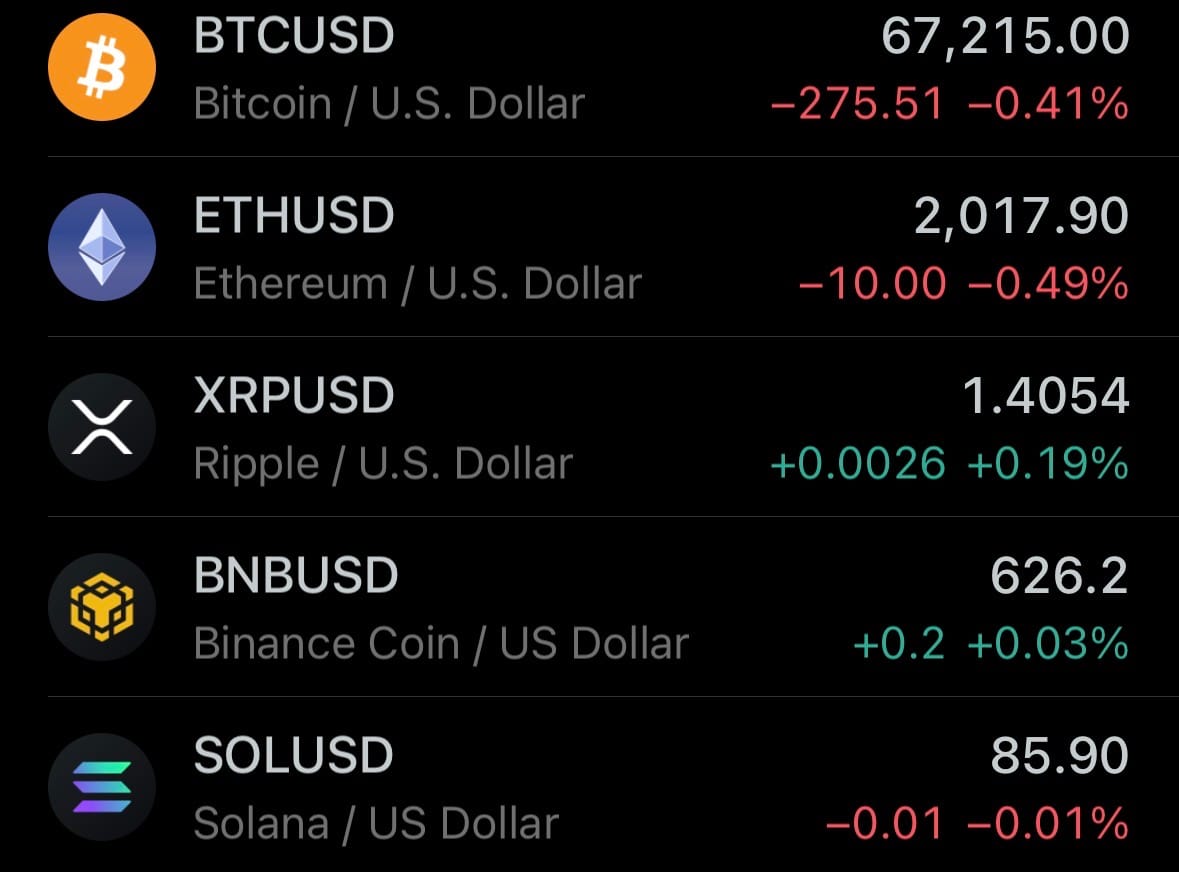
- Yesterday’s crypto market:
Geopolitics & Military Activity:
- On February 26, 2026, Pakistan's state-run media confirmed that the Pakistani Air Force conducted multiple airstrikes overnight under Operation Ghazab Lil Haq, targeting Taliban military facilities inside Afghanistan. The strikes hit two brigade headquarters in Kabul, a corps headquarters, brigade headquarters, ammunition depot, and logistics base in Kandahar, and a corps headquarters in Paktia province.

- Pakistani aircraft reportedly destroyed these sites with precision munitions, marking one of the most significant cross-border operations by Pakistan against Taliban targets since the 2021 Taliban takeover. No immediate casualty figures or Taliban response have been released, though the operation is described as a direct response to ongoing cross-border militant activity and security threats originating from Afghan soil.
Environment & Weather:
- On February 26, 2026, massive swarms of desert locusts covered National Road 1 near Boujdour in the Western Sahara Desert, blanketing the road, flying in thick clouds, and crashing into vehicles, sometimes reducing visibility and creating hazardous driving conditions. The swarms were filmed during a Budapest-to-Bamako rally expedition, with participants describing intense encounters as locusts hit cars and covered the highway.

- Moroccan authorities in southern regions from Tan-Tan to Dakhla confirmed the outbreak, attributing it to recent unusual rainfall that allowed egg-laying and vegetation growth, but reported the situation under control through ground teams, aerial spraying, and satellite monitoring. Desert locusts pose little direct danger to humans but can severely threaten crops, livestock, and the environment if swarms expand.
Science & Technology:
- On February 26, 2026, Perplexity AI released two new embedding models: pplx-embed-v1 and pplx-embed-context-v1. These models are built for fast, accurate search over huge amounts of web data, with top scores on major benchmarks.

- pplx-embed-v1 creates embeddings for individual text like queries or documents, while pplx-embed-context-v1 adds surrounding context for better results in retrieval-augmented generation (RAG) systems. Both come in a small 0.6B version (fast and cheap) and a larger 4B version (higher quality), support up to 32,000 tokens, and offer efficient INT8/binary formats. They are free under MIT license on Hugging Face, available via the Perplexity API (priced $0.004–$0.05 per million tokens), and detailed in an arXiv technical report.
Statistic:
- Largest assets on Earth by market capitalization:
- Gold: $36.095T
- Silver: $4.991T
- 🇺🇸 NVIDIA: $4.501T
- 🇺🇸 Apple: $4.011T
- 🇺🇸 Alphabet (Google): $3.715T
- 🇺🇸 Microsoft: $2.985T
- 🇺🇸 Amazon: $2.232T
- 🇹🇼 TSMC: $1.954T
- 🇺🇸 Meta Platforms: $1.661T
- 🇸🇦 Saudi Aramco: $1.609T
- 🇺🇸 Tesla: $1.533T
- 🇺🇸 Broadcom: $1.525T
- Bitcoin: $1.344T
- 🇺🇸 Berkshire Hathaway: $1.084T
- 🇰🇷 Samsung: $995.91B
- 🇺🇸 Walmart: $991.98B
- 🇺🇸 Eli Lilly: $964.13B
- 🇺🇸 Vanguard S&P 500 ETF: $859.07B
- 🇺🇸 JPMorgan Chase: $825.64B
- 🇺🇸 iShares Core S&P 500 ETF: $753.48B
- 🇺🇸 SPDR S&P 500 ETF: $699.79B
- 🇺🇸 Exxon Mobil: $618.93B
- 🇺🇸 Visa: $610.61B
- 🇨🇳 Tencent: $592.06B
- 🇺🇸 Johnson & Johnson: $586.73B
History:
- Satellite-based intelligence was born from a simple but transformative objective: observe adversaries without risking aircraft or agents. During the Cold War, after the 1960 U-2 incident proved that overflight reconnaissance could be denied, the United States accelerated space-based surveillance. The CORONA program, first launched in 1960, returned physical film capsules from orbit and revealed Soviet missile deployments in unprecedented detail. Through the 1960s and 1970s, satellites evolved from film-return systems to digital electro-optical imaging capable of transmitting data directly to ground stations. At the same time, signals intelligence satellites began intercepting radio, radar, and communications emissions, while infrared early-warning satellites were developed to detect ballistic missile launches by sensing heat signatures from rocket plumes. The Soviet Union built parallel reconnaissance and early-warning constellations, cementing space as a permanent intelligence domain. By the late 20th century, space-based intelligence had become a central pillar of nuclear deterrence and global military planning.
- Modern satellite intelligence operates across multiple technical layers. Imagery intelligence uses high-resolution optical sensors and synthetic aperture radar (SAR), allowing observation through cloud cover and at night. Signals intelligence satellites capture electronic emissions across broad regions, mapping radar systems, communications networks, and electronic activity. Early-warning constellations monitor missile launches in real time using infrared detection. Geospatial intelligence fuses imagery with mapping, terrain modeling, and analytics. The largest state operators today are the United States, China, and Russia. The United States maintains the most extensive and technologically advanced architecture, managed through organizations such as the National Reconnaissance Office, National Geospatial-Intelligence Agency, U.S. Space Force, and National Security Agency. China has rapidly expanded its reconnaissance networks, including optical, radar, and electronic surveillance satellites. Russia continues to operate and modernize its strategic early-warning and reconnaissance systems. Other nations—including France, the United Kingdom, India, Israel, and Japan—field national intelligence satellites as well. In parallel, commercial firms now operate large constellations capable of daily global imaging, adding another layer of visibility that was once exclusively governmental.
- Today, satellite intelligence has reached a level of persistence that fundamentally changes military movement. Large troop buildups, armored formations, naval deployments, and missile site construction are increasingly difficult to conceal from space-based observation. Optical satellites can capture high-resolution imagery of equipment and infrastructure; radar satellites can detect movement and changes even through cloud cover; electronic intelligence systems can map radar activations and communications patterns. This does not mean concealment is impossible—camouflage, deception, underground facilities, and emission control remain important—but it means that large-scale military operations rarely occur unnoticed in the open domain. The United States currently holds the most comprehensive space-based intelligence capability due to its combination of classified reconnaissance constellations, missile warning systems, secure communications satellites, and integration with allied and commercial data streams. Satellite intelligence has evolved from limited episodic photography to continuous orbital surveillance, shaping deterrence, operational planning, disaster response, and geopolitical transparency. In the modern era, space-based intelligence forms the high ground from which global military activity is observed, tracked, and analyzed.
Image of the day:

Thanks for reading! Earth is complicated, we make it simple.
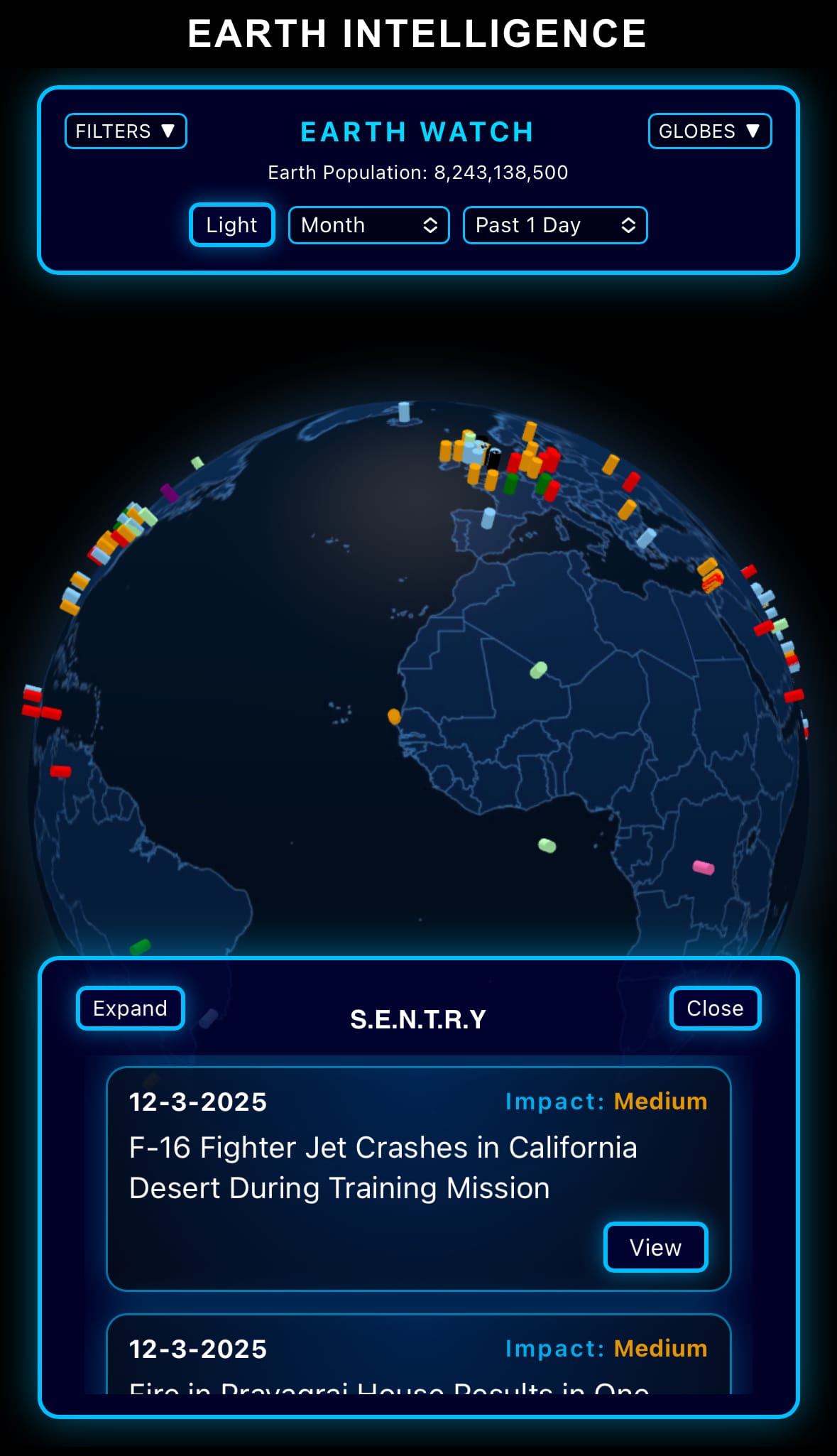
- Click below if you’d like to view our free EARTH WATCH globe:
- Download our mobile app:



Click below to view our previous newsletters:

Support/Suggestions Email:
earthintelligence@earthintel.news