Friday


Trending:
- As of March 20, 2026, a massive fire erupted at the Anjun Industrial auto parts plant in Daejeon, South Korea, around 1:17 p.m. local time, while about 170 workers were on site, many resting in a second-floor break room during lunch. The facility supplies engine valves to Hyundai Motor and Kia.
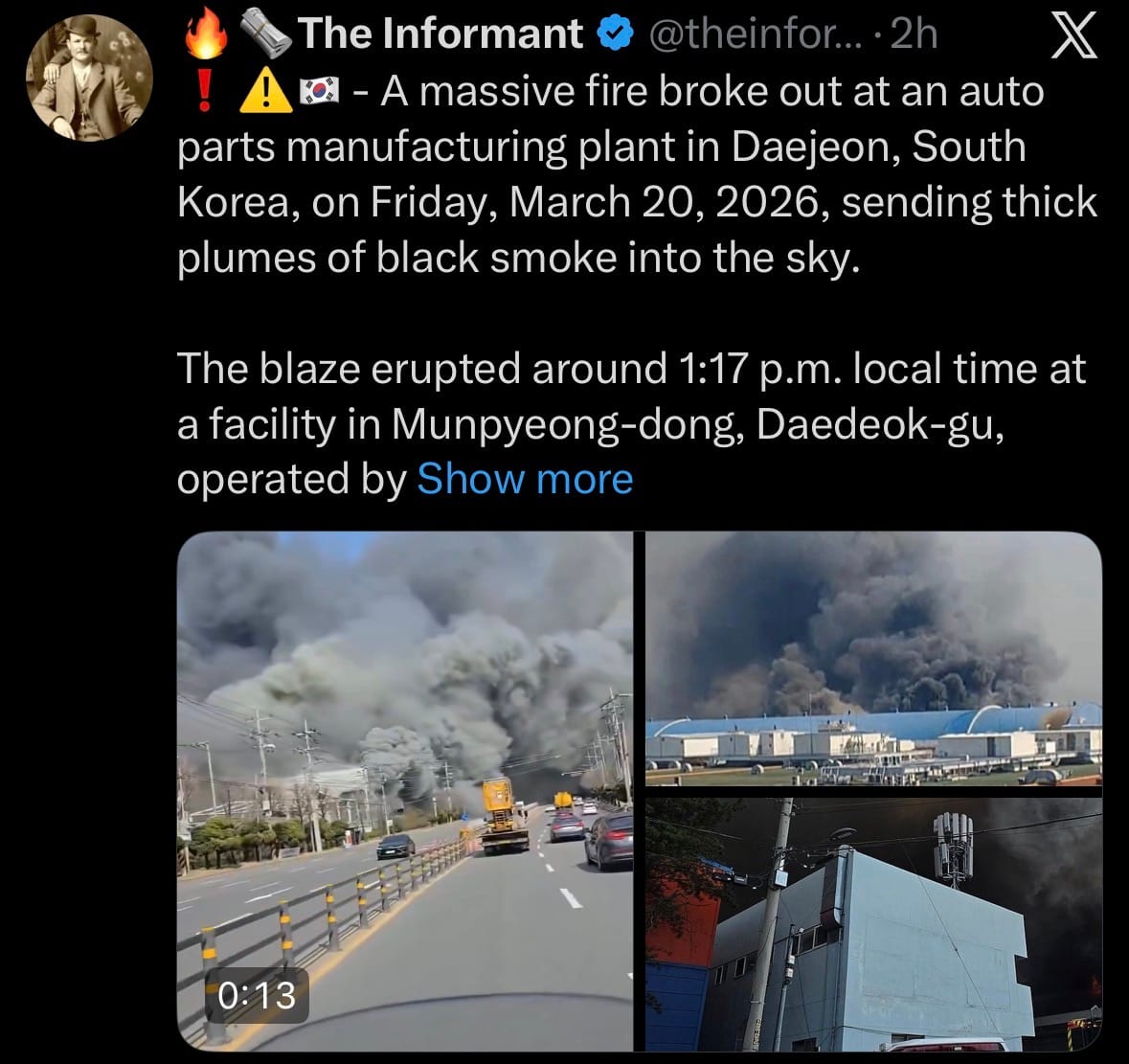
- South Korea’s National Fire Agency reports at least 55 people injured—24 seriously, mainly from smoke inhalation, burns, or injuries during escape, including jumps from the building—and 14 workers still unaccounted for, with rescue teams using phone tracking to search the site; one person was found in cardiac arrest earlier. Over 240 firefighters and dozens of vehicles were deployed in a national emergency response to fight the blaze, which sent thick black smoke high into the sky.
Geopolitics & Military Activity:
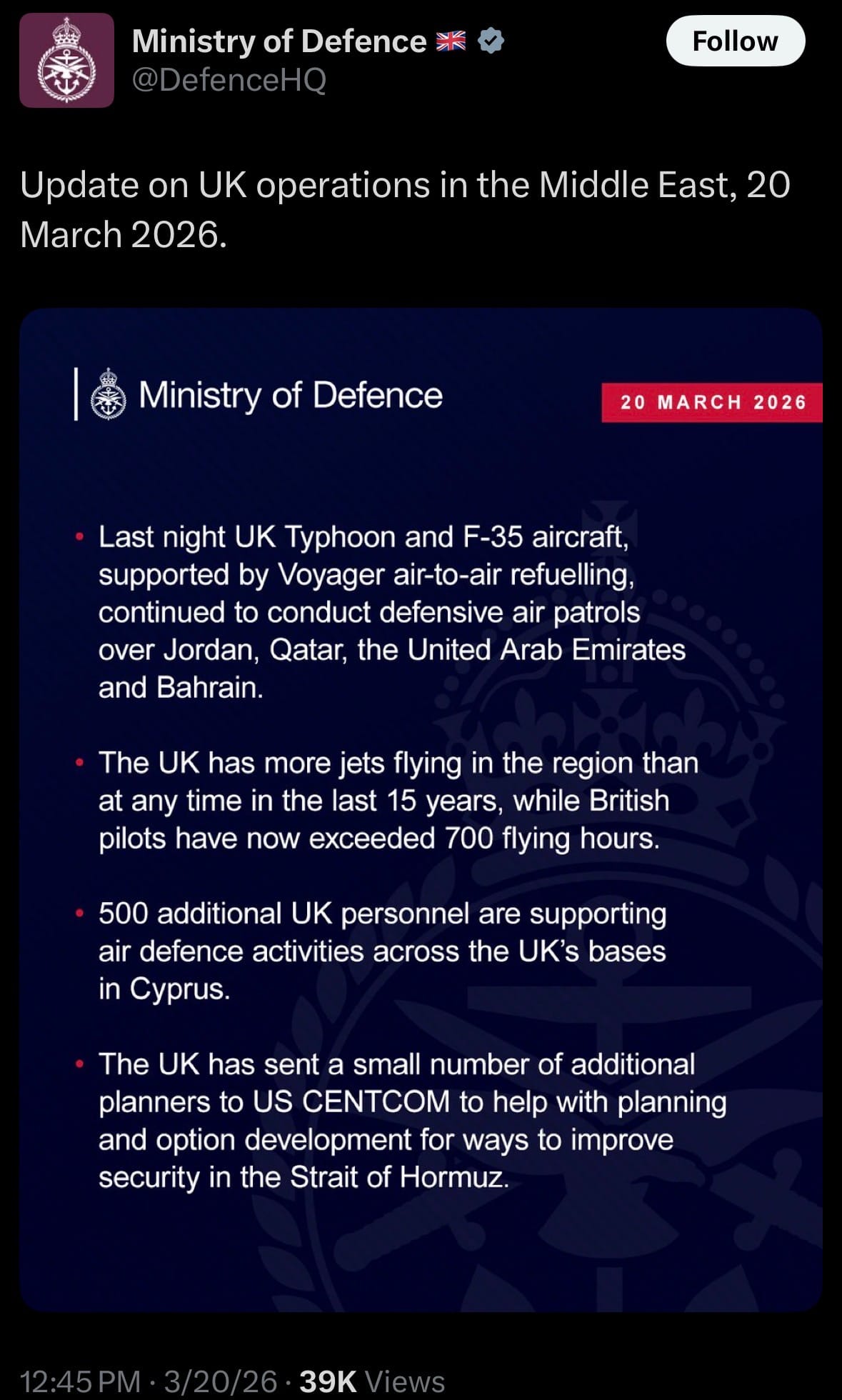
- As of March 20, 2026, Iran launched multiple waves of ballistic missile and drone attacks on Israel today (day 21 of the U.S.-Israel-Iran war), including strikes using cluster munitions that caused significant damage in central Israel, northern areas like Haifa (hitting an oil refinery with limited reported impact), Rehovot (two homes struck), Jerusalem's Old City (shrapnel injuries), and other sites in Tel Aviv and surrounding regions. The IDF reported intercepting most projectiles, but fragments and direct hits led to civilian injuries, structural damage, and ongoing rescue operations; at least a few deaths and dozens of injuries were confirmed across the barrages, with sirens sounding repeatedly nationwide.

- These attacks are part of Iran's continued retaliation for U.S. and Israeli strikes on Iranian targets (including recent hits on gas fields and military sites), amid escalating regional hostilities that also saw Iran strike Gulf energy infrastructure. No major new casualties or breakthroughs were reported from today's salvos compared to earlier waves, but the strikes underscore Iran's persistent missile capabilities despite heavy degradation from coalition operations. Hostilities show no signs of de-escalation, with Israel conducting counter-strikes on Iran and no ceasefire prospects in sight.


Environment & Weather:
- As of March 20, 2026, catastrophic flash flooding has hit Waialua and Haleiwa on Oahu’s North Shore, Hawaii, triggering an urgent evacuation order from the Honolulu Department of Emergency Management. Heavy rain and dangerously high water levels at Wahiawa Dam (nearly 84 feet at the spillway) have destroyed homes, flooded roads, and isolated areas, creating life-threatening conditions.
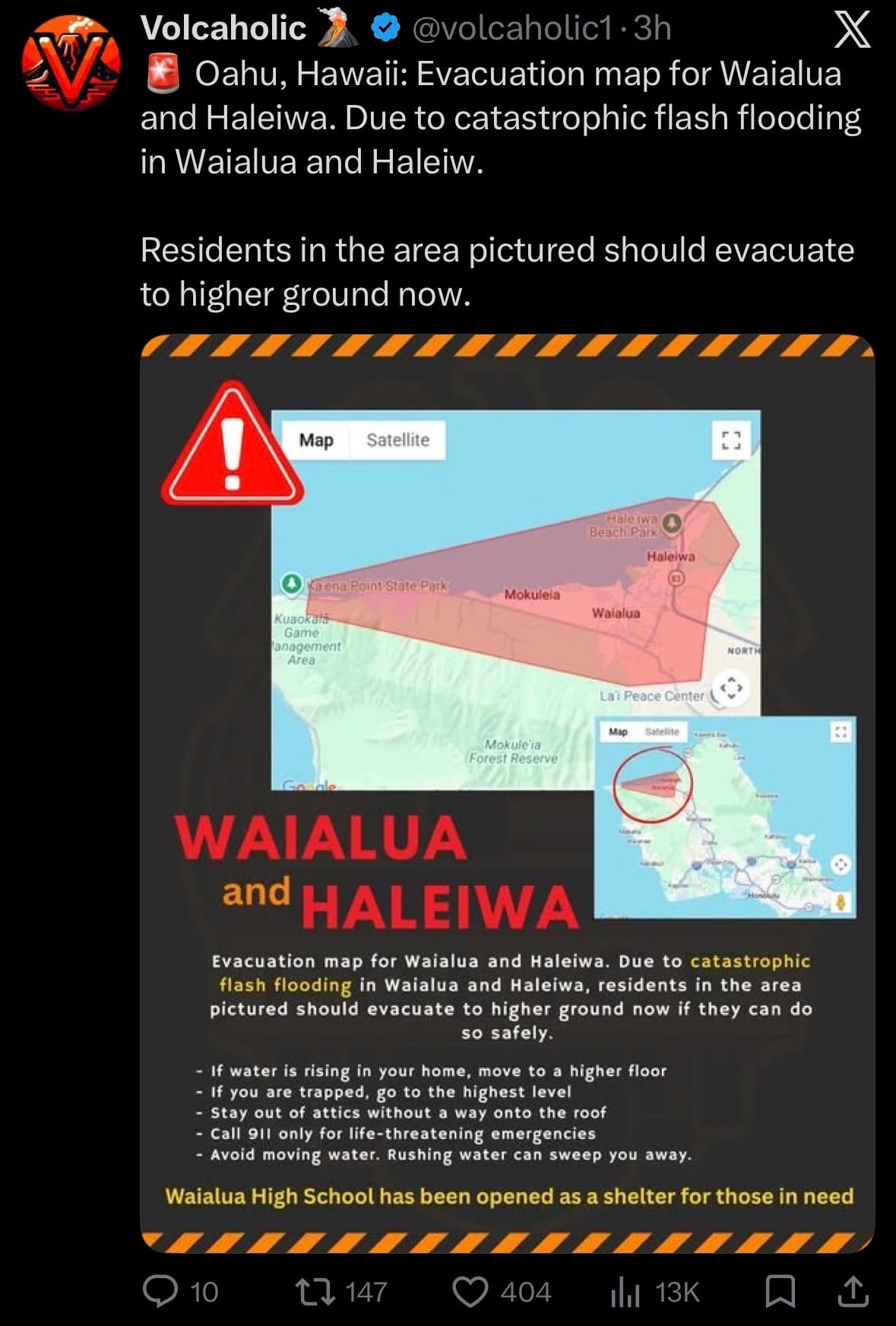
- Residents in affected zones—Haleiwa from Puuiki Street to Kamehameha Highway and Waialua from Kukea Circle to Otake Camp—must evacuate to higher ground immediately if safe; use Kaukonahua Road or Leong Bypass, and head to the shelter at Waialua High and Intermediate School if needed. Sirens are active, a flash flood emergency remains in effect, and risks continue from runoff even as rain slows.
Statistic:
- Largest assets on Earth by market capitalization:
- Gold: $31.344T
- 🇺🇸 NVIDIA: $4.198T
- Silver: $3.841T
- 🇺🇸 Apple: $3.646T
- 🇺🇸 Alphabet (Google): $3.605T
- 🇺🇸 Microsoft: $2.837T
- 🇺🇸 Amazon: $2.209T
- 🇸🇦 Saudi Aramco: $1.743T
- 🇹🇼 TSMC: $1.693T
- 🇺🇸 Meta Platforms: $1.492T
- 🇺🇸 Broadcom: $1.480T
- Bitcoin: $1.396T
- 🇺🇸 Tesla: $1.374T
- 🇺🇸 Berkshire Hathaway: $1.042T
- 🇺🇸 Walmart: $957.40B
- 🇰🇷 Samsung: $885.61B
- Vanguard S&P 500 ETF (VOO): $825.27B
- 🇺🇸 Eli Lilly: $806.12B
- 🇺🇸 JPMorgan Chase: $774.04B
- 🇺🇸 Exxon Mobil: $669.03B
- iShares Core S&P 500 ETF (IVV): $663.82B
- SPDR S&P 500 ETF (SPY): $650.04B
- 🇺🇸 Visa: $580.20B
- 🇨🇳 Tencent: $573.29B
- 🇺🇸 Johnson & Johnson: $566.37B
History:
- The history of data centers begins with the earliest days of computing, when machines were massive, centralized, and physically secured. In the 1940s–1960s, early computers like ENIAC (1945) and mainframe systems from companies such as IBM required entire rooms with controlled environments, power supply, and cooling. These early facilities were essentially the first data centers—centralized locations where computation and data storage were physically managed. By the 1960s and 1970s, governments, banks, and large corporations built dedicated computing centers to process financial records, census data, and military calculations. As computing demand grew, so did the need for reliable infrastructure: backup power, cooling systems, and network connectivity. The 1980s and 1990s introduced client-server computing and the early internet, which expanded the role of data centers from internal processing hubs to networked systems supporting digital communication and enterprise applications. Companies began building larger, more distributed facilities, and colocation providers emerged to host servers for multiple clients in shared environments.
- The modern data center era began in the 2000s with the rise of cloud computing and hyperscale infrastructure. Technology companies such as Amazon (AWS launched in 2006), Google, Microsoft, and later Meta began building massive data centers designed to handle global internet traffic, search, storage, and application hosting. These facilities—known as hyperscale data centers—contain hundreds of thousands of servers and are engineered for extreme efficiency, redundancy, and scalability. They are connected by high-speed fiber optic networks and strategically located near major internet exchange points and energy sources. By the 2010s, data centers had become the backbone of the digital economy, supporting everything from social media and streaming to financial systems and global communications. The largest players in this space today include Amazon Web Services (AWS), Microsoft Azure, Google Cloud, Meta, and Oracle, all of which operate global networks of data centers spanning North America, Europe, Asia, and beyond. These companies compete on compute capacity, storage, network speed, and increasingly on energy efficiency and sustainability.
- Today, data centers are evolving into AI-focused processing hubs, often described as the “brains” of modern digital infrastructure. AI workloads—especially large-scale machine learning and generative AI—require enormous computational power, driven by specialized hardware such as GPUs and custom AI accelerators. This has led to the development of AI data centers, which consume significantly more power and require advanced cooling solutions such as liquid cooling and high-density rack systems. These facilities are becoming some of the largest power consumers in certain regions, reshaping energy demand and infrastructure planning. Companies like NVIDIA (for AI chips), along with AWS, Microsoft, Google, and Meta, are building and operating these next-generation centers to support AI training and inference at global scale. The future points toward even more advanced systems, including edge data centers closer to users for low-latency processing, and potential integration with emerging technologies like quantum computing. From early room-sized computers to massive AI-driven compute clusters, data centers have evolved into the core processing layer of modern civilization—where data is stored, analyzed, and transformed into the intelligence that powers economies, governments, and global systems.
Image of the day:

Thanks for reading! Earth is complicated, we make it simple.
- Click below if you’d like to view our free EARTH WATCH globe:
- Download our mobile app:



Click below to view our previous newsletters:

Support/Suggestions Email:
support@earthintel.io