Friday☕️


Trending:
- As of March 26, 2026, the Pentagon announced major new framework agreements with defense contractors to significantly increase U.S. missile production and place the defense industrial base on a wartime footing due to stockpiles depleted by the Iran conflict.
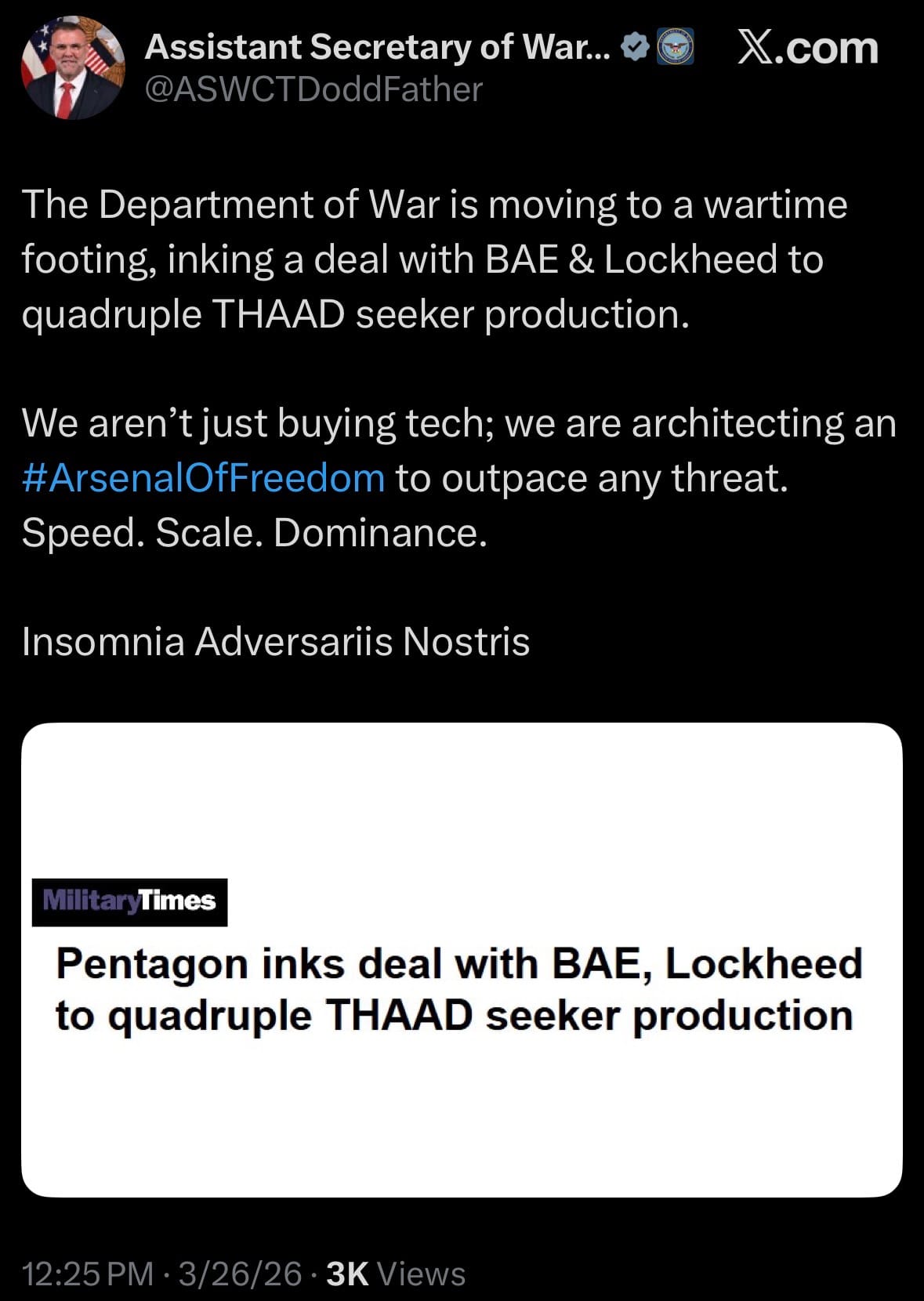
- The deals involve Lockheed Martin accelerating production of the Precision Strike Missile (PrSM), partnering with BAE Systems to quadruple THAAD interceptor seeker output, and Honeywell Aerospace surging production of critical munitions components (including navigation systems, steering actuators, and electronic warfare products) under a $500 million multi-year investment. These efforts build on previous ramps for Patriot PAC-3 and SM-6 missiles.
Economics & Markets:
- Yesterday’s U.S. stock market:

- Yesterday’s commodity market:

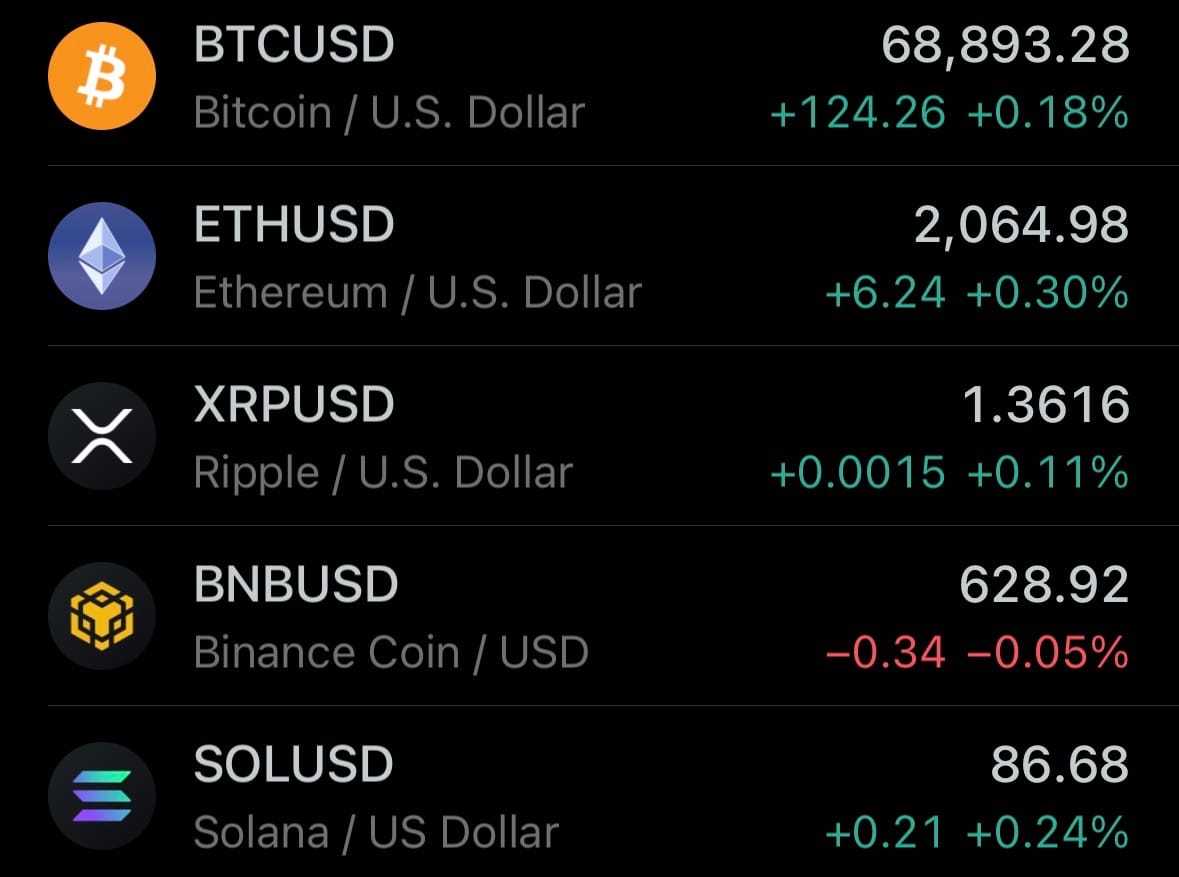
- Yesterday’s crypto market:
Geopolitics & Military Activity:
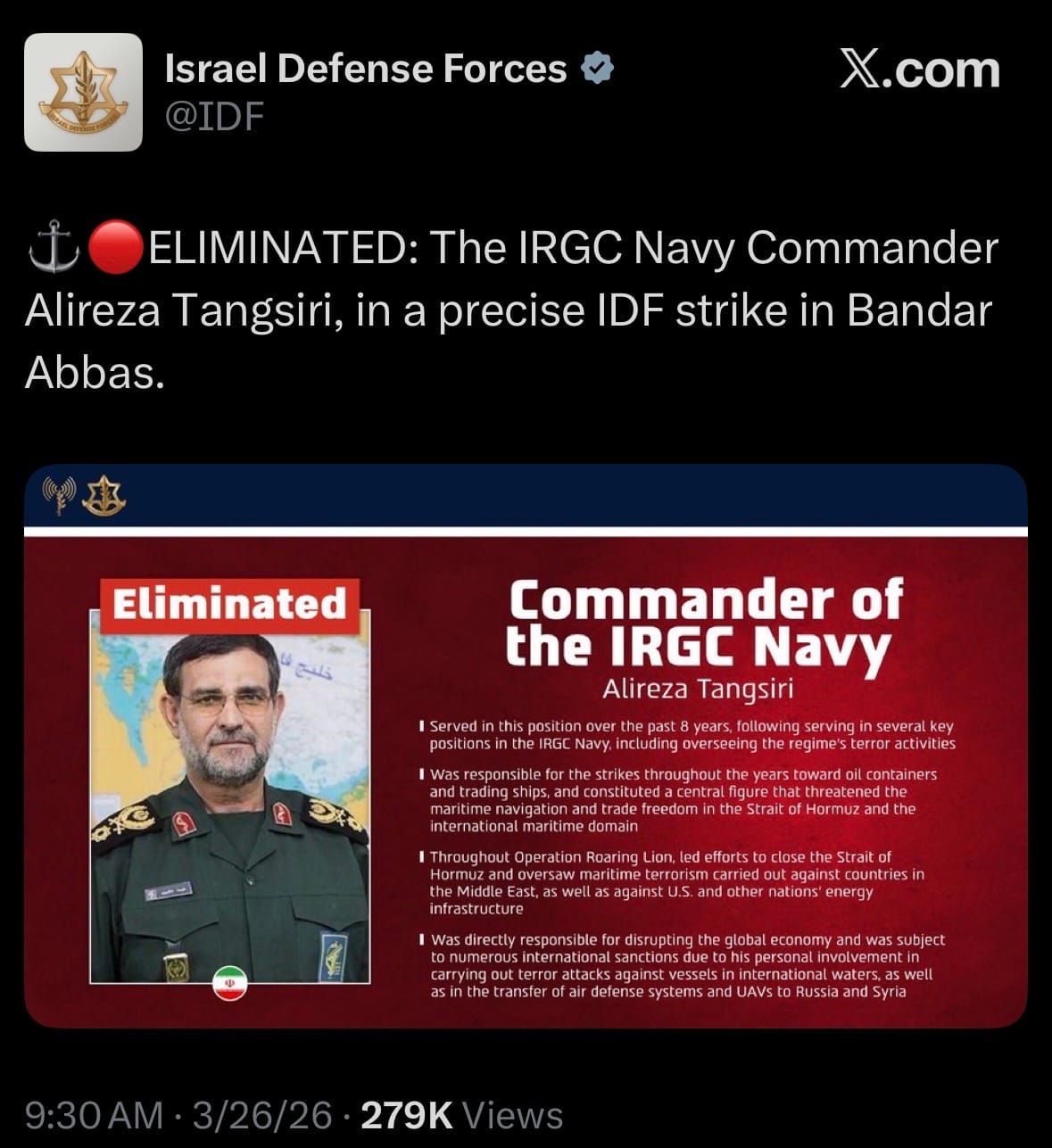
- As of March 26, 2026, Iran rejected the latest U.S. ceasefire proposal, calling it unfair and one-sided while demanding war reparations and formal U.S. recognition of Iranian control over the Strait of Hormuz.
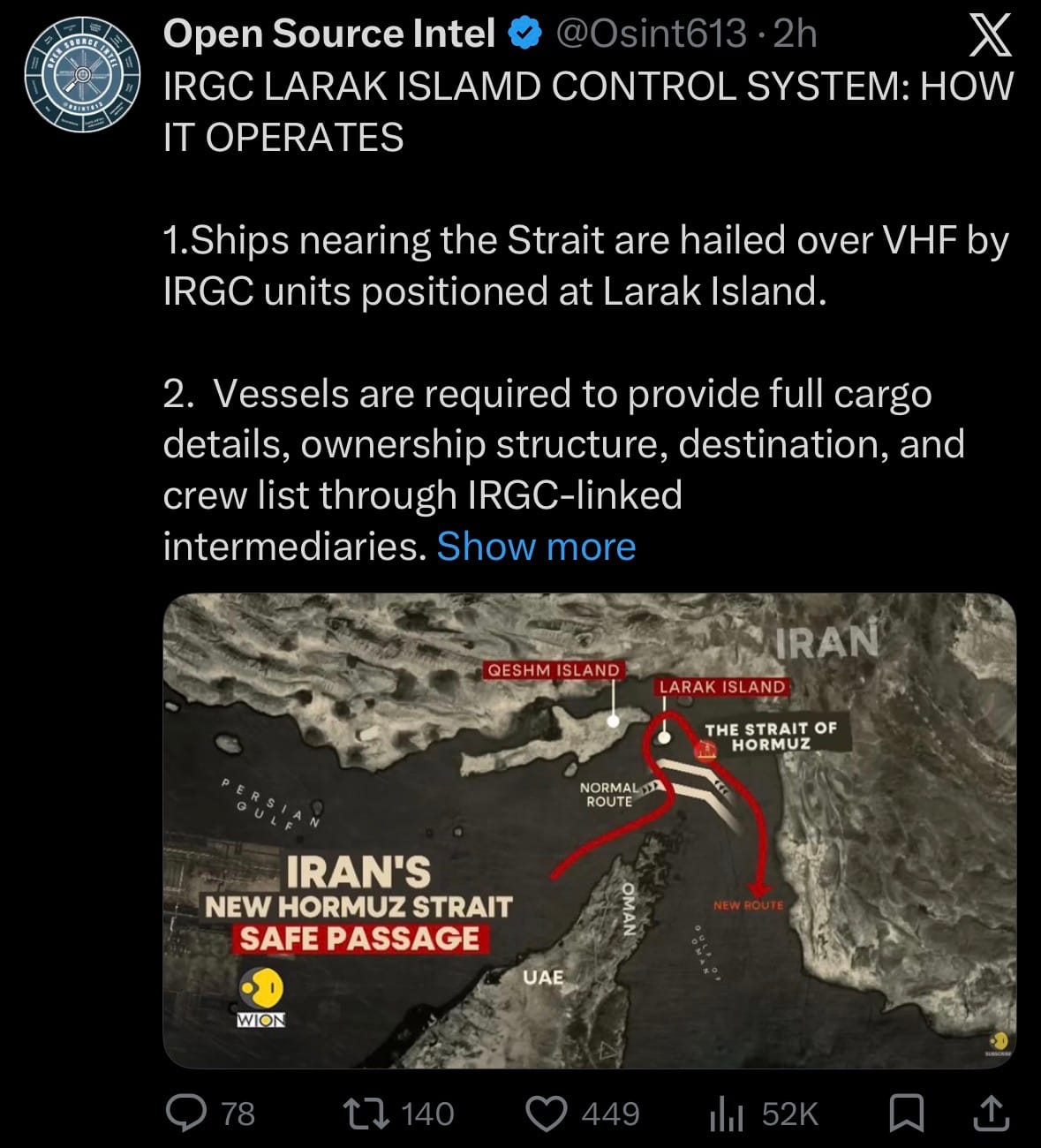
- Iran is now enforcing a de facto checkpoint in the strait near Larak Island, forcing ships into its territorial waters for inspections, political screening, and transit fees of up to $2 million, allowing only “non-hostile” vessels to pass while blocking or threatening others.
Science & Technology:
- On March 26, 2026, Shield AI announced it will acquire Aechelon Technology and raise $2 billion in new funding at a $12.7 billion valuation.
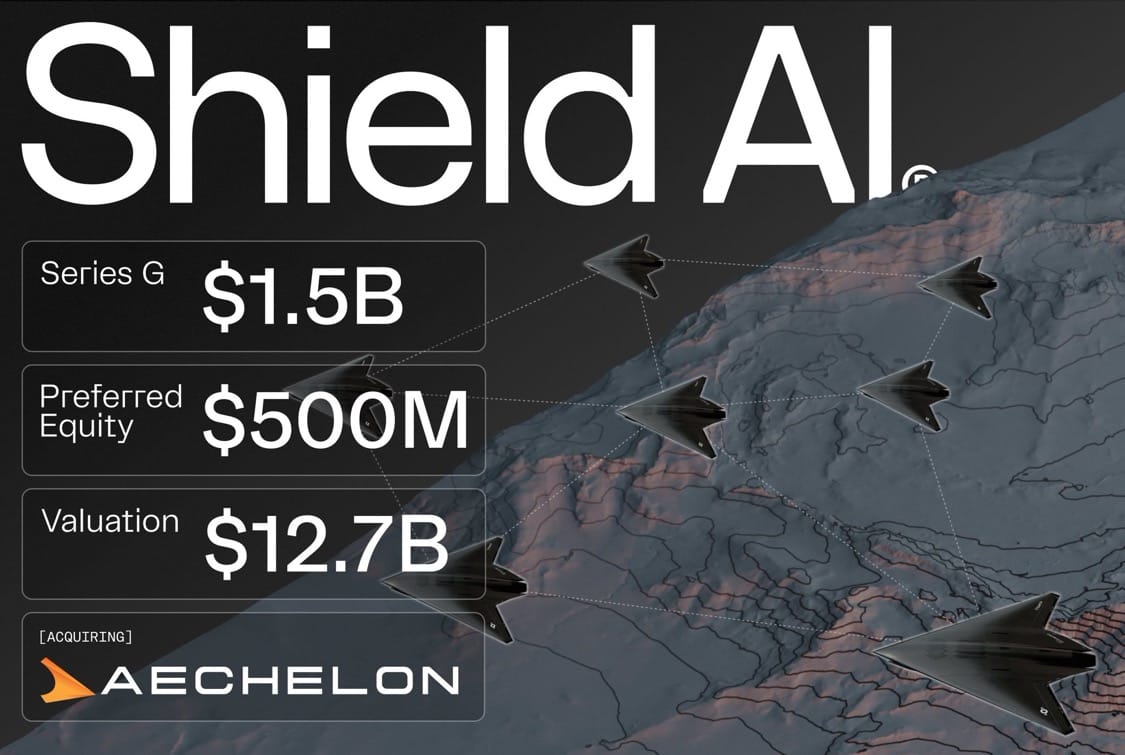
- The acquisition combines Shield AI’s Hivemind autonomy software with Aechelon’s advanced simulation technology, allowing defense systems to be designed in software, trained in highly realistic virtual environments, and continuously improved in real-world operations.
Space:
- On March 26, 2026, SpaceX successfully launched Starlink Group 17-17, deploying 25 Starlink V2 Mini satellites to low-Earth orbit using a Falcon 9 rocket from Space Launch Complex 4 East (SLC-4E) at Vandenberg Space Force Base in California.
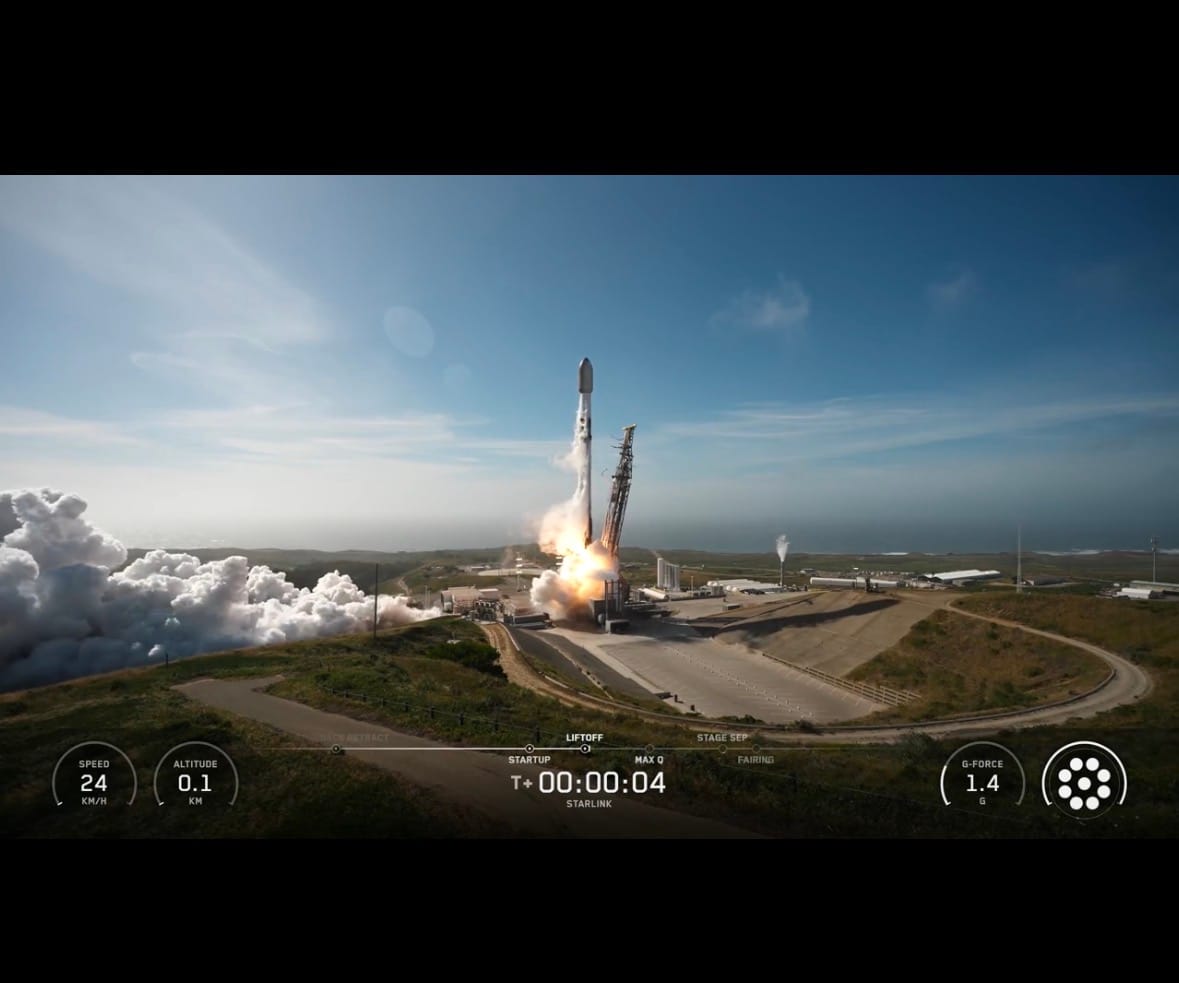
- The mission lifted off in the afternoon PDT, with the first-stage booster landing successfully on the droneship "Of Course I Still Love You" in the Pacific Ocean. This launch further expands the Starlink constellation for global broadband coverage.
Statistic:
- Largest public shipping companies by market capitalization:
- 🇩🇰 Maersk: $36.79B
- 🇨🇳 COSCO Shipping: $33.81B
- 🇩🇪 Hapag-Lloyd: $26.62B
- 🇨🇳 COSCO Shipping Energy: $18.90B
- 🇯🇵 Mitsui O.S.K. Lines: $14.75B
- 🇯🇵 Nippon Yūsen: $14.73B
- 🇹🇼 Evergreen Marine: $13.75B
- 🇰🇷 HMM: $12.39B
- 🇭🇰 Orient Overseas Container Line: $12.06B
- 🇭🇰 SITC International: $11.53B
- 🇯🇵 “K” Line: $10.65B
- 🇲🇾 MISC Berhad: $9.30B
- 🇭🇰 China Merchants Port: $8.46B
- 🇧🇲 Frontline: $7.47B
- 🇺🇸 Kirby Corporation: $7.30B
- 🇹🇼 Wan Hai Lines: $6.54B
- 🇶🇦 Qatar Gas Transport Company: $6.20B
- 🇹🇼 Yang Ming: $5.74B
- 🇳🇴 Wallenius Wilhelmsen: $5.28B
- 🇺🇸 Seaboard Corporation: $5.20B
- 🇺🇸 Matson: $5.08B
- 🇸🇦 National Shipping Company of Saudi Arabia (Bahri): $4.23B
- 🇺🇸 Tidewater: $4.00B
- 🇴🇲 Asyad Shipping Company: $3.95B
- 🇲🇨 Scorpio Tankers: $3.82B
History:
- The history of AIS (Automatic Identification System) and maritime transponders begins with the need to track ships in increasingly crowded and complex sea lanes. Before modern systems, ship tracking relied on radio communication, radar, and manual reporting, which were limited, delayed, and often unreliable over long distances. In response to growing maritime traffic and several major collisions, the International Maritime Organization (IMO) began developing a standardized tracking system in the late 20th century. AIS was formally adopted in the early 2000s, becoming mandatory under the SOLAS (Safety of Life at Sea) Convention in 2004 for most large commercial vessels. AIS transponders automatically broadcast key information—such as a ship’s identity, position (via GPS), speed, heading, and destination—to nearby ships, coastal stations, and satellites. This created a real-time, global maritime tracking system that dramatically improved navigation safety, collision avoidance, and port management. Over time, AIS data also became a critical tool for governments, intelligence agencies, and commercial platforms to monitor global shipping activity.
- As AIS became universal, it also created a new reality: ships were now constantly visible, which introduced both transparency and vulnerability. This led to the emergence of methods to manipulate or evade tracking. One of the most important developments is the concept of “dark shipping”, where vessels intentionally turn off their AIS transponders to avoid detection. This practice is often associated with sanctions evasion, illegal fishing, smuggling, or covert logistics. A more advanced evolution is the rise of “ghost fleets”—groups of vessels that operate outside normal regulatory frameworks, often using tactics such as flag switching (re-registering ships under different countries), spoofing AIS signals (broadcasting false locations), conducting ship-to-ship transfers at sea, and operating with minimal or falsified documentation. These fleets are commonly linked to sanctioned oil trade and other restricted activities, where ships may disable tracking systems while transferring cargo in remote areas, then reappear under different identities or routes. Because AIS is not encrypted and relies on self-reported data, it can be manipulated by actors with sufficient technical knowledge.
- Today, AIS and maritime transponders are part of a larger global maritime surveillance system that includes satellite AIS (S-AIS), radar satellites, and intelligence monitoring platforms. Major maritime powers—including the United States, China, European nations, and others—use a combination of AIS data and independent sensing technologies to track shipping activity worldwide. However, ghost fleets continue to exploit gaps in the system, operating in areas with limited surveillance or using deception techniques to mask their movements. These fleets play a significant role in sanctions evasion, particularly in oil transport, where ships may conduct covert transfers and obscure the origin and destination of cargo. The existence of AIS has made global shipping more transparent than ever, but it has also created a constant cat-and-mouse dynamic between tracking systems and those attempting to evade them. In the modern maritime domain, AIS is both a tool for safety and a battlefield for information control, where visibility, deception, and surveillance intersect across global trade routes.
Image of the day:

Thanks for reading! Earth is complicated, we make it simple.
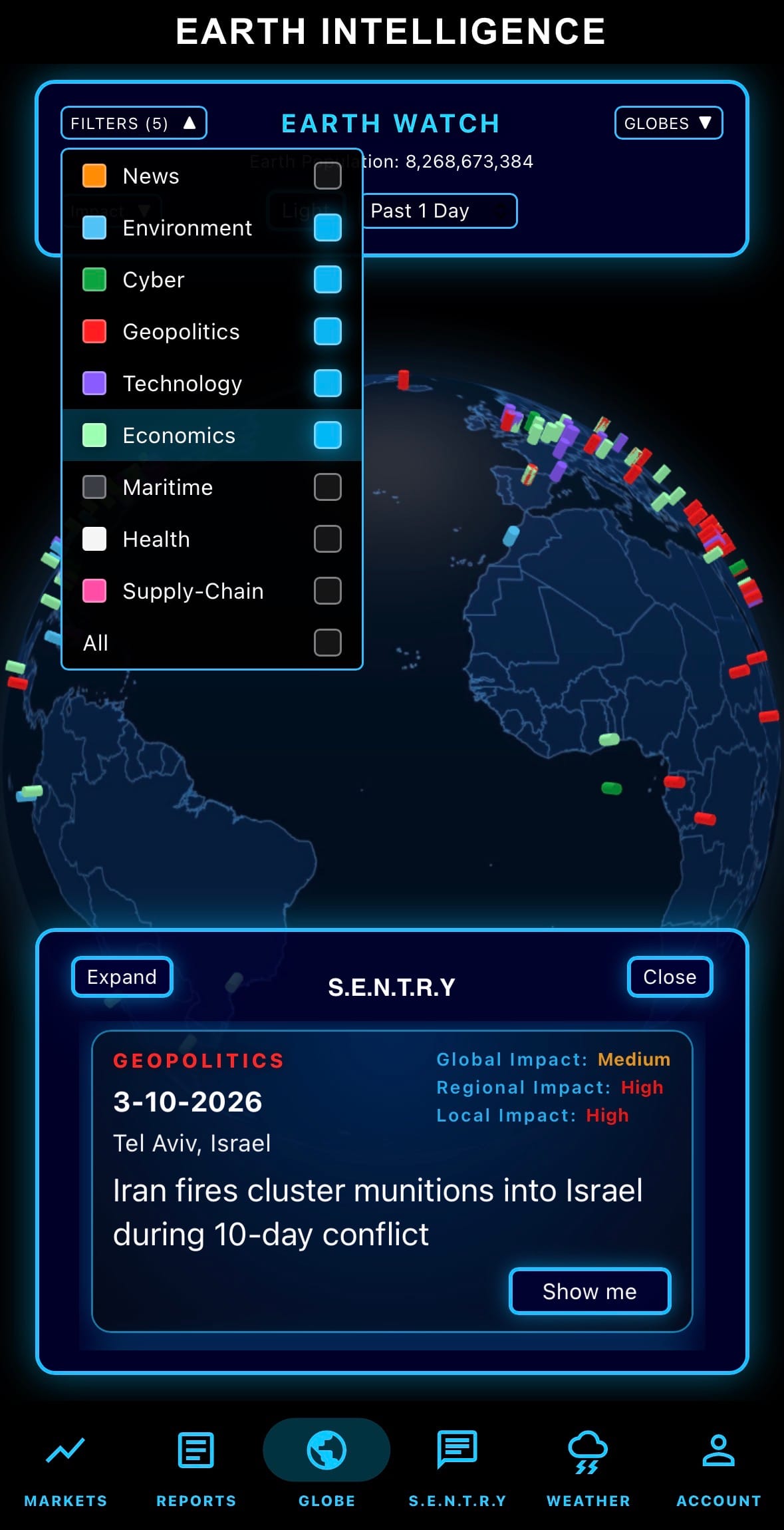
- Click below if you’d like to view our free EARTH WATCH globe:
- Download our mobile app:



Click below to view our previous newsletters:

Support/Suggestions Email:
support@earthintel.io