Friday☕️


Trending:
- On April 2, 2026, the U.S. Department of Justice announced the arrest of eight people in Southern California as part of a major health care fraud takedown, including owners of hospice facilities accused of billing taxpayers millions of dollars.
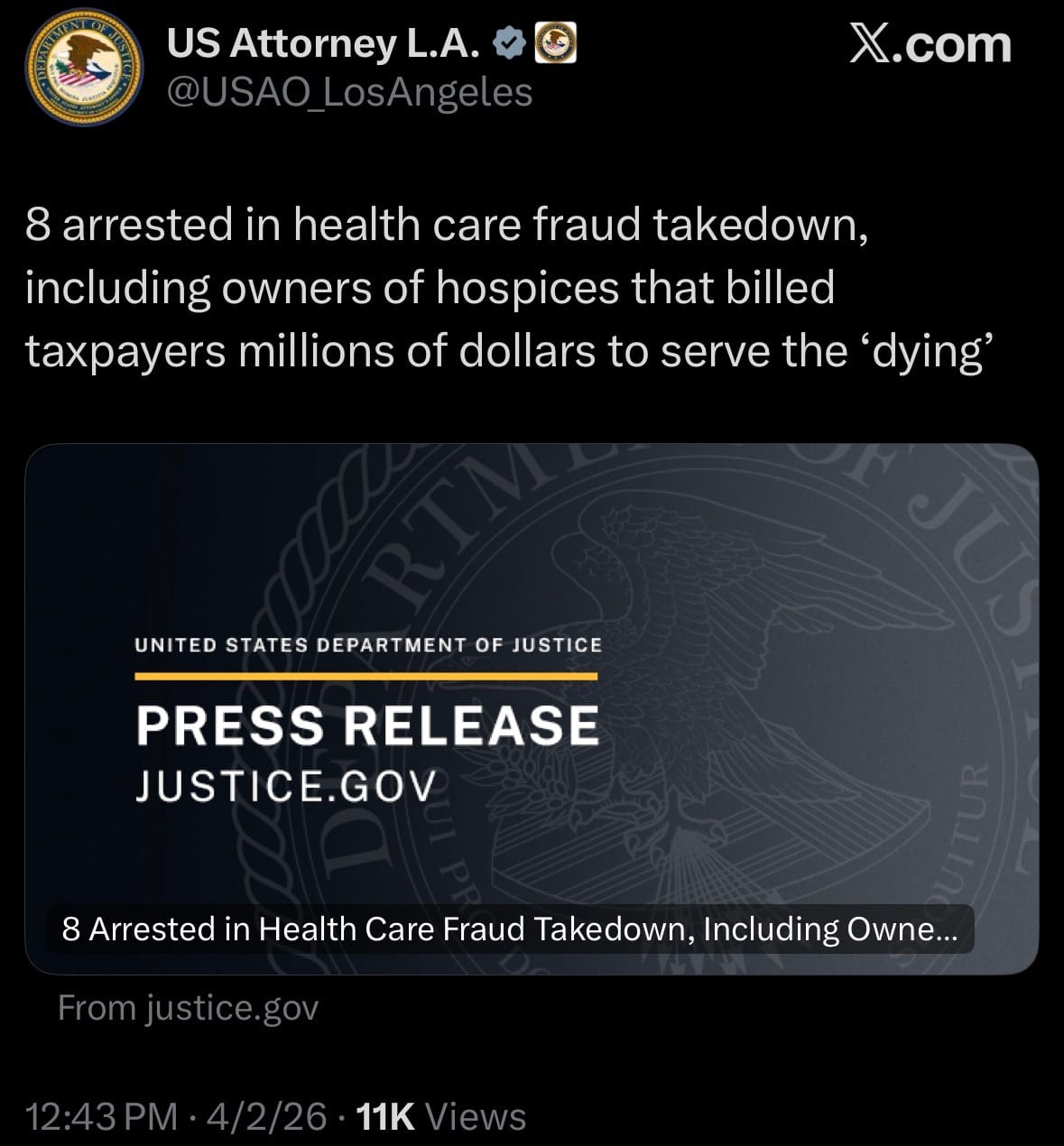
- The defendants — which include three nurses, a chiropractor, and a psychologist — allegedly ran sham hospice operations that defrauded Medicare of more than $50 million by enrolling patients who were not actually terminally ill and claiming they needed end-of-life care; the action was coordinated with the Vice President’s Task Force to Eliminate Fraud and highlights ongoing efforts to crack down on fraudulent hospice schemes that exploit the health care system.

Economics & Markets:
- Yesterday’s U.S. stock market:

- Yesterday’s commodity market:

- Yesterday‘s crypto market:

Geopolitics & Military Activity:
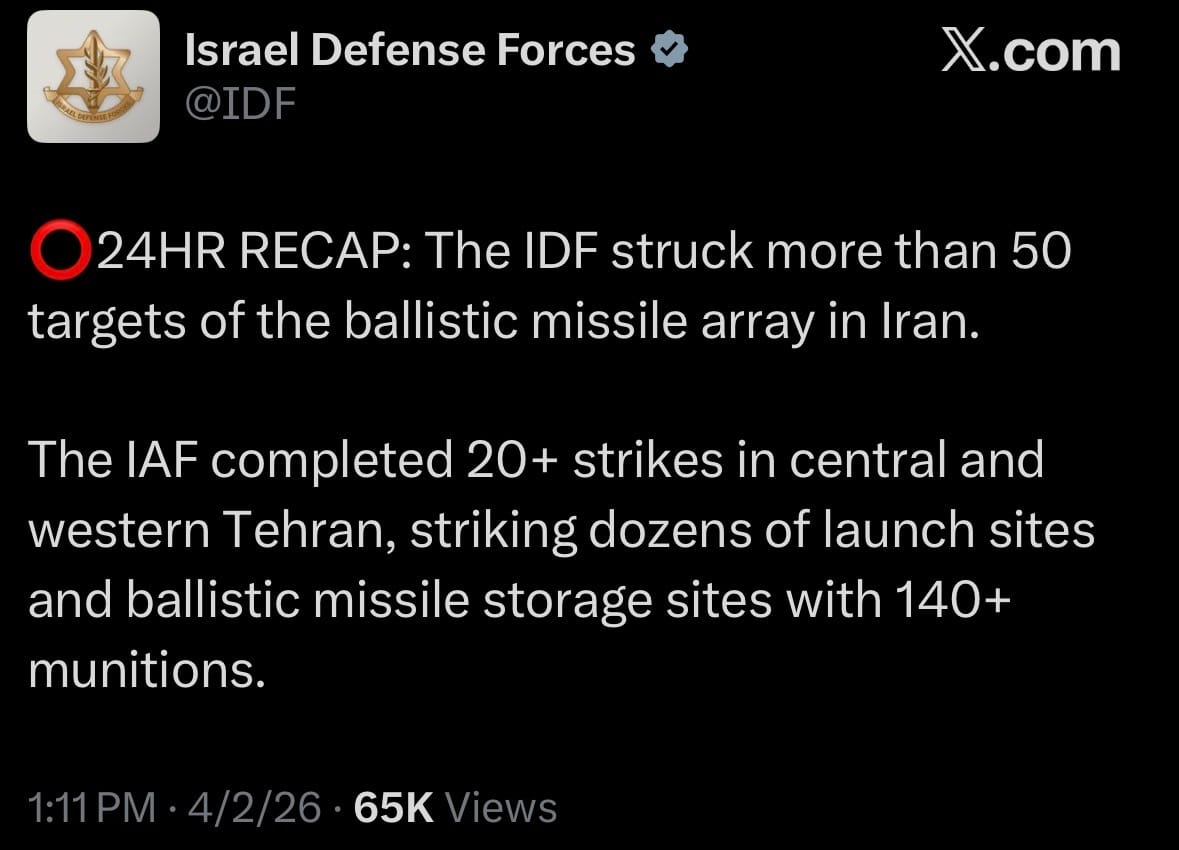
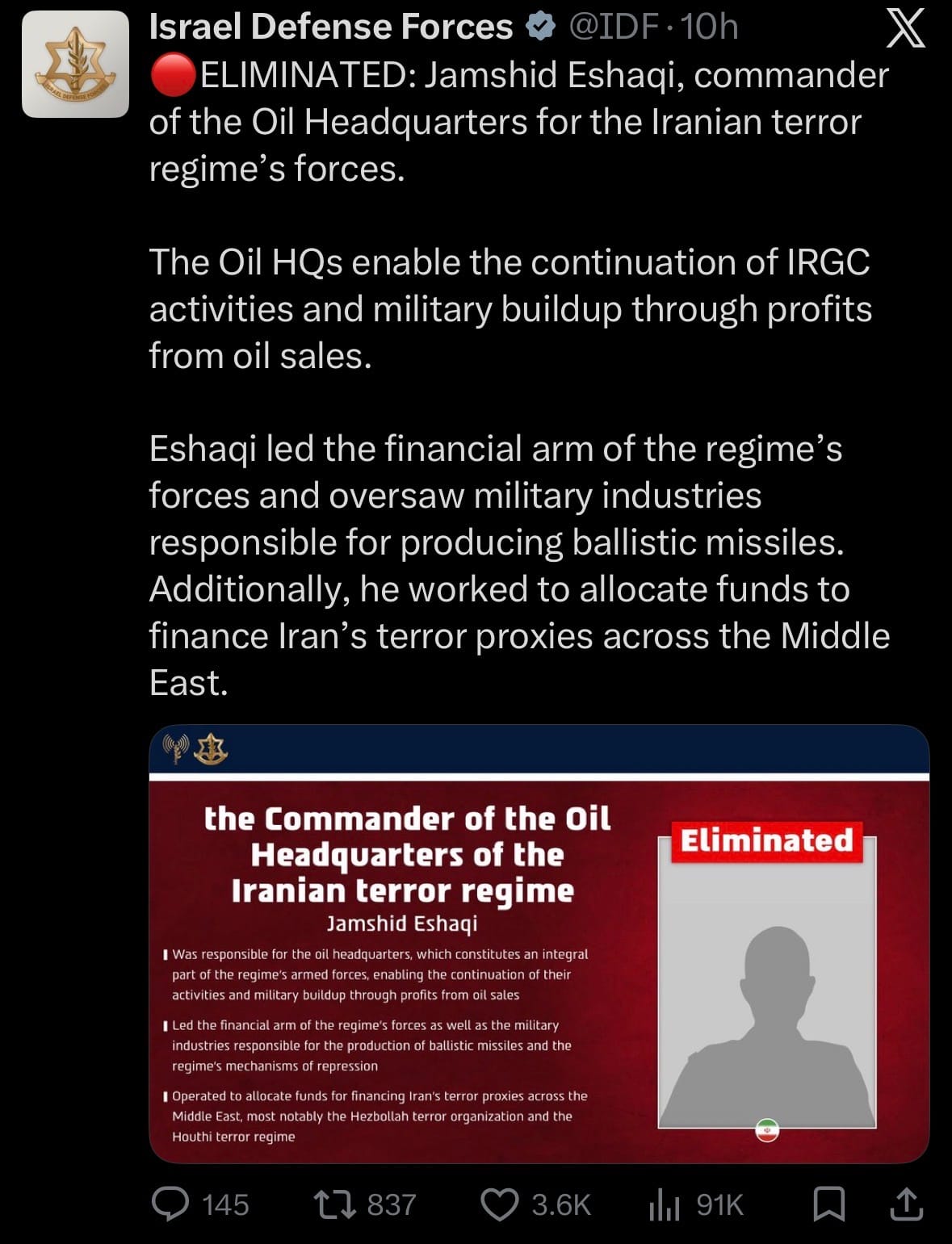
- On April 2, 2026, footage from a U.S. airstrike showed the B-1 Road Bridge in the Iranian city of Karaj partially collapsing after a direct hit from a U.S.-made GBU-31/BLU-109 JDAM bunker-buster bomb, with a large section of the road deck falling.
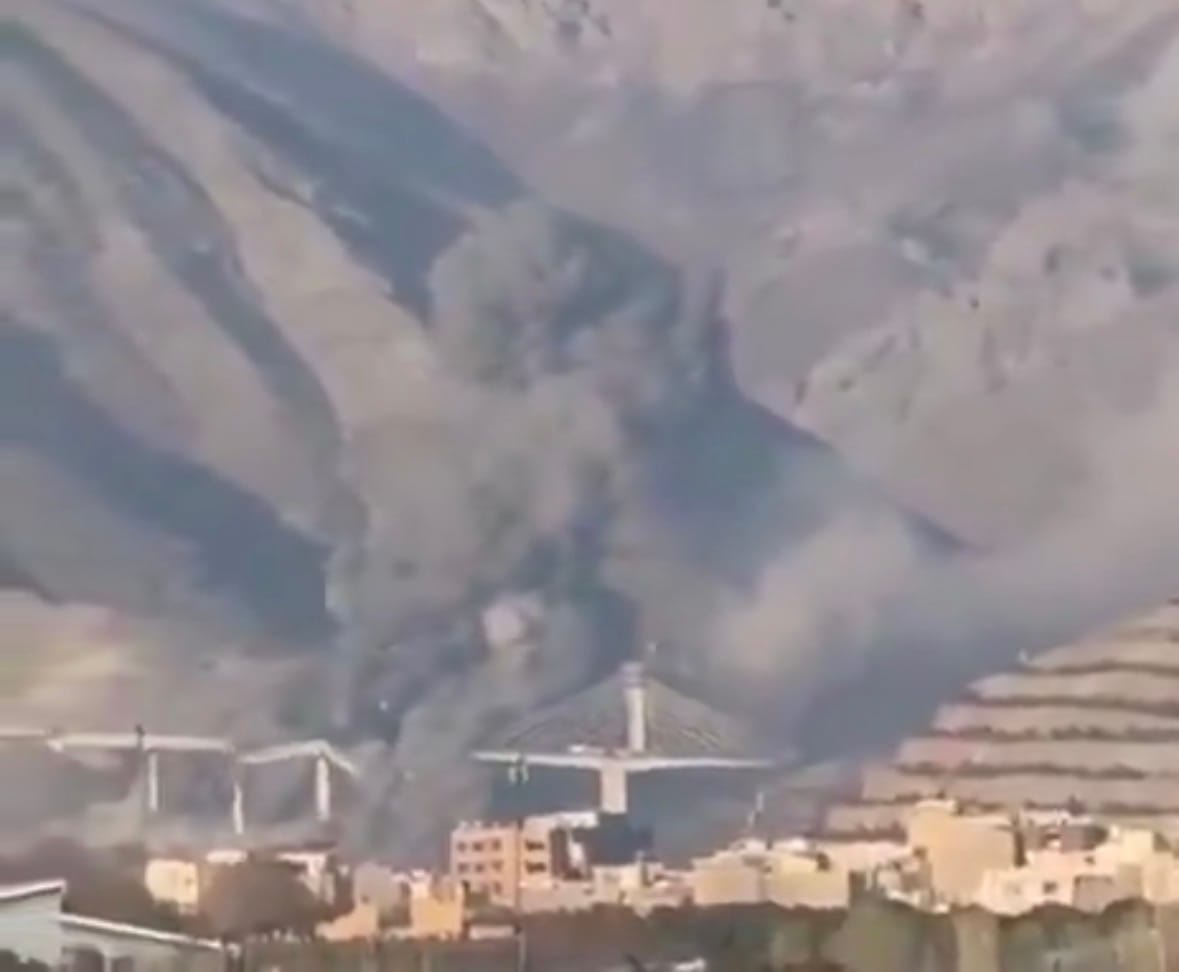
- The bridge, one of the tallest in the Middle East and a key link between Tehran and northern Iran, was struck during ongoing U.S. airstrikes earlier that day. In response, Iranian state media released lists of potential retaliatory targets, including strategic bridges in Kuwait, Bahrain, Saudi Arabia, the UAE (notably several in Abu Dhabi), and Jordan.
Science & Technology:


Space:

Statistic:
- Largest public insurance companies by market capitalization:
- 🇺🇸 UnitedHealth: $251.66B
- 🇩🇪 Allianz SE: $161.46B
- 🇨🇳 Ping An Insurance: $150.98B
- 🇨🇳 China Life Insurance: $149.18B
- 🇨🇭 Chubb: $128.41B
- 🇭🇰 AIA: $115.04B
- 🇺🇸 Progressive: $114.39B
- 🇨🇭 Zurich Insurance Group: $106.73B
- 🇫🇷 AXA: $96.10B
- 🇯🇵 Tokio Marine: $85.67B
- 🇺🇸 Marsh & McLennan: $85.54B
- 🇩🇪 Munich RE: $80.49B
- 🇺🇸 The Cigna Group: $72.12B
- 🇬🇧 Aon: $69.45B
- 🇺🇸 Elevance Health: $66.37B
- 🇺🇸 Travelers: $65.57B
- 🇮🇹 Generali: $61.89B
- 🇨🇦 Manulife Financial: $58.50B
- 🇺🇸 Arthur J. Gallagher & Co.: $55.94B
- 🇺🇸 Allstate: $53.73B
- 🇨🇳 China Pacific Insurance: $53.64B
- 🇮🇳 LIC (Life Insurance Corporation of India): $49.98B
- 🇧🇪 KBC: $48.95B
- 🇨🇭 Swiss Re: $48.84B
- 🇨🇳 PICC (People’s Insurance Company): $47.59B
History:
- The history of counter-drone systems developed as a direct response to the rise of drones in warfare. Early countermeasures were not specialized—during the late 20th century, drones were rare and expensive, so traditional systems like radar, anti-aircraft guns, and missiles were used if needed. In the 1990s–early 2000s, platforms like the MQ-1 Predator appeared, but there was still little dedicated counter-drone infrastructure because only advanced militaries operated them. The shift came in the 2010s, when drones became cheap, commercial, and widely available, allowing non-state actors and smaller forces to use them for surveillance, targeting, and attacks. This exposed a major gap: small drones were hard to detect, flew low, and could bypass traditional air defenses. Conflicts in Iraq and Syria were among the first where dedicated counter-drone systems were deployed to protect bases from improvised drone threats.
- From the mid-2010s onward, counter-drone systems evolved into three core layers: detection, identification, and neutralization. Detection includes specialized radar for small objects, RF (radio frequency) scanners to detect control signals, and electro-optical/infrared cameras. Neutralization splits into non-kinetic and kinetic methods. Non-kinetic systems include jamming (blocking control signals), GPS spoofing (misdirecting drones), and cyber takeover tools. Kinetic systems include anti-drone missiles, rapid-fire guns, and directed energy weapons like high-powered lasers. Countries leading early development include the United States, Israel, and European nations, with deployments expanding rapidly as drone threats increased. These systems became standard for protecting military bases, airports, and critical infrastructure.
- Today, counter-drone systems are a core part of modern warfare due to the rise of drone swarms and loitering munitions, especially seen in conflicts like Ukraine. Modern systems are fully integrated, combining sensors, AI, and automated responses into unified platforms. Major developers include Anduril (Lattice system), Raytheon, Lockheed Martin, Rafael (Israel), and others. New capabilities include autonomous interceptor drones, high-energy lasers, and electronic warfare systems designed to handle multiple drones simultaneously. The leading countries in this space are the United States and Israel, with rapid growth from China and Turkey. The focus has shifted from stopping single drones to defeating large-scale, coordinated drone attacks, making counter-drone systems one of the fastest-growing and most critical areas in modern defense.
Image of the day:

Thanks for reading! Earth is complicated, we make it simple.
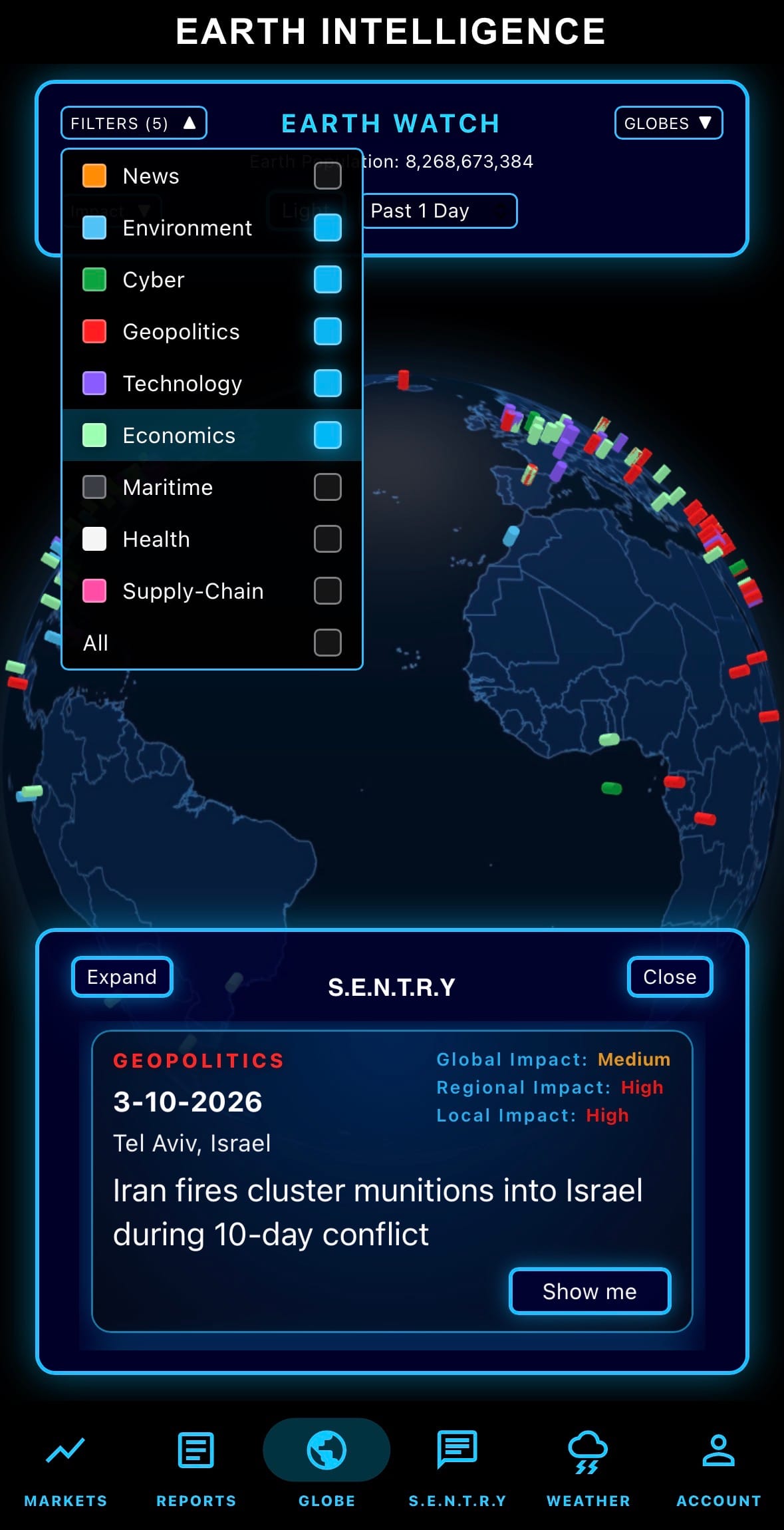
- Click below if you’d like to view our free EARTH WATCH globe:
- Download our mobile app:




Click below to view our previous newsletters:

Support/Suggestions Email:
support@earthintel.io