Monday☕️


Trending:
- On November 15, 2025, thousands of protesters gathered in Mexico City to demonstrate against rising violent crime, government corruption, and alleged ties between officials and drug cartels, leading to clashes with riot police near the National Palace. Demonstrators, inspired by a Gen-Z-led movement that began online, tore down security fences, threw rocks and fireworks, and attempted to storm the palace gates, prompting authorities to deploy tear gas and water cannons in response. At least 120 people were injured, including protesters, police officers, and journalists, with unrest spreading to other areas like Guadalajara and Monterrey, where similar rallies highlighted frustration over unchecked cartel violence and recent high-profile incidents, such as the murder of a mayor in Guerrero state.
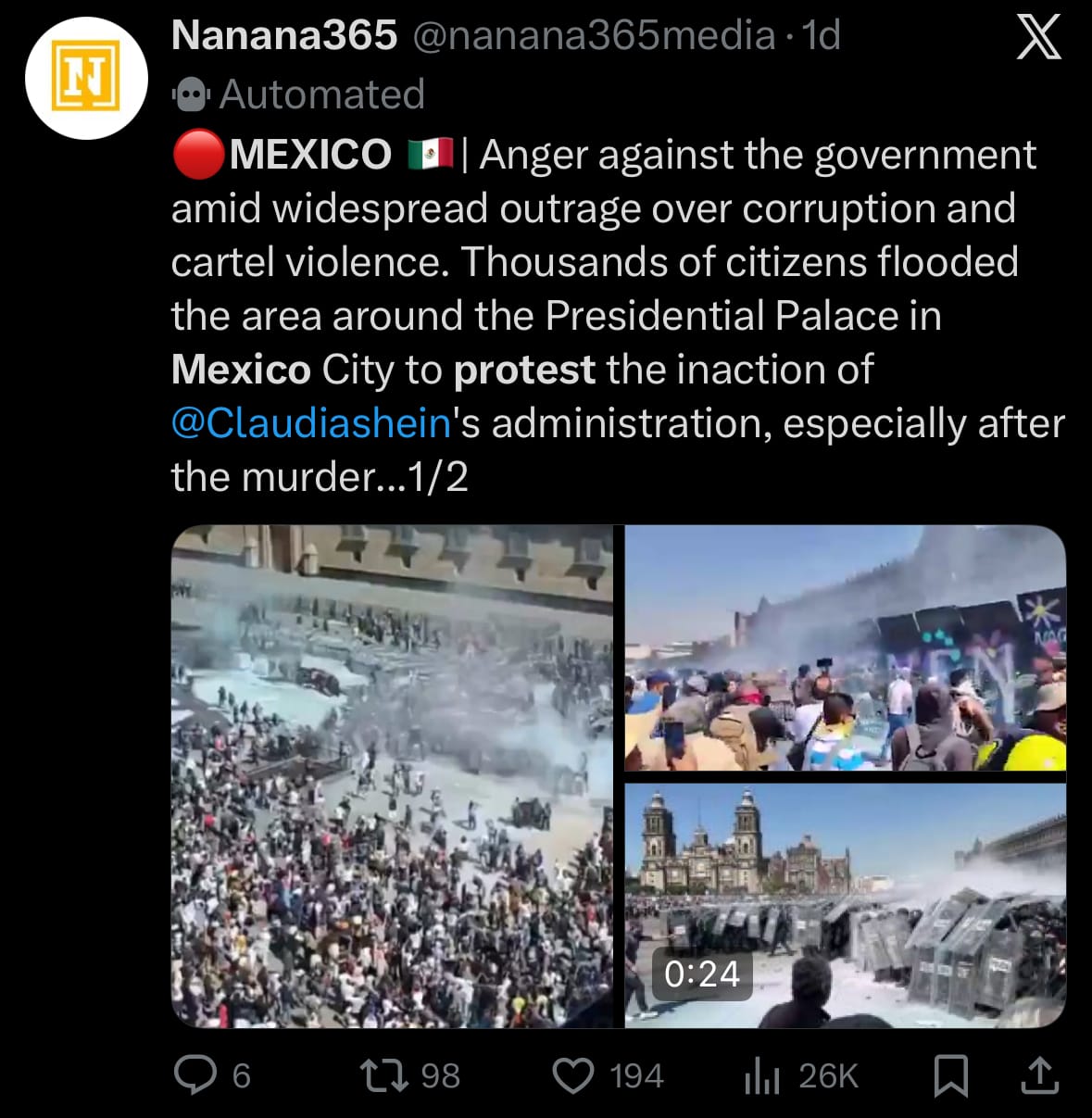
- The protests stem from widespread outrage over President Claudia Sheinbaum's continuation of her predecessor's "hugs not bullets" policy, which emphasizes social programs over direct military confrontations with cartels, a stance critics argue enables corruption and allows criminal groups to operate with impunity. This approach, aimed at addressing root causes like poverty rather than escalating violence, has sparked accusations of government complicity in cartel activities, fueling demands for stronger anti-corruption measures and aggressive enforcement to dismantle organized crime networks. While the demonstrations remained largely peaceful initially, the escalation underscores deepening public discontent with security failures and perceived institutional weaknesses, potentially pressuring the administration to reassess its strategy amid ongoing national debates.
Economics & Markets:
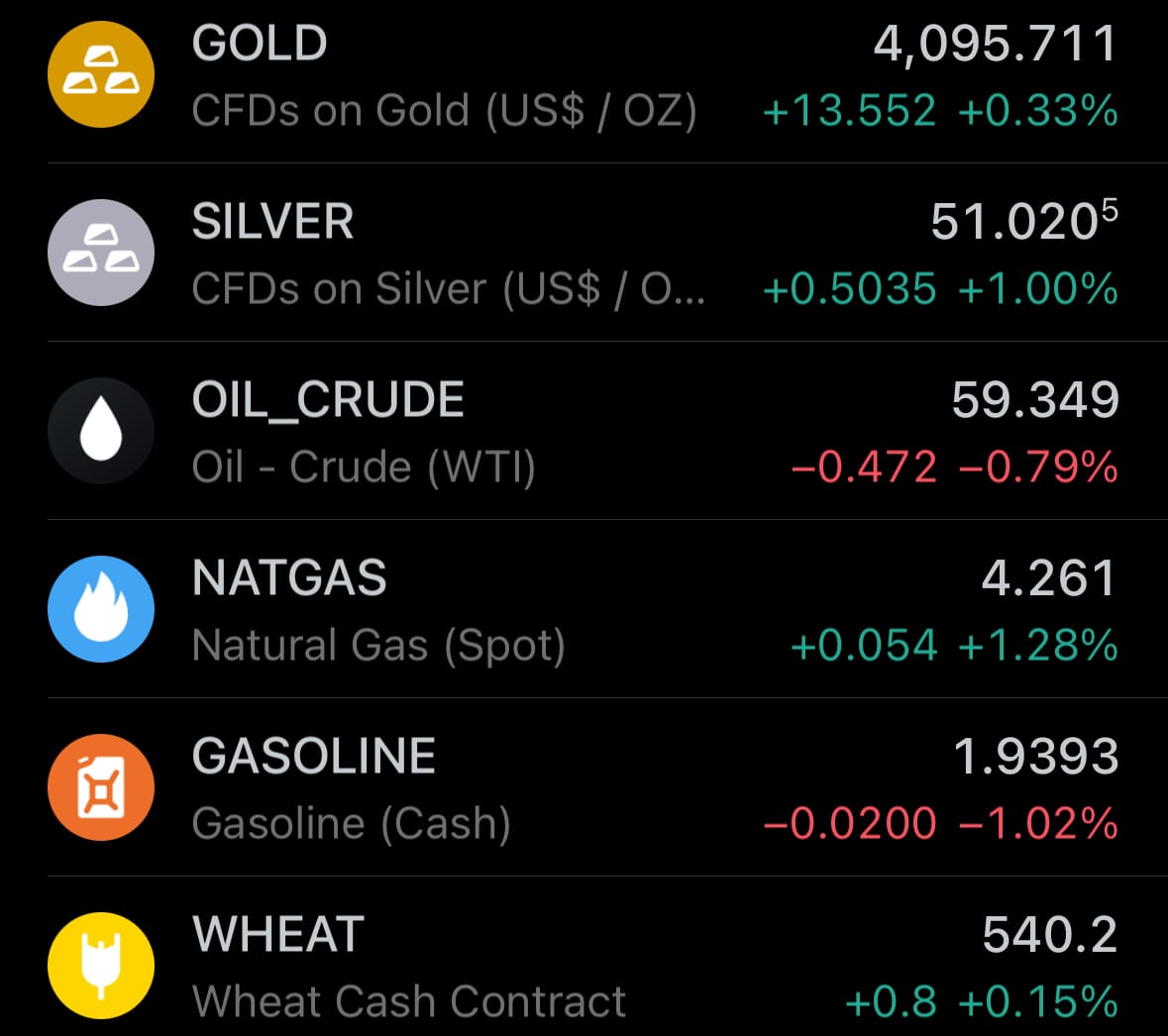
- Yesterday’s commodity market:
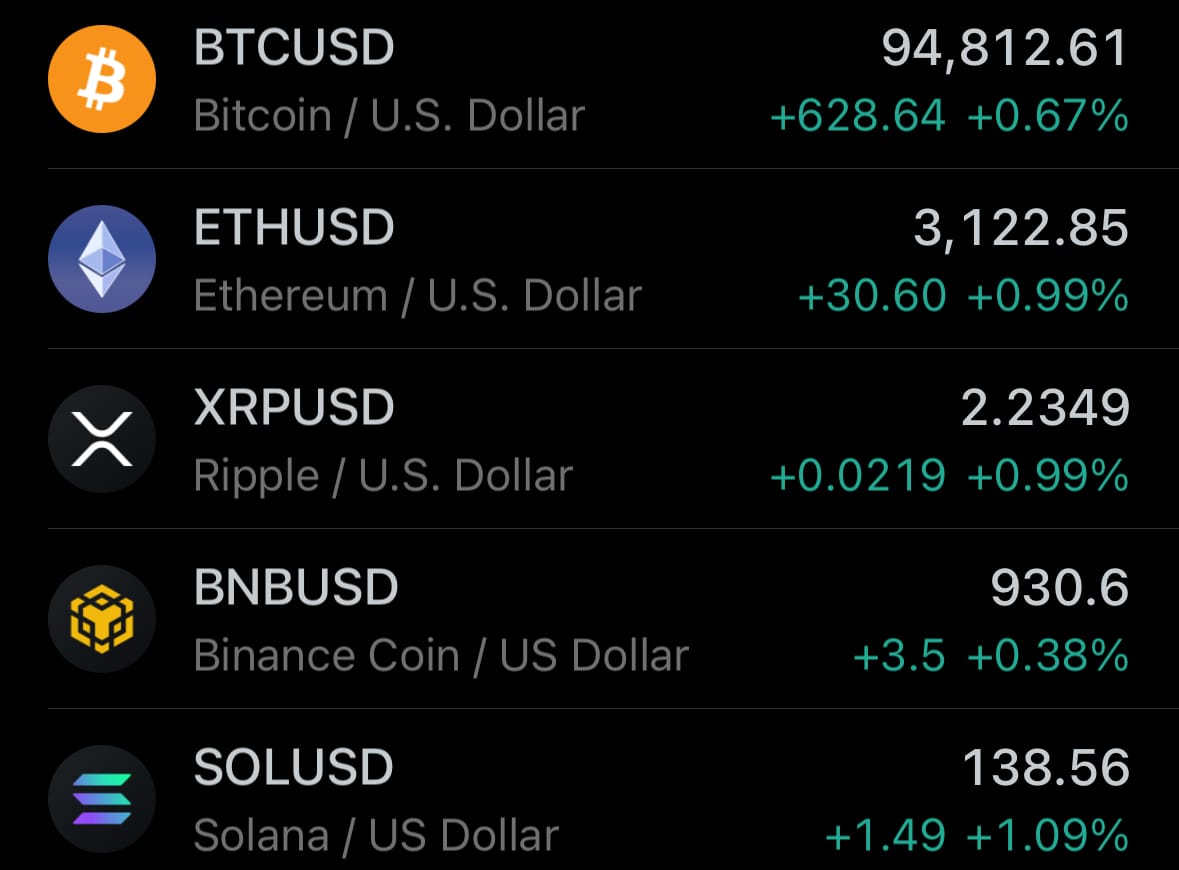
- Yesterday’s crypto market:
Geopolitics & Military Activity:
- On November 15, 2025, U.S. Secretary of Defense Pete Hegseth directed Joint Task Force Southern Spear to carry out a strike on a vessel linked to a designated terrorist organization in international waters of the Eastern Pacific, destroying the boat and killing three men on board. Intelligence indicated the vessel was smuggling narcotics along a known trafficking route, carrying illegal drugs.
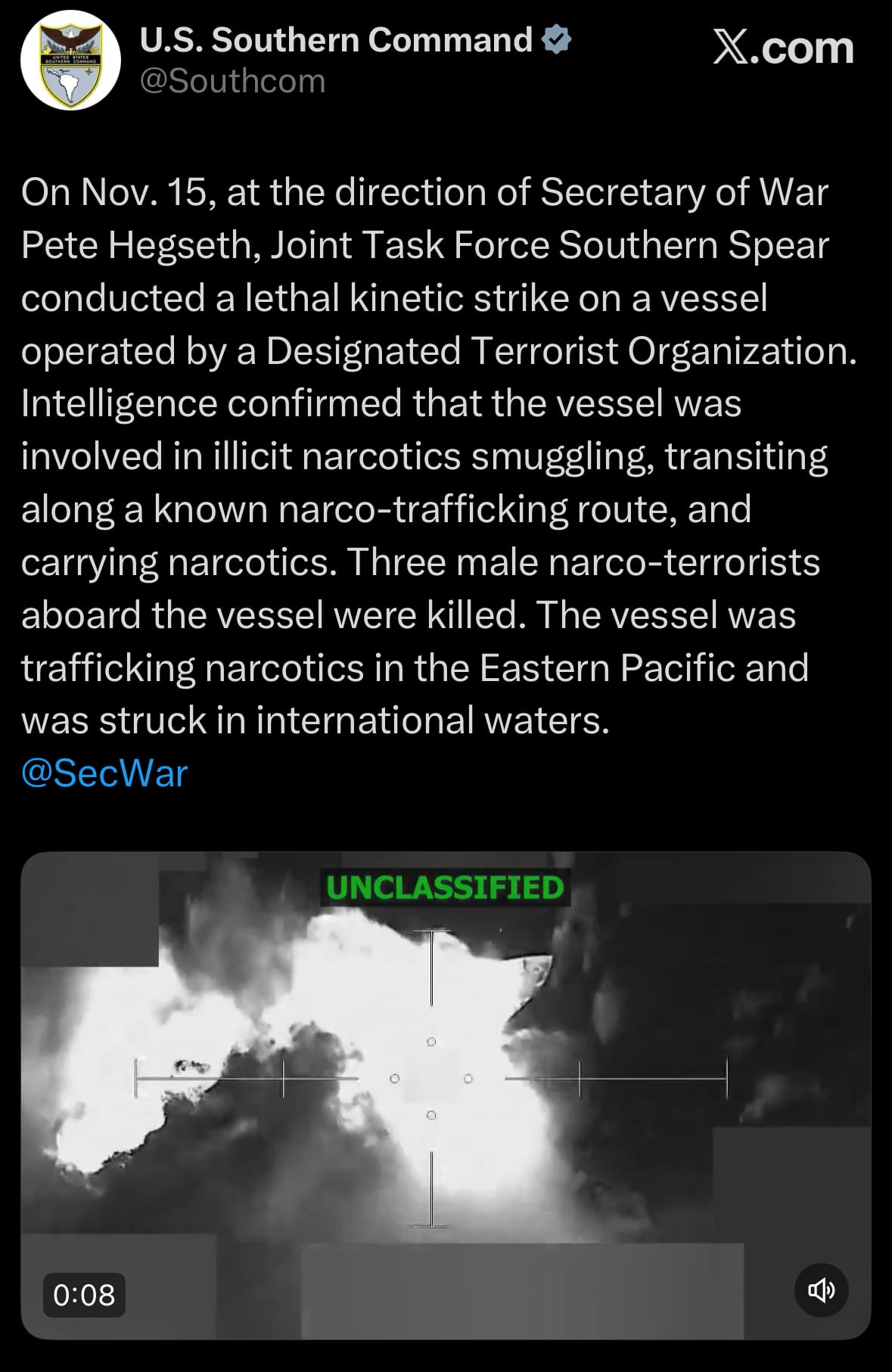
- This was the 21st such strike on suspected drug vessels in 2025, bringing the total deaths from these actions to at least 83. The Trump administration focuses on disrupting smuggling to combat domestic drug issues, while critics highlight issues with international law, humanitarian effects, and risks of regional escalation. No impacts on general maritime traffic occurred, and reviews are underway to assess the operation's role in reducing cross-border crime.
Science & Technology:
- On November 16, 2025, Samsung Electronics announced a $310 billion investment plan over the next five years, focused primarily on advancing AI technologies, including the construction of a new semiconductor manufacturing plant in Pyeongtaek, South Korea, set to begin operations in 2028. The facility, dubbed Pyeongtaek Plant 5, is designed to produce high-bandwidth memory and AI-specific chips to meet growing demand from data centers and computing applications. This initiative also encompasses the development of two new AI data centers by subsidiary Samsung SDS, potential acquisitions such as UK-based Graphcore and U.S.-based Ampere Computing, and a proposed stake in OpenAI to bolster collaborative innovation.
- The investment reflects Samsung's strategy to strengthen its position in the global AI and semiconductor markets amid intensifying competition from rivals like TSMC and Nvidia, aiming to enhance supply chain resilience and technological leadership. Analysts view the move as a response to surging AI adoption, potentially creating thousands of jobs and driving economic growth in South Korea, while addressing challenges like energy efficiency and advanced fabrication processes.
Statistic:
- Largest assets on Earth by market capitalization:
- Gold: $28.509T
- 🇺🇸 NVIDIA: $4.630T
- 🇺🇸 Apple: $4.033T
- 🇺🇸 Microsoft: $3.791T
- 🇺🇸 Alphabet (Google): $3.364T
- Silver: $2.865T
- 🇺🇸 Amazon: $2.539T
- Bitcoin: $1.891T
- 🇸🇦 Saudi Aramco: $1.649T
- 🇺🇸 Broadcom: $1.617T
- 🇺🇸 Meta Platforms: $1.537T
- 🇹🇼 TSMC: $1.477T
- 🇺🇸 Tesla: $1.344T
- 🇺🇸 Berkshire Hathaway: $1.107T
- 🇺🇸 Eli Lilly: $919.11B
- 🇺🇸 JPMorgan Chase: $842.48B
- 🇺🇸 Walmart: $817.53B
- 🇺🇸 Vanguard S&P 500 ETF: $788.57B
- 🇨🇳 Tencent: $750.21B
- 🇺🇸 iShares Core S&P 500 ETF: $713.97B
- 🇺🇸 SPDR S&P 500 ETF: $691.20B
- 🇺🇸 Visa: $648.59B
- 🇺🇸 Oracle: $635.29B
- 🇺🇸 Vanguard Total Stock Market Index Fund ETF Shares: $553.78B
- 🇺🇸 Exxon Mobil: $503.04B
History:
- Encryption’s story begins long before computers, in the ancient places where humans first learned that knowledge could be both powerful and dangerous. In Mesopotamia around 1500 BC, a clay tablet hides an encoded pottery recipe—the earliest known encrypted industrial secret. Across Egypt between 1500 and 1000 BC, scribes slipped deliberate substitutions into hieroglyphic inscriptions to conceal religious or magical knowledge from the uninitiated. The Indus Valley civilization may have protected trade information with symbol sequences whose meaning we still can’t fully decode. Meanwhile, the idea of secure communication spread across cultures. The Spartans (700–500 BC) used the scytale, wrapping leather around a wooden rod so the message could only be read on a matching cylinder. In India, the Arthashastra (4th century AD) advised spies to use substitution ciphers. In China, Sun Tzu’s writings (c. 500 BC) emphasized coded signals and deceptive communication as essential tools of war. When Julius Caesar encrypted his military dispatches with a letter shift in 58–50 BC, he was participating in a global pattern: civilizations everywhere were discovering that secrecy needed structure, and structure needed technique. The breakthrough came during the Islamic Golden Age when al-Kindi, working in Baghdad around 850 AD, invented frequency analysis—the first scientific method of breaking ciphers. From Renaissance Italy and its cipher disks to Edo-period Japan’s symbolic merchant codes to Africa’s Nsibidi system of secret glyphs, once humanity tasted cryptography, it became part of every society that needed to protect power, trade, religion, or strategy.
- The modern acceleration, however, came with machines and war. In the 1930s, Polish cryptanalysts made the first mathematical breakthroughs against Nazi Germany’s Enigma, lighting the fuse for what would become an intelligence arms race across Europe, the U.S., and Japan during World War II (1939–1945). Bletchley Park’s codebreakers, the Allied attacks on Japan’s Purple machine, and the global spread of radio encryption turned secrecy into an industrial science. After the war, cryptography evolved rapidly: in 1949, Claude Shannon published the mathematical foundations that defined secure communication for the digital age. When the 1970s arrived, everything changed. The U.S. released DES in 1977, the first widely adopted national encryption standard. That same year, public-key cryptography arrived—Diffie and Hellman’s key exchange (1976) and the RSA algorithm (1977) allowed strangers to encrypt messages without ever sharing a secret key. This was the spark that made secure digital commerce, online banking, and the modern internet possible. Cryptography became international: Belgian researchers created AES (2001), Japan, China, India, Israel, Russia, and South Korea built their own national suites, and the internet spread modern encryption to billions of users. Then came the quantum threat. Research labs in the U.S., China, Europe, and Canada demonstrated that quantum computers could eventually break classical systems like RSA using Shor’s algorithm. A global race began to invent new, unbreakable defenses. In 2022, NIST selected the first wave of post-quantum encryption standards—algorithms designed to survive the computing power of the next century. From clay tablets to quantum-resistant lattices, encryption has grown into one of humanity’s most universal tools: a shared global craft built to protect secrets in a world where information moves faster than thought.
Image of the day:

Thanks for reading!
- Earth Intelligence builds private, customizable intelligence systems that you own outright. We plug in any data source you rely on — financials, competitors, markets, regulations, internal ops, even predictive models — and fuse it all into a single command interface that replaces your patchwork of subscriptions. You get one unified brain for your organization: your data, your signals, your decisions, all flowing through an AI-powered system built only for you.
Earth is complicated, we make it simple.
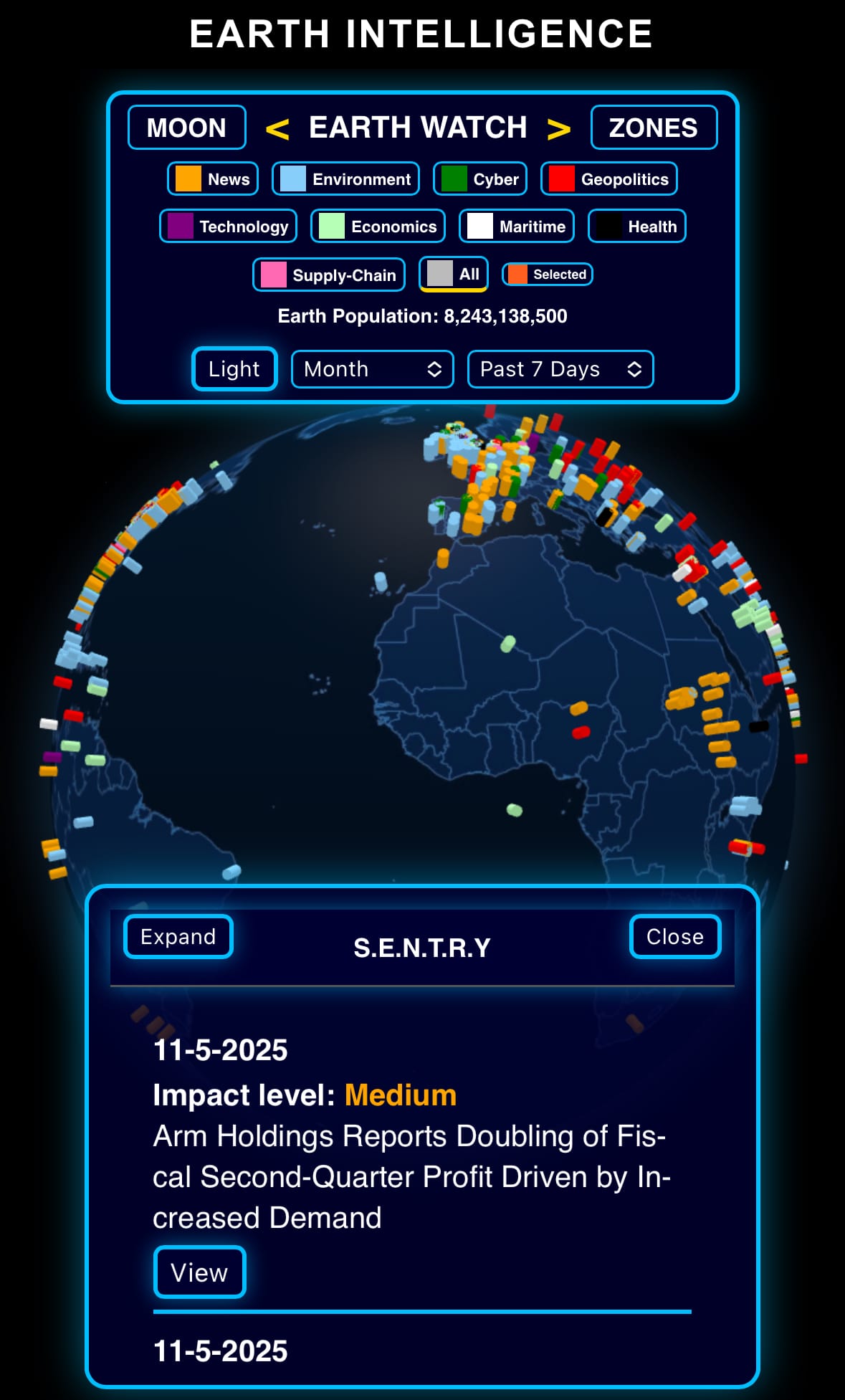
- Click below if you’d like to view our free EARTH WATCH globe:

Click below to view our previous newsletters:
Support/Suggestions Email:
earthintelligence@earthintel.news