Monday☕️


Economics & Markets:
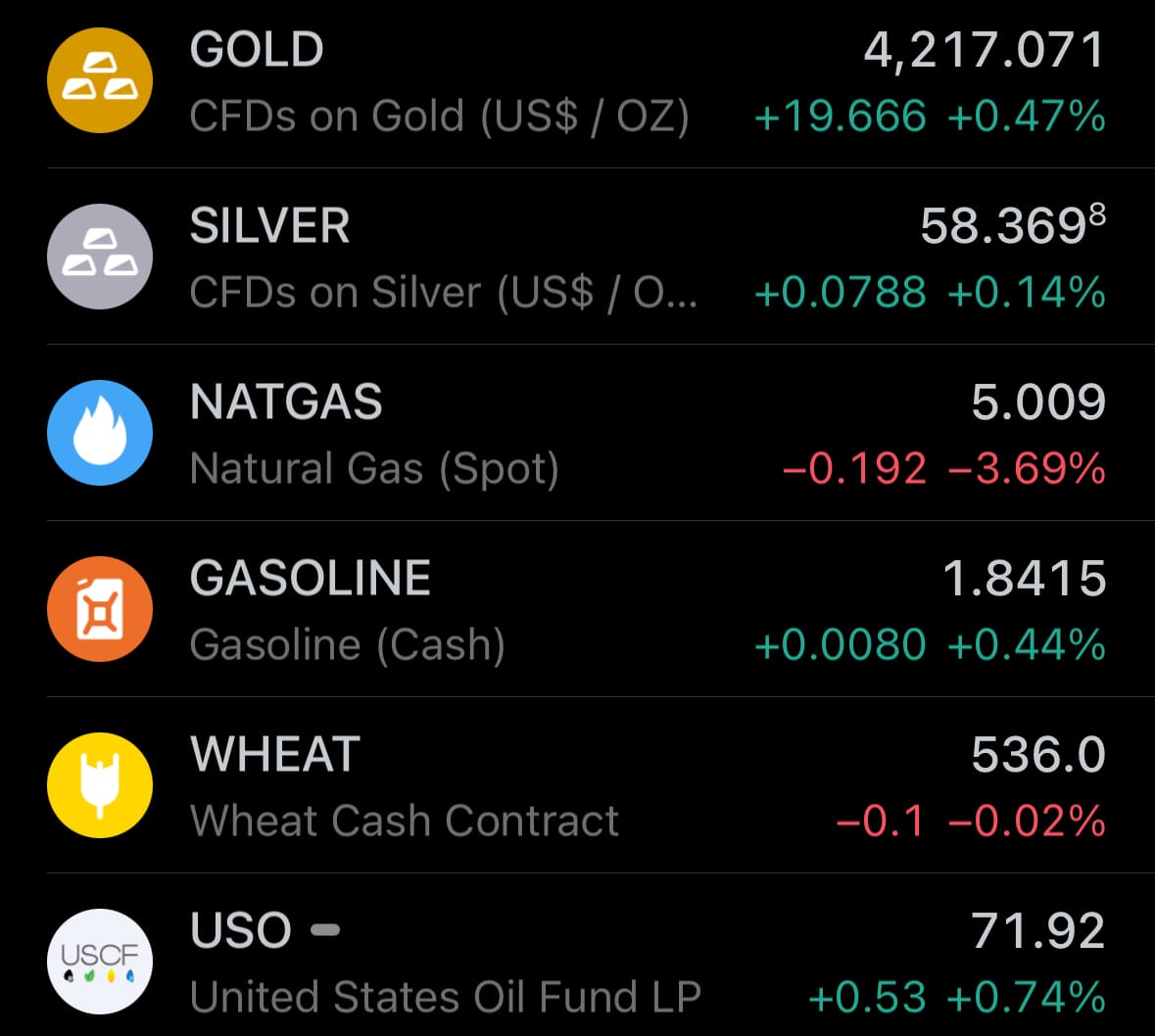
- Today’s commodity market:
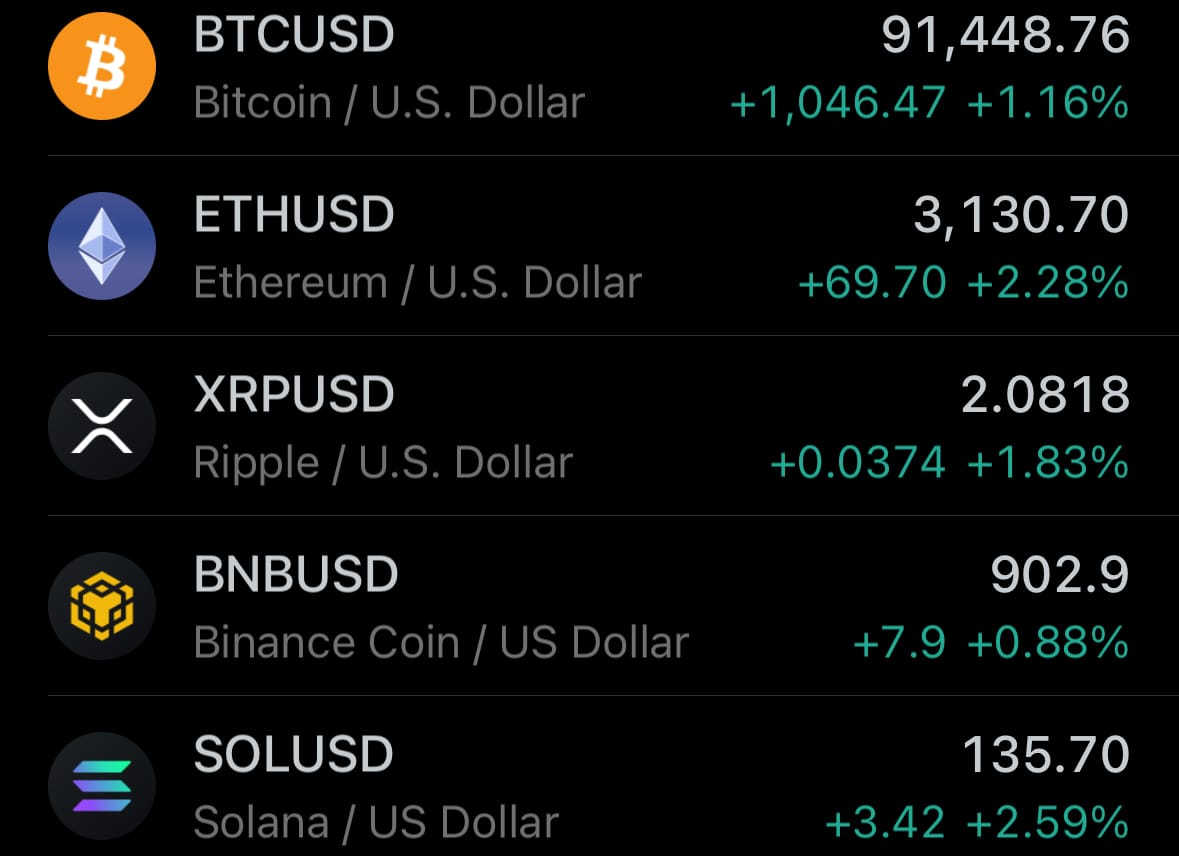
- Today’s crypto market:
Geopolitics & Military Activity:
- On December 8, 2025, Thailand launched airstrikes on Cambodian military positions near the disputed border in Preah Vihear and Oddar Meanchey provinces, escalating clashes that began with gunfire exchanges on December 7. Thai forces targeted artillery and mortar sites at Chong An Ma Pass after Cambodian troops allegedly shelled Thai positions at Anupong Base, resulting in one Thai soldier killed and eight wounded. Cambodia's Defense Ministry condemned the strikes as unprovoked, claiming Thai tanks fired first at 5:04 a.m. local time on Cambodian positions in An Ses and near Ta Moan Thom and Preah Vihear temples, with no immediate Cambodian casualties reported but three civilians seriously injured in earlier skirmishes. Both sides have evacuated civilians—over 385,000 in Thailand across four provinces and 1,100 families in Cambodia—amid mutual accusations of ceasefire violations.
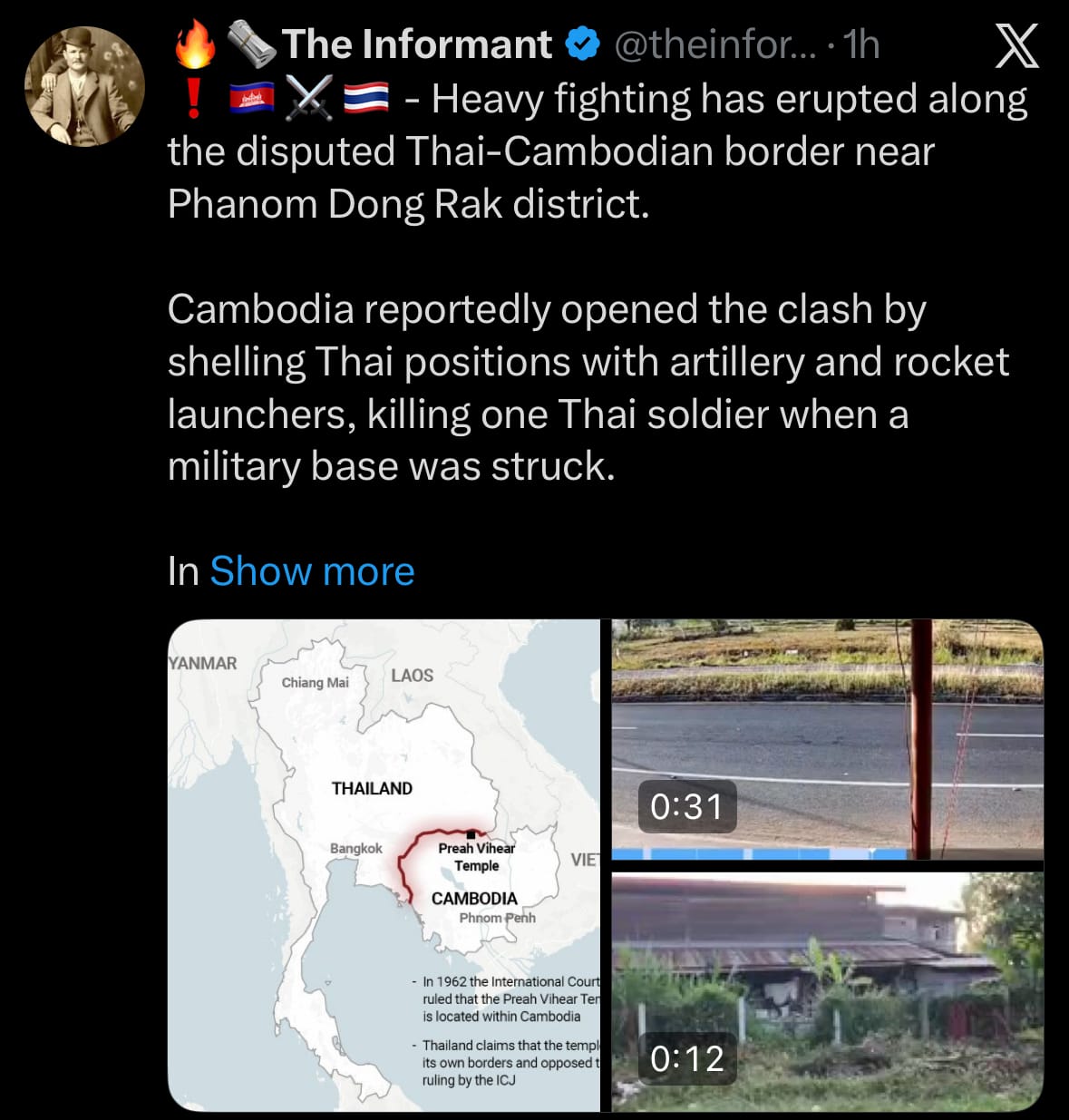
- The violence threatens a fragile October 26, 2025, ceasefire agreement brokered by U.S. President Donald Trump in Kuala Lumpur, which followed a deadly July conflict that killed at least 48 and displaced 300,000. Tensions reignited after a November landmine explosion injured Thai soldiers, prompting Thailand to suspend the deal and blame Cambodia for new mines, while Phnom Penh denied involvement. Malaysian Prime Minister Anwar Ibrahim, who witnessed the truce, urged restraint, and analysts note the failure to resolve century-old disputes over temple sites like Preah Vihear fuels nationalist escalations, with no immediate diplomatic intervention from ASEAN or the U.S. reported as of December 8.
Environment & Weather:
- On December 8, 2025, a strong atmospheric river storm system began impacting Northern California, delivering heavy rainfall and strong winds as the first major winter event of the season. The National Weather Service forecasted up to 10 inches of rain in coastal and northern areas through the weekend, with gusts reaching 70 mph along the North Coast, prompting flood watches for over 20 counties from Mendocino to San Francisco. The storm, rated Category 3 on the atmospheric river scale, has already caused road closures, power outages affecting thousands, and minor urban flooding in the San Francisco Bay Area, while higher elevations saw beneficial snow accumulation in the Sierra Nevada.
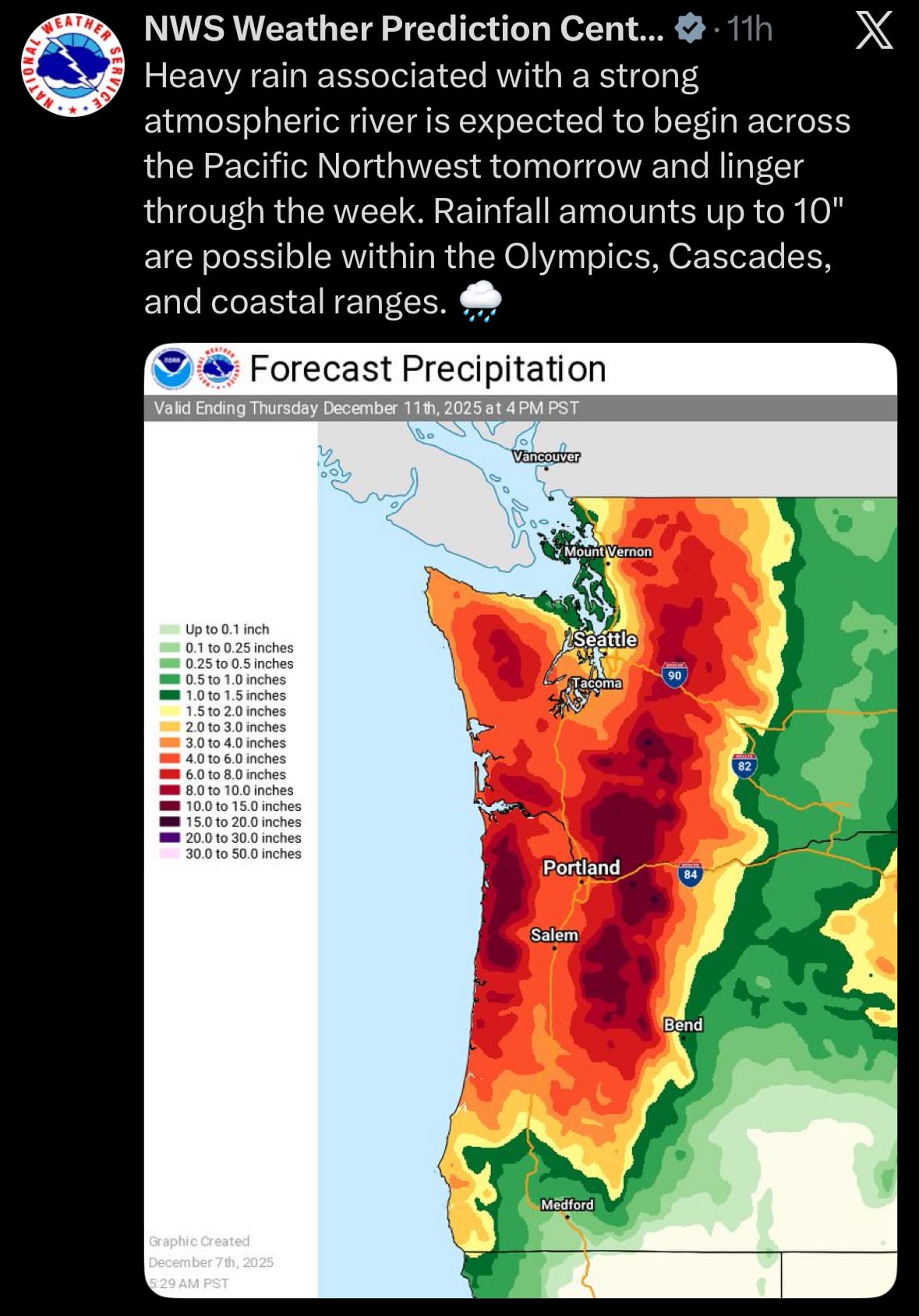
- Southern California, including Los Angeles and San Diego counties, is expected to see lighter but still significant precipitation—up to 4 inches—starting late December 8 and tapering by December 10, raising concerns for debris flows in burn scar areas from 2025 wildfires. The California Governor's Office of Emergency Services activated resources for potential evacuations, and experts note that while atmospheric rivers provide up to half of the state's annual water supply, this event's intensity could exacerbate erosion in deforested regions.
- On December 6, 2025, an M8.1-class solar flare erupted from Active Region 4299, located near the center of the solar disk, peaking at 20:39 UTC and lasting about 20 minutes. The event, rated R2 (moderate) on the radio blackout scale, disrupted high-frequency communications over parts of South America for roughly 30 minutes, affecting aviation and maritime operations. Accompanied by a Type II radio emission indicating a shock wave traveling at approximately 1,143 km/s, the flare produced a full-halo coronal mass ejection (CME)—a symmetrical blast of solar plasma visible in all directions from the Sun's perspective—confirming its Earth-directed trajectory. NASA's Solar Dynamics Observatory and SOHO coronagraphs captured the eruption, highlighting Region 4299's geoeffective position and its history of producing strong activity, including a prior G4 storm in November.
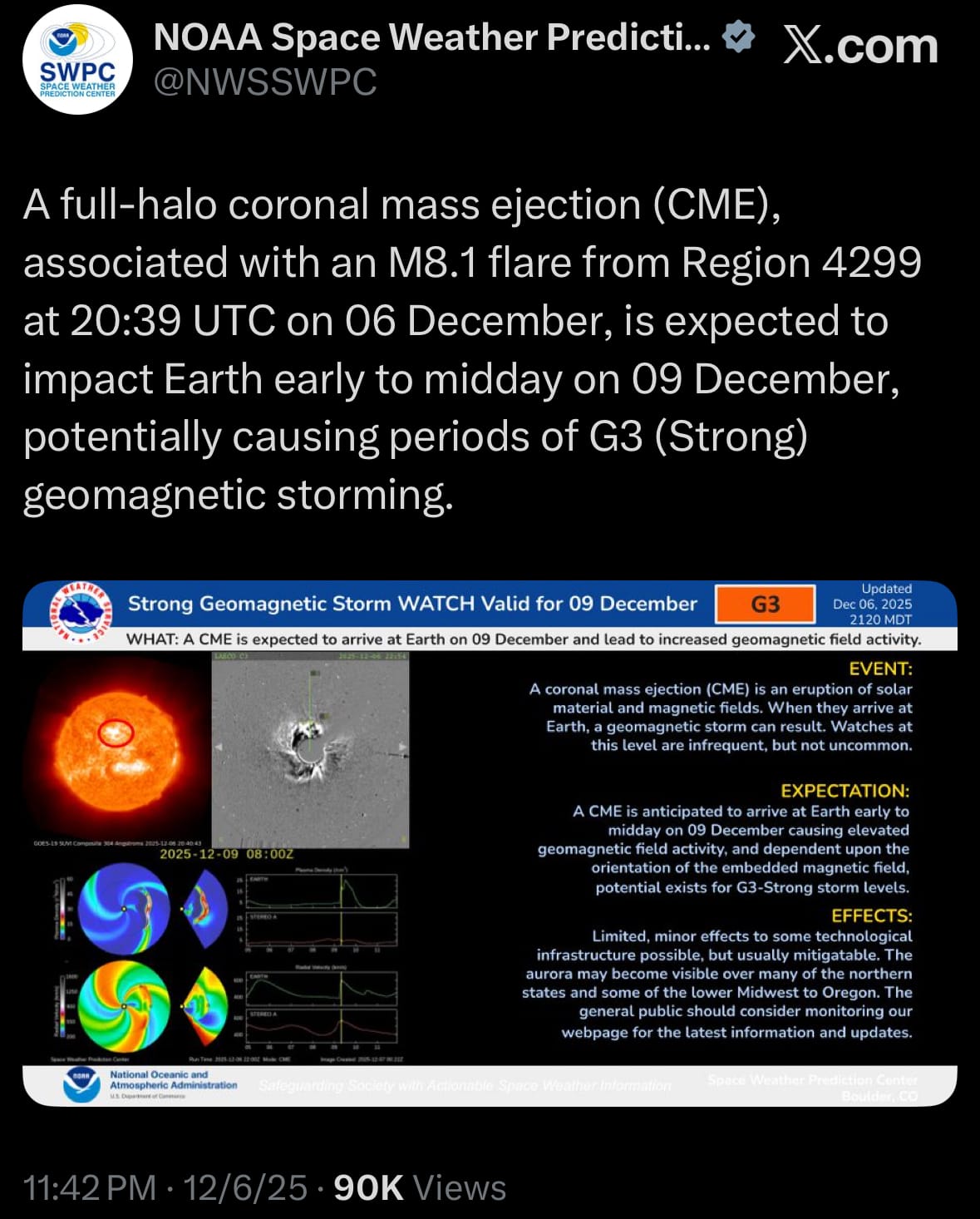
- NOAA's Space Weather Prediction Center issued a G3 (strong) geomagnetic storm watch for December 9, 2025, based on the WSA-ENLIL model initialized at 22:00 UTC on December 6, forecasting CME impact between early and midday UTC (late evening December 8 to early morning December 9 in the Americas). If the southward-oriented magnetic field aligns unfavorably, the storm could cause widespread auroras visible as far south as Illinois, Oregon, and northern Europe, along with potential voltage fluctuations in power grids, intermittent satellite navigation errors, and high-frequency radio blackouts at high latitudes. Region 4299 remains active with a 70% chance of additional M-class flares and 15% for X-class through December 8, underscoring ongoing solar maximum conditions.
Space:
- On December 7, 2025, SpaceX launched the Starlink Group 11-15 mission using a Falcon 9 rocket from Space Launch Complex 4E at Vandenberg Space Force Base in California. Liftoff occurred at 9:58 a.m. PST (17:58 UTC), within a multi-hour window, with the two-stage vehicle ascending on a southeasterly trajectory over the Pacific Ocean. The first stage, booster B1088 on its 12th flight, separated about 2.5 minutes after launch and landed successfully on the droneship Of Course I Still Love You approximately 8 minutes later.
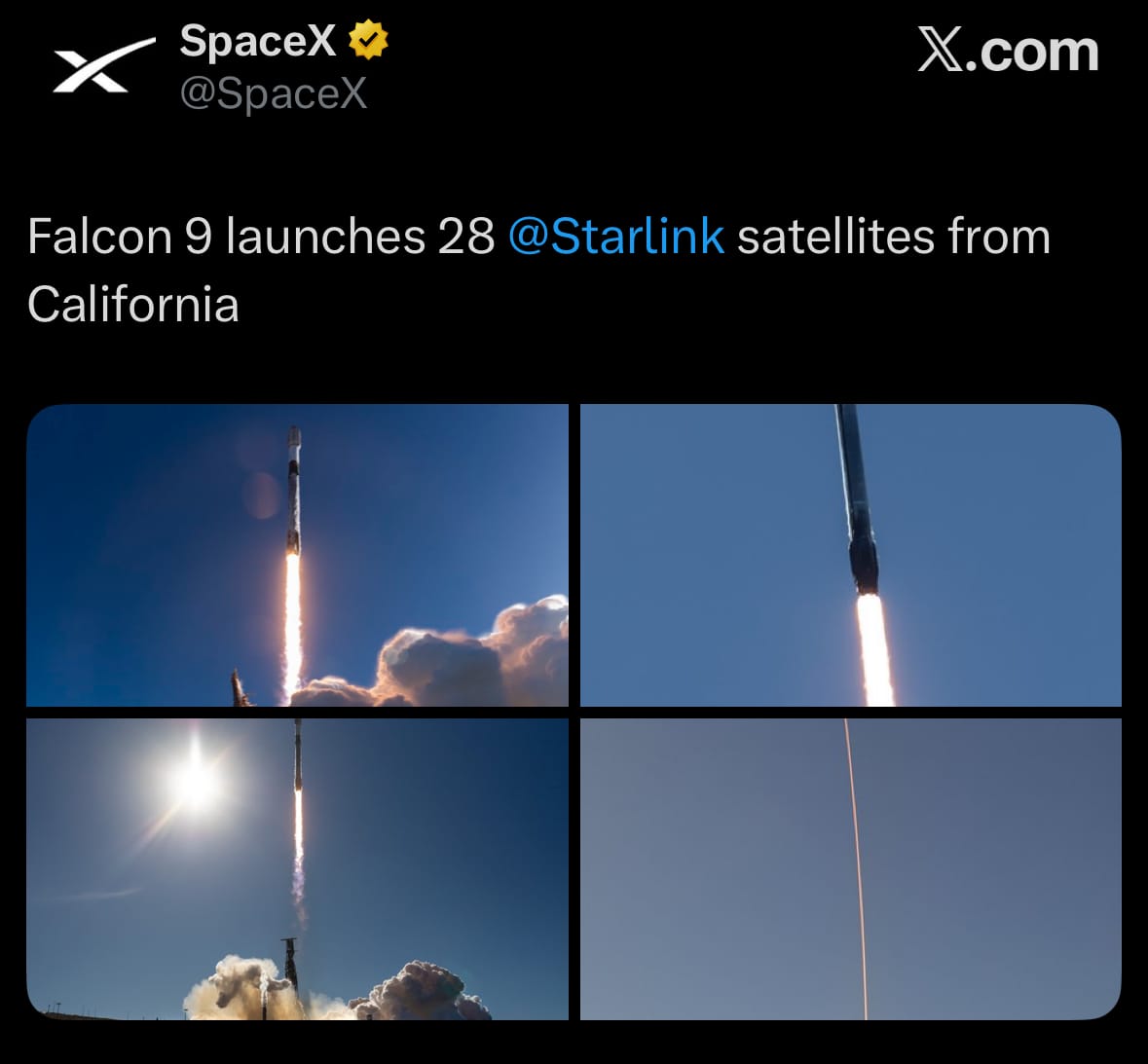
- The mission deployed 28 V2 Mini Starlink satellites into a sun-synchronous low Earth orbit at approximately 530 kilometers altitude, where they will raise themselves to operational positions to support global broadband internet access, including in high-latitude and remote areas. Deployment was confirmed about 60 minutes post-liftoff, with no anomalies reported and clear weather aiding the operation. The flight contributes to SpaceX's ongoing expansion of the mega-constellation, now exceeding 10,500 satellites launched overall, amid regulatory reviews for further deployments and concerns over space traffic management.
Statistic:
- Largest assets on Earth by market capitalization:
- Gold: $29.506T
- 🇺🇸 NVIDIA: $4.441T
- 🇺🇸 Apple: $4.137T
- 🇺🇸 Alphabet (Google): $3.888T
- 🇺🇸 Microsoft: $3.591T
- Silver: $3.308T
- 🇺🇸 Amazon: $2.453T
- 🇺🇸 Broadcom: $1.842T
- Bitcoin: $1.828T
- 🇺🇸 Meta Platforms: $1.697T
- 🇸🇦 Saudi Aramco: $1.573T
- 🇹🇼 TSMC: $1.528T
- 🇺🇸 Tesla: $1.513T
- 🇺🇸 Berkshire Hathaway: $1.088T
- 🇺🇸 Walmart: $917.75B
- 🇺🇸 Eli Lilly: $905.69B
- 🇺🇸 JPMorgan Chase: $866.28B
- 🇺🇸 Vanguard S&P 500 ETF: $826.38B
- 🇺🇸 iShares Core S&P 500 ETF: $736.34B
- 🇨🇳 Tencent: $707.41B
- 🇺🇸 SPDR S&P 500 ETF: $704.39B
- 🇺🇸 Visa: $642.91B
- 🇺🇸 Oracle: $620.27B
- Vanguard Total Stock Market Index Fund ETF Shares: $569.45B
- 🇰🇷 Samsung: $498.75B
History:
- The history of apps begins long before smartphones, rooted in the earliest days of computing when software came on punch cards, magnetic tape, and later floppy disks for personal computers like the Apple II (1977), IBM PC (1981), and Macintosh (1984). Through the 1980s and 90s, software slowly became more accessible: bulletin board systems, shareware disks, and early download sites like download.com (1996) let users install small, focused programs that looked increasingly like today’s “apps.” Meanwhile, mobile devices were quietly developing their own software ecosystems. PDAs like the PalmPilot (1996) and phones like Nokia’s Series 60 (early 2000s) allowed third-party apps, but distribution was scattered—carrier portals, brand-specific stores, and developer websites. Everything changed in 2007–2008 with the rise of the smartphone. Apple introduced the iPhone in 2007 and launched the App Store on July 10, 2008, creating the first unified marketplace for mobile apps. Google followed with the Android Market in late 2008 (later Google Play), enabling global distribution across many device manufacturers. These two ecosystems quickly absorbed the entire mobile software world.
- From the 2010s onward, apps became the center of digital life. Tablets, smart TVs, wearables, and gaming consoles adopted their own app stores, while desktop platforms like macOS and Windows integrated similar concepts. Economic models shifted from boxed software to digital marketplaces powered by subscriptions, in-app purchases, and centralized billing systems. Today, Apple’s App Store and Google Play dominate the global app economy, hosting millions of apps and processing billions of downloads each year. Smaller ecosystems—Amazon’s Appstore, Samsung Galaxy Store, Huawei AppGallery, and game-focused stores like Steam and the Epic Games Store—serve niche or regional markets, but the core structure remains: a handful of major digital storefronts controlling distribution, discovery, updates, and monetization for nearly all consumer software. The journey from punch cards to app stores represents a complete transformation of how humans create, access, and use software, turning applications into the universal digital tools of modern life.
Image of the day:
Thanks for reading! Earth is complicated, we make it simple.

- Click below if you’d like to view our free EARTH WATCH globe:
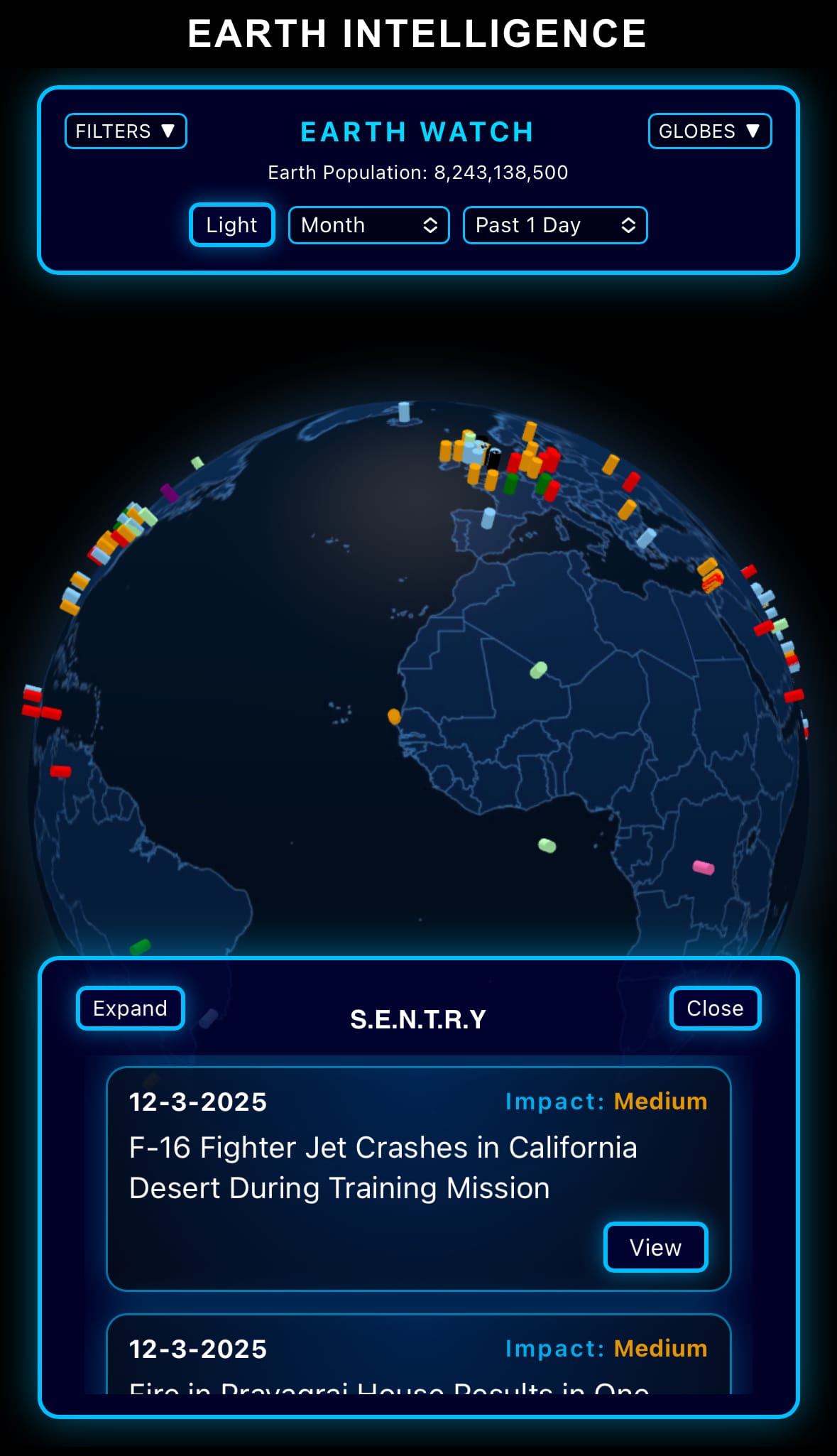
- Download our mobile app on the Apple App Store (Android coming soon):

Click below to view our previous newsletters:
Support/Suggestions Email:
earthintelligence@earthintel.news