Monday☕️


Trending:
- On December 20, 2025, a major power outage struck San Francisco, California, affecting up to 130,000 PG&E customers—roughly one-third of the city—at its peak on Saturday afternoon. The blackout, triggered by a fire at a PG&E substation at 8th and Mission streets, darkened large areas including the Richmond District, Presidio, Golden Gate Park, Sunset District, and parts of downtown. Disruptions included non-functioning traffic lights causing jams, halted Muni and BART services at several stations, business closures, and Waymo autonomous vehicles stalling in intersections (prompting temporary suspension of their service).
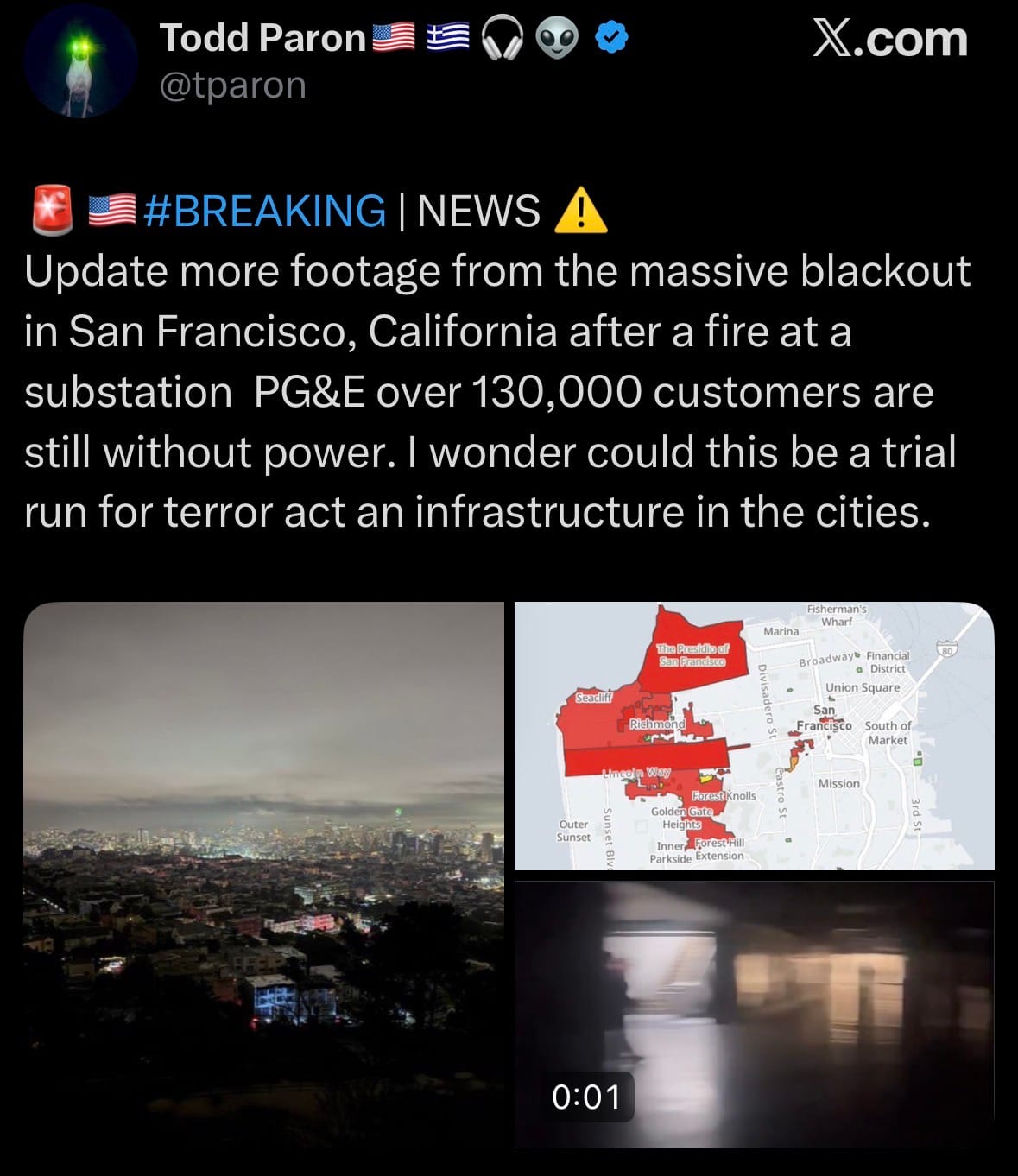
- By Sunday morning, power was restored to approximately 110,000 customers, with around 20,000-40,000 remaining affected into December 22, primarily in northwest neighborhoods. PG&E described substation damage as extensive, with full restoration targeted for Monday afternoon; as of latest reports, statewide outages stood at about 44,000 (mostly in San Francisco). The incident occurred amid rainy weather but was not linked to broader storm-related failures or rolling blackouts, unlike prior atmospheric river events.
Economics & Markets:
- Yesterday’s commodity market:

- Yesterday’s crypto market:

Geopolitics & Military Activity:
- On December 20, 2025, the U.S. Coast Guard, supported by the Department of War, conducted a pre-dawn boarding and apprehension of the Panama-flagged oil tanker Centuries in international waters of the Caribbean Sea east of Barbados. The vessel, which had recently loaded crude oil in Venezuela and was en route to Asia (likely China), was intercepted without resistance from the crew. Homeland Security Secretary Kristi Noem released video footage of the operation showing helicopters and boarding teams, stating the action targeted illicit movement of sanctioned oil allegedly funding "narco-terrorism." This marks the second such tanker interdiction in December, following the seizure of the sanctioned vessel Skipper on December 10.
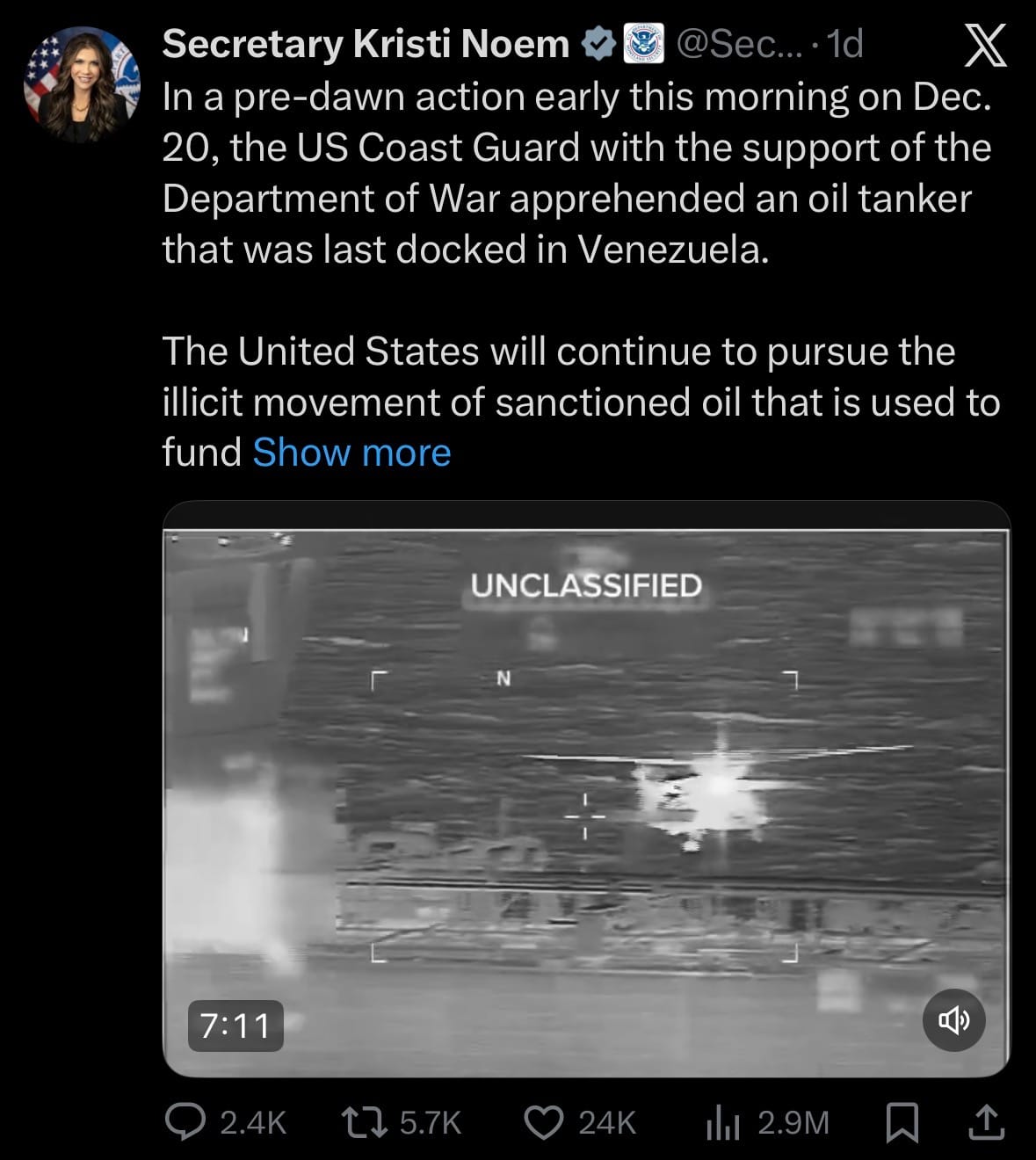
- The operation escalates enforcement of President Trump's December 16 announcement of a "total and complete blockade" of sanctioned oil tankers to and from Venezuela, amid a broader pressure campaign against President Nicolás Maduro's government, which the U.S. accuses of using oil revenues for illicit activities and designates as a foreign terrorist organization. Notably, the Centuries was not listed on U.S., EU, UK, or UN sanctions lists, and its cargo—Venezuelan crude—was claimed by U.S. officials to be sanctioned PDVSA oil trafficked via shadow fleet tactics. Venezuela denounced the action as "theft and international piracy," vowing to report it to the UN. Analysts note Venezuelan oil exports have sharply declined since the first seizure, with potential modest upward pressure on global oil prices, though supplies remain ample.
Environment & Weather:
- On December 21, 2025, a powerful cold lahar (volcanic mudflow) surged down the slopes of Mount Semeru in East Java, Indonesia, triggered by heavy afternoon rainfall remobilizing loose volcanic material from recent eruptions. Viral videos captured the fast-moving flow of mud, sand, rocks, and debris rushing through river channels, particularly along Sungai Regoyo in Lumajang Regency, causing panic among sand miners who fled the area. One miner was temporarily trapped mid-river but survived by sheltering behind rocks until the flow subsided; seismic recordings detected the event lasting over three hours with a maximum amplitude of 45 mm.
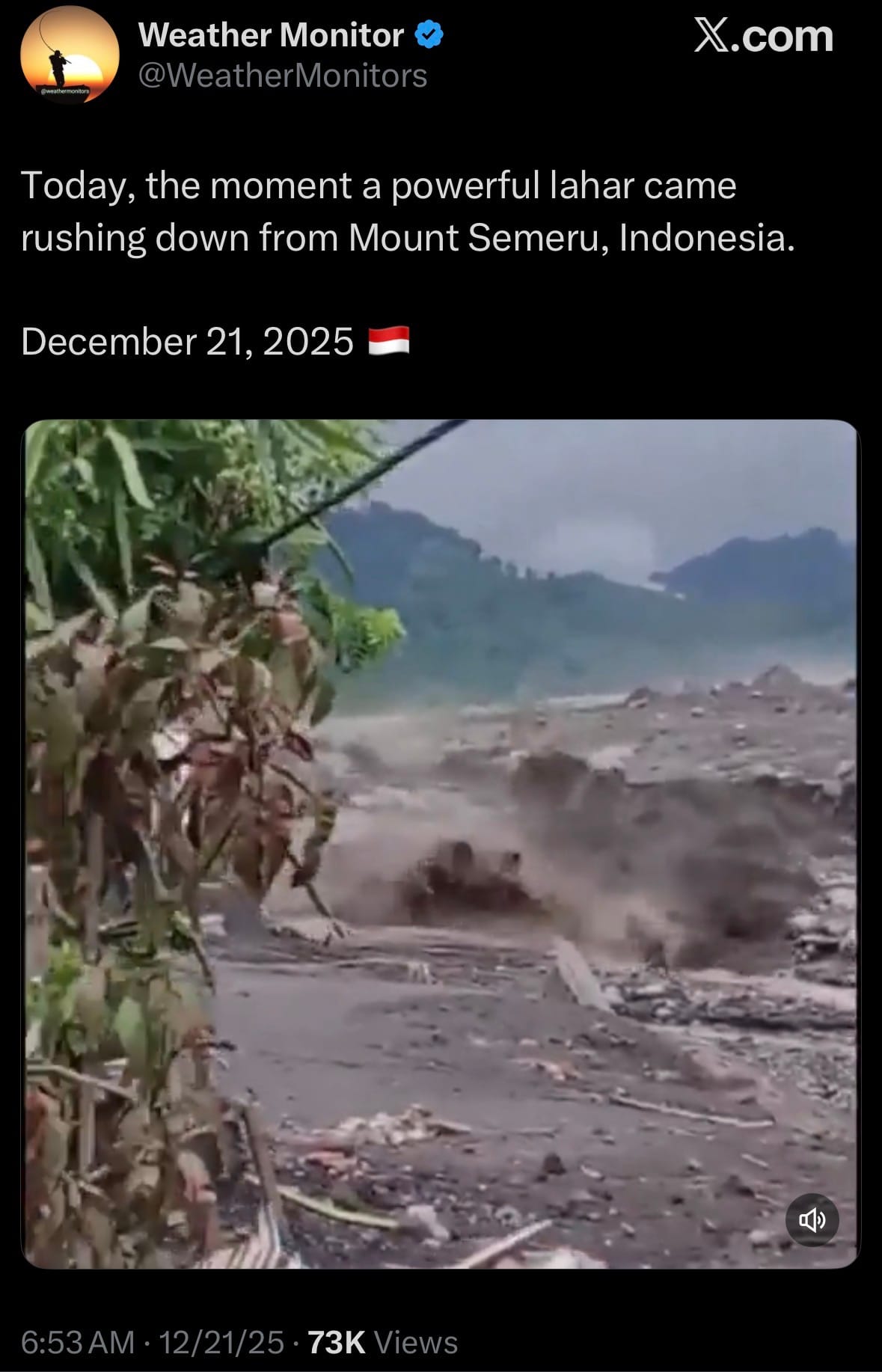
- Mount Semeru, Indonesia's most active volcano at Level III (Alert) status, had erupted six times earlier that morning with ash plumes up to 1,200 meters, adding to its near-continuous activity in 2025 (over 3,000 eruptions recorded nationwide, mostly from Semeru). Authorities from PVMBG maintain restrictions: no activity within 5 km of the crater or along southeastern drainages like Besuk Kobokan (up to 13-17 km due to lahar risks), with ongoing warnings for potential hot clouds, pyroclastic flows, and rain-triggered lahars in valleys originating from the summit. This event underscores persistent hazards from accumulated deposits, even without major new eruptions.
Space:
- On December 21, 2025, Rocket Lab successfully launched its Electron rocket on the “The Wisdom God Guides” mission from Launch Complex 1 in Mahia, New Zealand, at 7:36 p.m. NZDT (06:36 UTC). The mission deployed the QPS-SAR-15 synthetic aperture radar (SAR) satellite for Japanese company Institute for Q-shu Pioneers of Space, Inc. (iQPS) into a 575 km circular low Earth orbit at 42 degrees inclination. This marked Rocket Lab's 21st Electron launch of 2025—all successful—and the company's 79th Electron mission overall, capping a record-breaking year.
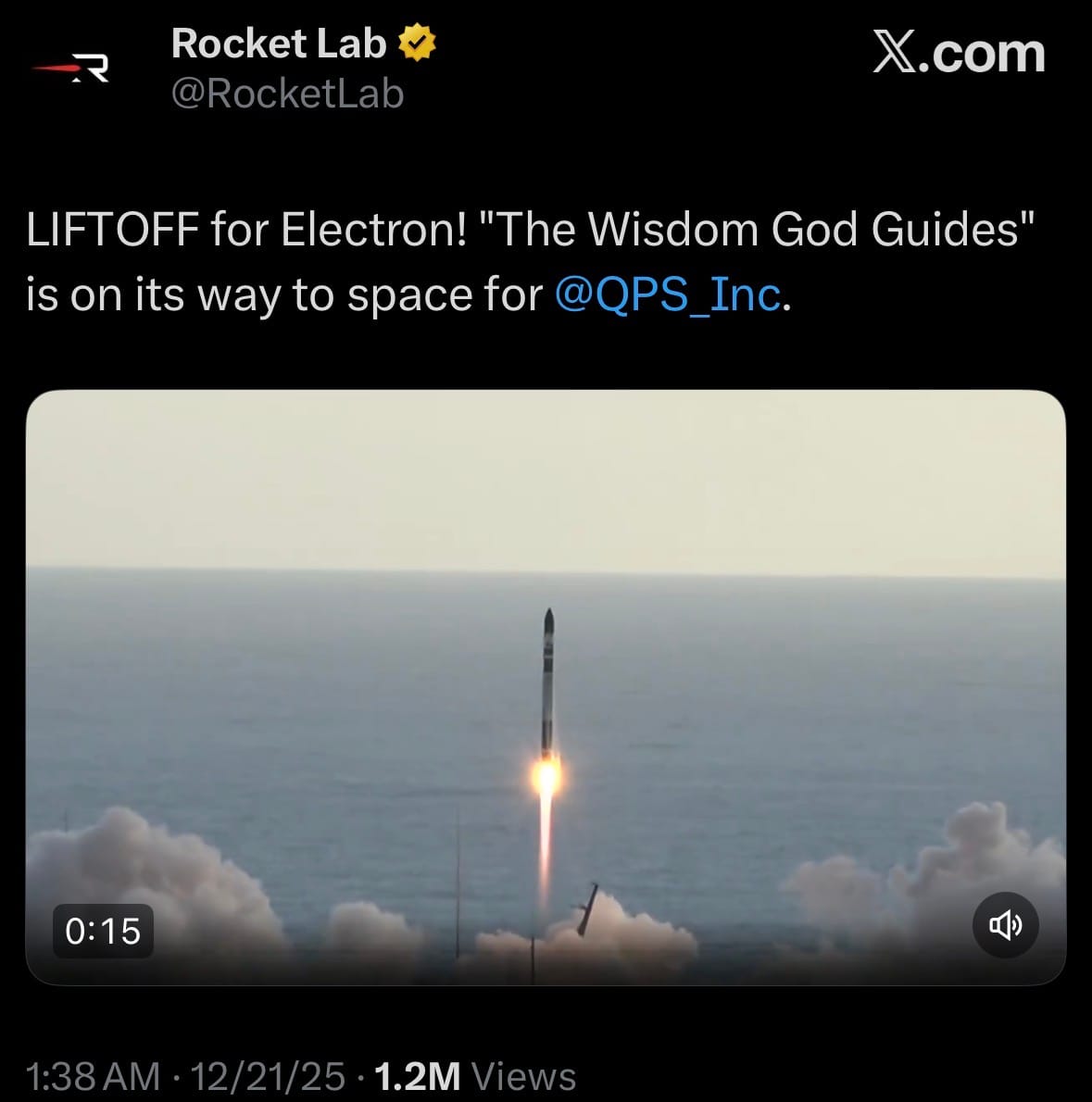
- QPS-SAR-15 joins iQPS's growing commercial SAR constellation, aimed at providing high-resolution (sub-meter) near-real-time Earth imagery day or night and in all weather conditions, supporting applications in disaster monitoring, agriculture, and infrastructure. Rocket Lab has now deployed seven satellites for iQPS since 2023, serving as the primary launcher, with five more dedicated missions contracted for 2026 as iQPS expands toward a 36-satellite network for global 10-minute revisit capabilities.
Michibiki 5 Launch:
- On December 22, 2025, Japan successfully launched the Michibiki No. 5 (QZS-5) navigation satellite aboard the eighth H3 rocket (H3 F8, H3-22S configuration) from the Yoshinobu Launch Complex at Tanegashima Space Center. Liftoff occurred during the early morning window (approximately 10:51 a.m. JST / 01:51 UTC), following prior scrubs on December 17 due to a ground equipment issue with cooling water injection and earlier delays for onboard checks. The Mitsubishi Heavy Industries-built rocket placed the satellite into a quasi-zenith transfer orbit, marking the H3's eighth flight and continuing its successful streak after recovering from a 2023 debut failure.
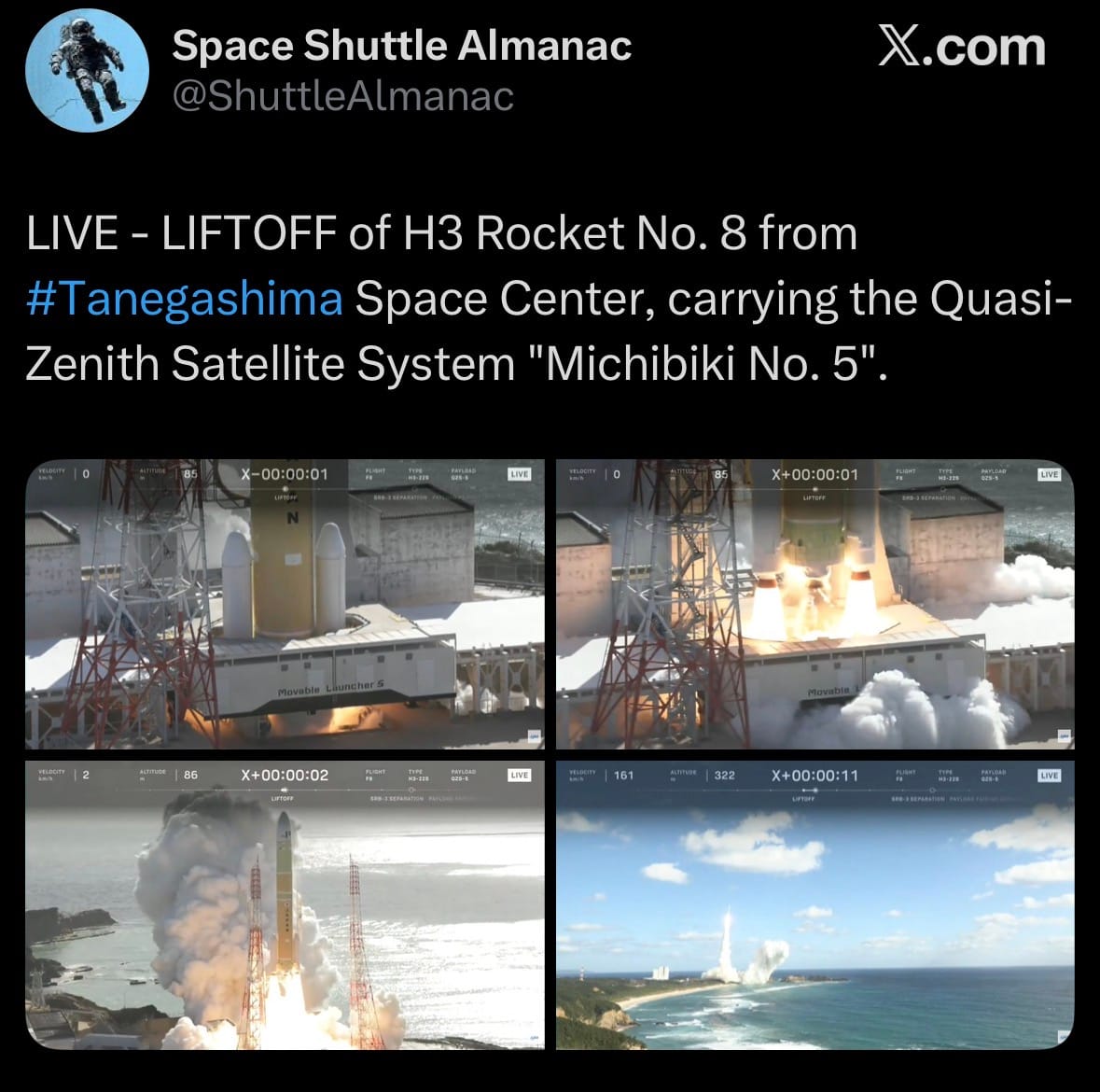
- Michibiki 5, developed by the Cabinet Office and manufactured by Mitsubishi Electric, expands Japan's Quasi-Zenith Satellite System (QZSS) toward a seven-satellite constellation, enhancing GPS augmentation for high-accuracy positioning (centimeter-level via signals like MADOCA-PPP) in urban canyons, mountainous areas, and the Asia-Oceania region. It joins the existing four operational satellites plus replacements, improving reliability, disaster messaging (e.g., J-Alert integration), and inter-satellite ranging for reduced orbit/clock errors. Future launches of QZS-6 and QZS-7 will complete the seven-satellite setup, enabling independent regional navigation without full GPS reliance, with long-term plans for an 11-satellite network.
Statistic:
- Largest assets on Earth by market capitalization:
- Gold: $30.766T
- 🇺🇸 NVIDIA: $4.406T
- 🇺🇸 Apple: $4.061T
- Silver: $3.903T
- 🇺🇸 Alphabet (Google): $3.725T
- 🇺🇸 Microsoft: $3.611T
- 🇺🇸 Amazon: $2.430T
- Bitcoin: $1.771T
- 🇺🇸 Meta Platforms: $1.660T
- 🇺🇸 Broadcom: $1.613T
- 🇺🇸 Tesla: $1.600T
- 🇸🇦 Saudi Aramco: $1.536T
- 🇹🇼 TSMC: $1.498T
- 🇺🇸 Berkshire Hathaway: $1.066T
- 🇺🇸 Eli Lilly: $960.49B
- 🇺🇸 Walmart: $911.77B
- 🇺🇸 JPMorgan Chase: $872.24B
- 🇺🇸 Vanguard S&P 500 ETF: $822.55B
- 🇺🇸 iShares Core S&P 500 ETF: $757.85B
- 🇨🇳 Tencent: $726.10B
- 🇺🇸 SPDR S&P 500 ETF: $699.90B
- 🇺🇸 Visa: $674.01B
- 🇺🇸 Vanguard Total Stock Market Index Fund ETF Shares: $567.19B
- 🇺🇸 Oracle: $551.55B
- Platinum: $524.42B
History:
- The bomber’s history begins with the moment aircraft proved they could carry weight beyond their own survival. In 1911, Italian forces dropped grenades from airplanes during the Italo-Turkish War, marking the first recorded aerial bombing. World War I accelerated the concept: Germany fielded Zeppelin airships and later Gotha bombers to strike cities, while Britain responded with the Handley Page Type O, establishing the idea that airpower could reach behind front lines. Between the wars, theorists like Giulio Douhet argued that strategic bombing—attacking industry, infrastructure, and civilian morale—could decide wars outright. World War II became the brutal testbed for these ideas. Germany used medium bombers like the Heinkel He 111 and Ju 88 for tactical and operational bombing, while Britain and the United States built massive fleets of heavy bombers: the Avro Lancaster, B-17 Flying Fortress, and B-24 Liberator, capable of long-range, high-payload missions. By 1944–1945, bombers had become instruments of total war, culminating in the B-29 Superfortress, which combined pressurization, advanced fire control, and intercontinental reach—and delivered the first nuclear weapons. The jet age followed immediately. In the late 1940s–1950s, bombers like the U.S. B-47 and B-52, Britain’s V-bombers, and the Soviet Tu-95 shifted strategic bombing into the nuclear era, emphasizing altitude, speed, and range to penetrate enemy airspace.
- From the 1960s onward, air defenses forced bombers to evolve again. Surface-to-air missiles and radar made high-altitude penetration dangerous, pushing designs toward low-level flight, electronic warfare, and eventually stealth. The U.S. pioneered this shift most aggressively. The B-1 explored speed and terrain-following flight, while the B-2 Spirit, entering service in 1997, represented a clean break: a flying-wing stealth bomber designed to evade radar rather than outrun it. Capable of delivering both conventional and nuclear payloads globally without forward basing, the B-2 demonstrated that survivability now came from invisibility and networked support. Other nations pursued their own paths—Russia developed long-range bombers like the Tu-160 and modernized the Tu-95, China fielded the H-6 family and is developing the stealth H-20, while Europe and others focused more on strike fighters than true strategic bombers. Today, the bomber’s future is defined by stealth, sensors, and integration. The U.S. B-21 Raider, entering service in the mid-2020s, pushes stealth further with open-architecture systems designed to evolve against future defenses, making it the most survivable and adaptable bomber ever built. It anchors a global strike doctrine unmatched by any other nation, combining low observability, long range, and flexible payloads. While other countries maintain capable bomber forces, the United States now dominates the strategic bomber domain through a combination of stealth technology, global logistics, and decades of operational integration—turning bombers from blunt instruments of mass destruction into precision tools of deterrence, signaling, and power projection in a contested world.
Image of the day:

Thanks for reading! Earth is complicated, we make it simple.

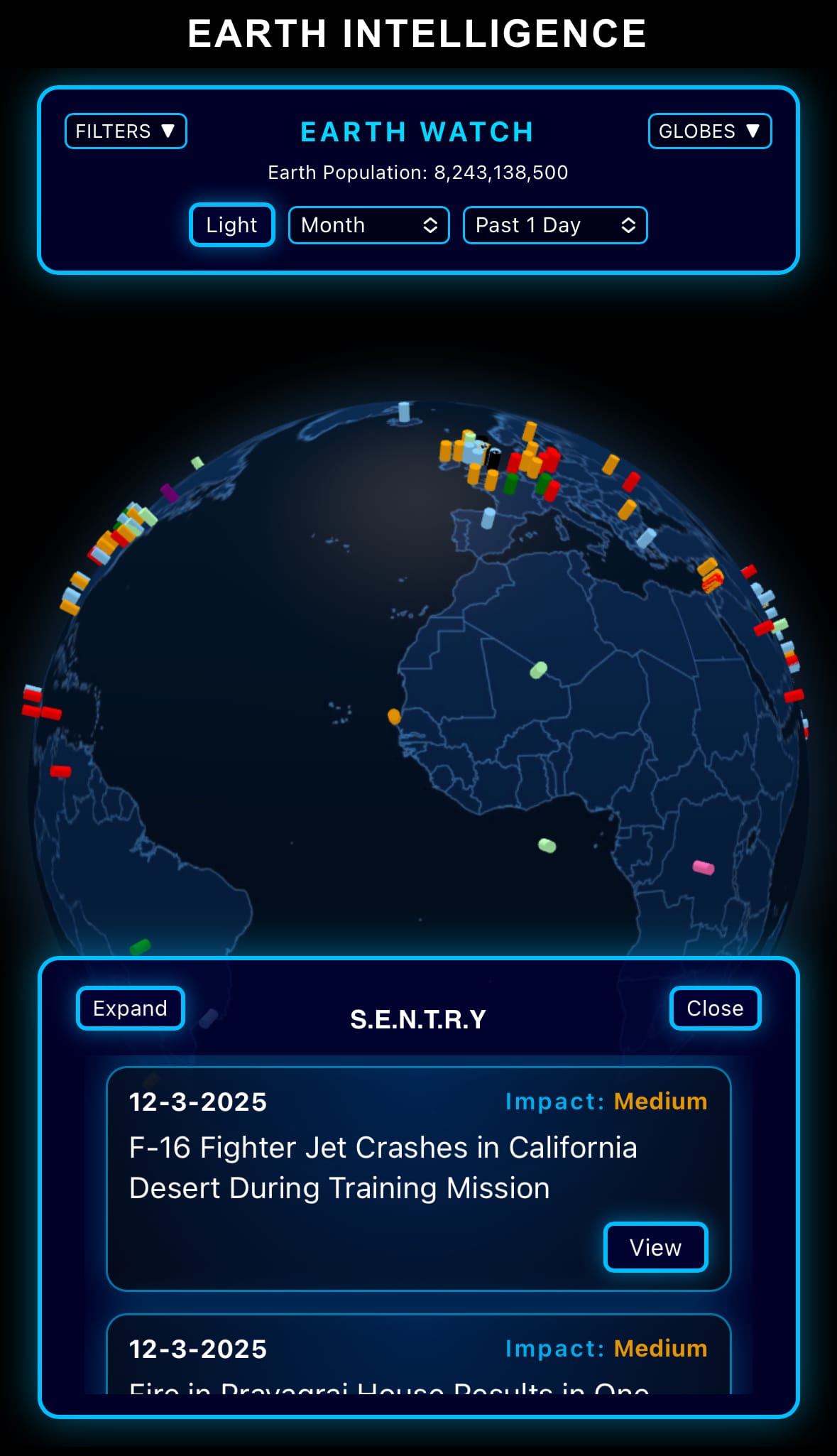
- Click below if you’d like to view our free EARTH WATCH globe:
- Download our mobile app:


Click below to view our previous newsletters:

Support/Suggestions Email:
earthintelligence@earthintel.news