Monday☕️


Trending:
- As of January 11, 2026, protests against Iran's government marked their 19th consecutive day, with demonstrations reported in over 160 cities across all 31 provinces, including intensified activity in Tehran, Isfahan, and Kurdish-majority western areas. Security forces clashed with protesters in multiple locations, using tear gas, batons, and live ammunition, resulting in an estimated death toll of at least 65-203 (per human rights groups and activists, with state media reporting lower figures) and over 2,300 arrests. The unrest, sparked by economic strikes over the rial's collapse and inflation above 40%, has broadened to demands for political change, including chants against Supreme Leader Ali Khamenei and calls for regime reform or replacement.

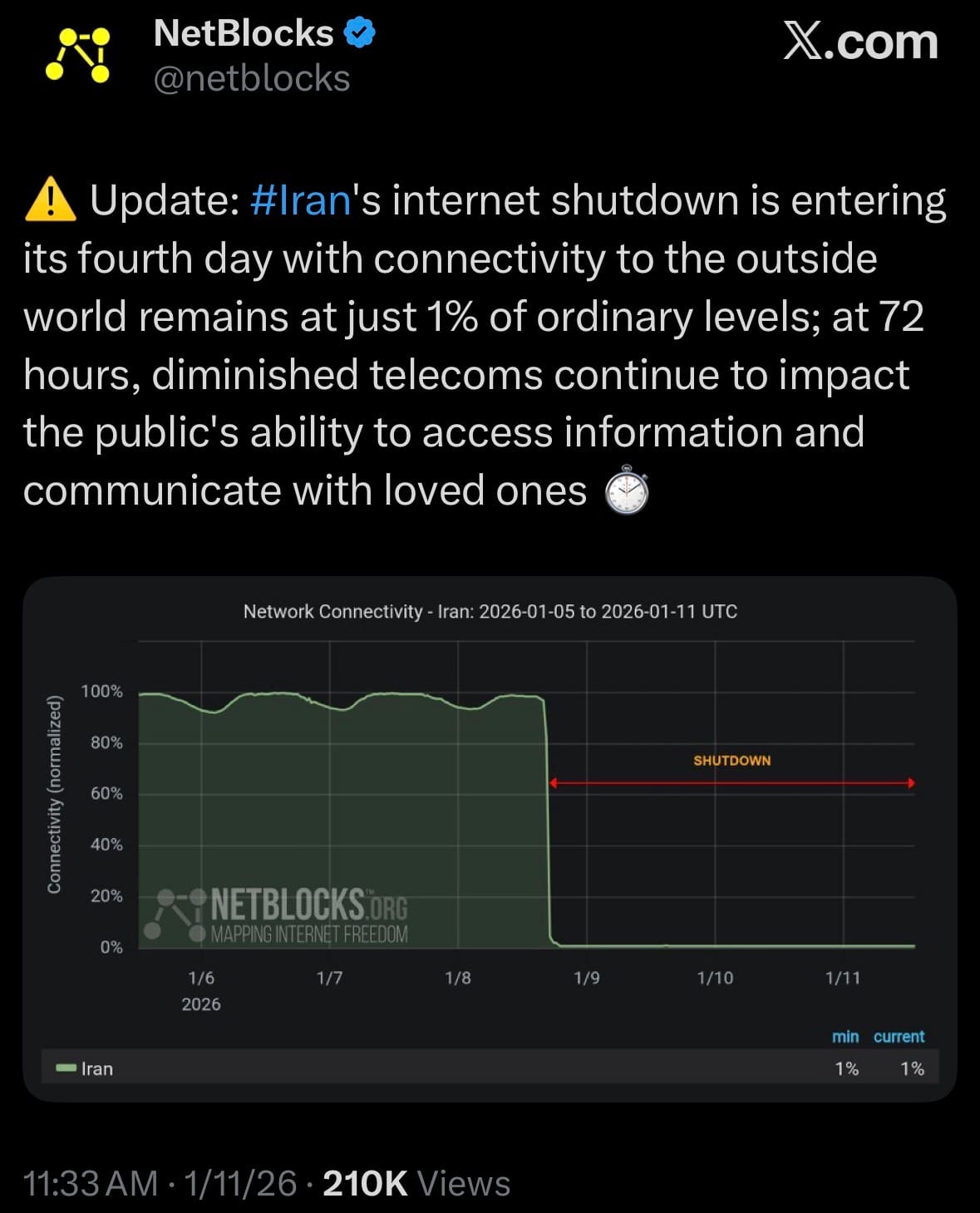
- Iranian authorities imposed a near-total internet blackout starting January 8, restricting mobile data, social media, and international calls to limit communication and media coverage of the protests, according to monitors like NetBlocks. Some Iranians have bypassed restrictions using VPNs or satellite links like Starlink, but the blackout has hindered reporting and organization. Separately, in Westwood, Los Angeles, California, a U-Haul truck drove into a crowd during an anti-Iranian regime rally on January 11, injuring at least two protesters; the driver was arrested by LAPD, with the incident under investigation as intentional, amid global solidarity events for Iran's demonstrators.
Economics & Markets:
- Yesterday’s commodity market:

- Yesterday’s crypto market:

Geopolitics & Military Activity:
- On January 10, 2026, U.S. Central Command (CENTCOM) forces, alongside partner forces, conducted large-scale airstrikes against multiple Islamic State (ISIS) targets across Syria. The strikes occurred around 12:30 p.m. Eastern Time and involved more than 20 aircraft (including F-15E Strike Eagles, A-10 Thunderbolt IIs, AC-130J gunships, MQ-9 Reapers, and Jordanian F-16s), firing over 90 precision munitions at more than 35 sites, including arms depots and supply lines. CENTCOM released unclassified video footage showing aircraft takeoffs and strikes, with no immediate reports of casualties or collateral damage.

- These actions are part of Operation Hawkeye Strike, launched on December 19, 2025, at the direction of President Trump in direct response to the December 13, 2025, ambush in Palmyra, Syria, where a lone gunman (suspected ISIS affiliate) killed two U.S. Army soldiers (Sgt. Edgar Brian Torres-Tovar and Sgt. William Nathaniel Howard from the Iowa National Guard) and one U.S. civilian interpreter, wounding three others. The operation follows earlier strikes that hit over 70 targets, with CENTCOM stating the ongoing campaign aims to degrade ISIS capabilities, prevent future attacks, and protect U.S. and partner forces in the region. This reflects sustained U.S. counterterrorism efforts in Syria amid ISIS remnants posing threats post-Assad regime change.
Space:
- On January 11, 2026, SpaceX successfully launched NASA's Pandora small satellite as part of the Twilight rideshare mission aboard a Falcon 9 rocket from Space Launch Complex 4E at Vandenberg Space Force Base in California. Liftoff occurred at 5:44 a.m. PST (13:44 UTC), deploying Pandora along with 39 other payloads into a sun-synchronous low Earth orbit. The 716-pound (325 kg) spacecraft separated successfully after about two and a half hours, with the first-stage booster (B1097 on its fifth flight) landing at Landing Zone 4. This marked NASA's first launch of 2026 and SpaceX's inaugural orbital mission of the year from the West Coast.

- Pandora, selected under NASA's Astrophysics Pioneers Program, is designed to characterize the atmospheres of at least 20 exoplanets and the activity of their host stars using a 17-inch (45 cm) telescope for transit observations over its one-year science operations phase. The mission aims to provide insights into atmospheric compositions, including hazes, clouds, and water vapor, enhancing understanding of planetary habitability beyond our solar system. Two other NASA-sponsored CubeSats—BlackCAT and SPARCS—were also deployed on the flight for related astrophysics studies. This launch advances low-cost, innovative space science while demonstrating rideshare efficiencies for multiple payloads.

Statistic:
- Largest assets on Earth by market capitalization:
- Gold: $32.027T
- Silver: $4.686T
- 🇺🇸 NVIDIA: $4.499T
- 🇺🇸 Alphabet (Google): $3.973T
- 🇺🇸 Apple: $3.832T
- 🇺🇸 Microsoft: $3.562T
- 🇺🇸 Amazon: $2.644T
- Bitcoin: $1.813T
- 🇹🇼 TSMC: $1.678T
- 🇺🇸 Meta Platforms (Facebook): $1.646T
- 🇺🇸 Broadcom: $1.635T
- 🇸🇦 Saudi Aramco: $1.562T
- 🇺🇸 Tesla: $1.480T
- 🇺🇸 Berkshire Hathaway: $1.076T
- 🇺🇸 Eli Lilly: $953.43B
- 🇺🇸 Walmart: $913.13B
- 🇺🇸 JPMorgan Chase: $905.19B
- 🇺🇸 Vanguard S&P 500 ETF: $836.64B
- 🇺🇸 iShares Core S&P 500 ETF: $763.19B
- 🇺🇸 SPDR S&P 500 ETF: $719.87B
- 🇨🇳 Tencent: $713.83B
- 🇺🇸 Visa: $675.02B
- 🇰🇷 Samsung: $641.07B
- Platinum: $598.20B
- 🇺🇸 Vanguard Total Stock Market Index Fund ETF: $577.62B
History:
- Database technology begins as humanity’s attempt to preserve memory outside the human mind. Long before computers, early civilizations built proto-databases using physical records: clay tablets in Mesopotamia around 3000 BC to track grain and taxes, papyrus rolls in Egypt, census ledgers in Rome and Han China. These systems established enduring principles—structured records, authoritative storage, retrieval, and consistency. In the industrial age, data management became mechanical. The breakthrough came in 1890, when Herman Hollerith introduced punch-card tabulation for the U.S. Census, allowing data to be stored, sorted, and counted at scale. This concept—data separated from human memory and processed mechanically—directly led to IBM and modern information processing. Early electronic computers in the 1950s–1960s stored data in flat files and hierarchical or network databases tightly coupled to application code. These systems worked, but they were rigid: changing data structures meant rewriting entire programs. Data existed to serve software, not the other way around.
- The modern database era begins in 1970, when Edgar F. Codd introduced the relational model. This was a foundational shift: data organized into tables with defined schemas, relationships expressed mathematically, and queries written declaratively rather than procedurally. This abstraction separated data from application logic and made systems far more flexible. Through the 1970s–1990s, relational databases dominated enterprise computing, powered by SQL (Structured Query Language) and systems such as Oracle, PostgreSQL (1986), MySQL (1995), IBM DB2, and Microsoft SQL Server. These databases excelled at structured data—rows, columns, transactions—and enforced strong consistency through ACID guarantees, making them ideal for finance, records, and operational systems. As the internet scaled in the 2000s, however, data began to change shape. Web applications generated massive volumes of logs, messages, documents, and media that didn’t fit cleanly into tables. This pressure gave rise to semi-structured data, commonly stored in formats like JSON, XML, and later Parquet, where records have flexible schemas. At the same time, NoSQL systems emerged—key-value stores, document databases, column-family stores, and graph databases—trading strict consistency for horizontal scalability and availability in distributed environments.
- Today’s database landscape is not one system but an ecosystem. Structured databases like PostgreSQL and SQL Server remain central for transactional integrity and complex queries. Semi-structured databases natively handle JSON documents, allowing flexible data models without losing query power—modern PostgreSQL, for example, blends relational structure with JSON support. Unstructured data—text, images, video, audio—lives in object storage and search systems, processed by indexing engines, machine learning pipelines, and increasingly vector databases designed for AI and semantic search. Specialized databases now dominate specific workloads: time-series databases for metrics and sensors, graph databases for relationships and networks, columnar warehouses for analytics at petabyte scale. Cloud-native architecture has pushed databases toward global distribution, replication, and managed services, while AI-driven workloads are reshaping how data is stored and retrieved. Across all of this evolution, the core purpose remains unchanged from ancient ledgers to modern systems: impose structure on memory, preserve truth over time, and allow humans and machines to ask increasingly complex questions of the past. What has changed is scale—today’s databases are no longer just storage systems; they are the computational backbone of modern civilization, powering finance, intelligence, science, logistics, and artificial intelligence at planetary scale.
Image of the day:

Thanks for reading! Earth is complicated, we make it simple.
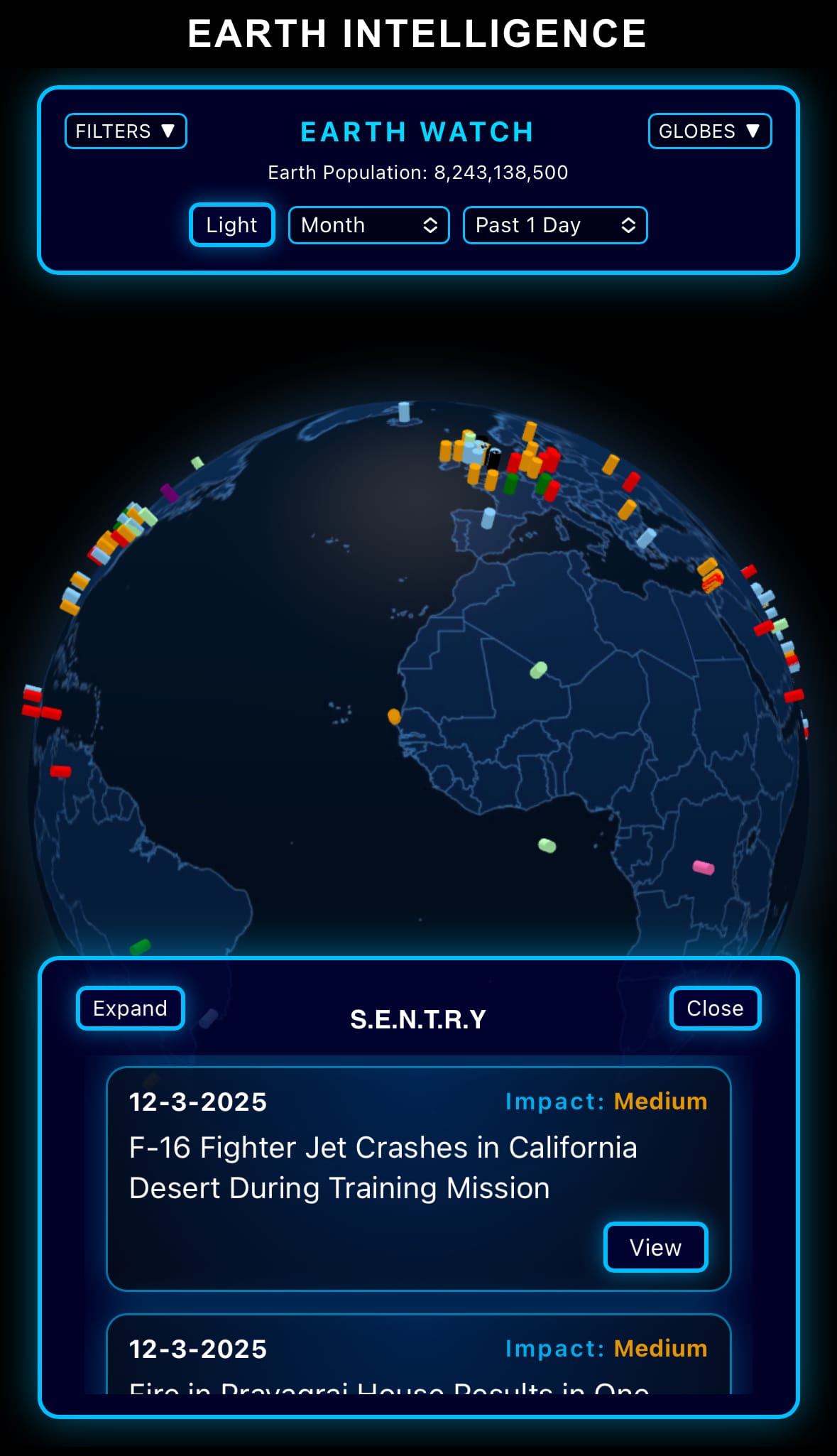
- Click below if you’d like to view our free EARTH WATCH globe:
- Download our mobile app:



Click below to view our previous newsletters:

Support/Suggestions Email:
earthintelligence@earthintel.news