Monday☕️


Trending:
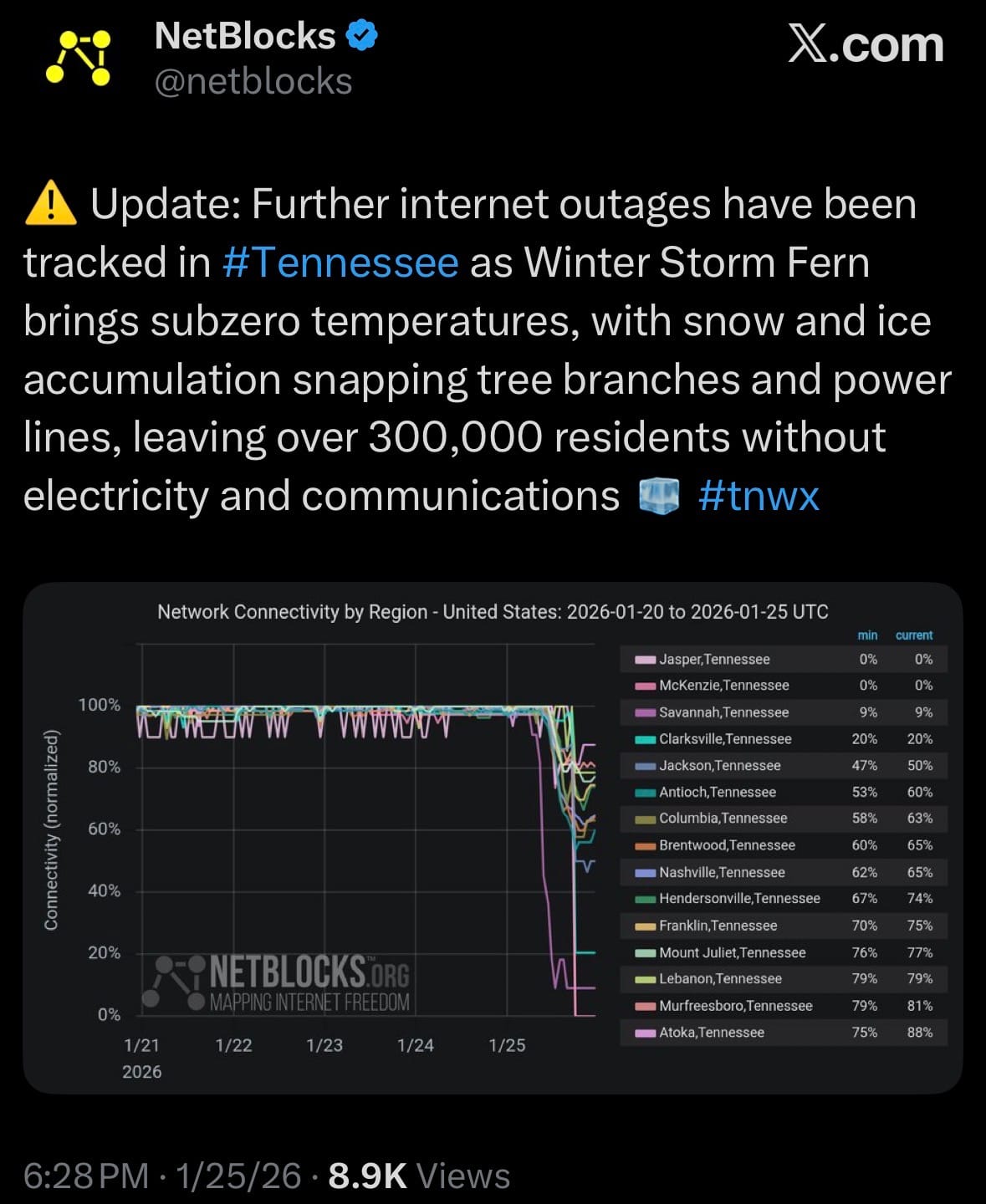
- As of January 25, 2026, a massive winter storm continues to impact much of the eastern and southern U.S., with over 1 million customers without power (primarily in Tennessee, Mississippi, Louisiana, Texas, Kentucky, and other states) due to heavy ice accumulation downing lines and trees. The National Weather Service (NWS) has described conditions as life-threatening, with widespread winter storm warnings, ice storm warnings, and extreme cold alerts affecting tens of millions across a corridor from the southern Plains through the Northeast.
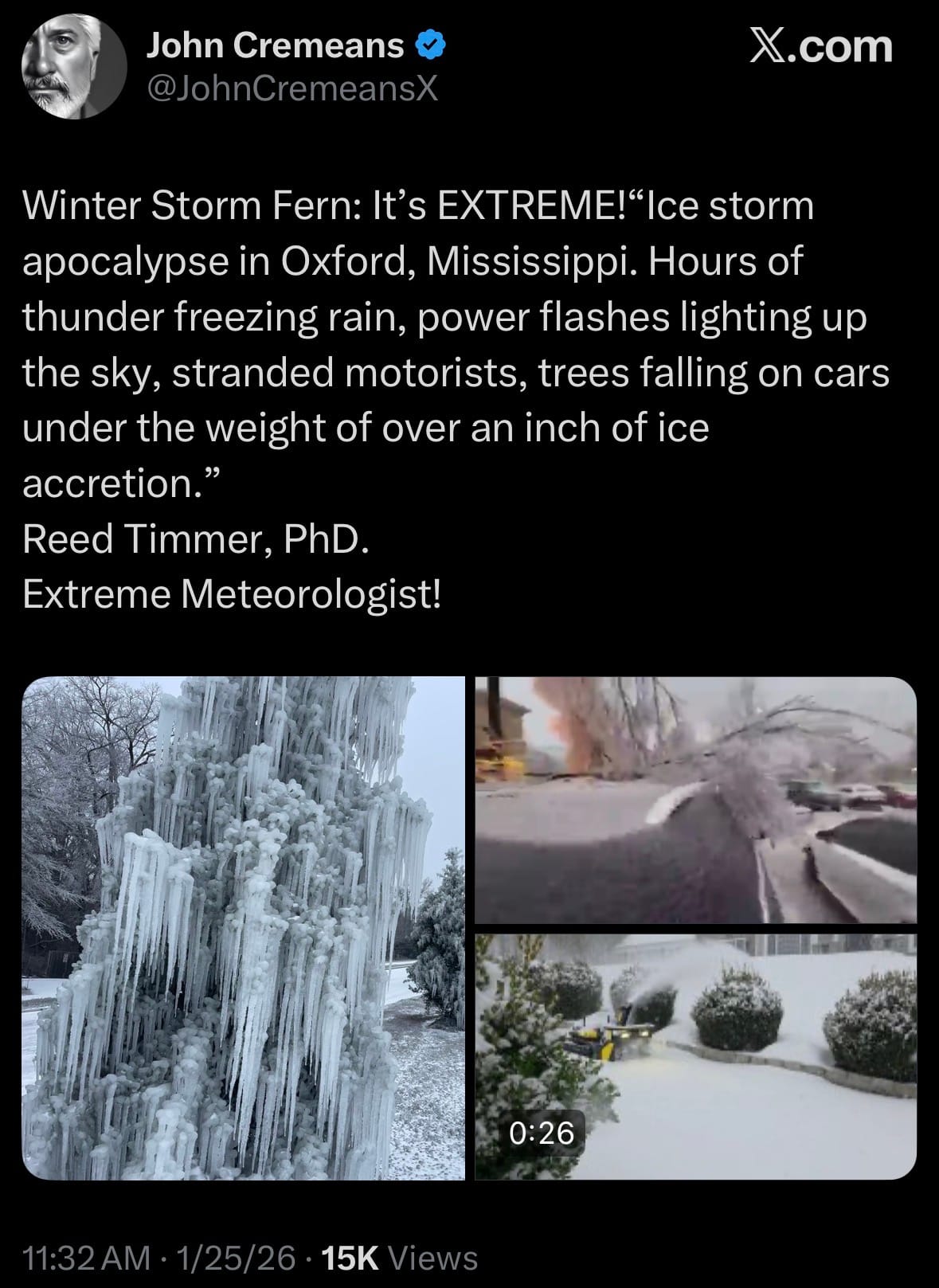
- For the coming days, the NWS forecasts lingering hazardous weather through early next week: heavy snow and sleet are expected to taper off in the Northeast by Monday evening (January 26), with totals of 12–18 inches possible in parts of Pennsylvania, New York, New England, and the Mid-Atlantic, though accumulations vary locally and may be lower near coasts. Behind the storm, bitterly cold temperatures and subzero wind chills (potentially -20°F or lower in the Northern Plains and upper Midwest) will persist into the workweek, keeping ice frozen on lines and roads, which could prolong power outages for days in affected areas. Freezing rain and ice threats may ease in the South and Mid-Atlantic sooner, but dangerous travel, tree damage, and infrastructure strain remain concerns, with recovery efforts ongoing amid multiple state emergency declarations and federal assistance approvals.
Economics & Markets:
- As of January 25, 2026, Europe’s primary aluminum production has collapsed sharply due to long-term smelter closures and idling—most notably Slovakia’s Slovalco plant, fully shut since early 2023 because of soaring energy costs—combined with new Chinese export controls on critical minerals and additives needed for aluminum alloys. Annual output has dropped to roughly 6–7 million tons, far below demand, forcing heavy reliance on imports.
- The EU’s Carbon Border Adjustment Mechanism (CBAM), fully in effect since January 1, 2026, adds a carbon tax on imported metals, creating a difficult situation: Europe penalizes high-carbon imports while its own cleaner but more expensive smelters stay offline due to energy prices. Slovak Prime Minister Robert Fico has urged restarting Slovalco and called for EU help or changes to emissions rules to revive the sector. China’s restrictions—often justified as environmental measures—have tightened supplies of key inputs like magnesium, raising costs and threatening aerospace, defense, and automotive industries. Markets remain volatile with low stocks for related metals, but no full continent-wide shutdowns have occurred yet; analysts warn of ongoing risks to downstream manufacturing if restarts or new sources don’t emerge soon.
- Yesterday’s commodity market:

- Yesterday’s crypto market:

Geopolitics & Military Activity:
- On January 25, 2026, Israeli airstrikes continued in southern Lebanon, with Lebanese sources reporting multiple strikes in the Al-Jabour (or Jabour) area, as well as nearby locations like Meidoun, Wadi Baraghz, Al-Reihan, Raghaz, and surrounding valleys. Reports from local media and monitoring channels indicated 12–15 airstrikes (some sources cited up to 14 using heavy munitions) carried out in quick succession, with warplanes flying at low to medium altitudes over the region.
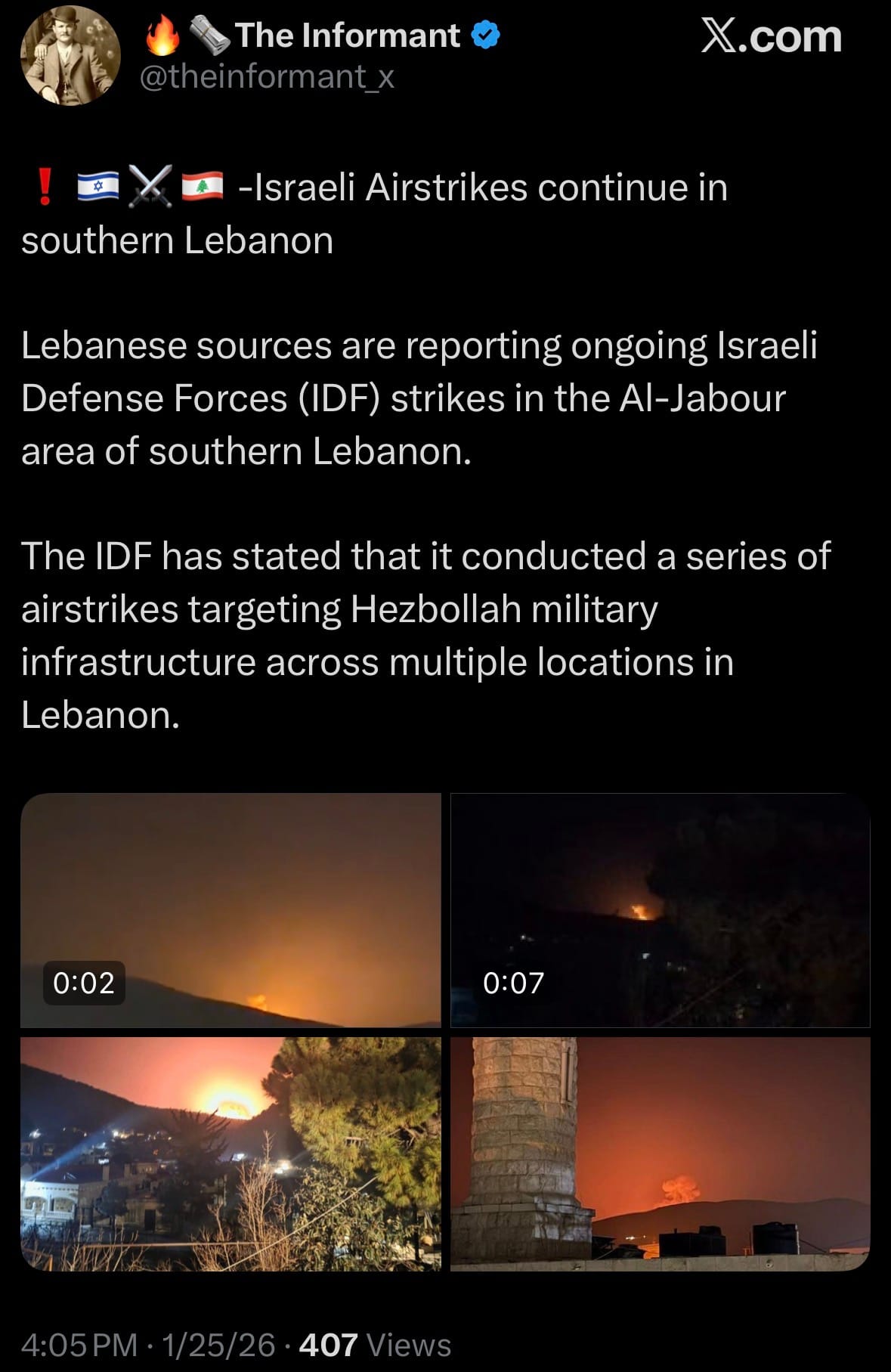
- The Israel Defense Forces (IDF) stated that the strikes targeted Hezbollah military infrastructure, including alleged rocket sites, training camps, weapons manufacturing facilities, and operatives across southern Lebanon. The IDF described the actions as responses to Hezbollah threats or ceasefire violations, with some strikes resulting in casualties (reports vary from 2 killed and several injured, including Hezbollah members, to claims of targeting specific figures like an artillery chief). These incidents occurred despite the November 2024 ceasefire agreement aimed at reducing hostilities, with both sides accusing each other of violations.
Space:
- On January 25, 2026, SpaceX successfully launched the Starlink Group 17-20 mission (also referred to as Starlink-348 in some tracking) from Space Launch Complex 4 East (SLC-4E) at Vandenberg Space Force Base in California. A Falcon 9 Block 5 rocket lifted off at 9:30 a.m. PST (17:30 UTC), deploying 25 Starlink satellites into a polar low-Earth orbit on a southerly trajectory.
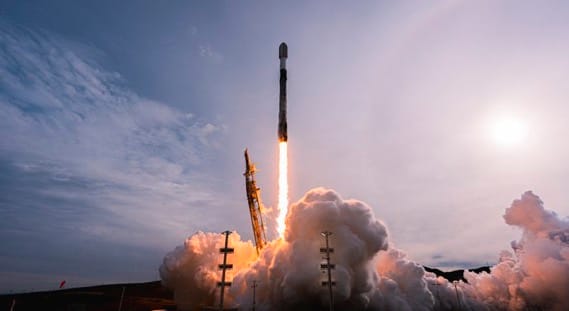
- The first-stage booster (B1097-6) landed successfully on the droneship Of Course I Still Love You (OCISLY) in the Pacific Ocean. SpaceX confirmed full satellite deployment about an hour after launch, with no issues reported. This was SpaceX's 10th Falcon 9 launch of 2026 and a routine addition to the Starlink constellation for global broadband coverage.
Statistic:
- Largest assets on Earth by market capitalization:
- Gold – $34.987T
- Silver – $5.904T
- 🇺🇸 NVIDIA – $4.569T
- 🇺🇸 Alphabet (Google) – $3.964T
- 🇺🇸 Apple – $3.665T
- 🇺🇸 Microsoft – $3.463T
- 🇺🇸 Amazon – $2.556T
- 🇹🇼 TSMC – $1.736T
- Bitcoin – $1.729T
- 🇺🇸 Meta Platforms – $1.660T
- 🇸🇦 Saudi Aramco – $1.633T
- 🇺🇸 Broadcom – $1.516T
- 🇺🇸 Tesla – $1.493T
- 🇺🇸 Berkshire Hathaway – $1.033T
- 🇺🇸 Eli Lilly – $954.08B
- 🇺🇸 Walmart – $938.64B
- 🇺🇸 Vanguard S&P 500 ETF (VOO) – $848.20B
- 🇺🇸 JPMorgan Chase – $810.47B
- 🇺🇸 iShares Core S&P 500 ETF (IVV) – $761.60B
- 🇺🇸 SPDR S&P 500 ETF (SPY) – $714.40B
- 🇰🇷 Samsung – $703.57B
- 🇨🇳 Tencent – $692.10B
- Platinum – $690.20B
- 🇺🇸 Visa – $629.49B
- 🇺🇸 Vanguard Total Stock Market ETF (VTI) – $579.93B
- 🇺🇸 Exxon Mobil – $575.41B
- 🇳🇱 ASML – $539.15B
- 🇺🇸 Johnson & Johnson – $530.38B
- 🇺🇸 Oracle – $509.00B
- 🇺🇸 Mastercard – $474.37B
History:
- Weather prediction begins as human pattern recognition and becomes one of the most computationally intensive sciences ever built, because the atmosphere is a chaotic, global fluid system. For most of history, forecasting meant local intuition—cloud shapes, wind shifts, seasonal memory, pressure-related pain—useful but unreliable beyond a day or two. The scientific turn starts in the 17th century when humans gain the ability to measure the atmosphere. The barometer (1643) makes air pressure visible; thermometers and hygrometers soon follow, turning weather from folklore into data. By the 1700s–early 1800s, ships, armies, and trading companies keep systematic logs of wind, storms, and temperature, while tools like the Beaufort wind scale standardize descriptions. The real breakthrough comes in the mid-1800s with the telegraph, which allows simultaneous weather observations from distant locations. This enables synoptic forecasting—mapping the atmosphere at a single moment to understand how large-scale systems move. Governments begin building national meteorological services, weather maps appear with pressure lines and storm tracks, and forecasting becomes a coordinated state function rather than isolated guesswork.
- The 20th century transforms forecasting into applied physics and computation. Scientists realize weather follows the laws of fluid dynamics and thermodynamics, but solving those equations fast enough is the challenge. In 1922, Lewis Fry Richardson attempts the first numerical weather forecast by hand—visionary, but far too slow. The conceptual framework sharpens in the 1920s–1930s with the development of air mass and frontal theory, giving storms a structured, predictable anatomy. World War II accelerates everything: radar reveals storms in real time, radiosondes routinely measure the upper atmosphere, and military urgency funds large-scale forecasting operations. The decisive leap comes in 1950, when early computers produce the first numerical forecasts, launching numerical weather prediction (NWP)—the idea of simulating the atmosphere forward from an observed starting state. From there, progress becomes an arms race in three areas: better observations, better models, and more computing power. Weather satellites beginning in 1960 turn the planet into a continuously observed system. Data assimilation techniques evolve to merge millions of imperfect observations into a coherent “best guess” of the atmosphere. Major forecasting centers emerge—the U.S., Europe, Japan—while ensemble forecasting (widely adopted from the 1990s onward) reframes prediction as probabilities rather than certainties, acknowledging chaos rather than fighting it.
- Today, weather prediction is entering a new phase where traditional physics-based models are being augmented—and in some cases rivaled—by AI-driven forecasting systems. Classical models still dominate operational forecasting, running on supercomputers that simulate atmospheric physics step by step. But these models are expensive, slow, and sensitive to small initial errors. AI approaches attack the problem differently: they learn how the atmosphere evolves by training on decades of global reanalysis data, effectively compressing the planet’s weather behavior into neural networks. Modern AI models can generate global forecasts in seconds, allowing massive ensembles and rapid updates. The future is not physics versus AI, but hybrid systems: physics models enforcing conservation laws and rare extremes, AI models delivering speed, pattern recognition, and probabilistic breadth, and real-time radar and satellite systems dominating short-term “nowcasting.” Weather prediction has evolved from reading clouds to running planetary-scale simulations, and now to machine-learned models that treat Earth’s atmosphere as a continuously monitored, dynamically predicted system—one that underpins aviation, shipping, disaster response, energy grids, agriculture, finance, and climate risk management. Forecasting is no longer about guessing tomorrow’s weather; it is about maintaining continuous situational awareness of a living planetary system.
Image of the day:

Thanks for reading! Earth is complicated, we make it simple.
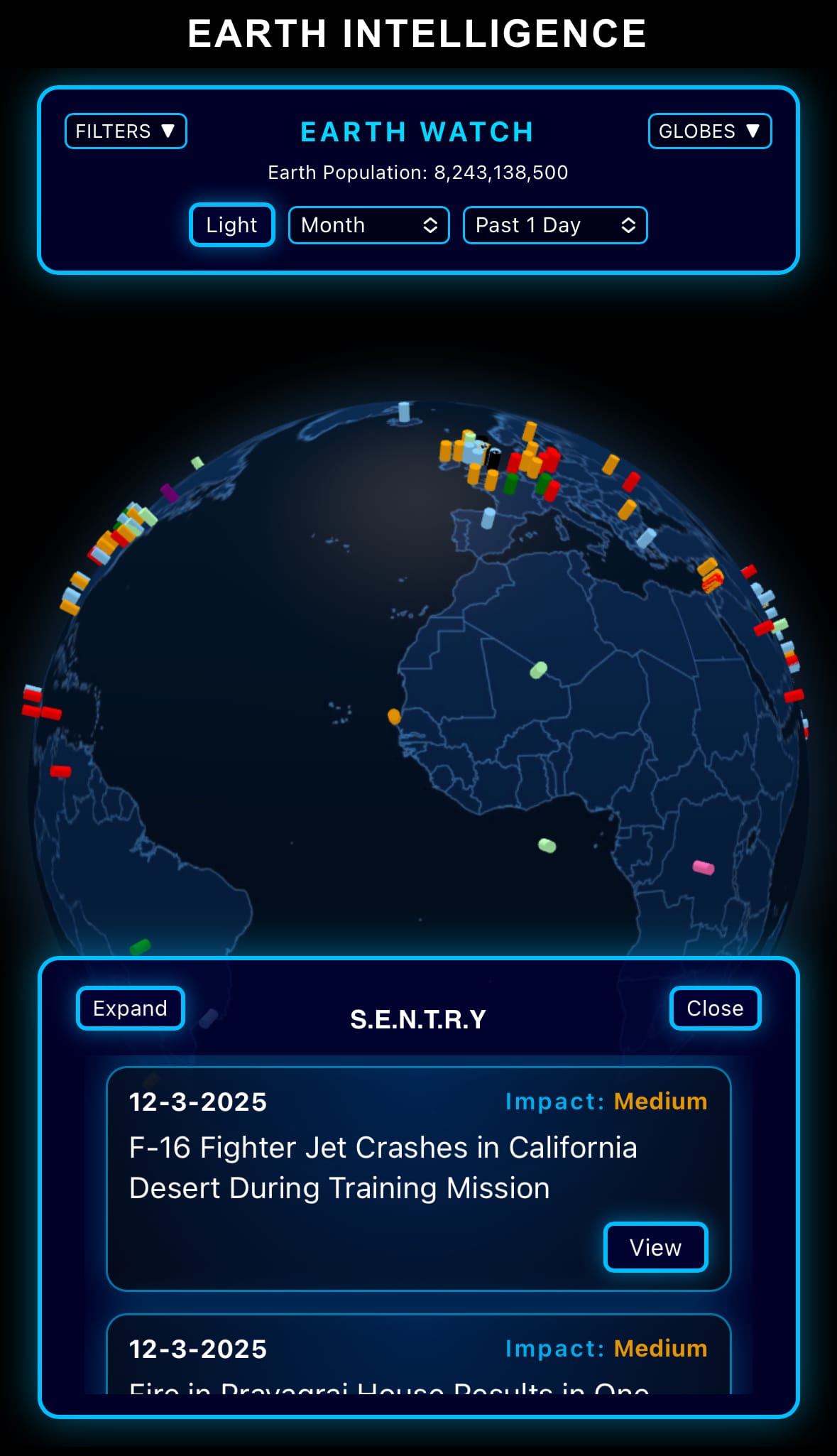
- Click below if you’d like to view our free EARTH WATCH globe:
- Download our mobile app:



Click below to view our previous newsletters:
Support/Suggestions Email:
earthintelligence@earthintel.news