Monday☕️


Trending:
- On January 29, 2026, a Nevada state court in Carson City issued a temporary restraining order (TRO) against Polymarket, operated by Blockratize Inc. The order prohibits the platform from offering event-based contracts—including prediction markets on sports, politics, and other events—to Nevada residents for an initial 14-day period.
- Judge Jason Woodbury ruled in favor of the Nevada Gaming Control Board (NGCB), determining that Polymarket's activities likely violate Nevada state gaming laws (such as NRS 463, which requires a license for wagering) and are not solely under federal Commodity Futures Trading Commission (CFTC) jurisdiction under the Commodity Exchange Act. The TRO remains in effect until a February 11 hearing on whether to grant a preliminary injunction. Polymarket has already restricted event contracts for Nevada users in response.
Economics & Markets:
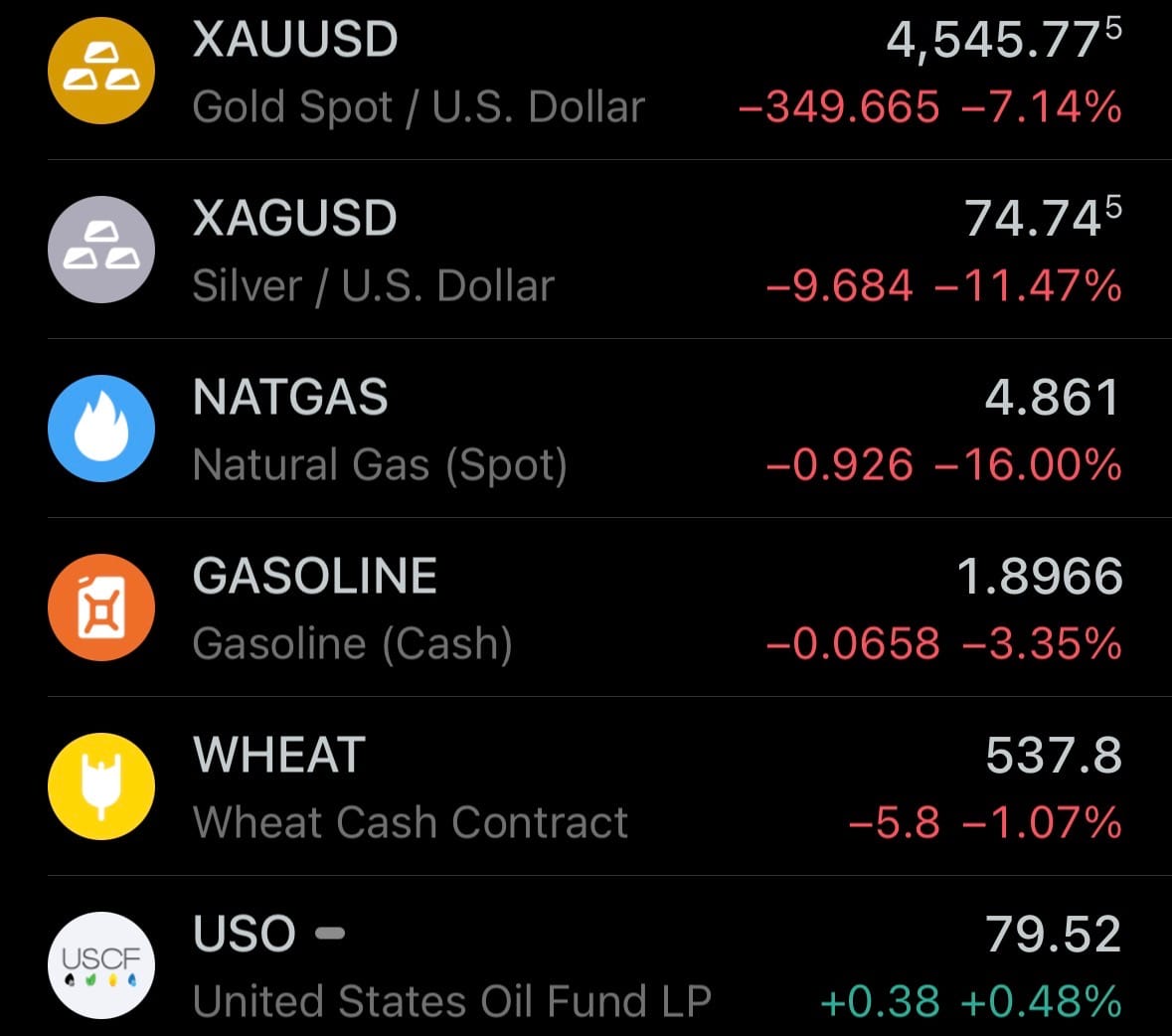
- Today’s commodity market:
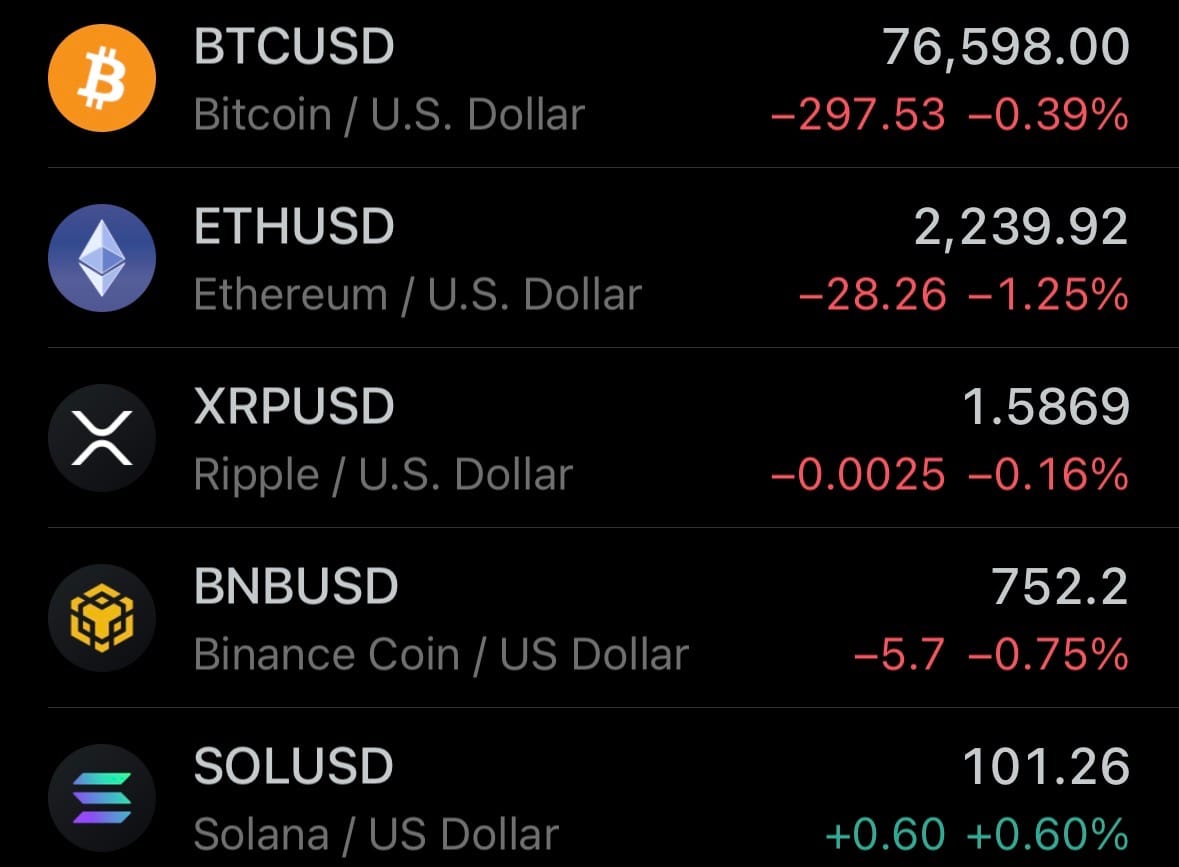
- Today’s crypto market:
Geopolitics & Military Activity:
- On February 2, 2026, Germany officially placed two combat battalions under the command of the Lithuania-based Bundeswehr brigade (known as the Forward Command Element or the enhanced Forward Presence multinational brigade in Rukla, Lithuania). This marks a significant step in the permanent stationing of German troops in Lithuania as part of NATO's eastern flank reinforcement.
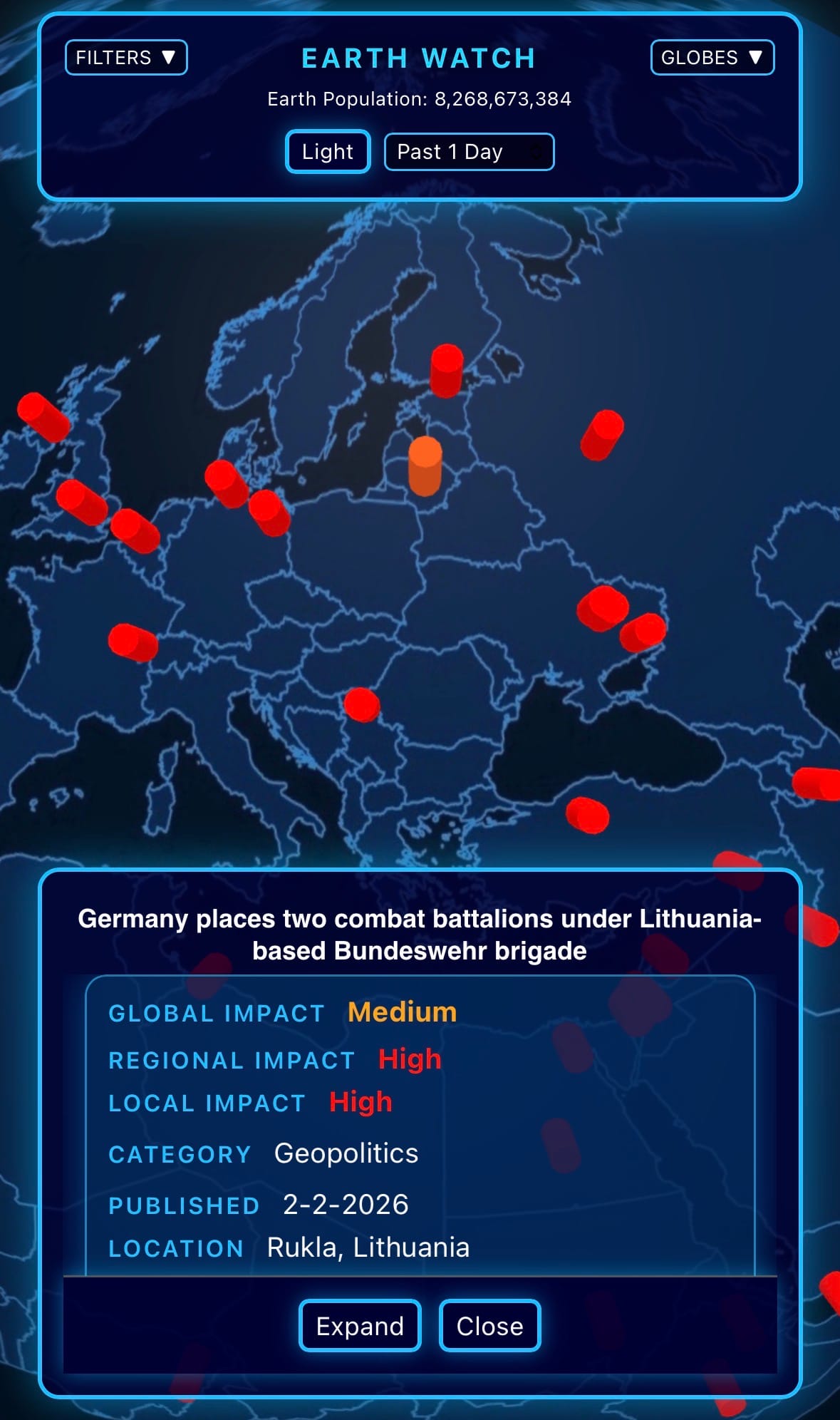
- The two battalions—a mechanized infantry battalion and a tank battalion—will form the core of Germany's contribution to the brigade, which is being expanded into a full multinational division-level capability by 2027. Approximately 4,800 German soldiers are now assigned long-term to Lithuania, with family accommodations, infrastructure upgrades, and joint training already underway. The move strengthens NATO's deterrence posture against potential Russian aggression, builds on the 2023 Germany-Lithuania agreement for permanent basing, and aligns with Berlin's increased defense spending and troop commitments to the alliance's eastern border.
Environment & Weather:
- On February 1, 2026 (evening U.S. time), the Sun unleashed a powerful X8.1 solar flare from sunspot region 4366—one of the strongest flares of the current solar cycle—followed by an X2.9 flare shortly after midnight on February 2. These flares caused strong (R3-level) radio blackouts on the sunlit side of Earth, mainly disrupting high-frequency radio, some aviation and maritime communications, especially over the Pacific east of Australia and other dayside areas.
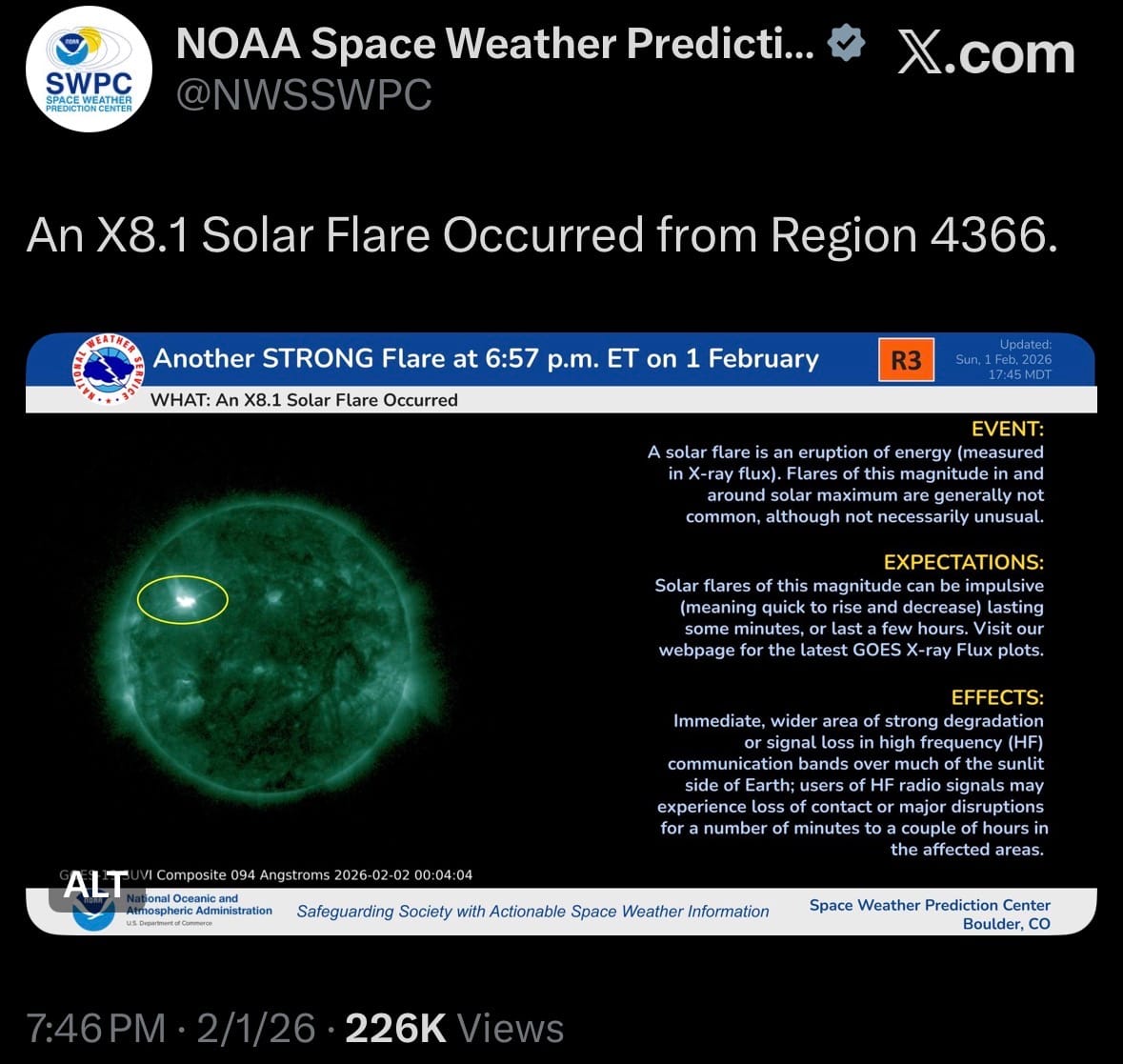
- As of February 2, 2026, the main effects are short-lived radio interference and possible minor GPS/navigation glitches in affected zones. No big geomagnetic storm has started, and no Earth-directed coronal mass ejection (CME) has been confirmed yet—so widespread auroras, power outages, or satellite problems are not expected right now. The sunspot region is still very active and could produce more strong flares in the next few days as it turns more toward Earth. NOAA and other space weather agencies are watching closely for any CMEs that might reach us later this week.
Science & Technology:
- On January 29, 2026, xAI announced the release of Grok Imagine 1.0, described as the biggest upgrade to its AI video generation tool yet. The new version enables 10-second video clips at 720p resolution with significantly improved audio quality, including cleaner, more natural-sounding synchronized sound effects and dialogue.
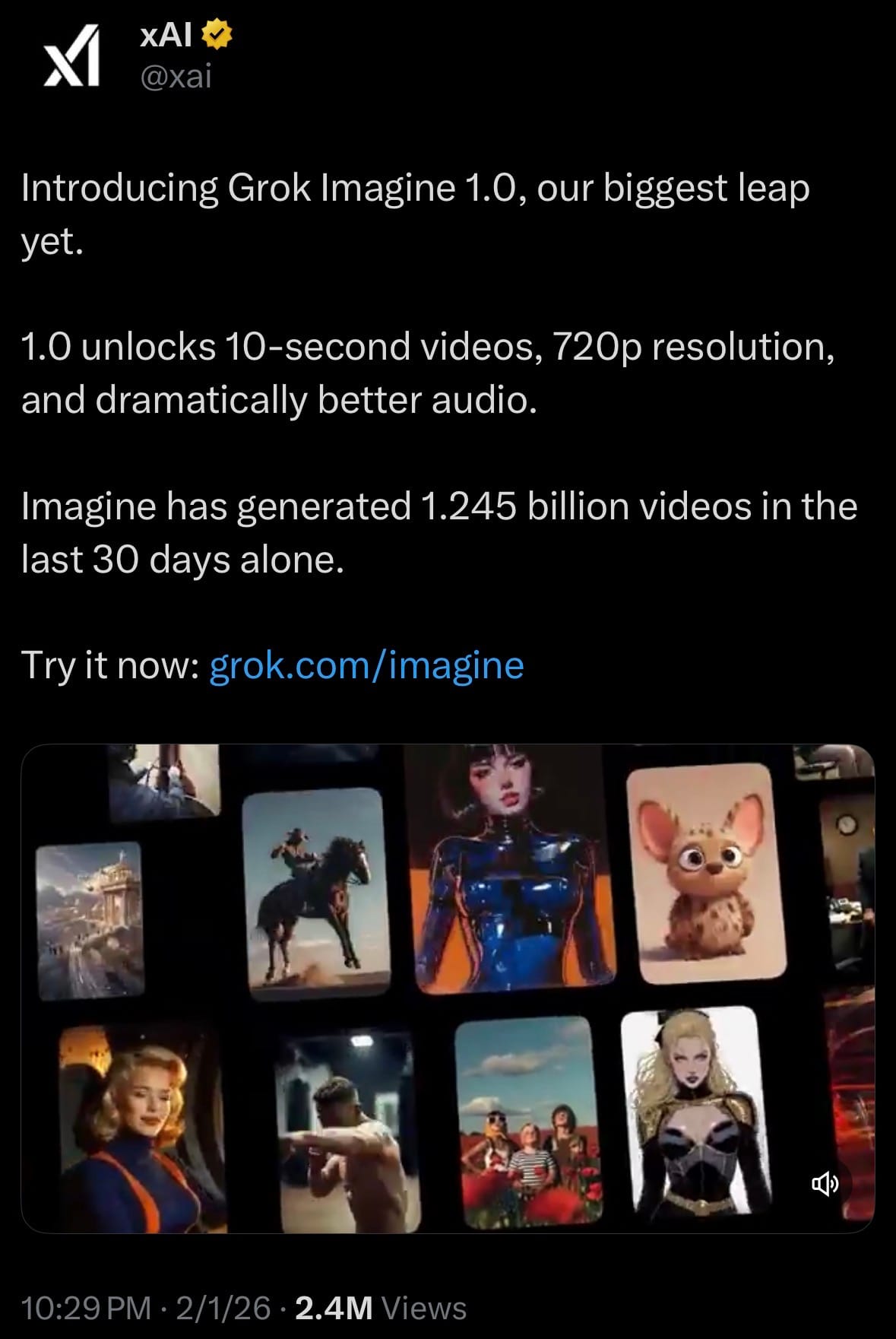
- In the past 30 days alone, Grok Imagine has generated 1.245 billion videos, reflecting massive user adoption since earlier video features launched. The 1.0 update is rolling out immediately to eligible users (typically Premium+ or SuperGrok subscribers) via the Grok app on iOS/Android and web, with no waitlist mentioned. Early examples shared show smoother motion, better prompt adherence, and enhanced realism in short clips.
Statistic:
- Largest assets on Earth by market capitalization:
- Gold: $31.633T
- 🇺🇸 NVIDIA: $4.653T
- Silver: $4.260T
- 🇺🇸 Alphabet (Google): $4.086T
- 🇺🇸 Apple: $3.813T
- 🇺🇸 Microsoft: $3.195T
- 🇺🇸 Amazon: $2.558T
- 🇺🇸 Meta Platforms: $1.812T
- 🇹🇼 TSMC: $1.714T
- 🇸🇦 Saudi Aramco: $1.623T
- 🇺🇸 Tesla: $1.615T
- 🇺🇸 Broadcom: $1.570T
- Bitcoin: $1.507T
- 🇺🇸 Berkshire Hathaway: $1.036T
- 🇺🇸 Walmart: $949.88B
- 🇺🇸 Eli Lilly: $929.76B
- 🇺🇸 Vanguard S&P 500 ETF (VOO): $851.40B
- 🇺🇸 JPMorgan Chase: $832.71B
- 🇺🇸 iShares Core S&P 500 ETF (IVV): $763.97B
- 🇺🇸 SPDR S&P 500 ETF (SPY): $710.84B
- 🇰🇷 Samsung: $692.72B
- 🇨🇳 Tencent: $689.21B
- 🇺🇸 Visa: $620.50B
- 🇺🇸 Exxon Mobil: $596.30B
- 🇺🇸 Vanguard Total Stock Market ETF (VTI): $579.95B
History:
- The history of phones begins as the quest to transmit the human voice across distance, but it quickly becomes about compressing time, authority, and decision-making. Early concepts appeared in the mid-1800s, when inventors explored converting sound into electrical signals. The decisive breakthrough came in 1876 with Alexander Graham Bell’s telephone, which turned voice into a continuous electrical waveform that could be sent over wires. Early telephone networks were manual, local, and fragile—operators physically connected calls, and coverage rarely extended beyond cities. Still, the strategic impact was immediate: governments, militaries, and businesses could coordinate faster than ever before. By the early 20th century, national wired telephone networks expanded rapidly, supported by switchboards, copper lines, and later automated exchanges. During World War I and World War II, telephony became a command-and-control backbone—secure landlines linked headquarters, factories, ports, and frontline units. Militaries quickly learned that phones were both powerful and dangerous: tapping lines, intercepting calls, and cutting cables became routine intelligence tactics. This pushed early development of encrypted and hardened military communications, while civilian systems emphasized reliability and scale.
- The second revolution came with mobility. Radio telephony emerged in the 1930s–1940s, initially for military and maritime use, allowing voice communication without physical wires. Postwar advances miniaturized electronics, and by the 1970s–1980s, the first cellular networks appeared, dividing territory into cells to reuse frequencies efficiently. Early mobile phones were bulky, expensive, and limited, but they solved a fundamental problem: communication anywhere, not just at fixed points. Digital cellular standards in the 1990s transformed phones into data devices—text messaging, digital voice, and early encryption entered mass use. Militaries evolved in parallel, deploying secure radios, encrypted satellite phones, and hardened mobile terminals to support distributed operations across land, sea, and air. By the late 1990s and early 2000s, phones were no longer just voice tools; they were identity devices, authentication tokens, and gateways into digital networks. Control of mobile infrastructure—cell towers, switching centers, spectrum—became a strategic national concern.
- The modern smartphone era detonated in the late 2000s, when phones converged computing, sensing, and networking into a single pocket-sized platform. Smartphones became personal command centers: GPS navigation, encrypted messaging, high-resolution cameras, biometric authentication, and constant internet access reshaped civilian life and military operations alike. For civilians, smartphones became the dominant personal computing platform on Earth. For militaries and governments, they became both asset and liability. Advanced military and secure phones now exist as hardened, encrypted variants—designed to resist interception, malware, location tracking, and compromise—often operating on protected networks, satellite links, or classified infrastructure. Modern phones also act as sensors in a larger system, feeding data into intelligence, logistics, and command networks. Today’s phone is no longer just a communication device; it is a node in a global information grid. From copper wires and switchboards to encrypted smartphones and military-grade secure devices, the evolution of phones mirrors the evolution of power itself: faster decisions, tighter coordination, and greater reach—balanced against the constant risk that whoever controls the network, the software, or the timing controls the conversation.
Image of the day:

Thanks for reading! Earth is complicated, we make it simple.
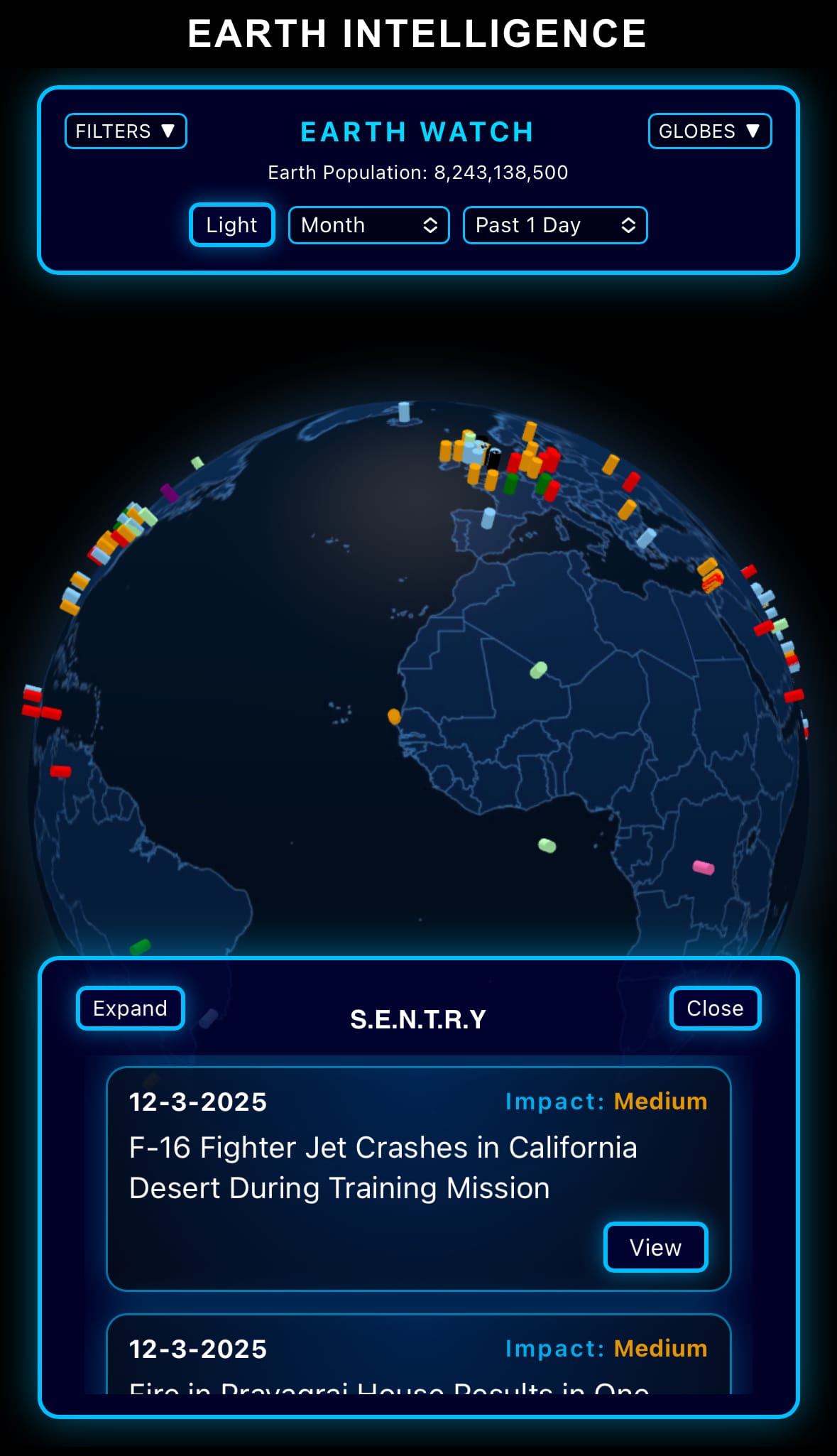
- Click below if you’d like to view our free EARTH WATCH globe:
- Download our mobile app:



Click below to view our previous newsletters:

Support/Suggestions Email:
earthintelligence@earthintel.news