Monday☕️


Trending:
- On February 8, 2026, Norway's ambassador to the United Nations, Mona Juul, stepped down after being suspended pending an internal inquiry into her past contacts with convicted sex offender Jeffrey Epstein. The contacts were revealed in a large batch of Epstein-related files released by the U.S. government in late January 2026. Norway's Foreign Minister Espen Barth Eide stated that Juul's association with Epstein represented a "serious failure of judgment" and made it difficult to rebuild necessary trust.
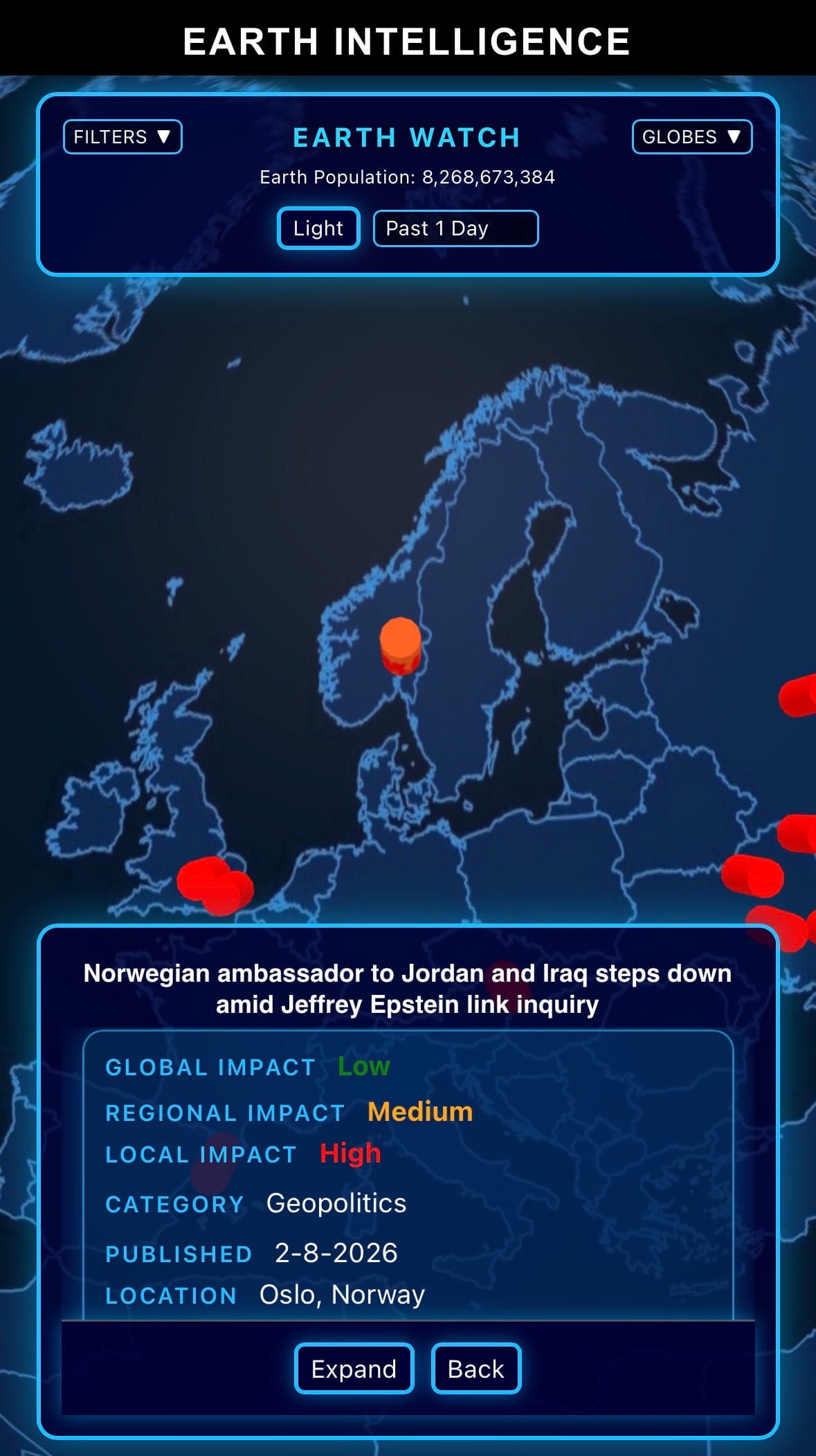
- The foreign ministry has also launched a review of past grants to the International Peace Institute (IPI), which was led by Juul's husband, Terje Rød-Larsen, until 2020. Juul's lawyer confirmed she would cooperate fully with the inquiry. The case has triggered related fallout elsewhere, including the resignation of British Prime Minister Keir Starmer's chief of staff, Morgan McSweeney, and renewed public apologies from Norway's Crown Princess Mette-Marit over her own earlier Epstein connection.
Economics & Markets:
- Yesterday’s commodity market:

- Yesterday’s crypto market:

Geopolitics & Military Activity:
- On February 7, 2026, Israel's security cabinet approved measures to expand Israeli control in parts of the occupied West Bank and reduce certain powers of the Palestinian Authority. Finance Minister Bezalel Smotrich announced the package, which includes allowing Israeli Jews to buy land more easily, opening land registry records to simplify purchases, transferring planning authority in sensitive Hebron areas to Israeli bodies, permitting Israeli enforcement of environmental and archaeological rules in Palestinian-administered zones, restarting a committee to acquire land for settlements, and enabling demolition of Palestinian structures considered harmful to heritage or the environment.
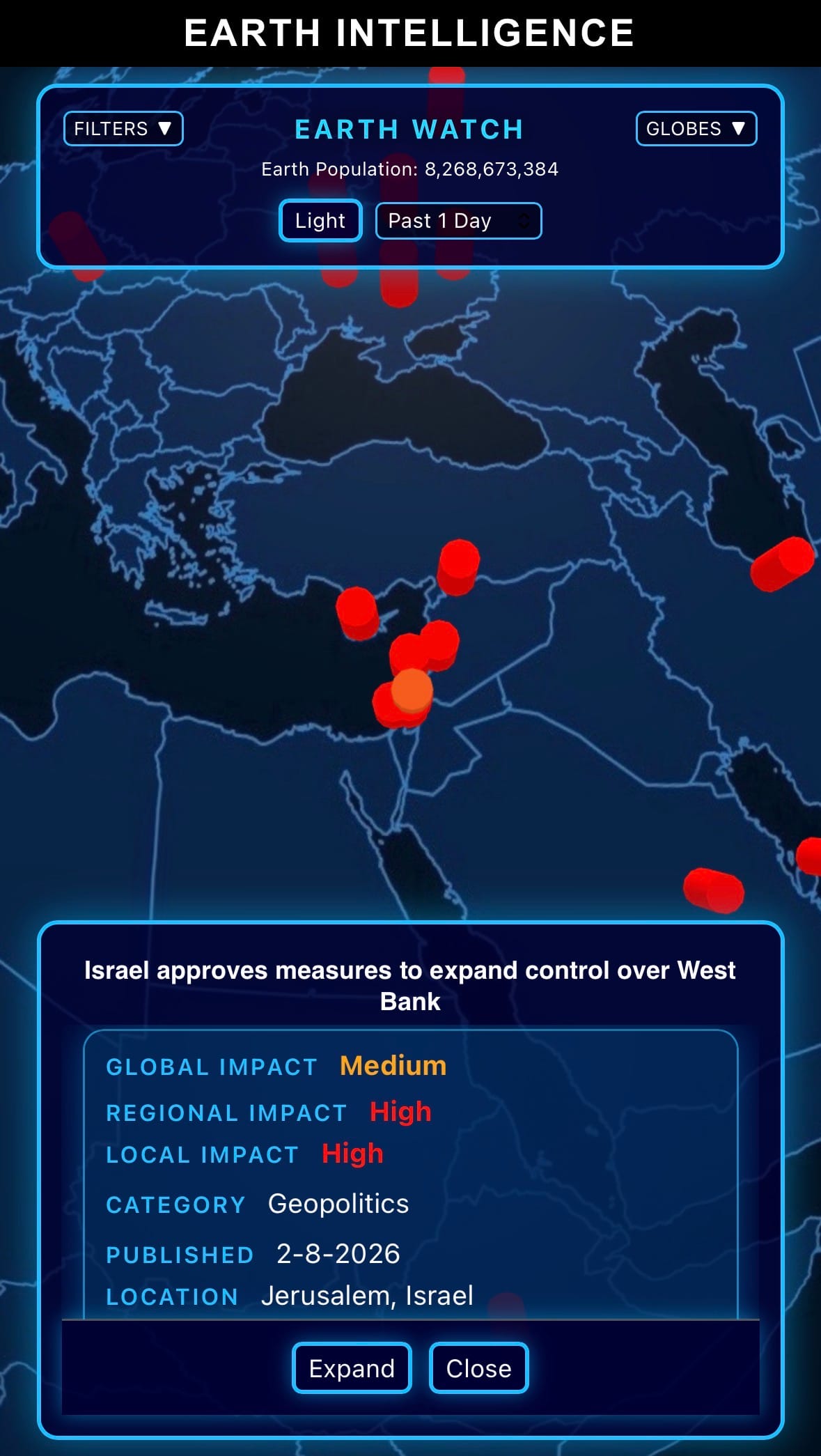
- Reactions were sharply divided. Israeli settler groups welcomed the decision, saying it removes unfair legal obstacles that have blocked settlement growth. Palestinian President Mahmoud Abbas condemned it as a step toward annexation and an attack on Palestinian authority. Jordan issued a strong protest, warning it threatens regional stability. Hamas called for intensified resistance. International observers and human rights groups expressed concern that the measures could accelerate settlement expansion and further weaken Palestinian control, particularly in Area C. No implementation began immediately after the vote.
Space:
- On February 7, 2026, SpaceX successfully launched Starlink Group 17-33 from Space Launch Complex 4 East (SLC-4E) at Vandenberg Space Force Base in California. A Falcon 9 Block 5 rocket lifted off at 12:58 p.m. PST (20:58 UTC), deploying 25 Starlink v2 Mini satellites into low Earth orbit on a polar trajectory.
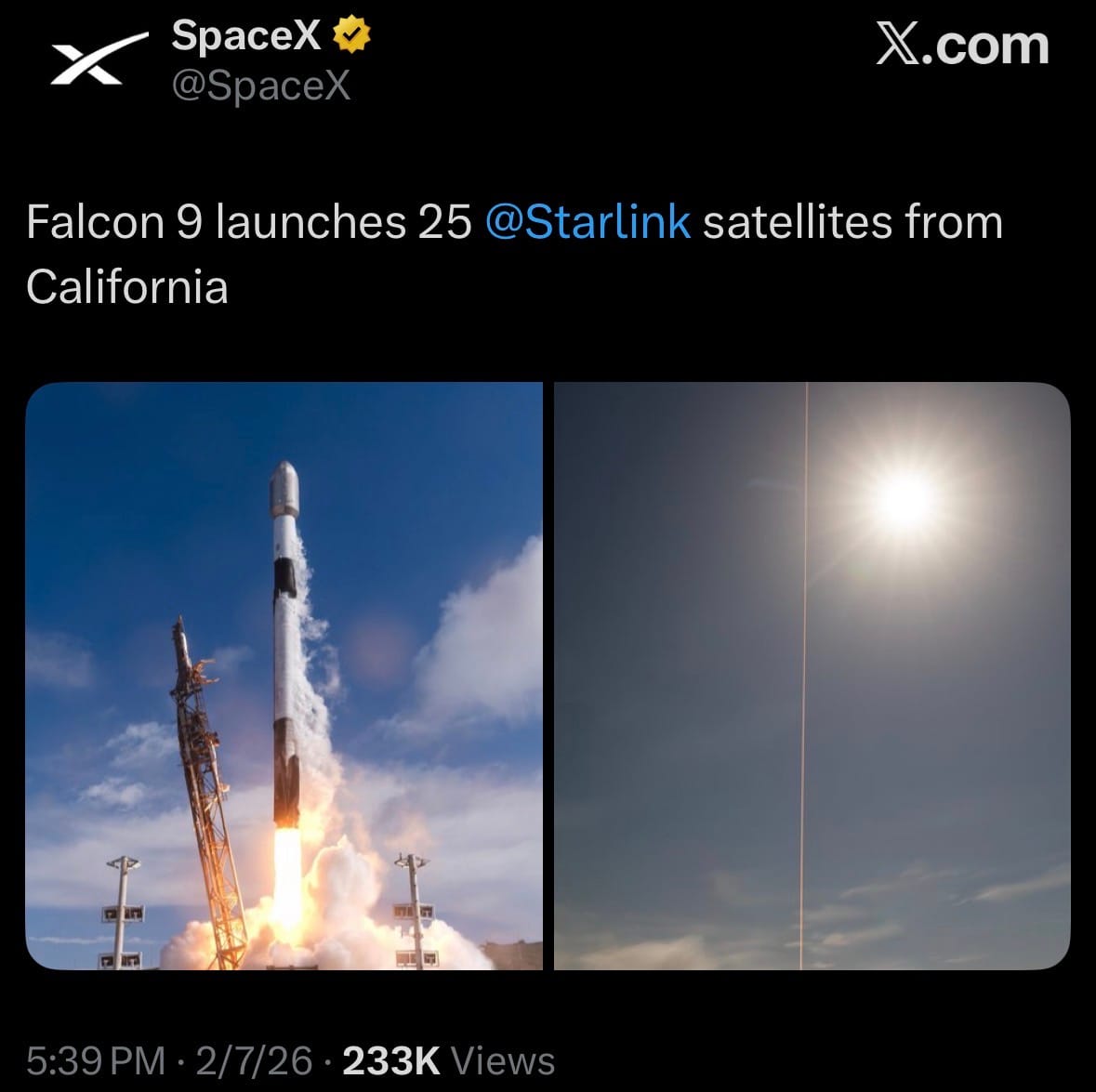
- The first-stage booster (B1088-13) completed its 13th flight and landed successfully on the droneship Of Course I Still Love You in the Pacific Ocean. This marked SpaceX's return-to-flight mission after a brief stand-down following an upper-stage anomaly on a prior launch. All satellites separated nominally about one hour after liftoff, and the mission was confirmed successful with no reported issues.
Statistic:
- Largest public companies on Earth by market capitalization:
- 🇺🇸 NVIDIA: $4.514T
- 🇺🇸 Apple: $4.087T
- 🇺🇸 Alphabet (Google): $3.908T
- 🇺🇸 Microsoft: $2.981T
- 🇺🇸 Amazon: $2.257T
- 🇹🇼 TSMC: $1.809T
- 🇺🇸 Meta Platforms: $1.673T
- 🇸🇦 Saudi Aramco: $1.644T
- 🇺🇸 Broadcom: $1.576T
- 🇺🇸 Tesla: $1.542T
- 🇺🇸 Berkshire Hathaway: $1.096T
- 🇺🇸 Walmart: $1.045T
- 🇺🇸 Eli Lilly: $948.61B
- 🇺🇸 JPMorgan Chase: $877.65B
- 🇰🇷 Samsung: $766.23B
- 🇨🇳 Tencent: $645.01B
- 🇺🇸 Visa: $639.29B
- 🇺🇸 Exxon Mobil: $628.56B
- 🇺🇸 Johnson & Johnson: $578.20B
- 🇳🇱 ASML: $548.45B
- 🇺🇸 Mastercard: $490.26B
- 🇺🇸 Costco: $444.47B
- 🇺🇸 Micron Technology: $444.22B
- 🇰🇷 SK Hynix: $419.46B
- 🇺🇸 Bank of America: $412.81B
History:
- Missile defense begins with the oldest air-defense problem: stopping something fast before it hits you. In World War I, anti-aircraft guns were essentially blind barrages; World War II added radar-directed fire control, proximity fuzes, and integrated warning networks that turned air defense into a true system. The ballistic missile age then detonated the challenge into near-space. By the 1950s–1960s, the United States and Soviet Union were building early-warning radar lines and experimental anti-ICBM interceptors, attempting the near-impossible task of striking a warhead moving several kilometers per second outside the atmosphere. Early U.S. programs like Nike Zeus evolved into Nike-X/Sentinel and culminated in the Safeguard system of the early 1970s, built around two distinct interceptor types: Spartan for long-range midcourse intercept in space and Sprint, an extremely fast terminal interceptor designed to catch warheads in the final seconds. The Soviets built their own capital-defense architecture around Moscow (from A-35 to later systems). But strategic logic intervened: a large national missile shield could destabilize deterrence, leading to the 1972 ABM Treaty, which constrained deployments while research continued. The 1980s Strategic Defense Initiative revived the vision of layered defense—space sensors, kinetic interceptors, directed-energy concepts—but the enduring legacy was the modern blueprint: layered detection, discrimination, and intercept tied together by command-and-control.
- Modern missile defense is not one weapon but a stacked architecture organized by when you intercept: boost phase (right after launch), midcourse (in space), and terminal (during reentry and descent). The U.S. strategic homeland layer is Ground-based Midcourse Defense (GMD), built around GBIs (Ground-Based Interceptors) stationed in Alaska and California. A GBI launches a multi-stage rocket that releases an exoatmospheric “hit-to-kill” vehicle—pure kinetic impact, not explosives—intended for limited ICBM threats. This layer depends as much on sensing as interceptors: early-warning satellites, massive radars, and discrimination systems designed to separate real warheads from decoys. Below that sits the mature regional stack: Aegis Ballistic Missile Defense on Navy cruisers and destroyers (and Aegis Ashore) uses SM-3 interceptors for exoatmospheric midcourse engagements; THAAD provides high-altitude terminal defense in the upper atmosphere; and Patriot PAC-3 handles lower terminal defense and aircraft/cruise missile threats. Israel operates the most battle-tested layered network on Earth: Iron Dome for rockets, David’s Sling for heavier regional threats, and Arrow-2/3 for ballistic missile defense, including intercepts in space. Russia fields a different ecosystem: integrated air and missile defense families (S-300/400/500) plus dedicated Moscow ABM evolution (A-135 toward A-235/Nudol) supported by large radar networks. China is rapidly expanding its own layered defenses and strategic sensor posture, while allies like Japan and South Korea integrate Aegis, Patriot, and indigenous layers into broader NATO and Indo-Pacific architectures. The true “players” are not just states but their industrial ecosystems—interceptors, radars, satellites, and battle-management networks fused into a single sensor-to-shooter web.
- The future of missile defense is being forced by two brutal realities: saturation and hypersonics. Traditional ballistic trajectories become predictable once tracked, but hypersonic glide vehicles maneuver at extreme speed along the edge of the atmosphere, compressing decision time and breaking older radar and interceptor assumptions. This is driving the next era toward persistent tracking and faster integration: proliferated space-based sensor layers to maintain custody of maneuvering threats, next-generation radars, upgraded naval arrays, and new interceptors designed specifically for the glide-phase problem. The long-term trajectory points back toward space—orbital tracking, boost-phase concepts, and even space-based interceptors or directed-energy systems—though these remain politically explosive and technically complex. Missile defense is ultimately an arms race between detection, decision, and interception versus speed, maneuver, countermeasures, and volume. The most advanced powers are not merely building missiles that hit missiles; they are building planetary-scale surveillance and battle-management architectures that decide, in seconds, what the sky means and what can be stopped.
Image of the day:

Thanks for reading! Earth is complicated, we make it simple.
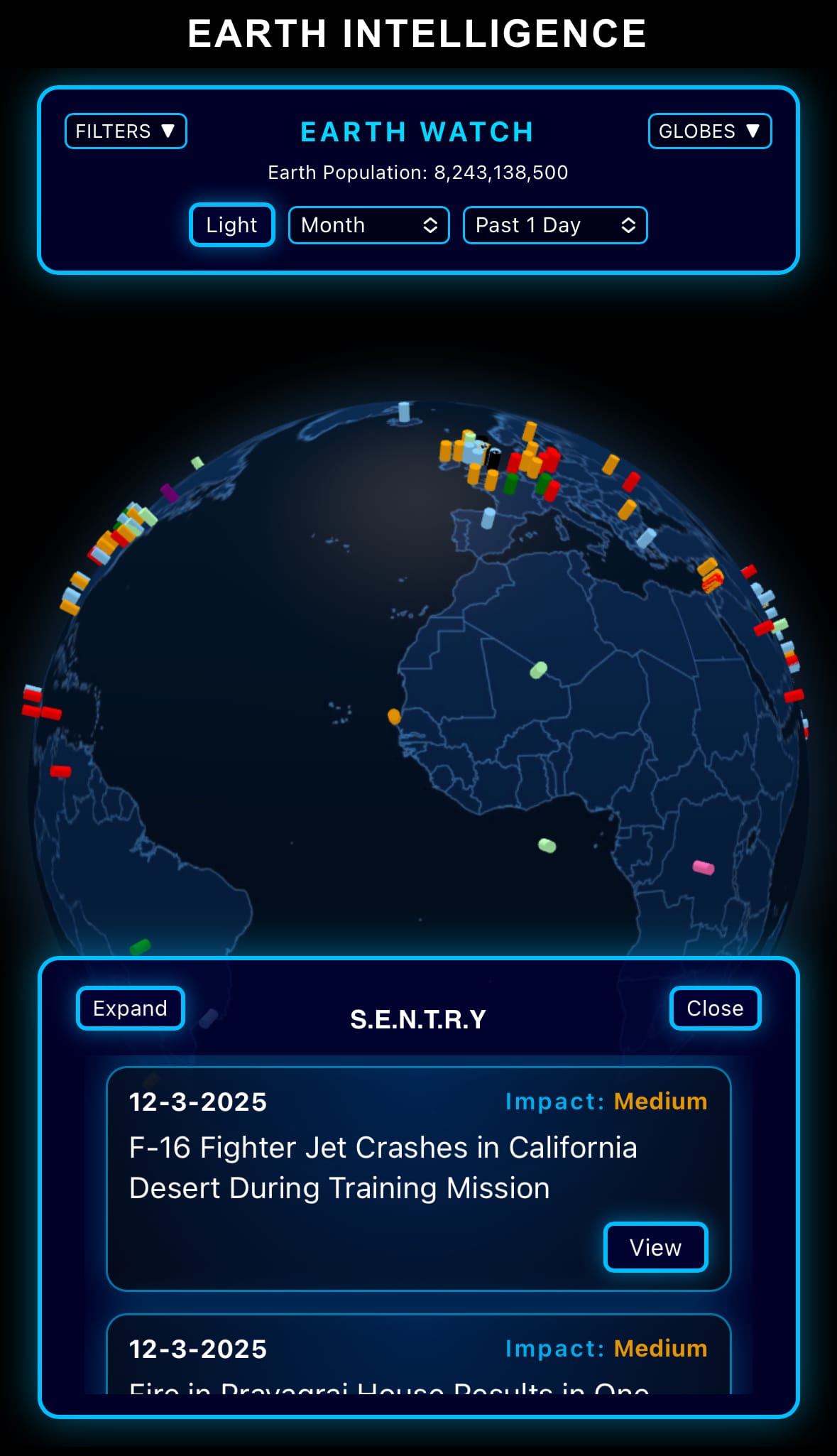
- Click below if you’d like to view our free EARTH WATCH globe:
- Download our mobile app:



Click below to view our previous newsletters:

Support/Suggestions Email:
earthintelligence@earthintel.news