Monday☕️


Trending:

Economics & Markets:
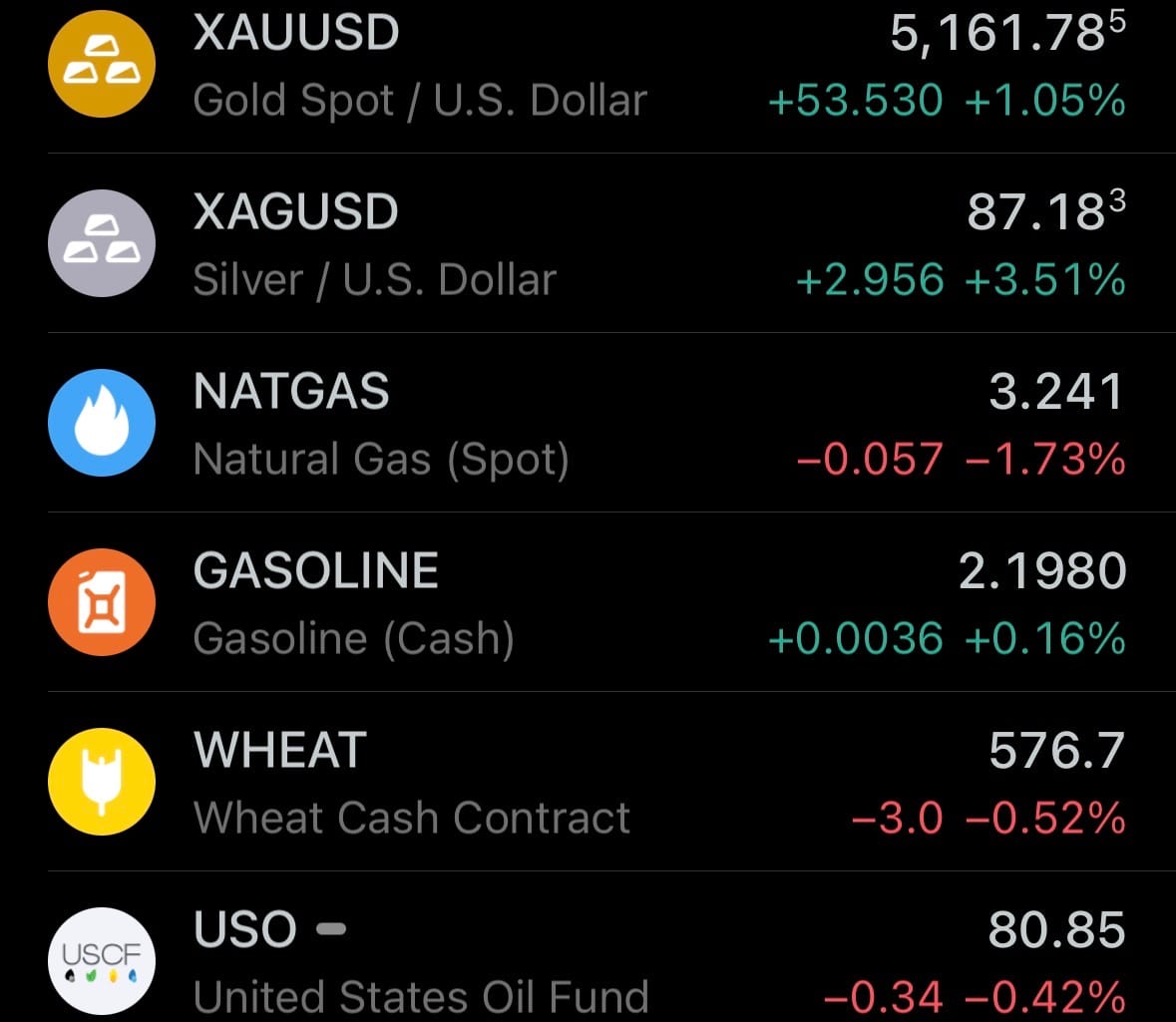
- Yesterday’s commodity market:
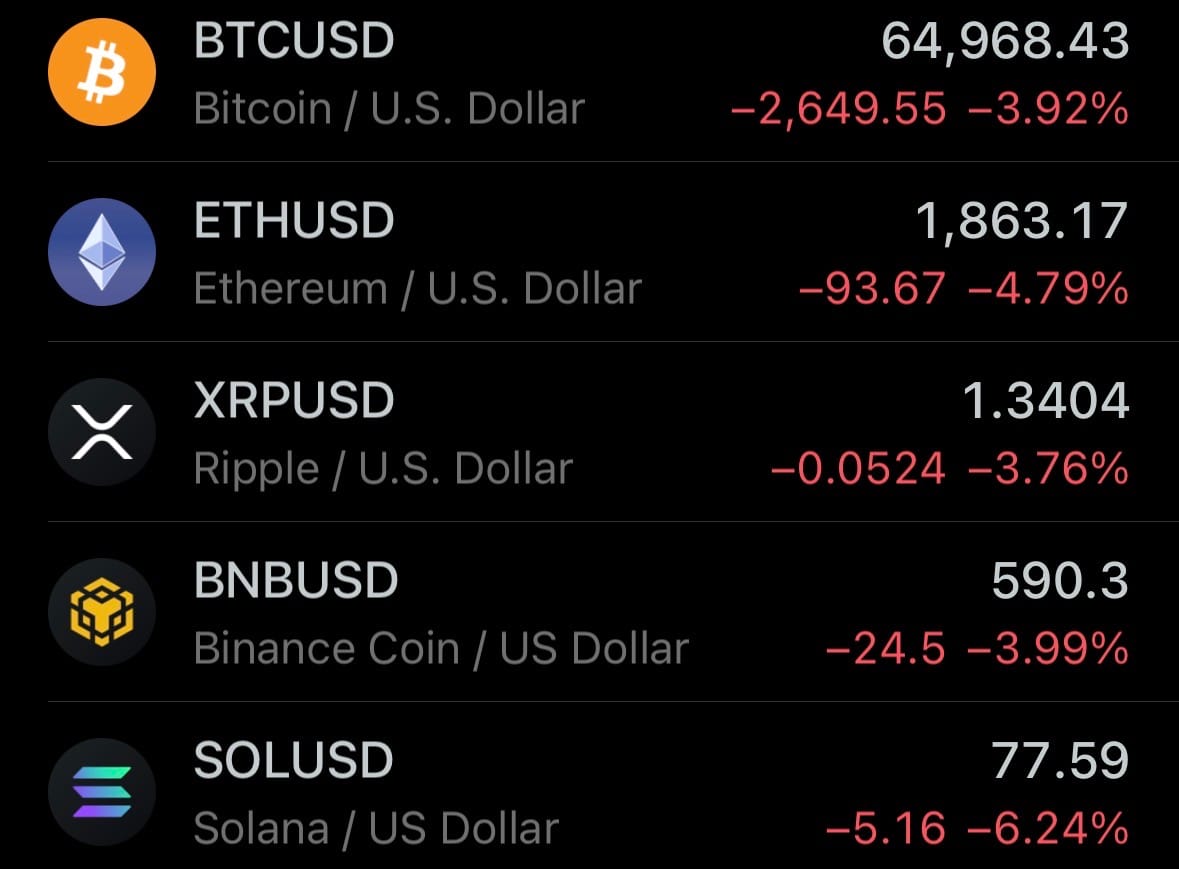
- Yesterday’s crypto market:
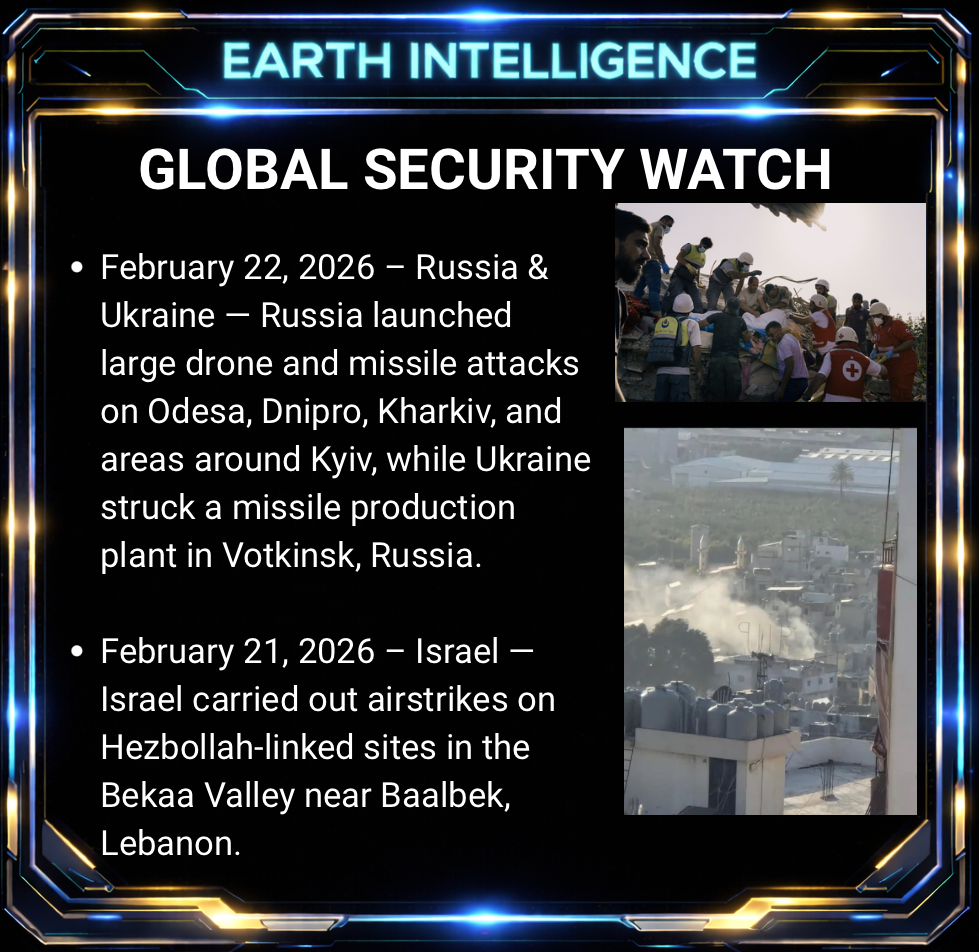
Geopolitics & Military Activity:
U.S. Iran Military Positioning:
- On February 22, 2026, the United States maintains an unprecedented military buildup near Iran, with two aircraft carrier strike groups—the USS Abraham Lincoln in the Arabian Sea and the USS Gerald R. Ford transiting toward the Mediterranean—supported by over 120 additional fighter jets (F-35s, F-22s, F-15s, F-16s), tankers, AWACS, and transport aircraft repositioned to bases in Jordan, Saudi Arabia, and Europe.
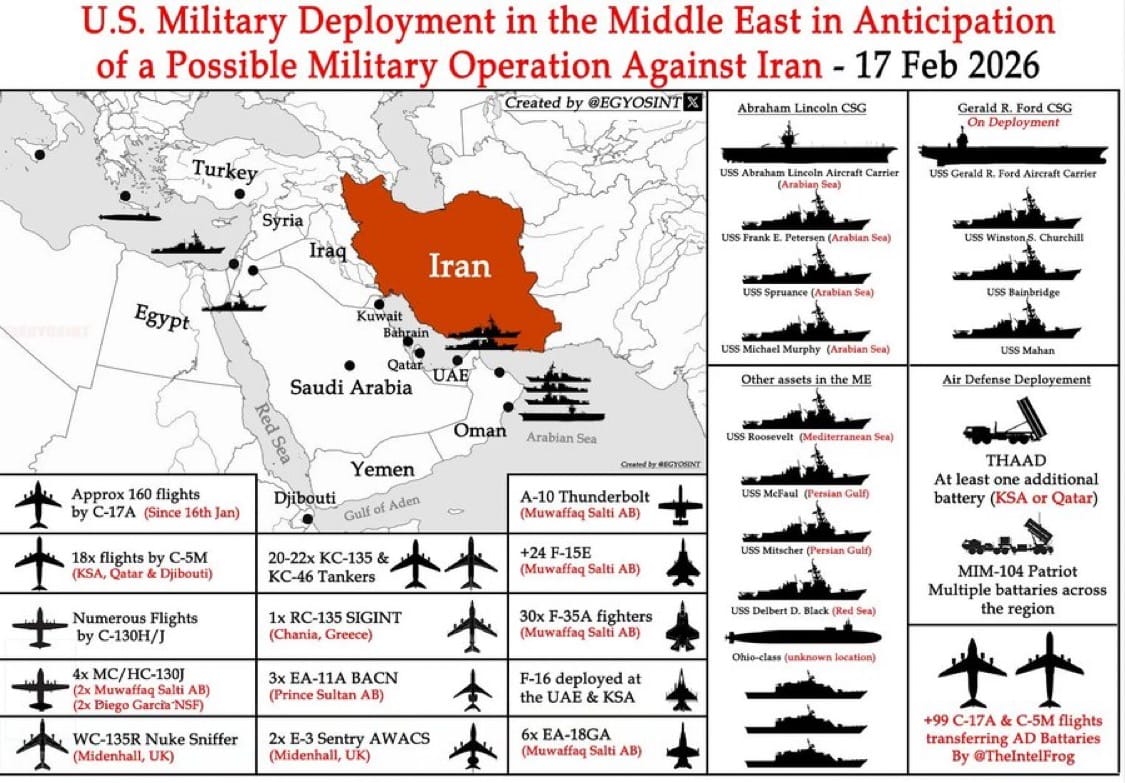
- This deployment represents 40-50% of globally deployable U.S. airpower, comparable to levels seen during the 1991 Gulf War and 2003 Iraq invasion, and continues to grow amid indirect nuclear negotiations with no strikes launched to date.
Environment & Weather:
Science & Technology:
- On February 20, 2026, Anthropic launched a new tool called Claude Code Security. It's in early testing and available only to some business users right now. The tool looks at your entire code and uses smart AI to find security problems that regular tools usually miss, like hidden bugs or tricky access issues.
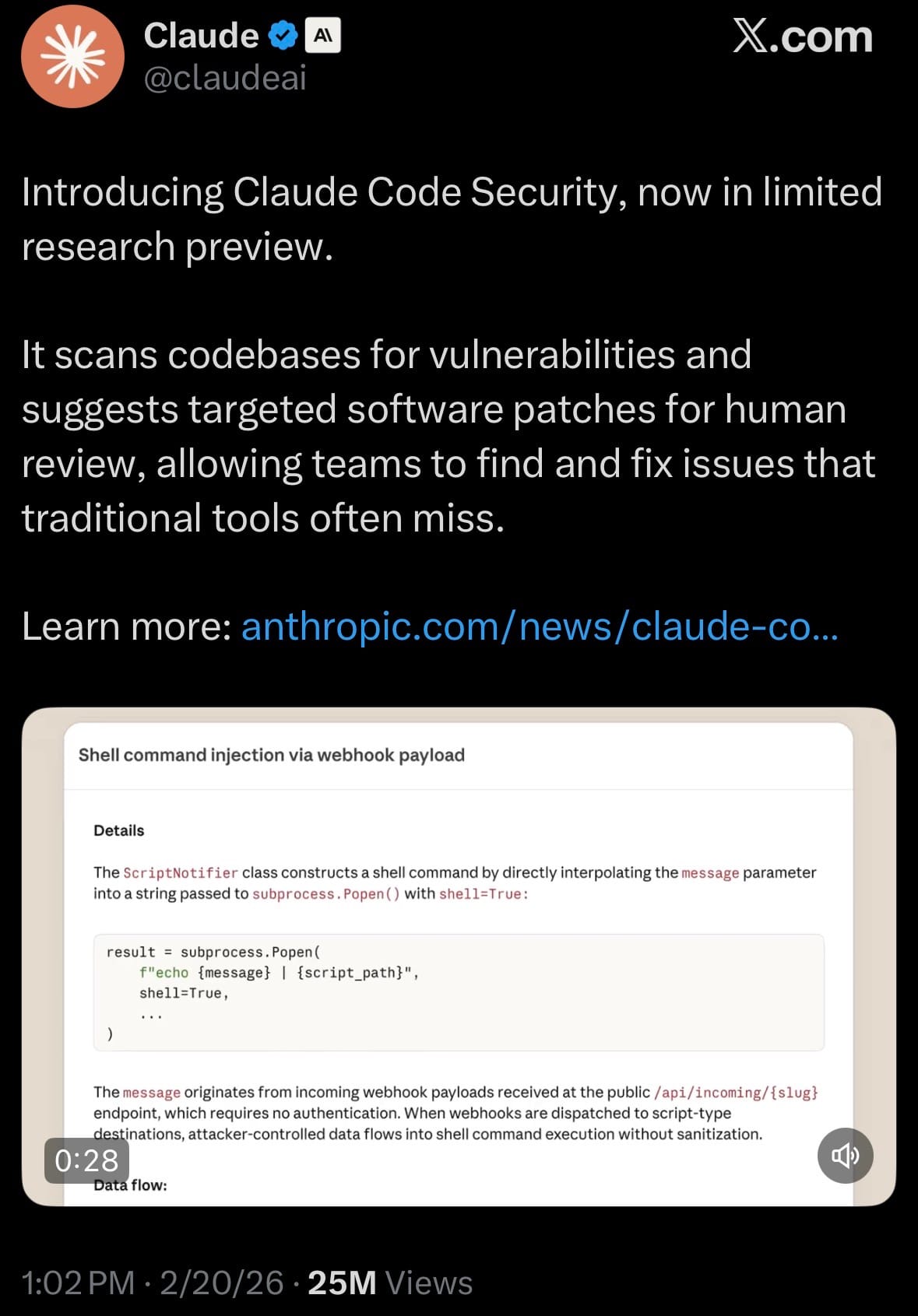
- It then shows clear suggestions for fixes, explains why they're needed, and rates how serious each problem is—but humans review and apply the changes themselves. This makes it easier and faster for developers and security teams to spot and repair weaknesses, especially in big or old code projects, helping keep software safer overall.
Statistic:
- Largest assets on Earth by market capitalization:
- Gold: $36.055T
- Silver: $4.900T
- 🇺🇸 NVIDIA: $4.621T
- 🇺🇸 Apple: $3.888T
- 🇺🇸 Alphabet (Google): $3.809T
- 🇺🇸 Microsoft: $2.952T
- 🇺🇸 Amazon: $2.255T
- 🇹🇼 TSMC: $1.921T
- 🇺🇸 Meta Platforms: $1.658T
- 🇸🇦 Saudi Aramco: $1.657T
- 🇺🇸 Broadcom: $1.577T
- 🇺🇸 Tesla: $1.545T
- Bitcoin: $1.296T
- 🇺🇸 Berkshire Hathaway: $1.074T
- 🇺🇸 Walmart: $980.58B
- 🇺🇸 Eli Lilly: $952.33B
- 🇰🇷 Samsung: $887.97B
- 🇺🇸 Vanguard S&P 500 ETF: $859.16B
- 🇺🇸 JPMorgan Chase: $846.05B
- 🇺🇸 iShares Core S&P 500 ETF: $754.47B
- 🇺🇸 SPDR S&P 500 ETF: $702.79B
- 🇺🇸 Exxon Mobil: $621.10B
- 🇺🇸 Visa: $618.80B
- 🇨🇳 Tencent: $613.62B
- 🇺🇸 Vanguard Total Stock Market ETF: $584.83B
History:
- Rare earths and strategic minerals are the quiet “elemental layer” beneath modern power: the stuff that turns electronics into weapons, motors into fleets, and energy into industry. Humans have fought over strategic materials forever—tin for Bronze Age weapons, iron for empire logistics, coal and steel for the industrial revolution, oil for the 20th century, uranium for the nuclear age—but the 21st century adds a new class of chokepoints: rare earth elements (17 metals like neodymium, praseodymium, dysprosium, terbium) plus “strategic” non–rare-earth minerals like lithium, cobalt, nickel, graphite, gallium, germanium, tungsten, and tantalum. The trick is that many of these aren’t truly rare in the crust; what’s rare is economical extraction, clean separation, and high-purity processing at scale. Rare earths are chemically similar and messy to separate. Their ores often come with radioactive byproducts (like thorium). Refining is complex, environmentally sensitive, and capital-intensive. So the real dominance isn’t just “who has the rocks,” it’s “who can refine and turn them into magnets, metals, chemicals, and components reliably and cheaply.”
- That’s why the modern story is basically a supply-chain empire story, and China built the most complete one. Over decades, China scaled mining, chemical separation, metal-making, alloying, and—most importantly—magnet manufacturing, which is where rare earths become real-world power. The largest mining/refining ecosystem sits in China with major state-linked and private champions across the chain (big miners and processors, plus the magnet giants that feed EVs, drones, robotics, and missile systems). Outside China, the standout producer is Lynas (Australia with major processing operations), long treated as the most important non-Chinese rare-earth supply anchor. The United States has pushed hard to rebuild capability through companies like MP Materials (ore and upstream steps) and partners working on separation, metal-making, and magnet production—because shipping raw concentrate abroad and buying finished magnets back is not “independence,” it’s dependency with extra steps. Europe and allies have been rebuilding pieces of the chain too—processing know-how, specialty chemicals, and component manufacturing—because the bottleneck is rarely “digging,” it’s “turning ore into usable high-purity material and then into components at scale.” The geopolitical reality is that separation plants, metal/alloy facilities, and magnet factories are the strategic crown jewels.
- On the demand side, the users are exactly the industries that define modern dominance. Rare earth magnets are the heart of high-performance electric motors and generators—meaning EV drivetrains, wind turbines, industrial robotics, drones, and precision actuators. They also sit inside high-end military systems: radar arrays, electronic warfare components, guidance systems, satellites, and aircraft subsystems depend on specialized materials and tight-tolerance supply. Batteries pull in their own mineral stack—lithium, nickel, cobalt, manganese, graphite—while semiconductors pull in gallium, germanium, and ultra-pure specialty materials. So the “largest players” aren’t only miners; they’re also the processors, magnet makers, battery manufacturers, and the end-product giants (EV manufacturers, wind OEMs, defense primes, and the big tech hardware ecosystem). This is why the U.S. and China treat strategic minerals like national security infrastructure: control of these inputs determines who can scale electrification, who can build the most advanced weapons reliably, and who can surge production in crisis. In the modern world, steel and oil still matter—but the fight for leverage increasingly runs through refineries, separation plants, and component factories, where the periodic table gets turned into capability.
Image of the day:

Thanks for reading! Earth is complicated, we make it simple.
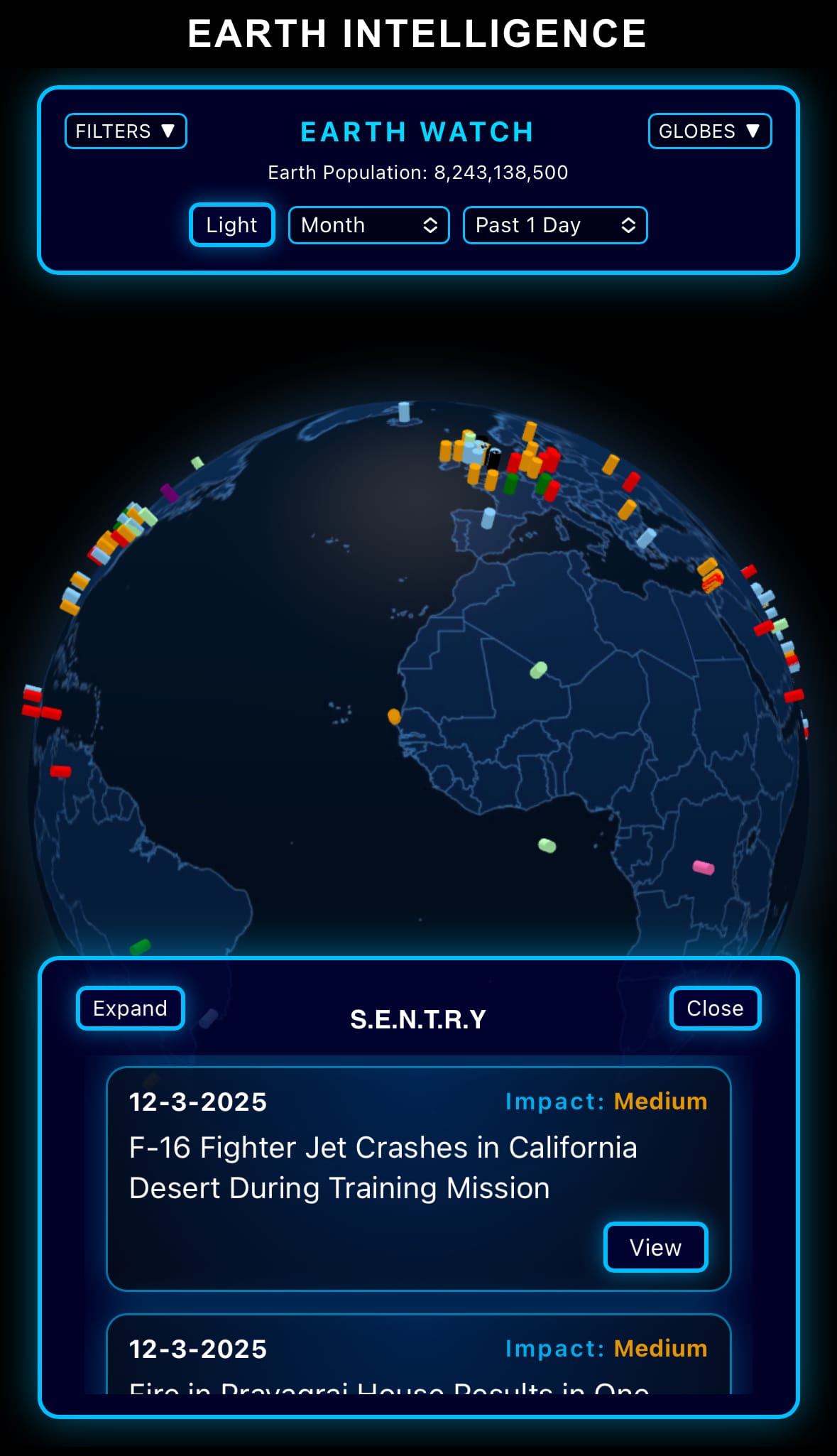
- Click below if you’d like to view our free EARTH WATCH globe:
- Download our mobile app:


Click below to view our previous newsletters:
Support/Suggestions Email:
earthintelligence@earthintel.news