Monday☕️


Trending:


Geopolitics & Military Activity:

- As of March 9, 2026, the Israel Defense Forces (IDF) carried out a precise strike in Beirut that eliminated five senior commanders from the IRGC Quds Force’s Lebanon Corps and Palestine Corps. The overnight naval strike targeted a hotel room where the commanders were meeting to coordinate support for Hezbollah, Hamas, and other Iranian-backed groups.
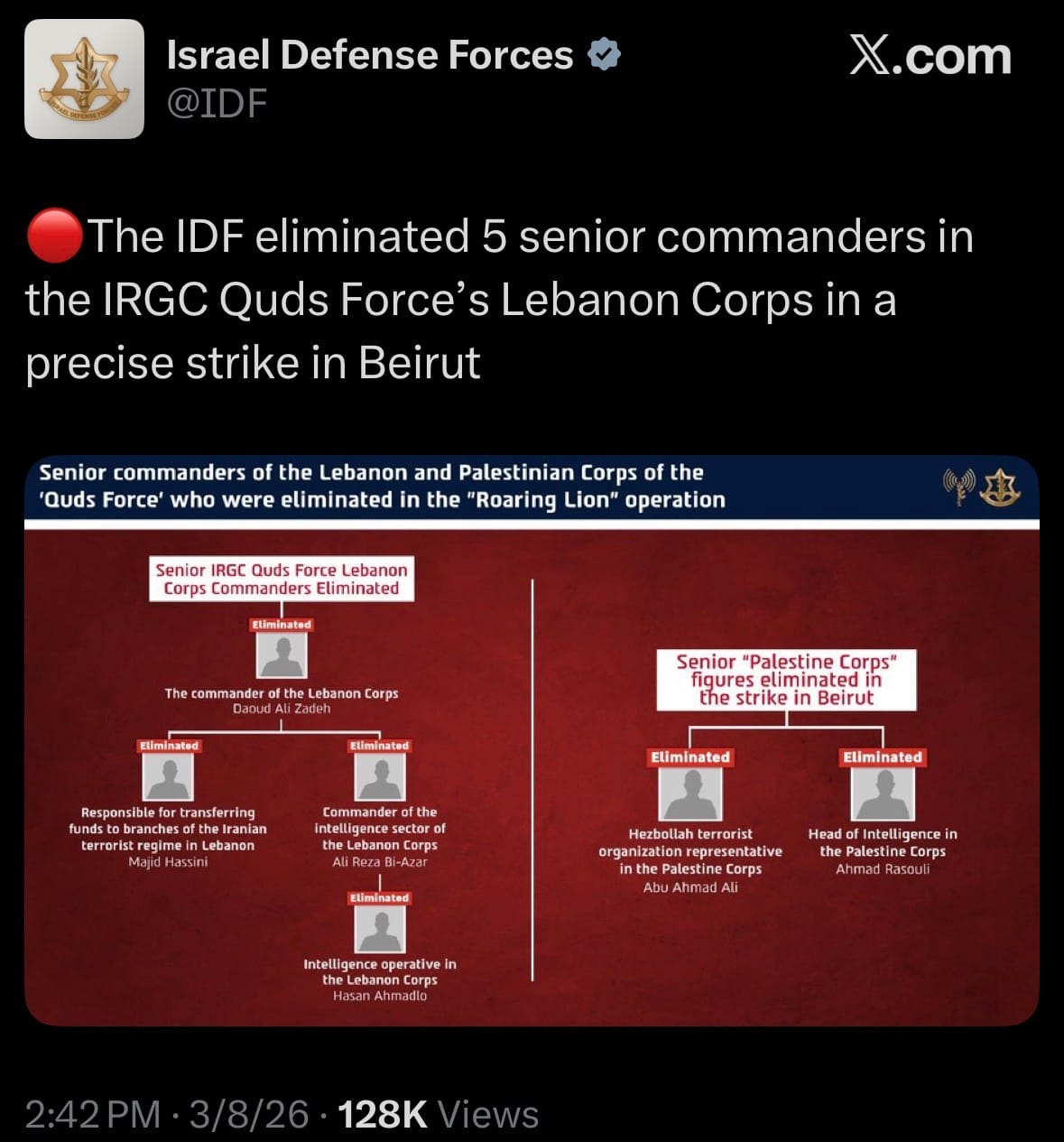
- The eliminated commanders were: Majid Hassini (financial operative), Ali Reza Bi-Azar (Lebanon Corps intelligence chief), Ahmad Rasouli (Palestine Corps intelligence chief), Hossein Ahmadlou (Lebanon Corps intelligence operative), and Abu Muhammad Ali (Hezbollah liaison to Palestine Corps).

Environment & Weather:
Science & Technology:
- The U.S. Department of the Air Force and Northrop Grumman have agreed to accelerate production of the B-21 Raider next-generation stealth bomber by increasing annual production capacity by 25%. This decision, announced on February 23, 2026, uses $4.5 billion in already-approved funding from fiscal year 2025 reconciliation legislation to compress delivery timelines while maintaining cost and performance standards.
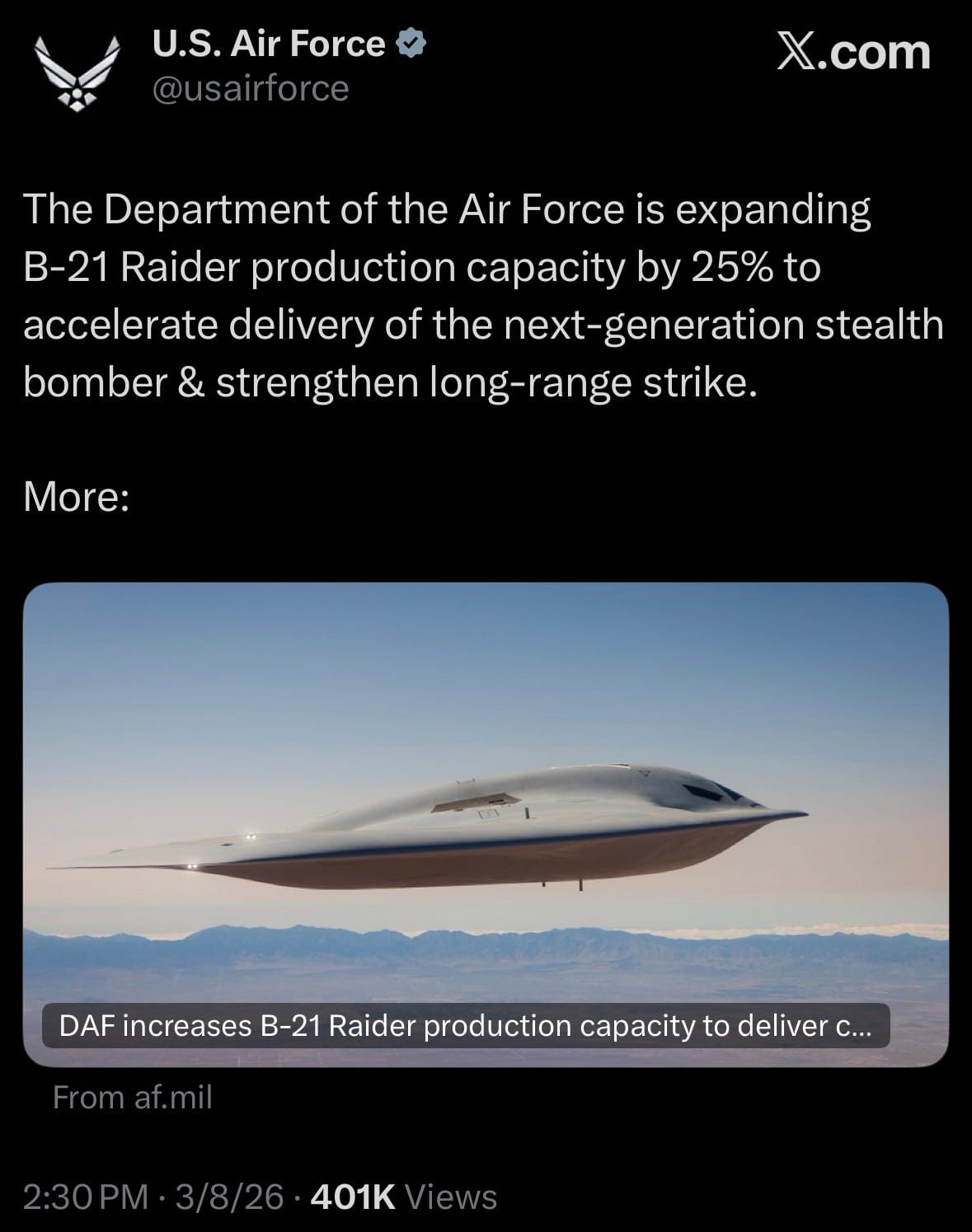
- The move reflects strong confidence in the program's progress, with aircraft delivered on schedule in 2025 and the first operational B-21 Raider set to arrive at Ellsworth Air Force Base in South Dakota in 2027. Officials emphasize that faster fielding strengthens long-range strike capabilities, credible deterrence, and the ability to counter emerging threats in contested environments.
Space:
- As of March 9, 2026, SpaceX successfully launched the Starlink Group 17-18 mission on Sunday, March 8, using a Falcon 9 rocket from Space Launch Complex 4 East (SLC-4E) at Vandenberg Space Force Base in California. Liftoff occurred at 7:00 a.m. PT (4:00 a.m. PDT local time, 11:00 UTC), deploying 25 next-generation Starlink v2 Mini satellites to low-Earth orbit about one hour later.
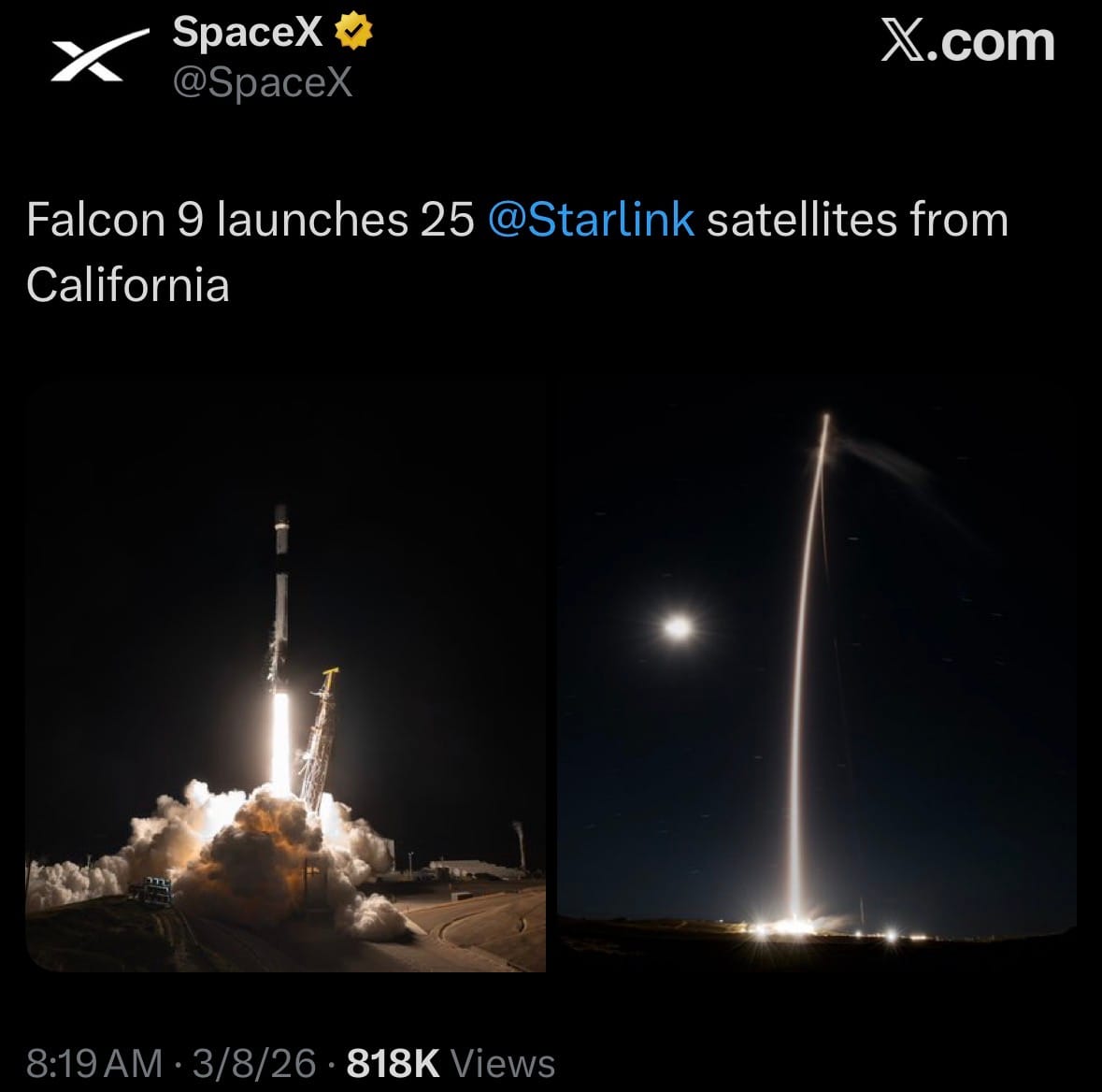
- The first-stage booster (B1097 on its seventh flight) landed successfully on the "Of Course I Still Love You" droneship in the Pacific Ocean, marking another routine recovery. This mission adds to the growing Starlink constellation, bringing the total number of active satellites to approximately 9,915 and supporting expanded global broadband coverage.
Statistic:
- Largest assets on Earth by market capitalization:
- Gold: $35.355T
- Silver: $4.636T
- 🇺🇸 NVIDIA: $4.323T
- 🇺🇸 Apple: $3.784T
- 🇺🇸 Alphabet (Google): $3.608T
- 🇺🇸 Microsoft: $3.039T
- 🇺🇸 Amazon: $2.287T
- 🇹🇼 TSMC: $1.757T
- 🇸🇦 Saudi Aramco: $1.736T
- 🇺🇸 Meta Platforms: $1.631T
- 🇺🇸 Broadcom: $1.566T
- 🇺🇸 Tesla: $1.488T
- Bitcoin: $1.326T
- 🇺🇸 Berkshire Hathaway: $1.076T
- 🇺🇸 Walmart: $987.03B
- 🇺🇸 Eli Lilly: $886.36B
- 🇺🇸 Vanguard S&P 500 ETF: $854.69B
- 🇺🇸 JPMorgan Chase: $780.73B
- 🇰🇷 Samsung: $764.27B
- 🇺🇸 iShares Core S&P 500 ETF: $730.03B
- 🇺🇸 SPDR S&P 500 ETF: $673.27B
- 🇺🇸 Exxon Mobil: $630.05B
- 🇺🇸 Visa: $611.88B
- 🇨🇳 Tencent: $590.34B
- 🇺🇸 Johnson & Johnson: $579.33B
History:
- Radar—Radio Detection and Ranging—grew out of late 19th-century discoveries in electromagnetism. In the 1860s, physicist James Clerk Maxwell predicted electromagnetic waves mathematically, and in 1887–1888, German scientist Heinrich Hertz experimentally confirmed their existence, proving that radio waves could travel through space and reflect off metal objects. This reflection principle became the foundation of radar. In 1904, German engineer Christian Hülsmeyer patented the Telemobiloscope, an early device capable of detecting ships in fog using reflected radio signals. Although primitive, it demonstrated that objects could be detected remotely using radio waves. Throughout the 1920s and early 1930s, multiple nations began exploring radio detection systems. The U.S. Naval Research Laboratory demonstrated radio reflection from aircraft in 1922, while in 1935 British scientist Robert Watson-Watt successfully tested an aircraft detection system that led to the development of Britain’s early-warning radar network.
- Radar became one of the most decisive technologies of World War II. Britain constructed the Chain Home radar network, operational by 1939, consisting of large coastal radar towers capable of detecting incoming German aircraft long before they reached British airspace. This network played a critical role during the Battle of Britain in 1940, allowing British fighter forces to intercept Luftwaffe raids efficiently. Germany developed radar systems such as Freya (early warning) and Würzburg (fire-control radar), while the United States deployed radar across naval fleets and aircraft for submarine detection and targeting. A major breakthrough came in 1940 when British researchers John Randall and Harry Boot invented the cavity magnetron, which produced powerful microwave signals that enabled compact, high-resolution radar systems. This allowed radar to be installed in aircraft, ships, and ground installations, dramatically improving detection capability at night and in poor weather. By the end of the war, radar had expanded into airborne interception radar, naval search radar, gun-laying radar, and ground-controlled interception networks.
- After World War II, radar evolved into a global sensing infrastructure used for defense, aviation, weather monitoring, and space surveillance. During the Cold War, large early-warning radar systems such as the DEW Line (Distant Early Warning Line) were built across the Arctic in the 1950s to detect Soviet bombers approaching North America. Airborne radar platforms expanded with aircraft like the E-3 Sentry AWACS introduced in the 1970s, capable of monitoring hundreds of aircraft across vast regions. Radar technology advanced with phased-array systems, allowing electronic beam steering instead of rotating antennas, and later with Active Electronically Scanned Array (AESA) radars developed in the late 20th and early 21st centuries. AESA radar is now used in modern fighter aircraft such as the F-22, F-35, Eurofighter Typhoon, and advanced Chinese and Russian fighters, allowing simultaneous tracking of many targets while resisting electronic jamming. Today radar networks monitor global airspace, guide aircraft safely through busy skies, detect ballistic missile launches, track ships at sea, observe weather systems, and even monitor satellites and debris in orbit. From early radio experiments in the late 1800s to highly advanced digital radar systems capable of tracking objects thousands of kilometers away, radar has become one of the core sensing technologies supporting modern defense, aviation, and global infrastructure.
Image of the day:

Thanks for reading! Earth is complicated, we make it simple.
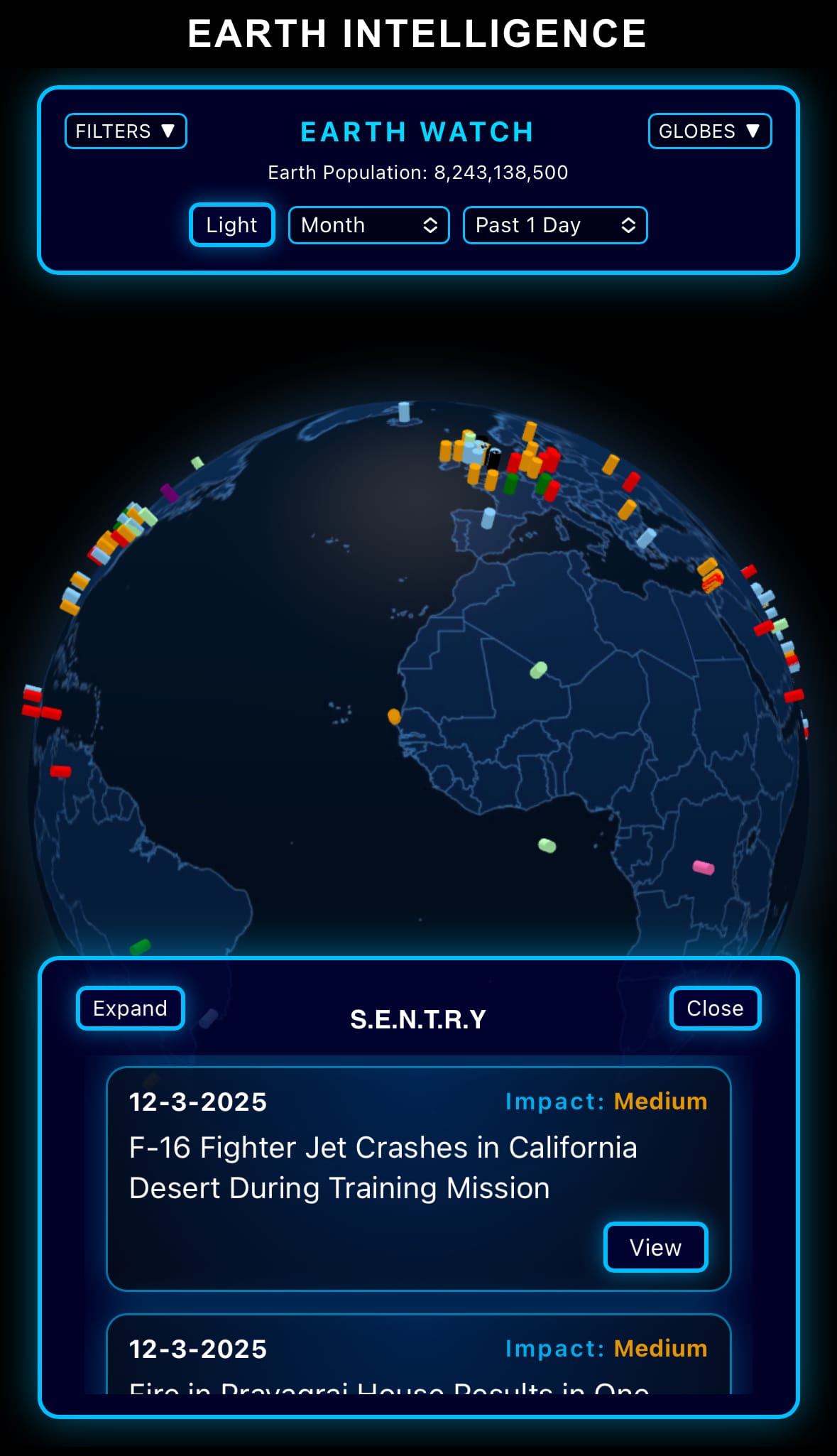
- Click below if you’d like to view our free EARTH WATCH globe:
- Download our mobile app:



Click below to view our previous newsletters:

Support/Suggestions Email:
support@earthintel.io