Monday☕️

Trending:
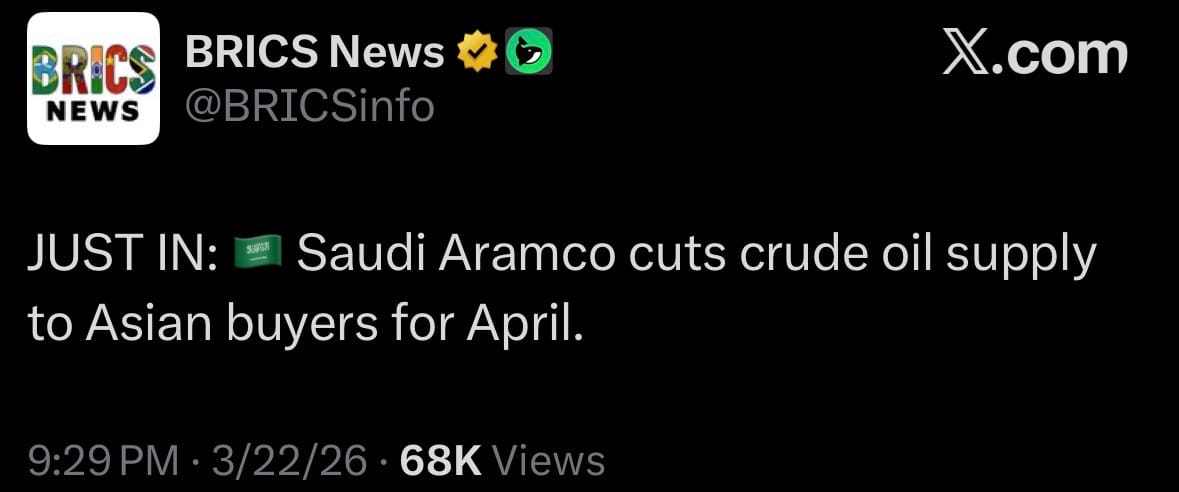
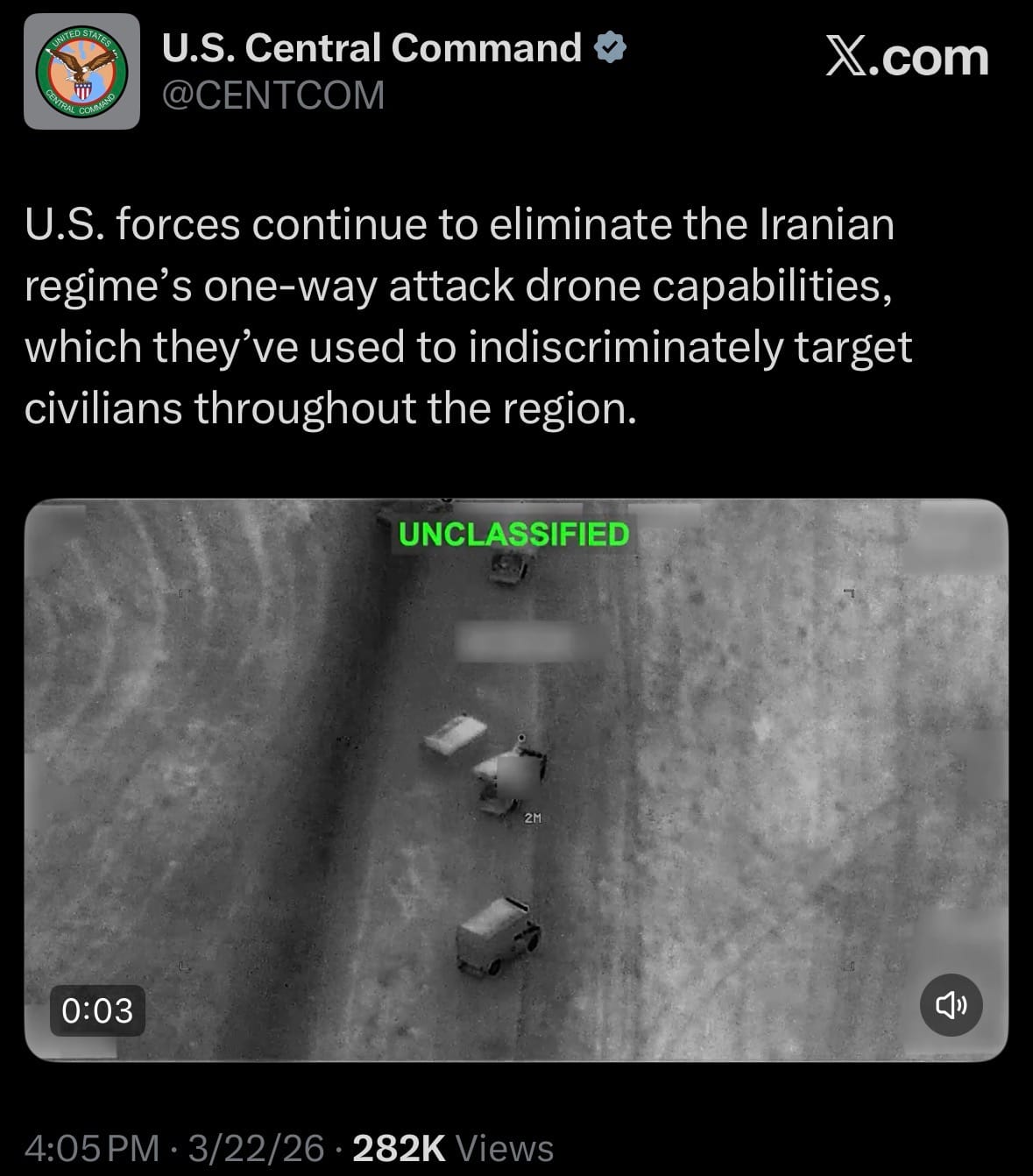
- As of March 23, 2026, the U.S.-Israel-Iran war has created a severe global energy crisis with the Strait of Hormuz blockaded and oil prices above $110 per barrel. Saudi Aramco has now paused all crude exports to Asia for the entire month of April, worsening shortages across the region. Europe is experiencing long gas lines, record-high fuel prices, and emergency rationing plans, while jet fuel prices have surged 35% there, forcing airlines to cancel flights and raise fares sharply. Asia is facing factory slowdowns, household blackouts, and jet fuel costs up 40% in key hubs like Singapore and Tokyo, crippling air cargo and passenger travel.
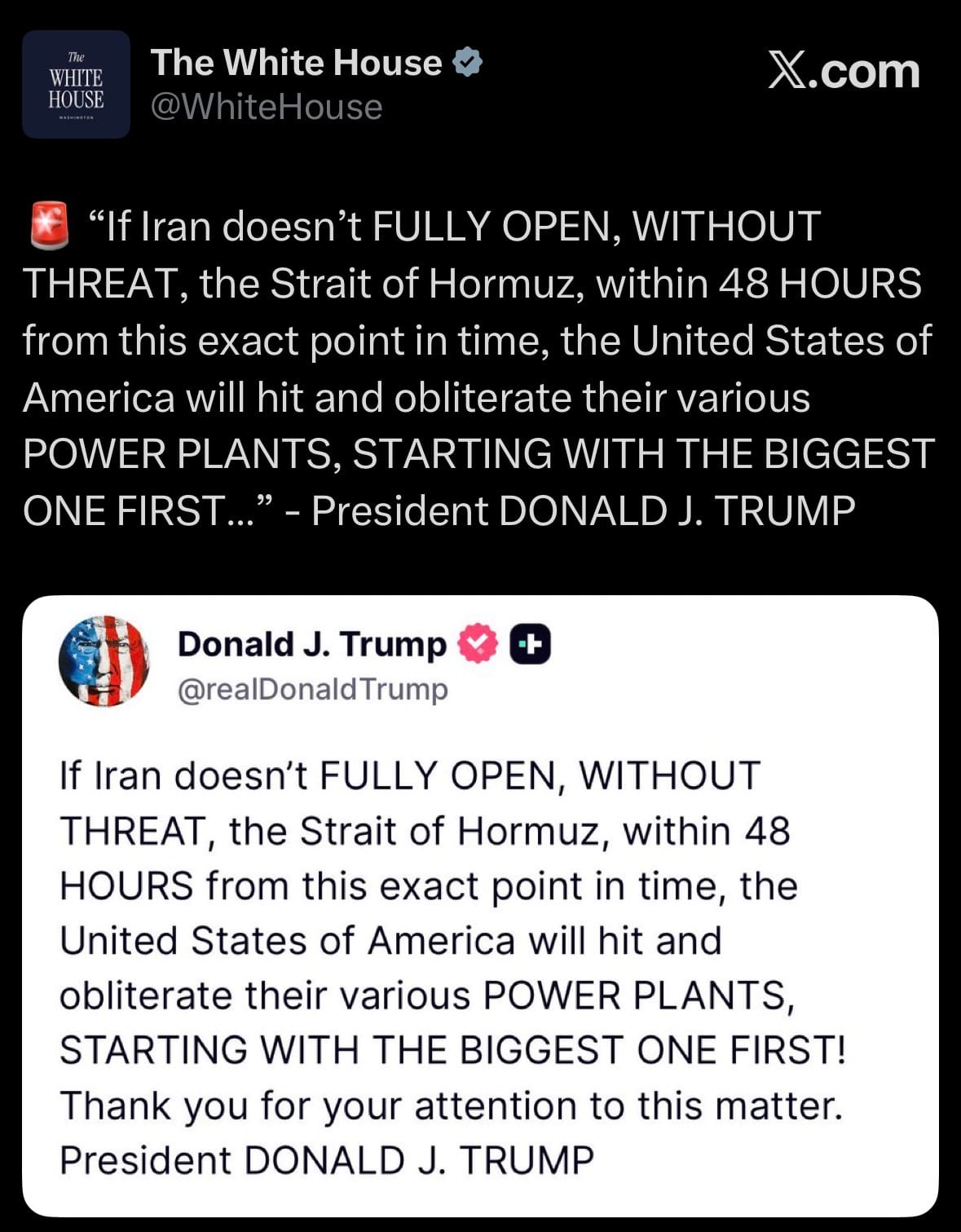
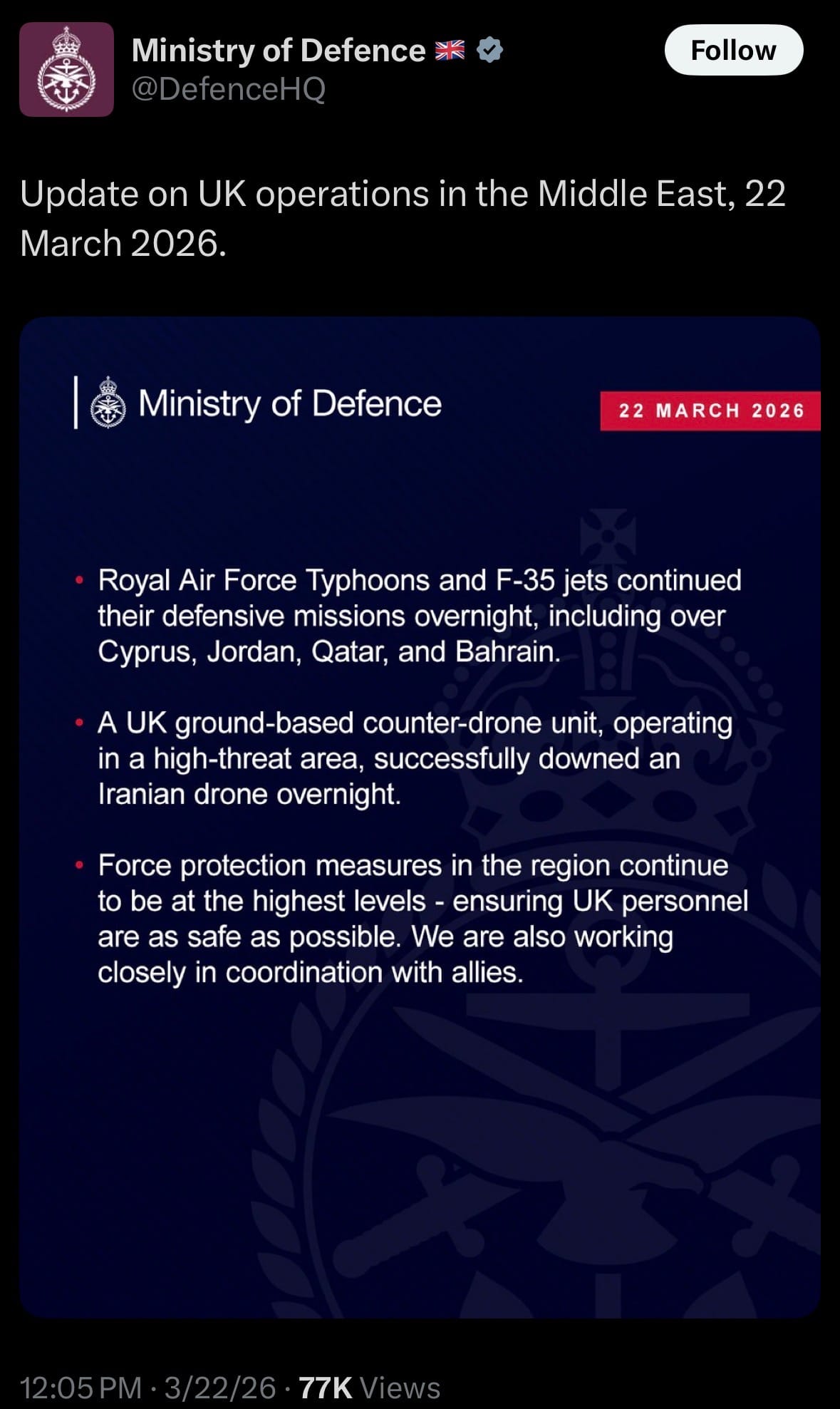
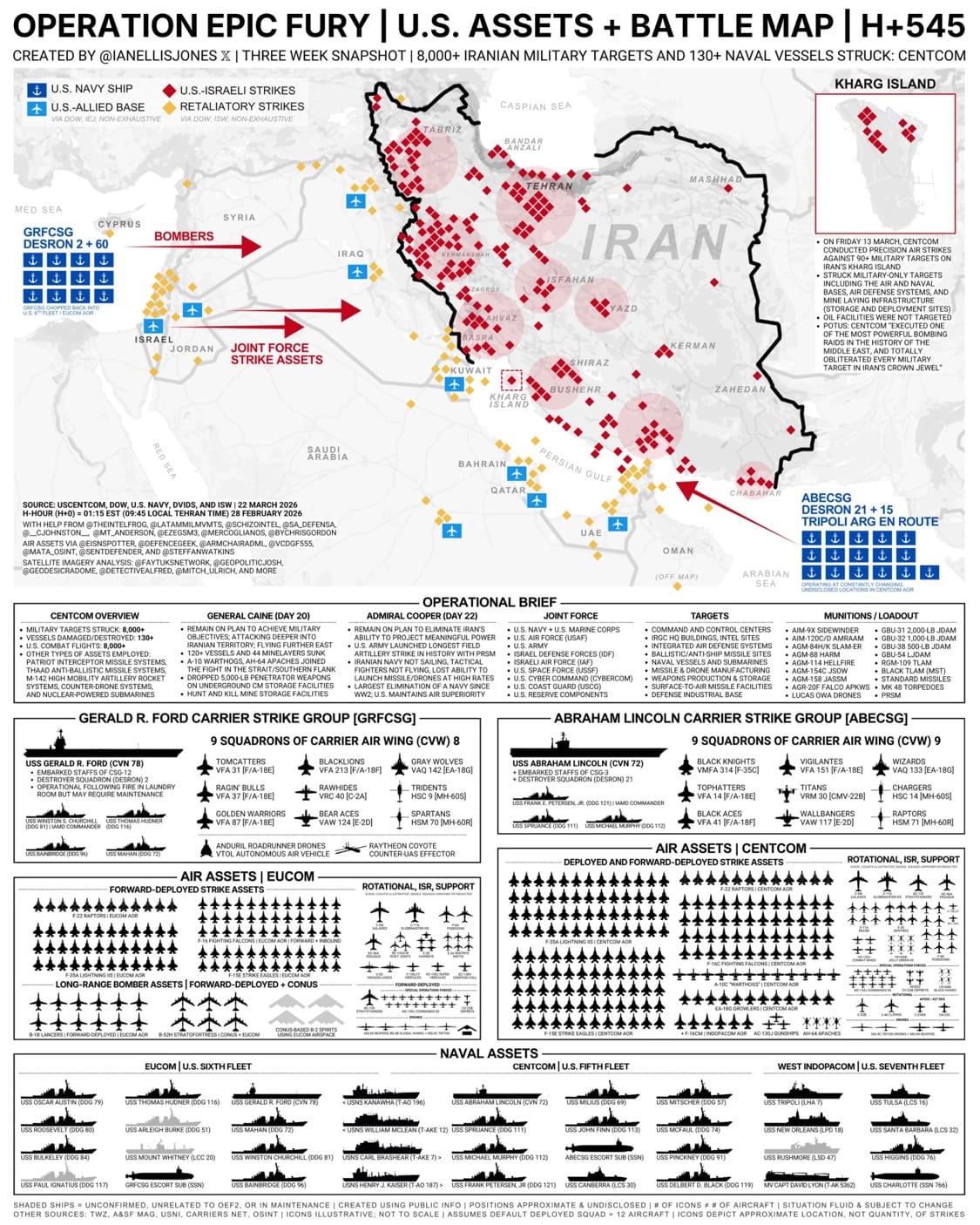
- Iran continues launching missile and drone strikes on its Gulf neighbors with no sign of stopping, while the UK has sent a nuclear-powered submarine to the region. The conflict shows no end in sight, hurting Europe and Asia the hardest through energy shortages, higher living costs, and disrupted aviation and trade.

Environment & Weather:
Science & Technology:
- As of March 22, 2026, Elon Musk announced that Tesla and xAI are jointly building the world's largest chip manufacturing facility, with a planned capacity of 1 terawatt-year (1TW/year) of compute power. The facility will integrate logic chip production, memory fabrication, and advanced packaging all under one roof to support massive AI training and inference needs.
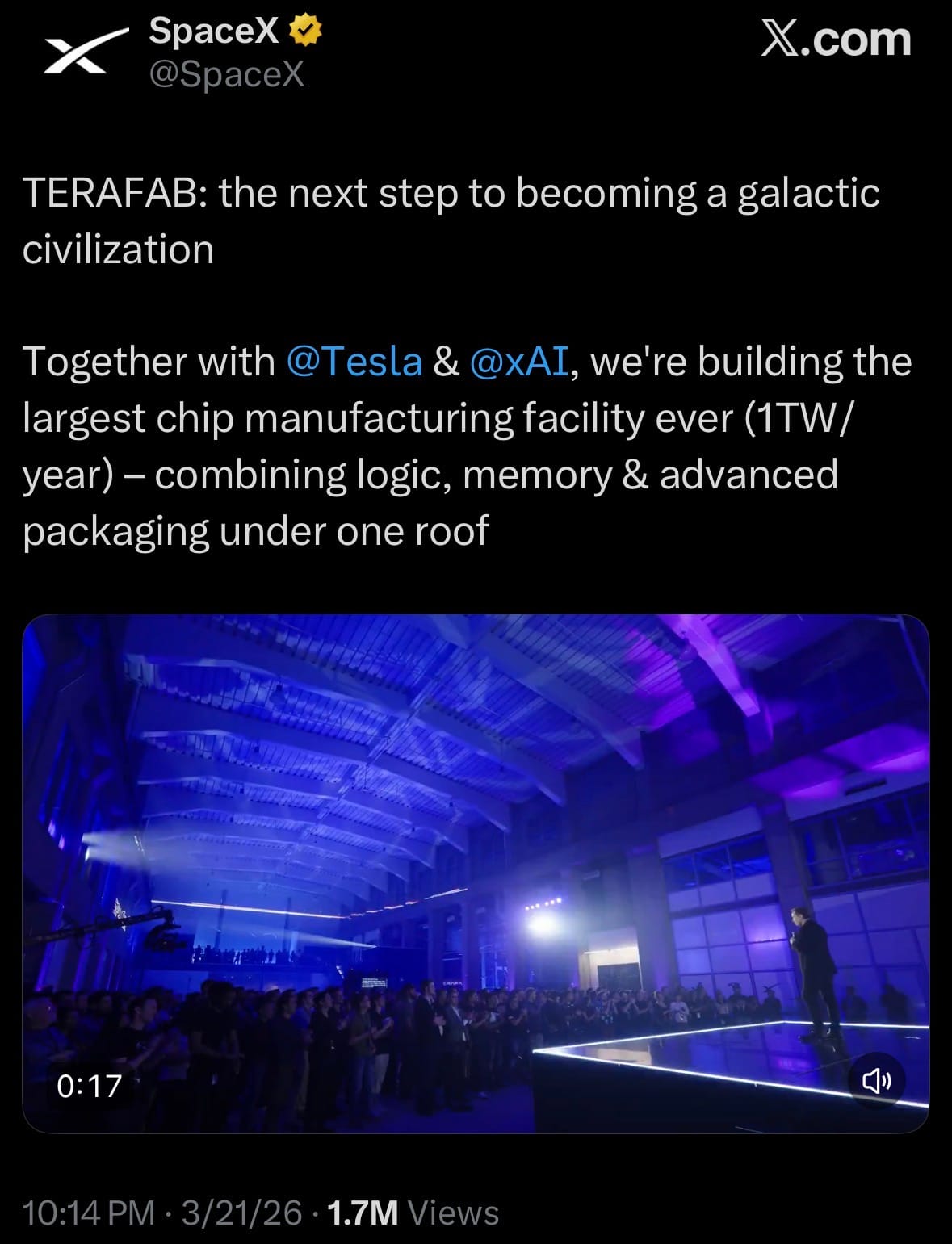
- This unprecedented scale aims to address chip supply constraints for Tesla's autonomous driving systems, Dojo supercomputers, and xAI's Grok models and future AI infrastructure. Construction details, exact location, and timeline were not specified in the announcement.
Space:
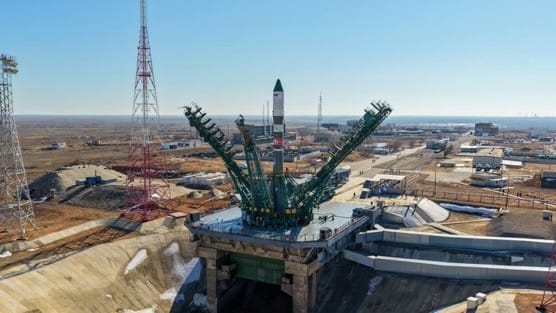
- On March 22, 2026, Russia successfully launched the Progress MS-33 (NASA designation Progress 94) cargo spacecraft on a Soyuz 2.1a rocket from the repaired Site 31/6 at Baikonur Cosmodrome, Kazakhstan, at 11:59 UTC. The uncrewed vehicle, carrying over 2,500 kg of food, fuel, water, and supplies, is en route to the International Space Station for a two-day rendezvous, with docking scheduled for March 24, 2026, at the Poisk module's zenith port to resupply the Expedition 74 crew.
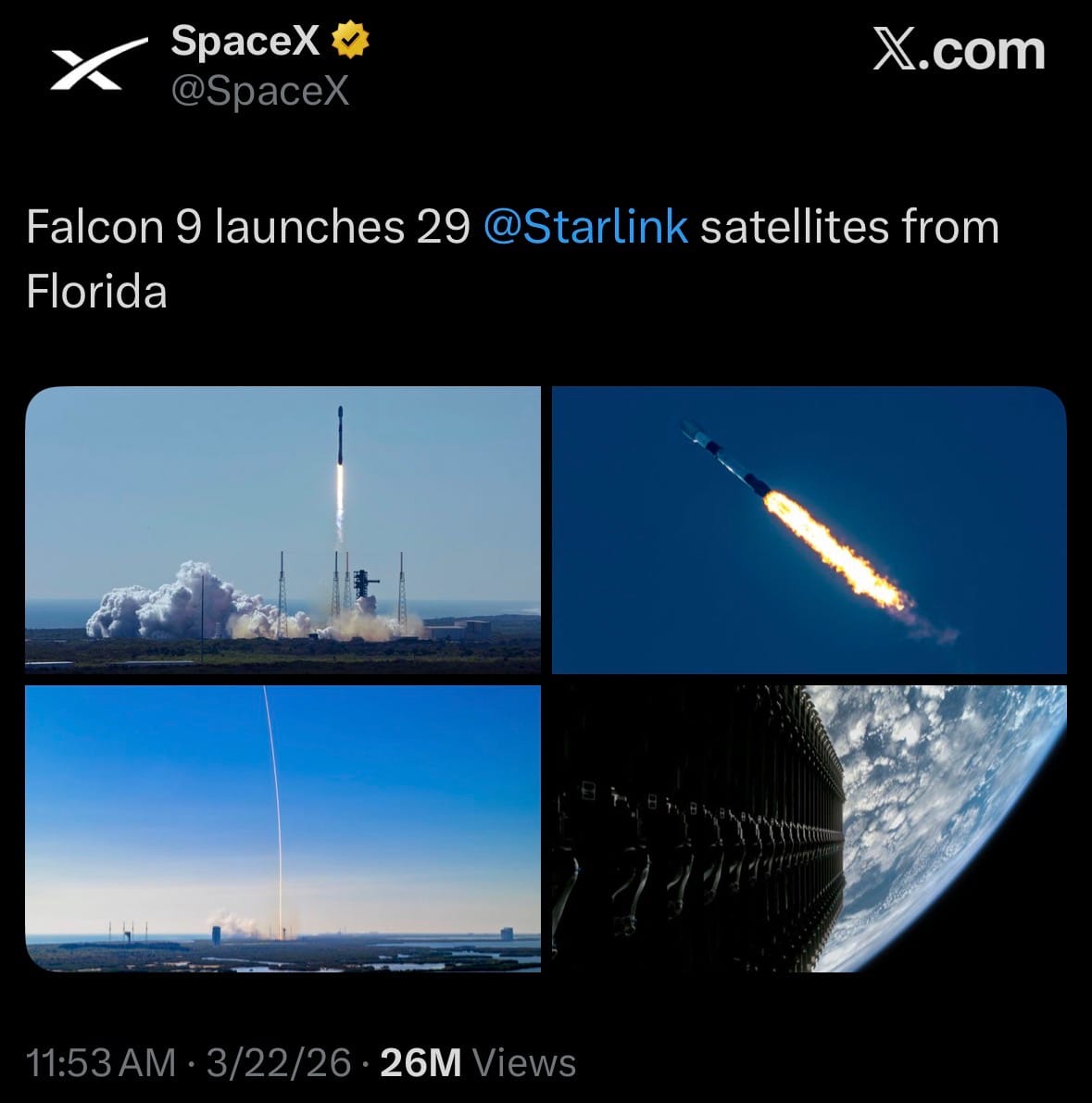
- On March 22, 2026, SpaceX launched 29 Starlink V2 Mini satellites on a Falcon 9 rocket from Cape Canaveral, Florida, for the Starlink 10-62 mission, successfully deploying them to low Earth orbit to expand global broadband coverage. The first-stage booster landed on the droneship “A Shortfall of Gravitas,” marking another routine addition to the Starlink constellation.
- On March 22, 2026, China successfully launched 10 CentiSpace-1 satellites using a Jielong-3 (Smart Dragon-3) solid rocket from the Haiyang offshore launch site in the Yellow Sea. The mission deployed the batch into low Earth orbit to support GNSS augmentation services, enhancing precision navigation by complementing systems like Beidou and GPS for the Beijing-based Future Navigation company.
Statistic:
- Largest assets on Earth by market capitalization:
- Gold: $30.803T
- 🇺🇸 NVIDIA: $4.203T
- Silver: $3.806T
- 🇺🇸 Apple: $3.644T
- 🇺🇸 Alphabet (Google): $3.614T
- 🇺🇸 Microsoft: $2.838T
- 🇺🇸 Amazon: $2.204T
- 🇸🇦 Saudi Aramco: $1.743T
- 🇹🇼 TSMC: $1.707T
- 🇺🇸 Meta Platforms: $1.501T
- 🇺🇸 Broadcom: $1.472T
- 🇺🇸 Tesla: $1.380T
- Bitcoin: $1.361T
- 🇺🇸 Berkshire Hathaway: $1.037T
- 🇺🇸 Walmart: $948.87B
- 🇰🇷 Samsung: $836.99B
- Vanguard S&P 500 ETF (VOO): $826.37B
- 🇺🇸 Eli Lilly: $811.51B
- 🇺🇸 JPMorgan Chase: $772.86B
- iShares Core S&P 500 ETF (IVV): $677.15B
- 🇺🇸 Exxon Mobil: $665.30B
- SPDR S&P 500 ETF (SPY): $641.94B
- 🇺🇸 Visa: $581.53B
- 🇨🇳 Tencent: $572.84B
- 🇺🇸 Johnson & Johnson: $567.21B
History:
- The history of nuclear-powered submarines begins in the early Cold War, when the limitations of diesel-electric submarines—needing to surface frequently for air—became a major strategic weakness. The breakthrough came with nuclear propulsion, which allowed submarines to remain submerged for months and operate with far greater speed and endurance. The first nuclear-powered submarine, the USS Nautilus (SSN-571), was launched by the United States in 1954, powered by a nuclear reactor developed under Admiral Hyman Rickover, often called the “father of the nuclear Navy.” Nautilus demonstrated the revolutionary advantage of nuclear propulsion by traveling beneath the Arctic ice and completing a submerged transit of the North Pole in 1958. This capability transformed submarines from coastal or regional assets into true global platforms. The Soviet Union quickly followed with its own nuclear submarines in the late 1950s, initiating an underwater arms race. By the 1960s, both nations had developed ballistic missile submarines (SSBNs), capable of carrying nuclear missiles and forming one of the most survivable legs of the nuclear triad. These submarines could remain hidden in the ocean for extended periods, making them extremely difficult to detect and a key component of deterrence strategy.
- Today, nuclear-powered submarines are among the most advanced and strategically important military systems in existence. They fall into two main categories: attack submarines (SSNs), designed for hunting ships and other submarines, and ballistic missile submarines (SSBNs), designed to carry nuclear weapons. The United States is widely considered the most advanced operator, with submarines such as the Virginia-class (SSN) and Ohio-class (SSBN), supported by highly advanced sonar, stealth technology, and global operational experience. The U.S. Navy operates the largest and most capable nuclear submarine fleet overall, with dozens of SSNs and SSBNs. Russia also maintains a large and powerful fleet, including advanced submarines like the Borei-class SSBN and Yasen-class SSN, known for high speed, heavy armament, and deep-diving capability. China has rapidly expanded its nuclear submarine program, developing classes such as the Jin-class SSBN and Type 093/095 attack submarines, though it is generally considered less advanced in stealth compared to the U.S. and Russia. The United Kingdom and France both operate smaller but highly capable nuclear submarine fleets, each maintaining SSBNs as part of their nuclear deterrent. In terms of numbers, the United States and Russia have the most nuclear-powered submarines, while China is growing quickly. In terms of overall capability—stealth, sensor systems, and global reach—the United States is generally regarded as the leading power, with the most advanced and operationally integrated submarine force in the world. Nuclear-powered submarines remain one of the most powerful and survivable military assets, capable of operating undetected across the globe and playing a central role in modern naval warfare and strategic deterrence.
Image of the day:
Thanks for reading! Earth is complicated, we make it simple.
- Click below if you’d like to view our free EARTH WATCH globe:
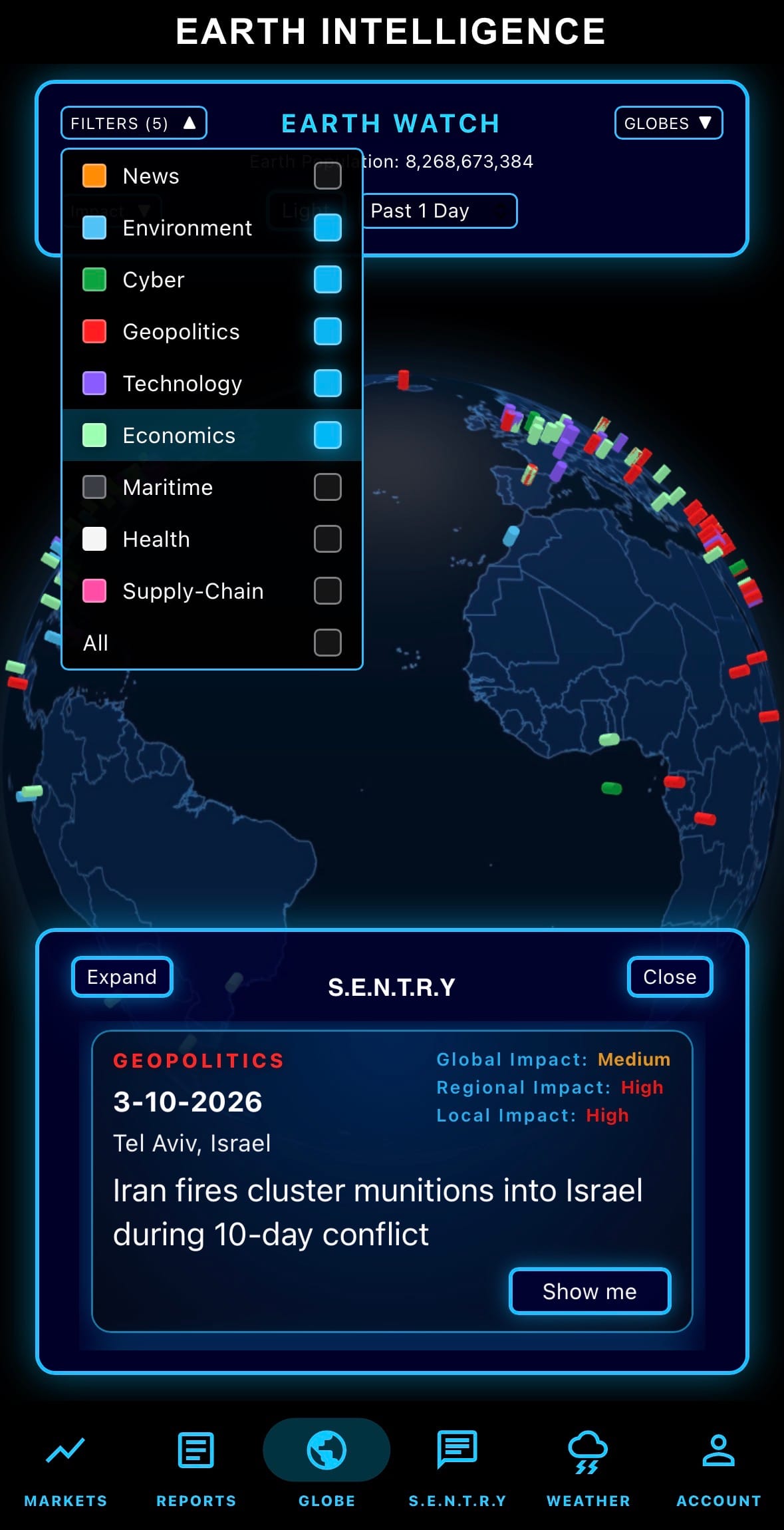
- Download our mobile app:



Click below to view our previous newsletters:
Support/Suggestions Email:
support@earthintel.io