Your daily briefing on the world, markets, science and technology.
Snapshot:
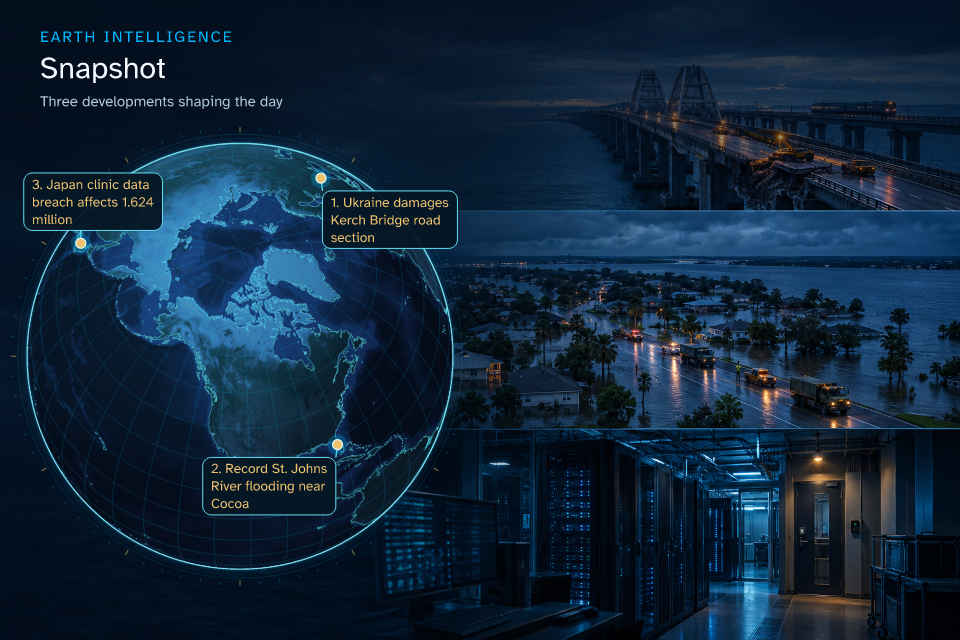
November 19, 2026 — Ukraine struck the Kerch Bridge linking Russia and Russian-occupied Crimea, damaging its road section; trains resumed after assessment, and Russia said it would rebuild it.
November 19, 2026 — Record flooding on Florida’s St. Johns River cut off Cocoa and Rockledge neighborhoods and entered homes; the state deployed nearly 200 Guard personnel and 50 high-water vehicles.
November 18, 2026 — SBC Medical Group said an intruder took Japanese clinic-system data linked to 1.624 million people, including some passwords; the full scope and any misuse remain unknown.
Geopolitics & Military Activity:
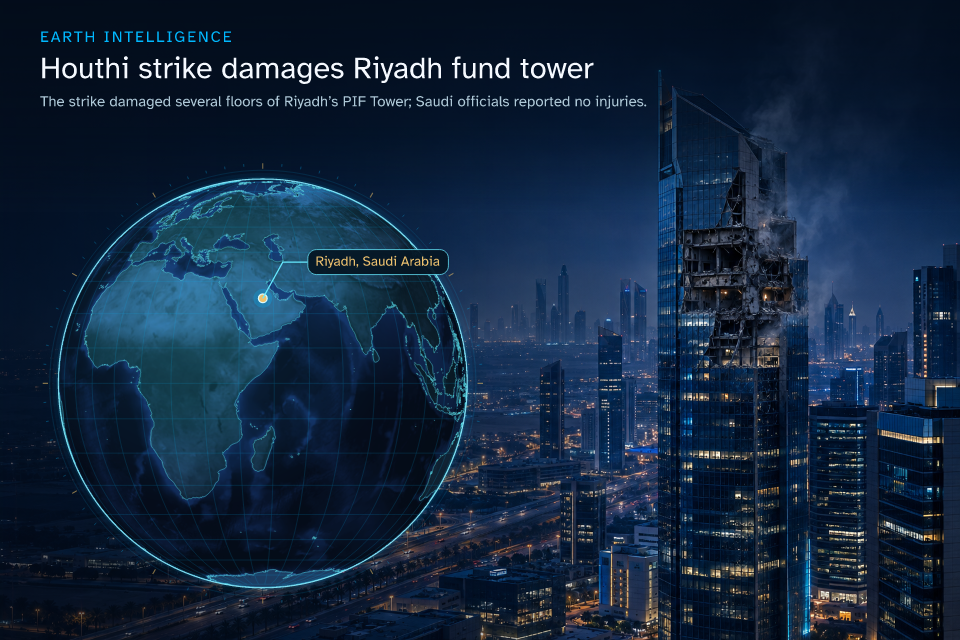
November 19, 2026 — Houthi forces in Yemen struck a tower housing Saudi Arabia’s state investment fund in Riyadh, Saudi Arabia, damaging several floors and nearby buildings. Civil defence reported no injuries; the financial district closed to visitors.
November 19, 2026 — Germany, France, the United Kingdom, Ukraine and the United States agreed in Berlin, Germany, to seek more air-defence missiles and continue military support for Ukraine. Their proposed postwar security force would deploy only after a ceasefire.
November 19, 2026 — Russia flew two nuclear-capable Tu-95 bombers from Da Nang, Vietnam, past Taiwan and through the Tsushima Strait near Japan. Japan scrambled fighter jets, and Taiwan tracked the aircraft.
November 19, 2026 — Japan and India signed a letter of intent in Tokyo, Japan, for Japanese forces to use Indian ranges in future live-fire missile training. The agreement does not mean the training has started.
Economics & Markets:
November 19, 2026 — U.S. stocks fell again in New York, United States, as investors sold artificial-intelligence shares amid doubts about the boom. The S&P 500 lost 2%, its sixth straight decline, and closed 8.2% below last month’s record.
November 19, 2026 — The International Energy Agency, an energy-policy group, released a global outlook with scenarios rather than forecasts. It says a prolonged Strait of Hormuz risk could cut oil flows through the waterway from 20 million barrels a day before the crisis to 8.5 million in 2030.
November 18, 2026 — Bank of Ghana, the country’s central bank, cut its main interest rate from 14% to 11% in Accra, Ghana. It also shortened its main cash-management operation to seven days to keep short-term market rates closer to the new rate.
November 19, 2026 — South African Reserve Bank, the country’s central bank, kept its main interest rate at 7.25% in South Africa. Four of seven committee members backed the pause, while three sought a 0.25-point rise as the bank judged inflation risks to be rising.
Asset
Price
As of (Eastern)
🇺🇸 Apple
349.10999 USD/share
Nov 19, 2026, 7:32 PM EST
🇺🇸 Microsoft
498.16 USD/share
Nov 19, 2026, 7:32 PM EST
🇺🇸 NVIDIA
146 USD/share
Nov 19, 2026, 7:32 PM EST
🇺🇸 Alphabet
270.73001 USD/share
Nov 19, 2026, 7:32 PM EST
🇺🇸 Amazon
257.14499 USD/share
Nov 19, 2026, 7:34 PM EST
🇹🇼 TSMC
352.089996 USD/share
Nov 19, 2026, 7:34 PM EST
🇸🇦 Saudi Aramco
26.48 SAR/share
Nov 19, 2026, 7:34 PM EST
🇺🇸 Broadcom
346.54999 USD/share
Nov 19, 2026, 7:34 PM EST
🇺🇸 Meta Platforms
596.19 USD/share
Nov 19, 2026, 7:34 PM EST
🇺🇸 Tesla
374.42999 USD/share
Nov 19, 2026, 7:34 PM EST
🌐 Gold
3614.25877 USD/troy ounce
Nov 19, 2026, 7:31 PM EST
🌐 Silver
42.83441 USD/troy ounce
Nov 19, 2026, 7:31 PM EST
🌐 Bitcoin
62076 USD/coin
Nov 19, 2026, 7:31 PM EST
🌐 Ethereum
1755.37 USD/coin
Nov 19, 2026, 7:31 PM EST
Business:
November 19, 2026 — TPG, an investment firm, and Corpay, a payments company, agreed to buy BILL, a San Jose, United States platform used by small businesses to pay bills, for $6 billion cash. It would leave the stock market in 2027 if approved.
November 19, 2026 — Intuit, a United States finance-software company, agreed to sell its Mailchimp email-marketing business to Italian software company Bending Spoons for $3.68 billion. The sale is expected in early 2027 after regulatory approvals and other closing conditions.
November 19, 2026 — Walmart, a retailer, reported $188.8 billion in third-quarter sales and raised its fiscal-year forecast in Bentonville, United States. Global online sales rose 17%, while the new forecast calls for 4.9%–5.2% sales growth.
November 19, 2026 — Alibaba, a China-based online-shopping and cloud company, reported $40.5 billion in quarterly revenue in Hong Kong, China. Sales from its artificial-intelligence cloud services rose 53%, while it spent $7.5 billion building more computing capacity.
Politics & Society:
November 19, 2026 — Serbia’s Parliament elected Aleksandar Cupic, a university lecturer from the student-led Students List, as speaker in Belgrade, Serbia. The post makes him acting president, and he is expected to schedule a presidential election by year-end.
November 19, 2026 — Mongolia’s Parliament voted 96–4 to accept President Khurelsukh Ukhnaa’s resignation in Ulaanbaatar, Mongolia, after allegations he benefited from a railway project, which he denies. The speaker becomes interim president pending an election within four months.
November 19, 2026 — Indonesia’s House of Representatives passed an asset forfeiture law in Jakarta, Indonesia, allowing authorities in some cases to seize assets tied to corruption or other crimes without first winning a criminal conviction. The law includes oversight rules intended to limit abuse.
November 19, 2026 — South Korea’s Supreme Court overturned former Prime Minister Han Duck-soo’s 15-year sentence and returned the case to a lower court in Seoul, South Korea. The court said prosecutors had not proved he intended to support the 2024 martial-law decree; he remains detained.
Environment & Weather:
November 19, 2026 — The Odisha State Disaster Management Authority, the state emergency agency, deployed 74 rescue teams and began moving vulnerable residents to shelters in Odisha, India, before Cyclone Akvan. India’s national weather service forecast landfall near Gopalpur, Odisha, India, on November 20, with 90–100 km/h winds.
November 19, 2026 — Heavy rain prompted flash-flood warnings in Los Angeles, California, United States, including recent wildfire burn areas. City crews dealt with flooded roads, while evacuation warnings stayed in place and the Sepulveda Basin and Lake Balboa closed.
November 19, 2026 — Cook Islands Prime Minister Mark Brown declared an emergency for Nassau, Cook Islands, as Category 4 Cyclone Xavier approached. The order lets the government direct agencies, evacuate residents and use resources for the response.
Cyber:
November 19, 2026 — JPMorgan Chase, a U.S. bank, and Visa and Mastercard, payment networks, said attacks on outside providers exposed some customer contact or marketing data. JPMorgan’s leak involved thousands; Visa’s provider was in Asia-Pacific, and payment details were not affected.
November 19, 2026 — N-able, an IT-management company, said an unidentified intruder reached a server used by its email-filtering services across the Americas, Europe and Asia-Pacific. It disabled management tools while restoring them; email delivery continued, and no customer-data theft is confirmed.
November 19, 2026 — The European Commission, the European Union’s executive body, confirmed a series of AI-assisted attacks on its systems in Brussels, Belgium. It temporarily took several applications offline and restored most; no staff-wide data breach is confirmed, and the attacker is unidentified.
Science & Technology:
November 18, 2026 — The U.S. Food and Drug Administration approved Infilbray from Genzyme, a Sanofi drugmaker, for brain and nerve symptoms of type 3 Gaucher disease in adults and children weighing at least 15 kilograms in the United States. A 43-person trial found improvement after 52 weeks, but the label warns of serious psychiatric risks.
November 19, 2026 — The U.S. Multiple Myeloma Immunotherapy Consortium, a group of eight cancer centers, documented delayed severe bowel inflammation in 41 of 1,308 U.S. patients treated with Carvykti, an immune-cell therapy for multiple myeloma. Thirty needed intravenous nutrition and 17 died while it was active; the retrospective referral-based study cannot define risk for all users.
November 19, 2026 — Google and Ohio Power Company, an electricity utility, filed a plan to replace 15.5 miles of transmission wire in Columbus, Ohio, United States, with higher-capacity lines paid for by Google. Regulators must approve it; it could deliver 24 megawatts of Google’s contracted power about two years early and later enable more capacity along the corridor.
November 19, 2026 — GE HealthCare, a medical-imaging company, said a Phase 2 trial at sites in the United States, Europe and Asia found its experimental manganese MRI dye gave results similar to gadolinium dye, with no safety concerns observed. The company will move it into Phase 3 testing; it is not approved for patient use.
Space:
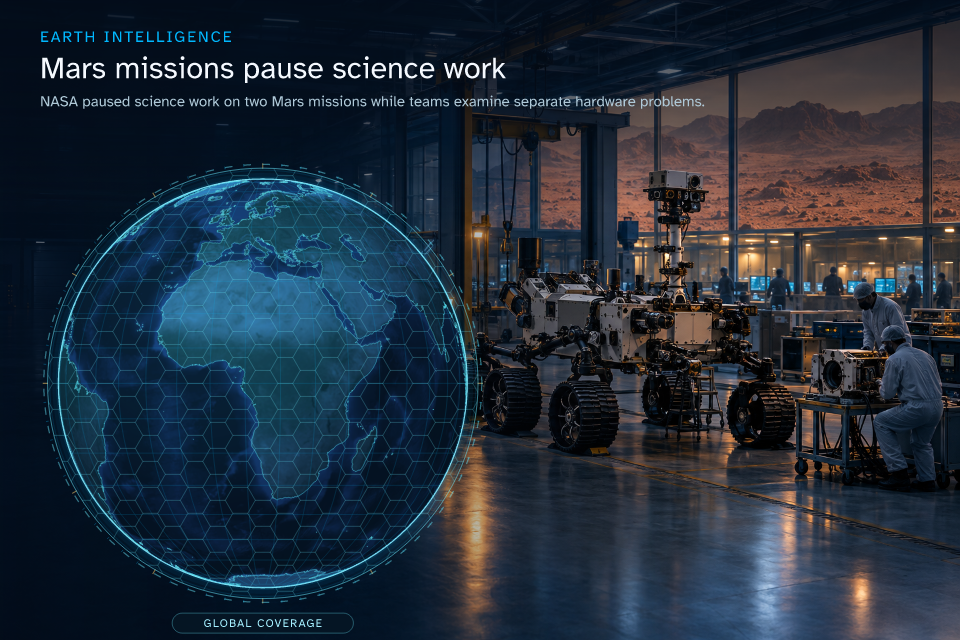
November 19, 2026 — NASA, the United States space agency, paused science work by the Perseverance rover and Mars Odyssey orbiter while it investigates separate hardware faults. Perseverance can still contact Earth, but its science work and Odyssey’s relay service are offline.
November 19, 2026 — European Space Agency member states selected Plasma Observatory as Europe’s next medium-sized science mission. The seven-satellite project now moves toward approval and construction for a planned late-2030s launch to study energy from the Sun around Earth.
November 19, 2026 — Lunar Outpost, a lunar-vehicle maker based in Colorado, United States, passed NASA’s preliminary design review for its Pegasus rover. The review moves the planned 2028 Moon vehicle into its next design stage; it is not yet flight-ready.
November 19, 2026 — An international team led by the Weizmann Institute of Science in Rehovot, Israel, found PSR J1622-7204, a neutron star spinning 261 times a second, in NASA Fermi data. The new method took 10 computer-hours; an older one failed after 600 years of equivalent computer work.
Trends:
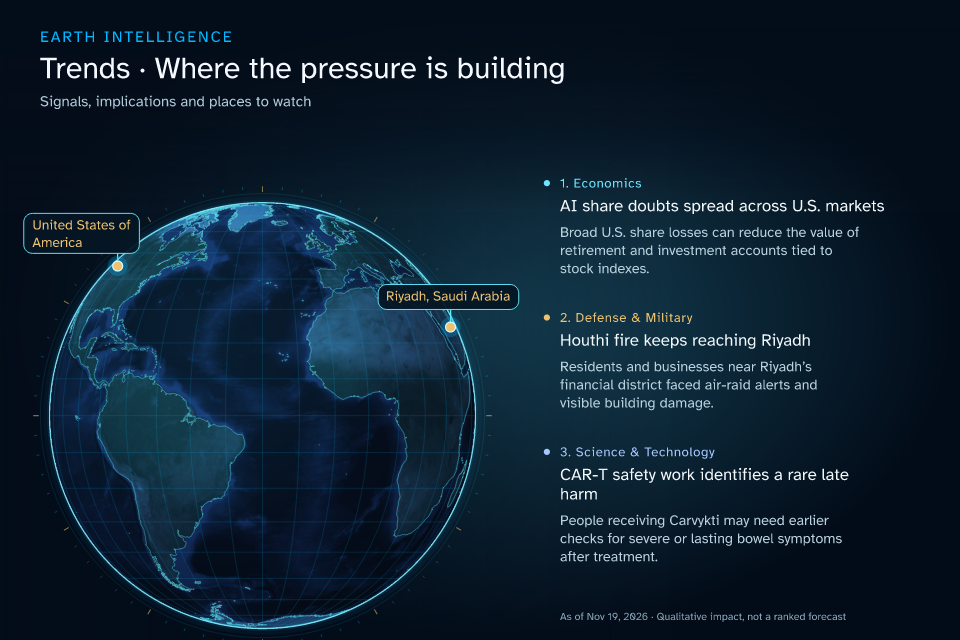
U.S. stock markets fell for a sixth session on November 19 as AI shares fell and more than 90% of S&P 500 stocks declined; retirement funds tied to these indexes can move sharply, though the indexes remain up this year. Houthi missile debris damaged Riyadh, Saudi Arabia, showing repeated attacks are reaching the capital. A U.S. cancer study found a rare, serious delayed bowel illness after Carvykti, supporting longer patient monitoring.
What to watch: • The U.S. stock sell-off: watch whether losses keep spreading beyond AI shares; the Riyadh, Saudi Arabia strike: watch for further damage or service disruption; the Carvykti study: watch whether clinics add earlier checks for lasting diarrhea. The study cannot define every patient’s risk or prove the best treatment.
Statistic of the Day:
Australia’s seasonally adjusted unemployment rate was 4.9 percent in October 2026.
The unemployment rate is the share of people in the labour force who did not have a job, were available to work and were looking for one. Seasonal adjustment removes regular calendar patterns to make monthly figures easier to compare.
History of Pulsars: from radio pulses to gamma-ray searches:
Pulsars are fast-spinning neutron stars—the crushed cores left after some stars explode—whose sweeping beams appear as regular flashes. First found in radio data in 1967, they became precise tools for testing gravity and for finding sources that shine mainly in gamma rays.
July 1, 1934: Walter Baade and Fritz Zwicky proposed that a supernova could leave a neutron star. The idea offered a possible compact stellar remnant, but telescopes had not yet detected one.
November 28, 1967: Cambridge graduate student Jocelyn Bell noticed a repeating radio signal while examining telescope charts in Cambridge, United Kingdom. Its clock-like regularity did not fit the radio sources the project was built to study.
February 24, 1968: A paper announced the new signals as pulsars. Follow-up observations showed that rapidly spinning, strongly magnetic neutron stars could sweep beams past Earth, making them appear to flash.
1974: Russell Hulse and Joseph Taylor found a pulsar orbiting another dense star. Years of timing its pulses showed the orbit shrinking as Einstein’s theory predicted when energy leaves as gravitational waves.
June 11, 2008: NASA launched the Fermi Gamma-ray Space Telescope, whose Large Area Telescope scans the full sky for the highest-energy light. It later found pulsars from gamma-ray flashes alone, revealing objects radio searches can miss.
Image of the Day:
Thanks for reading! Earth is complicated, we make it simple.