Thursday☕️


Trending:
- On November 12, 2025, the U.S. government shutdown concluded after President Donald Trump signed a funding bill passed by the House of Representatives earlier that evening, marking the end of the longest shutdown in U.S. history at 43 days. The bipartisan measure, which had cleared the Senate unanimously, provides temporary funding for federal agencies through the end of January 2026, averting further disruptions amid ongoing negotiations over broader spending priorities, including border security and domestic programs.

- The shutdown began on October 1, 2025, due to disagreements on fiscal year appropriations, affecting nine federal departments and leaving approximately 800,000 workers furloughed or working without pay. The resolution means federal agencies can reopen as early as November 13, with back pay issued to affected employees, restoration of essential services such as food assistance programs, national parks operations, and airport security screenings, and resumption of non-essential functions like tax refunds and regulatory oversight.
Economics & Markets:
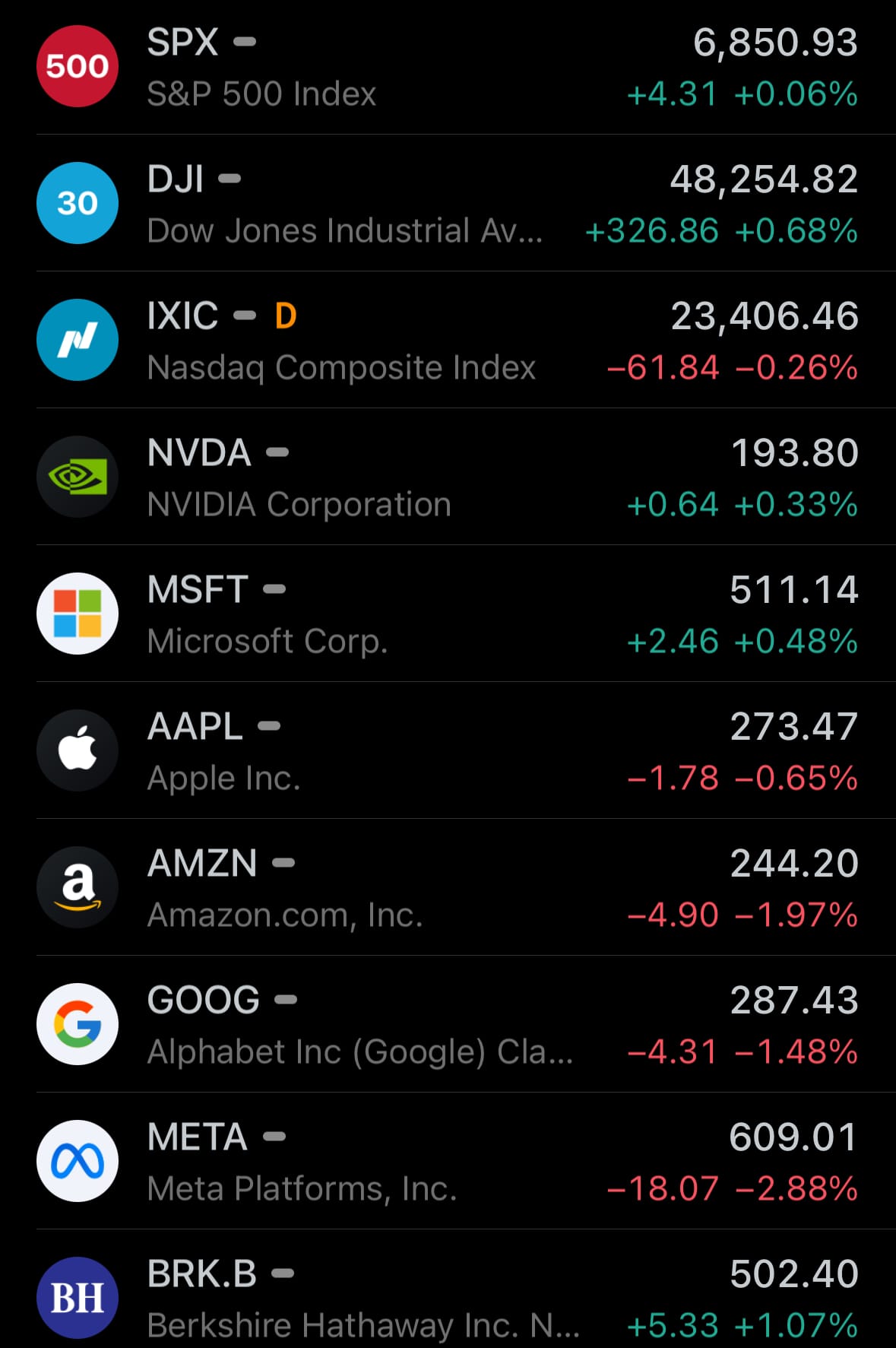
- Yesterday’s U.S. stock market:
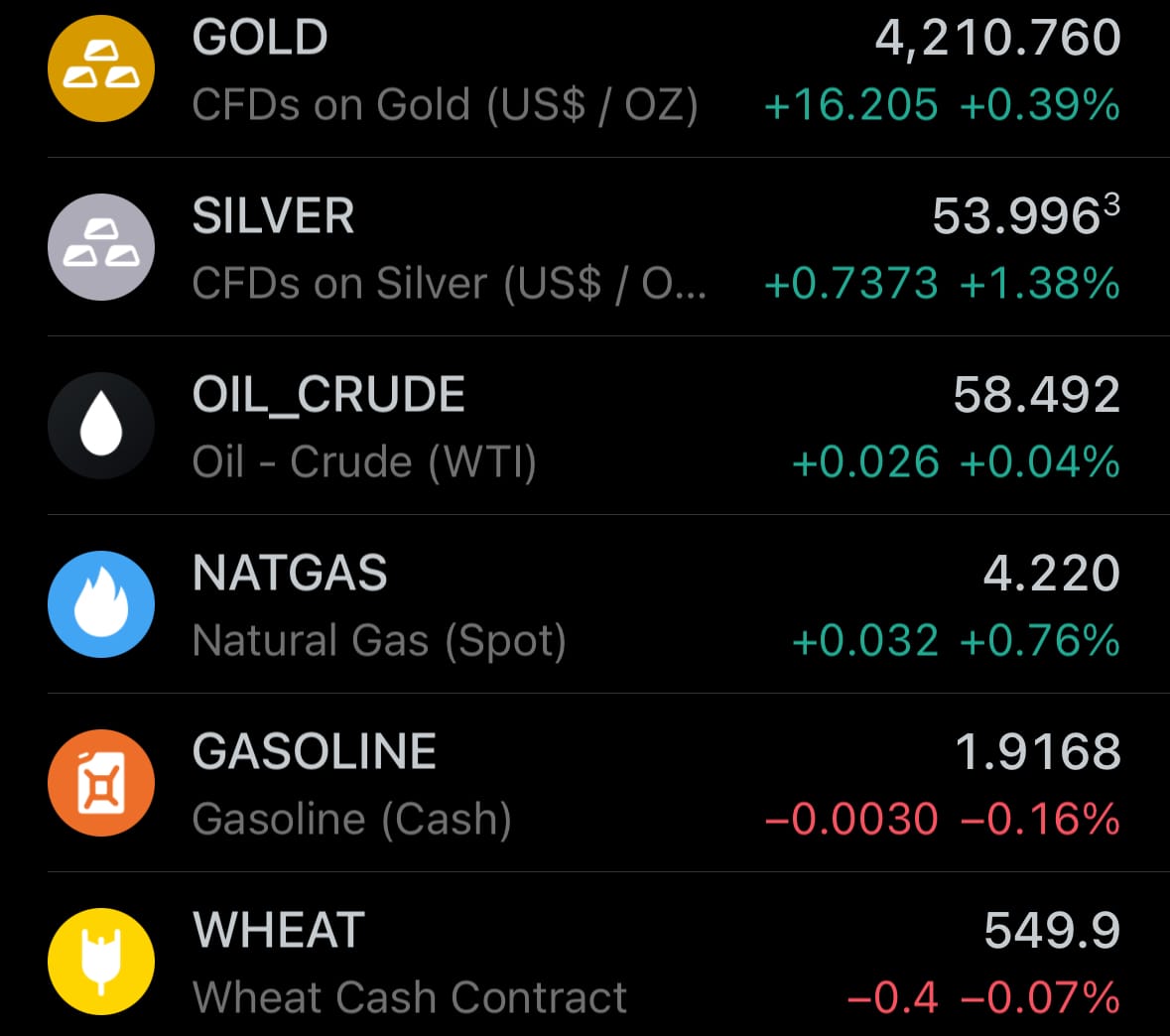
- Yesterday’s commodity market:
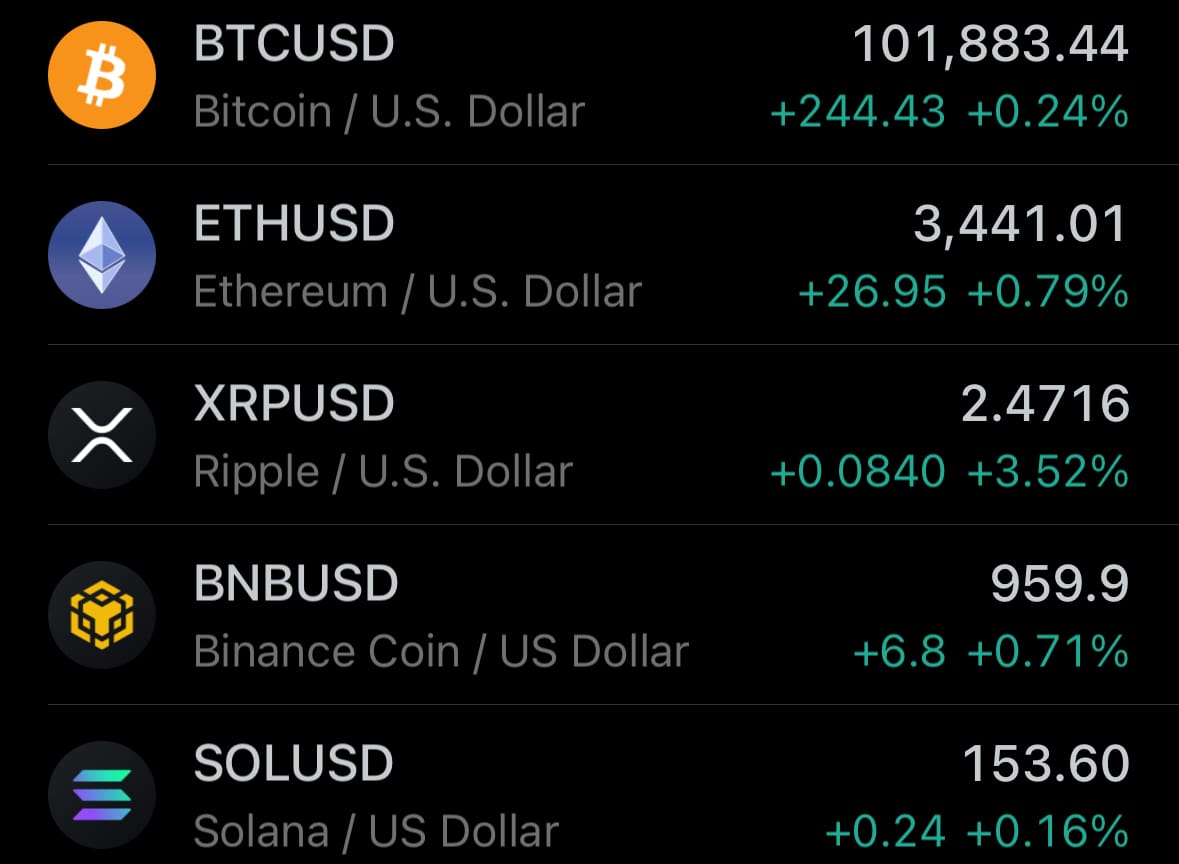
- Yesterday’s crypto market:
Geopolitics & Military Activity:
- On November 12, 2025, U.S. Central Command (CENTCOM) announced that its forces had advised, assisted, and enabled more than 22 operations against ISIS in Syria over the past month, from October 1 to November 6, in coordination with Syrian partners under Combined Joint Task Force – Operation Inherent Resolve (CJTF-OIR). These counter-ISIS efforts targeted the group's remnants to reduce their capacity for local attacks and international terrorism, aligning with ongoing stabilization initiatives in formerly ISIS-controlled areas. The announcement highlighted Syria's recent entry as the 90th member of the Global Coalition Against ISIS, emphasizing a shift toward preventing the group's regeneration through coalition efforts.
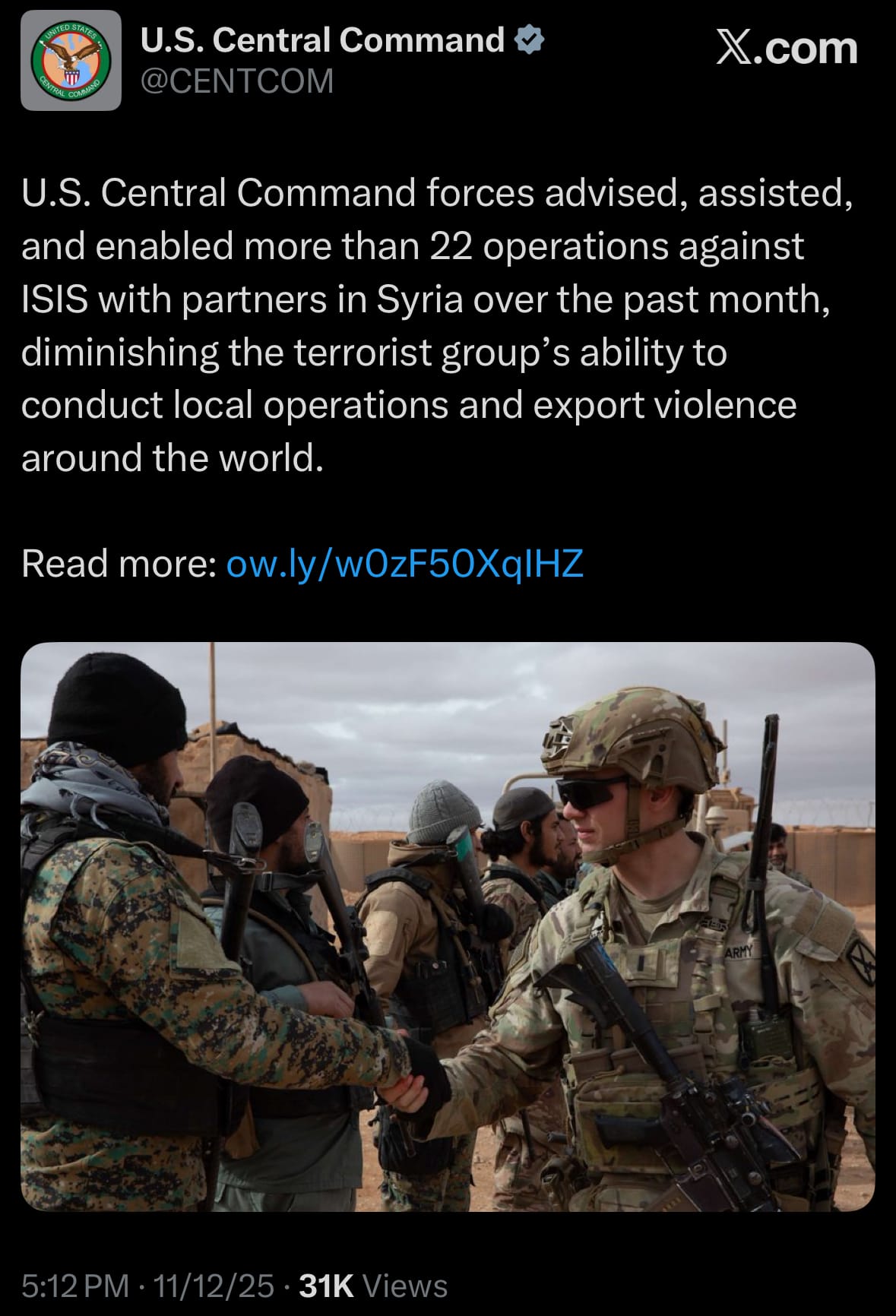
- The operations resulted in five ISIS members killed and 19 captured, contributing to broader goals of denying ISIS opportunities to rebuild by addressing detainee repatriation and displaced persons camps, where populations have decreased from 70,000 in 2019 to under 30,000 today. CENTCOM Commander Adm. Brad Cooper stressed the importance of aggressive pursuit of ISIS while advocating for expedited returns of vulnerable populations to prevent radicalization, noting that such actions deliver a decisive blow to the group's sustainability and support lasting gains against terrorism in the region.
Environment & Weather:
Science & Technology:
- On November 12, 2025, OpenAI announced the release of GPT-5.1, an upgraded version of its GPT-5 series designed to make ChatGPT smarter and more conversational overall. This update includes two primary models: GPT-5.1 Instant, the default for most interactions, and GPT-5.1 Thinking, focused on advanced reasoning tasks. The rollout begins immediately for paid subscribers such as Pro, Plus, Go, and Business users, with a gradual expansion over the next few days to ensure stability, followed by access for free and logged-out users. Enterprise and education plans receive a seven-day early-access option that is off by default, after which GPT-5.1 becomes the standard. API availability is slated for later in the week, with legacy GPT-5 models remaining selectable for paid users for three months to ease the transition.

- GPT-5.1 introduces enhanced capabilities like adaptive reasoning, where the model decides when to think deeply for complex queries such as math or coding problems, improving accuracy without slowing simple responses. It features a warmer, more empathetic and playful tone by default, better adherence to user instructions, and clearer explanations with reduced jargon. Personalization options have been expanded with new presets including Professional, Candid, and Quirky, alongside fine-tuning for traits like conciseness or emoji usage, allowing immediate application across chats.

Earth Intelligence:
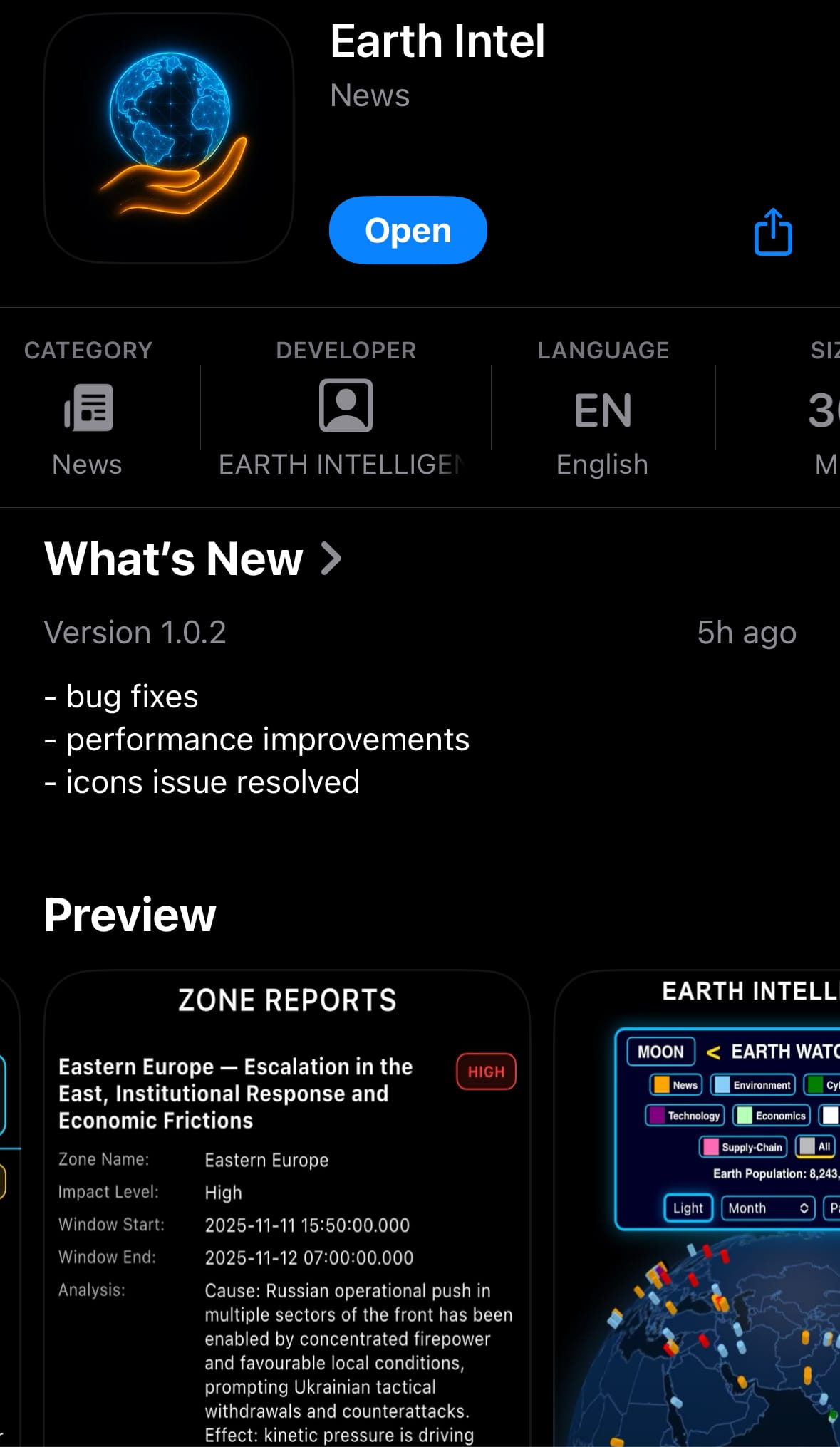
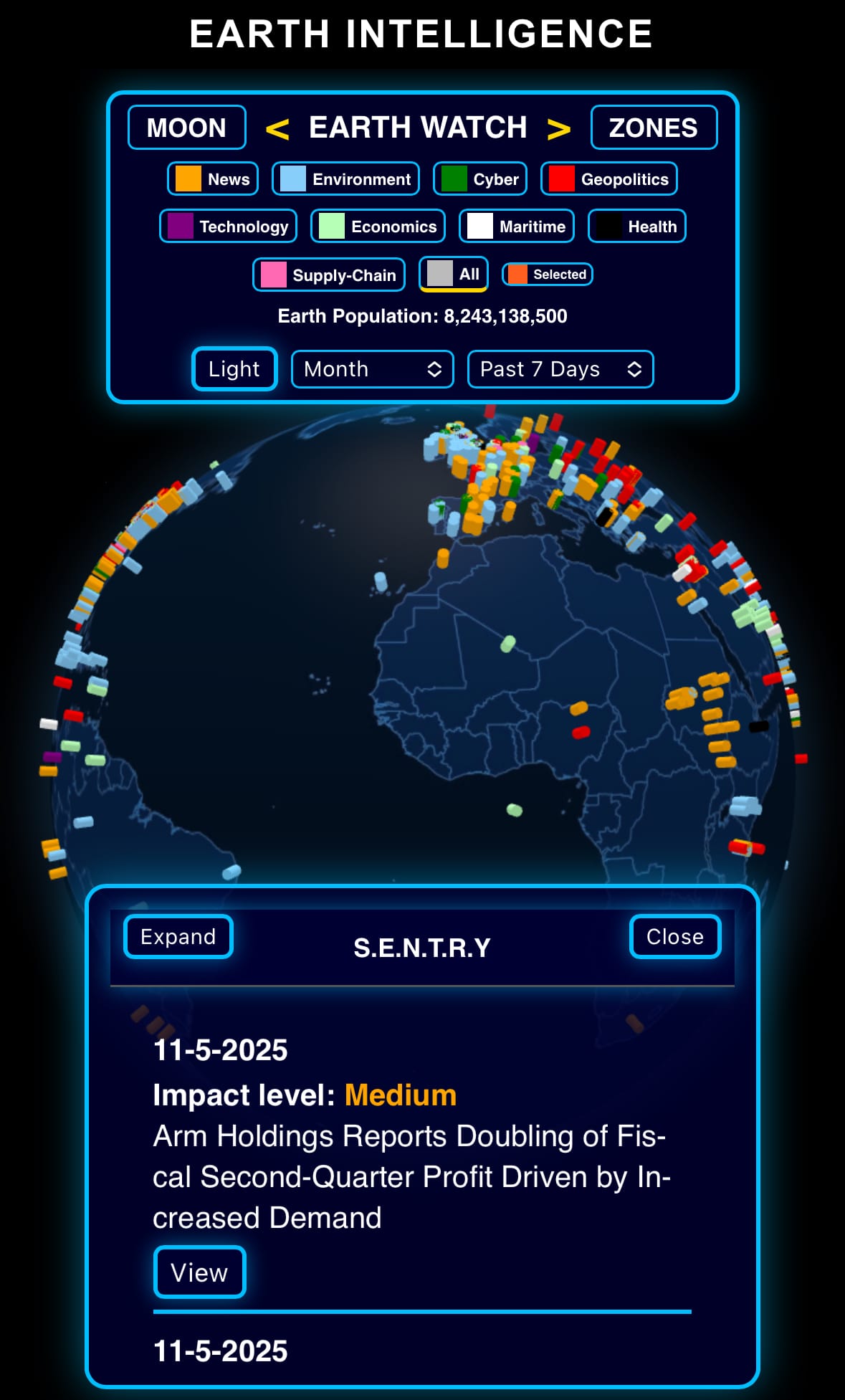
- We just launched an app on the Apple App store. The app is free to use, no sign up/sign in required and is completely powered by S.E.N.T.R.Y.; our Strategic Earth Node Tracking Relevant Event Yields. The primary features are the 3DGlobe, an AI feed of global events, and Zone Reports. We’ll be launching version 2 later this week and preparing for an Android launch as well.
- Thanks again for reading and let us know if you have any questions or suggestions. We also build custom systems like this for businesses and decision makers looking for real time interest awareness. While our systems are in their infancy stage, they will evolve rapidly.
Statistic:
- Largest assets on Earth by market capitalization:
- Gold: $29.352T
- 🇺🇸 NVIDIA: $4.718T
- 🇺🇸 Apple: $4.040T
- 🇺🇸 Microsoft: $3.798T
- 🇺🇸 Alphabet (Google): $3.463T
- Silver: $3.053T
- 🇺🇸 Amazon: $2.610T
- Bitcoin: $2.037T
- 🇺🇸 Broadcom: $1.677T
- 🇸🇦 Saudi Aramco: $1.674T
- 🇺🇸 Meta Platforms: $1.535T
- 🇹🇼 TSMC: $1.507T
- 🇺🇸 Tesla: $1.432T
- 🇺🇸 Berkshire Hathaway: $1.085T
- 🇺🇸 Eli Lilly: $912.39B
- 🇺🇸 JPMorgan Chase: $872.24B
- 🇺🇸 Walmart: $824.71B
- VOO: $801.84B
- 🇨🇳 Tencent: $765.81B
- IVV: $724.81B
- SPY: $705.37B
- 🇺🇸 Visa: $654.00B
- 🇺🇸 Oracle: $647.10B
- VTI: $563.86B
- 🇺🇸 Mastercard: $503.98B
- 🇺🇸 Exxon Mobil: $498.11B
History:
- Humanity’s earliest swords emerged as copper and bronze prototypes around 3300–1200 BC, with true long-bladed weapons taking shape during the Bronze Age in regions like Mesopotamia, the Aegean, and Egypt. The shift to iron around 1200–600 BC transformed swordcraft, producing tougher blades such as the Greek xiphos, the Roman gladius, and later the spatha, which spread across Europe with the Roman cavalry and Germanic tribes. Through the Middle Ages, swordmaking became a refined craft: the Viking Age (c. 800–1100 CE) introduced pattern-welded blades, and the High Medieval period (1100–1300 CE) produced arming swords optimized for mail armor. As plate armor hardened, the late medieval longsword (1300–1500 CE) shifted toward thrust-heavy designs. The Renaissance (1500–1600 CE) then evolved the sword into the rapier—a civilian dueling and status weapon emphasizing speed, precision, and technique.
- Swords began losing their battlefield primacy with the rise of gunpowder weapons in the 16th century, especially after the spread of the matchlock arquebus (1500s) and later the flintlock musket (1600s–1700s). By the 18th and 19th centuries, industrialized firearms and massed musket fire made swords largely secondary—used mostly by officers and cavalry for signaling, honor, and close-quarters charges. After World War I (1914–1918) entrenched automatic weapons and explosive artillery as the core of modern combat, swords disappeared from military doctrine entirely. What endured were smaller blades—combat knives, trench daggers, bayonets—tools for utility and last-resort fighting rather than primary weapons. Today, swords persist as ceremonial icons, martial arts instruments, and cultural heirlooms, relics of an age when steel and human skill defined warfare long before chemistry and ballistics took over.
Image of the day:

Thanks for reading!
- EARTH INTELLIGENCE builds private intelligence systems for organizations — connecting their internal and external data with AI to create one interactive command center for real-time awareness, decision making, and predictions.
Earth is complicated, we make it simple.
- Click below if you’d like to view our free EARTH WATCH globe:

Click below to view our previous newsletters:
Support/Suggestions Email:
earthintelligence@earthintel.news