Thursday☕️


Economics & Markets:
- Today’s commodity market:

- Today’s crypto market:

Geopolitics & Military Activity:
- On November 27, 2025, the Israel Defense Forces carried out a series of airstrikes in southern Lebanon targeting sites associated with Hezbollah, including alleged rocket launchers, weapons depots, and military infrastructure in the Jezzine district and Nabatieh region. Operations focused on areas near the villages of Jarmaq and Mahmoudiyeh, as well as highlands between Jabal al-Rafi and Jarmaq Heights, Aiyshiyyeh, Kfar Rema, and Iqlim al-Tuffah, following intelligence on the group's rearmament activities despite a ceasefire agreement reached in November 2024. The IDF stated these actions were necessary to prevent Hezbollah from rebuilding offensive capabilities, while affirming commitment to the truce terms that require the group's disarmament south of the Litani River and Israeli withdrawal from certain positions.
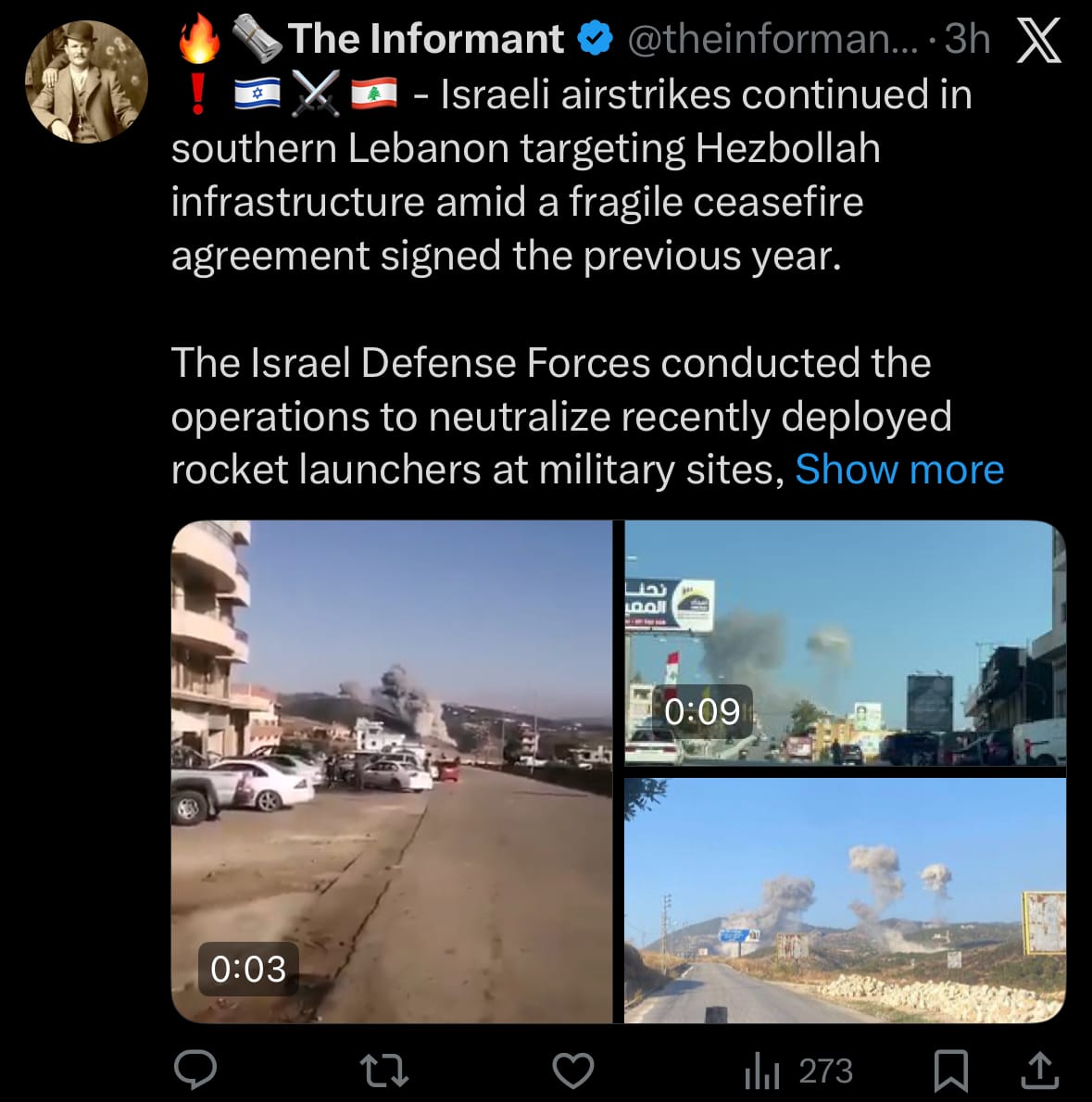
- Lebanese media, including the National News Agency, reported no immediate casualties from these strikes, though prior operations in the same areas on November 22 caused civilian injuries and property damage. The incidents fit into a broader pattern of daily Israeli airstrikes since early November, totaling over 100 reported actions, amid reciprocal claims of ceasefire violations—Israel accusing Hezbollah of rearming and the group alleging aggressive Israeli overflights and incursions. The agreement, mediated by the U.S. and France, has not held nominally and faces strain from ongoing displacements affecting more than 64,000 Lebanese residents and calls from the UN for investigations into potential breaches by both sides.
Environment & Weather:
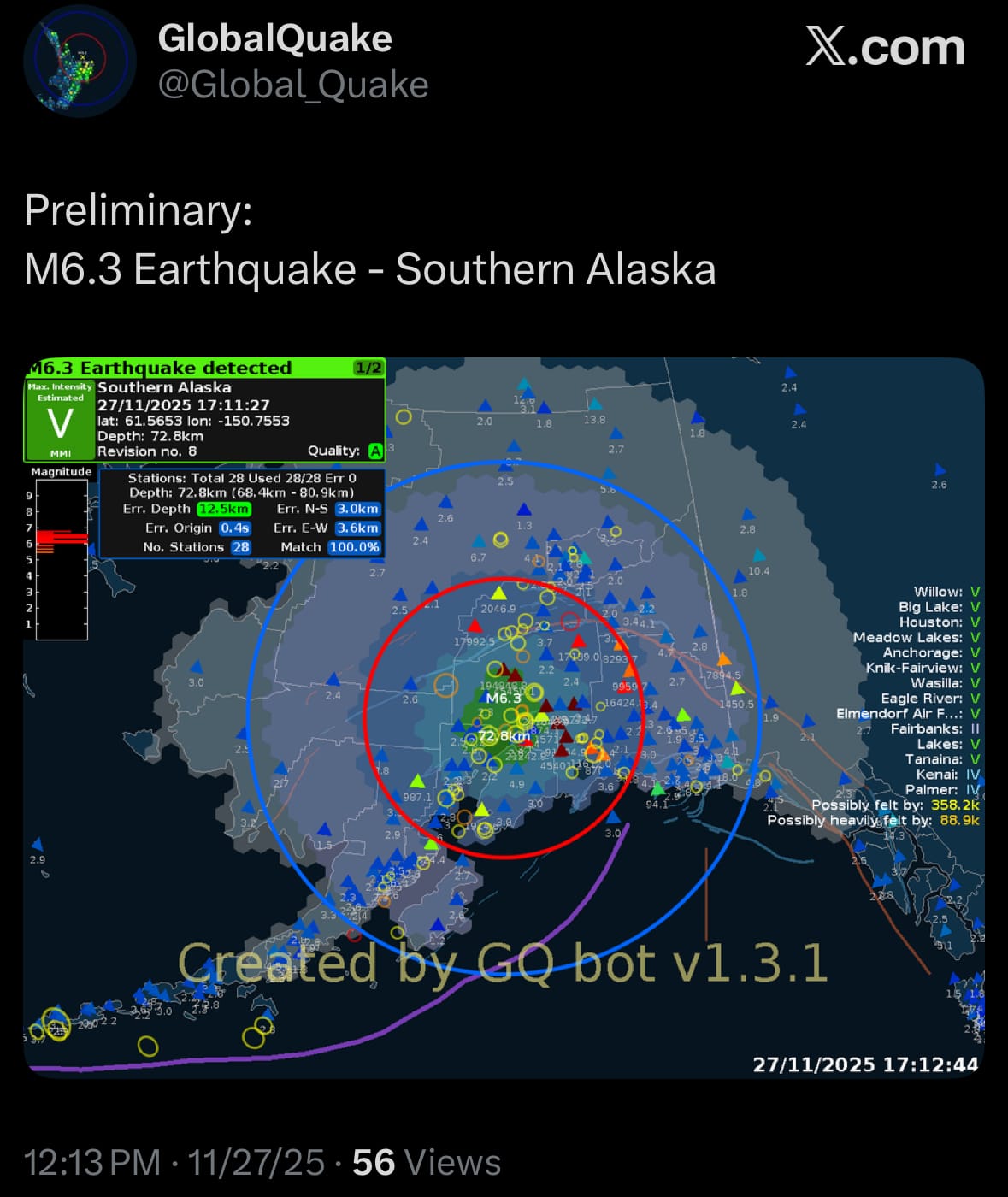
- On November 27, 2025, torrential monsoon rains triggered by a rare tropical cyclone, Senyar, caused severe flash floods and landslides across Indonesia's Sumatra island, particularly in North Sumatra province, resulting in at least 49 deaths and 67 people missing, according to the National Disaster Management Agency. Rivers burst their banks in multiple districts, including Central Tapanuli, North Tapanuli, and South Tapanuli, submerging over 2,000 homes and public buildings, destroying bridges, and uprooting trees, while landslides buried villages under mud and debris. Rescuers, using rubber boats and ropes, evacuated nearly 5,000 residents to temporary shelters amid power outages and blocked roads, with operations hampered by ongoing downpours and a "total cutoff" of communications in remote areas; authorities reported additional impacts in West Sumatra and Aceh, where 10 districts were flooded.

- The disaster, exacerbated by illegal logging and palm oil plantation expansion that worsened soil erosion, is part of a broader wave of extreme weather affecting Southeast Asia, including deadly floods in Thailand and Malaysia, potentially linked to interactions between Cyclone Senyar and Typhoon Koto. Indonesia's Meteorology, Climatology and Geophysics Agency forecasted more heavy rain through next week, prompting plans for cloud seeding to mitigate further flooding, while a 6.3-magnitude earthquake struck near Aceh on November 26 without reported casualties but adding strain to response efforts. Experts attribute the intensity to seasonal monsoon patterns in the archipelago's vulnerable mountainous and floodplain regions, where millions reside, highlighting recurring risks from climate variability and land-use changes.
Space:
- On November 27, 2025, the Soyuz MS-28 spacecraft launched successfully at 9:27 UTC from Site 31/6 at the Baikonur Cosmodrome in Kazakhstan aboard a Soyuz-2.1a rocket, carrying NASA astronaut Christopher Williams and Roscosmos cosmonauts Sergey Kud-Sverchkov and Sergey Mikayev to the International Space Station. Kud-Sverchkov served as mission commander, with Mikayev as flight engineer and Williams as a mission specialist; all three underwent extensive training at the Gagarin Cosmonaut Training Center, including simulations and survival exercises. The ascent proceeded nominally through three stages and four strap-on boosters, placing the crewed vehicle into a low Earth orbit trajectory for a fast-track rendezvous, with the spacecraft docking autonomously to the ISS's Rassvet module at approximately 12:38 UTC after a two-orbit journey. Hatches opened shortly thereafter, allowing the trio to join the Expedition 73 crew for initial handover activities.
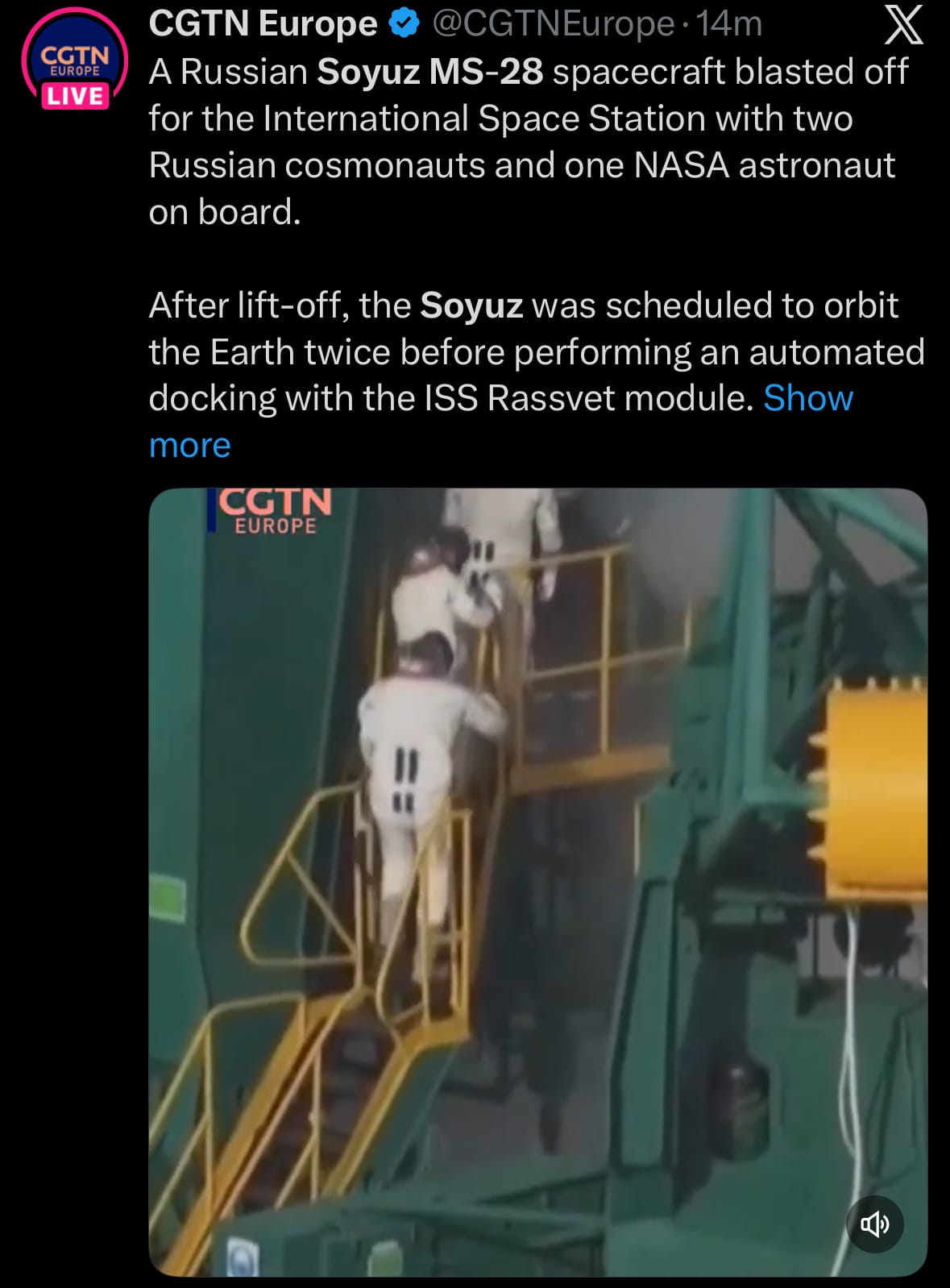
- The eight-month mission, part of the ongoing NASA-Roscosmos seat-swap agreement extended into 2025, will see the crew contribute to over 200 scientific experiments in microgravity, focusing on human health, biological research, and Earth observation, while maintaining station systems and preparing for future commercial crew rotations. This flight marks the 28th Soyuz mission to the ISS since 2000 and underscores continued international cooperation amid geopolitical tensions, with Williams' assignment highlighting NASA's reliance on Russian transport vehicles until the full operationalization of its own capabilities. The crew is scheduled to return in July 2026 aboard the same spacecraft, overlapping with Expedition 74 to ensure continuous habitation of the orbital laboratory.

Statistic:
- Largest assets on Earth by market capitalization:
- Gold: $29.134T
- 🇺🇸 NVIDIA: $4.381T
- 🇺🇸 Apple: $4.118T
- 🇺🇸 Alphabet (Google): $3.866T
- 🇺🇸 Microsoft: $3.608T
- Silver: $3.017T
- 🇺🇸 Amazon: $2.449T
- 🇺🇸 Broadcom: $1.877T
- Bitcoin: $1.814T
- 🇺🇸 Meta Platforms (Facebook): $1.597T
- 🇸🇦 Saudi Aramco: $1.587T
- 🇹🇼 TSMC: $1.503T
- 🇺🇸 Tesla: $1.418T
- 🇺🇸 Berkshire Hathaway: $1.102T
- 🇺🇸 Eli Lilly: $989.99B
- 🇺🇸 Walmart: $870.66B
- 🇺🇸 JPMorgan Chase: $845.93B
- Vanguard S&P 500 ETF: $797.66B
- iShares Core S&P 500 ETF: $728.85B
- 🇨🇳 Tencent: $721.20B
- SPDR S&P 500 ETF: $698.11B
- 🇺🇸 Visa: $647.86B
- 🇺🇸 Oracle: $584.29B
- Vanguard Total Stock Market Index Fund ETF Shares: $561.47B
- 🇺🇸 Johnson & Johnson: $500.07B
History:
- Satellites move from theory to hardware in less than a generation. The idea appears in early 20th-century rocketry and in the writings of Konstantin Tsiolkovsky and others, but the real break happens on October 4, 1957, when the Soviet Union launches Sputnik 1—the first artificial satellite and a blunt signal that space has become a military and political domain. In the 1960s, orbital roles split and multiply: TIROS weather satellites and Telstar 1 prove you can move weather data and live TV through space; the U.S. Navy’s Transit and then the Navstar GPS program begin turning navigation into a satellite problem; and Corona reconnaissance satellites quietly replace risky spy plane overflights, returning film capsules with images of Soviet missile fields that reshape Cold War planning. The 1970s and 1980s add systematic Earth observation and persistent strategic awareness: Landsat 1 in 1972 starts an unbroken record of global land imaging, while defense early-warning satellites watch for missile launches in infrared, turning “warning time” from minutes into tens of minutes. By decade: the 1950s prove orbit is possible; the 1960s demonstrate communications and reconnaissance; the 1970s industrialize Earth imaging and begin GPS; the 1980s and 1990s build full navigation constellations (GPS, GLONASS) and geostationary comsat rings; the 2000s introduce smaller, cheaper platforms and commercial imaging constellations; the 2010s and 2020s detonate into the era of megaconstellations in low Earth orbit. At the same time, militaries lean harder on space: dedicated constellations now handle secure command-and-control, nuclear missile early warning, electronic intelligence, targeting support, and encrypted data links. A huge fraction of that infrastructure—especially in the U.S., Russia, and China—is classified. We know what some spacecraft are supposed to do from public filings, orbits, and occasional leaks; we don’t know the full mission set of many payloads, and we definitely don’t have a public inventory of what each state is trying to weaponize. Concepts like orbital kinetic bombardment (“rods from God”), high-energy laser platforms, and space-based interceptors have been studied seriously on paper and in technology demos, but they sit in a gray zone: theoretically feasible, politically explosive, and—so far—unconfirmed as deployed operational systems. What is certain is that satellites have become the eyes, ears, and nervous system of modern militaries; the details of the claws and teeth are the part kept in the dark.
- Commercial space tears the old model apart. For most of the Space Age, a “big” space power meant a handful of large, exquisitely expensive satellites and a few dozen launches per year across the whole planet. That logic dies the moment reusable rockets and mass-produced satellites hit scale. SpaceX, flying Falcon 9 again and again, turns launch from a rare national event into routine logistics, and Starlink becomes the first true orbital megaconstellation. By late 2025, SpaceX has launched over 10,000 Starlink satellites, with roughly 8,600–8,800 operational in orbit—more active spacecraft than all other operators on Earth combined. That single company now defines the global baseline for satellite deployment, launch cadence, and low-latency internet from space, and it is the main reason the United States sits at the top of the satellite and launch ecosystem. Around it, other constellations are forming—Amazon’s Kuiper, OneWeb/Eutelsat, Chinese and European sovereign networks—but the gravitational center of orbital infrastructure is currently American and overwhelmingly driven by SpaceX’s industrial machine. The next decade is not just “more of the same.” Thousands more satellites are planned for global broadband, sub-meter Earth imaging, climate and disaster monitoring, and persistent commercial ISR (intelligence, surveillance, reconnaissance). Concepts that sounded like science fiction a few years ago—edge computing “data centers” in orbit, autonomous inspection satellites, modular private space stations, layered missile-defense architectures with space-based tracking and cueing—are moving from PowerPoint into hardware roadmaps. On top of that sits the shadow layer: classified national constellations, experimental inspector or stalker satellites, and whatever closed-door programs are exploring kinetic, directed-energy, or cyber-centric space warfare. The trajectory is clear even if the details are not: Earth is wrapping itself in a dense, contested technical shell used for connectivity, commerce, intelligence, and deterrence. Sputnik’s lonely beep has turned into a continuous roar of traffic, and the players that can build, launch, and operate at scale—led right now by the U.S. and SpaceX—get to shape the rules of that orbital high ground.
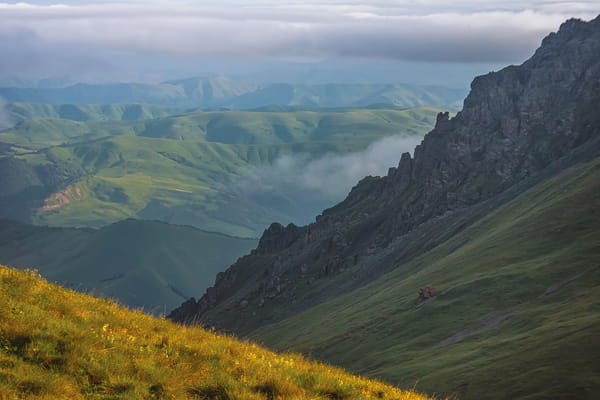
Image of the day:

Thanks for reading! Earth is complicated, we make it simple.
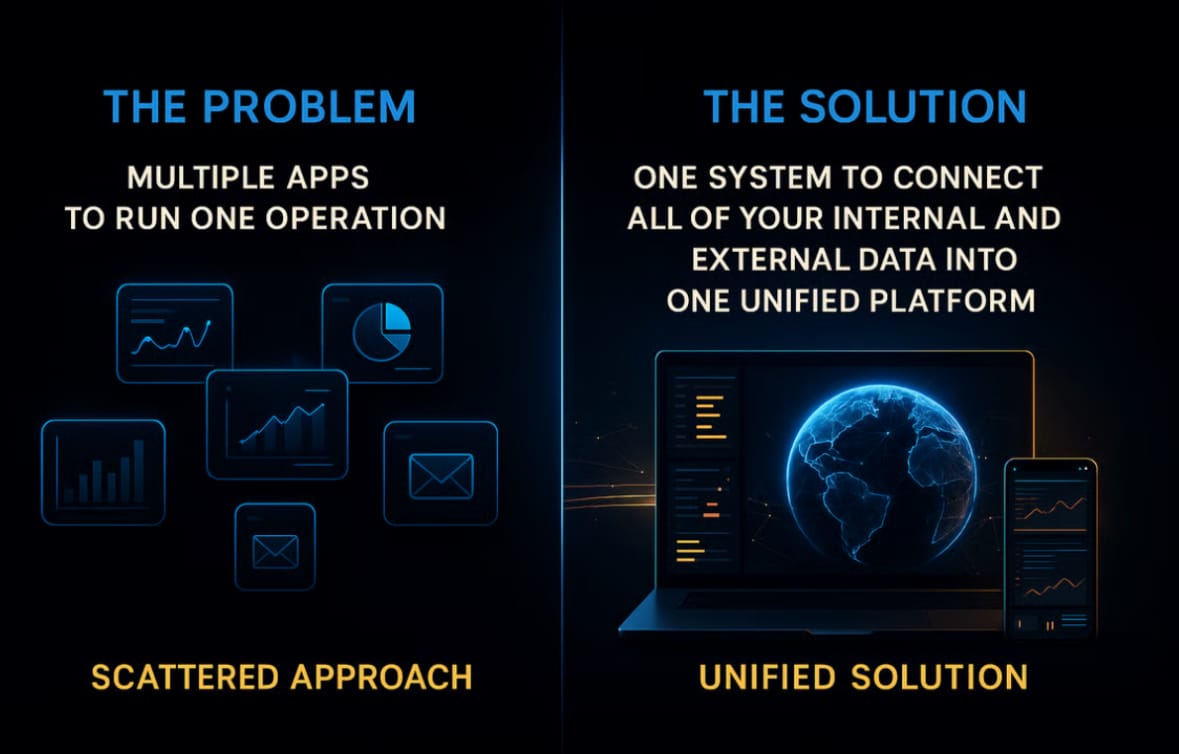

- Click below if you’d like to view our free EARTH WATCH globe:
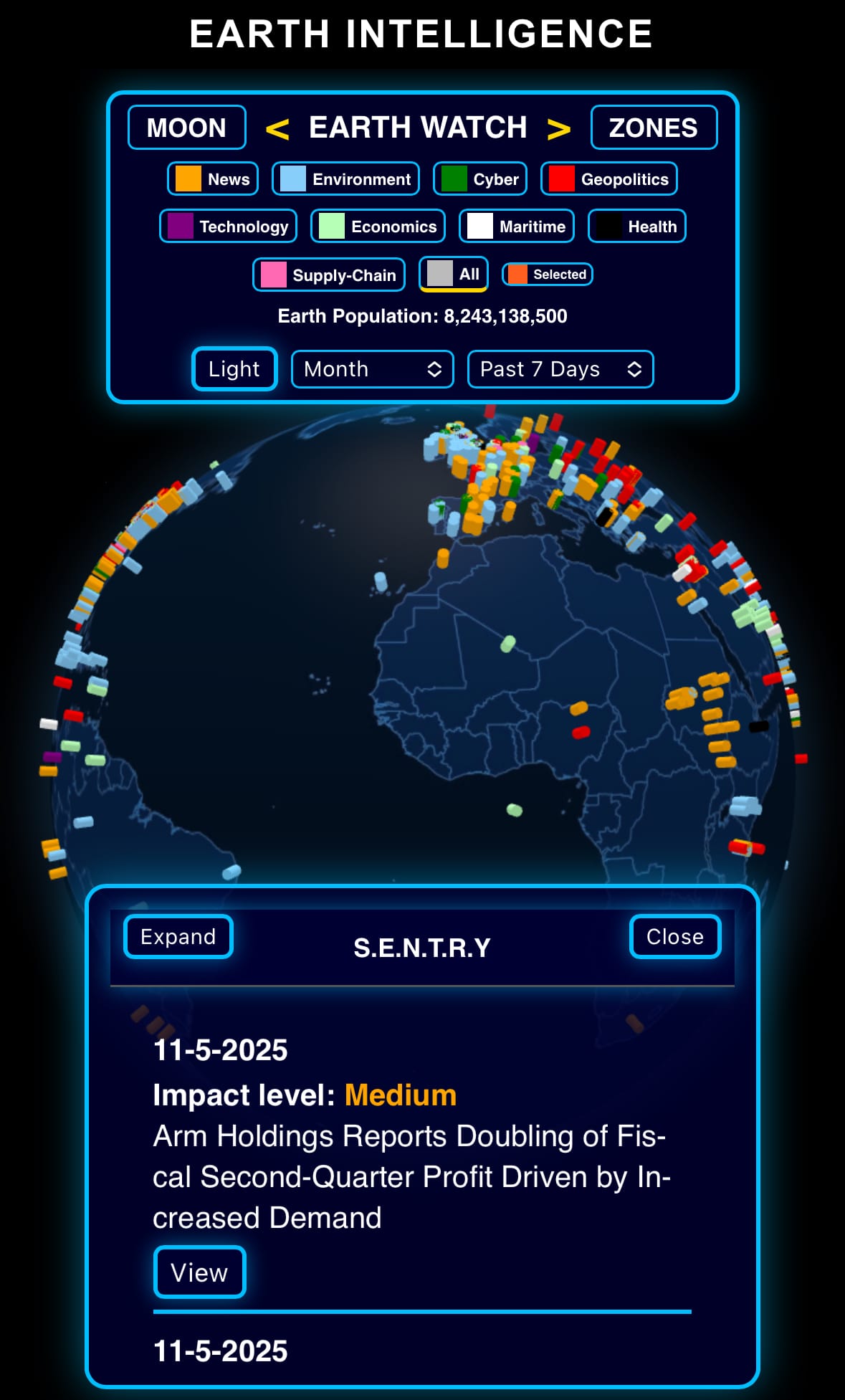
- Download our mobile app on the Apple App Store (Android coming soon):

Click below to view our previous newsletters:

Support/Suggestions Email:
earthintelligence@earthintel.news