Thursday☕️


Trending:
- On December 3, 2025, an F-16C Fighting Falcon assigned to the U.S. Air Force Thunderbirds demonstration squadron crashed during a routine training mission over controlled airspace in California's Mojave Desert, approximately two miles south of Trona Airport in San Bernardino County. The incident occurred at around 10:45 a.m. PST, near the edge of Death Valley National Park and about 27 miles northeast of Naval Air Weapons Station China Lake. The single-engine fighter jet, valued at roughly $20 million, impacted a dry lake bed, producing a large fireball and plume of black smoke, as captured in eyewitness videos and photos shared on social media. Local residents reported hearing a loud boom, and the crash site is in a remote, unpopulated area used for military exercises.

- The pilot ejected safely using the aircraft's ejection seat and parachute moments before impact, sustaining only minor injuries and being transported to a hospital in Ridgecrest for evaluation; the Air Force confirmed the individual is in stable condition. No ground injuries or damage occurred, and no ordnance was aboard the jet. Edwards Air Force Base deployed an environmental response team to address potential hazards from hydrazine fuel, a toxic substance used in the emergency power unit. The 57th Wing Public Affairs Office is leading the investigation into the cause, with further details pending; the Thunderbirds, based at Nellis Air Force Base in Nevada, continue operations with their remaining aircraft.
Economics & Markets:
- Yesterday’s U.S. stock market:

- Yesterday’s commodity market:

- Yesterday’s crypto market:

Geopolitics & Military Activity:
- On December 3, 2025, UAE-backed Hadhrami Elite Forces, affiliated with the Southern Transitional Council (STC), seized control of Seiyun—a major city in Yemen's eastern Hadhramaut Governorate—and its international airport after limited clashes with Saudi-backed Hadhramaut Tribal Alliance forces and elements of the First Military Region under Yemen's Presidential Leadership Council. The rapid operation, dubbed "Promising Future," involved UAE-supplied armored vehicles such as NIMR Abjan and Spartan-SUT APCs, with visual evidence showing Elite Forces entering the city center and replacing the Yemeni national flag with the STC banner at key sites like the presidential palace. Fighting occurred primarily at the airport and palace, resulting in unspecified deaths and injuries, while clashes persisted east near al-Hawi; no broader involvement from Houthi forces was reported, as they maintain no presence in the area.

- The STC issued statements urging residents and military personnel to remain indoors for safety, labeling the displaced forces as enablers of the Muslim Brotherhood and declaring southern Yemen, including Hadhramaut, free from terrorism. They accused the oil-rich Wadi Hadramaut valleys around Seiyun of long facilitating resource smuggling that indirectly aided Houthi operations, exacerbating southern losses. Celebrations broke out in STC-controlled al-Mukalla, Hadhramaut's coastal capital, following the capture of nearby towns like al-Qatin. Saudi Arabia, via its Yemen committee chairman Mohammed al-Qahtani, condemned the move and demanded withdrawal of non-local forces, reaffirming support for Yemeni institutions; local journalist Marki al-Dani appealed for Houthi assistance against the advance, though no response was noted. This escalation highlights deepening UAE-Saudi rivalries in Yemen's proxy dynamics, potentially shifting control over Hadhramaut's strategic oil fields and trade routes.
Environment & Weather:

Cyber:

Science & Technology:
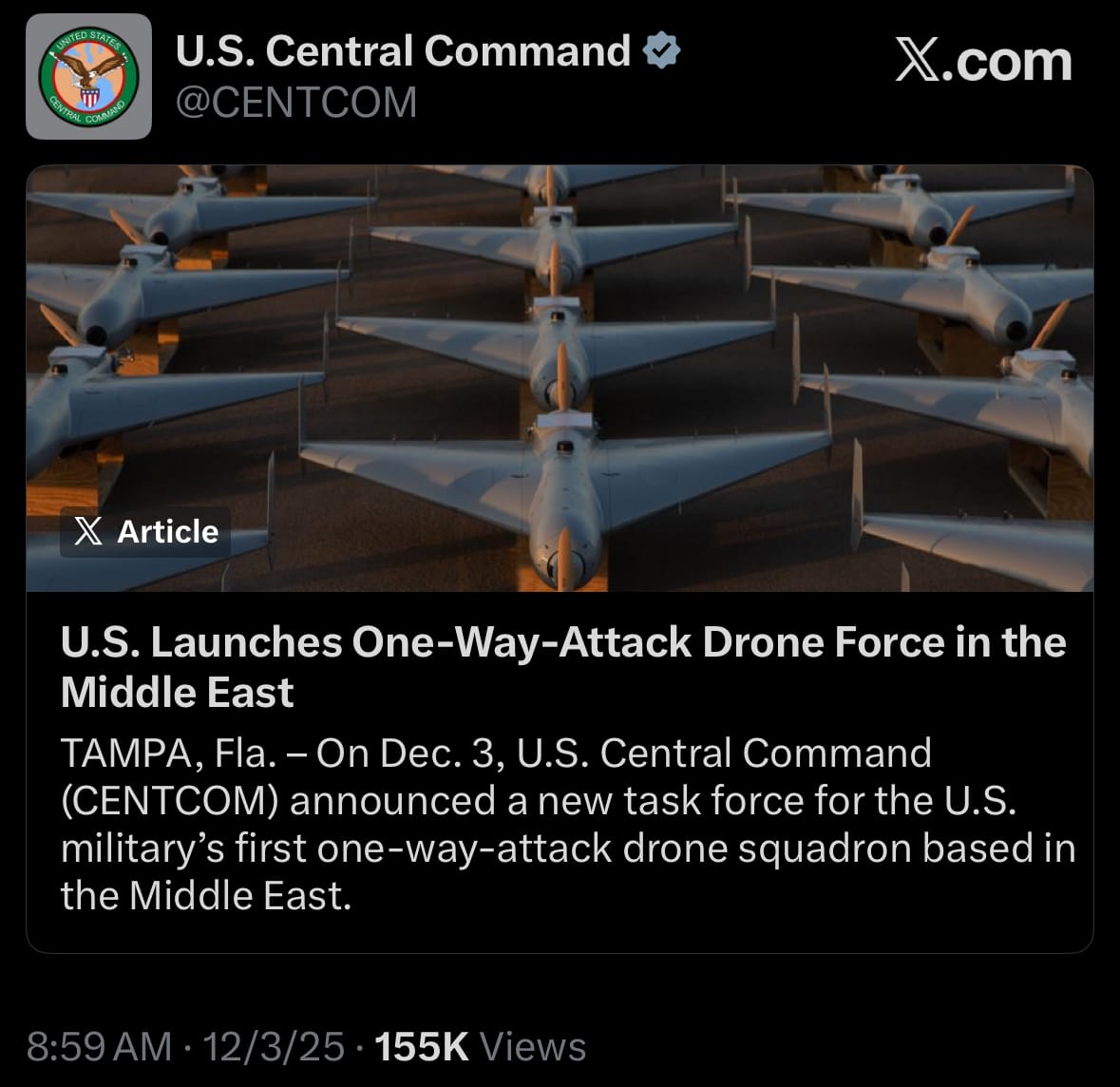
- On December 3, 2025, U.S. Central Command officially launched Task Force Scorpion Strike, a new special-operations drone unit operating in the Middle East. The squadron is equipped with Low-Cost Uncrewed Combat Attack System (LUCAS) one-way attack drones and is already deployed at an undisclosed base. CENTCOM stated the unit’s purpose is to provide rapid, low-cost strike options against threats such as Iranian-backed militias and Houthi forces in Yemen. The LUCAS drone was developed by U.S. company SpektreWorks using reverse-engineering of a captured Iranian Shahed-136. It closely resembles the Iranian design in shape, size, and performance but is produced domestically.

- Each drone costs around $35,000, carries a 40-pound warhead, has a range of approximately 350 nautical miles, and can fly for up to six hours. It can be launched from catapults, vehicles, ships, or rocket-assisted platforms and is designed to operate in autonomous swarms. The program was ordered in August 2025 by Defense Secretary Pete Hegseth as part of a broader push to field large numbers of inexpensive combat drones across U.S. forces by the end of fiscal year 2026. This development reflects a wider shift in military power toward mass-produced, low-cost drones and missiles that can be deployed in overwhelming numbers, making traditional high-value platforms increasingly vulnerable. Drone technology is fundamentally changing the battlefield by enabling long-range precision strikes, saturation attacks, and persistent surveillance at a fraction of the cost of manned aircraft or expensive missiles.
Statistic:
- Largest assets on Earth by market capitalization:
- Gold: $29.445T
- 🇺🇸 NVIDIA: $4.372T
- 🇺🇸 Apple: $4.216T
- 🇺🇸 Alphabet (Google): $3.870T
- 🇺🇸 Microsoft: $3.551T
- Silver: $3.316T
- 🇺🇸 Amazon: $2.484T
- Bitcoin: $1.866T
- 🇺🇸 Broadcom: $1.797T
- 🇺🇸 Meta Platforms: $1.612T
- 🇸🇦 Saudi Aramco: $1.576T
- 🇹🇼 TSMC: $1.532T
- 🇺🇸 Tesla: $1.485T
- 🇺🇸 Berkshire Hathaway: $1.086T
- 🇺🇸 Eli Lilly: $926.54B
- 🇺🇸 Walmart: $913.03B
- 🇺🇸 JPMorgan Chase: $858.28B
- 🇺🇸 Vanguard S&P 500 ETF: $824.14B
- 🇺🇸 iShares Core S&P 500 ETF: $733.16B
- 🇨🇳 Tencent: $710.20B
- 🇺🇸 SPDR S&P 500 ETF: $701.21B
- 🇺🇸 Visa: $639.75B
- 🇺🇸 Oracle: $592.19B
- 🇺🇸 Vanguard Total Stock Market ETF: $567.77B
- 🇺🇸 Exxon Mobil: $502.21B
History:
- The idea of cutting a navigable waterway across Egypt is one of the oldest engineering ambitions in human history. As early as 1850 BC, during Egypt’s Middle Kingdom, pharaohs attempted to dig canals linking the Nile River to the Red Sea, creating an inland maritime shortcut centuries before most civilizations even mastered deep-water sailing. Pharaoh Necho II, around 600 BC, launched a massive effort to reopen and expand the route, reportedly losing tens of thousands of workers to disease and exhaustion. In circa 500 BC, Darius I of Persia rebuilt and extended the canal, leaving stone stelae celebrating the achievement. Later, Ptolemy II in the 3rd century BC and the Roman Emperor Trajan in the 2nd century AD restored sections again. These early canals were engineering marvels for their eras, but because they connected the Nile floodplain to the tidal Red Sea, they repeatedly silted up, shifted with seasons, or became impassable. After the fall of Rome, the canal slowly decayed and was eventually abandoned. For more than a millennium, the Suez region remained an unrealized engineering dream discussed by Arab scientists, medieval geographers, and—most famously—Napoleon Bonaparte, who studied the isthmus in 1799 but abandoned the project after mistakenly believing the Red Sea sat higher than the Mediterranean. The real breakthrough came when Ferdinand de Lesseps secured concessions from Sa’id Pasha in 1854 and 1856, enabling construction of a modern, sea-level canal. Work began in 1859, initially relying on tens of thousands of Egyptian laborers forcibly conscripted under the corvée system. After European outrage forced its abolition in 1863, mechanized dredging replaced manual labor, accelerating the project. Despite enormous financial strain, diplomatic battles, and disease outbreaks, the Suez Canal opened on November 17, 1869, with global ceremonies that symbolized a new era: Europe and Asia were now directly connected through a single, continuous waterway.
- The canal immediately altered global trade routes and imperial strategy. France originally controlled the Suez Canal Company, but in 1875, Britain purchased Egypt’s shares, gaining decisive influence. After the 1882 Anglo-Egyptian War, Britain occupied Egypt, making the canal a central artery of the British Empire, vital for connecting London to India, East Africa, the Middle East, and later Australia. During World War I (1914–1918) and World War II (1939–1945), the canal was a lifeline for Allied logistics, surviving multiple attempts at sabotage and assault. In the postwar era, Egypt moved toward reclaiming control. On July 26, 1956, President Gamal Abdel Nasser nationalized the canal, triggering the Suez Crisis, in which Britain, France, and Israel invaded Egypt. Although they achieved early military success, pressure from the United States and the Soviet Union forced a withdrawal—marking the end of European colonial dominance in the region. The canal closed again during the 1967 Six-Day War, becoming a fortified frontline for eight years until it reopened on June 5, 1975, after painstaking clearance of mines and sunken ships. From the late 20th century onward, Egypt modernized the canal through dredging, expansion, and new navigation systems. The most significant upgrade came with the New Suez Canal, completed in 2015, adding parallel channels that reduced transit time and increased daily ship capacity. Today the canal carries around 12–15% of global trade, 30% of all container shipping, and nearly 10% of the world’s oil and gas transport, making it one of the most critical—and vulnerable—chokepoints on Earth. The 2021 Ever Given grounding, which blocked the canal for six days, exposed how fragile global supply chains truly are when a single ship can halt billions of dollars in commerce. Now equipped with advanced tug fleets, expanded channels, and continuous dredging, the Suez Canal remains a vital artery of world commerce—an ancient dream realized, repeatedly contested, and continually reshaped by the forces of global power.
Image of the day:

Thanks for reading! Earth is complicated, we make it simple.


- Click below if you’d like to view our free EARTH WATCH globe:
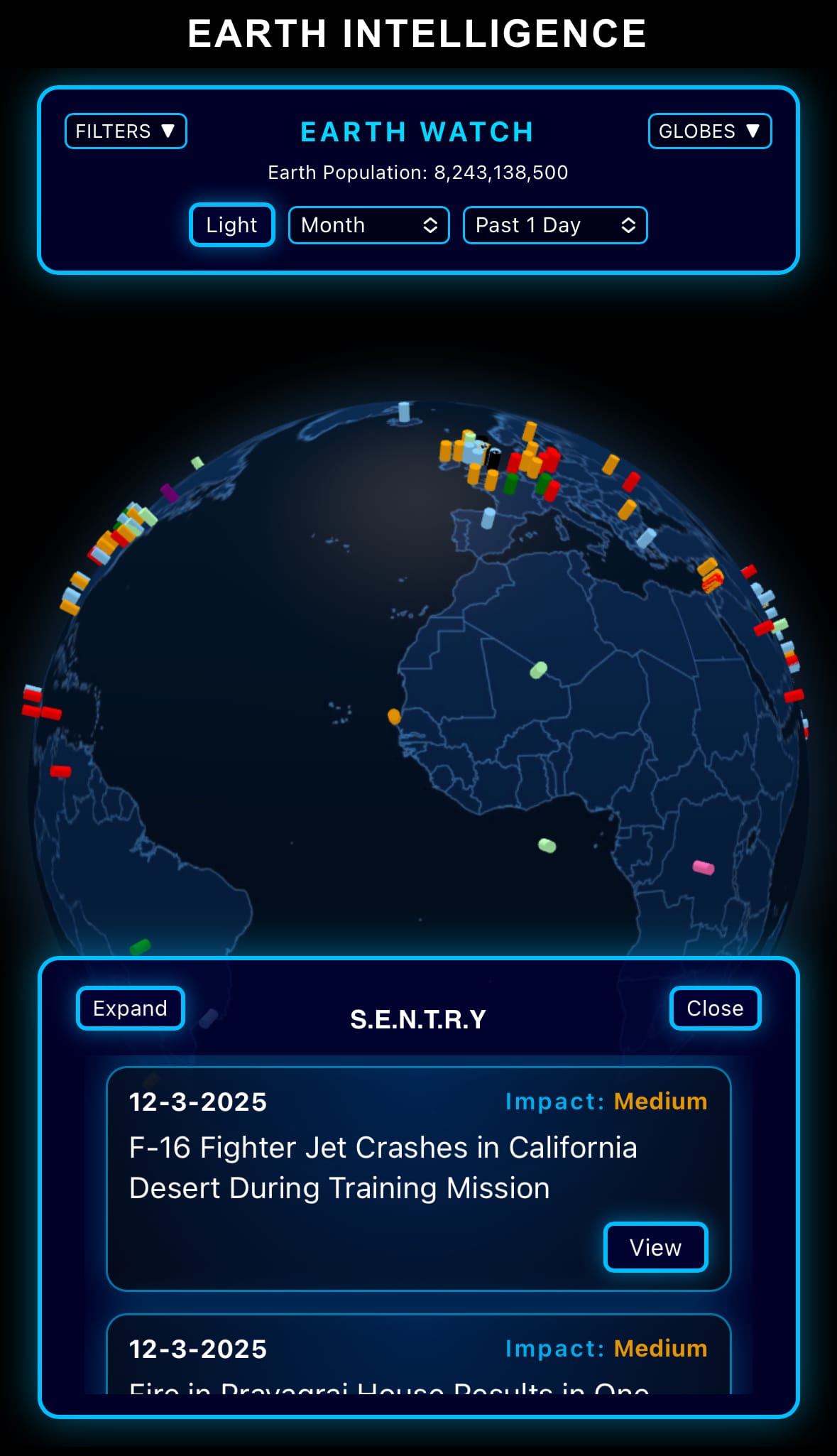
- Download our mobile app on the Apple App Store (Android coming soon):

Click below to view our previous newsletters:

Support/Suggestions Email:
earthintelligence@earthintel.news