Thursday☕️


Trending:
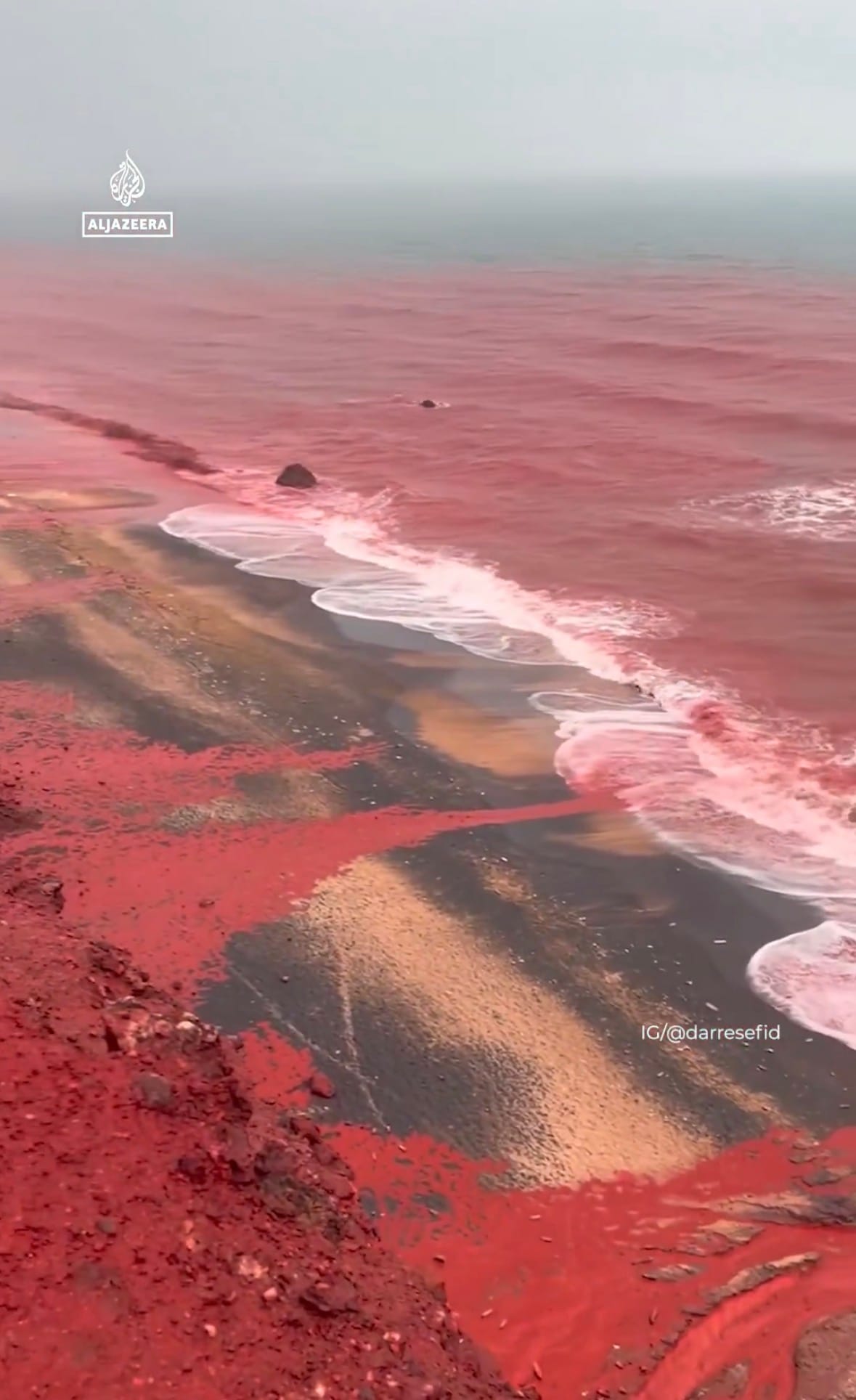
- On December 17, 2025, viral videos and images showed the coastline of Hormuz Island in Iran's Persian Gulf turning bright red following heavy rainfall on December 16. The phenomenon occurred primarily at the island's famous Red Beach (Sahel Sorkh), where rainwater washed iron-oxide-rich soil—particularly hematite—from the hills and cliffs into streams, beaches, and shallow coastal waters, creating crimson runoff and staining the sea. Known locally as "golak," this red ochre soil is a hallmark of Hormuz, often called the "Rainbow Island" for its diverse mineral colors derived from ancient volcanic and salt dome geology.
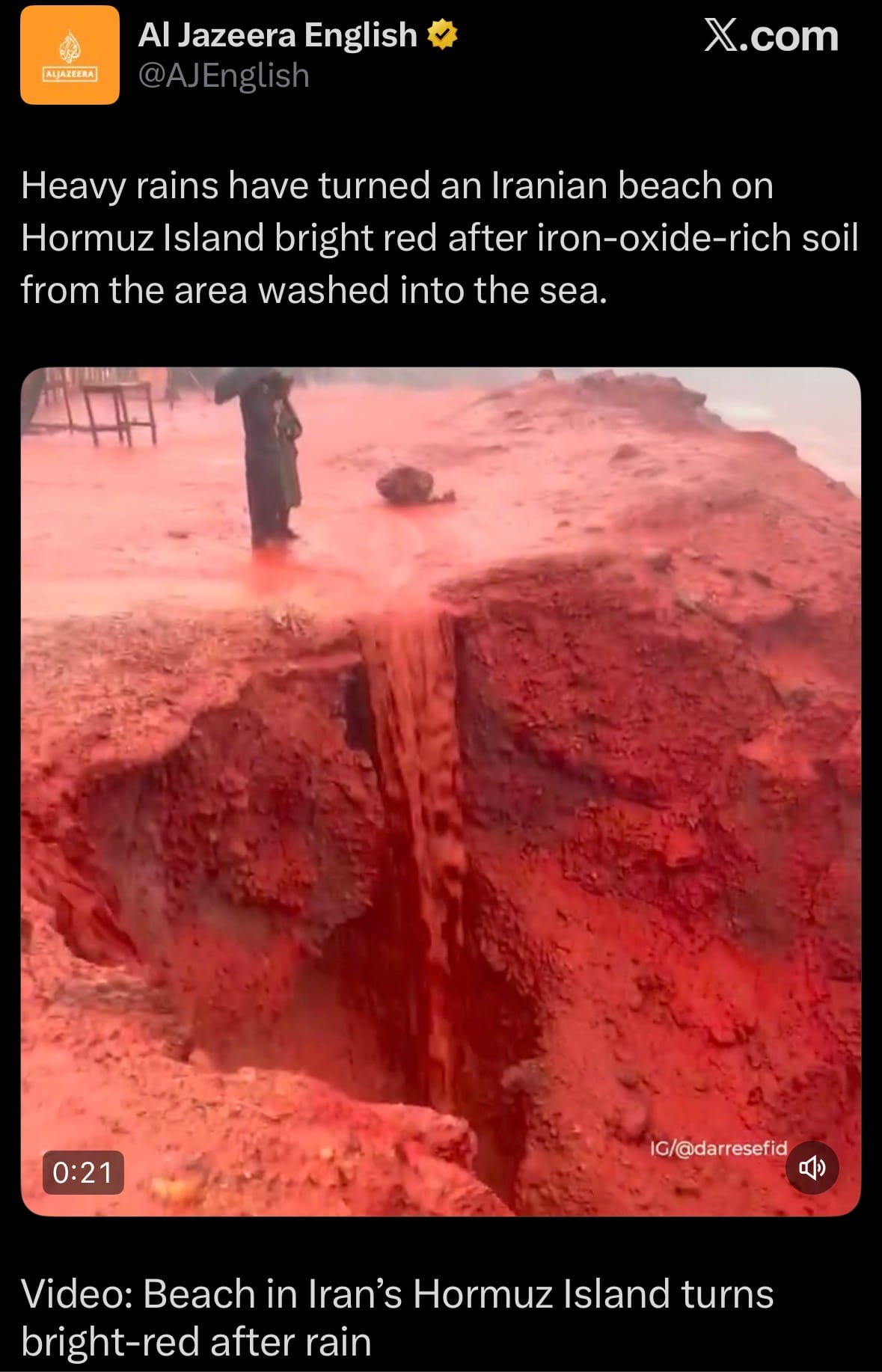
- The iron oxide particles suspend in water, absorbing shorter light wavelengths and reflecting red, producing the dramatic effect. Similar occurrences have been documented in prior years during rainfall, attracting tourists to the site.
Economics & Markets:
- Yesterday’s U.S. stock market:

- Yesterday’s commodity market:

- Yesterday’s crypto market:

Geopolitics & Military Activity:
- On December 17, 2025, U.S. Southern Command (SOUTHCOM) announced that Joint Task Force Southern Spear conducted a lethal kinetic strike on a single vessel in international waters of the Eastern Pacific, killing four individuals described as male narco-terrorists. The strike, authorized by Secretary of Defense Pete Hegseth, targeted a boat intelligence indicated was operated by a designated terrorist organization, transiting a known narco-trafficking route, and engaged in drug smuggling. SOUTHCOM released video footage of the operation, with no U.S. forces harmed.

- This incident brings the total deaths in Operation Southern Spear to at least 99 across more than 26 strikes on 27 vessels since September 2025, as part of the Trump administration's campaign against designated drug cartels.
Science & Technology:
- On December 17, 2025, xAI announced the launch of the Grok Voice Agent API, enabling developers to build real-time voice agents capable of conversing in dozens of languages with native-level proficiency, automatically switching languages mid-conversation, calling custom tools, and accessing real-time search across X and the web. The API powers low-latency streaming audio interactions via WebSocket, supports multiple expressive voices (including Ara, Eve, Leo, Rex, Sal, and companion personas like Mika and Valentin), and is built on the same in-house stack used for Grok Voice in mobile apps and millions of Tesla vehicles, where it integrates with vehicle controls for tasks like route planning.

- The API is compatible with the OpenAI Realtime API specification and available through the xAI LiveKit Plugin, with a voice playground for testing. Priced at a flat $0.05 per minute, it ranks #1 on the Big Bench Audio benchmark and offers sub-second latency—nearly 5x faster than competitors—with strong performance in pronunciation and domain-specific terminology (e.g., medical, legal, financial). Standalone speech-to-text and text-to-speech endpoints are planned for release soon. For details on accessing the xAI API, visit https://x.ai/api.
Statistic:
- Largest public companies by market capitalization:
- 🇺🇸 NVIDIA: $4.161T
- 🇺🇸 Apple: $4.034T
- 🇺🇸 Alphabet (Google): $3.598T
- 🇺🇸 Microsoft: $3.539T
- 🇺🇸 Amazon: $2.365T
- 🇺🇸 Meta Platforms (Facebook): $1.637T
- 🇺🇸 Tesla: $1.554T
- 🇺🇸 Broadcom: $1.539T
- 🇸🇦 Saudi Aramco: $1.521T
- 🇹🇼 TSMC: $1.436T
- 🇺🇸 Berkshire Hathaway: $1.087T
- 🇺🇸 Eli Lilly: $933.91B
- 🇺🇸 Walmart: $922.14B
- 🇺🇸 JPMorgan Chase: $866.11B
- 🇨🇳 Tencent: $691.59B
- 🇺🇸 Visa: $664.67B
- 🇺🇸 Oracle: $512.73B
- 🇺🇸 Mastercard: $511.19B
- 🇺🇸 Johnson & Johnson: $506.74B
- 🇺🇸 Exxon Mobil: $500.54B
- 🇰🇷 Samsung: $481.88B
- 🇺🇸 Palantir: $422.55B
- 🇺🇸 Bank of America: $404.04B
- 🇺🇸 Netflix: $401.65B
- 🇺🇸 AbbVie: $396.44B
History:
- Laser technology begins as a theoretical idea before it becomes one of the most versatile tools ever created. In 1917, Albert Einstein laid the groundwork with the concept of stimulated emission, showing that atoms could be forced to emit coherent light under the right conditions. That idea remained dormant until the mid-20th century, when microwave research produced the maser (microwave amplification) in 1954, built by Charles Townes and colleagues. The leap to visible light came in 1960, when Theodore Maiman demonstrated the first working laser using a ruby crystal—coining the term Light Amplification by Stimulated Emission of Radiation. Early lasers were inefficient and fragile, but breakthroughs came quickly: helium-neon gas lasers (1961) enabled continuous beams; CO₂ lasers (1964) delivered high power for cutting and welding; and semiconductor diode lasers (1962) made lasers small, cheap, and scalable. By the 1970s–1980s, solid-state lasers, fiber optics, and tunable lasers matured alongside advances in materials science and precision optics. The invention of optical fiber communication transformed lasers from laboratory tools into the backbone of global telecommunications, while improvements in beam coherence, wavelength control, and power density pushed lasers into medicine, manufacturing, and scientific research.
- Today, lasers sit at the intersection of civilian infrastructure and military capability. In civilian life, lasers power global internet traffic, barcode scanners, LiDAR mapping, precision manufacturing, semiconductor lithography, eye surgery, cancer treatments, autonomous vehicles, and scientific instruments like gravitational-wave detectors. The most advanced commercial and scientific players include companies and institutions in the United States, Europe, Japan, South Korea, and China, with leadership in areas like high-power fiber lasers, ultrafast femtosecond lasers, and extreme ultraviolet (EUV) lithography—critical for advanced chip manufacturing. Militarily, lasers have evolved from range-finding and targeting tools into active weapon and defense systems. Modern armed forces deploy lasers for missile defense, drone interception, counter-sensor operations, and space situational awareness, benefiting from attributes like speed-of-light engagement, precision, and low per-shot cost. The United States, China, and Russia lead in high-energy laser research, while classified programs explore space-based sensing and directed-energy concepts. At the same time, lasers are deeply embedded in intelligence, surveillance, communications, and navigation systems. A technology that began as an abstract quantum idea now spans everything from civilian surgery to strategic deterrence, making lasers one of the most quietly influential—and widely deployed—technologies of the modern world.
Image of the day:

Thanks for reading! Earth is complicated, we make it simple.
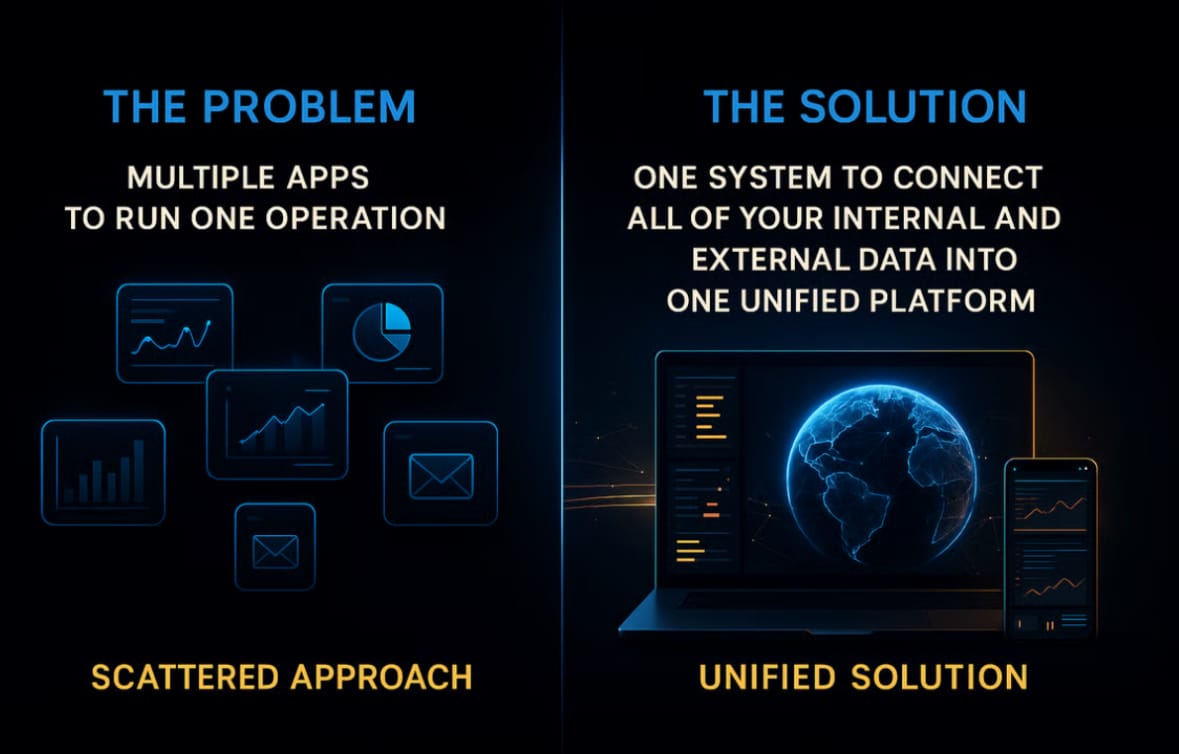

- Click below if you’d like to view our free EARTH WATCH globe:
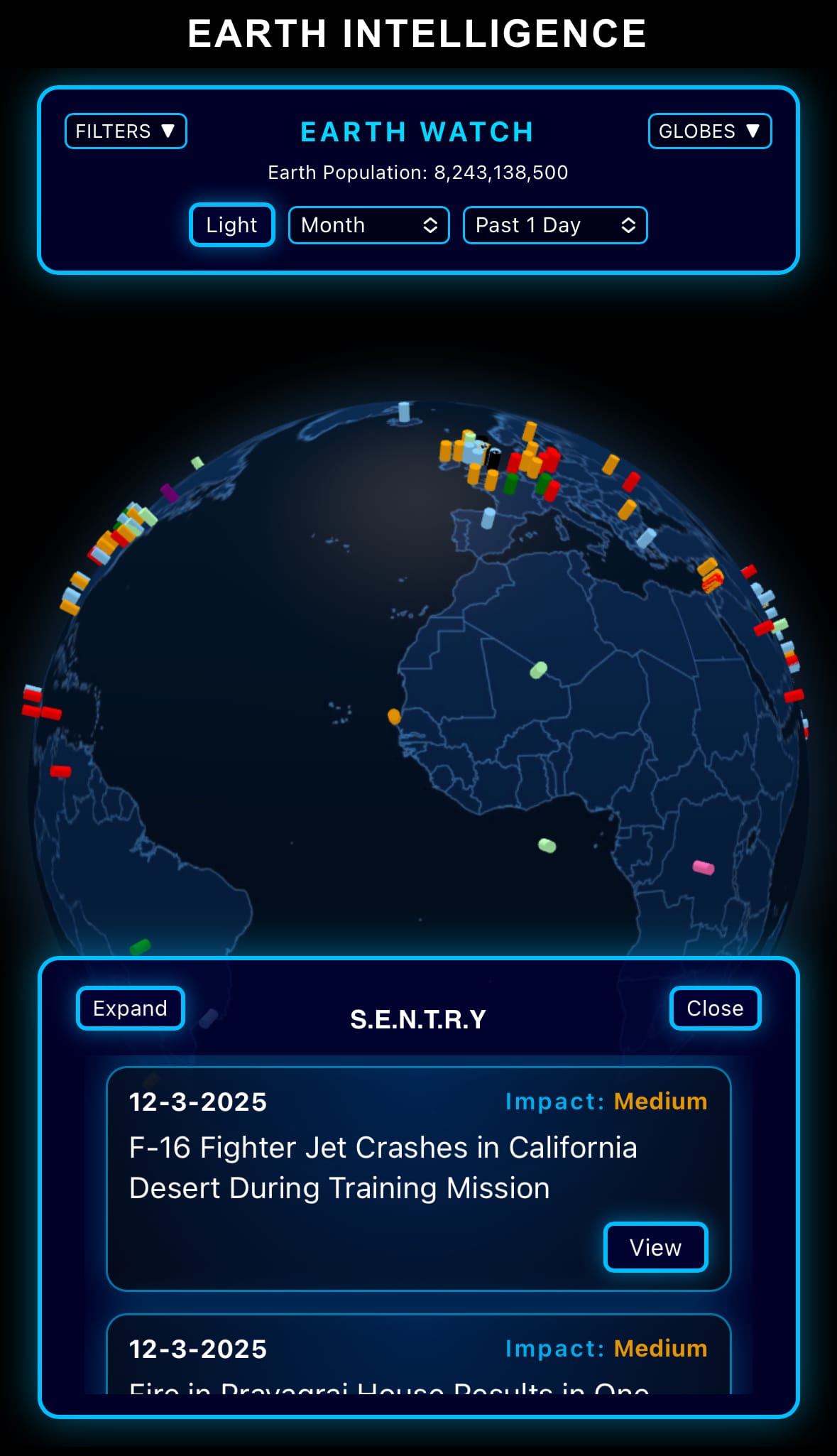
- Download our mobile app on the Apple App Store (Android coming soon):

Click below to view our previous newsletters:

Support/Suggestions Email:
earthintelligence@earthintel.news