Friday☕️


Trending:
- On December 25, 2025, Russian Tu-95MS strategic bombers—nuclear-capable but armed conventionally for this mission—conducted a patrol over neutral waters of the Barents and Norwegian Seas, lasting more than seven hours. NATO fighter jets were scrambled to monitor and escort the aircraft at certain stages, as they approached areas near northern UK and Norwegian airspace without entering sovereign territory. Russia's Defense Ministry described the flight as a scheduled operation in full compliance with international rules, accompanied in parts by Su-33 fighters.
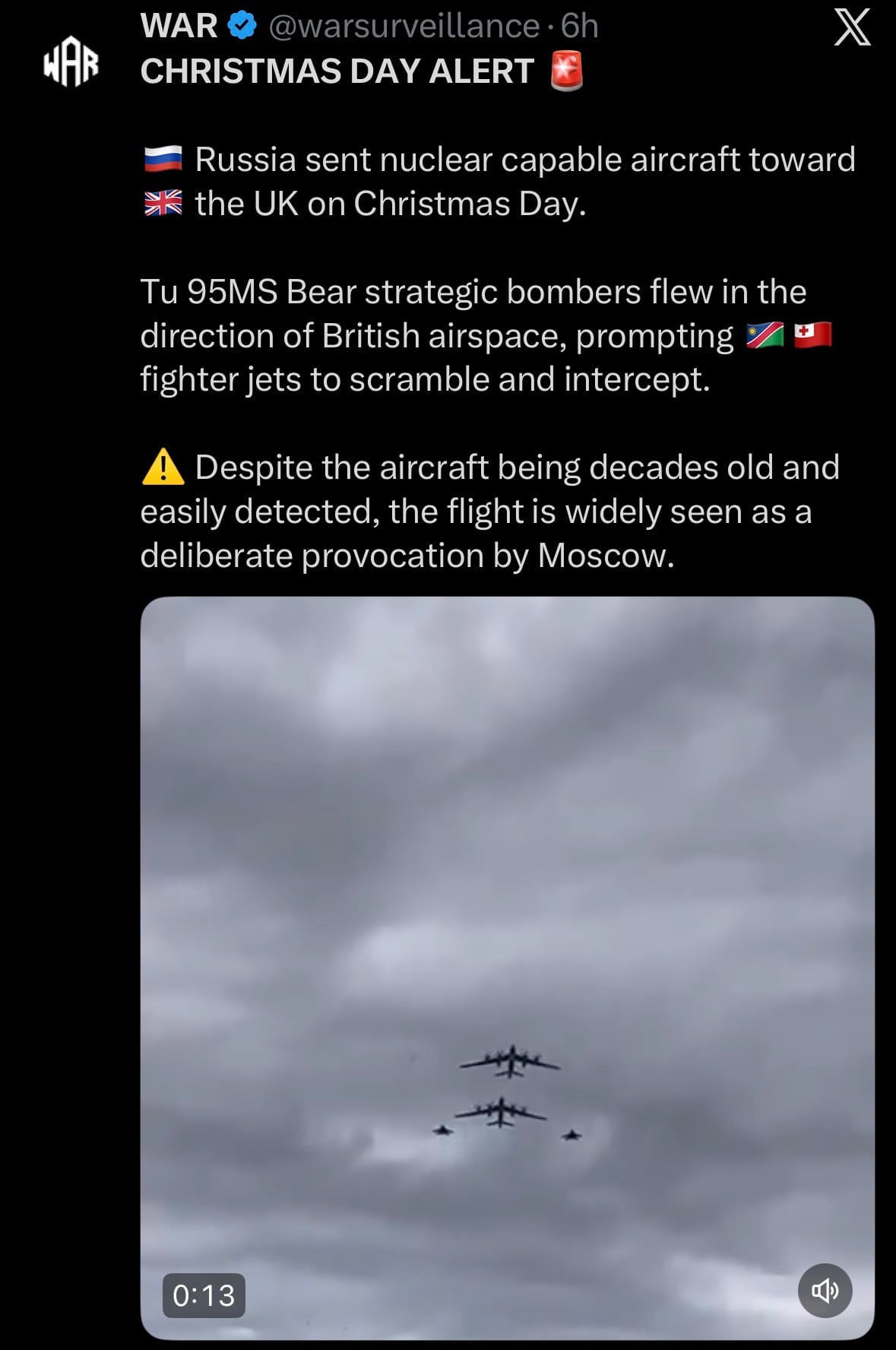
- The incident coincided with Russian long-range aviation strikes on Ukraine, prompting additional NATO responses including Polish aircraft activations. Western media and analysts widely interpreted the timing on Christmas Day as a deliberate signal of presence and provocation amid ongoing tensions over the Ukraine war, while Russian statements emphasized routine training. No airspace violations occurred, and such patrols—common in recent years—serve to test response times and assert strategic reach without escalation.
Economics & Markets:
- Yesterday’s commodity market:

- Yesterday’s crypto market:

Geopolitics & Military Activity:
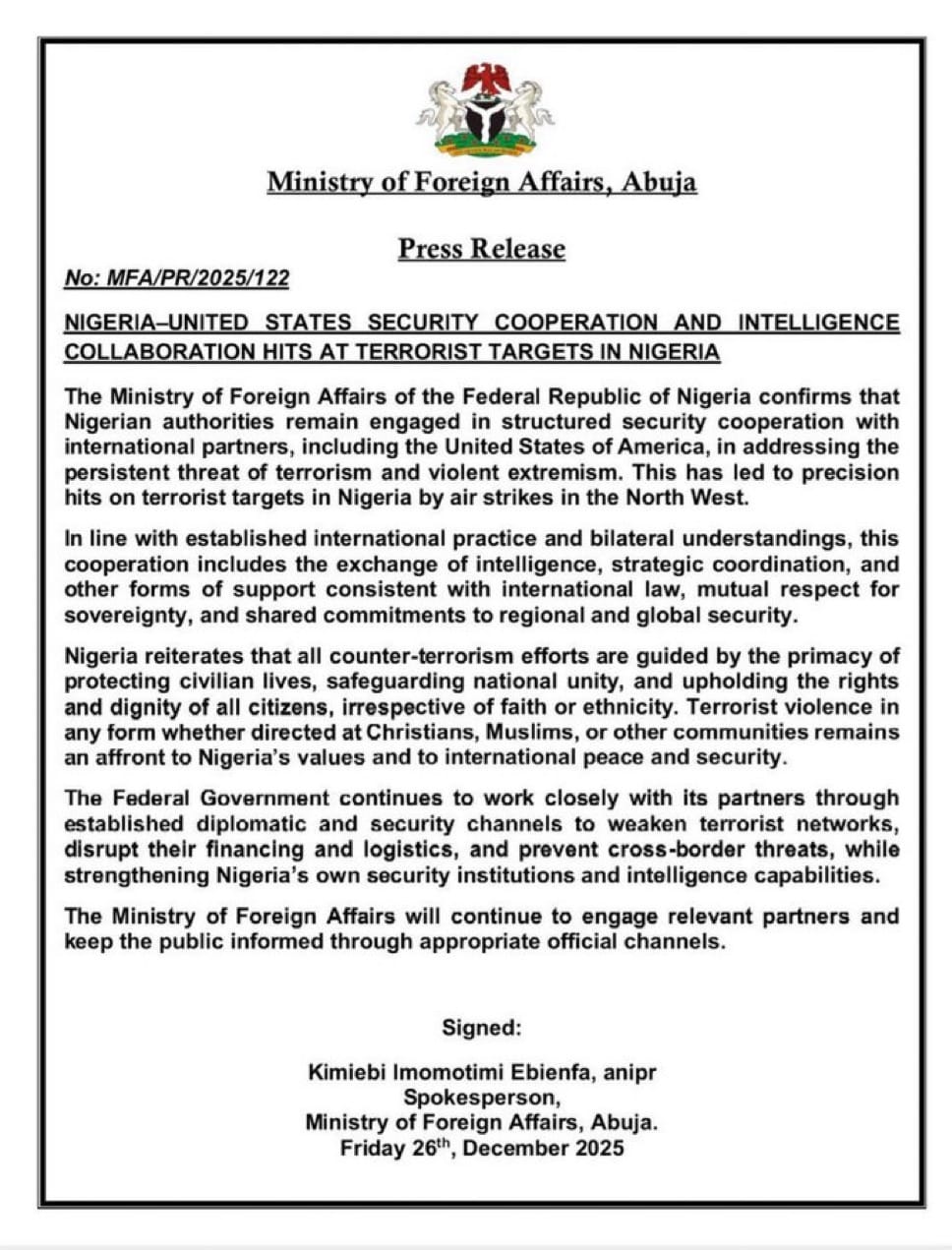
- On December 25, 2025, U.S. forces under U.S. Africa Command (AFRICOM) conducted airstrikes against Islamic State (ISIS)-affiliated militants in Sokoto State, northwest Nigeria. The operation was announced by President Donald Trump on Truth Social and confirmed by AFRICOM as having been carried out in coordination with and at the request of Nigerian authorities. AFRICOM reported the deaths of multiple militants with no civilian casualties.
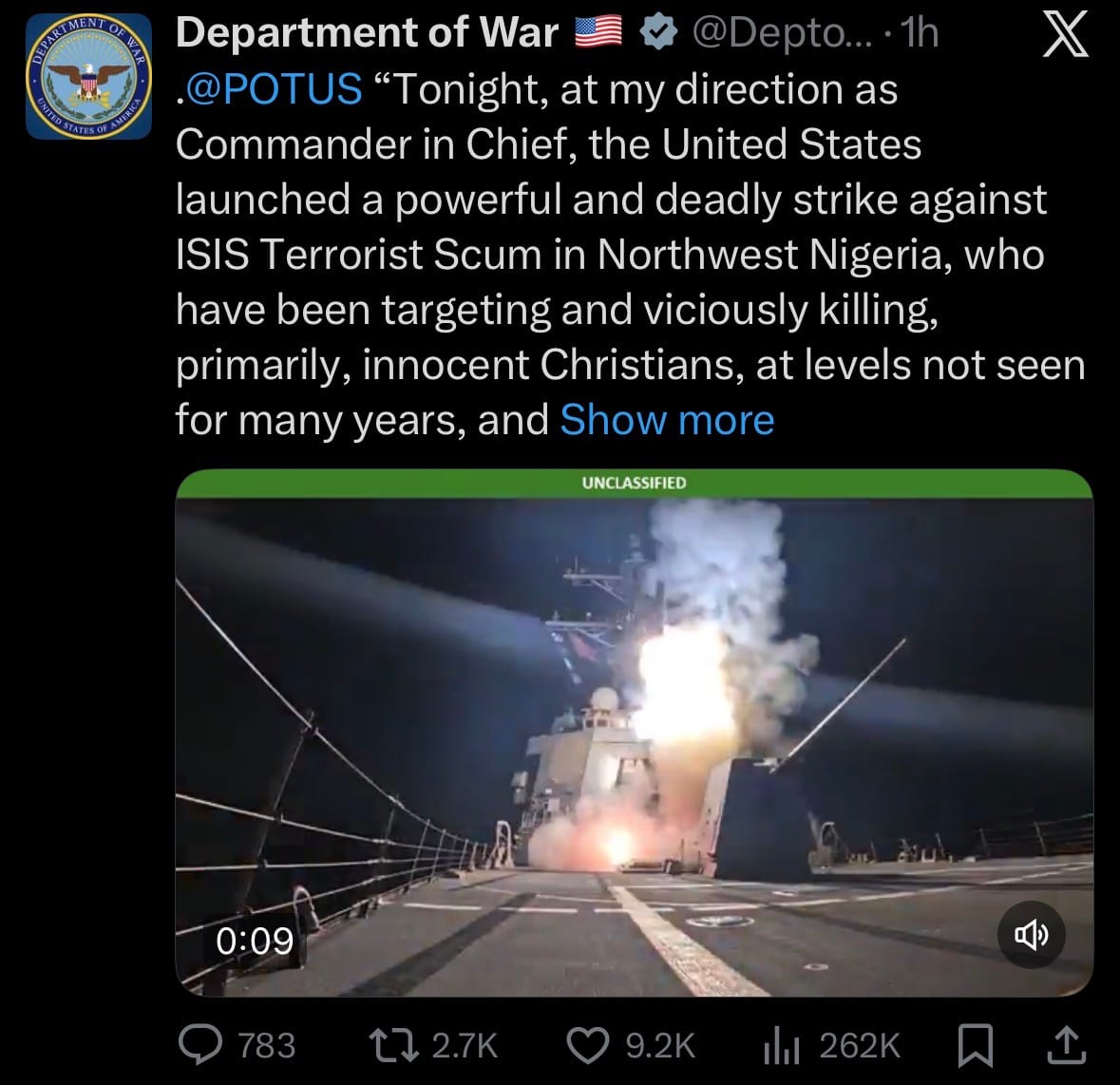
- The action follows increased U.S. attention to security issues in Nigeria, including earlier statements from the Trump administration concerning violence against religious communities. Trump described the militants as primarily targeting Christians in severe attacks. Nigerian officials and regional analysts note that the insurgency in northwest Nigeria—involving groups like ISIS West Africa Province—results in casualties among both Christian and Muslim populations and is frequently driven by a mix of ethnic, land, and resource disputes alongside extremist ideology.
Space:
- On December 26, 2025, China successfully launched a Long March 8A rocket from Commercial Launch Complex 1 at the Wenchang Space Launch Site in Hainan Province. Liftoff occurred at approximately 23:26 UTC on December 25 (7:26 a.m. Beijing time on December 26), deploying an undisclosed number of SatNet LEO Group 17 broadband communication satellites into polar low Earth orbit.
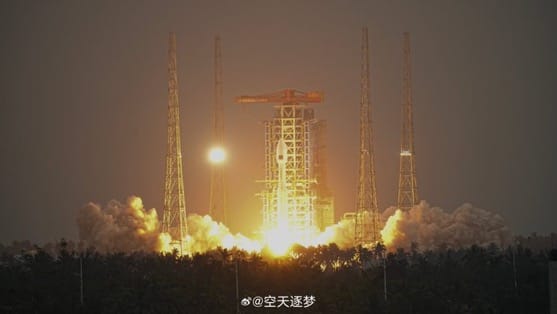
- The satellites, operated by state-owned China Satellite Network Group, advance the GuoWang (SatNet) megaconstellation toward its planned 12,992-satellite network for global high-speed internet, directly competing with Starlink. No anomalies were reported, and successful orbital insertion was confirmed.
Russian Launch:
- On December 25, 2025, Russia successfully launched a Soyuz-2.1a rocket from Site 43/4 at the Plesetsk Cosmodrome, deploying the Obzor-R No.1 radar Earth observation satellite into sun-synchronous orbit. Liftoff occurred at 14:11 UTC (17:11 Moscow time), with the Russian Ministry of Defense confirming normal flight, orbital insertion, and establishment of stable telemetry; onboard systems were reported functioning normally. The mission, conducted by Aerospace Forces Space Troops, was described as placing a "spacecraft" (military satellite) in orbit, aligning with the long-delayed Obzor-R program.
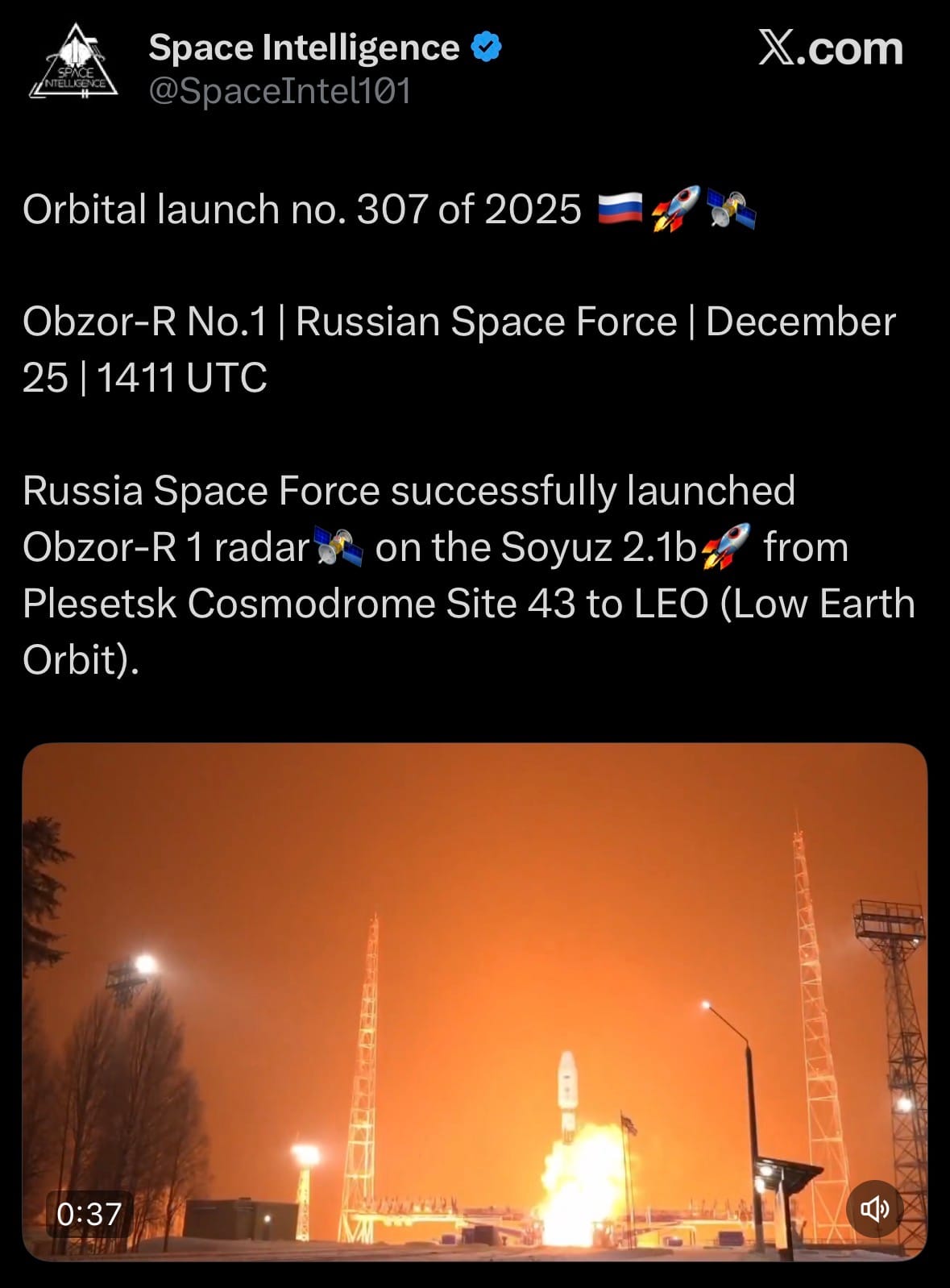
- Obzor-R No.1, developed by Progress Rocket Space Centre for Roscosmos, features an X-band synthetic aperture radar (BRLK) capable of all-weather, day-night imaging with resolutions down to 500 meters (finer in spotlight modes). Initially a civilian project but launched from a military site, it supports operational monitoring for disaster response, resource management, and defense applications. This marks Russia's first dedicated active radar observation satellite in years, contributing to the nation's 16th orbital launch of 2025 (nine for the Ministry of Defense). No secondary payloads were officially confirmed.
Statistic:
- Largest public automakers on Earth by market capitalization:
- 🇺🇸 Tesla: $1.614T
- 🇯🇵 Toyota: $282.47B
- 🇨🇳 Xiaomi: $131.07B
- 🇨🇳 BYD: $126.07B
- 🇺🇸 General Motors: $78.90B
- 🇩🇪 Mercedes-Benz: $67.30B
- 🇮🇹 Ferrari: $66.81B
- 🇩🇪 BMW: $66.57B
- 🇩🇪 Volkswagen: $62.34B
- 🇮🇳 Maruti Suzuki India: $58.61B
- 🇺🇸 Ford: $53.23B
- 🇰🇷 Hyundai: $52.00B
- 🇮🇳 Mahindra & Mahindra: $48.68B
- 🇩🇪 Porsche: $48.65B
- 🇯🇵 Honda: $39.06B
- 🇰🇷 Kia: $32.33B
- 🇳🇱 Stellantis: $31.86B
- 🇨🇳 Seres Group: $29.61B
- 🇯🇵 Suzuki Motor: $28.94B
- 🇨🇳 Great Wall Motors: $27.08B
- 🇺🇸 Rivian: $25.90B
- 🇨🇳 SAIC Motor: $25.33B
- 🇨🇳 Geely: $23.32B
- 🇨🇳 Chery Automobile: $22.63B
- 🇮🇳 Hyundai Motor India: $20.91B
History:
- Earth intelligence begins as survival awareness long before it becomes formal strategy. The earliest humans practiced intelligence instinctively—scouts reading terrain, tracking animals, watching rival groups, predicting weather and seasonal cycles. By 3000–2000 BC, early states such as Sumer, Egypt, and the Indus Valley institutionalized intelligence through record-keeping, census data, messengers, and early mapping. Empires learned that power came from knowing space, people, and time better than rivals. The Assyrian Empire (c. 1400–600 BC) maintained some of the first documented intelligence networks, using scouts, informants, and written reports to monitor borders and rebellions. Persia (c. 550–330 BC) expanded this into a continental system with roads, courier relays, and regional governors feeding information back to the center. Rome (c. 500 BC–400 AD) refined intelligence further—military scouts (speculatores), detailed maps, census administration, and signal systems (flags, fires, messengers) allowed Rome to coordinate across three continents. In Han China (206 BC–220 AD), intelligence blended bureaucracy, cartography, population data, and early counterintelligence, with written reports flowing through imperial command structures. Across these civilizations, intelligence was not yet a separate discipline—it was embedded in governance, logistics, geography, and human observation. Intelligence meant understanding the land, the people on it, and how both changed over time.
- The modern foundations of Earth intelligence emerge with industrialization and electrification. The 19th century introduces the telegraph (1830s–1840s), creating the first true signals intelligence (SIGINT)—intercepting information faster than physical movement. Weather observation networks form in the mid-1800s, marking the beginnings of systematic environmental intelligence. During World War I (1914–1918), aerial reconnaissance from balloons and aircraft adds a vertical dimension to intelligence for the first time. World War II (1939–1945) fuses intelligence into a multi-domain enterprise: photographic interpretation, radar, cryptanalysis (notably Bletchley Park), electronic warfare, and industrial-scale analysis. After 1947, the Cold War transforms intelligence into a planetary activity. Satellites begin with Sputnik (1957) and quickly evolve into continuous Earth observation, birthing geospatial intelligence (GEOINT). Signals intelligence moves into space; maritime intelligence tracks global shipping; environmental data becomes strategic for agriculture, energy, and military planning. The digital revolution of the 1970s–1990s adds cyber intelligence, as computers and networks become targets and sensors simultaneously. Intelligence is now layered: HUMINT (people), SIGINT (signals), GEOINT (space and terrain), MASINT (physical signatures), CYBINT (networks), and OSINT (open data). Yet these disciplines largely remain siloed, optimized for individual missions rather than holistic understanding.
- In the 21st century, intelligence crosses a final threshold: Earth itself becomes a unified, observable system. Satellites, sensor networks, undersea cables, financial data, social platforms, climate models, and AI analytics now generate continuous planetary telemetry. Conflicts, markets, migrations, pandemics, environmental disasters, cyber incidents, and supply-chain shocks are no longer isolated events—they cascade across domains. This reality demands a new intelligence frame: Earth intelligence as an integrated discipline. Earth intelligence is not just about adversaries or threats; it is about understanding Earth as a living, interconnected system spanning human behavior, cyber infrastructure, geospatial reality, maritime flows, atmospheric and environmental dynamics, orbital space, and information networks. It recognizes that modern power comes from synthesis—seeing how signals affect societies, how climate affects stability, how cyber actions shape physical outcomes, how oceans, land, air, and data layers overlap. That is the foundation behind the name Earth Intelligence: intelligence not confined to one domain, nation, or moment, but intelligence grounded in the cohesive nature of the planet itself. In an era where the decisive advantage is anticipation rather than reaction, Earth intelligence represents the evolution of intelligence from battlefield awareness to planetary understanding—seeing the whole Earth clearly enough to navigate what comes next.
Image of the day:

Thanks for reading! Earth is complicated, we make it simple.
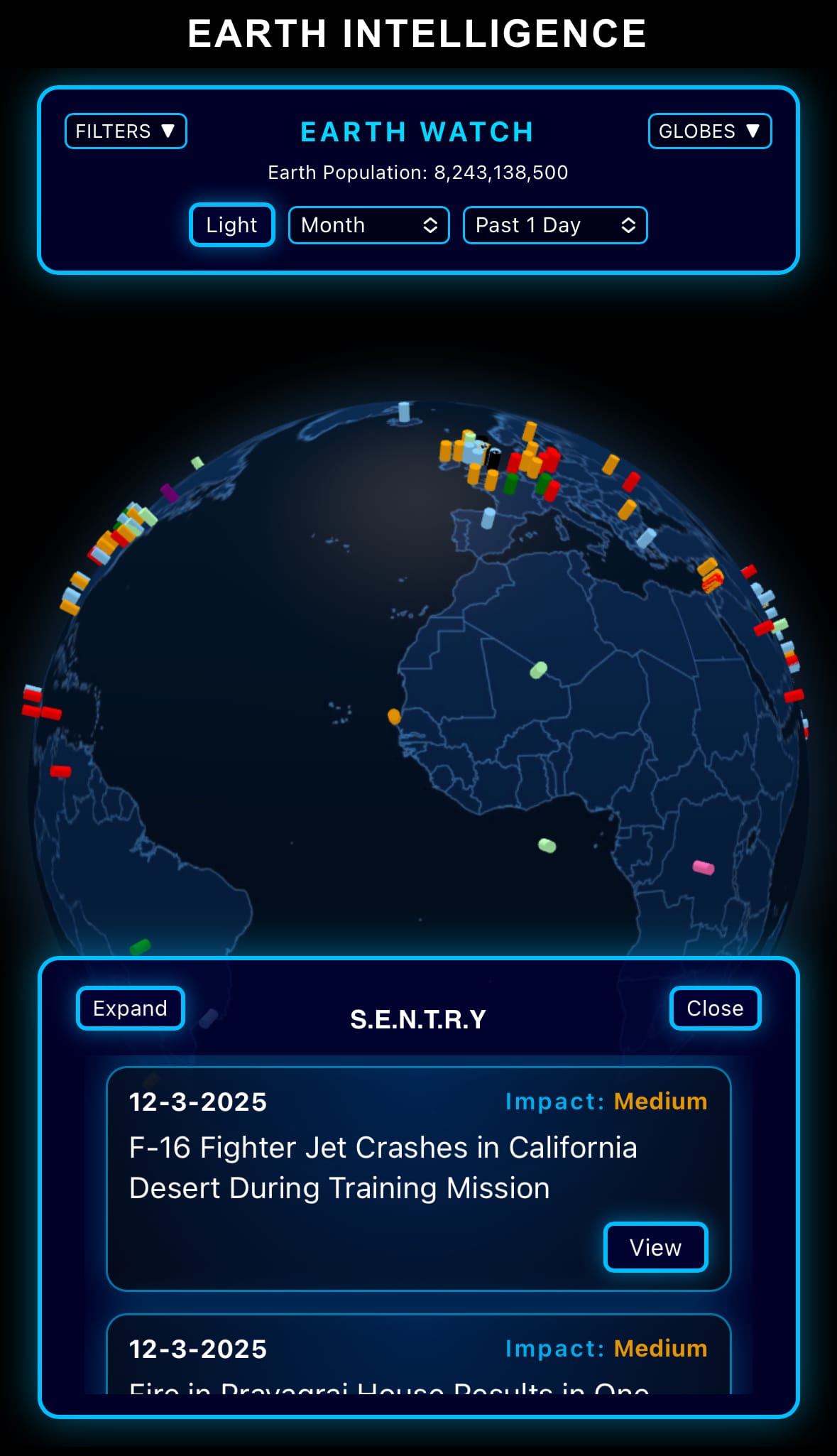
- Click below if you’d like to view our free EARTH WATCH globe:
- Download our mobile app:



Click below to view our previous newsletters:

Support/Suggestions Email:
earthintelligence@earthintel.news