Thursday☕️


Trending:
- On January 14, 2026, Verizon experienced a widespread network outage affecting wireless voice, data, and text services for many customers across the United States. The disruption began around midday Eastern Time, with Downdetector receiving over 1.5 million user reports at its peak (dropping to tens of thousands by evening), concentrated in major cities like New York, Chicago, Los Angeles, Atlanta, Houston, and Washington, D.C. Affected users saw "SOS" mode on their phones (indicating no cellular connectivity), preventing calls and mobile data use, though Wi-Fi calling and texts over Wi-Fi often remained functional.

- Verizon confirmed the issue, stating engineering teams were actively working to identify and resolve it, with no specific cause disclosed (possibilities include core network problems or configuration errors rather than a widespread tower failure). Competitors like T-Mobile and AT&T reported normal operations, though some cross-carrier calls to Verizon numbers failed. Emergency services advised using alternative devices or landlines for 911 calls during the outage. Verizon apologized for the inconvenience and promised account credits for impacted customers, with partial restoration occurring throughout the day but some issues persisting into the evening. This marks one of the most significant U.S. carrier outages in recent years, highlighting vulnerabilities in national mobile infrastructure.
Economics & Markets:
- Yesterday’s U.S. stock market:

- Yesterday’s commodity market:

- Yesterday’s crypto market:

Geopolitics & Military Activity:
- On January 14, 2026, U.S. aerial refueling operations intensified across the Middle East, with KC-135 and KC-46 tankers supporting extended fighter jet patrols and heavy aircraft movements observed in eastern Iraq, northern Israel, and southern Syria. Open-source flight tracking and eyewitness accounts indicated possible dogfighting practice or defensive maneuvers by U.S. and allied jets, with one group withdrawing from Iraqi airspace while a new wave of aircraft arrived. No U.S. aircraft have approached or crossed the Iranian border, and neither CENTCOM nor the Pentagon has reported any combat engagements as of Yesterday @10:17 PM EST.
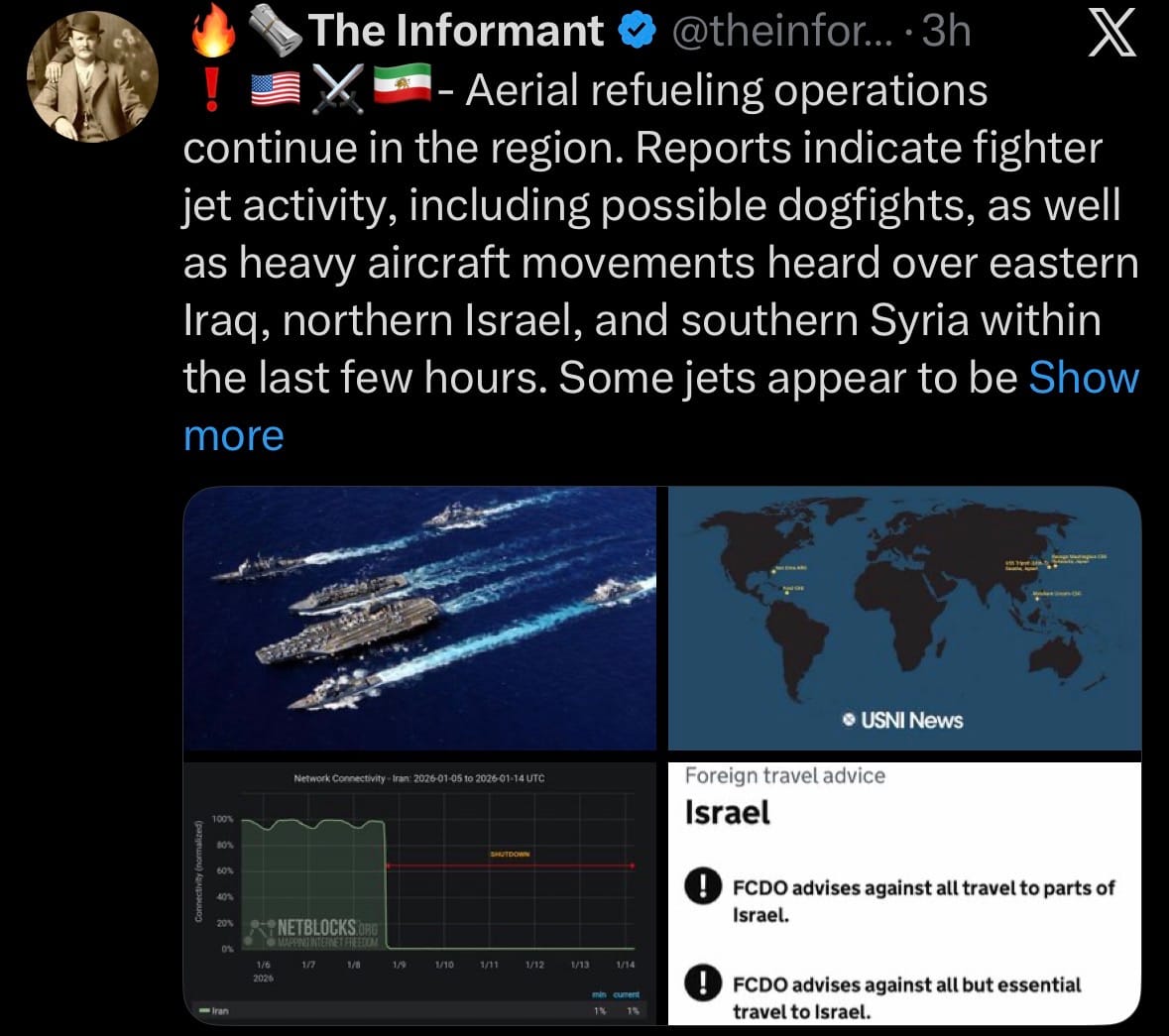
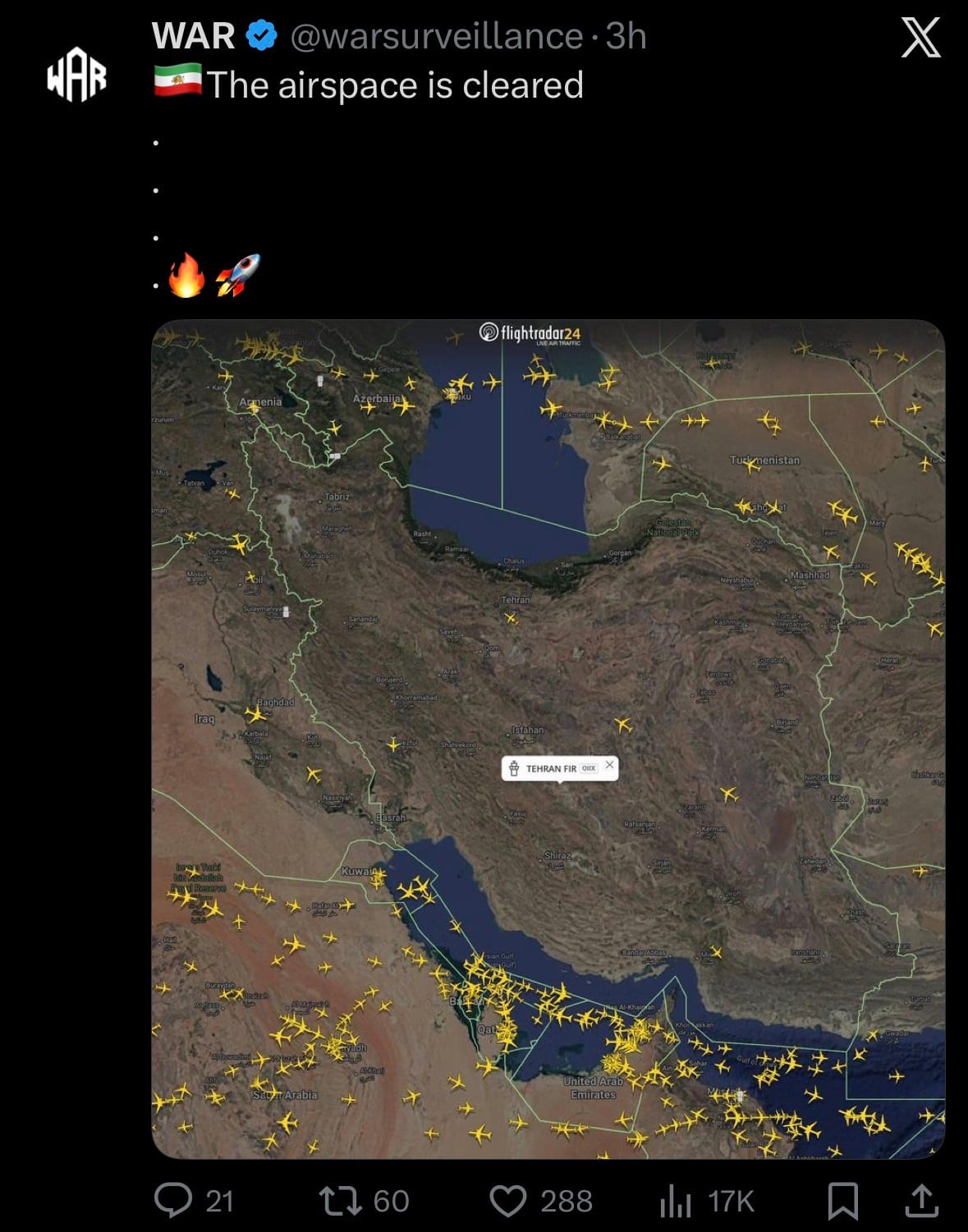
- These activities coincide with heightened tensions under the Trump administration, which is reportedly considering military strikes against Iran amid the ongoing nationwide protests now in their third week and the regime's violent crackdown. At the same time, Iran has begun clearing large portions of its airspace, with civilian flights rerouted or canceled and military air traffic restricted, according to regional aviation authorities and flight data. The USS Abraham Lincoln Carrier Strike Group (including destroyers USS Spruance, USS Michael Murphy, and USS Frank E. Petersen, Jr.) was ordered to leave the South China Sea and head toward the U.S. Central Command area, with arrival in the Arabian Sea expected in about one week. The U.K. Foreign Office updated its travel advisory for Israel, advising against all but essential travel due to the escalating regional situation. Iran remains under a near-total internet and communications blackout (now exceeding 160 hours), making independent verification of events inside the country extremely difficult.
Science & Technology:
- On January 14, 2026, Tesla officially announced the operational start of its Lithium Refinery in Robstown, Texas, describing it as a major step toward energy independence for North America. The facility, located near Corpus Christi, is designed to process raw lithium ore into battery-grade lithium hydroxide, with initial production capacity targeted at 50,000 metric tons per year (enough for roughly 1 million Tesla vehicles annually at current battery sizes). Tesla stated the refinery will supply its Gigafactories in Texas and Nevada, reducing reliance on imported lithium compounds from Asia and South America.

- The announcement highlighted several benefits: creating hundreds of high-paying jobs in South Texas, lowering the carbon footprint of battery production through local sourcing and efficient processing, and accelerating Tesla's mission to transition the world to sustainable energy. Tesla emphasized that regionalized access to critical battery minerals strengthens supply-chain resilience, mitigates geopolitical risks, and supports long-term cost reductions for electric vehicles. The refinery uses a proprietary acid-free process developed by Tesla to minimize environmental impact compared to traditional methods. Full ramp-up is expected over the coming months, with the site serving as a model for future mineral processing initiatives in North America.
Statistic:
- Largest public aircraft manufacturers by market capitalization:
- 🇺🇸 RTX – $266.59B
- 🇳🇱 Airbus – $198.08B
- 🇺🇸 Boeing – $189.98B
- 🇫🇷 Safran – $155.48B
- 🇺🇸 Lockheed Martin – $133.70B
- 🇺🇸 General Dynamics – $98.86B
- 🇺🇸 Northrop Grumman – $93.51B
- 🇬🇧 BAE Systems – $79.94B
- 🇮🇹 Leonardo – $39.04B
- 🇸🇪 SAAB AB – $40.48B
- 🇮🇳 Hindustan Aeronautics – $33.07B
- 🇫🇷 Dassault Aviation – $28.15B
- 🇨🇳 AVIC Shenyang Aircraft Company – $25.09B
- 🇺🇸 Textron – $16.78B
- 🇨🇦 Bombardier – $17.76B
- 🇧🇷 Embraer – $12.96B
- 🇰🇷 Korea Aerospace Industries – $10.57B
- 🇺🇸 Joby Aviation – $13.78B
- 🇺🇸 Kratos Defense & Security Solutions – $20.51B
- 🇺🇸 AeroVironment – $19.06B
History:
- Air warfare begins as an extension of vision and mobility, then rapidly becomes the decisive layer of modern conflict. Long before powered flight, armies sought advantage through elevation—kites in China by the 5th century AD, balloons during the French Revolutionary Wars (1790s), and aerial observation in the American Civil War (1861–1865). Powered aircraft transformed this logic completely. In World War I (1914–1918), planes evolved from unarmed scouts into fighters and bombers within a few years, introducing dogfighting, formation bombing, and the first concepts of air superiority. Between the wars, aircraft design leapt forward—metal airframes, higher speeds, longer ranges—and airpower theorists argued wars could be decided from the sky. World War II (1939–1945) proved them largely right. Germany’s Luftwaffe demonstrated early dominance through Blitzkrieg, integrating fighters and close air support to collapse enemy defenses. In Europe, strategic bombing and escort fighters reshaped industrial warfare. In the Pacific, air warfare reached its purest form: aircraft carriers replaced battleships as the decisive naval force. Battles like Coral Sea (1942) and Midway (1942) showed that fleets could annihilate each other without visual contact—control of the air over the ocean meant control of the sea itself. Fighters, dive bombers, and torpedo planes became the core weapons of naval warfare. By war’s end, aircraft were delivering nuclear weapons, cementing airpower as an existential force. The Cold War then pushed air warfare into jets, missiles, and global reach. Korea and Vietnam demonstrated contested air environments, while long-range bombers, aerial refueling, and carrier aviation allowed continuous global strike capability. Strategy shifted toward precision, persistence, and integration rather than sheer mass.
- From the 1970s onward, air warfare entered the stealth, sensor, and networked era, where dominance depends on seeing first, striking first, and surviving inside defended airspace. Precision-guided munitions, airborne early warning, electronic warfare, and satellite integration transformed aircraft into nodes in a global system. Air defense evolved in parallel—layered radar networks, interceptor aircraft, surface-to-air missiles, and point defenses—but offense steadily adapted. The decisive leap was stealth. The United States introduced the first operational stealth aircraft with the F-117 (1983), then fundamentally changed strategic airpower with the B-2 Spirit (1997)—the world’s first true stealth bomber capable of penetrating advanced air defenses undetected. This capability remains unique: the United States is the only nation on Earth to operate stealth bombers, now extending that dominance with the B-21 Raider, designed for future contested environments. Advanced fighters like the F-22 and F-35 fused stealth, sensor fusion, and electronic warfare, while drones added persistence and scale—from strike platforms like the MQ-9 Reaper to autonomous and swarming systems that saturate airspace. Modern air warfare is no longer about isolated dogfights; it is about controlling the air domain across land and sea through integrated aircraft, carriers as mobile airbases, precision strike, and information dominance. Across every major war from 1914 to today, the lesson has sharpened: whoever controls the air controls the tempo, reach, and outcome of modern warfare—and in the full-spectrum integration of airpower, stealth, and global projection, the United States remains unmatched.
Image of the day:

Thanks for reading! Earth is complicated, we make it simple.
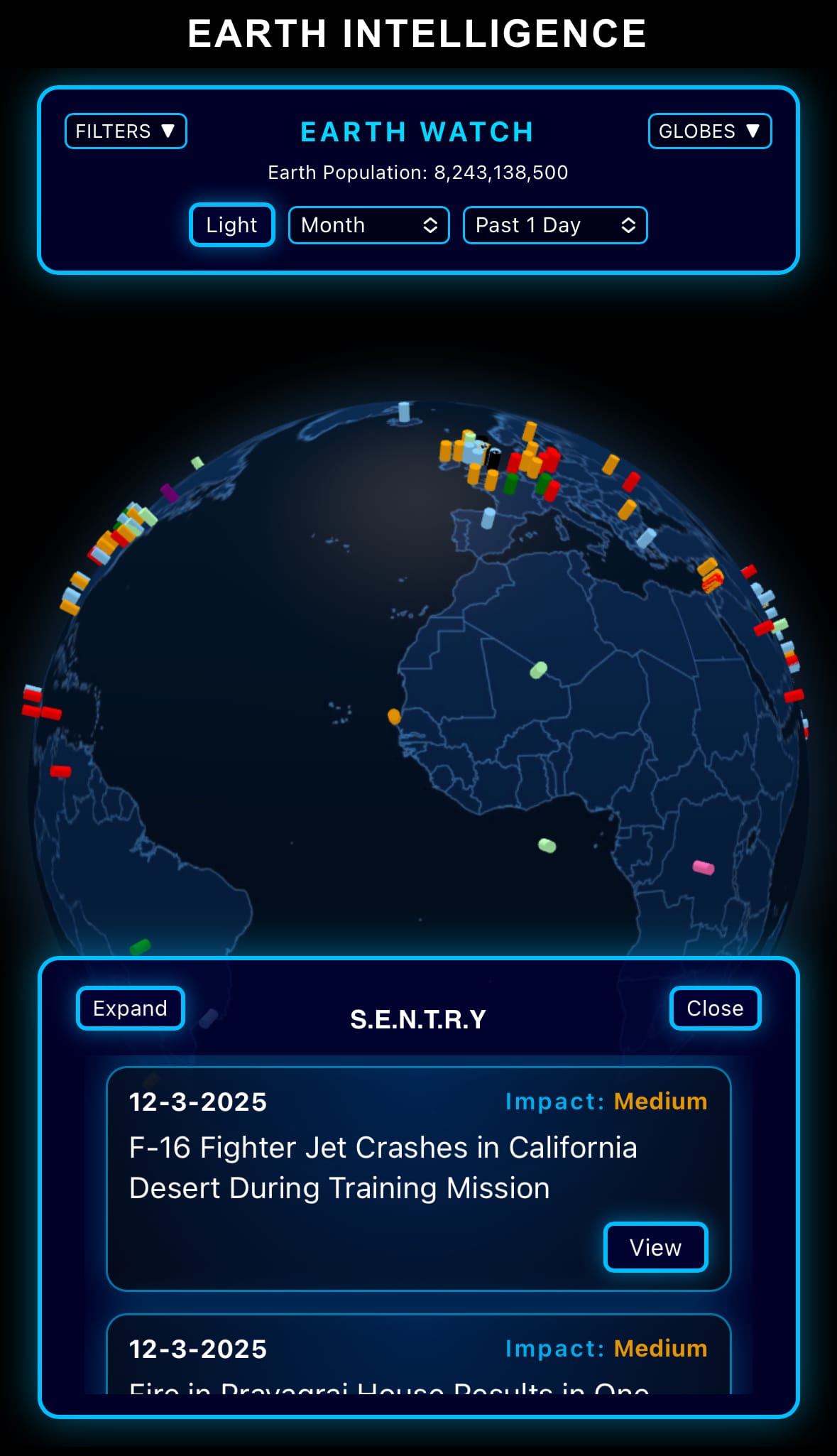
- Click below if you’d like to view our free EARTH WATCH globe:
- Download our mobile app:



Click below to view our previous newsletters:

Support/Suggestions Email:
earthintelligence@earthintel.news