Thursday☕️


Trending:
- As of January 21, 2026, more than 300 hours have passed since Iranian authorities imposed a near-total nationwide internet blackout on January 8, amid escalating anti-government protests that began in late December 2025 and spread across all 31 provinces. The shutdown—one of the most comprehensive in Iran's history—has severely limited domestic and international communications, including mobile networks and some phone services, as a reported tactic to suppress dissent, isolate protesters, and obscure the scale of the security forces' crackdown.
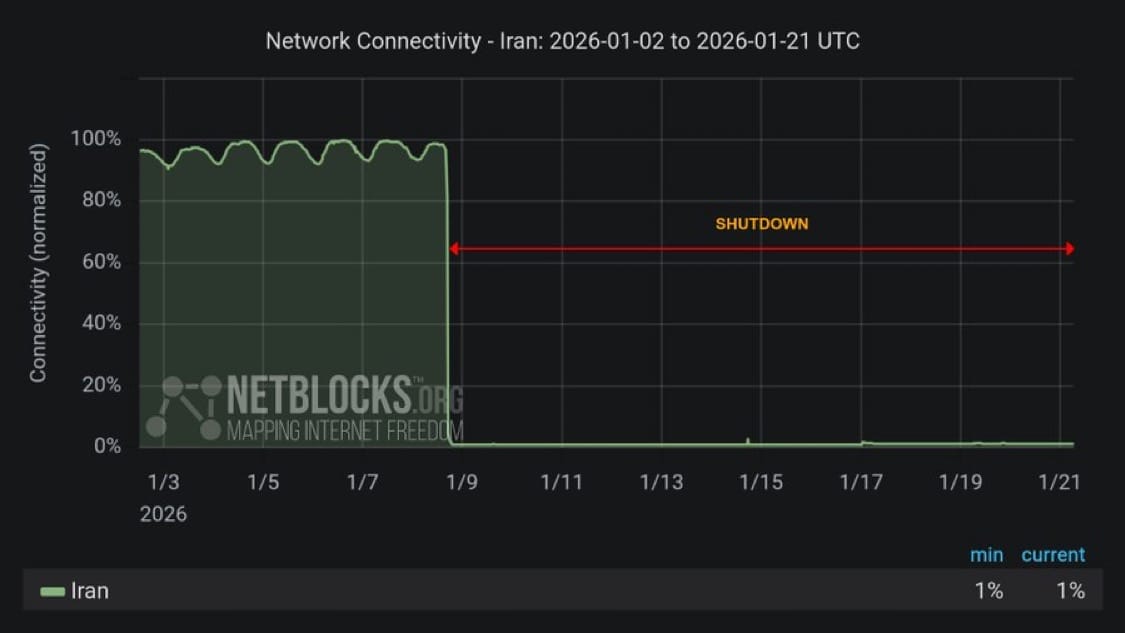
- The protests, driven by economic hardship, political grievances, and calls for regime change, have faced intense repression, with security forces using live fire, mass arrests, and other measures. Death toll estimates vary widely due to the information blackout: independent groups like HRANA report over 4,500 verified or investigated deaths (including some security personnel), Iran Human Rights cites at least 3,428, and some sources suggest figures as high as 12,000–20,000, with many deaths occurring in the initial days of intensified violence around January 8–9. Supreme Leader Ayatollah Ali Khamenei has acknowledged "several thousands" killed, blaming external actors like the U.S. and Israel, while regime officials have described the unrest as terrorism. Protests have reportedly decreased in scale due to the crackdown, but tensions remain high with ongoing arrests, military deployments in some areas, and international calls for sanctions and accountability. No full restoration of internet access has occurred, though partial domestic connectivity and limited testing of filtered networks have been noted.
Economics & Markets:
- Yesterday’s U.S. stock market:

- Yesterday’s commodity market:

- Yesterday’s crypto market:

Geopolitics & Military Activity:
- On January 21, 2026, U.S. Central Command (CENTCOM) announced the launch of a new mission to transfer ISIS detainees from northeastern Syria to secure facilities in Iraq. The operation began that day with the successful movement of 150 ISIS fighters from a detention site in Hasakah, Syria, to a secure location in Iraq. CENTCOM stated that up to 7,000 ISIS detainees could eventually be transferred from Syrian facilities to Iraqi-controlled prisons as part of the effort.
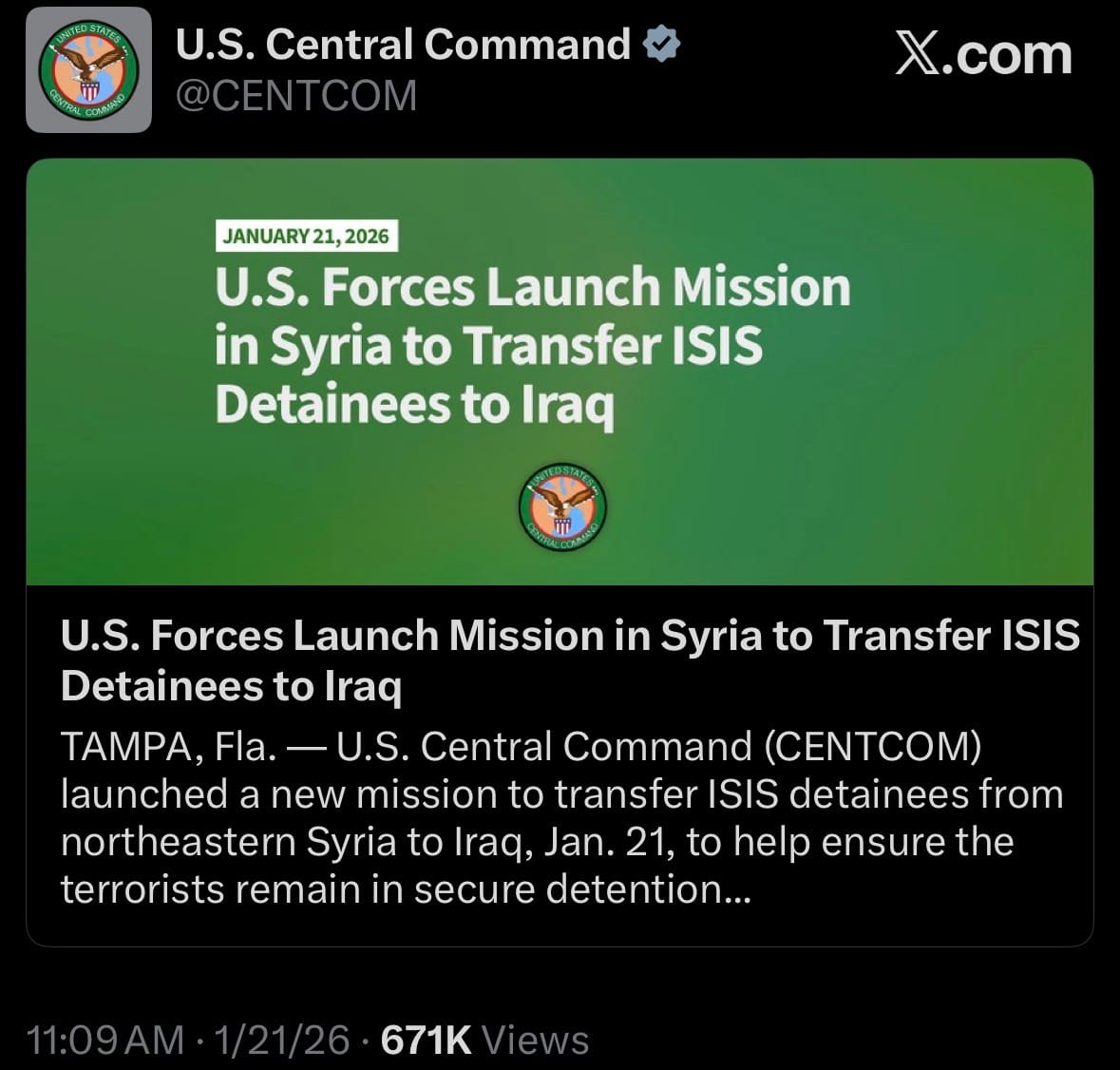
- CENTCOM emphasized close coordination with regional partners, particularly the Iraqi government, to ensure the transfers are orderly and secure. Adm. Brad Cooper, CENTCOM commander, highlighted the importance of preventing potential breakouts that could threaten U.S. and regional security, while thanking Iraq for its cooperation in the ongoing fight against ISIS. In 2025, U.S. and partner forces detained more than 300 ISIS operatives in Syria and killed over 20 during operations in the same area.
Science & Technology:
- On January 21, 2026, xAI rolled out an update to Grok Imagine enabling 10-second video generation, with significant improvements in overall quality, including much sharper and clearer visuals plus clean, synchronized audio. The feature allows users to create short clips directly from text prompts (no base image required anymore), building on Grok's existing image-to-video and text-to-video capabilities powered by models like Aurora.

- The rollout is currently active for users (with some randomness in clip length and no timer control yet for precise duration selection), but a full stable version with refinements is expected soon. Early examples shared on X show dynamic scenes with better motion coherence and natural-sounding sound effects. This positions Grok Imagine as a faster, more accessible contender in AI video tools, with users noting rapid progress—though it remains in an evolving phase amid competition from tools like Sora, Veo, and Runway. Access is available via the Grok app on iOS/Android or web, subject to subscription tiers (e.g., Premium+ or SuperGrok for fuller/unlimited use), following recent restrictions on image features for non-paying users due to misuse concerns.
Comet Browser Upgrade:
- On January 21, 2026, Perplexity updated the Comet browser's AI agent to use Claude Opus 4.5 as its default model. This upgrade greatly improves the agent's reasoning power and its ability to manage complex, multi-step tasks directly in the browser.
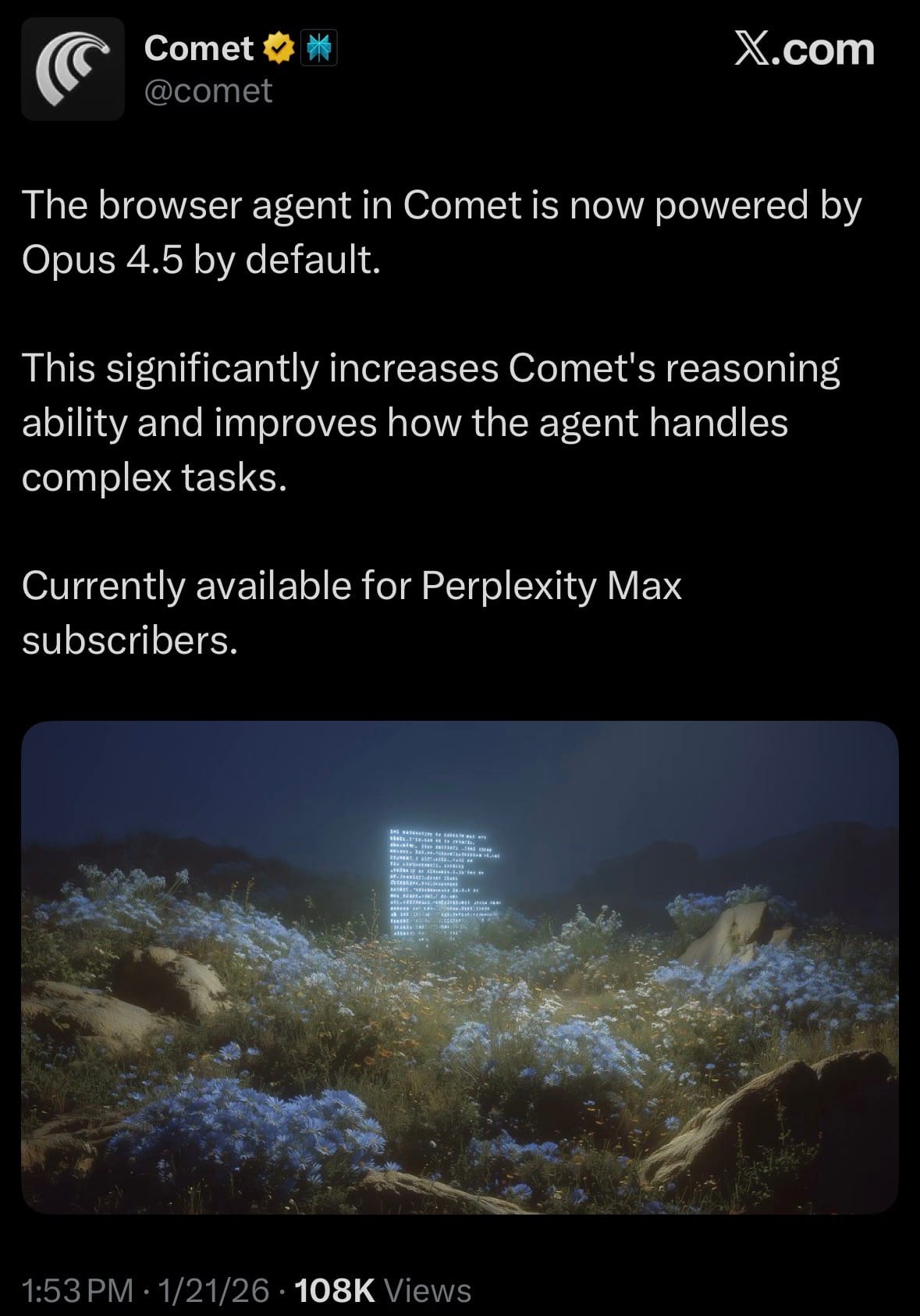
- The change is live now but only for Perplexity Max subscribers. You can use it right away in the Comet browser on Mac, Windows, or Android. Comet is an AI-first web browser with a built-in assistant that handles research, email/calendar tasks, tab management, shopping comparisons, and more through its sidebar. Switching to Opus 4.5 makes automation smoother and more reliable, with early users noting better real-world performance. No timeline was given for wider access.
Statistic:
- Largest public pharmaceutical companies on Earth by market capitalization:
- 🇺🇸 Eli Lilly – $966.84B
- 🇺🇸 Johnson & Johnson – $525.25B
- 🇺🇸 AbbVie – $382.02B
- 🇨🇭 Roche – $347.64B
- 🇬🇧 AstraZeneca – $280.72B
- 🇨🇭 Novartis – $278.43B
- 🇺🇸 Merck – $277.52B
- 🇩🇰 Novo Nordisk – $263.58B
- 🇺🇸 Amgen – $185.02B
- 🇺🇸 Gilead Sciences – $160.20B
- 🇺🇸 Pfizer – $147.20B
- 🇺🇸 Vertex Pharmaceuticals – $118.23B
- 🇫🇷 Sanofi – $112.16B
- 🇺🇸 Bristol-Myers Squibb – $110.94B
- 🇺🇸 CVS Health – $103.44B
- 🇬🇧 GSK – $97.15B
- 🇯🇵 Chugai Pharmaceutical – $86.49B
- 🇺🇸 Regeneron Pharmaceuticals – $79.41B
- 🇩🇪 Merck KGaA – $63.12B
- 🇦🇺 CSL – $57.76B
- 🇨🇳 Jiangsu Hengrui Medicine – $57.28B
- 🇧🇪 UCB – $56.57B
- 🇺🇸 Zoetis – $55.43B
- 🇯🇵 Takeda Pharmaceutical – $53.51B
- 🇳🇱 Argenx – $50.51B
- 🇨🇭 Lonza – $49.25B
History:
- The nuclear triad emerges from one unforgiving strategic insight of the atomic age: deterrence only works if no adversary can ever be certain they’ve eliminated your ability to strike back. In the immediate aftermath of 1945, nuclear weapons were delivered by aircraft alone, making early deterrence slow, visible, and vulnerable. That changed rapidly. By 1949, when the Soviet Union detonated its first nuclear weapon, and through the 1950s, the United States and USSR raced to build faster, harder-to-destroy delivery systems. Long-range bombers gave way to intercontinental ballistic missiles (ICBMs) capable of crossing continents in minutes, and then to ballistic missile submarines (SSBNs) that could disappear into the oceans for months at a time. By the early 1960s, strategic planners recognized that relying on any single method invited disaster. The triad crystallized as doctrine: three fundamentally different platforms—air, land, and sea—each compensating for the others’ weaknesses. Beneath all of it sat an invisible fourth pillar: nuclear command, control, and communications—early-warning radars, infrared satellites, hardened command centers, and secure communications—ensuring the weapons could be detected, authorized, and launched even under attack. The triad was never about fighting a nuclear war; it was about making one impossible to win.
- Each leg of the triad plays a distinct and deliberately engineered role. The land-based leg consists of ICBMs housed in hardened silos or mounted on mobile launchers, designed for speed and certainty. Once launched, they are nearly impossible to stop, delivering warheads within minutes. The sea-based leg—SSBNs armed with submarine-launched ballistic missiles (SLBMs)—is the most survivable element of the triad. A single SSBN can remain hidden across vast ocean spaces, making it extraordinarily difficult for any adversary to locate and neutralize the entire force. The air-based leg is the most flexible: strategic bombers can be deployed forward, visibly signal intent, carry both nuclear and conventional weapons, launch long-range standoff missiles, and—crucially—be recalled after launch orders, something missiles cannot do. The United States operates the most balanced and technologically advanced version of this structure. Its land leg currently rests on Minuteman III ICBMs, transitioning to the next-generation Sentinel system. Its sea leg is anchored by Ohio-class SSBNs carrying Trident II D5 SLBMs, with the quieter, more survivable Columbia-class submarines under construction. The air leg is where the U.S. holds a unique advantage: a bomber force composed of B-52Hs for standoff strike, the B-2 Spirit, and the incoming B-21 Raider—making the United States the only nation on Earth with operational stealth bombers capable of penetrating the most advanced air defense systems. Russia fields a formidable triad of its own, emphasizing missile mass and mobility: silo and road-mobile ICBMs like Yars and Sarmat, Borei-class SSBNs with Bulava SLBMs, and large bombers such as the Tu-160 and Tu-95MS launching nuclear cruise missiles. China’s triad is newer and still expanding, with modern road-mobile ICBMs (DF-31, DF-41), a growing SSBN fleet (Type 094, with next-generation platforms expected), and an emerging air leg built around nuclear-capable bombers and future stealth designs.
- What separates dominance from mere possession is integration, survivability, and credibility under stress. The United States leads not because it has the most warheads, but because it has built the most cohesive, modernized, and globally integrated triad system. Its bombers can launch from continental bases, refuel globally, penetrate denied airspace, or strike from standoff range. Its submarines operate with unmatched quieting, patrol discipline, and command assurance. Its missile force is embedded in hardened infrastructure tied into layered early-warning and decision networks. And all three legs are fused through a mature command-and-control architecture backed by space-based sensors, airborne command posts, and decades of operational refinement. Russia retains immense destructive power, China is rapidly closing gaps, but neither currently matches the U.S. in full-spectrum integration—especially in the air leg, where stealth bombers fundamentally alter deterrence calculus by threatening penetration where missiles and conventional aircraft may fail. The nuclear triad, at its core, is engineered uncertainty: the certainty that no enemy can remove all retaliatory options, and the uncertainty that keeps nuclear war from ever starting. In that system, the United States remains the most technologically complete and strategically flexible nuclear power on Earth.
Image of the day:

Thanks for reading! Earth is complicated, we make it simple.
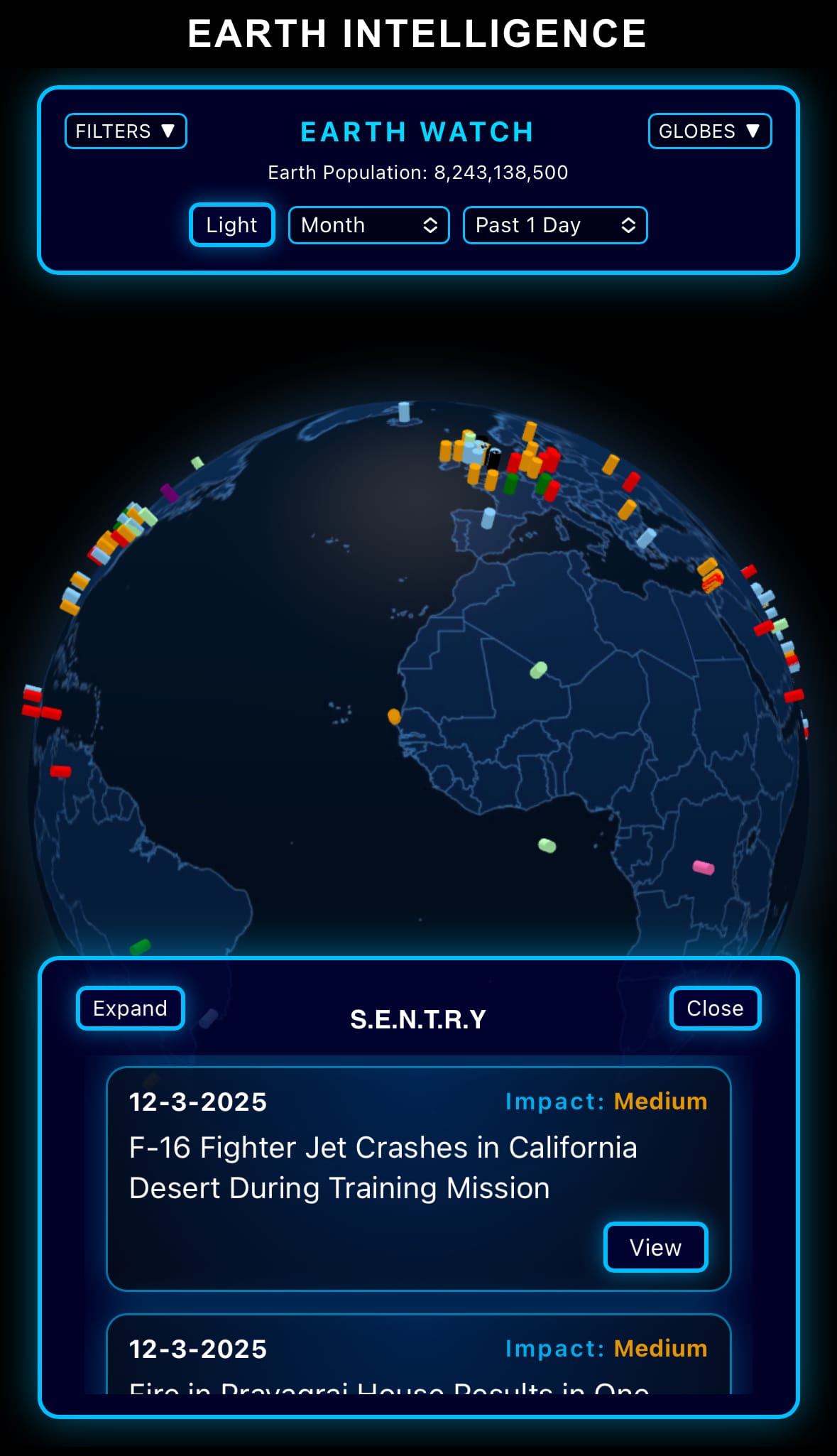
- Click below if you’d like to view our free EARTH WATCH globe:
- Download our mobile app:



Click below to view our previous newsletters:
Support/Suggestions Email:
earthintelligence@earthintel.news