Thursday☕️


Trending:
- On February 4, 2026, The Washington Post announced a major restructuring that reportedly includes cutting approximately one-third of its staff, though the exact number has not been officially confirmed by the company. The layoffs would affect hundreds of employees across the newsroom, business, and operations divisions and are described as necessary to adapt to declining print revenue, digital subscription challenges, and competition from low-cost online news sources.
- The reorganization, led by CEO Will Lewis and publisher David Shipley, involves consolidating departments, shifting focus to digital-first journalism, video, and audience engagement, and eliminating some print-centric roles. The Post stated the changes aim to protect core investigative and local reporting while investing in new revenue streams.
Economics & Markets:
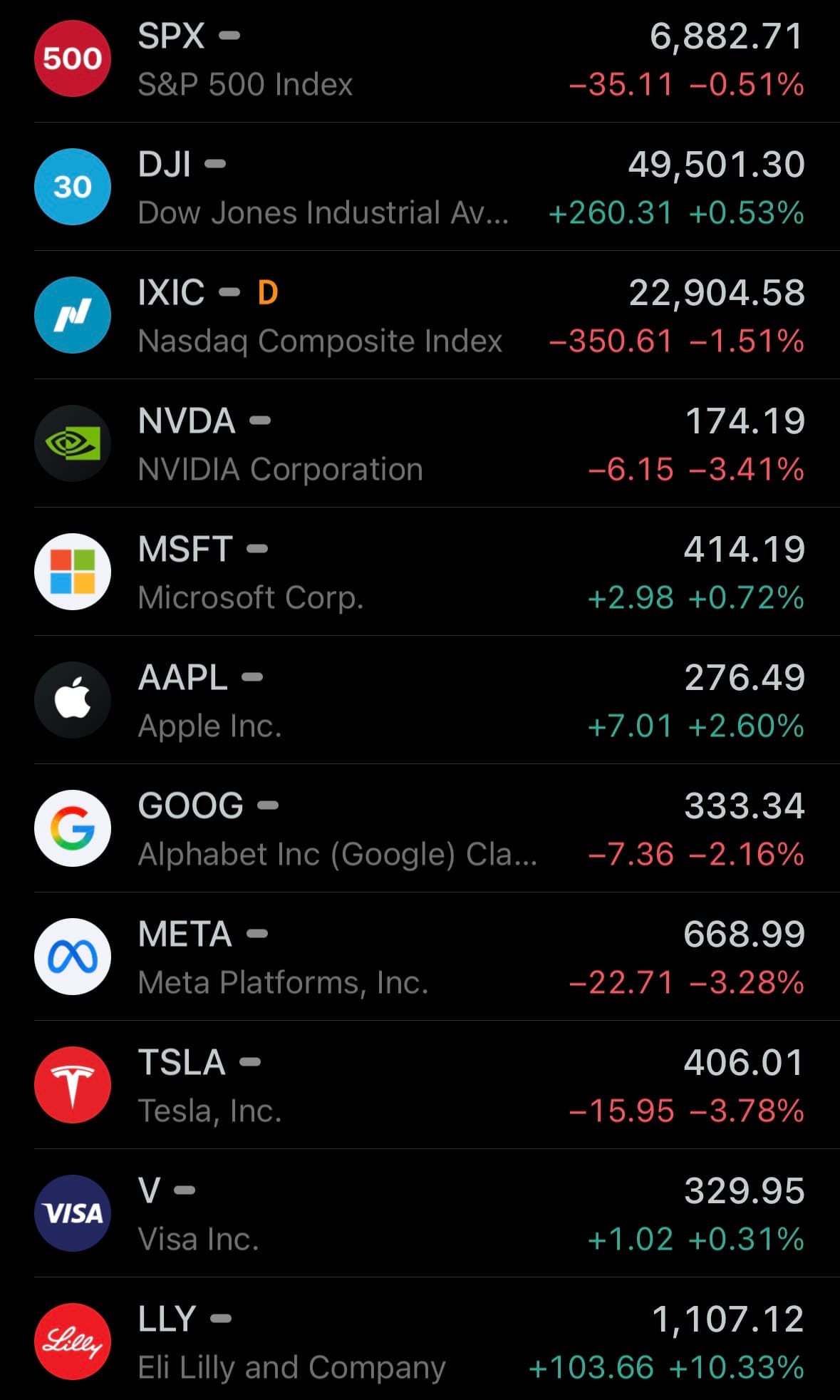
- Yesterday’s U.S. stock market:
- Yesterday’s commodity market:

- Yesterday’s crypto market:

Geopolitics & Military Activity:
- From January 27 to February 2, 2026, U.S. Central Command (CENTCOM) conducted five airstrikes against ISIS targets across Syria. The strikes, carried out by fixed-wing aircraft, helicopters, and drones, used 50 precision-guided munitions to destroy an ISIS communications site, a key logistics node, and multiple weapons storage facilities.

- The operations were part of Operation Hawkeye Strike, launched in response to the December 13, 2025, ISIS ambush in Palmyra that killed two U.S. service members and an American interpreter. CENTCOM reported that the campaign has resulted in more than 50 ISIS terrorists killed or captured, including the targeted killing of Bilal Hasan al-Jasim—a senior ISIS figure linked to the Palmyra attack—on January 16 in northwest
Law Enforcement:

Science & Technology:
- On February 4, 2026, OpenAI announced that ChatGPT now fully supports MCP Apps. MCP stands for Model Context Protocol—a new open standard that lets AI models easily connect to external data, tools, and apps in a consistent way. It was created by the MCP committee (a group working on better compatibility between different AI chat systems), and OpenAI helped shape the MCP Apps specification using the same rules that already run custom apps inside ChatGPT.
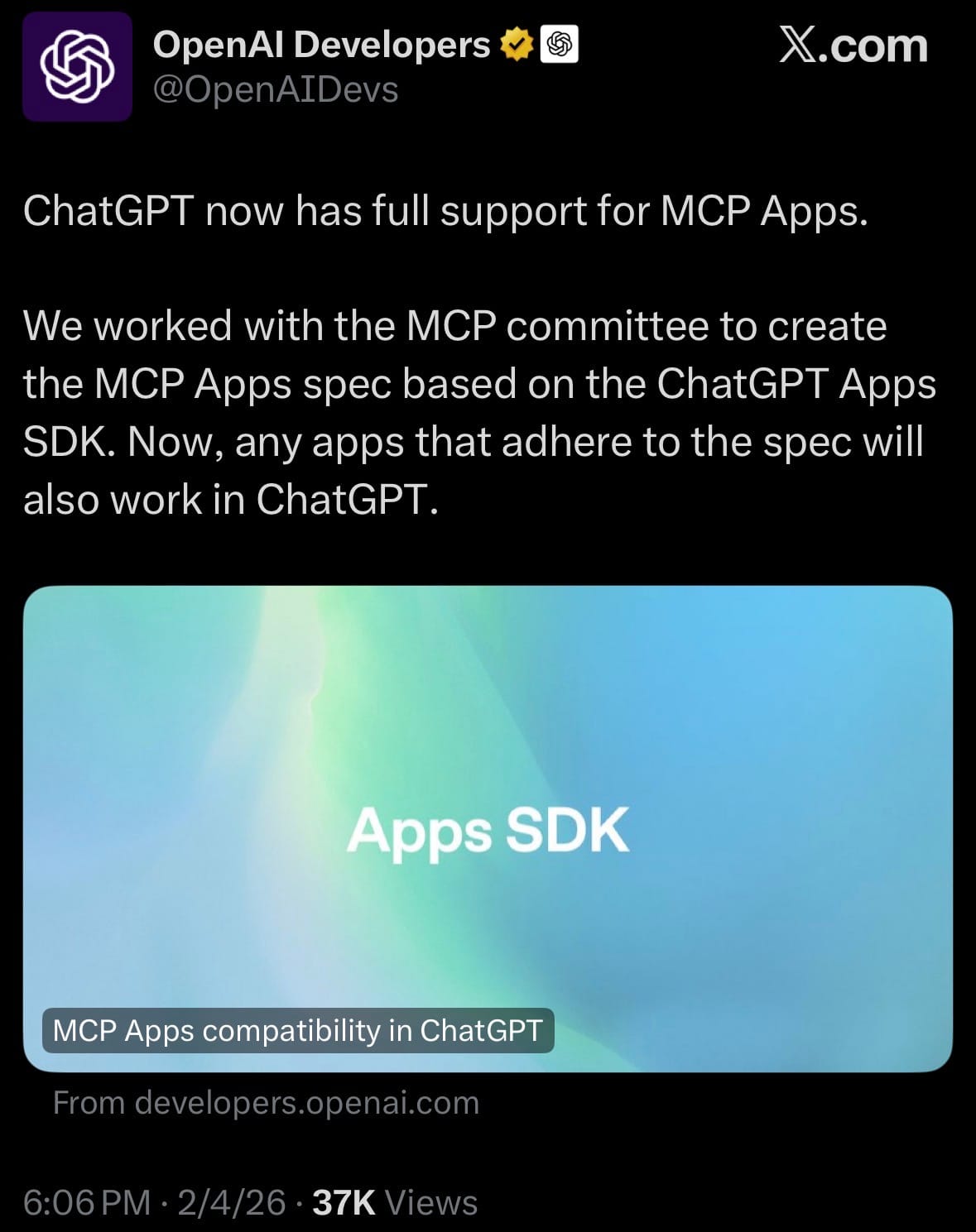
- In simple terms, this means any app or tool built to follow the MCP Apps rules will now work directly inside ChatGPT—no extra setup needed from developers or users. Whether it’s a calculator, research tool, game, productivity helper, or anything that needs to pull in data or perform actions, it can plug in smoothly. The update is live right now for everyone using ChatGPT. Developers can build or update their apps to the MCP standard and know they’ll run in ChatGPT without any special integration work.
Space:
- On February 4, 2026, the Federal Communications Commission's Space Bureau accepted for filing SpaceX's application to launch and operate a constellation of up to one million satellites designed as orbital data centers. The FCC is now seeking public comments on the proposal, with initial comments due by March 6, 2026, and reply comments by March 16, 2026.
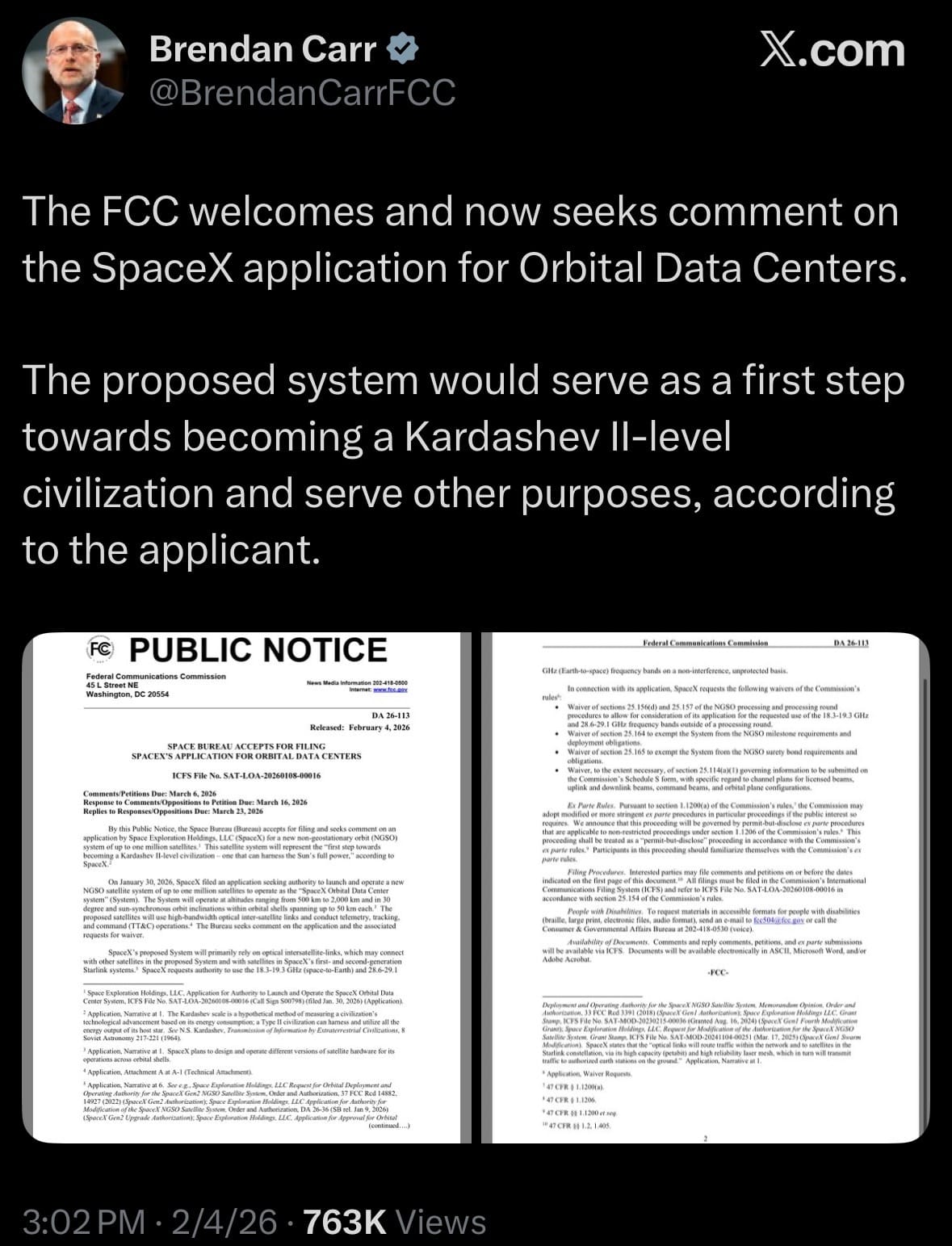
- SpaceX described the system as a first step toward becoming a Kardashev II-level civilization—one capable of harnessing a significant portion of the Sun’s energy—while providing massive, solar-powered AI compute capacity to meet growing data demands. The satellites would operate in low Earth orbit (500–2,000 km altitude) in sun-synchronous and 30-degree inclinations for near-constant solar power, using optical inter-satellite links and minimal radio spectrum to avoid interference. The application requests waivers from standard FCC milestone requirements (e.g., deploying half the constellation in six years) and emphasizes sustainability measures like end-of-life disposal. The FCC's quick acceptance and comment period signal early regulatory review of the ambitious plan, which relies heavily on Starship for high-volume launches.
Statistic:
- Largest assets on Earth by market capitalization:
- Gold: $34.522T
- Silver: $4.886T
- 🇺🇸 NVIDIA: $4.241T
- 🇺🇸 Apple: $4.063T
- 🇺🇸 Alphabet (Google): $4.024T
- 🇺🇸 Microsoft: $3.078T
- 🇺🇸 Amazon: $2.490T
- 🇺🇸 Meta Platforms: $1.692T
- 🇹🇼 TSMC: $1.689T
- 🇸🇦 Saudi Aramco: $1.654T
- 🇺🇸 Tesla: $1.523T
- 🇺🇸 Broadcom: $1.460T
- Bitcoin: $1.453T
- 🇺🇸 Berkshire Hathaway: $1.086T
- 🇺🇸 Walmart: $1.020T
- 🇺🇸 Eli Lilly: $992.48B
- 🇺🇸 JPMorgan Chase: $863.69B
- 🇺🇸 Vanguard S&P 500 ETF (VOO): $844.29B
- 🇺🇸 iShares Core S&P 500 ETF (IVV): $757.59B
- 🇰🇷 Samsung: $748.20B
- 🇺🇸 SPDR S&P 500 ETF (SPY): $703.33B
- 🇨🇳 Tencent: $637.61B
- 🇺🇸 Visa: $636.15B
- 🇺🇸 Exxon Mobil: $622.41B
- 🇬🇧 AstraZeneca: $581.20B
History:
- Data centers start as literal compute temples—rooms built around machines so massive and sensitive they demanded their own controlled environment. In the 1940s–1950s, early computers and mainframes (government, defense, university, and big industry systems) required specialized “computer rooms” with dedicated power conditioning, cooling, fire suppression, and strict physical access. Through the 1960s–1970s, centralized data processing became the backbone of modern institutions: banks, airlines, governments, and telecoms ran batch jobs and transaction processing on mainframes, and “uptime” became a strategic requirement rather than a convenience. This is where the core anatomy of a data center forms: redundancy, environmental control, guarded access, and operational discipline—because a failed compute room could halt payroll, flight scheduling, or national systems. In the 1980s, minicomputers and then commodity servers began pushing compute out of the monolith, but networking quietly reversed the trend: as soon as systems needed to talk to each other reliably, they started clustering back into dedicated facilities. By the 1990s, the internet turns data centers from internal corporate assets into commercial infrastructure. Colocation facilities appear—neutral buildings where companies rent space, power, and cooling—and the “server room” evolves into a professionally managed platform measured in electrical capacity, cooling capacity, and availability “nines.”
- The 2000s and 2010s are the era where data centers stop being buildings and become an abstraction: the cloud. The enabling breakthroughs were virtualization, distributed storage, and software-defined networking—turning physical servers into flexible pools of compute that could be allocated on demand. This is when hyperscalers emerge as the dominant architects of modern digital reality: AWS, Microsoft Azure, and Google Cloud build massive global fleets; Oracle builds a major enterprise cloud footprint; Meta builds gigantic data center campuses optimized for social-scale data and AI; and other major players—telecoms, financial networks, government clouds—expand alongside them. The modern hyperscale data center is engineered like a power plant crossed with a factory: high-voltage substations, redundant feeds, diesel generators, battery UPS systems, fiber backbones, and relentless automation. The objective is not “servers in racks,” but a continuous conversion of electricity into computation at industrial scale. Workloads evolved from websites and databases to streaming, global search, real-time advertising markets, global messaging, and security systems. A new layer also emerges: edge data centers—smaller facilities placed closer to users to reduce latency for video, gaming, finance, and later autonomous and industrial systems. Over time, the world’s digital economy becomes physically anchored to these sites, and the companies that own the largest data center footprints effectively own the default substrate on which modern software runs.
- Now the center of gravity has shifted again: AI has turned data centers into something closer to machine minds—factories for training and running neural networks. Classic data centers were optimized for general compute; AI data centers are optimized for accelerators—GPUs and specialized chips—packed into dense clusters with extreme power draw and heat. That changes everything: cooling shifts toward liquid solutions; power delivery becomes a dominant design constraint; and the limiting factor becomes megawatts, not square footage. In many regions, AI data centers are becoming some of the largest single loads on local grids, forcing utilities and cities to treat them like heavy industry. They are not just hosting applications; they are running massive training cycles, building and refining models that then power search, copilots, recommendations, security analytics, and decision systems. In practical terms, the modern AI data center is a perception-and-reasoning engine connected to the internet—absorbing data, transforming it into models, and deploying those models back into the world as services. This is why the biggest builders—AWS, Microsoft, Google, Meta, and others—are in a global build race: whoever has the most reliable access to compute, power, and chips has the strongest position in AI capability. Looking forward, the next frontier is compute that escapes current constraints: modular “power-first” campuses built around dedicated generation, advanced cooling, and on-site substations; wider use of small-edge inference centers; and eventually specialized facilities for quantum computing and quantum-secure processing. Quantum won’t replace AI GPUs in the near term, but it may become a strategic accelerator for certain classes of problems—optimization, materials, cryptography—feeding the AI ecosystem like a new kind of high-end co-processor. The trajectory is clear: data centers began as rooms protecting machines; they became the cloud’s industrial backbone; and now they are evolving into the planet’s distributed cognitive infrastructure—an emerging layer of “machine intelligence factories” that convert raw energy into insight, prediction, and control at civilization scale.
Image of the day:

Thanks for reading! Earth is complicated, we make it simple.
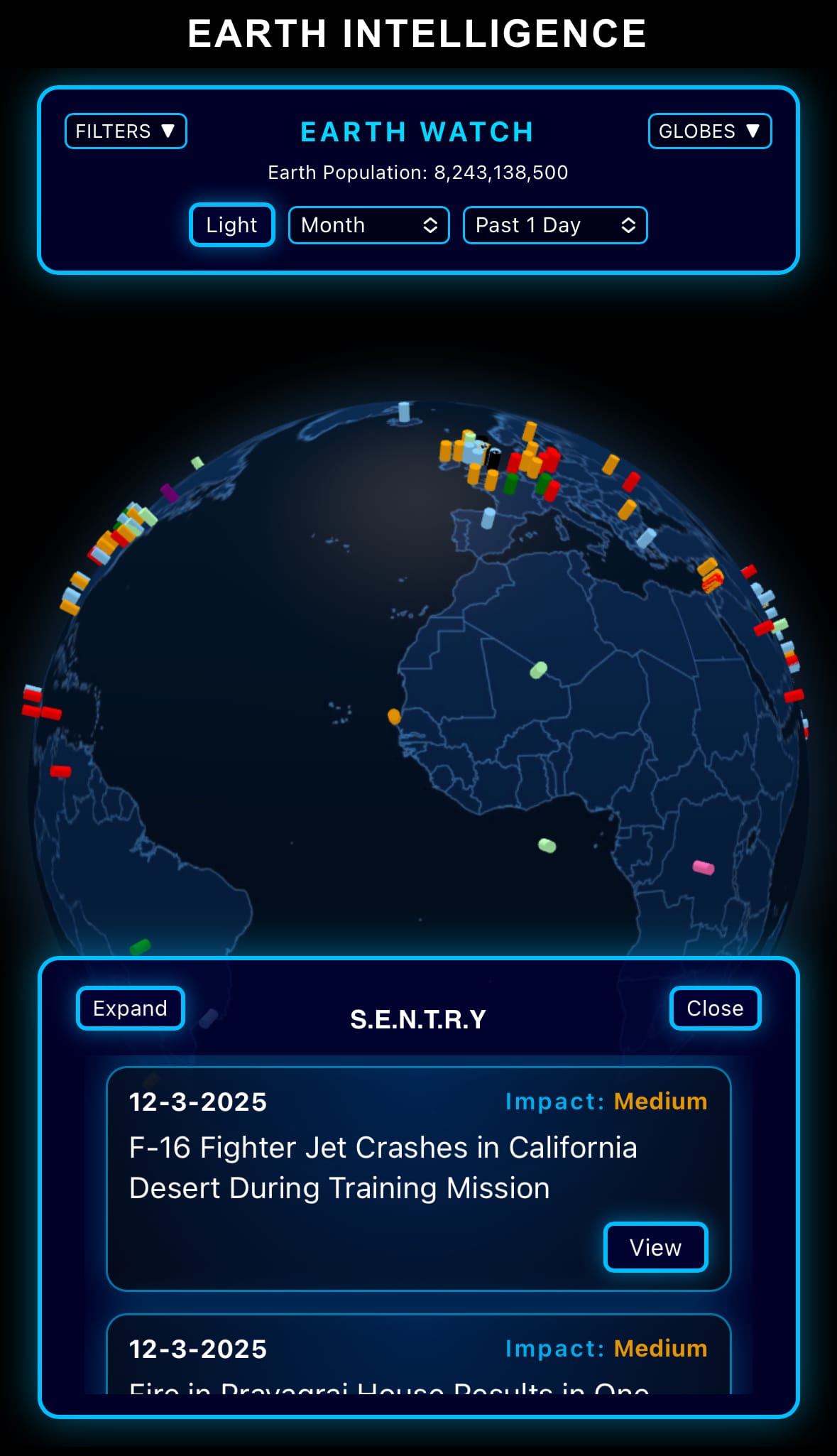
- Click below if you’d like to view our free EARTH WATCH globe:
- Download our mobile app:



Click below to view our previous newsletters:

Support/Suggestions Email:
earthintelligence@earthintel.news