Thursday☕️


Trending:
Economics & Markets:
- On February 11, 2026, Coinbase launched Agentic Wallets through its Developer Platform, introducing the first wallet infrastructure specifically designed for autonomous AI agents. This new system allows AI agents to independently hold and manage cryptocurrency funds, maintain a digital identity, and perform on-chain transactions—such as sending payments, trading tokens, earning yield, or paying for services—without requiring human approval for each action.

- It builds on Coinbase's earlier AgentKit framework (launched in 2024 for embedding wallets) by providing ready-to-use wallets that integrate with AI models and environments. Key features include built-in security guardrails like programmable spending limits, session caps, transaction restrictions, and key isolation in trusted execution environments to prevent unauthorized or risky behavior.
- Yesterday’s U.S. stock market:

- Yesterday’s commodity market:

- Yesterday’s crypto market:

Geopolitics & Military Activity:
Cyber:
- On February 11, 2026, WhatsApp (owned by Meta Platforms) reported that access to its service was blocked in Russia. The block was implemented by Roskomnadzor, Russia's communications regulator, which removed key WhatsApp domains—including whatsapp.com and web.whatsapp.com—from the national DNS system. This prevented direct connections for the majority of users unless they used tools such as VPNs to bypass the restriction.
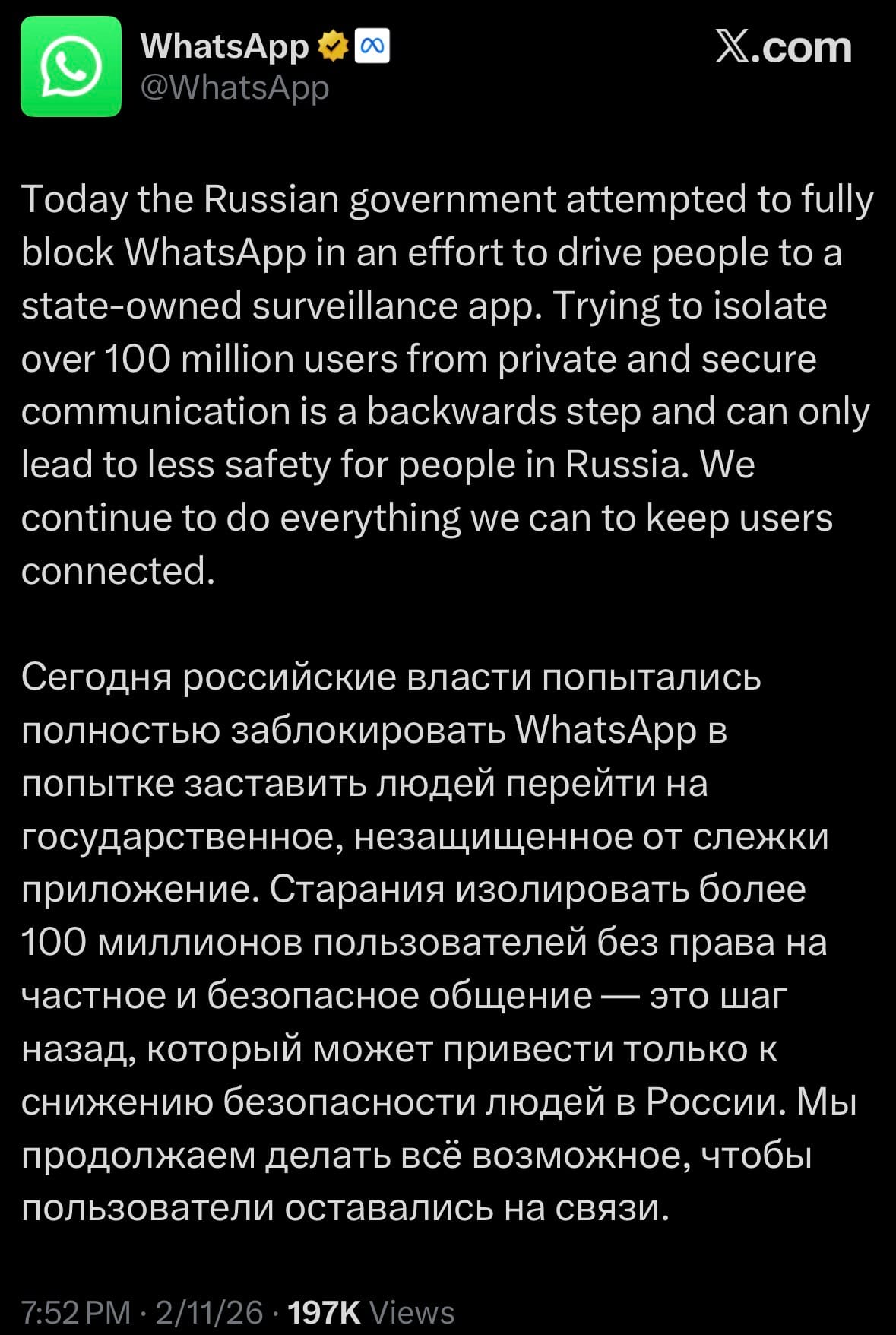
- Reports indicate the measure affected millions of users who could no longer send or receive messages, suggesting a full block rather than limited throttling. The action follows earlier restrictions on voice and video calling features in WhatsApp and other messaging apps, as well as recent blocks on domains related to Facebook, Instagram, and YouTube. It coincides with Russian authorities promoting the use of MAX, a domestic messaging application developed with ties to state-linked entities. The company said it is working to help users stay connected, including by supporting workarounds like VPNs.
Space:
- On February 11, 2026, SpaceX successfully launched the Starlink Group 17-34 mission using a Falcon 9 rocket from Space Launch Complex 4 East (SLC-4E) at Vandenberg Space Force Base in California. Liftoff occurred at 9:11 a.m. PT (12:11 p.m. ET / 17:11 UTC), deploying 24 Starlink v2 Mini satellites into low-Earth orbit to expand the company's global broadband internet constellation, which now exceeds 9,600 operational satellites.
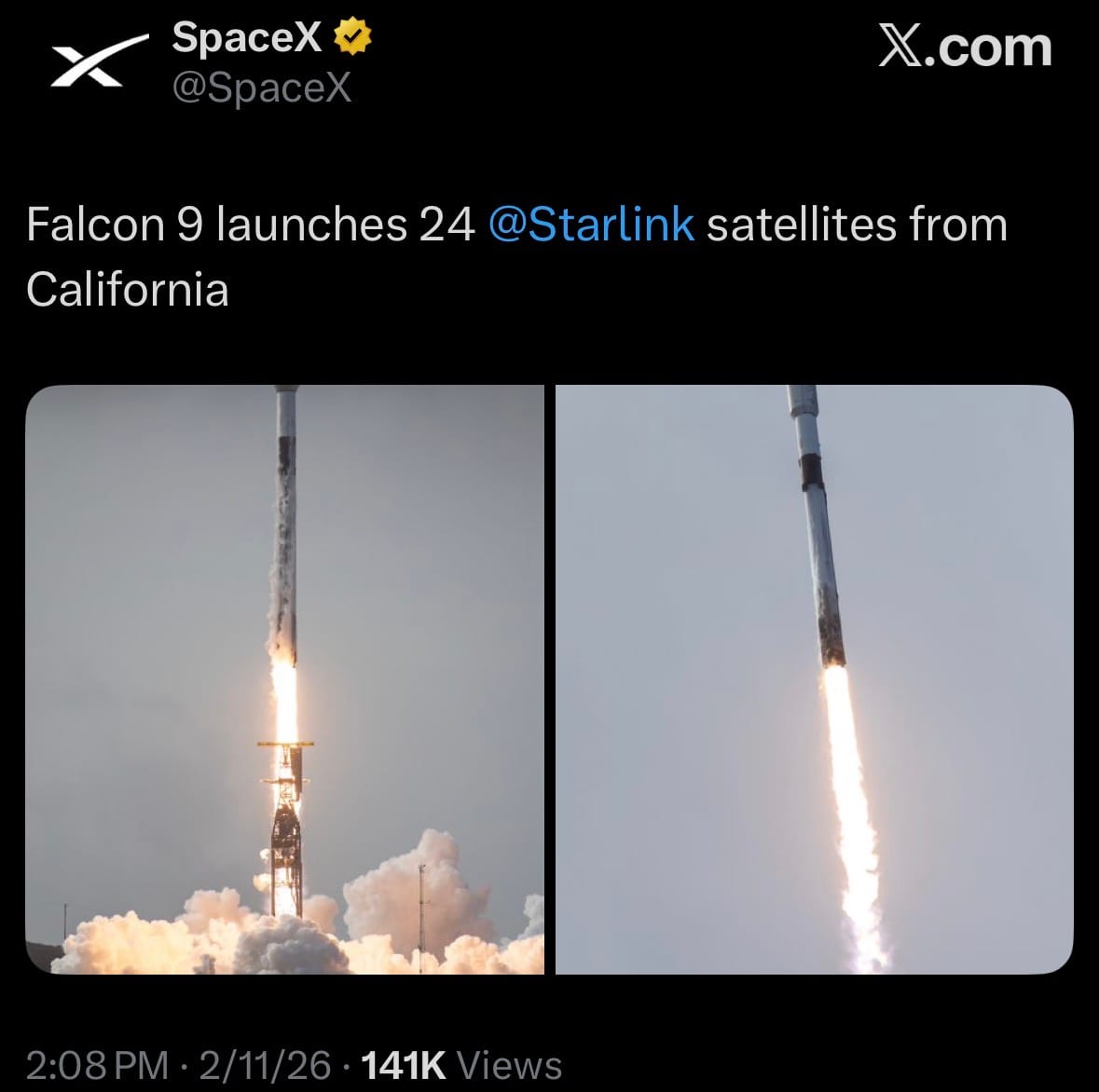
- The mission used Falcon 9 first stage booster B1100 on its third flight (previously used for NROL-105 and another Starlink mission). Following separation, the booster landed successfully on the droneship "Of Course I Still Love You" in the Pacific Ocean. The second stage performed its burns nominally, with satellite deployment confirmed about 63 minutes after launch. This was SpaceX's 12th Starlink mission of 2026 and another routine addition to the network aimed at providing high-speed internet coverage worldwide.
Statistic:
- Largest public tech companies on Earth by market capitalization:
- 🇺🇸 NVIDIA: $4.626T
- 🇺🇸 Apple: $4.049T
- 🇺🇸 Alphabet (Google): $3.765T
- 🇺🇸 Microsoft: $3.005T
- 🇺🇸 Amazon: $2.192T
- 🇹🇼 TSMC: $1.940T
- 🇺🇸 Meta Platforms: $1.691T
- 🇺🇸 Broadcom: $1.625T
- 🇺🇸 Tesla: $1.608T
- 🇰🇷 Samsung: $824.27B
- 🇨🇳 Tencent: $626.97B
- 🇳🇱 ASML: $557.23B
- 🇺🇸 Micron Technology: $461.84B
- 🇺🇸 Oracle: $451.69B
- 🇰🇷 SK Hynix: $424.65B
- 🇨🇳 Alibaba: $392.28B
- 🇺🇸 AMD: $348.22B
- 🇺🇸 Cisco: $337.97B
- 🇺🇸 Netflix: $337.78B
- 🇺🇸 Palantir: $323.38B
- 🇺🇸 Lam Research: $295.31B
- 🇺🇸 Applied Materials: $269.77B
- 🇺🇸 IBM: $255.00B
- 🇺🇸 Intel: $241.21B
- 🇩🇪 SAP: $236.45B
History:
- Sound has been used as a weapon in human conflict for thousands of years, mostly through its psychological impact rather than its physical force. Ancient armies used war drums, horns, and coordinated shouting to intimidate enemies, maintain cohesion, and overwhelm morale. In more modern conflicts, sound became part of organized psychological warfare: during World War II, loudspeakers were used for propaganda and disruption, and in the Vietnam War, amplified broadcasts were sometimes deployed to unsettle opposing forces. These early uses were not “sound weapons” in the technological sense, but they established a core principle: sound can shape human behavior, fear, and decision-making long before it causes direct physical harm.
- Modern acoustic weapons emerged in the late 20th and early 21st centuries, enabled by advances in electronics, amplification, and directional audio technology. The most widely known and publicly deployed example is the Long Range Acoustic Device (LRAD), developed in the early 2000s for maritime security and communication. LRAD systems can project focused beams of sound over long distances, allowing ships or security forces to issue warnings or produce intense deterrent tones. At close range, these tones can cause pain, disorientation, and potential hearing damage, which is why LRADs are often categorized as “less-lethal” rather than harmless. These systems have been used in anti-piracy defense, facility protection, and crowd-control situations, though their deployment has been controversial due to health concerns and questions about appropriate use. Other experimental approaches have explored infrasonic and ultrasonic effects, but many of the more extreme claims about these frequencies remain unproven or limited in practical deployment.
- In recent years, sound-based and directed-energy systems have also become associated with broader public speculation, especially when unexplained incidents occur. Reports such as the so-called “Havana Syndrome” have raised debates about whether some symptoms could be linked to acoustic or microwave-based mechanisms, though no definitive consensus has been reached publicly. Claims about covert “sonic weapons” being used in specific political or military events—such as rumors surrounding recent U.S. operations in Venezuela remain unverified. Overall, the clearest reality is that acoustic weapons like LRAD exist and are in operational use, while more advanced or clandestine systems remain uncertain in both capability and deployment. Sound weapons reflect a wider trend in modern conflict: the growth of non-kinetic tools designed to influence behavior, disrupt coordination, and apply pressure without traditional gunfire, raising serious ethical and regulatory challenges as technology evolves.
Image of the day:

Thanks for reading! Earth is complicated, we make it simple.
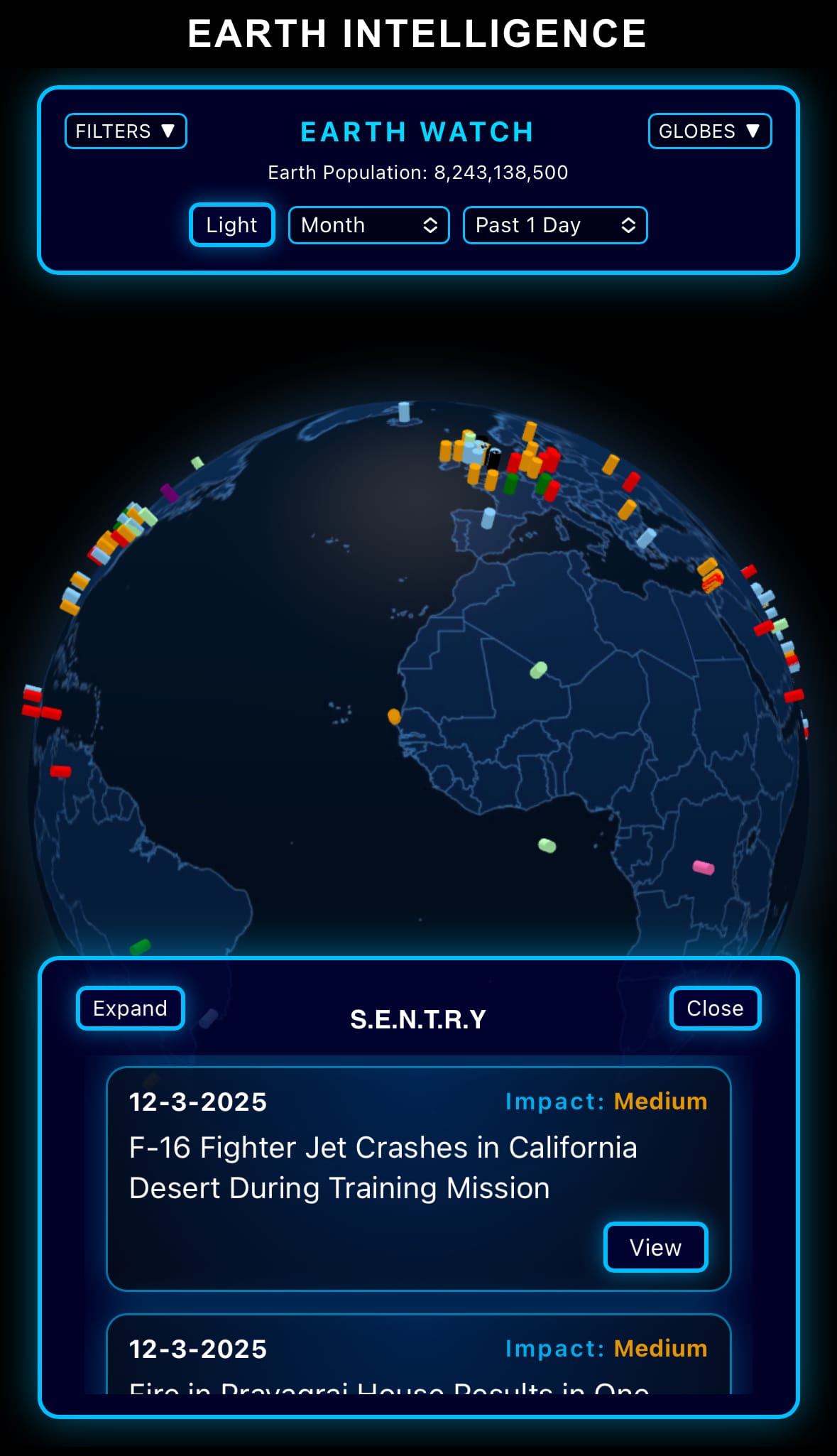
- Click below if you’d like to view our free EARTH WATCH globe:
- Download our mobile app:



Click below to view our previous newsletters:
Support/Suggestions Email:
earthintelligence@earthintel.news