Thursday☕️


Trending:
- On February 25, 2026, Cuban border guard forces opened fire on a Florida-registered speedboat (FL7726SH) after it entered Cuban territorial waters near Cayo Falcones, Villa Clara province, about one nautical mile from the El Pino channel. According to Cuba’s Ministry of the Interior, a patrol boat approached to identify the vessel, the speedboat’s crew fired first and wounded the patrol commander, and Cuban forces returned fire, killing four people and injuring six on board.

- The wounded were evacuated and treated in Cuba; no Cuban deaths were reported beyond the commander’s injury. The Cuban government called it a defense of sovereignty, while a New York Times report, citing a U.S. official, said the boat belonged to an unescorted flotilla of Cuban exiles attempting to extract relatives from the island; investigations are ongoing on both sides.
Economics & Markets:
- Yesterday’s U.S. stock market:

- Yesterday’s commodity market:

- Yesterday’s crypto market:

Geopolitics & Military Activity:

Science & Technology:
- On February 25, 2026, Perplexity AI introduced Perplexity Computer, a new unified AI system that combines multiple AI capabilities into a single platform. It acts as a general-purpose digital worker capable of handling entire projects end-to-end, including researching topics, designing solutions, writing code, deploying applications, and managing ongoing tasks or operations.

- Perplexity Computer orchestrates work across 19 specialized AI models running in parallel, with persistent memory, file system access, browser/web tools, command-line capabilities, and hundreds of connectors to break down complex instructions into steps, delegate subtasks, and execute workflows that can run for hours, days, or even months with minimal human input. It is currently available on the web to Perplexity Max subscribers (with usage-based credits: 10,000 monthly plus a one-time 20,000 bonus expiring after 30 days), and is expected to roll out soon to Enterprise Max users, with broader access to Pro plans planned after initial testing.
Space:
- On February 25, 2026, SpaceX successfully launched a Falcon 9 rocket carrying 25 Starlink satellites to low-Earth orbit from Space Launch Complex 4 East (SLC-4E) at Vandenberg Space Force Base in California at 6:17 a.m. PT (1417 UTC).
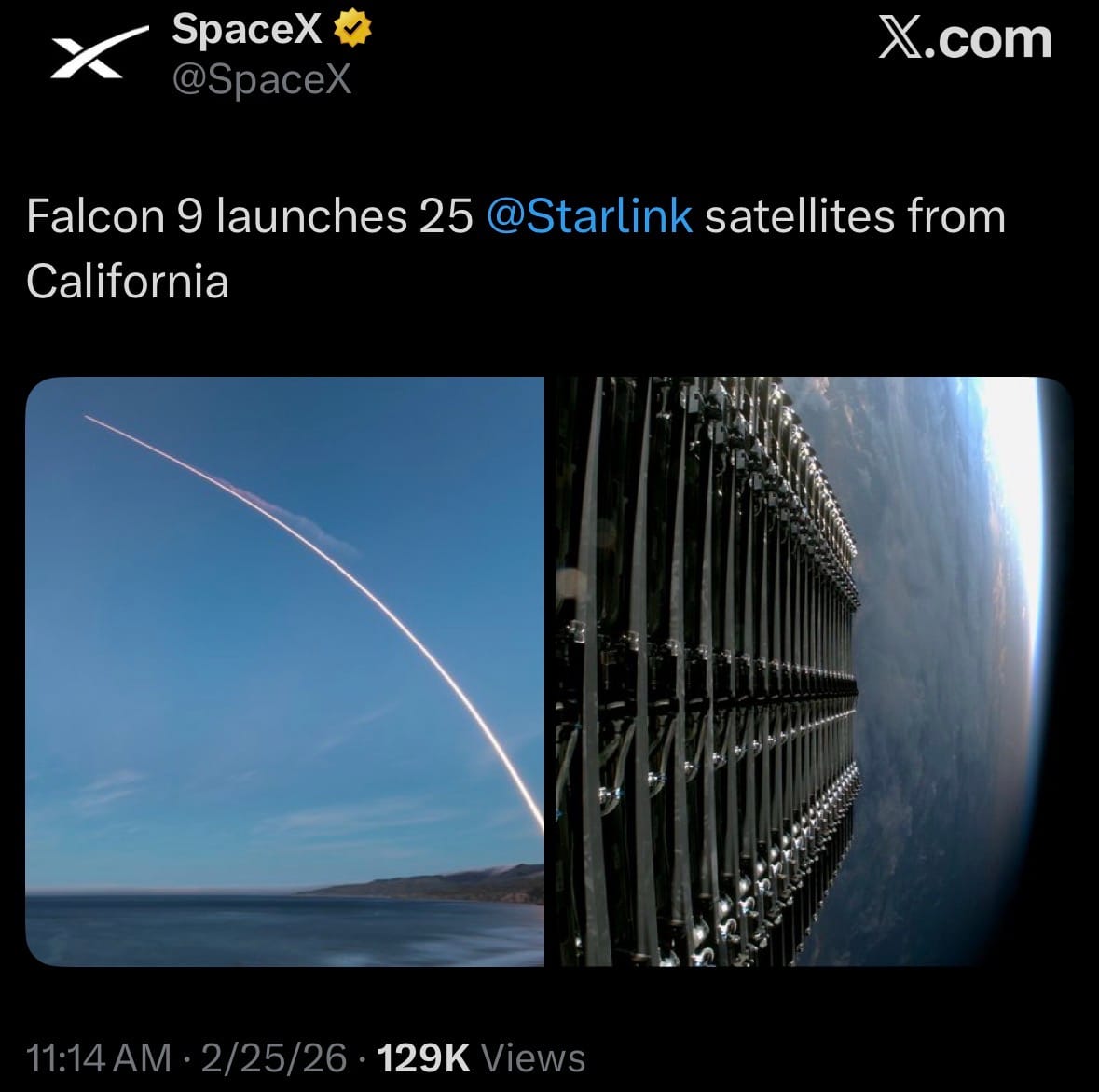
- The mission, designated Starlink Group 17-26, deployed 25 v2 Mini satellites into a Sun-synchronous orbit, with the first-stage booster (B1093 on its 11th flight) landing successfully on the droneship "Of Course I Still Love You" in the Pacific Ocean.
Statistic:
- Largest public companies on Earth by market capitalization:
- 🇺🇸 NVIDIA: $4.761T
- 🇺🇸 Apple: $4.030T
- 🇺🇸 Alphabet (Google): $3.786T
- 🇺🇸 Microsoft: $2.977T
- 🇺🇸 Amazon: $2.261T
- 🇹🇼 TSMC: $2.010T
- 🇸🇦 Saudi Aramco: $1.659T
- 🇺🇸 Meta Platforms: $1.653T
- 🇺🇸 Broadcom: $1.575T
- 🇺🇸 Tesla: $1.566T
- 🇺🇸 Berkshire Hathaway: $1.065T
- 🇺🇸 Walmart: $1.002T
- 🇰🇷 Samsung: $983.35B
- 🇺🇸 Eli Lilly: $970.55B
- 🇺🇸 JPMorgan Chase: $818.00B
- 🇺🇸 Exxon Mobil: $628.61B
- 🇺🇸 Visa: $603.45B
- 🇨🇳 Tencent: $603.42B
- 🇳🇱 ASML: $592.51B
- 🇺🇸 Johnson & Johnson: $590.83B
- 🇰🇷 SK Hynix: $502.42B
- 🇺🇸 Micron Technology: $482.84B
- 🇺🇸 Mastercard: $454.59B
- 🇺🇸 Costco: $441.63B
- 🇺🇸 Oracle: $425.04B
History:
- The military-industrial complex began the moment warfare became industrial. In ancient and medieval periods, states relied on royal armories, shipyards, and private craftsmen to supply swords, cannon, ships, and powder. Venice’s Arsenal in the 12th–16th centuries is often cited as one of the first large-scale military production systems, capable of assembling ships in near-assembly-line fashion. The Industrial Revolution changed everything. Steelmaking, rail transport, precision machining, and explosives chemistry turned weapons production into a specialized sector. By the early 20th century, private firms were designing artillery, aircraft, engines, and naval systems under government contract. World War I industrialized artillery and armored vehicles; World War II transformed entire national economies into war factories. In the United States, companies that would later become giants—Boeing (aircraft), Lockheed (aircraft), North American Aviation, General Dynamics (land and naval systems), and others—scaled production to unprecedented levels. Germany mobilized firms like Krupp and Messerschmitt; the Soviet Union built centralized design bureaus; the United Kingdom leaned on firms like Vickers and Rolls-Royce. War proved that industrial capacity was as decisive as battlefield tactics.
- After 1945, the Cold War locked this state-industry partnership into a permanent structure. Advanced jet aircraft, intercontinental ballistic missiles, nuclear submarines, early warning radar, and space systems required continuous research, long development cycles, and massive capital. In the United States, consolidation through the 1980s and 1990s produced a handful of dominant “prime contractors”: Lockheed Martin (formed in 1995), Boeing Defense, Northrop Grumman, Raytheon (now RTX), and General Dynamics. These firms became system integrators capable of delivering entire aircraft, missile defense networks, satellites, and naval vessels. Europe developed its own champions: BAE Systems in the U.K.; Airbus and related European aerospace programs; Dassault in France; Rheinmetall and Krauss-Maffei Wegmann in Germany; Leonardo in Italy. Russia retained large state-controlled defense conglomerates drawing from Soviet industrial structures. China built an extensive, state-directed defense manufacturing base spanning shipbuilding, aerospace, missile systems, and electronics, tightly integrated with national strategy. Israel developed a highly agile defense sector, including Israel Aerospace Industries, Rafael, and Elbit Systems, known for rapid innovation in drones, missile defense, and electronic warfare.
- In the 21st century, the military-industrial complex has evolved again. Traditional primes still dominate high-end platforms—stealth aircraft, aircraft carriers, ballistic missile submarines, long-range missiles—but a new ecosystem of technology-driven defense firms has emerged. Companies focused on autonomy, artificial intelligence, sensor fusion, and unmanned systems are increasingly integrated into national defense procurement. Firms like Anduril and Palantir represent a shift toward software-centric defense capability, while established primes are investing heavily in AI, cyber defense, and advanced manufacturing. Today’s defense industrial base is layered: governments fund research and set strategic direction; prime contractors integrate large systems; thousands of subcontractors supply specialized components; and technology startups push rapid iteration in drones, autonomy, and data systems. Across the United States, China, Russia, Europe, and Israel, the military-industrial complex remains a central pillar of national power—an industrial engine that converts research, capital, and raw materials into deterrence, projection capability, and technological advantage.
Image of the day:

Thanks for reading! Earth is complicated, we make it simple.
- Click below if you’d like to view our free EARTH WATCH globe:

- Download our mobile app:



Click below to view our previous newsletters:

Support/Suggestions Email:
earthintelligence@earthintel.news