Thursday☕️


Economics & Markets:
- Foreign investors sold Asian equities for a fourth consecutive month in February, with record net foreign outflows of $13.67 billion from South Korea, according to LSEG data covering exchanges in South Korea, Taiwan, Thailand, India, Indonesia, Vietnam and the Philippines. Overall, foreign selling erased roughly $5.36 billion from regional equities.
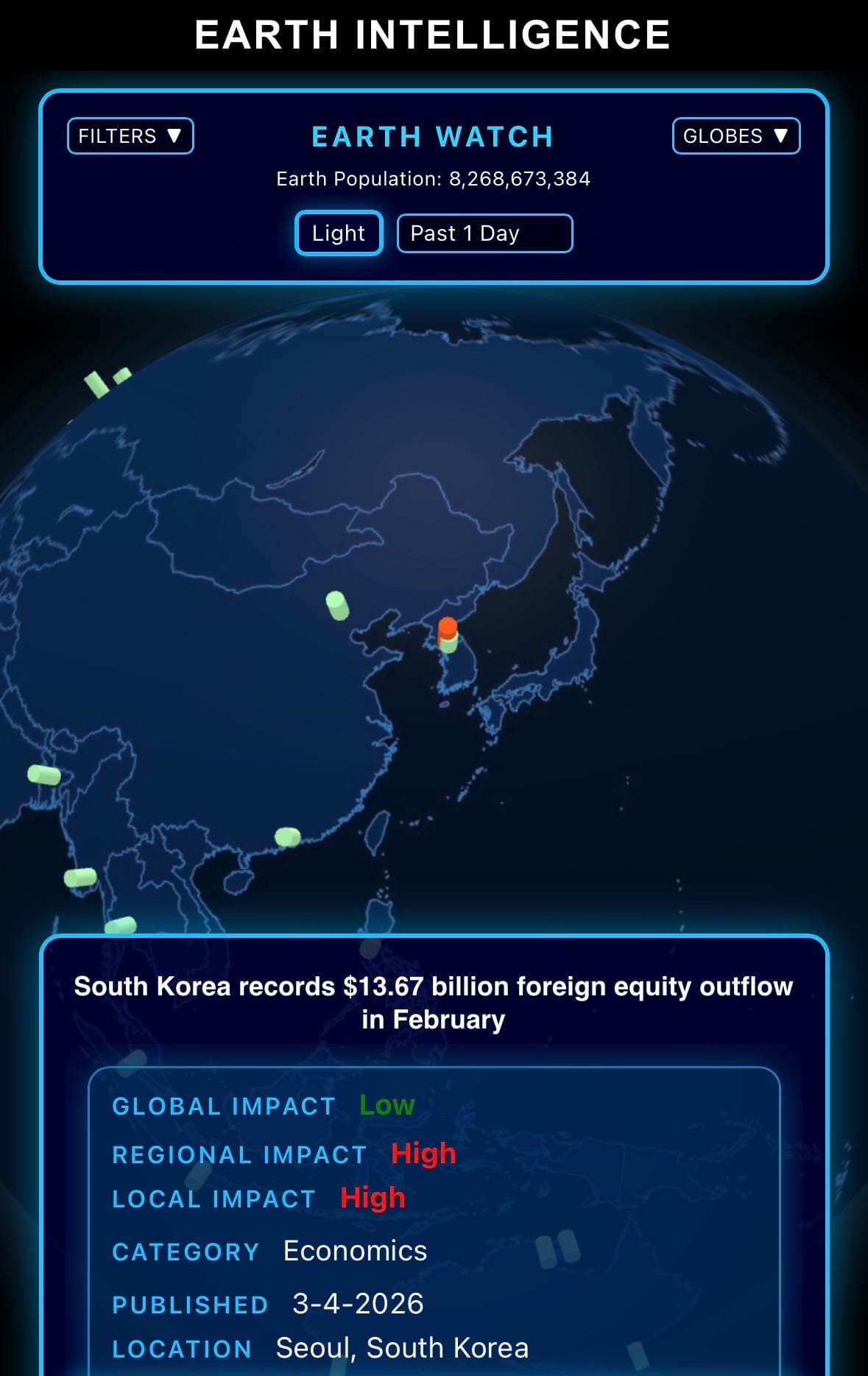
- Vietnam saw $301 million of outflows (its largest monthly outflow since October 2025), while Taiwan, India, Thailand, Indonesia and the Philippines recorded inflows of $4.04 billion, $2.5 billion, $1.75 billion, $192 million and $144 million, respectively.
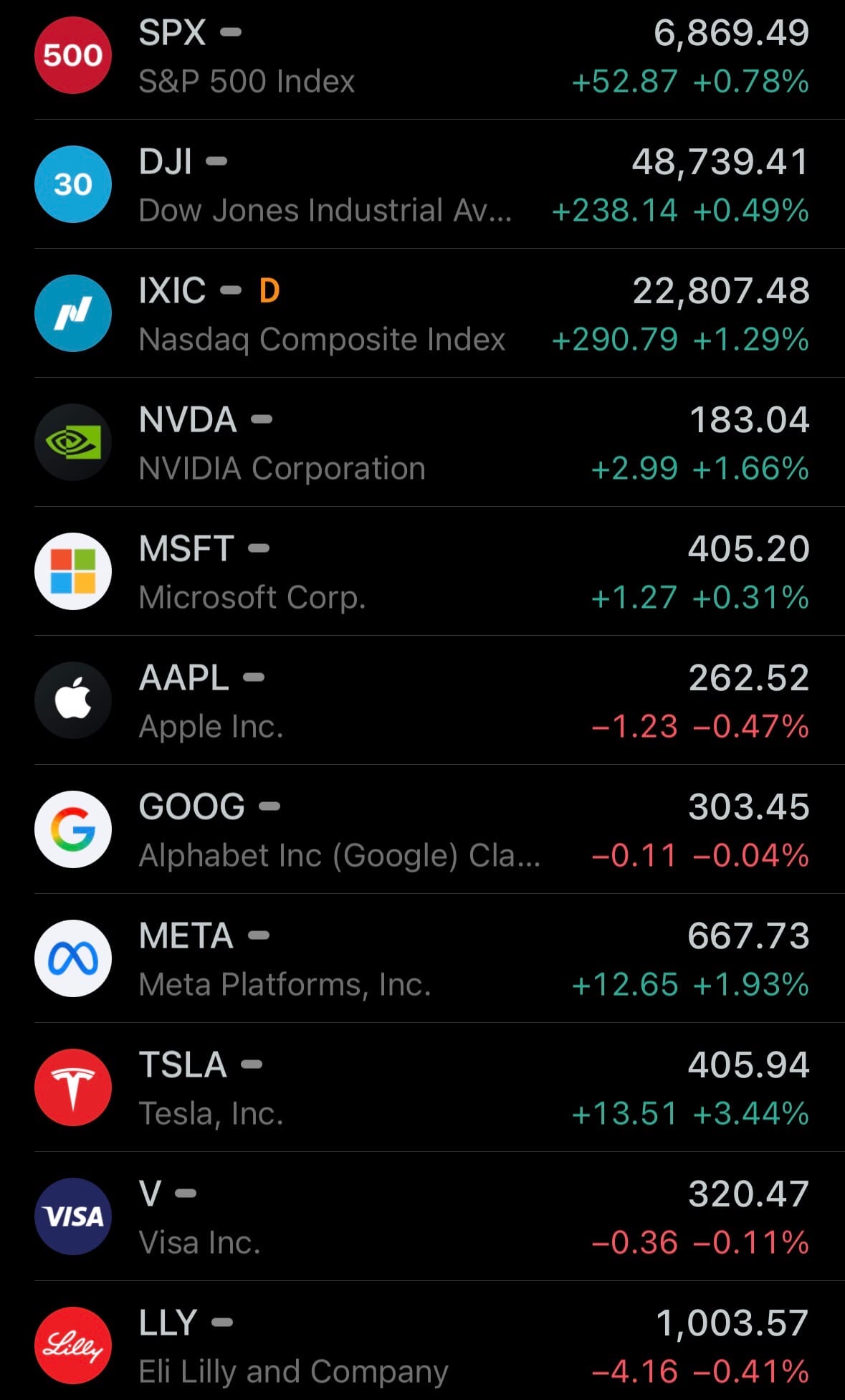
- Yesterday’s U.S. stock market:
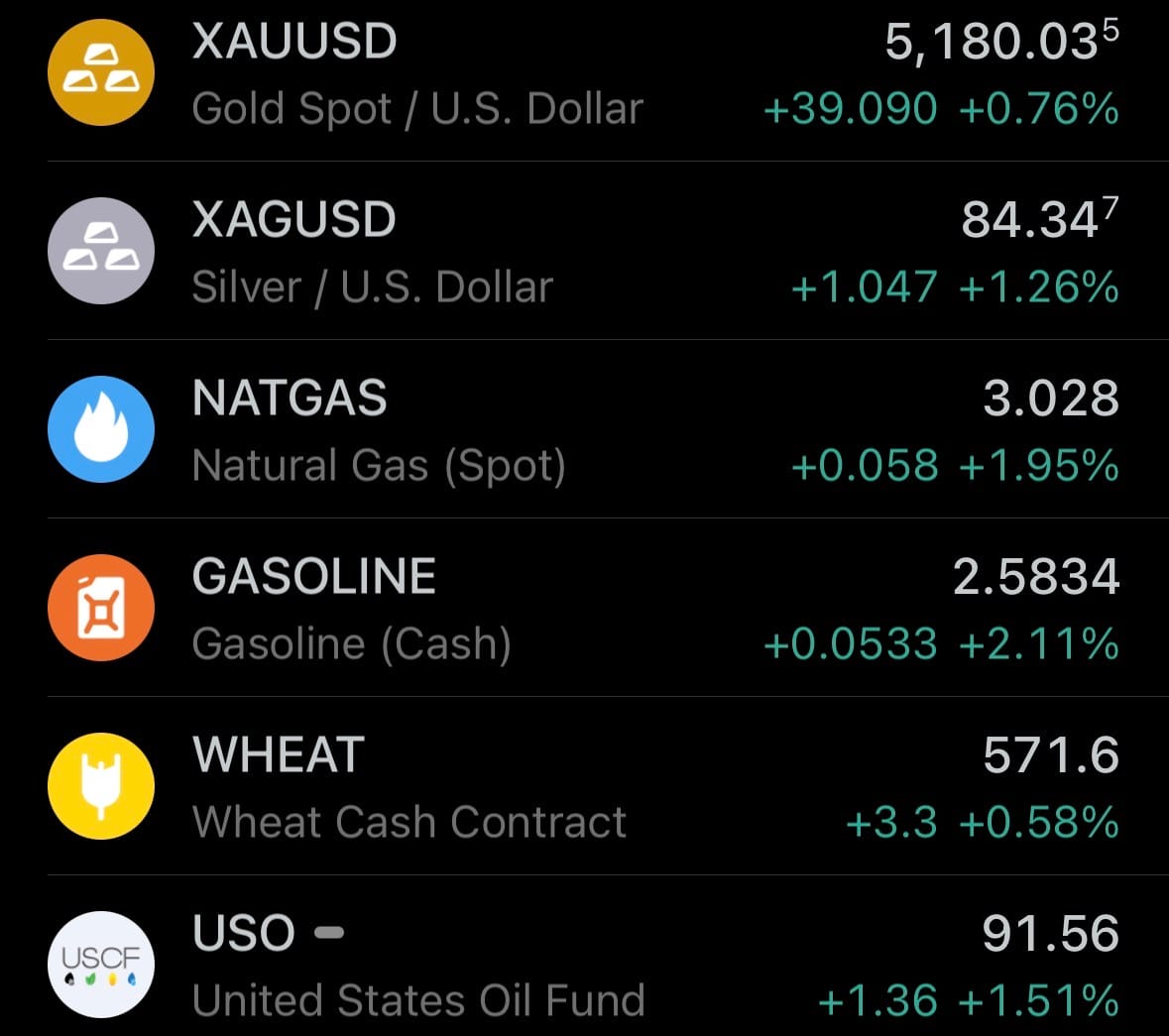
- Yesterday’s commodity market:
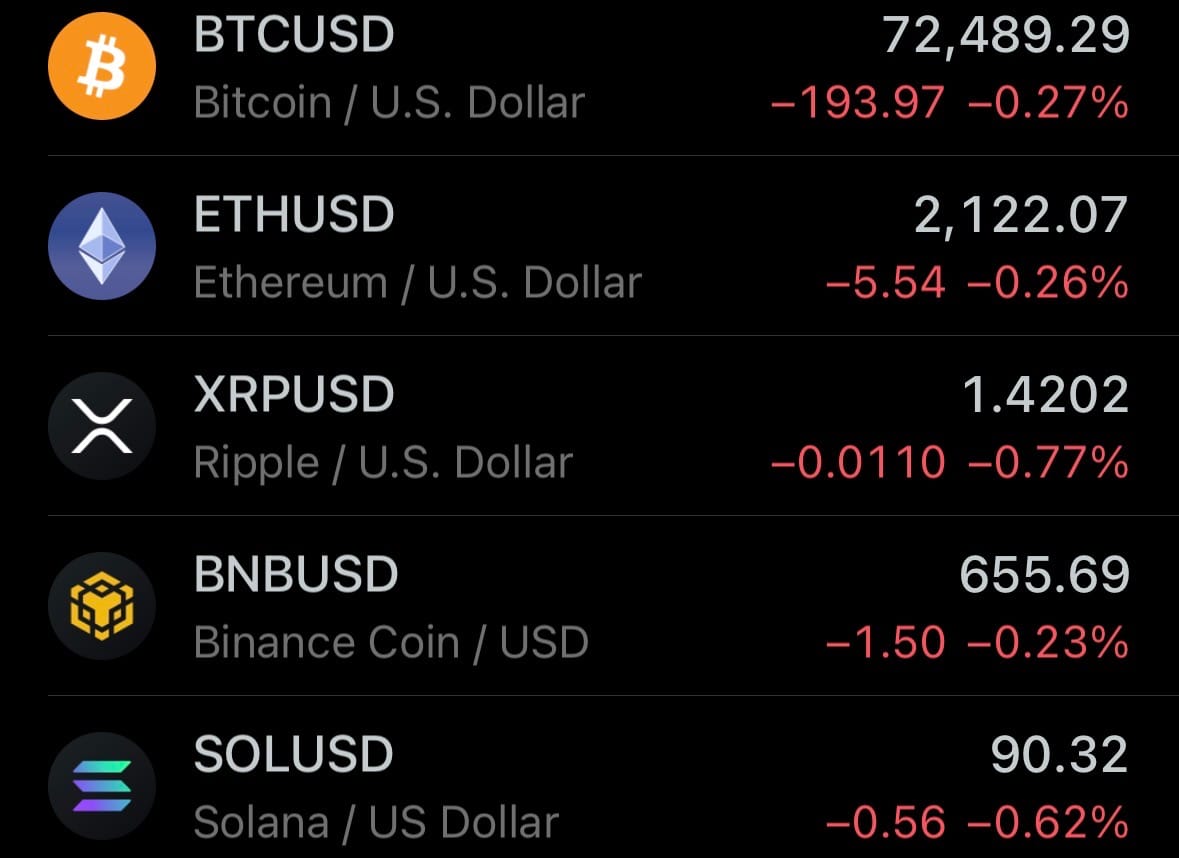
- Yesterday’s crypto market:
Geopolitics & Military Activity:
- As of March 5, 2026, the Middle East conflict has erupted into open war between the United States, Israel, and Iran, now entering its fifth day. U.S. and Israeli strikes since late February killed Iran's Supreme Leader Ayatollah Ali Khamenei and destroyed key nuclear, missile, and military facilities. Under Operation Epic Fury, the U.S. Navy has sunk over 20 Iranian warships—including the frigate IRIS Dena torpedoed by a submarine in the Indian Ocean—marking the first U.S. torpedo sinking of an enemy vessel since World War II.
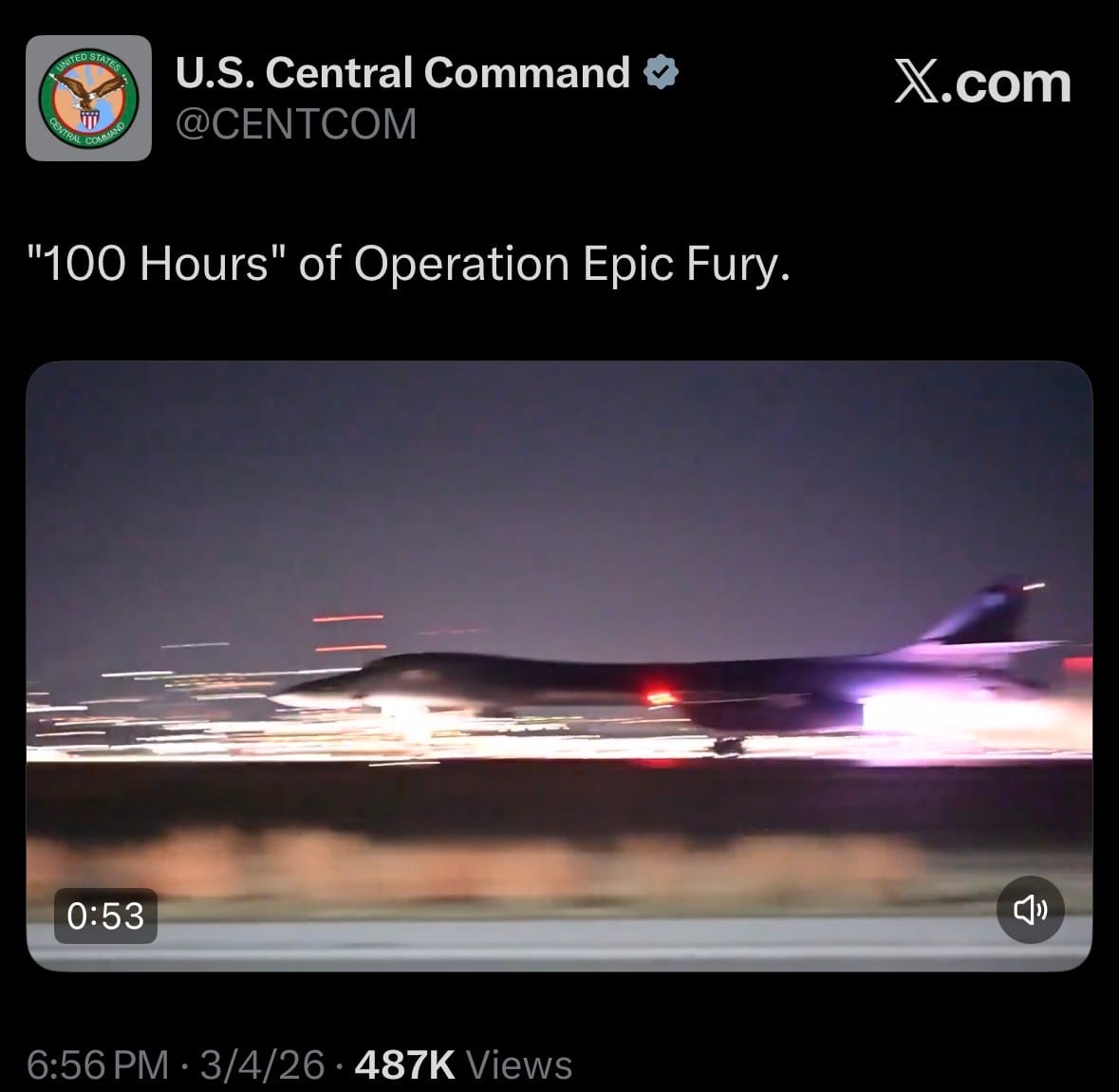
- Iran has retaliated with massive missile and drone barrages targeting Israel, U.S. bases across the region, and energy infrastructure in Saudi Arabia and Qatar, causing hundreds of deaths, surging oil prices, and widespread airspace closures with no ceasefire in sight.
Environment & Weather:
Science & Technology:
- On March 4, 2026, Apple unveiled the all-new MacBook Neo, an affordable entry-level laptop designed to bring the Mac experience to more people worldwide. It features a durable aluminum design in four vibrant colors (blush, indigo, silver, and citrus), a 13-inch Liquid Retina display, up to 16 hours of battery life, and the A18 Pro chip (from the iPhone 16 Pro series) for solid everyday performance, Apple Intelligence support, and seamless iPhone integration.
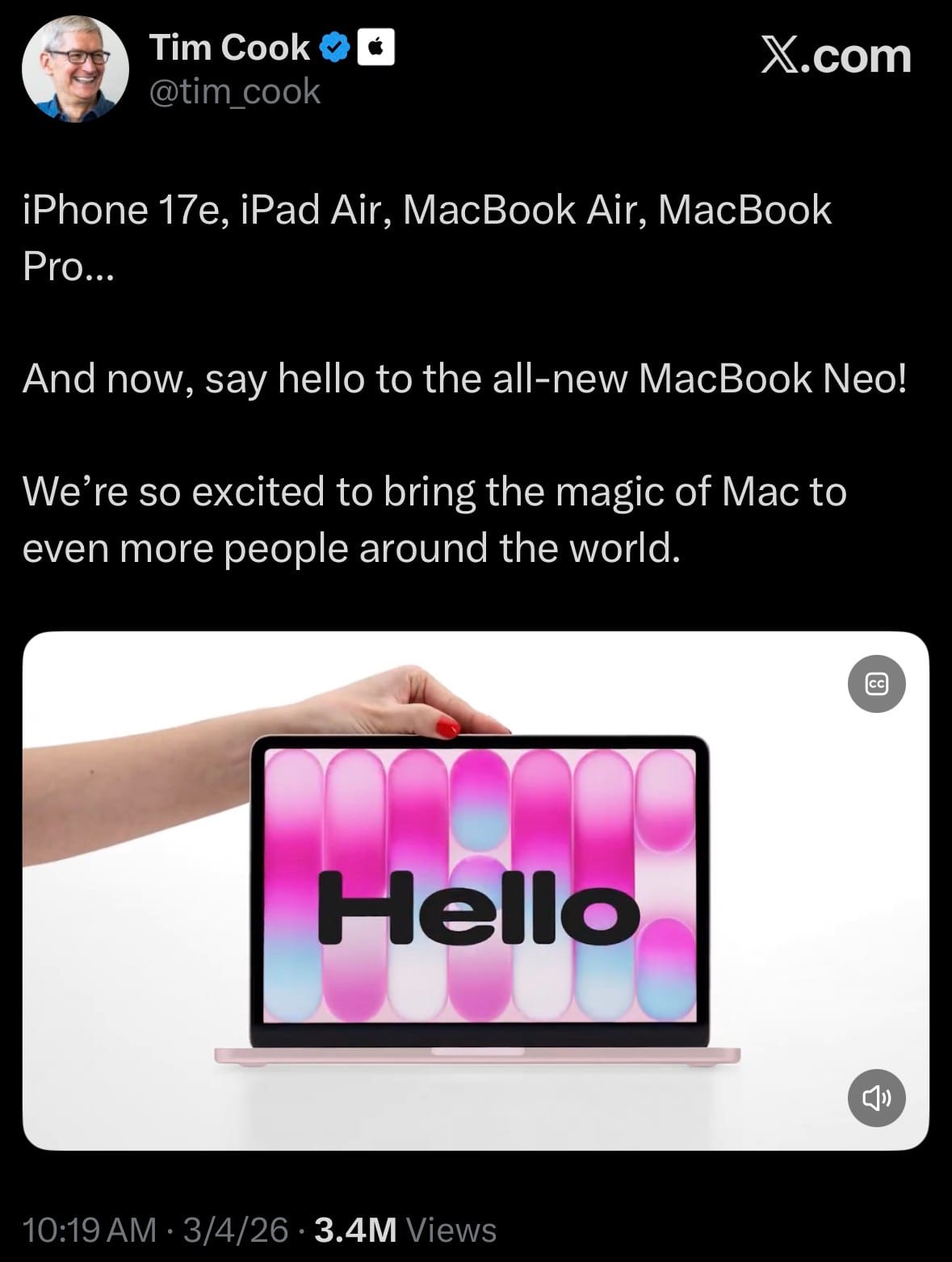
- Starting at $599 (or $499 for education buyers), it's Apple's most budget-friendly Mac ever, with a base model offering 256GB storage and 8GB RAM (no Touch ID), while a $699 version adds Touch ID and 512GB storage. Pre-orders begin today, with availability starting March 11, 2026.
Perplexity Voice:
- On March 4, 2026, Perplexity introduced Voice Mode for its Perplexity Computer feature, enabling users to interact hands-free with the advanced AI agent system. This update allows people to simply speak their requests and commands, letting the AI handle complex workflows through natural conversation instead of typed inputs.

- The new capability builds on Perplexity Computer's multi-model orchestration, where the system can now execute tasks, research, or manage projects while users talk freely. Features like an Extended Speaking option prevent interruptions, giving the AI time to listen fully before responding or acting. This enhancement makes Perplexity Computer feel more intuitive and JARVIS-like, bridging voice interaction with powerful agentic AI for seamless productivity.
Statistic:
- Largest European Union companies by market capitalization:
- 🇳🇱 ASML: $549.47B
- 🇫🇷 LVMH: $293.11B
- 🇫🇷 Hermès: $235.51B
- 🇫🇷 L’Oréal: $232.56B
- 🇩🇪 SAP: $228.20B
- 🇳🇱 Prosus: $212.77B
- 🇩🇪 Siemens: $212.32B
- 🇪🇸 Inditex: $193.19B
- 🇩🇪 Deutsche Telekom: $191.24B
- 🇪🇸 Santander: $171.52B
- 🇩🇰 Novo Nordisk: $171.12B
- 🇫🇷 Schneider Electric: $168.87B
- 🇫🇷 TotalEnergies: $163.37B
- 🇳🇱 Airbus: $162.79B
- 🇩🇪 Siemens Energy: $162.23B
- 🇩🇪 Allianz SE: $161.11B
- 🇫🇷 Safran: $158.53B
- 🇪🇸 Iberdrola: $152.32B
- 🇧🇪 Anheuser-Busch InBev: $147.17B
- 🇮🇪 Eaton: $137.99B
- 🇮🇪 Accenture: $130.22B
- 🇪🇸 BBVA: $126.26B
- 🇮🇪 Medtronic: $122.73B
- 🇸🇪 Investor AB: $121.97B
- 🇮🇹 UniCredit: $119.97B
History:
- Undersea cable networks began with the realization that information could travel across oceans faster than ships could carry messages. The first major milestone came in the mid-19th century with the invention of the electric telegraph. Entrepreneurs and engineers quickly began experimenting with laying insulated telegraph wires across the seafloor. One of the most ambitious projects was led by American financier Cyrus West Field, who helped organize the effort to lay the first transatlantic cable between North America and Europe. In August 1858, the first cable briefly connected Ireland to Newfoundland, allowing a famous exchange of messages between Queen Victoria and U.S. President James Buchanan. However, the cable failed after only a few weeks due to technical limitations and excessive voltage used to push signals through the line. The true breakthrough came in 1866, when the enormous steamship SS Great Eastern successfully laid a stronger cable from Valentia Island, Ireland, to Heart’s Content, Newfoundland, creating the first reliable transatlantic communication link. Messages that once took weeks by ship could now be transmitted in minutes. Over the next several decades, telegraph cables expanded rapidly across the world, linking Europe to Asia, Africa, and the Americas. These early cables formed the first global communication network and became essential for diplomacy, financial markets, military coordination, and global trade.
- The next major evolution came in the 20th century as communication shifted from telegraph signals to voice transmission. Engineers developed coaxial cable technology capable of carrying telephone calls across oceans. A major milestone was the TAT-1 cable in 1956, the first transatlantic telephone cable connecting Scotland and Newfoundland. It could initially carry dozens of simultaneous voice calls, which was revolutionary at the time. However, the most important transformation occurred with the invention of fiber-optic communication. In the 1960s, researchers demonstrated that light could travel through glass fibers with very little signal loss. This eventually led to the deployment of the first transatlantic fiber-optic cable, TAT-8 in 1988, built by a consortium including AT&T, British Telecom, and France Télécom. Fiber optics allowed enormous amounts of data to travel through cables as pulses of light. Through the 1990s and 2000s, improvements such as optical amplifiers and wavelength-division multiplexing dramatically increased capacity, allowing multiple streams of data to travel through the same fiber. Undersea cables became the primary infrastructure for global digital communication, supporting the growth of the internet, financial trading networks, cloud computing, and global telecommunications.
- Today, undersea cables form the physical backbone of the global internet, carrying the vast majority of international data traffic between continents. Modern cables consist of bundles of fiber-optic strands protected by layers of insulation, steel reinforcement, and waterproof shielding. Signals are amplified periodically by repeaters placed along the cable on the ocean floor. The world currently operates hundreds of submarine cable systems spanning roughly 1.7 million kilometers across the seabed. Major technology companies such as Google, Meta, Microsoft, and Amazon increasingly invest directly in these cables to control bandwidth, reliability, and latency for their global cloud infrastructure. Some of the largest cable systems ever built illustrate the scale of modern infrastructure. The 2Africa cable, completed in the 2020s, stretches approximately 45,000 kilometers around the African continent and is designed to deliver extremely high data capacity between dozens of countries. Another major example is MAREA, a high-capacity transatlantic cable linking the United States and Spain that significantly increased bandwidth between North America and Europe. Because these cables concentrate global data traffic along specific routes, they have become strategic infrastructure. Key chokepoints include areas like the English Channel, the Mediterranean routes near Egypt, and Southeast Asian maritime corridors, where multiple cables converge. Most cable damage historically comes from accidents such as fishing equipment or ship anchors, but concerns have grown about the vulnerability of these networks to sabotage or geopolitical conflict. Despite satellites and wireless communications, the modern digital world still depends overwhelmingly on thin strands of glass laid across the ocean floor, making undersea cable networks one of the most critical—and often overlooked—pieces of infrastructure supporting global connectivity.
Image of the day:

Thanks for reading! Earth is complicated, we make it simple.
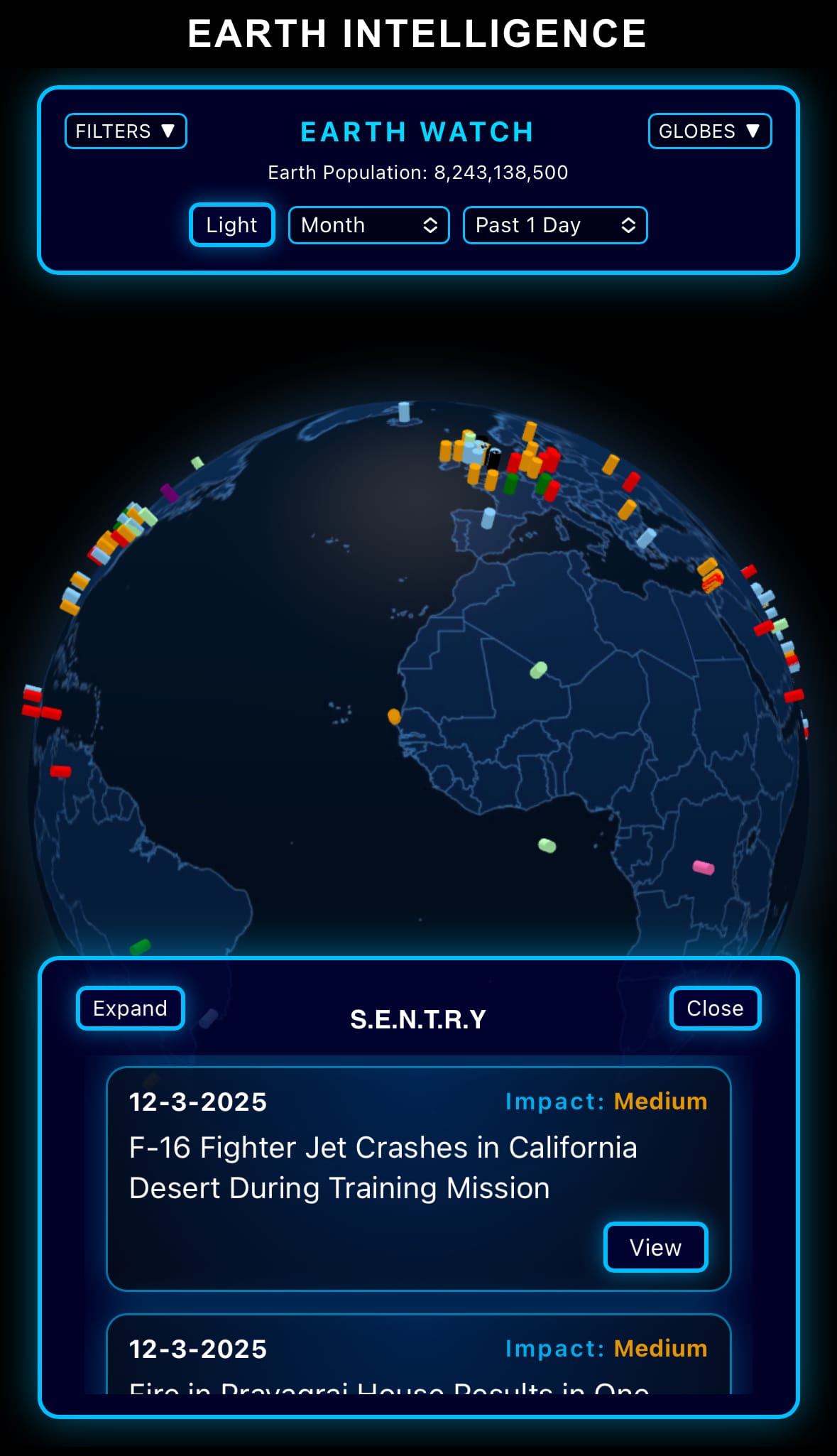
- Click below if you’d like to view our free EARTH WATCH globe:
- Download our mobile app:



Click below to view our previous newsletters:

Support/Suggestions Email:
support@earthintel.io