Tuesday☕️


Trending:
- On September 8, 2025, Nepal's government lifted a social media ban imposed on September 4, after violent protests caused at least 19 deaths and over 100 injuries. The ban affected over two dozen platforms, including Facebook, X, and YouTube, for failing to register with the Ministry of Communication and Information Technology, with officials aiming to address misinformation, hate speech, and regulatory compliance. Protests escalated on September 8 in Kathmandu and other areas, led by younger demonstrators near Parliament, resulting in clashes with police using tear gas, batons, and rubber bullets, followed by army deployment and curfews in several districts. Prime Minister KP Sharma Oli expressed regret, attributing the violence to misunderstandings, and announced financial aid for victims' families plus a 15-day investigative committee, while Home Minister Ramesh Lekhak resigned over the security handling.

- Enacted under a court order, the ban was defended by Communications Minister Prithvi Subba Gurung as necessary for regulating foreign platforms. Protesters argued it limited free speech and information access, expanding demands to include anti-corruption measures, economic reforms, and political changes, with some calling for reinstatement of the monarchy abolished in 2008. Social media is key in Nepal for news, commerce, and activism, and the events underscore ongoing discussions about governance, youth engagement, and economic-political challenges. This incident reflects a broader global trend of governments curbing social media to control information, while platforms' algorithms create filter bubbles that reinforce specific narratives.
Economics & Markets:
- Yesterday’s U.S. stock market:

- Today’s commodity market:

- Today’s crypto market:

Environment & Weather:


Space:
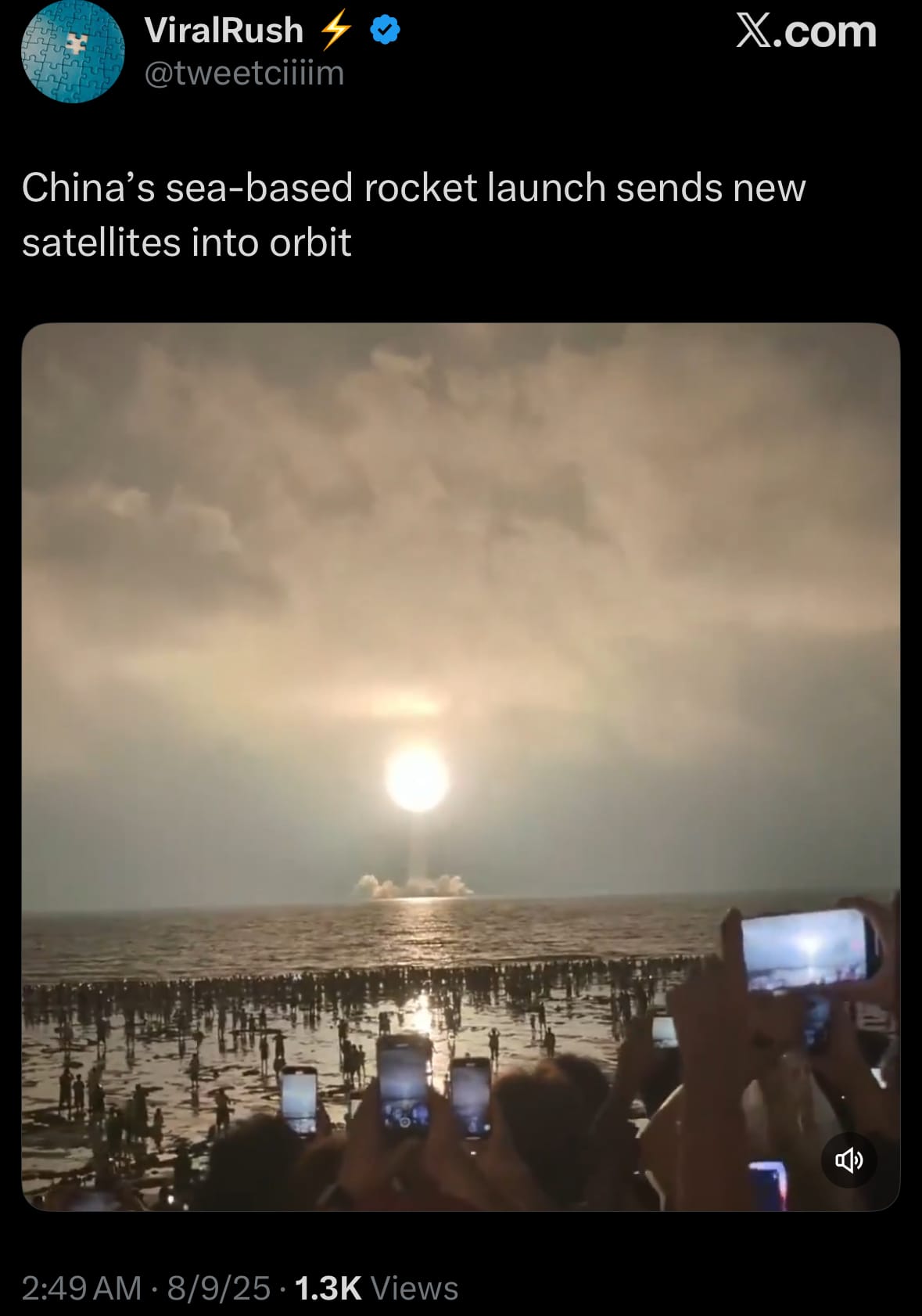
- On September 9, 2025, China successfully launched 11 satellites as part of the Geely Constellation Group 05 using a Smart Dragon-3 rocket from waters off east China's Shandong Province. The satellites entered their planned low-Earth orbits, representing the fifth batch in the Geely Future Mobility Constellation and bringing the total number of operational satellites to 52. These low-Earth orbit communications satellites are intended to support autonomous driving technologies, global IoT connectivity, high-precision navigation, and remote sensing applications, aiming to improve smart mobility solutions for vehicles and related sectors.
- The Geely Constellation, officially known as the Geely Future Mobility Constellation, is a satellite network project developed by Geespace, a subsidiary of Zhejiang Geely Holding Group, a major Chinese automotive and technology company founded in 1986 that owns brands such as Volvo, Lotus, and Lynk & Co.
- On September 9, 2025, China successfully launched the Yaogan-45 remote sensing satellite from the Wenchang Spacecraft Launch Site in Hainan Province using a modified Long March-7 carrier rocket. The satellite entered its preset orbit as planned, marking the 594th flight mission of the Long March carrier rocket series. Officially, Yaogan-45 is designed for applications including scientific experiments, land resource surveys, crop yield estimates, and disaster prevention and relief efforts.
- The Yaogan series consists of Chinese military reconnaissance satellites operated by the People's Liberation Army's Strategic Support Force, with the program beginning in 2006 and encompassing over 149 successful launches as of recent records. These satellites employ various technologies such as synthetic-aperture radar for all-weather imaging, electro-optical sensors for high-resolution visuals, and electronic intelligence systems for maritime surveillance and signal detection. While officially described for civilian remote sensing purposes, they are widely speculated to support military operations including targeting naval forces, terrain mapping, and monitoring adversarial activities in regions like the Taiwan Strait.
Science & Technology:
- On September 8, 2025, Anduril Industries was awarded a $159 million contract by the U.S. Army for the initial prototyping phase of a night vision and mixed reality system as part of the Soldier Borne Mission Command (SBMC) program, formerly known as IVAS Next. This initiative aims to equip soldiers with enhanced perception and decision-making capabilities by integrating advanced technologies such as fused spectral bands for superior night vision, augmented reality overlays for real-time battlefield data, and AI-driven controls for robotic teammates.

- The helmet-mounted system is built on Anduril's Lattice platform, with the SBMC-Architecture serving as its software foundation, and involves collaboration with 14 industry partners including Meta, Qualcomm, Palantir, L3Harris, Maxar, and others to accelerate development and third-party integrations. Anduril Industries is an American defense technology company founded in June 2017 by entrepreneur Palmer Luckey, known for creating Oculus VR, with a focus on building advanced AI, autonomous weapon systems, and hardware solutions for military agencies, national security, and border surveillance.
Statistic:
- Largest public telecommunication companies by market capitalization:
- 🇺🇸 T-Mobile US: $273.36B
- 🇨🇳 China Mobile: $243.06B
- 🇺🇸 AT&T: $206.64B
- 🇺🇸 Verizon: $182.65B
- 🇩🇪 Deutsche Telekom: $175.77B
- 🇯🇵 SoftBank: $148.09B
- 🇮🇳 Bharti Airtel: $128.50B
- 🇺🇸 Comcast: $125.53B
- 🇺🇸 American Tower: $90.67B
- 🇯🇵 NTT (Nippon Telegraph & Telephone): $89.19B
- 🇨🇳 China Telecom: $88.95B
- 🇯🇵 KDDI: $64.61B
- 🇲🇽 America Movil: $59.38B
- 🇸🇬 Singtel: $55.43B
- 🇸🇦 Saudi Telecom Company: $55.34B
- 🇫🇷 Orange: $42.35B
- 🇦🇪 Emirates Telecom (Etisalat Group): $41.91B
- 🇺🇸 Crown Castle: $40.88B
- 🇨🇭 Swisscom: $38.41B
- 🇭🇰 China Unicom: $37.58B
- 🇦🇺 Telstra: $36.34B
- 🇺🇸 Charter Communications: $36.04B
- 🇹🇼 Chunghwa Telecom: $34.28B
- 🇪🇸 Telefónica: $30.21B
- 🇬🇧 Vodafone: $28.45B
History:
- Chess originated in northern India around the 6th century CE in the form of chaturanga, a military strategy game that represented infantry, cavalry, elephants, and chariots. By the 7th century it spread to Persia as shatranj, and following the Islamic conquest of Persia in 651 CE, it moved throughout the Islamic world. By the 9th and 10th centuries, chess reached Europe through Spain and Italy, and by the 12th century it was firmly established across the continent. The medieval game mirrored European social structures, with kings, queens, bishops, knights, and pawns symbolizing different societal roles.
- In the late 15th century, the modern form of chess emerged in southern Europe. New rules gave bishops long-range movement, the queen its powerful reach, and added castling to speed up play. The 19th century brought standardization: the first modern tournament was held in London in 1851, and Wilhelm Steinitz became the first official World Chess Champion in 1886. The 20th century saw the creation of FIDE in 1924, the rise of legendary players like Capablanca, Alekhine, Botvinnik, and Fischer, and iconic Cold War matches such as Fischer versus Spassky in 1972. In 1997, IBM’s Deep Blue defeated Garry Kasparov, marking a turning point in human versus machine competition.
- Today, chess continues to thrive online through platforms like Chess.com and Lichess, with streaming and global tournaments attracting millions of new players. The rise of AI, including advanced engines like Stockfish and AlphaZero, has reshaped how professionals and amateurs alike study the game, keeping chess at the center of both cultural and technological innovation.
Image of the day:

Thanks for reading!
Earth is complicated, we make it simple.
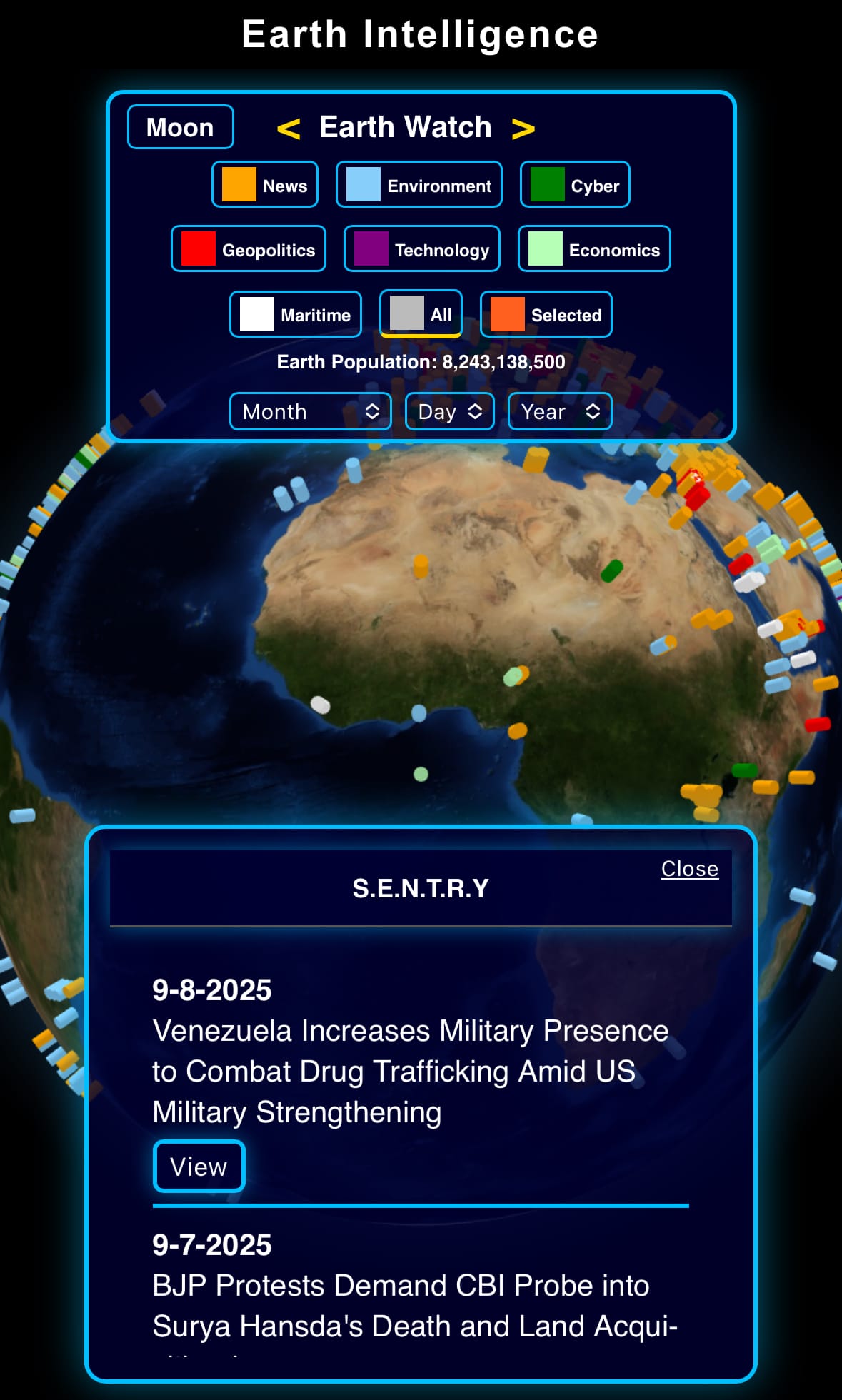
Monitor the planet with the Earth Intelligence System. Click the image below to view the Earth Intelligence System:


Support/Suggestions Email:
earthintelligence@earthintel.news