Tuesday☕️


Trending:
- On November 17, 2025, the United Nations Security Council adopted a U.S.-drafted resolution endorsing President Donald Trump's peace plan for Gaza, marking a significant step toward addressing the ongoing conflict following a fragile truce. The vote, held at the UN headquarters in New York, passed with broad support, authorizing the deployment of an international stabilization force to oversee security, protect civilians, and facilitate humanitarian aid in the region. The plan outlines phases for ceasefire consolidation, reconstruction efforts, and governance reforms, emphasizing the need for cooperation between Israel, Hamas, and other stakeholders to prevent further violence.

- The resolution's implementation now rests on both sides' commitment to key provisions, including the demilitarization of Gaza, the dismantling of terrorist infrastructure, and the withdrawal of Israeli forces in exchange for security guarantees. While the plan aims to foster long-term stability through economic development and border controls, challenges remain in enforcing compliance, with potential for renewed tensions if parties fail to adhere. Analysts note that successful execution could pave the way for broader Middle East peace talks, though it depends on mutual trust-building measures and international oversight to ensure equitable outcomes for all involved.
Economics & Markets:
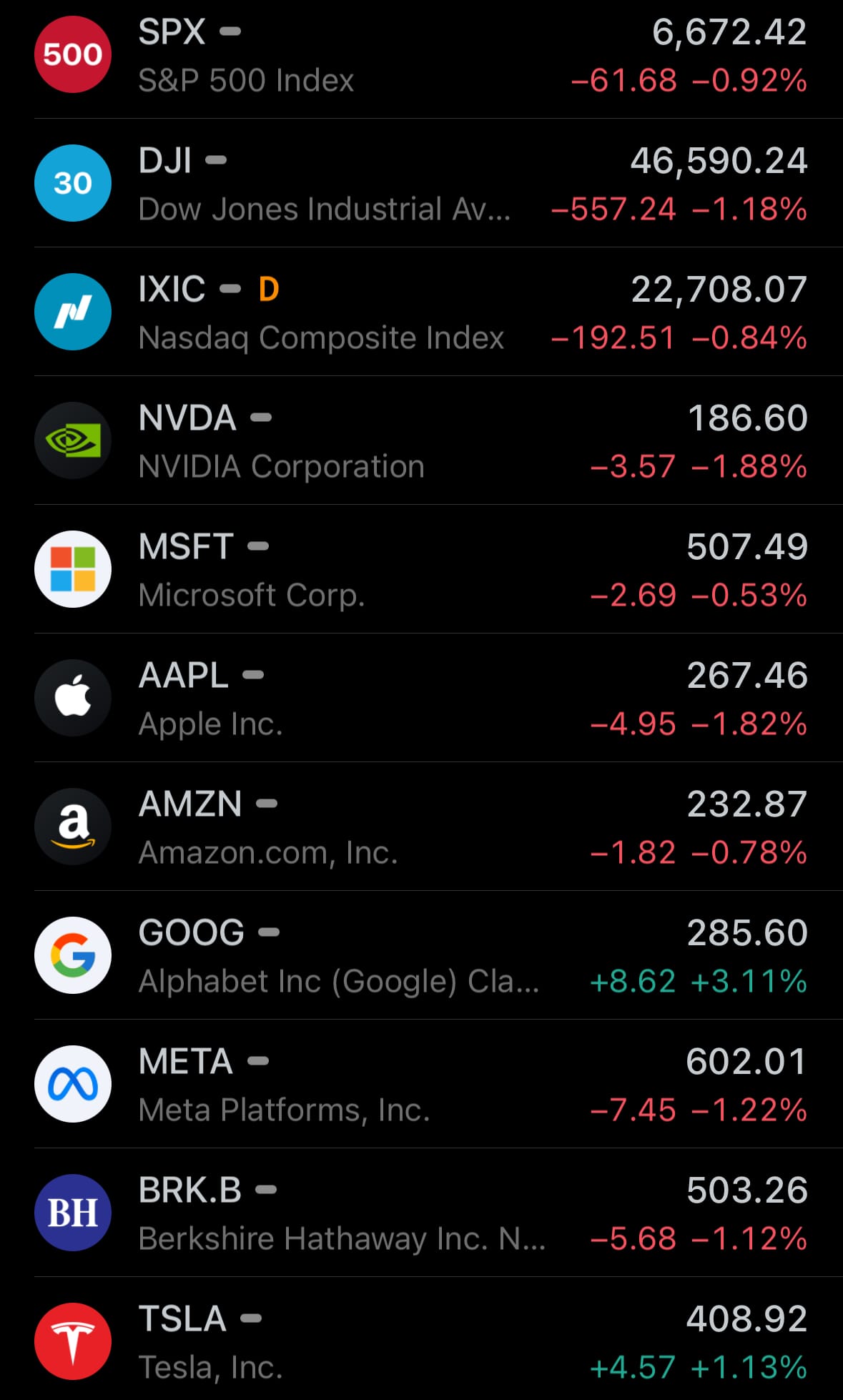
- Yesterday’s U.S. stock market:
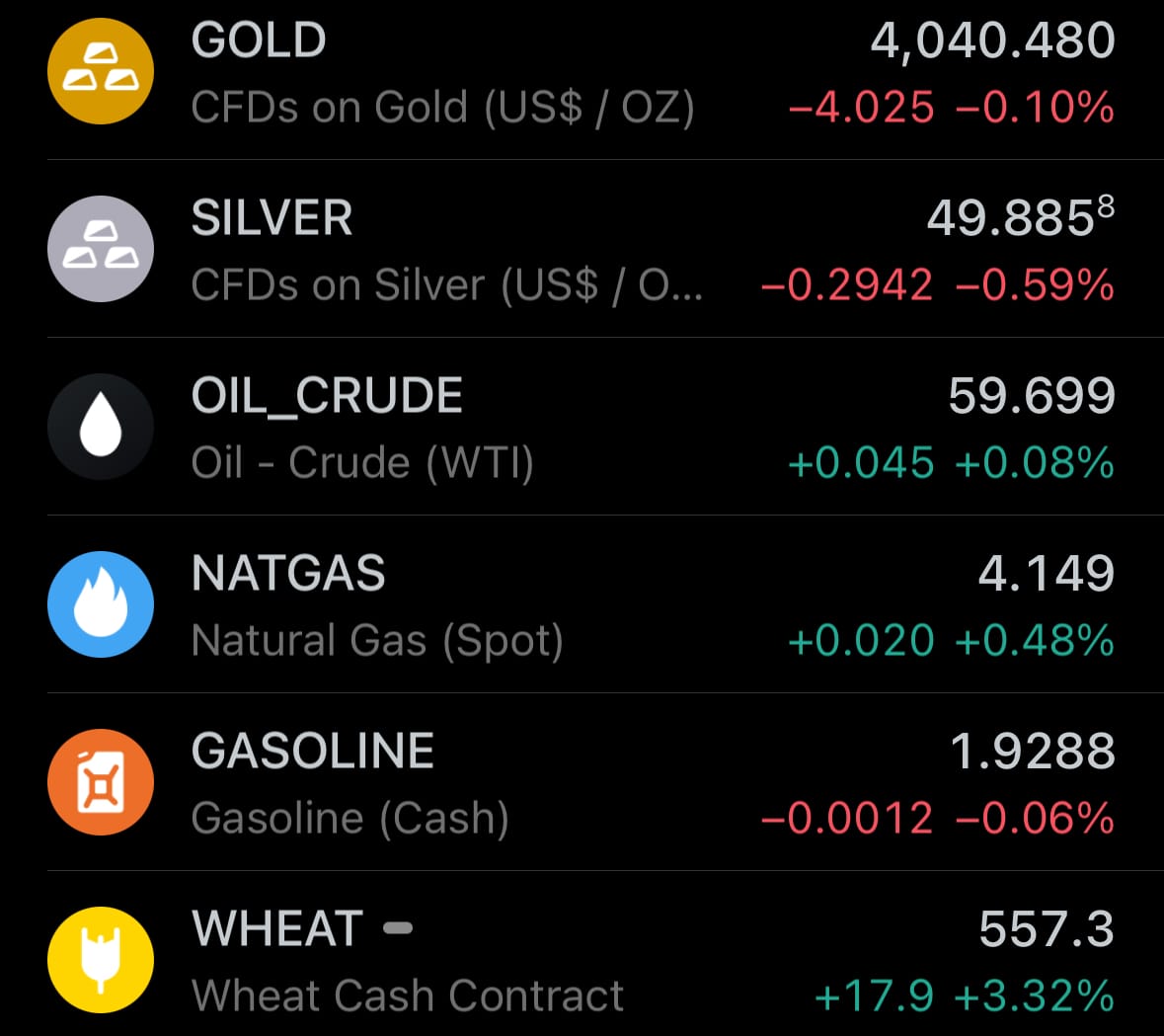
- Yesterday’s commodity market:
- Yesterday’s crypto market:

Geopolitics & Military Activity:


Environment & Weather:

Science & Technology:
- On November 17, 2025, xAI announced the release of Grok 4.1, an updated version of its AI model designed to enhance conversational capabilities and overall performance. The model is now available to all users on grok.com, X.com, and the iOS and Android apps, with an immediate rollout in auto mode and explicit selection options for users. It builds on Grok 4 by incorporating refinements for more natural and fluid dialogue, while maintaining access restrictions for premium features. A silent rollout phase occurred from November 1 to 14 for testing, leading to the full public launch today.

- Grok 4.1 offers improvements such as three times lower hallucination rates compared to previous models, faster response times, and higher quality outputs across tasks like reasoning and general queries. The Grok 4.1 Thinking variant tops several benchmarks for advanced problem-solving, positioning it competitively against other leading AI systems. This update reflects xAI's ongoing efforts to iterate on its technology amid rapid industry advancements, potentially broadening user adoption through better reliability and engagement without major architectural overhauls.
Space:
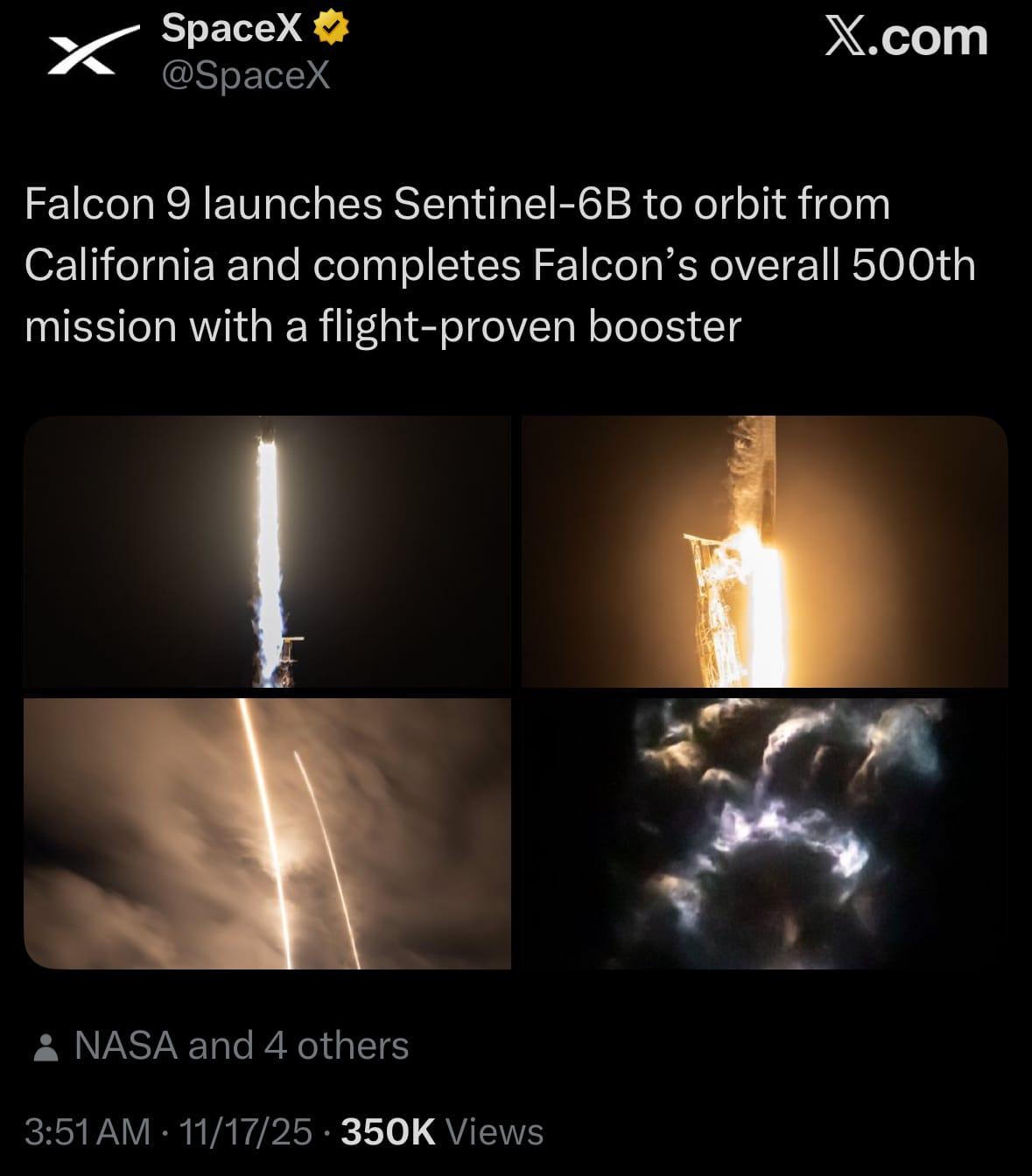
- On November 16, 2025, SpaceX successfully launched the Sentinel-6B satellite aboard a Falcon 9 rocket from Space Launch Complex 4E at Vandenberg Space Force Base in California, with liftoff occurring at 9:21 p.m. PT after a brief delay from the initial window. The reusable first-stage booster, on its third flight, separated as planned and landed on a drone ship in the Pacific Ocean, marking another milestone in SpaceX's recovery operations. The upper stage deployed the satellite into a sun-synchronous orbit approximately one hour after launch, with no anomalies reported during the ascent.
- Sentinel-6B is an ocean-monitoring satellite developed through an international partnership involving NASA, the European Space Agency, NOAA, and other organizations, serving as the second in a duo designed to provide continuous high-precision data on global sea levels over a decade. It uses advanced radar altimetry to measure ocean surface height, wave heights, and wind speeds, aiding in climate research, weather forecasting, and understanding phenomena like sea level rise due to global warming. This mission extends the legacy of prior Sentinel satellites, ensuring long-term datasets for environmental monitoring without introducing new technologies but focusing on data continuity.
Statistic:
- Largest public automakers by market capitalization:
- 🇺🇸 Tesla: $1.359T
- 🇯🇵 Toyota: $259.36B
- 🇨🇳 Xiaomi: $139.06B
- 🇨🇳 BYD: $128.51B
- 🇮🇹 Ferrari: $71.95B
- 🇩🇪 Mercedes-Benz: $65.33B
- 🇺🇸 General Motors: $64.65B
- 🇩🇪 BMW: $61.48B
- 🇩🇪 Volkswagen: $56.95B
- 🇮🇳 Maruti Suzuki India: $56.34B
- 🇺🇸 Ford: $51.32B
- 🇮🇳 Mahindra & Mahindra: $50.59B
- 🇰🇷 Hyundai: $48.36B
- 🇩🇪 Porsche: $47.86B
- 🇯🇵 Honda: $37.62B
- 🇨🇳 Seres Group: $32.75B
- 🇰🇷 Kia: $31.31B
- 🇳🇱 Stellantis: $28.82B
- 🇯🇵 Suzuki Motor: $28.42B
- 🇨🇳 Great Wall Motors: $26.99B
- 🇨🇳 SAIC Motor: $25.32B
- 🇨🇳 Chery Automobile: $22.85B
- 🇨🇳 Geely: $22.38B
- 🇨🇳 XPeng: $21.93B
- 🇮🇳 Hyundai Motor India: $21.81B
History:
- Humanity’s instinct to store knowledge deepened as civilizations grew more complex, and across the world each culture engineered its own version of a “database” long before the word existed. In Mesopotamia around 3000 BC, clay tablets tracked grain, taxes, and contracts—immutable, heavy, and built for permanence. Egypt’s papyrus archives (2500 BC onward) allowed for lighter storage but forced readers to scroll sequentially, making them early linear-access databases. China advanced the craft with bamboo-slip record systems during the Zhou and Han dynasties (1000–200 BC), bundling slips with string in a format surprisingly close to modern linked data. The ancient Maya carved astronomical records into stelae between 300 BC and 900 AD, while the Roman Empire built massive bureaucratic archives for census, law, and military logistics—organized by location and topic, essentially the first globally scaled government database. Medieval monasteries (500–1400 AD) turned scriptoria into slow-motion information hubs, copying and indexing manuscripts by hand. Islamic scholars during the Abbasid Caliphate (8th–13th centuries) pioneered library cataloging systems in Baghdad’s House of Wisdom, proving that metadata—information about information—is older than the modern world. Renaissance Europe expanded paper-based indexing with alphabetical lists, subject catalogs, and early cross-references, laying cognitive infrastructure for systematic data retrieval. By the 1700s and 1800s, global governments and corporations relied on card catalogs, registries, and sprawling filing rooms. For the first time, the problem wasn’t recording data—it was drowning in it.
- The shift from human indexing to machine indexing began with Herman Hollerith’s punch cards in 1890, turning census data into a format machines could read, sort, and count. Early computers in the 1950s formalized digital storage with hierarchical databases—tree-shaped structures built for predictable, carefully organized information. The 1970s brought a conceptual earthquake: Edgar F. Codd’s relational model. Tables, keys, relationships, and SQL transformed how people thought about structure, consistency, and logic. As businesses digitized through the 1980s and 1990s, relational databases like Oracle, MySQL, and PostgreSQL became the backbone of finance, government, logistics, telecommunications—anywhere order mattered. Then the internet erupted. The world started producing unstructured data: emails, PDFs, photos, web pages, logs, sensor streams. Rigid schemas strained under this chaos. Semi-structured formats like XML and later JSON arrived to bridge the gap, offering flexible shape without fixed tables. NoSQL systems in the 2000s—MongoDB, Cassandra, DynamoDB—embraced scalability over strict rules, supporting the rise of global-scale applications. By the 2010s and early 2020s, databases became polyglots: PostgreSQL evolved into a platform for structured, semi-structured, geospatial, time-series, and JSON data all at once. Vector databases emerged to store meaning itself—embeddings powering AI search and reasoning. And now, in 2025, we’re entering the era of AI-native databases: engines that ingest raw unstructured data, infer patterns automatically, and answer queries semantically rather than literally. Across five thousand years—clay tablets, bamboo slips, parchment libraries, punch cards, SQL, JSON, and now intelligent data engines—the story has been a steady march toward systems that not only store human knowledge but increasingly understand it, connect it, and act on it.
Image of the day:

Thanks for reading!
- Earth Intelligence builds private, customizable intelligence systems that you own outright. We plug in any data source you rely on — financials, competitors, markets, regulations, internal ops, even predictive models — and fuse it all into a single command interface that replaces your patchwork of subscriptions. You get one unified brain for your organization: your data, your signals, your decisions, all flowing through an AI-powered system built only for you.
Earth is complicated, we make it simple.
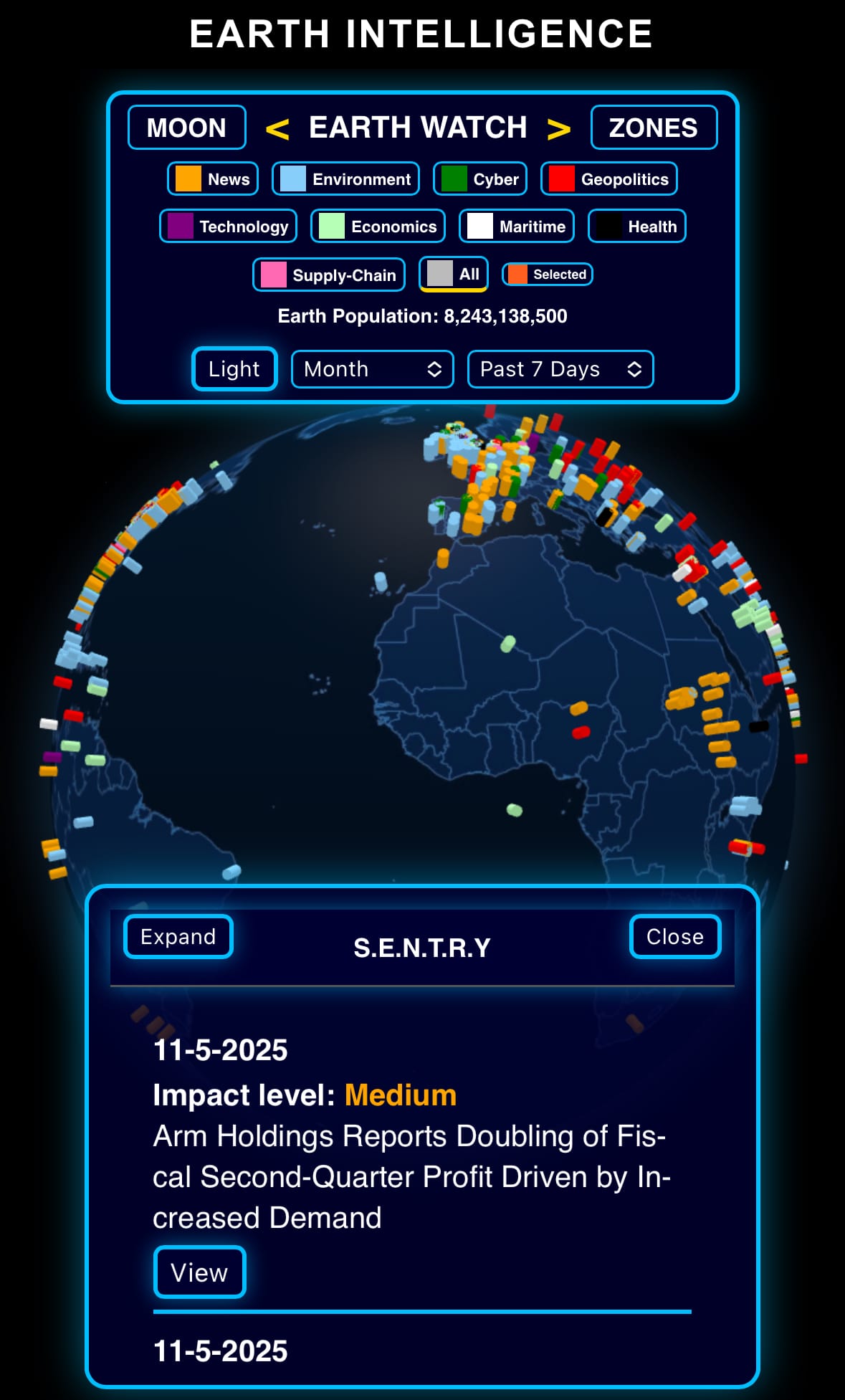
- Click below if you’d like to view our free EARTH WATCH globe:

Click below to view our previous newsletters:

Support/Suggestions Email:
earthintelligence@earthintel.news