Tuesday☕️

Trending:
- On December 8, 2025, Florida Governor Ron DeSantis issued an executive order immediately designating the Muslim Brotherhood and the Council on American-Islamic Relations (CAIR) as foreign terrorist organizations under state law. The order instructs all Florida state agencies to take lawful steps to prevent these groups from operating in the state, including denying contracts, funding, or other benefits to anyone who provides them material support.
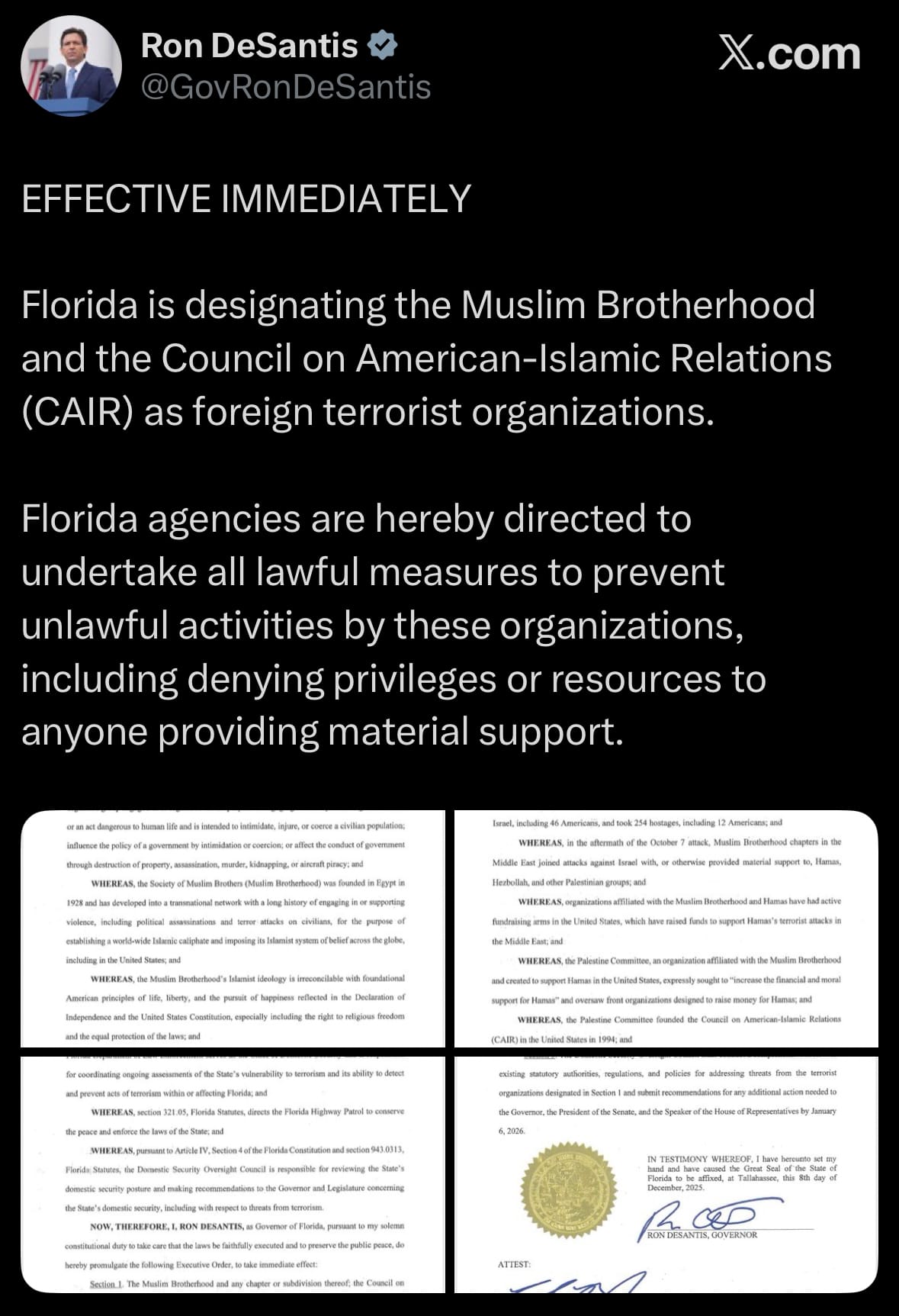
- The move follows a similar designation by Texas in November 2025 and comes as the Trump administration is pursuing a federal process to label certain Muslim Brotherhood entities as terrorist organizations. DeSantis cited past federal investigations linking individuals associated with CAIR to terrorism-financing cases and alleged connections between the Muslim Brotherhood and groups such as Hamas. CAIR, the largest Muslim civil-rights organization in the United States, called the designation politically motivated and said it plans to challenge it in court, arguing that it violates free-speech and free-association rights.
Economics & Markets:
- Yesterday’s U.S. stock market:

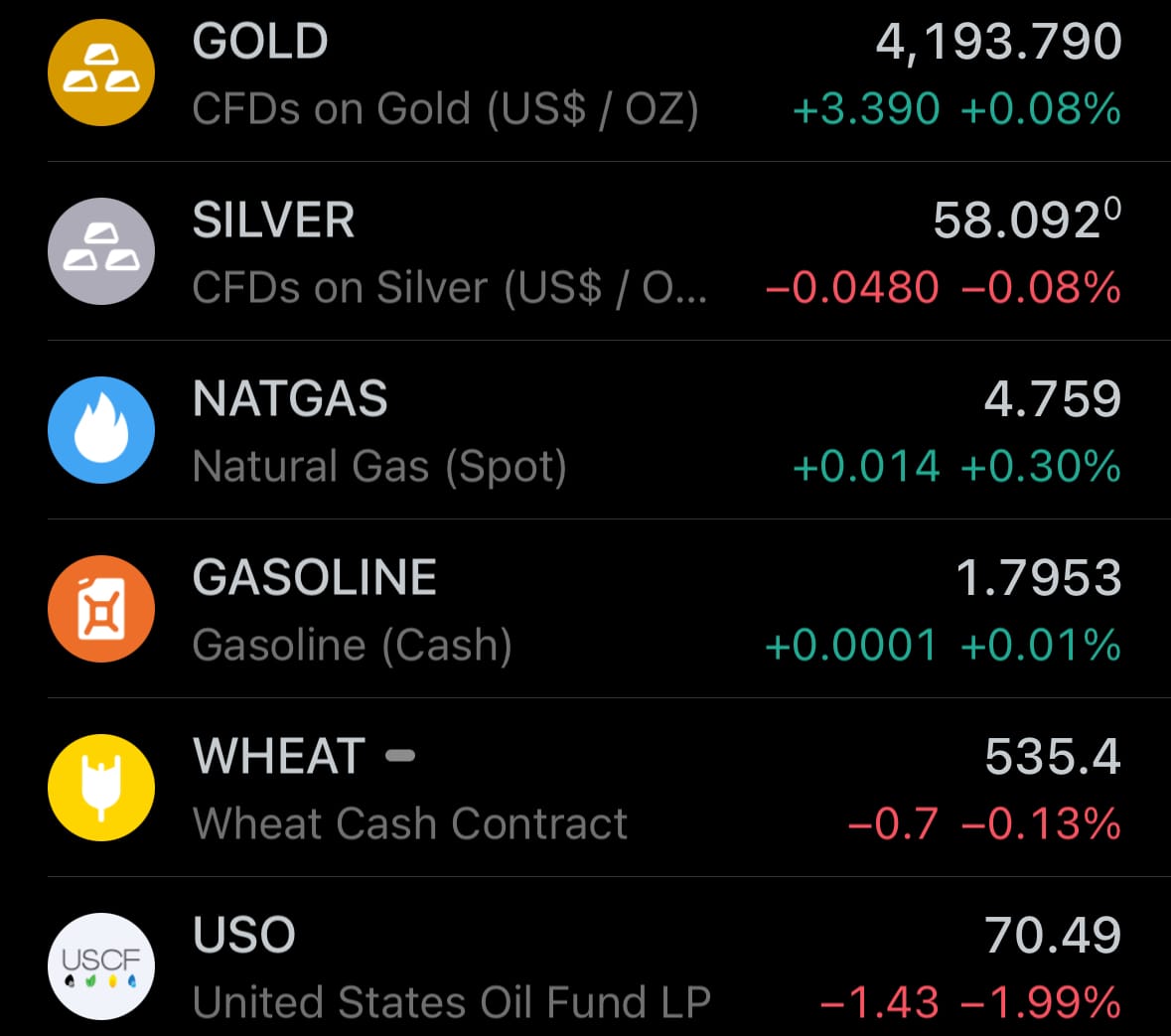
- Yesterday’s commodity market:
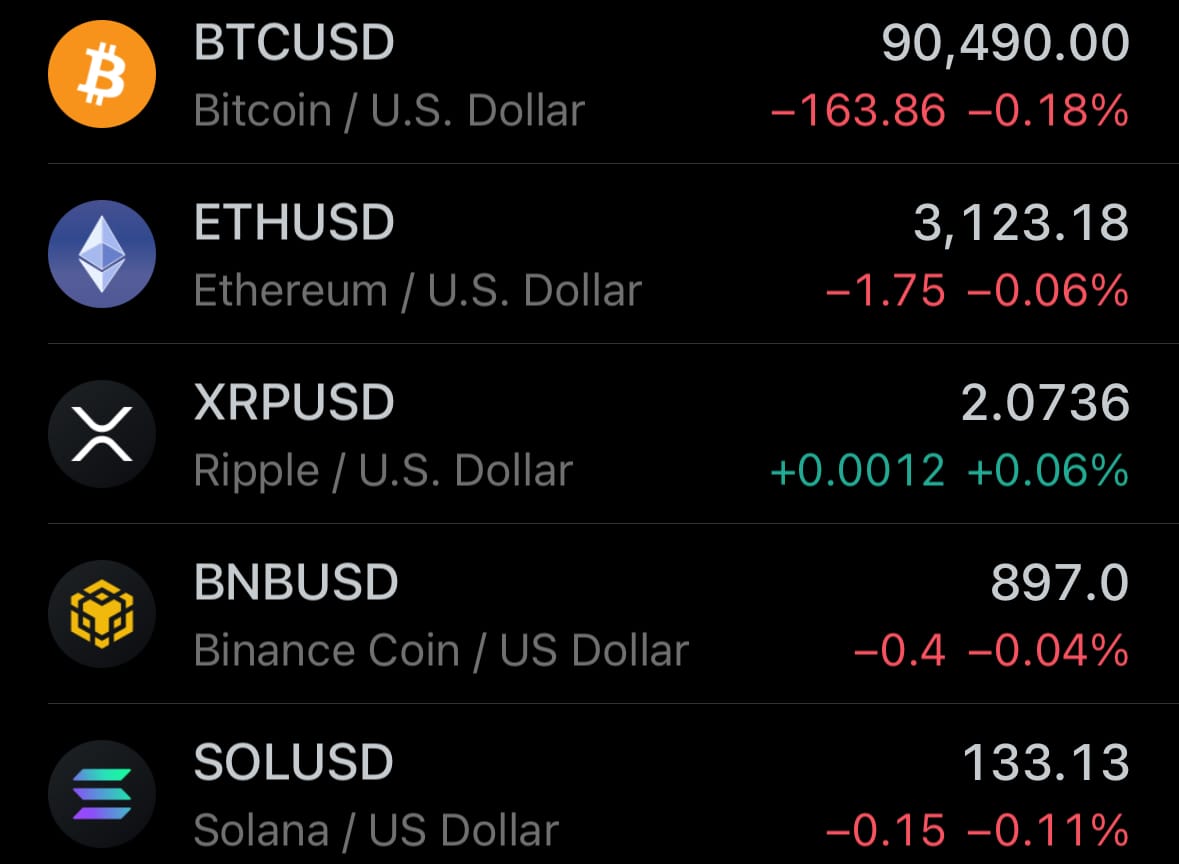
- Yesterday’s crypto market:
Geopolitics & Military Activity:
- On December 8, 2025, the Israel Defense Forces carried out a series of airstrikes in southern Lebanon, targeting sites linked to Hezbollah, including a training facility used by the group's elite Radwan Force in the Jabal Safi area. The IDF confirmed the operation hit multiple locations such as Wadi Roumine, the Iqlim al-Tuffah highlands near Jbaa, and a rocket-launching site, stating the strikes addressed violations of the November 2024 ceasefire by preventing attacks on Israel. Lebanese media reported explosions and fires in residential areas around Jbaa, Mahrouna, al-Majadel, and Baraachit, with no immediate casualties confirmed but evacuations ordered beforehand.
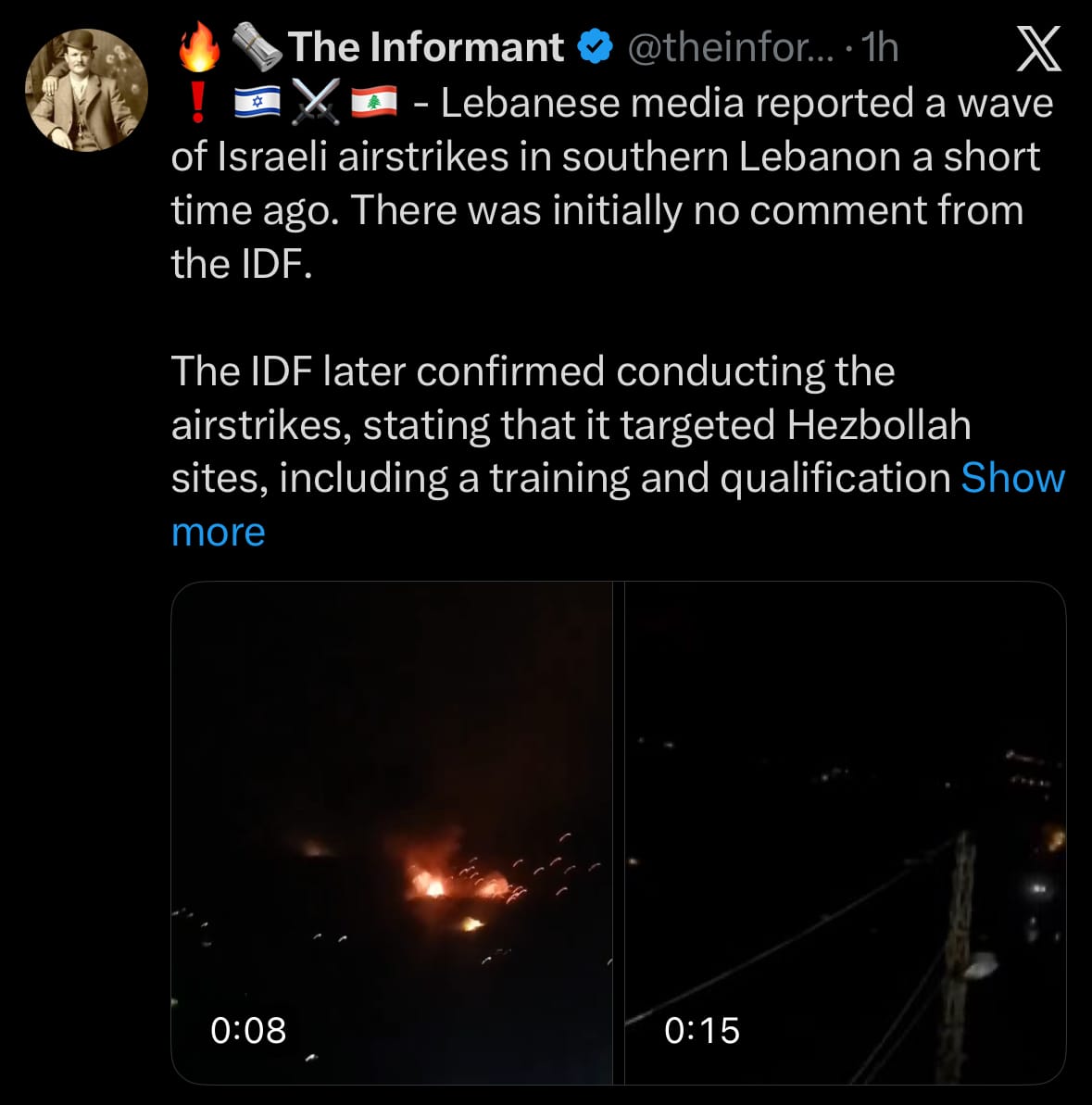
- The raids occurred amid ongoing accusations of ceasefire breaches, with the IDF claiming Hezbollah was rebuilding capabilities south of the Litani River, while Lebanese officials and UNIFIL documented over 5,000 Israeli violations since the truce. This follows direct Israel-Lebanon talks on December 7—the first in decades—focused on economic ties, though tensions persist over disarmament under UN Resolution 1701. Hezbollah has not commented publicly, but the strikes risk derailing planned follow-up negotiations on December 19.
Thailand & Cambodia Conflict:
- On December 8, 2025, fighting between Thailand and Cambodia along their disputed border intensified after cross-border gunfire on December 7 killed one Thai soldier and wounded eight. Thailand responded with airstrikes on Cambodian military positions in Preah Vihear and Oddar Meanchey provinces; Cambodia accused Thailand of starting the clash with tank fire. Both sides used artillery and small-arms fire, resulting in at least one Thai soldier and four Cambodian civilians killed, with additional injuries reported.
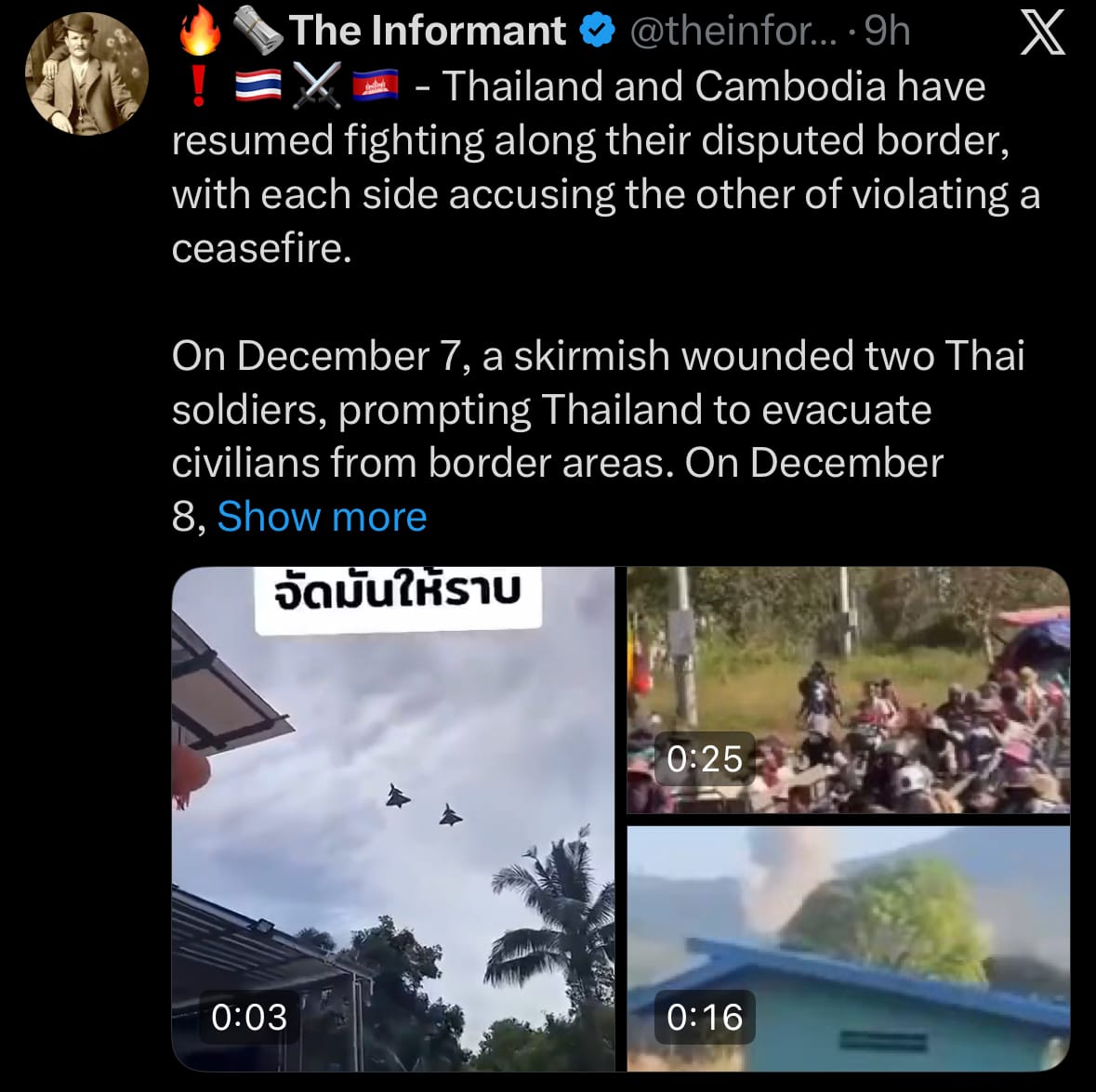
- Large-scale evacuations took place: Thailand moved more than 385,000 residents from four eastern provinces to shelters, while Cambodia relocated around 1,100 families from border villages. The U.S. Embassy warned Americans to avoid the area. The violence endangers the October 26 ceasefire brokered by President Trump and Malaysia after a deadly July clash, with each country blaming the other for the renewed fighting and calls for restraint coming from the UN, Malaysia, and the United States.
Environment & Weather:
- On December 8, 2025, at 11:15 p.m. Japan time (14:15 UTC), a magnitude-7.6 earthquake struck off the northeast coast of Honshu, about 80 km east of Aomori Prefecture at a depth of 50 km. Strong shaking (upper 6 on Japan’s intensity scale) hit Aomori and Iwate prefectures and was felt across northern Honshu, Hokkaido, and Tokyo. No deaths were reported, but at least 23 people were injured, thousands lost power, some buildings suffered minor damage, and a few small fires broke out.
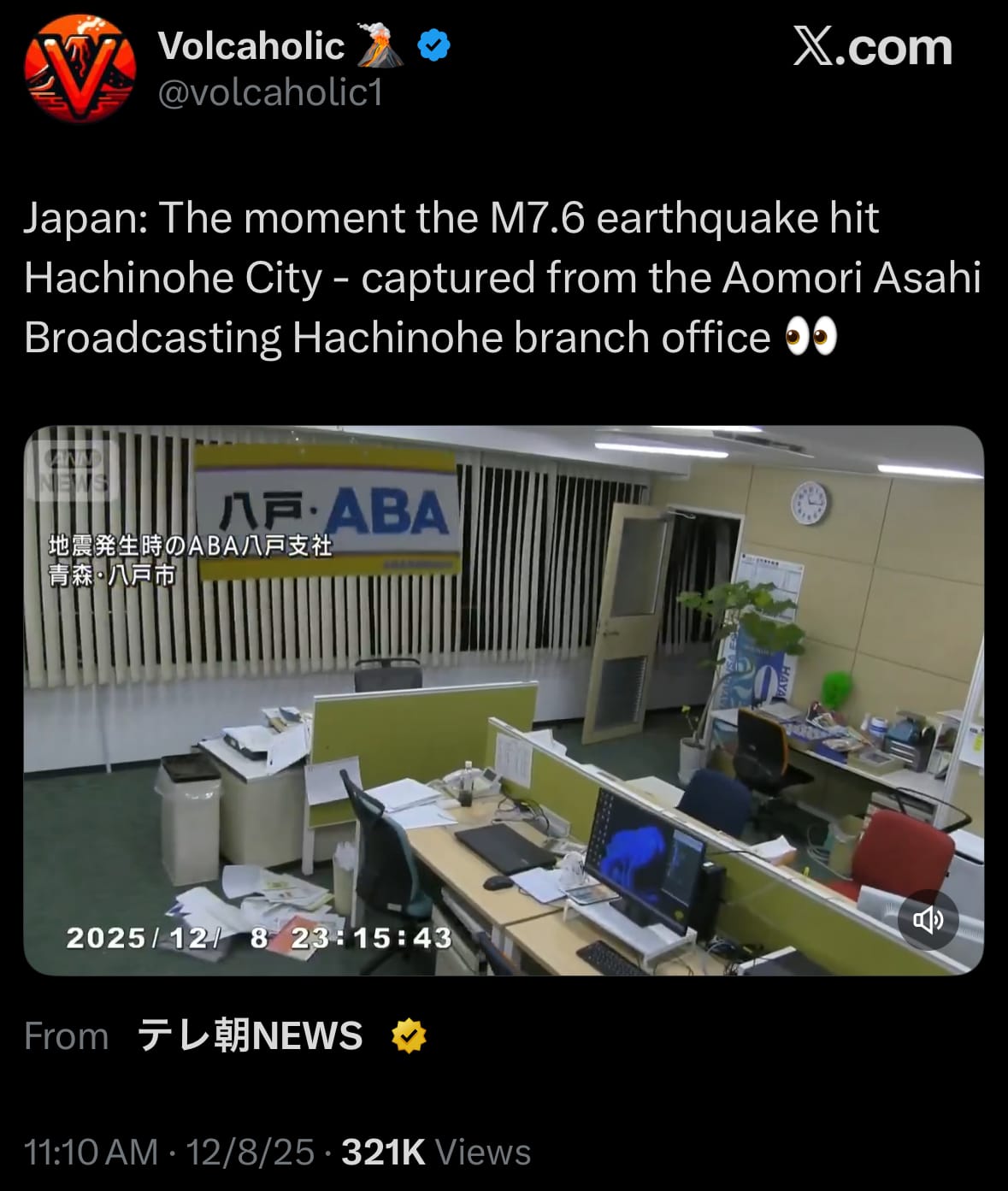
- A tsunami warning for waves up to 3 meters was issued for parts of Aomori, Iwate, and Hokkaido, but only small waves of 20–70 cm arrived. The warning was downgraded to an advisory within hours. The government ordered evacuations for about 90,000 residents in coastal areas and warned of possible strong aftershocks, including a one-week heightened alert for the separate Nankai Trough region. Rail and road services were briefly halted for safety checks.
Space:
- On December 8, 2025, China launched the SatNet LEO Group 15 mission using a Long March 12 rocket from the Wenchang Space Launch Site in Hainan province, successfully deploying the batch of satellites into low Earth orbit at approximately 1,150 kilometers altitude.
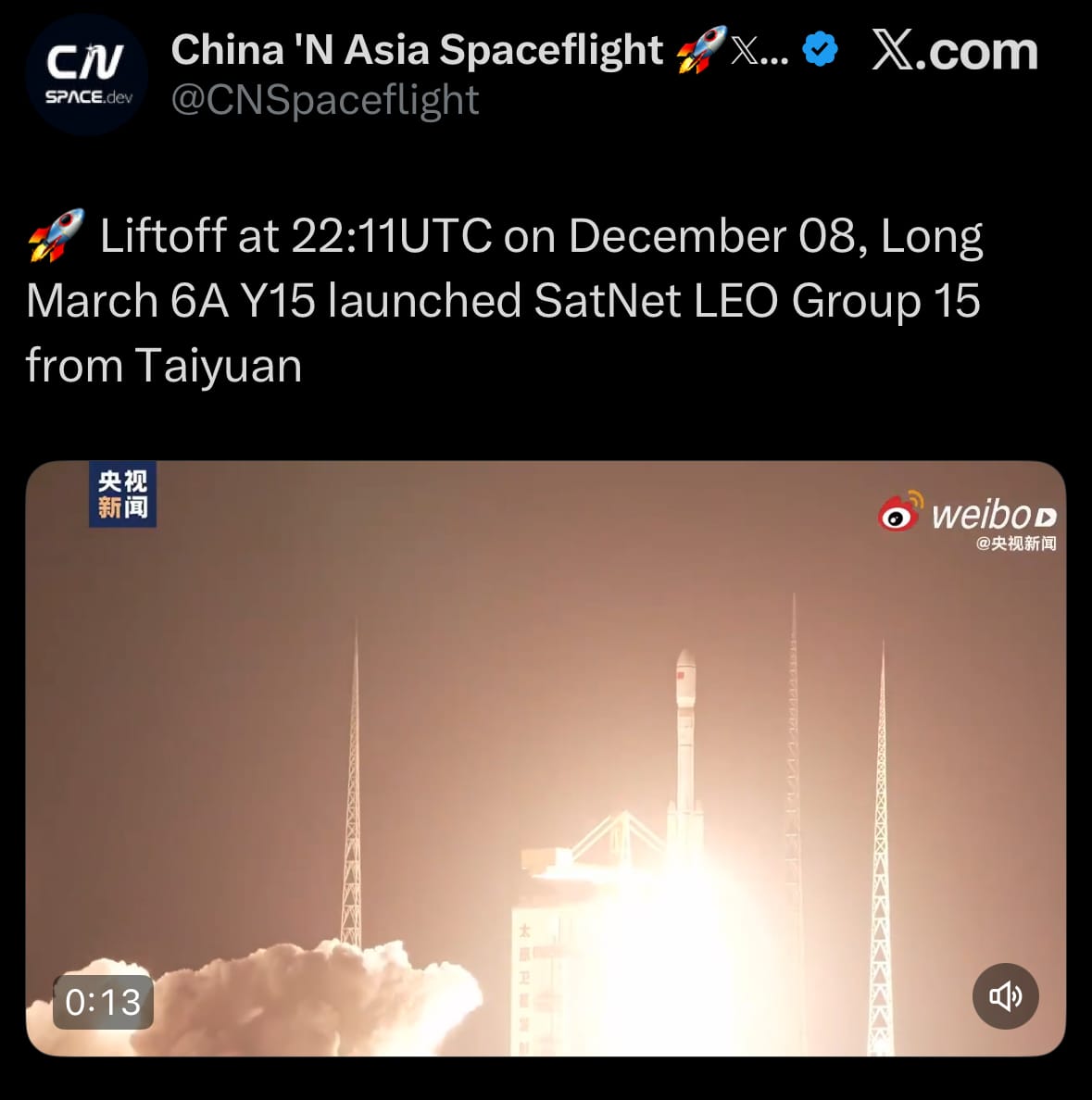
- The mission proceeded without reported anomalies, contributing to China's accelerating space cadence amid favorable weather conditions at the coastal site. SatNet LEO Group 15 consists of an undisclosed number of low Earth orbit communication satellites for the GuoWang (SatNet) megaconstellation, operated by the state-owned China Satellite Network Group Co., Ltd., aimed at providing global broadband internet coverage with dual civilian and military applications.
SpaceX Launch:
- On December 8, 2025, SpaceX successfully launched the Starlink Group 6-92 mission using a Falcon 9 rocket from Launch Complex 39A at NASA's Kennedy Space Center in Florida. Liftoff occurred at 5:26 p.m. EST (22:26 UTC), within an extended evening window, with the two-stage vehicle ascending on a southeasterly trajectory over the Atlantic Ocean.
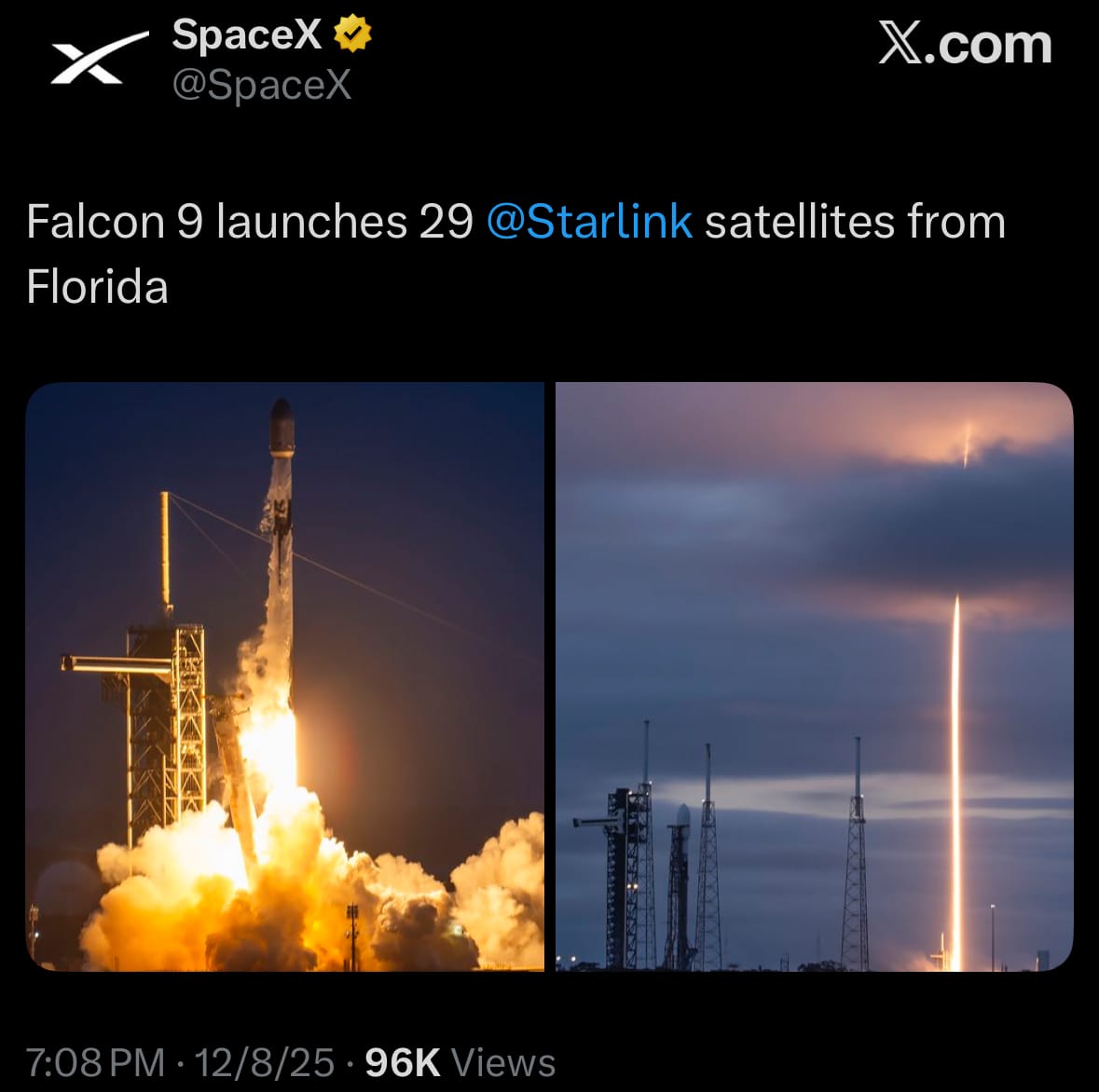
- This marked SpaceX's 158th Falcon 9 mission of 2025 and the 112th dedicated to the Starlink constellation. The mission deployed 29 V2 Mini Starlink satellites into low Earth orbit at approximately 530 kilometers altitude, where they will maneuver to operational slots to expand global broadband coverage, including in lower-inclination regions for improved equatorial performance.
Statistic:
- Largest public tech companies on Earth by market capitalization:
- 🇺🇸 NVIDIA: $4.517T
- 🇺🇸 Apple: $4.123T
- 🇺🇸 Alphabet (Google): $3.795T
- 🇺🇸 Microsoft: $3.649T
- 🇺🇸 Amazon: $2.425T
- 🇺🇸 Broadcom: $1.894T
- 🇺🇸 Meta Platforms: $1.680T
- 🇹🇼 TSMC: $1.565T
- 🇺🇸 Tesla: $1.461T
- 🇨🇳 Tencent: $703.61B
- 🇺🇸 Oracle: $628.71B
- 🇰🇷 Samsung: $496.87B
- 🇳🇱 ASML: $434.60B
- 🇺🇸 Palantir: $432.56B
- 🇺🇸 Netflix: $410.13B
- 🇨🇳 Alibaba: $377.29B
- 🇺🇸 AMD: $359.97B
- 🇺🇸 Cisco: $311.58B
- 🇺🇸 IBM: $289.00B
- 🇩🇪 SAP: $283.50B
History:
- The submarine’s story begins with early experiments in submersible craft long before true underwater navigation was possible. Cornelis Drebbel demonstrated the first crewed submersible on the Thames in 1620, followed by early military attempts such as David Bushnell’s Turtle in 1775 and Robert Fulton’s Nautilus in 1800. The first successful wartime submarine attack occurred in 1864, when the Confederate CSS Hunley sank the USS Housatonic during the American Civil War, even though the Hunley was lost moments later. Real submarines emerged in the late 19th and early 20th centuries, driven by steel hulls, compressed air systems, and the invention of the self-propelled torpedo (1866). By the 1890s–1900s, major powers—including France, Britain, Germany, Russia, and the United States—were commissioning diesel-electric submarines that ran on diesel at the surface and on batteries underwater. These vessels proved their strategic value in both world wars: German U-boats nearly strangled Britain’s supply lines in World War I and again in World War II, while U.S. submarines crippled Japan’s merchant fleet in the Pacific. Despite their impact, early submarines had clear limits: they needed frequent surfacing, had slow submerged speeds, and could not operate underwater for long.
- The nuclear revolution transformed everything. The U.S. Navy’s USS Nautilus went to sea in 1955 as the world’s first nuclear-powered submarine and, in 1958, became the first vessel to reach the North Pole beneath the ice. Nuclear propulsion allowed submarines to stay submerged for months, turning them into nearly invisible global assets. The first ballistic-missile submarine, USS George Washington (1959), created the underwater leg of the nuclear triad, soon matched by Soviet, British, French, Chinese, and eventually Indian nuclear fleets. From the Cold War into the 21st century, submarine classes such as the U.S. Los Angeles and Virginia, the Soviet/Russian Typhoon and Yasen, Britain’s Astute, France’s Barracuda, and China’s Type 093/095 became some of the most advanced machines ever built. Meanwhile, diesel-electric submarines evolved with air-independent propulsion (AIP) in the 1990s–2000s and, more recently, lithium-ion batteries in Japanese and German designs, allowing them to operate far more quietly and longer underwater. Modern submarines now carry cruise missiles, special operations teams, advanced sensors, and hypersonic weapons—while nuclear-armed SSBNs remain hidden to ensure second-strike deterrence. From a leather-wrapped 1620 submersible to today’s stealthy nuclear leviathans, submarines have become one of the most strategically important—and secretive—technologies on Earth.
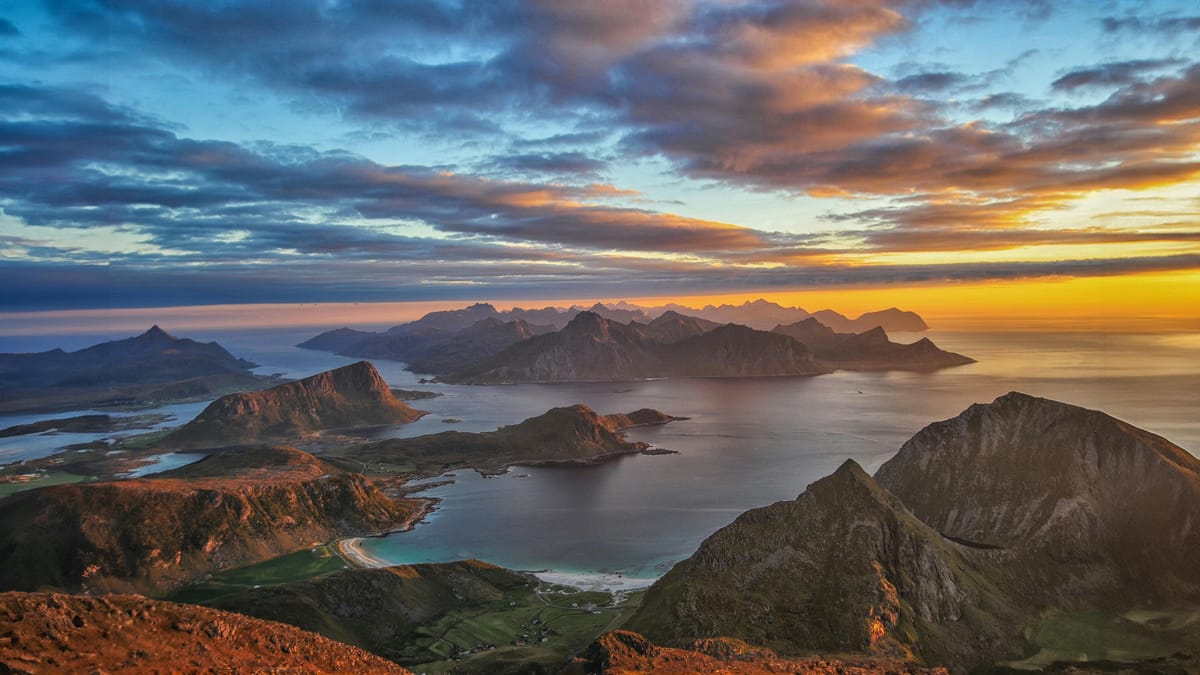
Image of the day:

Thanks for reading! Earth is complicated, we make it simple.
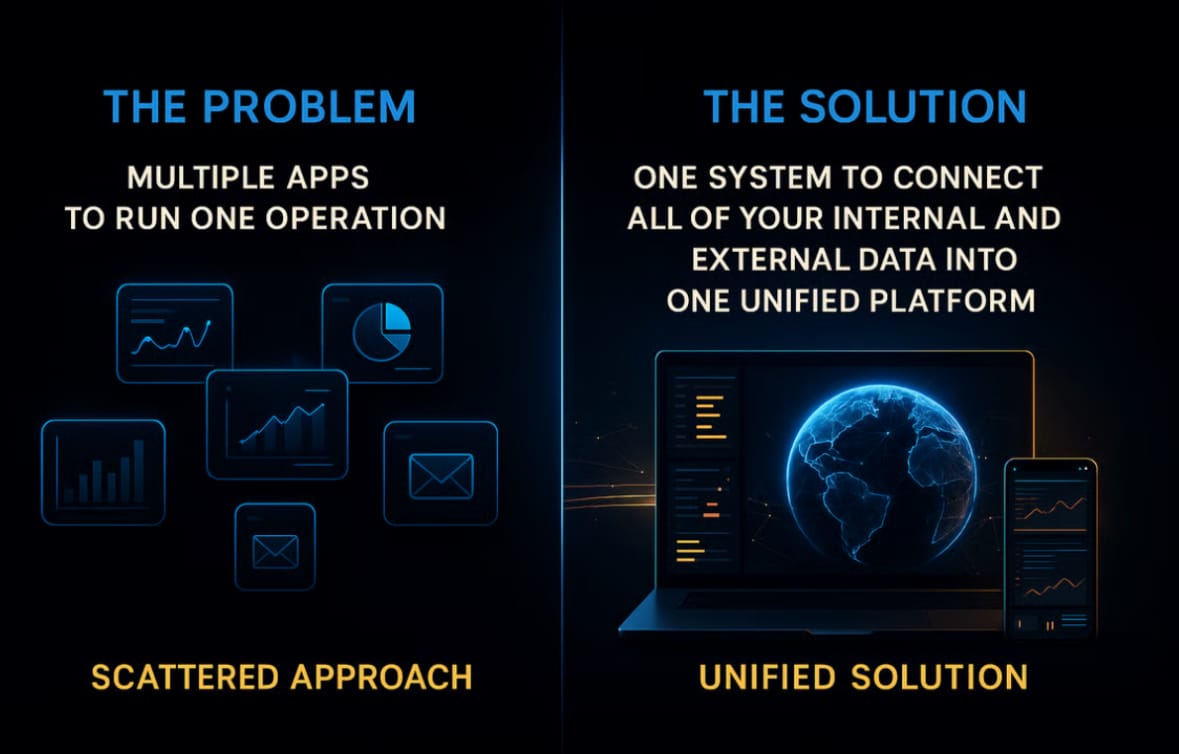

- Click below if you’d like to view our free EARTH WATCH globe:
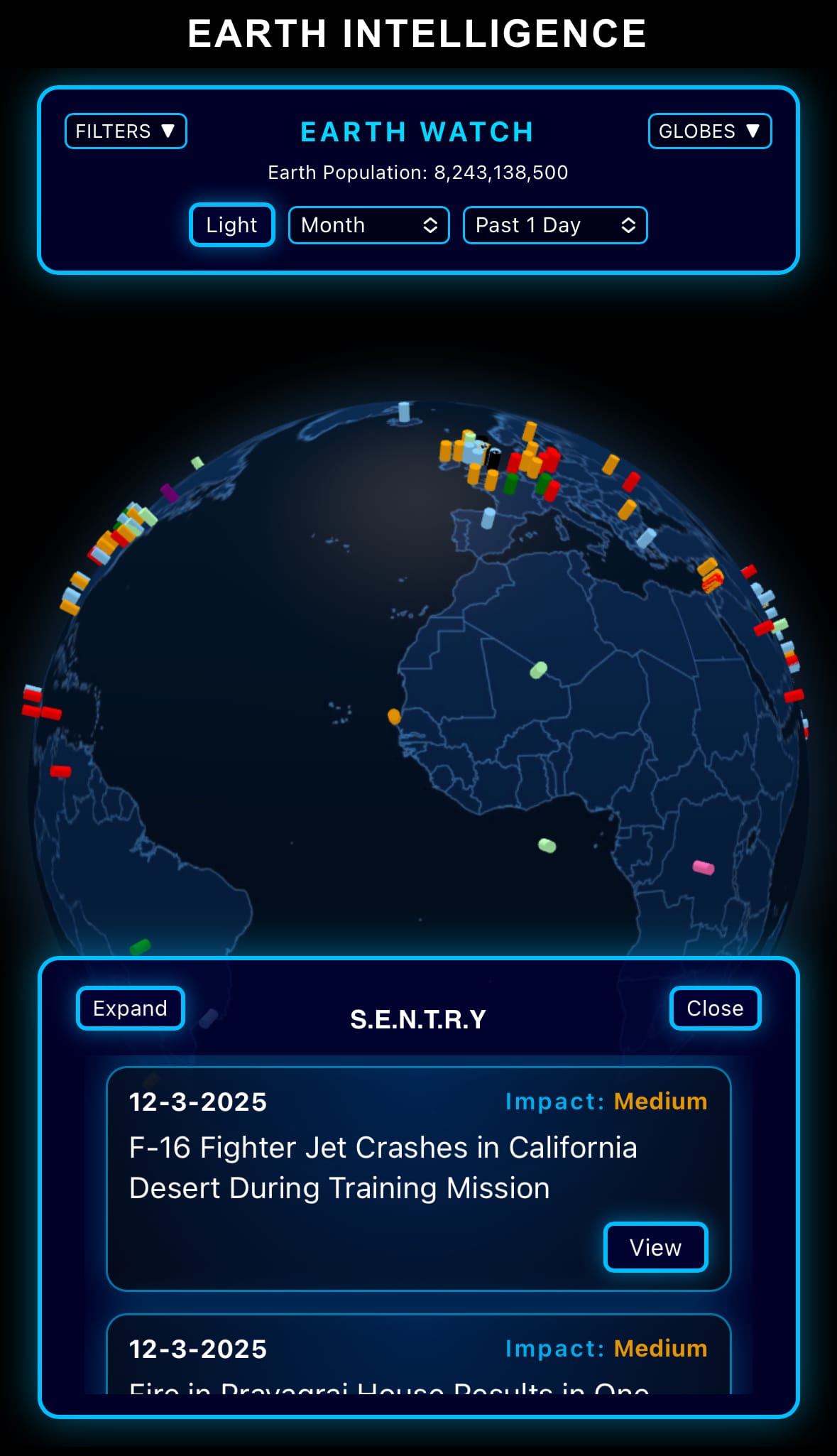
- Download our mobile app on the Apple App Store (Android coming soon):

Click below to view our previous newsletters:
Support/Suggestions Email:
earthintelligence@earthintel.news