Tuesday☕️


Trending:
- On December 15, 2025, Ukraine's Security Service (SBU), in a joint operation with the Ukrainian Navy, claimed to have struck a Russian Project 636.3 Varshavyanka-class diesel-electric submarine (NATO: Improved Kilo) in the port of Novorossiysk using "Sub Sea Baby" underwater drones. The SBU stated the attack caused critical damage, rendering the vessel inoperable, and marked the first reported instance of a submarine being hit by such drones. The submarine, capable of launching Kalibr cruise missiles used against Ukraine, was valued at approximately $400 million (potentially $500 million for a replacement due to sanctions).
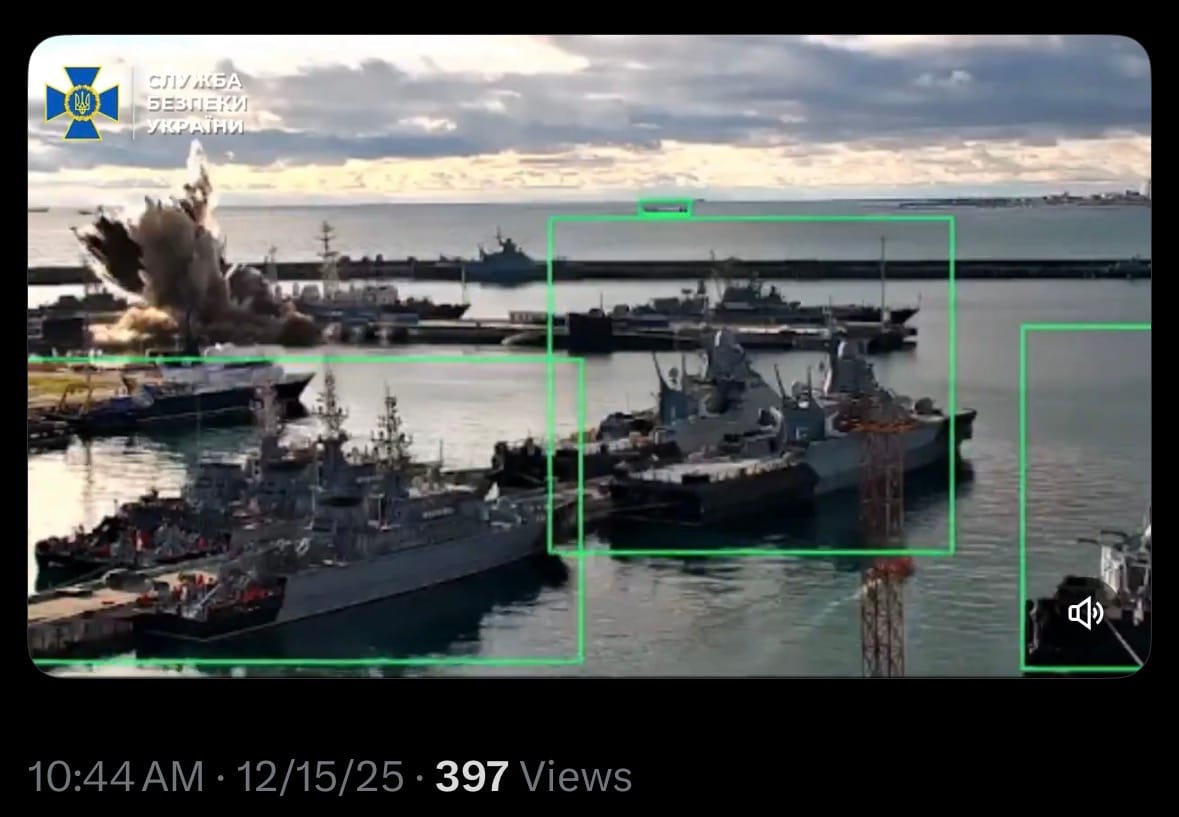
- It had been relocated to Novorossiysk from Sevastopol after prior Ukrainian surface drone operations displaced Russian naval assets from Crimea. The SBU released video footage showing an explosion near the docked submarine.
Economics & Markets:
- Yesterday’s U.S. stock market:

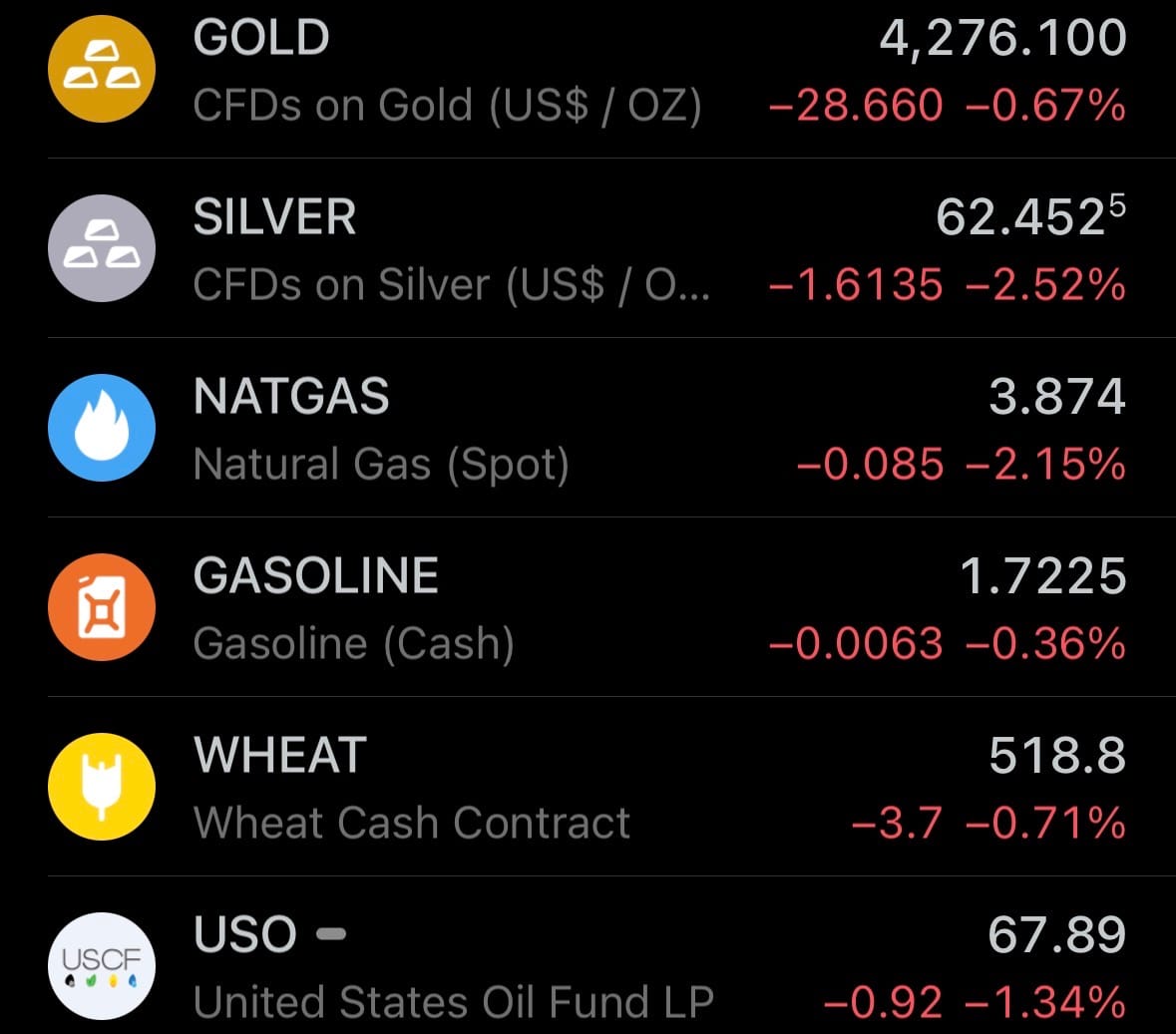
- Today’s commodity market:
- Today’s crypto market:

Geopolitics & Military Activity:
- On December 15, 2025, U.S. Southern Command (SOUTHCOM) announced that Joint Task Force Southern Spear conducted lethal kinetic strikes on three vessels in international waters of the Eastern Pacific. The strikes, directed by Secretary of War Pete Hegseth, targeted boats operated by designated terrorist organizations, which intelligence indicated were transiting known narco-trafficking routes and engaged in drug smuggling.
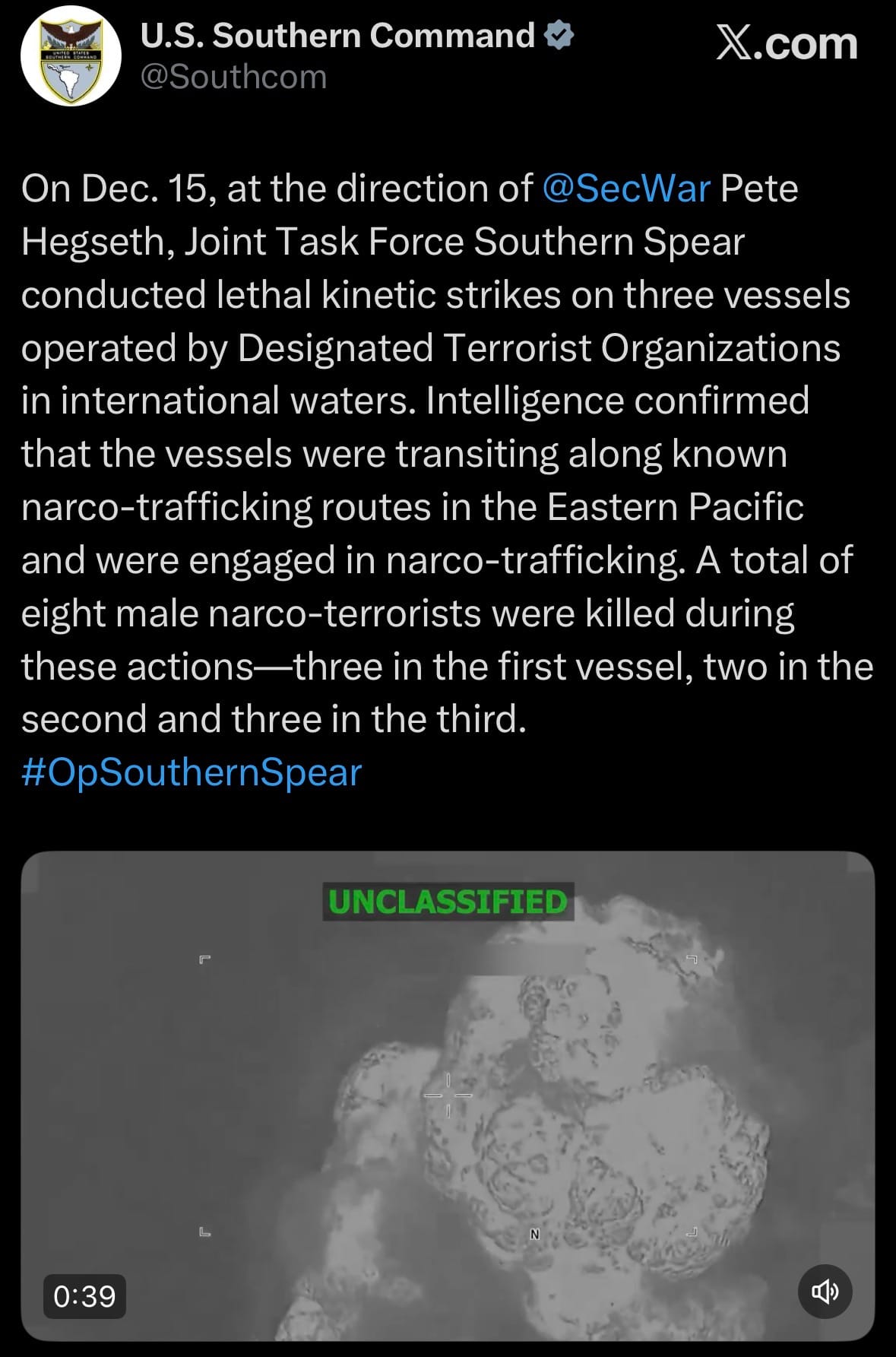
- A total of eight individuals were killed: three on the first vessel, two on the second, and three on the third. SOUTHCOM released video footage of the operations as part of Operation Southern Spear, an ongoing campaign to disrupt illicit drug networks in the Western Hemisphere. The strikes mark the latest in a series of U.S. military actions since September 2025 that have killed at least 95 people across multiple vessels, amid the Trump administration's designation of certain drug cartels as terrorist groups.
Environment & Weather:
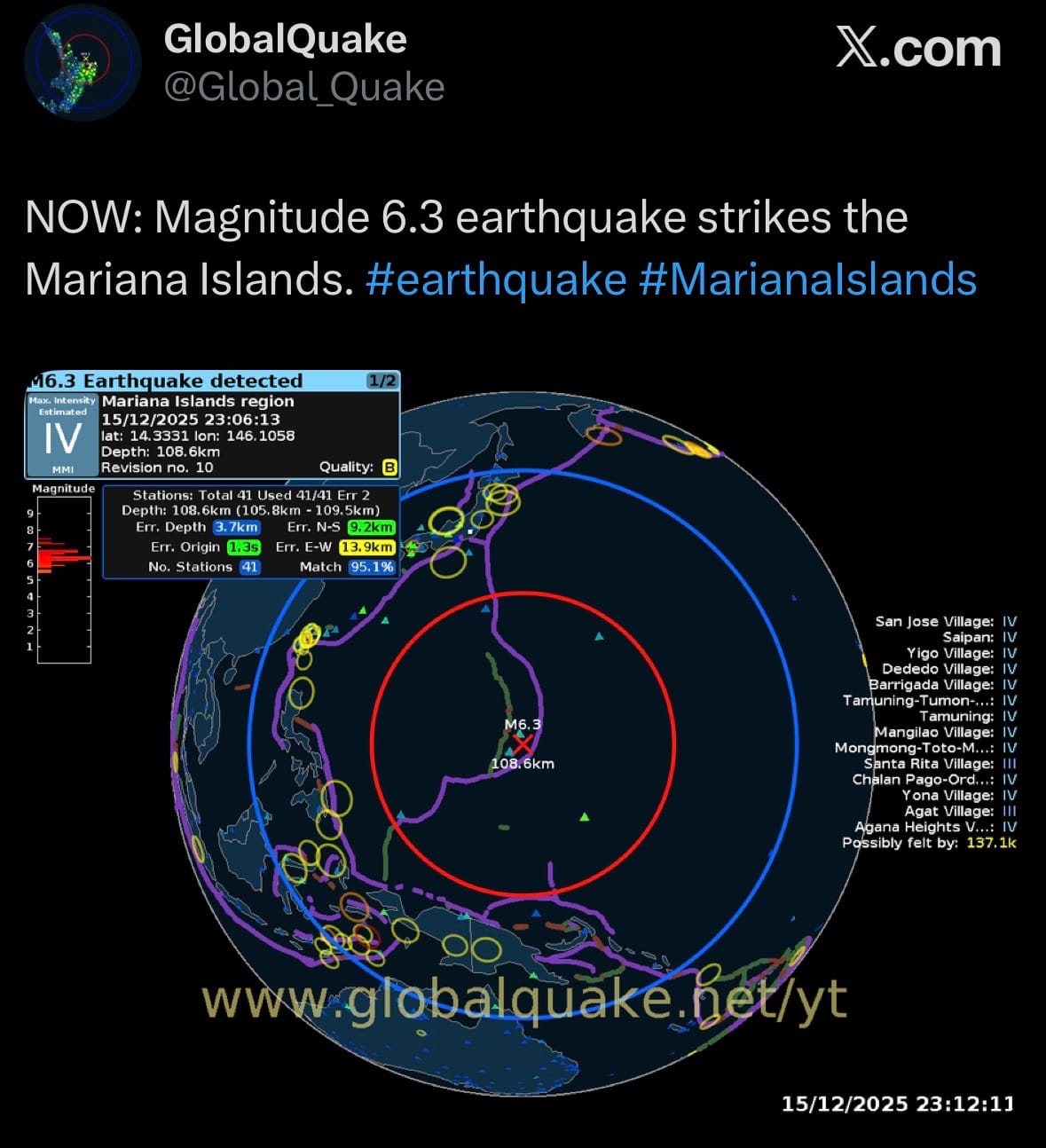
Space:
- On December 15, 2025, SpaceX launched the Starlink Group 6-82 mission using a Falcon 9 rocket from Space Launch Complex 40 at Cape Canaveral Space Force Station in Florida. Liftoff occurred at 12:25 a.m. EST (05:25 UTC) after weather concerns, including low-level winds, delayed earlier attempts. The mission deployed 29 Starlink V2 Mini satellites into low Earth orbit to expand the company's global broadband constellation. The first-stage booster (B1092) successfully landed on the droneship A Shortfall of Gravitas in the Atlantic Ocean, marking its ninth flight and SpaceX's 550th booster recovery overall.
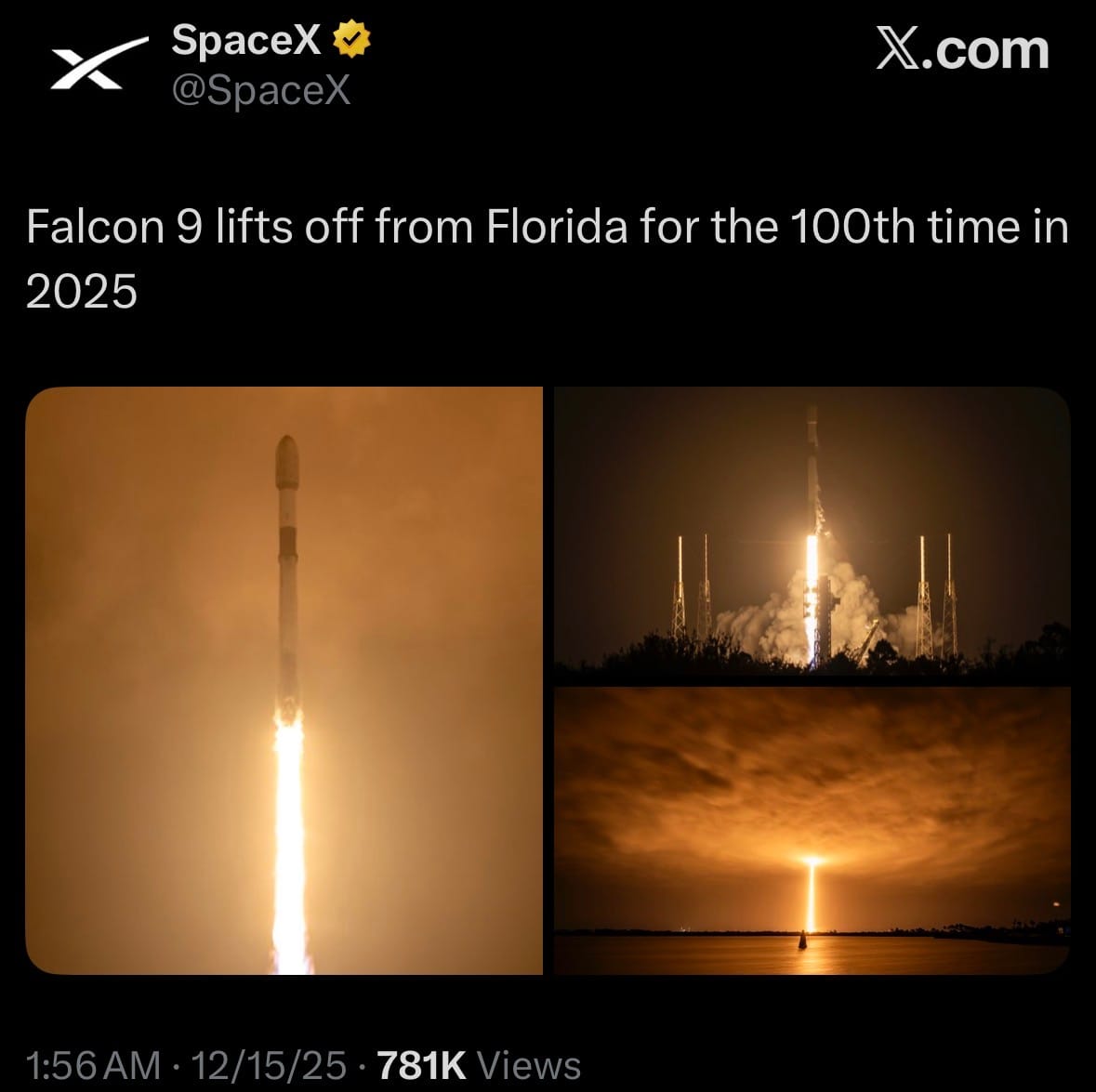
- The launch was SpaceX's 163rd Falcon 9 mission of 2025 and the 100th from Florida this year, following a Starlink launch from California the previous day. Deployment of the satellites was confirmed after about an hour, following a coast phase and second engine burn. The mission contributed to the Starlink network, which now includes over 10,000 satellites launched to date. Amateur astronomers later captured images of the satellite train in the night sky.
Chinese Launch:
- On December 16, 2025, China launched the Ziyuan-3 04 (ZY-3 04) satellite aboard a Long March 4C (Chang Zheng-4C) rocket from the Taiyuan Satellite Launch Center in Shanxi Province. The mission deployed the fourth high-resolution Earth observation satellite in the Ziyuan-3 series, designed for stereo mapping and remote sensing. Operated by the Ministry of Natural Resources, the satellite provides panchromatic imagery at approximately 2.1-2.7 meters resolution, along with multispectral capabilities, supporting applications in land resource surveys, urban planning, disaster management, agriculture, and environmental monitoring.
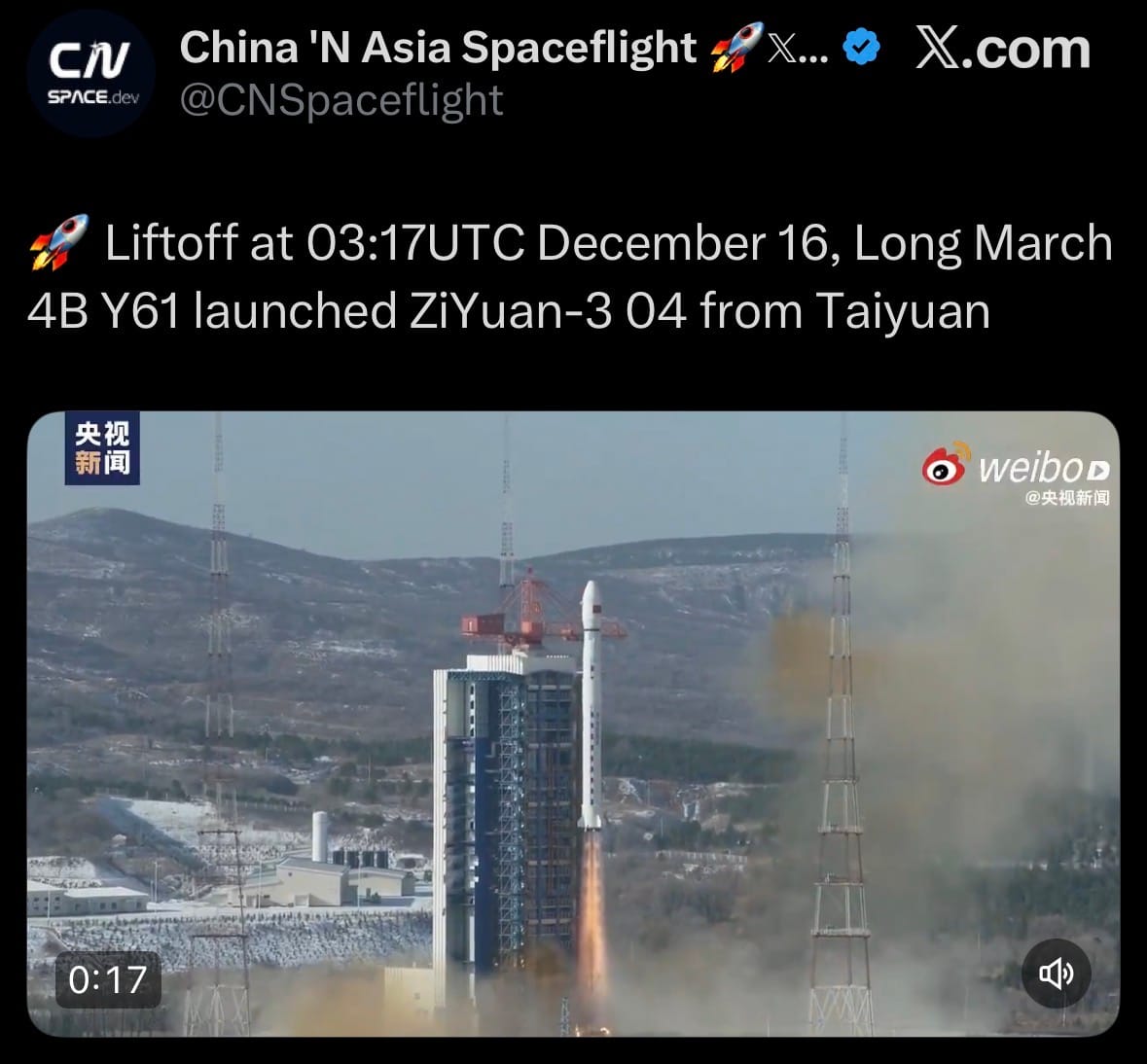
- The launch, part of China's ongoing expansion of its civilian remote sensing constellation, achieved orbit successfully in a sun-synchronous configuration. This marks the latest addition to the Ziyuan-3 family, following ZY-3 01 (2012), ZY-3 02 (2016), and ZY-3 03 (2020), enhancing global revisit coverage and data accuracy for national resource management. No secondary payloads were reported.
Statistic:
- Largest public clothing companies on Earth by market capitalization:
- 🇫🇷 LVMH: $365.56B
- 🇫🇷 Hermès: $265.35B
- 🇪🇸 Inditex: $200.13B
- 🇺🇸 TJX Companies: $174.40B
- 🇫🇷 Dior: $124.13B
- 🇯🇵 Fast Retailing: $112.22B
- 🇺🇸 Nike: $100.19B
- 🇺🇸 Cintas: $75.93B
- 🇺🇸 Ross Stores: $59.93B
- 🇫🇷 Kering: $43.85B
- 🇩🇪 Adidas: $34.91B
- 🇸🇪 H&M: $31.08B
- 🇺🇸 Tapestry: $25.58B
- 🇨🇦 lululemon athletica: $24.46B
- 🇺🇸 Ralph Lauren: $22.54B
- 🇬🇧 Next plc: $20.83B
- 🇮🇹 Moncler: $18.04B
- 🇺🇸 Burlington Stores: $16.95B
- 🇮🇹 Prada: $14.75B
- 🇨🇦 Gildan: $11.13B
- 🇵🇱 LPP SA: $10.58B
- 🇺🇸 Gap Inc.: $9.97B
- 🇨🇦 Aritzia: $9.53B
- 🇺🇸 Levi Strauss & Co.: $8.68B
- 🇮🇹 Brunello Cucinelli: $7.80B
History:
- Cloud seeding begins as a scientific experiment driven by the desire to influence weather rather than simply predict it. The concept emerges in the 1940s, when researchers realized that clouds often contain supercooled water droplets that fail to form rain without a trigger. In 1946, scientists Vincent Schaefer and Irving Langmuir at General Electric conducted the first successful cloud-seeding experiment by dispersing dry ice (solid CO₂) into a cloud, causing ice crystals to form and precipitation to fall. Shortly afterward, silver iodide—which mimics the crystalline structure of ice—became the preferred seeding agent due to its effectiveness and ease of dispersal. During the 1950s–1960s, cloud seeding spread rapidly, fueled by Cold War optimism and government funding. The United States launched large-scale programs such as Project Cirrus (1947) and Project Skywater (1962–1983) to study precipitation enhancement and drought mitigation. Other countries followed suit, including the Soviet Union, Australia, and Israel. At the same time, controversy grew: weather systems are chaotic, proving causation was difficult, and ethical questions emerged about who “owns” modified rainfall. The technology took a darker turn during the Vietnam War, when the U.S. military ran Operation Popeye (1967–1972) to extend monsoon seasons over supply routes—an effort that ultimately led to the 1977 ENMOD Convention, banning hostile weather modification as a weapon.
- From the late 20th century into today, cloud seeding shifted from experimental science to operational infrastructure in certain regions. Advances in meteorology, radar, aircraft, and atmospheric modeling made seeding more targeted and measurable, especially for snowpack enhancement in mountainous regions. The United States continues to run seeding programs at the state level—particularly in Colorado, Utah, Wyoming, and California—primarily to increase winter snowpack for water supply rather than direct rainfall. China, however, has become the world’s largest and most ambitious cloud-seeding operator. Beginning in the 1990s and massively expanding after 2008, China built a nationwide weather-modification system using aircraft, rockets, artillery shells, and ground-based generators to induce rain and snow, suppress hail, and clear air pollution. By the 2020s, China claimed coverage over millions of square kilometers, integrating cloud seeding into agricultural planning, disaster mitigation, and water security strategy. Other major players include Russia, which uses seeding to clear skies for national events, and countries in the Middle East, such as the UAE, which invest heavily in seeding to combat arid conditions. As climate change increases drought risk and water stress, cloud seeding has re-emerged as a strategic tool at the edge of atmospheric control: not a solution to weather scarcity, but a probabilistic intervention used by states willing to operate in the gray zone between natural systems and engineered influence.
Image of the day:

Thanks for reading! Earth is complicated, we make it simple.
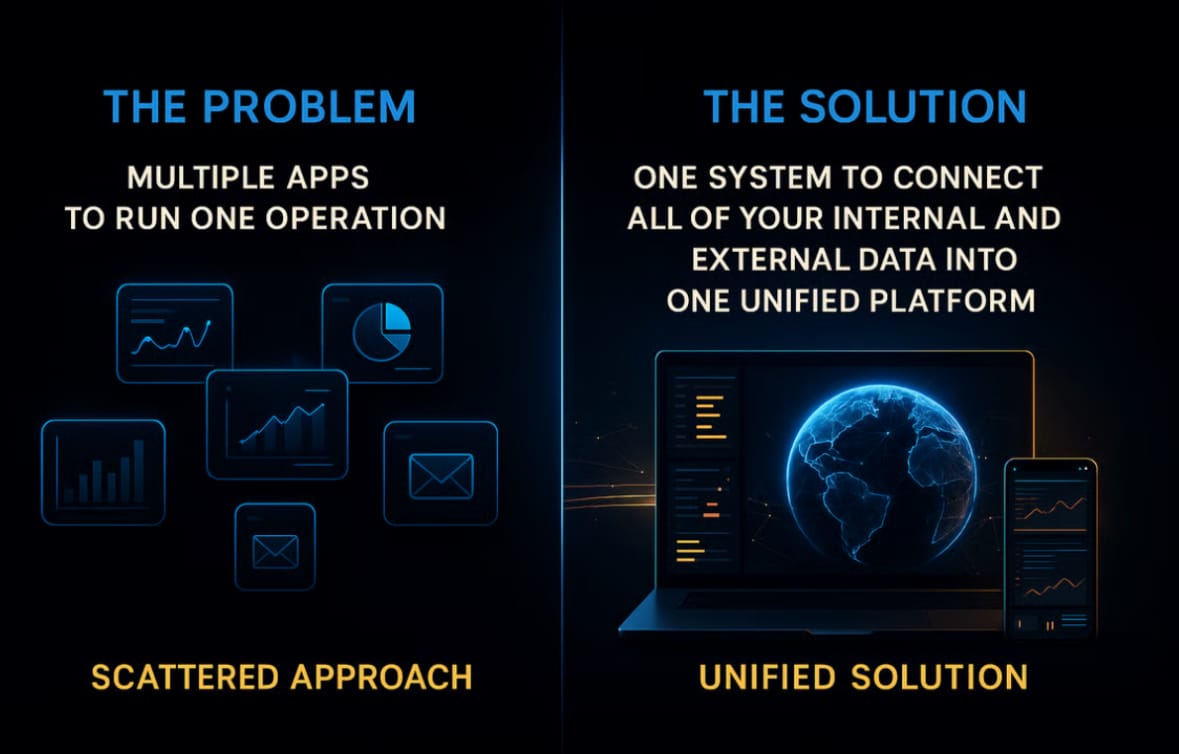

- Click below if you’d like to view our free EARTH WATCH globe:
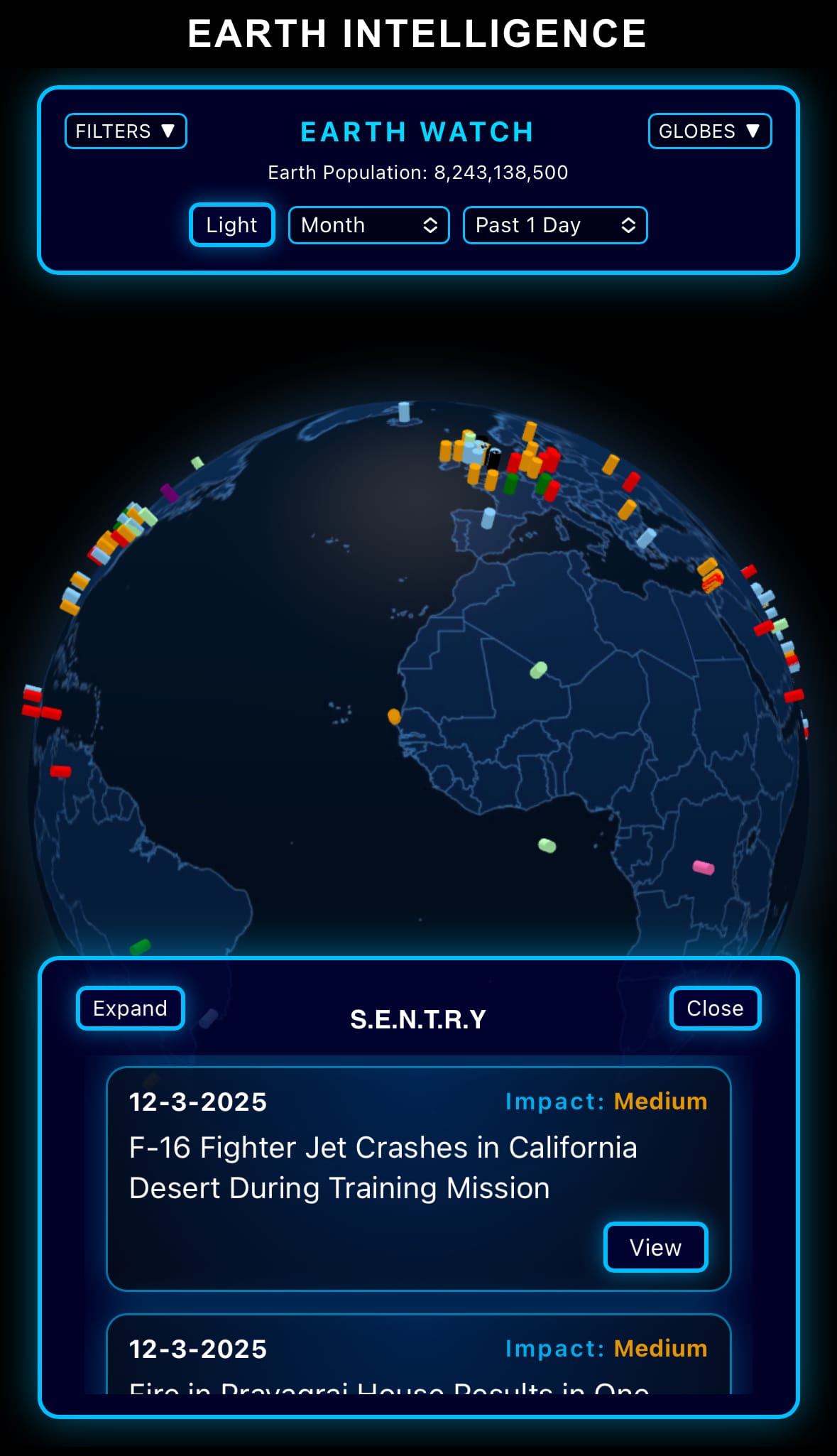
- Download our mobile app on the Apple App Store (Android coming soon):

Click below to view our previous newsletters:

Support/Suggestions Email:
earthintelligence@earthintel.news