Tuesday☕️


Economics & Markets:
- Yesterday’s U.S. stock market:

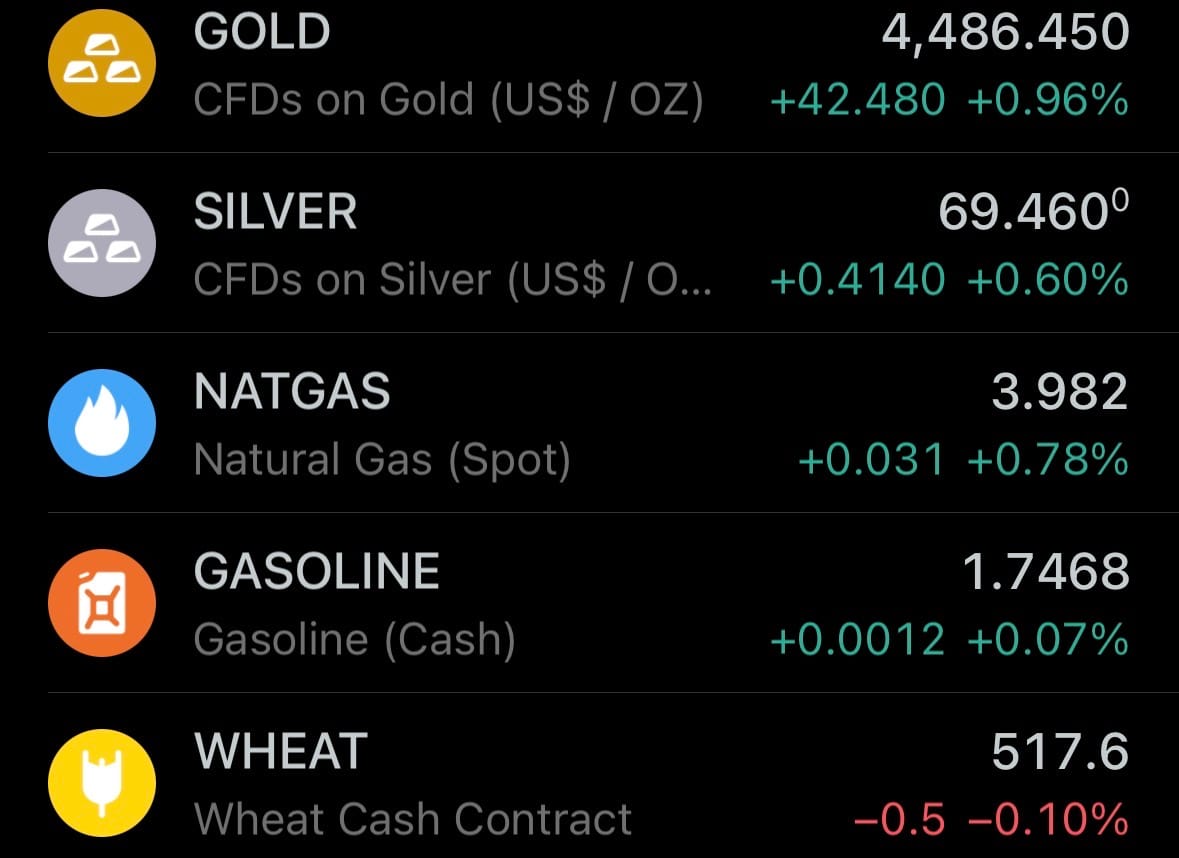
- Yesterday’s commodity market:
- Yesterday’s crypto market:

Geopolitics & Military Activity:
- On December 22, 2025, U.S. Joint Task Force Southern Spear conducted a lethal kinetic strike on a low-profile vessel in the Eastern Pacific, killing one male described as a narco-terrorist. Authorized by Secretary of Defense Pete Hegseth, the strike targeted a boat intelligence linked to a designated terrorist organization engaged in drug smuggling along known trafficking routes. No U.S. forces were harmed, and footage was released.
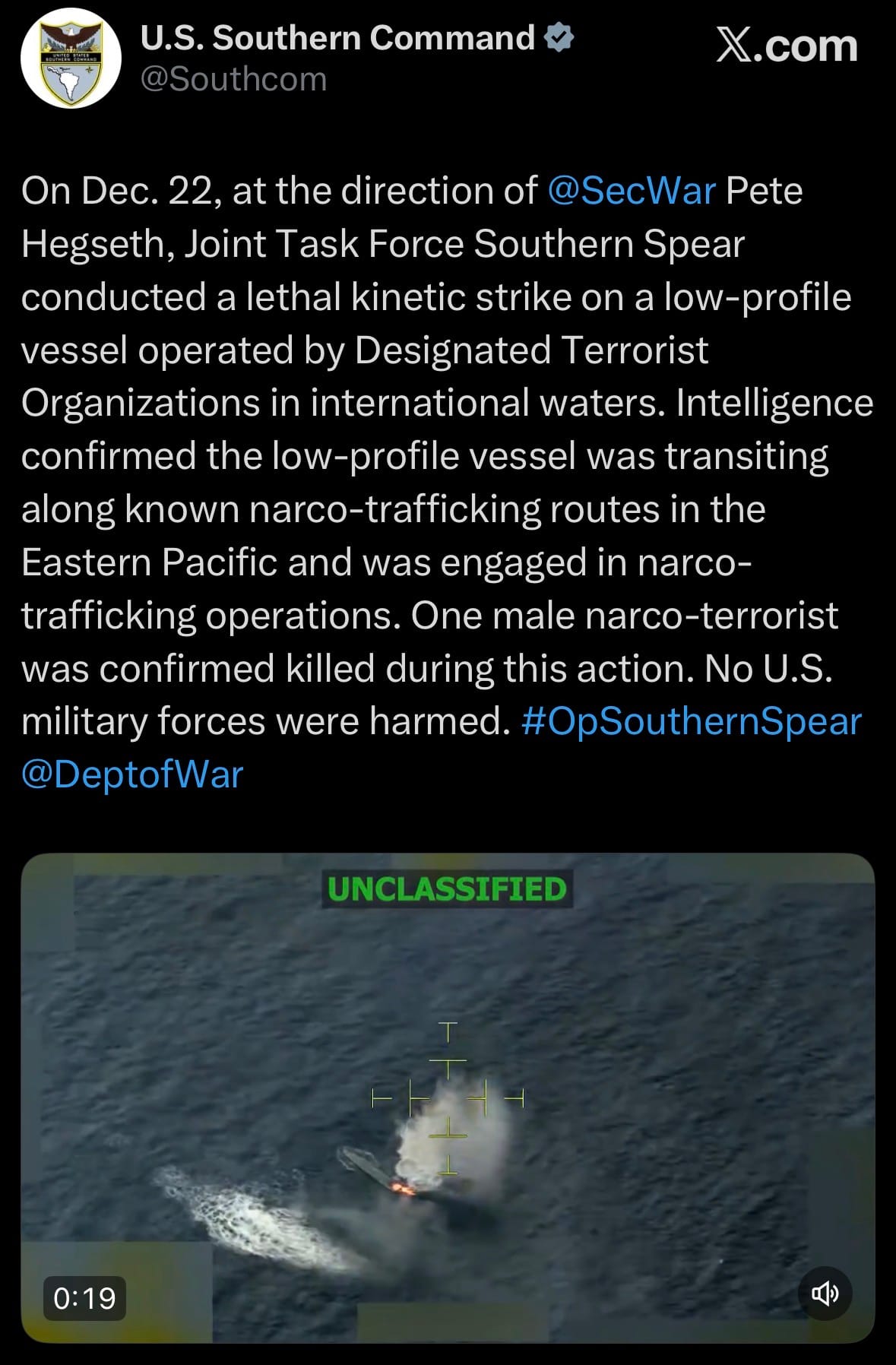
- This brings the death toll in Operation Southern Spear to at least 105 across over 28 strikes since September 2025.
USS DEFIANT:
- On December 22, 2025, President Donald Trump announced a new Trump-class large surface warship program, designating the lead vessel USS Defiant (BBG-1) and calling the ships modern "battleships." The announcement at Mar-a-Lago, with Secretary of Defense Pete Hegseth and Navy Secretary John Phelan, showcased concept art of vessels armed with hypersonic missiles, directed-energy lasers, railguns, and nuclear-capable cruise missiles. Initial plans include two ships, with potential growth to 10-25 under the "Golden Fleet" initiative to boost U.S. shipbuilding and fleet modernization.
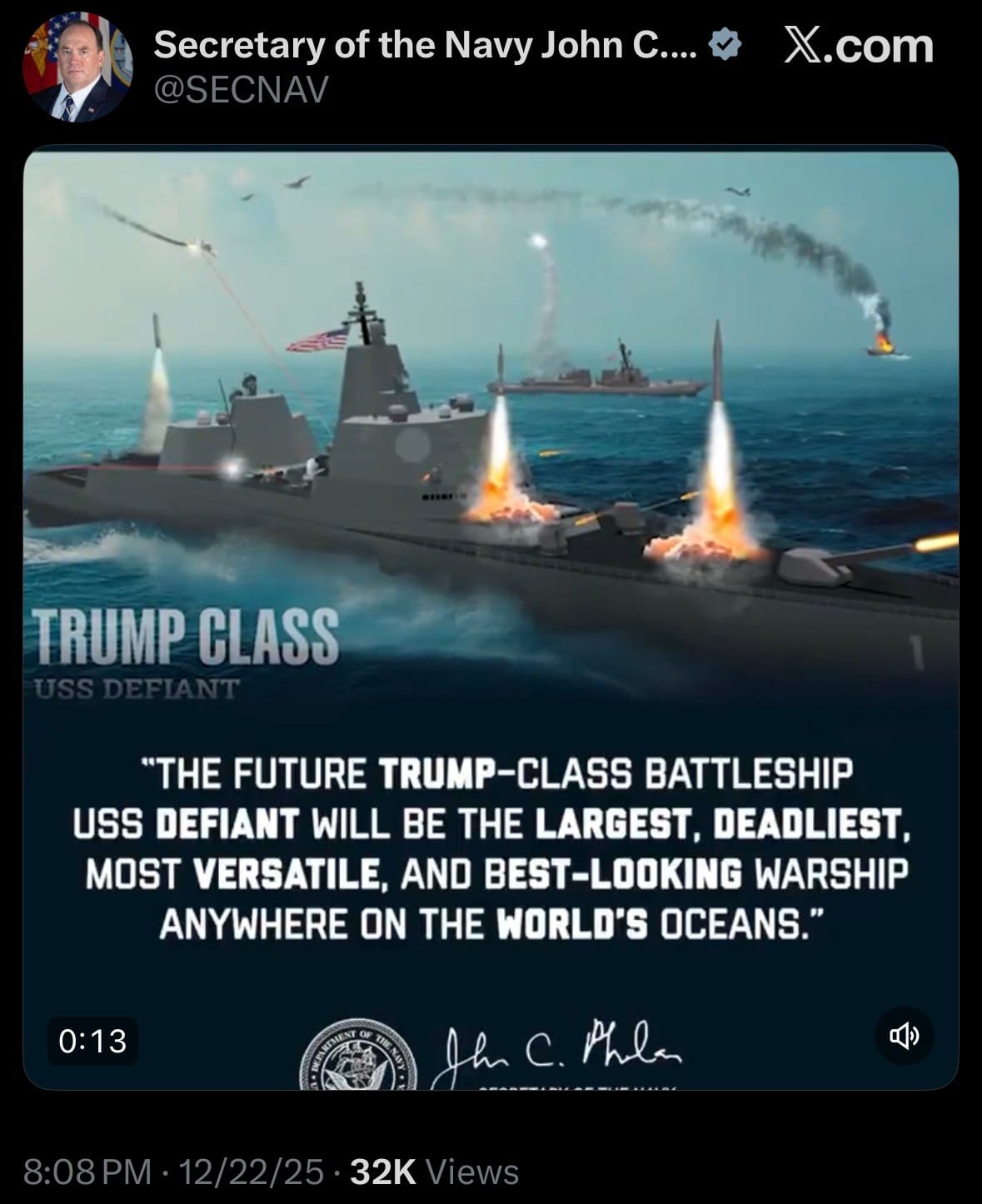
- The proposed 30,000-40,000-ton ships—larger than Arleigh Burke destroyers but smaller than WWII battleships—focus on proven technologies like expanded vertical launch systems, aesthetics, and deterrence. This follows Navy decisions to cut the delayed Constellation-class frigate and explore a new frigate based on the Coast Guard's Legend-class cutter.
Environment & Weather:
- On December 22-23, 2025, severe flooding struck Corrientes City and surrounding areas in northeastern Argentina's Corrientes Province after torrential rains dumped 140-340 mm of water in under 48 hours, with some localities recording up to 250 mm in eight hours. Provincial authorities reported over 600 families affected, with more than 150 people evacuated and sheltered in schools; municipal and civil defense teams deployed pumps, cleared drains, and provided assistance amid ongoing orange-level alerts for further storms.

- The event, described by locals and officials as one of the most intense in recent records, prompted a coordinated emergency response from the provincial government and municipality, including machinery for water removal and cleanup in hardest-hit neighborhoods. Additional precipitation of up to 110 mm was forecast, prolonging risks as saturated ground limited absorption.
Space:
- On December 22, 2025 (December 23 UTC), South Korean startup Innospace's Hanbit-Nano small launch vehicle failed on its maiden orbital flight during the Spaceward mission from Alcântara Space Center, Brazil. The two-stage rocket (hybrid first stage, liquid methane second stage) lifted off at ~01:13 UTC but exploded around 50 seconds into flight during max-Q, with debris falling back to the ground. No injuries occurred, and the livestream ended abruptly.
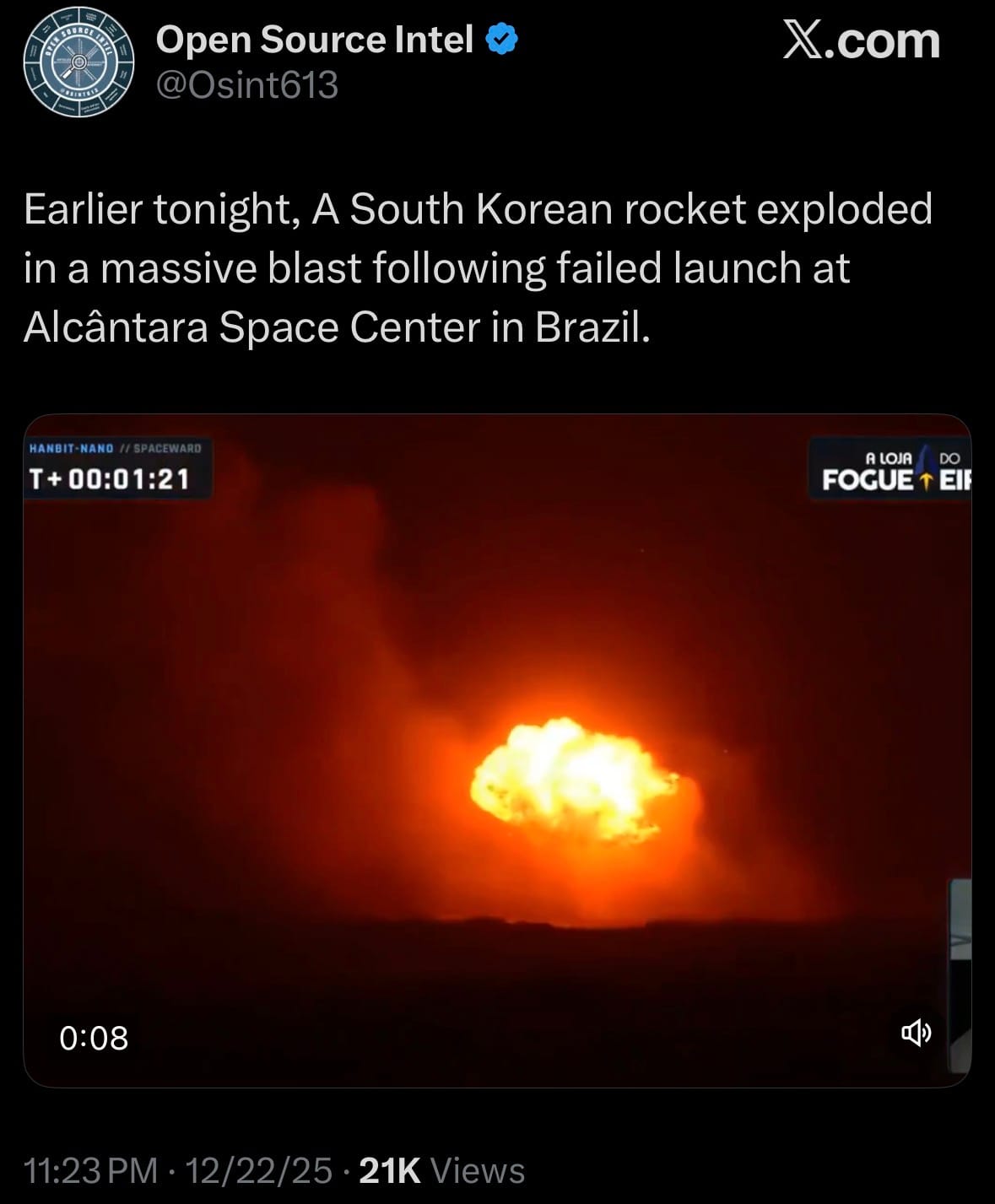
- The mission was to deploy eight customer payloads—including five small satellites from Brazil's AEB, Universidade Federal do Maranhão, and India's Grahaa Space for climate monitoring, technology, and education—plus three experimental payloads into 300 km orbit. This aimed to be Innospace's first commercial orbital success after suborbital tests; investigations into the failure are ongoing.
- On December 23, 2025, China successfully conducted the maiden flight of the Long March 12A medium-lift rocket from Jiuquan Satellite Launch Center. Liftoff occurred at ~02:00 UTC (10:00 a.m. Beijing time), with the liquid-fueled rocket—powered by four YF-100K engines on the first stage and two YF-115 engines on the second—deploying multiple experimental satellites for technology demonstration, Earth observation, and communications testing into orbit.
- The CZ-12A, capable of lifting 10 tons to LEO or 6 tons to SSO, enhances China's launch capacity with a design suited for cost-effective, high-frequency missions (future variants from coastal sites). This debut contributes to China's projected record of over 100 orbital launches in 2025; no booster recovery was attempted.
Statistic:
- Largest public semiconductor companies by market capitalization:
- 🇺🇸 NVIDIA: $4.472T
- 🇺🇸 Broadcom: $1.618T
- 🇹🇼 TSMC: $1.521T
- 🇰🇷 Samsung: $506.72B
- 🇳🇱 ASML: $410.26B
- 🇺🇸 AMD: $349.94B
- 🇺🇸 Micron Technology: $311.30B
- 🇰🇷 SK Hynix: $274.25B
- 🇺🇸 Lam Research: $221.00B
- 🇺🇸 Applied Materials: $206.33B
- 🇺🇸 QUALCOMM: $187.98B
- 🇺🇸 Intel: $173.48B
- 🇺🇸 KLA: $166.66B
- 🇺🇸 Texas Instruments: $162.57B
- 🇺🇸 Analog Devices: $135.05B
- 🇬🇧 Arm Holdings: $120.20B
- 🇯🇵 Tokyo Electron: $96.29B
- 🇺🇸 Synopsys: $92.06B
- 🇯🇵 Advantest: $90.95B
- 🇨🇳 SMIC: $87.97B
- 🇨🇳 Cambricon Technologies: $79.46B
- 🇺🇸 Marvell Technology: $73.10B
- 🇹🇼 MediaTek: $70.66B
- 🇳🇱 NXP Semiconductors: $57.71B
- 🇩🇪 Infineon: $56.17B
History:
- Undersea communication cables begin as a strategic response to distance, not the internet. In 1851, the first submarine telegraph cable crossed the English Channel, and by 1866 a durable transatlantic cable permanently linked Europe and North America, collapsing communication times from weeks to minutes. These early copper cables became instruments of empire: by the late 19th century, Britain controlled much of the world’s cable infrastructure, giving it enormous diplomatic and military leverage. During World War I and World War II, undersea cables were cut, tapped, and protected as critical wartime assets, proving that seabed communications were as strategically important as naval routes. Postwar demand for voice communication led to coaxial submarine telephone cables in the 1950s–1960s, but their capacity was limited. The true revolution came with fiber optics. After the first commercial fiber systems went live on land in 1977, engineers adapted the technology for the ocean. In 1988, TAT-8, the first transatlantic fiber-optic cable, entered service, carrying vastly more data with lower signal loss than any predecessor. Through the 1990s, optical amplifiers, wavelength-division multiplexing, and improved repeaters turned undersea cables into high-capacity digital pipelines capable of supporting the early internet, global finance, and multinational corporate networks.
- The 2000s marked the transformation of undersea cables from telecom infrastructure into the backbone of the digital world. As internet traffic exploded with broadband, streaming, cloud computing, and mobile data, cable capacity scaled exponentially. Dense wavelength-division multiplexing allowed a single fiber pair to carry tens, then hundreds, of terabits per second. By the late 2000s, new transpacific and transatlantic systems supported globalized markets, real-time trading, and data-center interconnection. In the 2010s, ownership shifted dramatically: major technology companies—Google, Meta, Amazon, Microsoft—began financing and operating their own cables to control latency, reliability, and data flow for cloud services and AI workloads. Today, more than 500 active undersea fiber-optic cables, spanning over 1.4 million kilometers, carry over 95% of intercontinental data traffic. This scale has turned cables into geopolitical flashpoints. Accidental damage from fishing and anchors remains common, but concern over espionage, surveillance, and deliberate sabotage has grown, especially after heightened great-power competition in the 2020s. Nations now track cable routes, harden landing stations, deploy repair fleets, and quietly prepare contingency plans, knowing that disabling a small number of key links could disrupt economies, militaries, and entire regions. In the modern era, undersea fiber cables are no longer just communication tools—they are strategic infrastructure on par with energy pipelines and shipping lanes, forming a fragile, invisible nervous system that keeps the global digital world alive.
Image of the day:

Thanks for reading! Earth is complicated, we make it simple.
- Click below if you’d like to view our free EARTH WATCH globe:
- Download our mobile app:



Click below to view our previous newsletters:

Support/Suggestions Email:
earthintelligence@earthintel.news