Tuesday☕️


Trending:
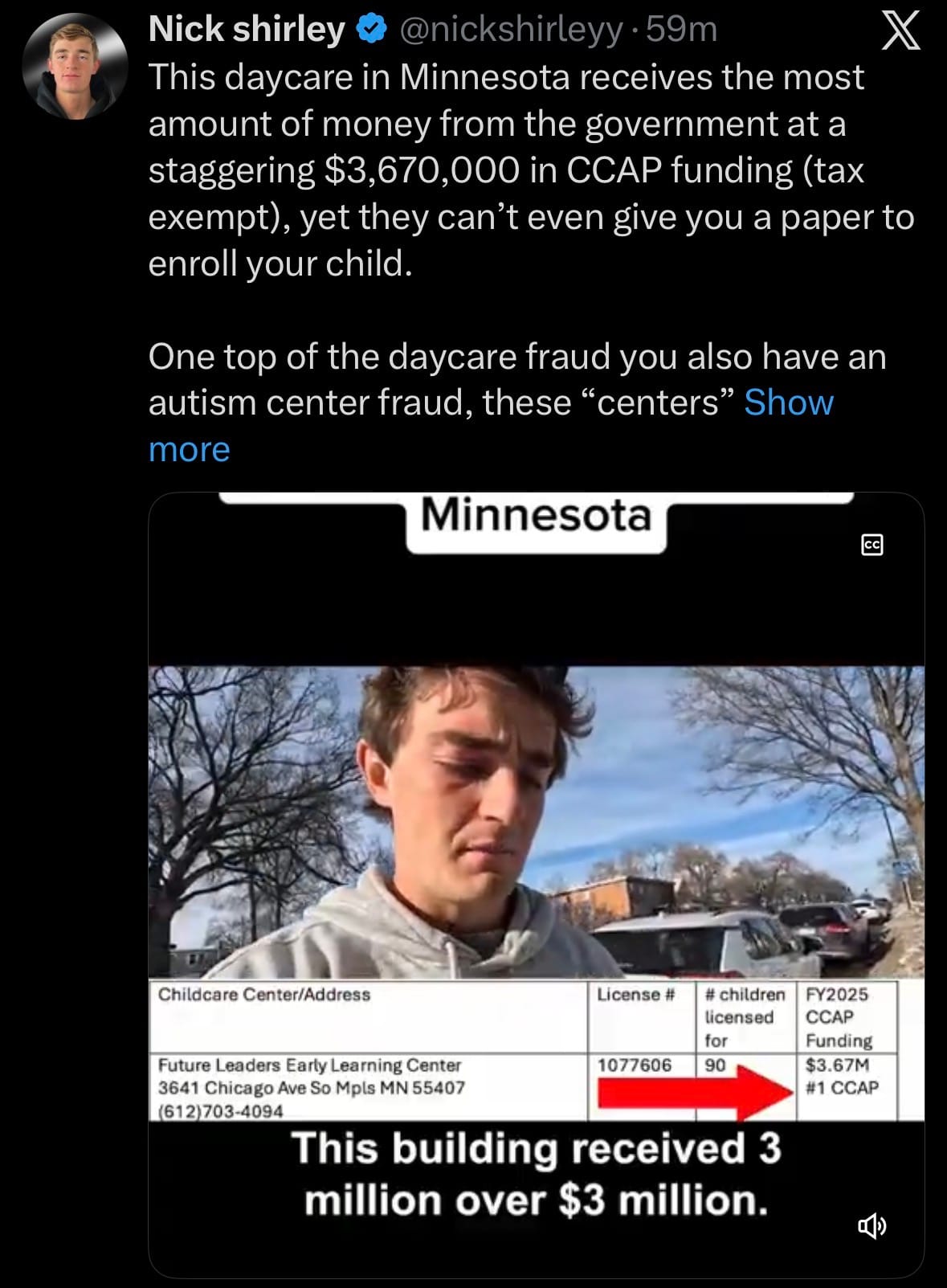
- On December 26-29, 2025, a video by independent journalist and YouTuber Nick Shirley went viral, amassing over 120 million views on X and millions more on YouTube, alleging widespread fraud in Minnesota's childcare assistance programs. Shirley visited several Minneapolis daycare centers—many appearing empty, locked, or inactive despite being licensed for dozens of children—and highlighted cases like the "Quality Learning Center" (with a misspelled sign) that reportedly received $1.9 million in 2025 from the state's Child Care Assistance Program (CCAP), part of claims totaling over $110 million in suspicious payments uncovered in one day. The video sparked national attention, with endorsements from figures like Elon Musk, JD Vance, and Kash Patel, amplifying scrutiny on Governor Tim Walz's administration amid ongoing federal probes into broader social services fraud (including a prior $250 million COVID-era scheme with 78 indictments).
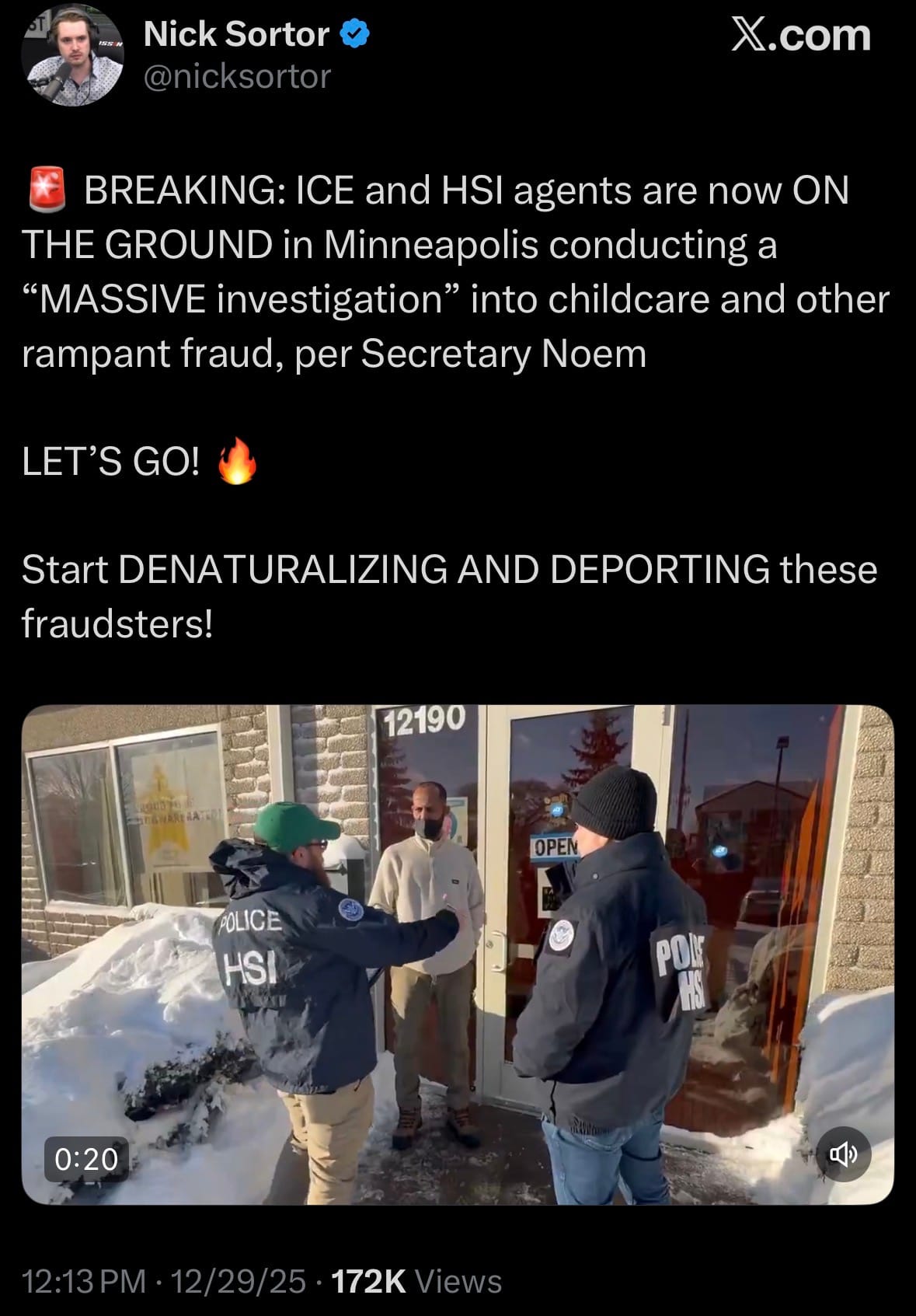
- The allegations build on existing investigations into Minnesota's welfare programs, where federal authorities estimate up to $1-9 billion in losses across childcare, nutrition, and other aid, often involving overstated reimbursements or shell operations. While some centers cited in the video have documented violations or low activity, state officials defend oversight efforts and note automatic payments based on claims; the FBI confirmed surging resources to the state before the video, calling it the "tip of the iceberg." Public discourse has spread to similar unverified claims in states like Ohio (via viral TikToks urging Shirley to investigate Columbus daycares) and others, with users and commentators suggesting parallel fraud in childcare funding nationwide, though no confirmed multi-state probes tied directly to this video have emerged yet. This highlights growing concerns over taxpayer-funded program vulnerabilities, potentially fueling broader audits of assistance schemes across the U.S.
Economics & Markets:
- Yesterday’s U.S. stock market:

- Yesterday’s commodity market:

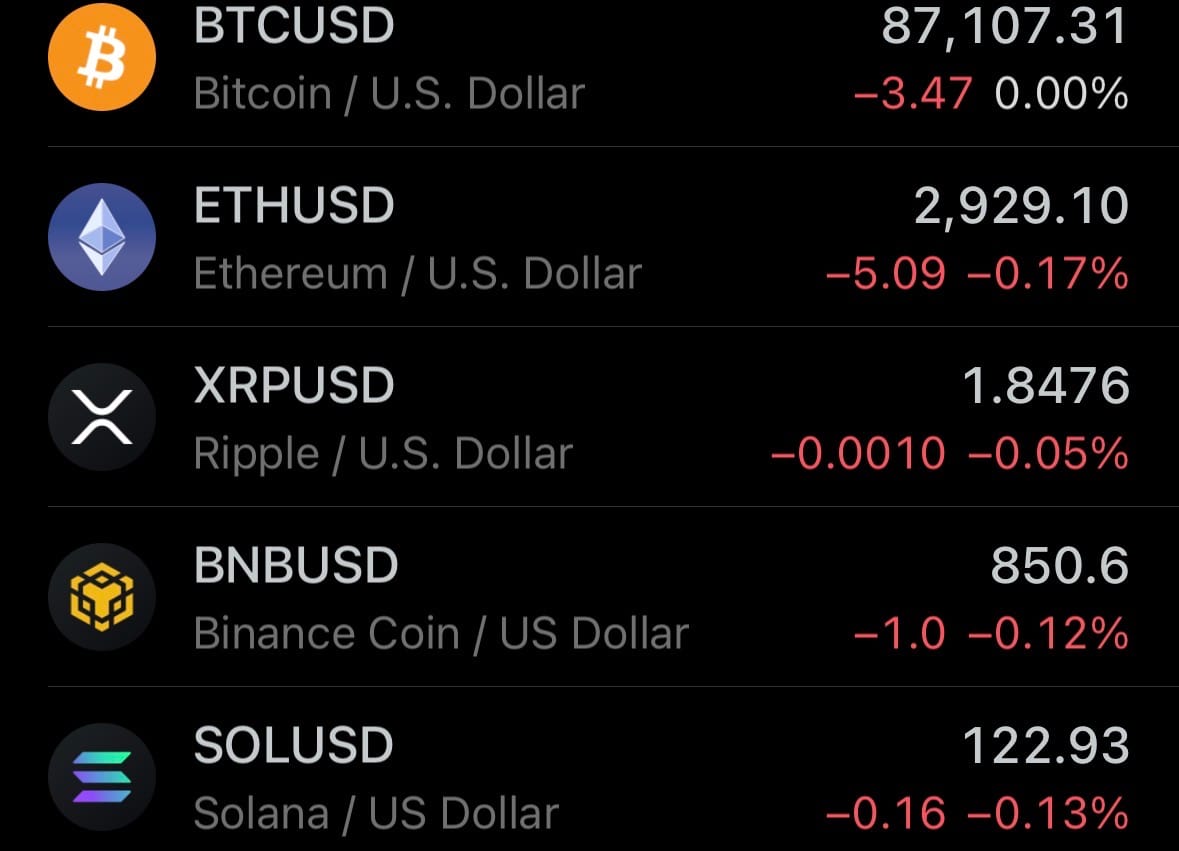
- Yesterday’s crypto market:
Geopolitics & Military Activity:
- On December 29, 2025, Joint Task Force Southern Spear conducted a lethal kinetic strike on a vessel in international waters of the Eastern Pacific, killing two individuals described as male narco-terrorists. Authorized by Secretary of Defense Pete Hegseth, the strike targeted a boat intelligence linked to a designated terrorist organization engaged in drug smuggling along known trafficking routes. No U.S. forces were harmed, and video footage was released.
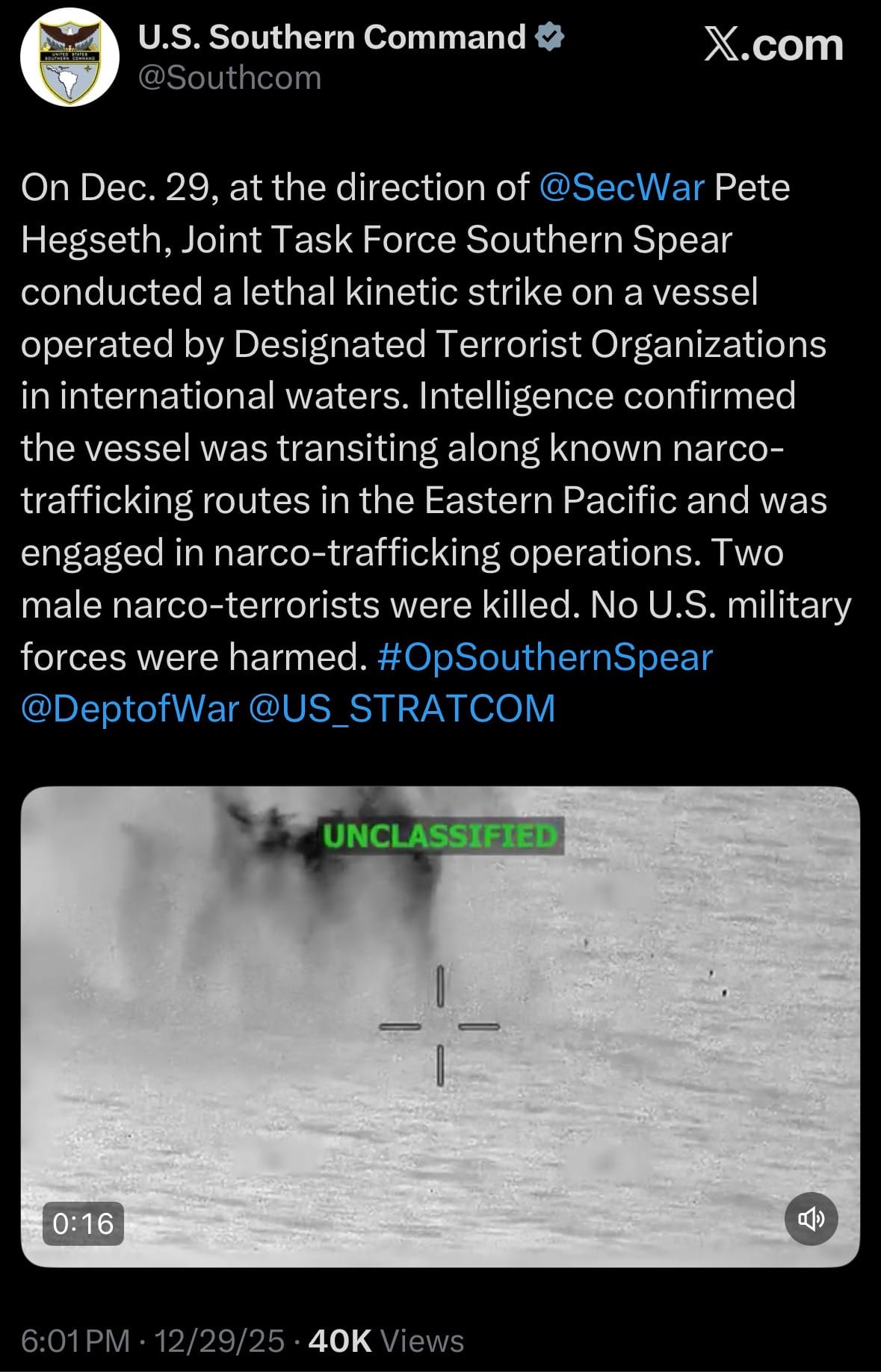
- This action raises the reported death toll in Operation Southern Spear to at least 107 across over 29 strikes since September 2025, demonstrating a sustained and aggressive U.S. security posture in the Eastern Pacific and Caribbean to intercept illicit trafficking networks. The frequent, precise operations underscore Washington's heightened commitment to maritime domain awareness and kinetic disruption in these regions, aiming to deter and dismantle narco-terrorist activities at sea. Continued operations signal a long-term strategy to maintain dominance over key drug transit zones, enhancing overall hemispheric stability through proactive enforcement.
Cyber:
- On December 29, 2025, hackers began actively exploiting a serious security flaw (CVE-2025-14847, nicknamed "MongoBleed") in MongoDB databases. This unauthenticated vulnerability lets attackers send specially crafted messages to leak sensitive data—like passwords, API keys, and session tokens—from server memory without needing login credentials. Proof-of-concept attacks appeared publicly on December 26, and real-world exploitation followed quickly.

- Over 87,000 MongoDB servers are exposed on the internet and potentially vulnerable. This mainly affects companies, developers, and organizations running self-hosted MongoDB instances (cloud-hosted MongoDB Atlas was patched automatically). If you use MongoDB for any application storing user data, secrets, or credentials, update immediately to the patched versions (e.g., 8.2.3 or later) to prevent data leaks—delaying could expose confidential information to attackers scanning the web.
Statistic:
- Largest public banking companies by market capitalization:
- 🇺🇸 JPMorgan Chase: $890.23B
- 🇺🇸 Bank of America: $409.97B
- 🇨🇳 Agricultural Bank of China: $381.70B
- 🇨🇳 ICBC: $358.12B
- 🇨🇳 China Construction Bank: $346.18B
- 🇺🇸 Wells Fargo: $302.78B
- 🇺🇸 Morgan Stanley: $287.24B
- 🇬🇧 HSBC: $270.70B
- 🇺🇸 Goldman Sachs: $270.08B
- 🇨🇳 Bank of China: $261.26B
- 🇨🇦 Royal Bank Of Canada: $241.28B
- 🇺🇸 Citigroup: $217.46B
- 🇮🇳 HDFC Bank: $186.35B
- 🇺🇸 Charles Schwab: $183.89B
- 🇯🇵 Mitsubishi UFJ Financial: $180.66B
- 🇦🇺 Commonwealth Bank: $179.70B
- 🇪🇸 Santander: $171.55B
- 🇨🇳 CM Bank: $169.17B
- 🇨🇦 Toronto Dominion Bank: $161.90B
- 🇺🇸 Capital One: $157.16B
- 🇨🇭 UBS: $146.68B
- 🇪🇸 Banco Bilbao Vizcaya Argentaria: $131.08B
- 🇯🇵 Sumitomo Mitsui Financial Group: $125.27B
- 🇸🇬 DBS Group: $124.02B
- 🇮🇹 UniCredit: $122.84B
History:
- The torpedo begins as an idea before it becomes a weapon: how to strike ships below the waterline, where armor is weakest. Early attempts in the 18th and early 19th centuries involved crude explosive charges on poles or drifting mines, but these required close contact and were unreliable. The modern torpedo truly emerges in 1866, when British engineer Robert Whitehead developed the first self-propelled, steerable underwater weapon for the Austro-Hungarian Navy. Whitehead’s torpedo used compressed air for propulsion, gyroscopes for stabilization, and preset depth control—a revolutionary combination that immediately changed naval warfare. By the late 19th century, torpedoes forced navies to rethink ship design, leading to the rise of destroyers (originally “torpedo-boat destroyers”) and new defensive tactics. In World War I, torpedoes became strategic weapons: German U-boats used them to sink merchant shipping, demonstrating that small submarines armed with torpedoes could threaten entire empires. By World War II, torpedo technology had advanced significantly—improved propulsion, magnetic and contact detonators, and longer ranges made them decisive weapons at sea. Submarine-launched torpedoes crippled supply lines, while aerial torpedoes—famously used by Japan at Pearl Harbor (1941) and by Britain against the Bismarck (1941)—proved aircraft could deliver underwater weapons effectively.
- After 1945, torpedoes entered the guided, high-speed era. Early Cold War designs introduced active and passive acoustic homing, allowing torpedoes to track targets autonomously rather than run straight courses. Nuclear submarines pushed requirements further: torpedoes needed longer range, greater speed, and sophisticated guidance to operate in deep, contested oceans. By the 1960s–1970s, heavyweight torpedoes became the primary weapon of attack submarines, while lightweight torpedoes were optimized for anti-submarine warfare from ships and aircraft. Modern torpedoes now use wire guidance, advanced sonar, digital signal processing, and counter-countermeasures to distinguish targets from decoys and clutter. Some employ supercavitation—using gas bubbles to reduce drag and reach extreme speeds—while others prioritize stealth and endurance. Today’s leading naval powers—the United States, Russia, China, the United Kingdom, France, and others—field torpedoes that can operate autonomously across complex underwater environments, network with launch platforms, and adapt mid-course. What began as a compressed-air projectile has evolved into one of the most lethal and sophisticated weapons ever built: a silent, intelligent system that embodies undersea warfare itself, where detection, guidance, and precision matter more than sheer explosive force.
Image of the day:

Thanks for reading! Earth is complicated, we make it simple.
- Click below if you’d like to view our free EARTH WATCH globe:
- Download our mobile app:



Click below to view our previous newsletters:

Support/Suggestions Email:
earthintelligence@earthintel.news