Tuesday☕️


Trending:
- On February 2, 2026, Elon Musk announced that SpaceX has acquired xAI, merging the two companies into one organization combining capabilities in AI development, rocket technology, Starlink satellite internet, direct-to-mobile satellite connectivity, and real-time information platforms. The stated long-term goal is to develop large-scale AI systems in space to advance scientific understanding and support human expansion beyond Earth.

- The primary proposal is to deploy up to one million satellites functioning as orbital data centers to provide massive AI computing power, addressing constraints of terrestrial data centers such as electricity consumption and cooling requirements. Musk argued that space-based systems, powered by continuous solar energy, could become the most cost-effective option for AI compute within 2–3 years.
Economics & Markets:
- Yesterday’s U.S. stock market:

- Yesterday’s commodity market:

- Yesterday’s crypto market:

Business:
- On February 2, 2026, Ondas Holdings Inc. (Nasdaq: ONDS) announced it has entered into a definitive agreement to acquire Rotron Aero, a UK-based developer of advanced unmanned aerial systems (UAS) and long-range autonomous platforms designed for extended-reach operations and autonomous strike missions.

- The acquisition aims to strengthen Ondas' "systems of systems" architecture by adding long-range unmanned vehicles, attritable one-way autonomous attack platforms, advanced propulsion and engineering capabilities, integrated command-and-control technologies, and an established presence in the UK/European defense market. This expands Ondas Autonomous Systems (OAS) offerings in defense and security, supporting scalable, cost-effective technologies for modern battlefield needs.
Science & Technology:
- On February 2, 2026, OpenAI introduced the Codex app, described as a powerful command center for building and managing AI agents. The app is now available for download on macOS. The Codex app serves as a unified interface for developers and users to create, orchestrate, debug, and deploy AI agents built with OpenAI models.

- Key features include a visual workflow builder for chaining agent actions, real-time monitoring of agent performance, integrated code editing and execution, access to tools and APIs, collaboration tools for team-based agent development, and direct integration with the latest models (including o3 and GPT-5 series). It is designed to simplify the process of turning agent ideas into production-ready systems, with support for multi-agent setups, custom tools, memory management, and evaluation suites.
Statistic:
- Largest public automakers on Earth by market capitalization:
- 🇺🇸 Tesla: $1.582T
- 🇯🇵 Toyota: $303.25B
- 🇨🇳 BYD: $116.70B
- 🇨🇳 Xiaomi: $116.57B
- 🇰🇷 Hyundai: $87.12B
- 🇺🇸 General Motors: $78.61B
- 🇩🇪 BMW: $63.25B
- 🇩🇪 Volkswagen: $61.68B
- 🇩🇪 Mercedes-Benz: $60.95B
- 🇮🇹 Ferrari: $59.57B
- 🇺🇸 Ford: $55.02B
- 🇮🇳 Maruti Suzuki India: $49.55B
- 🇮🇳 Mahindra & Mahindra: $45.55B
- 🇩🇪 Porsche: $43.82B
- 🇰🇷 Kia: $40.21B
- 🇯🇵 Honda: $39.94B
- 🇳🇱 Stellantis: $28.59B
- 🇯🇵 Suzuki Motor: $26.68B
- 🇨🇳 Seres Group: $26.19B
- 🇨🇳 Great Wall Motors: $25.18B
- 🇨🇳 SAIC Motor: $23.25B
- 🇨🇳 Geely: $22.53B
- 🇨🇳 Chery Automobile: $21.15B
- 🇮🇳 Hyundai Motor India: $19.57B
- 🇺🇸 Rivian: $17.70B
History:
- The history of identity systems begins with a simple problem: how to prove who someone is when trust alone is no longer enough. In early societies, identity was personal and local—recognized by face, voice, lineage, or reputation. As states grew, identity had to scale. Ancient civilizations used seals, signet rings, and written records as early authentication tools; a stamped clay tablet in Mesopotamia or a wax seal in Rome wasn’t just decoration, it was legal authority. Empires tracked identity through censuses, tax rolls, and household registries—China maintained population records as early as 200 BC, while Rome issued travel papers and recorded citizenship status. In medieval Europe, identity was tied to fealty and land, validated by documents, witnesses, and heraldry. The invention of widespread literacy and printing made identity portable: letters of introduction, notarized documents, and eventually passports allowed individuals to move across jurisdictions while carrying proof of who they were. By the 18th–19th centuries, modern states began formalizing identity at scale through birth records, property registries, and standardized documentation—laying the groundwork for bureaucratic control.
- The industrial age turned identity into an administrative system, and later, a security system. As populations exploded and mobility increased, governments needed reliable ways to distinguish citizens, workers, soldiers, and foreigners. The passport became standardized in the early 20th century, particularly after World War I, when borders hardened and states demanded proof of nationality. At the same time, new forms of biometric identification emerged. Fingerprinting, adopted widely by police forces in the late 1800s, provided a physical, difficult-to-forge marker of identity and quickly became foundational to law enforcement and criminal justice. Militaries built personnel identification systems to manage mass mobilization, while companies introduced employee badges and credentials. During the Cold War, identity systems expanded alongside surveillance and intelligence: background checks, clearance levels, and compartmentalization determined who could access information, facilities, and command authority. Identity was no longer just about who you were—it was about what you were allowed to do, where you could go, and what systems would respond to you.
- In the digital era, identity became both more powerful and more fragile. Passwords, PINs, and usernames emerged as the first generation of digital authentication, but they proved weak against scale, reuse, and compromise. This drove the rise of multi-factor authentication—combining something you know (password), something you have (token, phone), and something you are (biometrics like fingerprints, facial recognition, and iris scans). Smartphones turned identity into a continuous signal: biometrics, location, device fingerprints, and behavior patterns now authenticate users invisibly in real time. Governments deploy national digital ID systems; financial institutions rely on identity verification to control access to money; militaries and intelligence agencies use hardened, layered identity frameworks tied to encryption keys, zero-trust architectures, and classified networks. Identity has become a control plane for civilization—governing access to borders, banking, healthcare, communications, weapons systems, and data itself. As identity systems move toward cryptographic credentials, decentralized identity, and AI-driven verification, the stakes grow higher: whoever controls identity infrastructure can include or exclude, enable or disable, trust or deny. In the modern world, identity is no longer just proof of self—it is the master key that determines participation in society, security, and power.
Image of the day:

Thanks for reading! Earth is complicated, we make it simple.
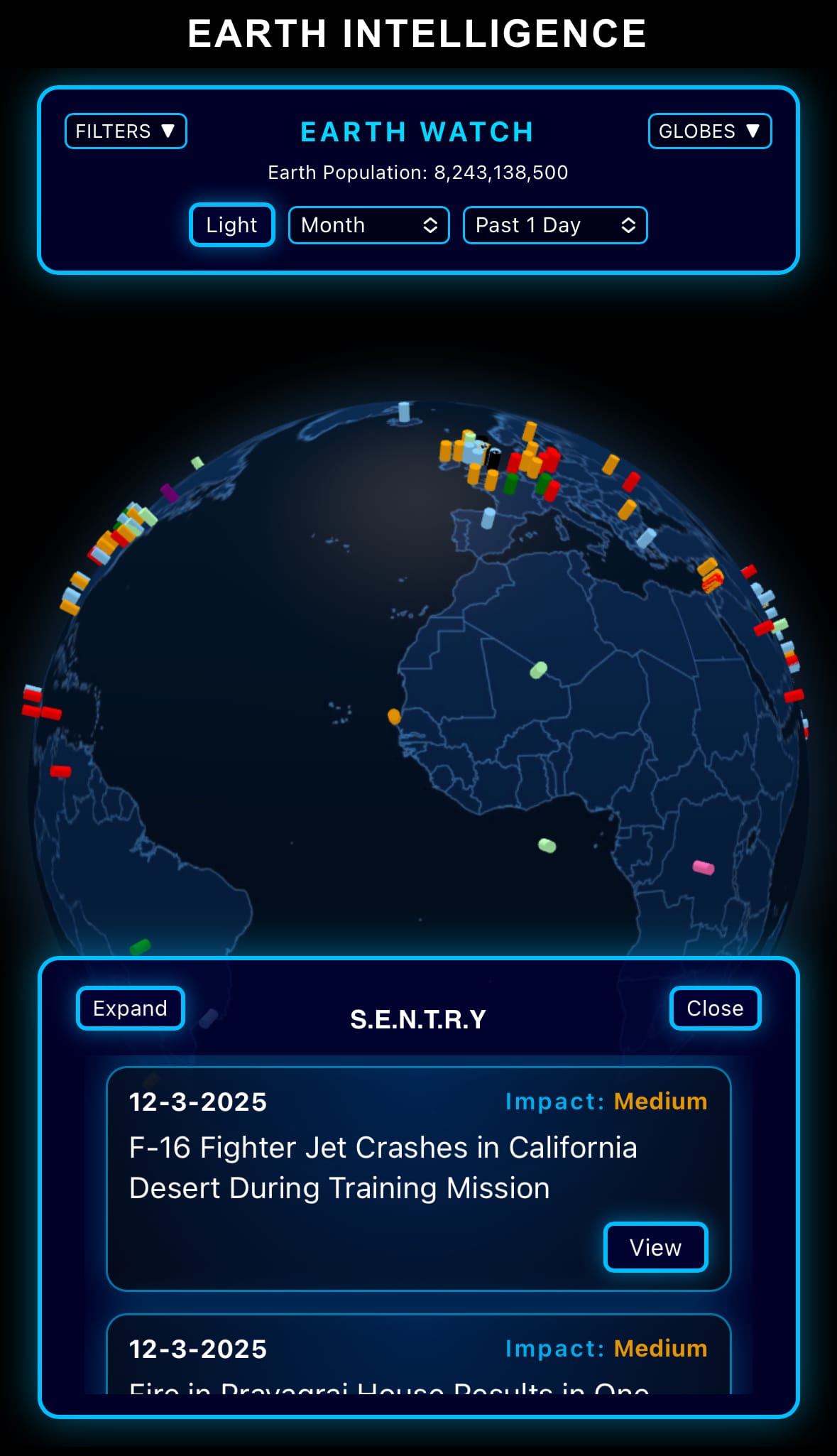
- Click below if you’d like to view our free EARTH WATCH globe:
- Download our mobile app:



Click below to view our previous newsletters:

Support/Suggestions Email:
earthintelligence@earthintel.news