Tuesday☕️

Trending:
- On February 16, 2026, Canadian Prime Minister Mark Carney announced that Canada is renewing its relationship with China through a new strategic partnership, which includes China granting visa-free travel to Canadian passport holders. The policy, confirmed by China's Foreign Ministry, allows ordinary Canadian passport holders to enter China without a visa for up to 30 days for purposes including tourism, business, family visits, exchanges, and transit, effective from February 17, 2026, through December 31, 2026.
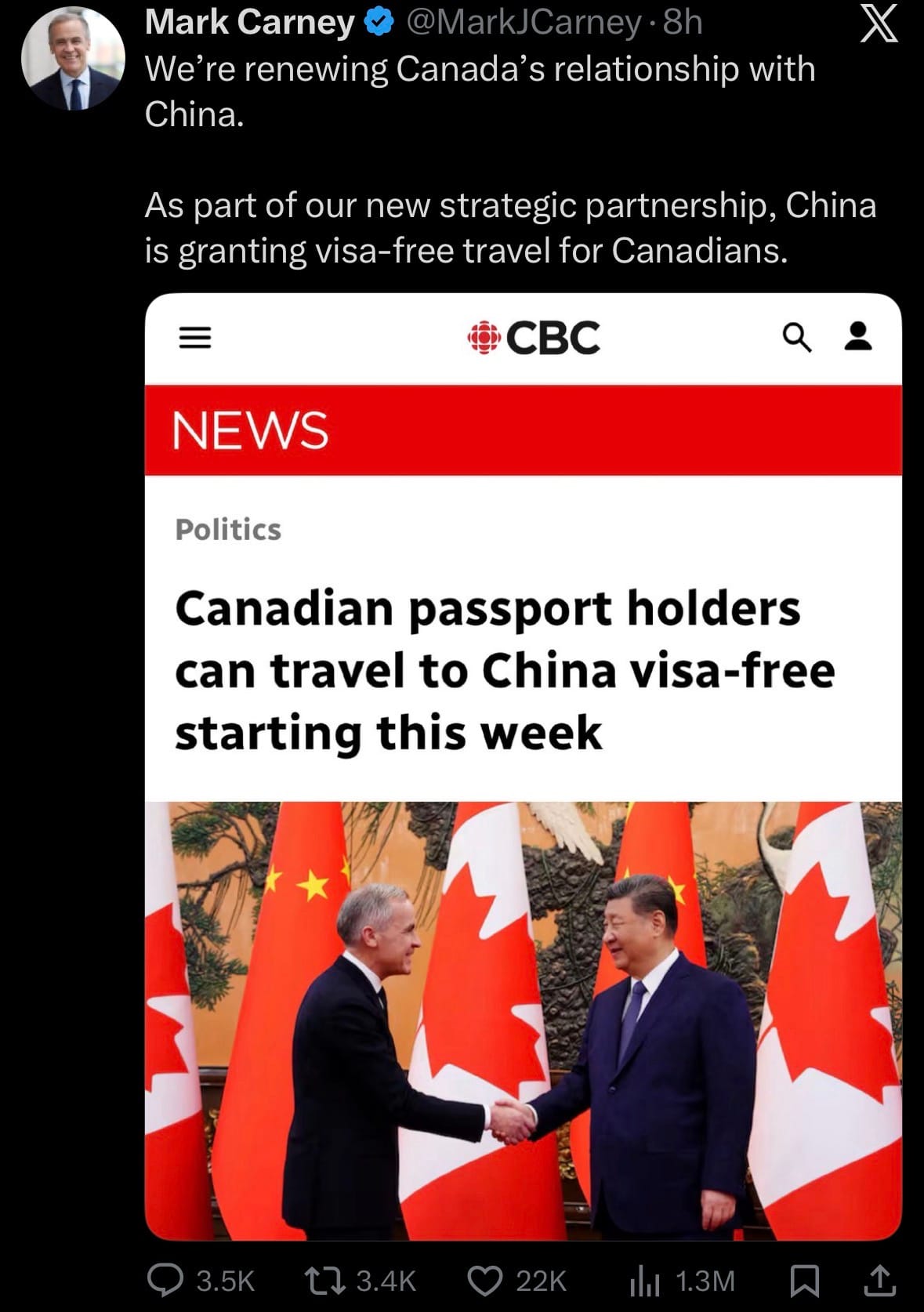
- This development follows Prime Minister Carney's January visit to Beijing, where he secured commitments from President Xi Jinping to facilitate easier people-to-people ties as part of broader efforts to strengthen economic and diplomatic relations. The move aligns with China's expansion of its unilateral visa-waiver program to additional countries, aiming to boost tourism and business exchanges amid improving bilateral dynamics.
Economics & Markets:
- Yesterday’s U.S. stock market:

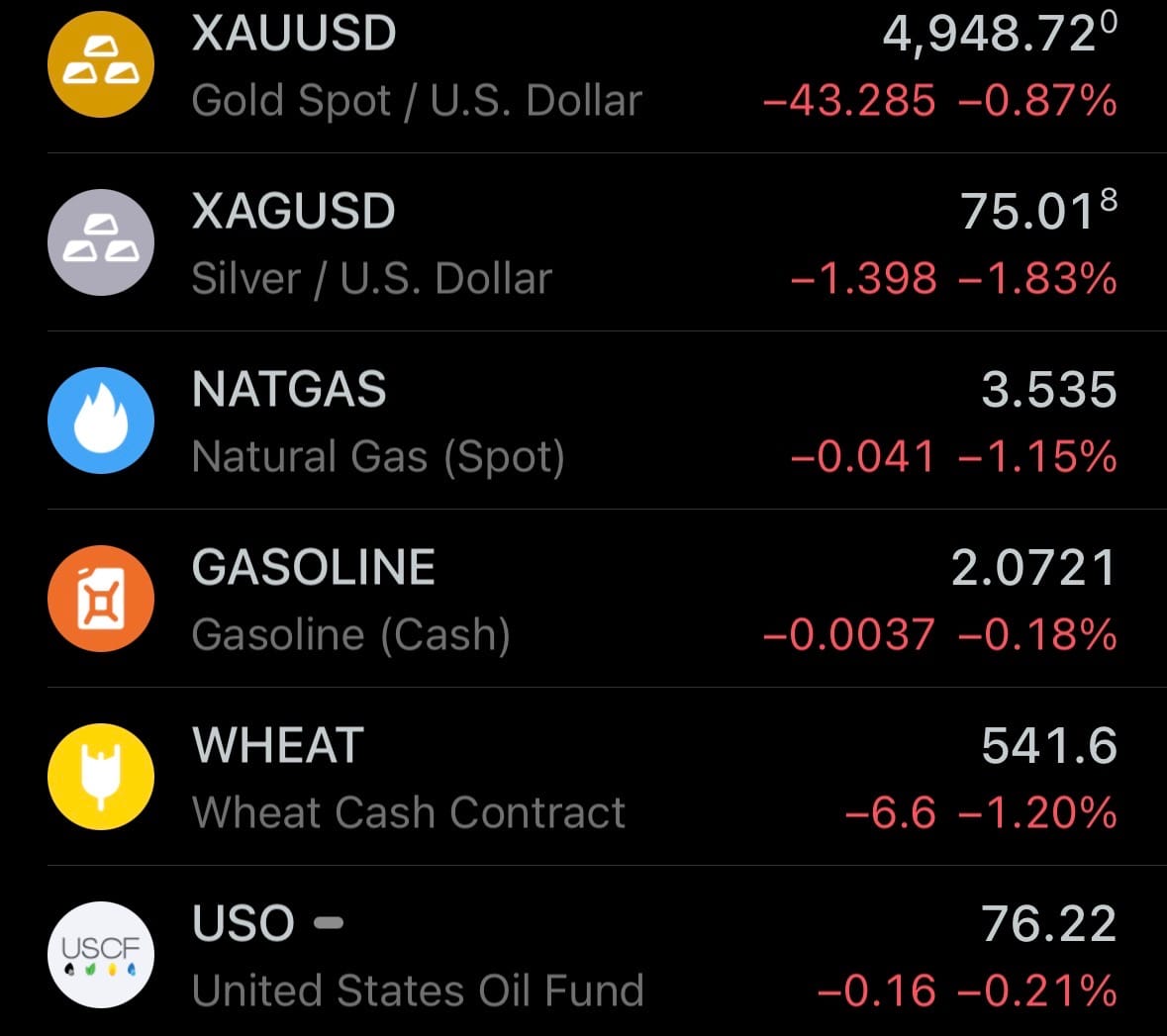
- Yesterday’s commodity market:
- Yesterday’s crypto market:

Environment & Weather:
- On February 16, 2026, heavy snow and poor visibility caused hazardous conditions on Donner Summit along eastbound Interstate 80 near Truckee, California, leading to several vehicle spin-outs, crashes, and vehicles sliding into embankments as darkness fell. The California Highway Patrol and Caltrans closed I-80 in both directions over the summit around midday due to the accumulating incidents and whiteout conditions from an ongoing winter storm.

- The closure lasted several hours while crews cleared the roadway and enforced chain requirements. I-80 later reopened in both directions with chain controls still in effect, and authorities advised drivers to reduce speed, carry chains, and exercise caution to prevent further accidents in the Sierra Nevada region.
Science & Technology:
- On February 16, 2026, the U.S. Department of Defense and Department of Energy announced the successful air transport of Valar Atomics' Ward 250 micro nuclear reactor components—a 5-megawatt, transportable advanced reactor—from March Air Reserve Base, California, to Hill Air Force Base, Utah, via C-17 Globemaster III aircraft on February 15. The unfueled modules will next move to the Utah San Rafael Energy Lab in Orangeville for testing. Officials called it the first airlift of a nuclear reactor, advancing President Donald Trump's Executive Order 14299 (signed May 23, 2025) to deploy advanced nuclear technologies for national security, military energy resilience, and potential AI infrastructure support.
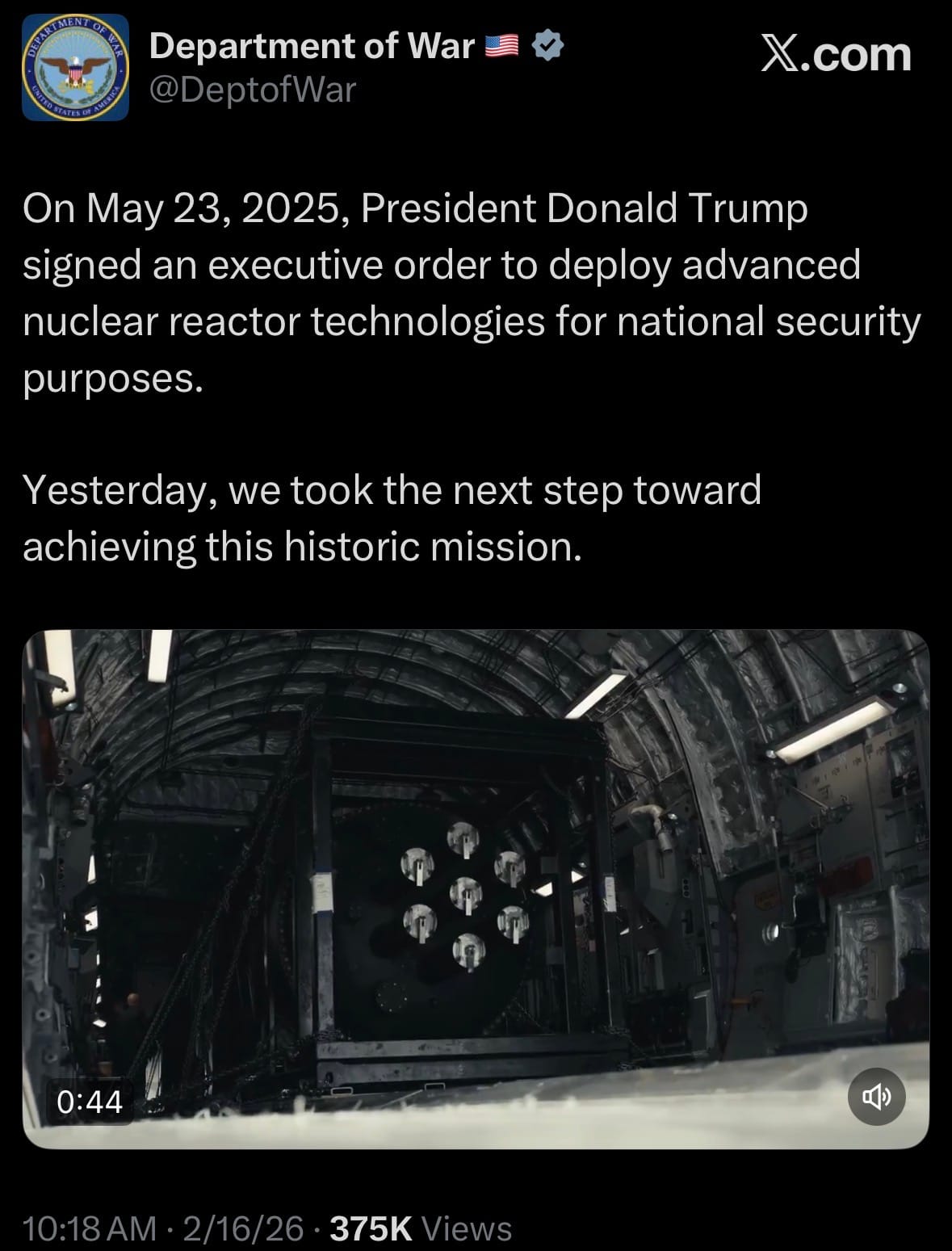
- The operation involved multiple C-17 flights, with Energy Secretary Chris Wright and Under Secretary of Defense Michael Duffey on board. It represents progress toward operational advanced reactors, with officials expecting at least three small reactors to reach criticality by July 4, 2026, under related programs, in line with goals to expand U.S. nuclear capacity for defense purposes.
Space:
- On February 16, 2026, SpaceX successfully launched the Starlink Group 6-103 mission at 2:59 a.m. ET (07:59 UTC) using a Falcon 9 rocket from Space Launch Complex 40 at Cape Canaveral Space Force Station, Florida. The mission deployed 29 Starlink v2 Mini satellites into low-Earth orbit, adding to the company's broadband internet constellation, which now exceeds 9,600 satellites.
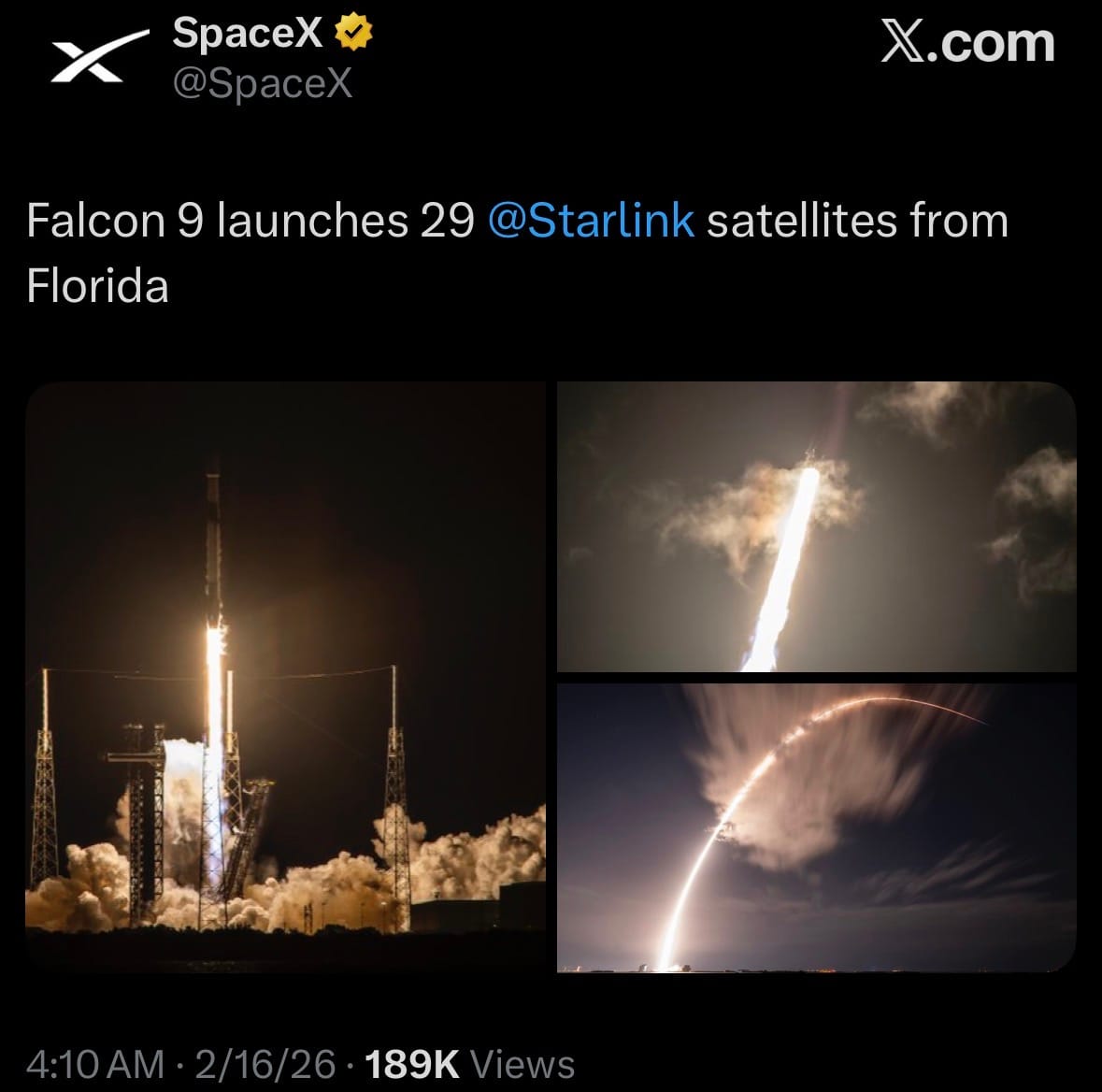
- The Falcon 9 first stage booster (B1090), on its 10th flight, landed successfully on the droneship "A Shortfall of Gravitas" in the Atlantic Ocean, marking the 231st consecutive successful Falcon 9 booster landing. The launch occurred after weather delays earlier in the window, and deployment was confirmed about one hour after liftoff into an initial parking orbit.
Statistic:
- Largest public automakers on Earth by market capitalization:
- 🇺🇸 Tesla: $1.566T
- 🇯🇵 Toyota: $323.61B
- 🇨🇳 Xiaomi: $123.23B
- 🇨🇳 BYD: $121.69B
- 🇰🇷 Hyundai: $89.93B
- 🇺🇸 General Motors: $75.63B
- 🇮🇹 Ferrari: $67.10B
- 🇩🇪 BMW: $64.61B
- 🇩🇪 Volkswagen: $61.69B
- 🇩🇪 Mercedes-Benz: $60.42B
- 🇺🇸 Ford: $56.33B
- 🇮🇳 Maruti Suzuki India: $52.06B
- 🇮🇳 Mahindra & Mahindra: $46.21B
- 🇩🇪 Porsche: $44.96B
- 🇰🇷 Kia: $43.93B
- 🇯🇵 Honda: $41.30B
- 🇯🇵 Suzuki Motor: $29.19B
- 🇨🇳 Seres Group: $27.54B
- 🇨🇳 Great Wall Motors: $25.59B
- 🇨🇳 SAIC Motor: $23.83B
- 🇨🇳 Geely: $23.61B
- 🇳🇱 Stellantis: $22.38B
- 🇺🇸 Rivian: $22.00B
- 🇨🇳 Chery Automobile: $20.95B
- 🇮🇳 Hyundai Motor India: $19.31B
History:
- Underwater intelligence starts as the oldest naval problem: the ocean hides everything. For most of history, “seeing” underwater meant soundings—lead lines, weighted ropes, and charts built from patient measurement—because depth and seabed shape decided whether fleets could maneuver, land troops, or avoid wrecking in shallow waters. By the 1700s–1800s, navies and hydrographic offices professionalized this into systematic seafloor mapping, turning harbors, straits, and approaches into surveyed terrain. The real breakthrough arrived with the physics of acoustics. In the late 1800s and early 1900s, scientists proved that sound travels far in water and can be used for detection; World War I turned that fact into urgent engineering. German U-boats forced the Allies to invent modern anti-submarine detection: early hydrophones (underwater microphones) let ships listen for propellers, but bearing-only listening was slow and imprecise. Between World War I and World War II, the British developed ASDIC—the early active sonar concept—sending out pings and timing echoes to find submarines. World War II then industrialized underwater intelligence: sonar became standard, convoy escorts carried active sonar and depth charges, and navies learned the brutal chess of sound—how temperature layers bend acoustics, how submarines hide in “shadow zones,” and how noise discipline can be life or death.
- The Cold War is when underwater intelligence becomes a global, continuous sensor war. Nuclear submarines (starting in the 1950s) changed the geometry: they could stay submerged longer, travel faster, and operate worldwide, turning the deep ocean into a strategic battlefield. This pushed two parallel revolutions. First, submarines themselves became intelligence platforms—quiet collectors that could trail adversary boats, map seafloors, tap cables, and gather signals near coasts while remaining nearly invisible. Second, nations built persistent surveillance networks. The most famous is SOSUS (Sound Surveillance System), deployed beginning in the 1950s, which used fixed hydrophone arrays on the seabed to detect and track submarine signatures across ocean basins by exploiting long-range sound channels. Surface ships evolved too: modern destroyers and frigates gained hull-mounted sonars, but the real advantage came from towed-array sonar—long cables of hydrophones pulled behind a ship to reduce self-noise and listen farther—plus maritime patrol aircraft dropping sonobuoys to create temporary underwater listening grids. Underwater intelligence became less about a single sensor and more about fusion: ships, aircraft, submarines, and seabed arrays feeding tracks into command networks to build a moving picture of what’s beneath the surface.
- Today, underwater intelligence is shifting from “find the submarine” to “own the seabed”—because the seabed carries cables, pipelines, and the physical arteries of global trade and communications. Modern navies run layered systems: advanced passive arrays that can classify targets by acoustic fingerprints; active sonar modes designed for cluttered coastal waters; multistatic concepts where one platform pings and others listen; and high-resolution seabed mapping using side-scan sonar and synthetic aperture techniques. The newest leap is autonomy: unmanned underwater vehicles (UUVs) and underwater drones can patrol, map, listen, and inspect infrastructure without risking crews, while larger autonomous systems act as mobile “seabed sentries.” You also see the rise of distributed “listeners”—networks of sensors placed on the ocean floor near chokepoints, ports, and cable routes—paired with rapid-response platforms that can investigate anomalies. Modern warships “see underwater” not with a single magic sensor, but by combining sonar types, oceanographic data (salinity/temperature layers), and networked tracking to turn the ocean into a probabilistic battlefield map. The ocean still hides, but underwater intelligence has become a full-stack discipline: submarines as stealth scouts, ships as mobile sensor hubs, seabed arrays as persistent watchtowers, and autonomous drones as tireless patrolmen—an invisible contest for control of the planet’s most secret domain.
Image of the day:

Thanks for reading! Earth is complicated, we make it simple.
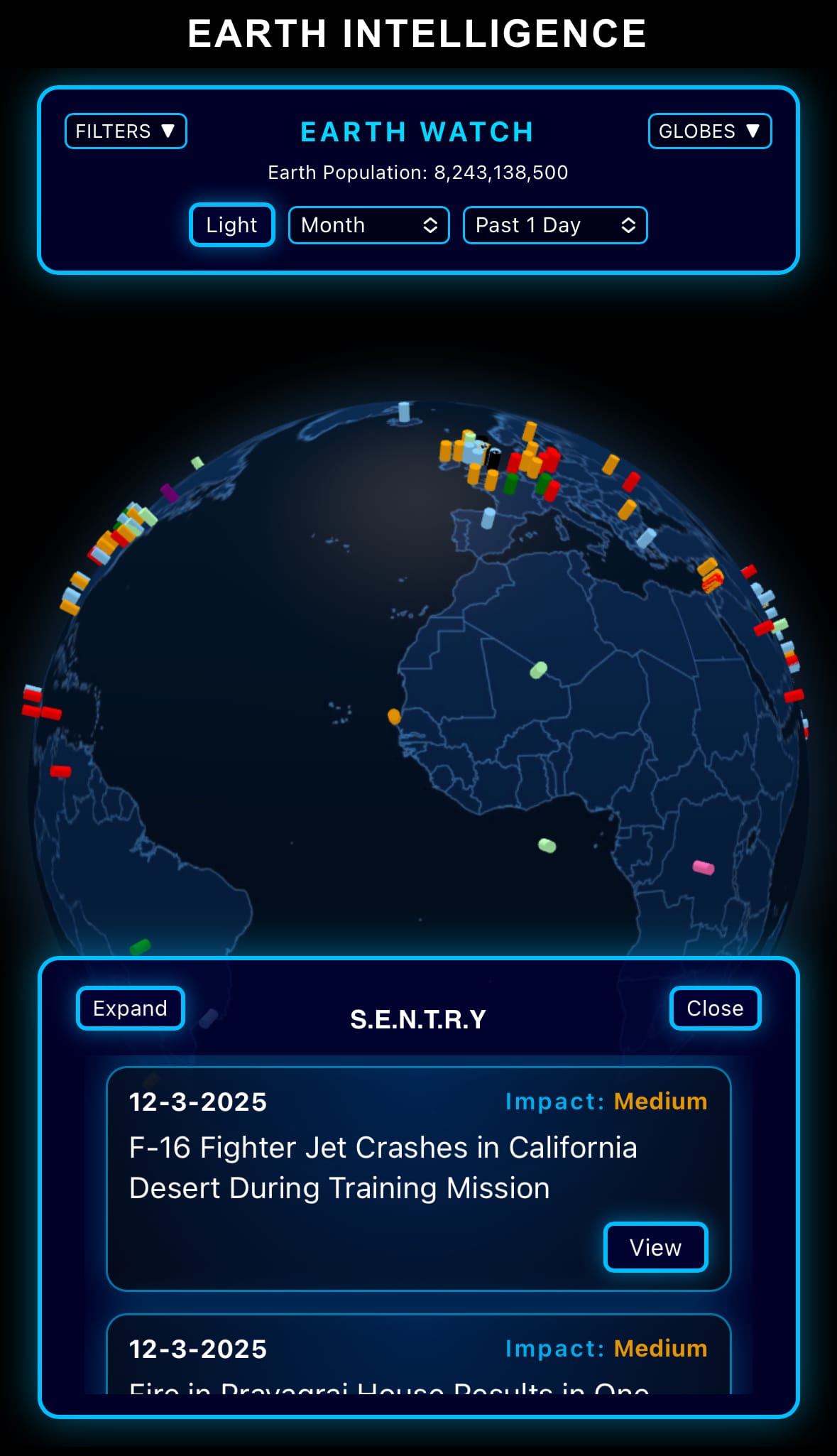
- Click below if you’d like to view our free EARTH WATCH globe:
- Download our mobile app:



Click below to view our previous newsletters:

Support/Suggestions Email:
earthintelligence@earthintel.news