Tuesday☕️


Economics & Markets:

- Yesterday’s U.S. stock market:

- Yesterday’s commodity market:

- Yesterday’s crypto market:

Geopolitics & Military Activity:


Law Enforcement:

Environment & Weather:



Science & Technology:
- On March 30, 2026, Anthropic rolled out Computer Use in Claude Code. Claude can now directly control your computer — open apps, click through menus and interfaces, navigate your desktop, and even test the code it creates — all from the command line.

- This powerful new capability is currently available in research preview for users on Pro and Max plans.
Space:
- On March 30, 2026, SpaceX successfully launched Transporter-16, its 16th dedicated smallsat rideshare mission.

- A Falcon 9 rocket lifted off from Vandenberg Space Force Base in California, carrying 119 seperate payloads to Sun-synchronous orbit, while the first-stage booster landed successfully on the droneship "Of Course I Still Love You" in the Pacific Ocean.
- On March 30, 2026, SpaceX successfully launched Starlink Group 10-44, deploying 29 Starlink V2 Mini satellites into low-Earth orbit from Space Launch Complex 40 at Cape Canaveral, Florida.
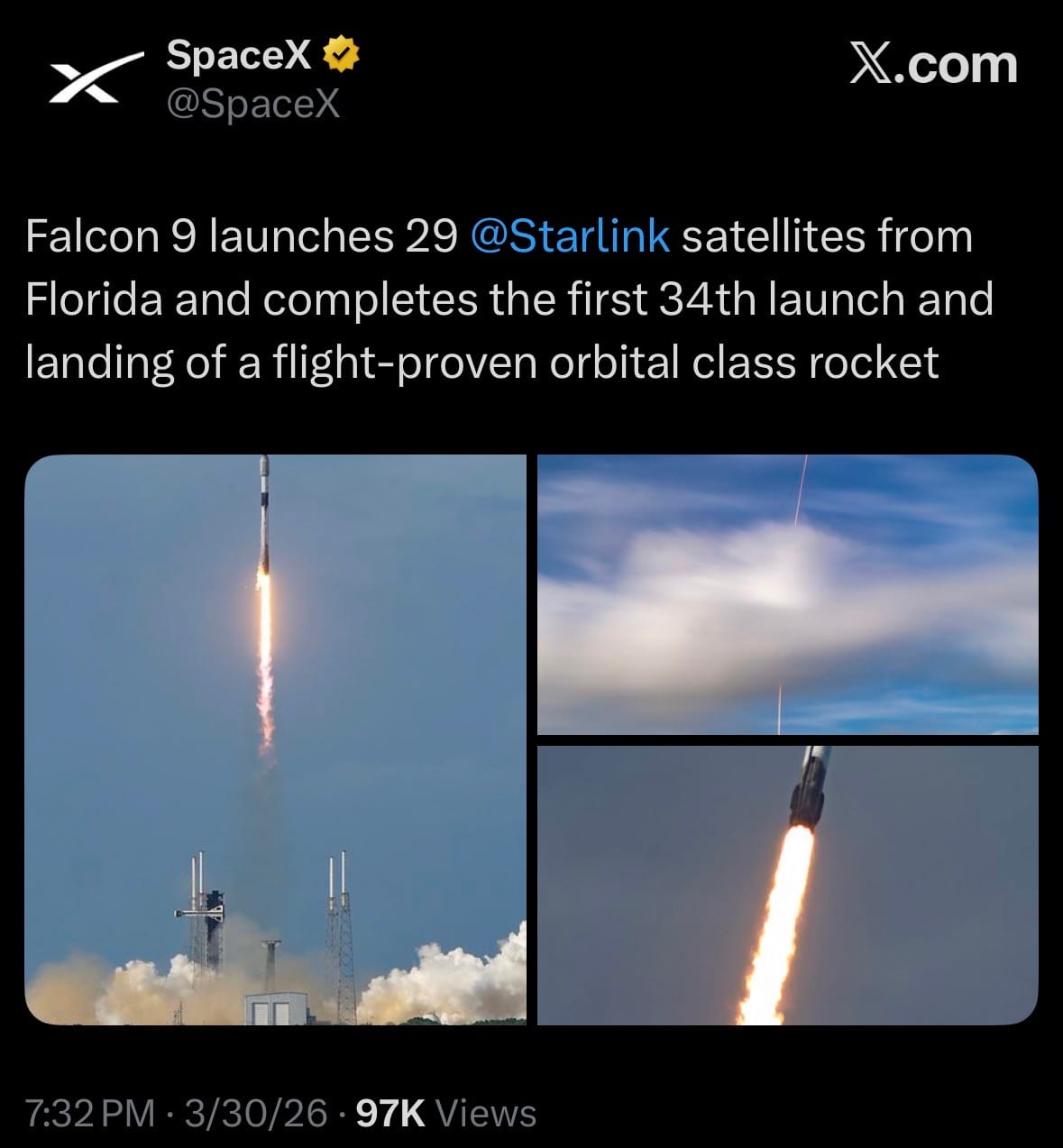
- The first-stage booster landed successfully on the droneship “A Shortfall of Gravitas” in the Atlantic Ocean, continuing the rapid expansion of the Starlink constellation.
Statistic:
- Largest public semiconductors on Earth by market capitalization:
- 🇺🇸 NVIDIA: $4.014T
- 🇹🇼 TSMC: $1.641T
- 🇺🇸 Broadcom: $1.391T
- 🇰🇷 Samsung: $749.94B
- 🇳🇱 ASML: $492.37B
- 🇰🇷 SK Hynix: $375.16B
- 🇺🇸 Micron Technology: $362.90B
- 🇺🇸 AMD: $319.62B
- 🇺🇸 Applied Materials: $256.43B
- 🇺🇸 Lam Research: $251.11B
- 🇺🇸 Intel: $206.81B
- 🇺🇸 KLA: $181.66B
- 🇺🇸 Texas Instruments: $169.72B
- 🇺🇸 Analog Devices: $147.97B
- 🇬🇧 Arm Holdings: $145.45B
- 🇺🇸 QUALCOMM: $135.71B
- 🇯🇵 Tokyo Electron: $107.91B
- 🇯🇵 Advantest: $93.06B
- 🇺🇸 Marvell Technology: $76.78B
- 🇹🇼 MediaTek: $75.22B
- 🇺🇸 Synopsys: $73.39B
- 🇨🇳 SMIC: $63.43B
- 🇨🇳 Cambricon Technologies: $61.58B
- 🇩🇪 Infineon: $55.73B
- 🇺🇸 Monolithic Power Systems: $49.23B
History:
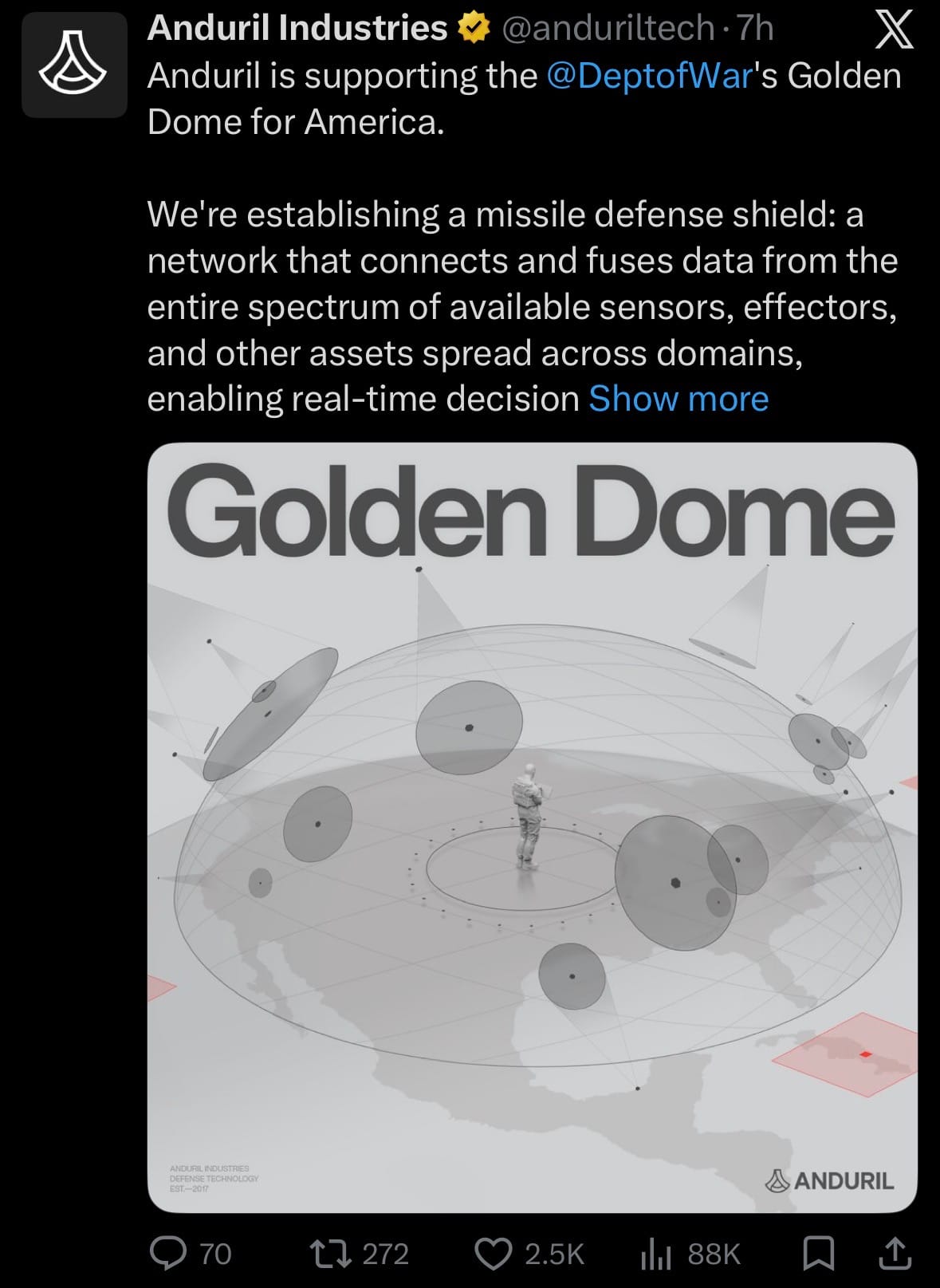
- The history of U.S. Ground-Based Interceptors (GBIs) is rooted in the Cold War race to defend against intercontinental ballistic missiles (ICBMs). Early missile defense concepts emerged in the 1950s–1960s with programs like Nike Zeus and later Safeguard, which attempted to intercept incoming nuclear missiles using nuclear-tipped interceptors. These systems were limited and controversial, leading to the 1972 Anti-Ballistic Missile (ABM) Treaty between the United States and the Soviet Union, which restricted large-scale missile defense systems. For decades, missile defense remained constrained, but research continued in the background. A major shift came in 1983 with President Ronald Reagan’s Strategic Defense Initiative (SDI), often called “Star Wars,” which envisioned advanced systems—including space-based interceptors—to destroy incoming missiles. While SDI never fully materialized, it accelerated research into hit-to-kill technology, where interceptors destroy targets through direct collision rather than explosive warheads. After the Cold War, the focus shifted from large-scale nuclear war to defending against limited missile threats from emerging states.
- The modern GBI system was developed in the late 1990s and early 2000s under the Ground-based Midcourse Defense (GMD) program. The system became operational in 2004, designed to intercept incoming ballistic missiles during the midcourse phase of flight—when the warhead is traveling through space. GBIs are deployed primarily in Fort Greely, Alaska, and Vandenberg Space Force Base, California, positioned to defend the U.S. homeland from potential missile threats coming over the polar region. Each interceptor consists of a large multi-stage rocket that carries an Exoatmospheric Kill Vehicle (EKV), which separates in space and uses onboard sensors and guidance systems to track and collide with the incoming warhead at high speed—essentially hitting a bullet with another bullet. The system relies on a broader network of sensors, including early warning radars, satellite detection systems, and command-and-control infrastructure, to detect launches, track targets, and guide interceptors.
- Today, the United States maintains over 40 deployed GBIs, forming the core of its homeland missile defense system. The system is designed primarily to defend against limited ICBM attacks, not large-scale nuclear exchanges. Development continues with next-generation upgrades, including the Next Generation Interceptor (NGI) program, which aims to improve reliability, discrimination (distinguishing real warheads from decoys), and overall effectiveness, with deployment expected in the late 2020s. The U.S. is the only country with a deployed homeland defense system of this type at this scale, though other nations like Russia and China are also developing advanced missile defense technologies. GBIs represent one layer of a broader missile defense architecture that includes systems like Aegis (sea-based), THAAD, and Patriot, each covering different phases of missile flight. In modern strategic terms, GBIs are part of a larger effort to create a layered missile defense system, capable of detecting, tracking, and intercepting threats across multiple domains—from space to the atmosphere—making them one of the most advanced and critical components of U.S. defense infrastructure.
Image of the day:

Thanks for reading! Earth is complicated, we make it simple.
- Click below if you’d like to view our free EARTH WATCH globe:
- Download our mobile app:



Click below to view our previous newsletters:

Support/Suggestions Email:
support@earthintel.io