Wednesday☕️


Trending:
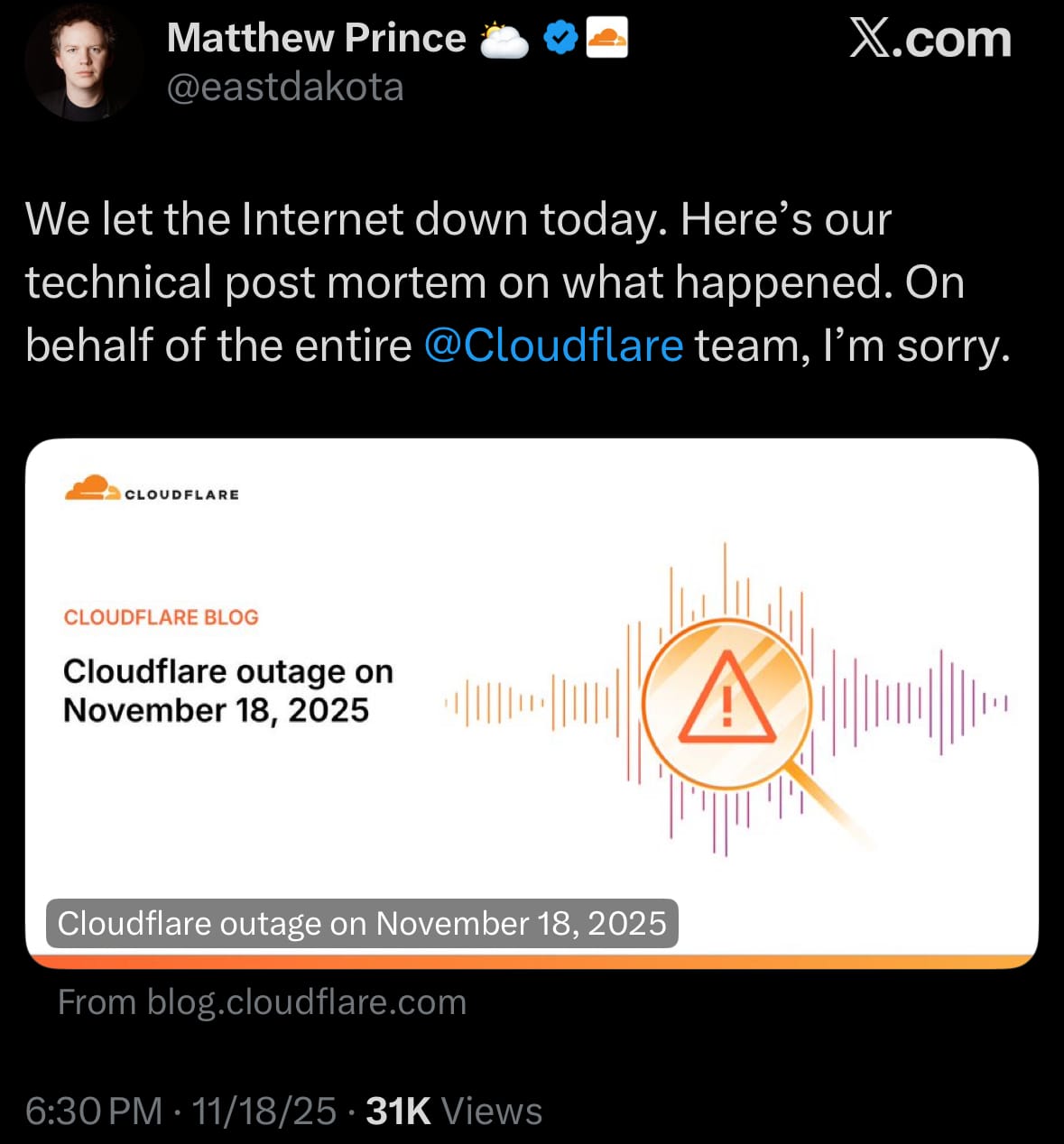
- On November 18, 2025, Cloudflare experienced a widespread outage that disrupted internet services for several hours, starting around 8:00 a.m. ET and peaking with over 11,000 user reports by mid-morning before being resolved by approximately 11:00 a.m. ET. The incident affected major platforms including X, ChatGPT, League of Legends, and numerous other websites reliant on Cloudflare's content delivery and security services, resulting in error messages like "Challenges Error" and temporary inaccessibility. Cloudflare confirmed the issue stemmed from a software deployment error involving a new file version that mismatched expected sizes in dependent services, leading to traffic spikes and service interruptions.

- The outage highlighted vulnerabilities in global internet infrastructure, as Cloudflare supports millions of sites against attacks and handles vast web traffic, with no reports of data breaches or malicious activity involved. While services returned to normal without lasting damage, it prompted discussions on deployment practices and redundancy, especially amid growing reliance on cloud providers. User complaints dropped sharply post-resolution, and Cloudflare issued a post-mortem analysis to prevent future occurrences, underscoring the need for robust testing in high-stakes updates.
- CEO Statement:
Economics & Markets:
- Yesterday’s U.S. stock market:

- Yesterday’s commodity market:

- Yesterday’s crypto market:

Geopolitics & Military Activity:
- On November 18, 2025, the Israel Defense Forces carried out a precision airstrike on a Hamas military compound inside the Ain al-Hilweh Palestinian refugee camp near Sidon in southern Lebanon, stating that the site was used by operatives to train for attacks against Israeli forces and civilians. The IDF reported using guided munitions, live surveillance, and intelligence to limit civilian harm, and affirmed it would keep targeting Hamas assets in Lebanon. Lebanese health officials said the strike killed at least 13 people and injured others, occurring in a crowded camp home to thousands of Palestinian refugees.

- The incident points to continued friction between Israel and Hamas in the region, with the camp known for hosting various armed groups despite Lebanese security measures. Hamas had no immediate comment, but the strike fits a series of Israeli actions against targets in Lebanon, raising worries about civilian safety in dense areas. International groups have urged caution to protect non-combatants, noting the difficulties of accurate operations in urban refugee zones without outside checks on the details.
Environment & Weather:
Cyber:

Science & Technology:
- On November 18, 2025, Google announced Gemini 3, its most advanced AI model yet, building on Gemini 2.5 from eight months earlier, with improvements in reasoning, handling multiple types of data, and user engagement. The release features variants like Gemini 3 Pro, tailored for the Gemini app and rolling out globally to users over 18 in supported countries and languages, and Gemini 3 Ultra, immediately accessible on the web for U.S. subscribers to Google AI Ultra. Developers can access Gemini 3 through the updated Gemini API starting the same day, enabling integration into custom applications. This launch ramps up competition with companies like OpenAI, featuring a new generative interface for lively responses and a separate coding app to simplify programming work.

- Gemini 3 sets new records in benchmarks for coding, search, and logical thinking, along with features like "vibe-checks" for responses that better match context and user style. It expands uses in creating content and solving problems, showing Google's effort to lead in AI after past delays. The update highlights industry progress, likely improving how people interact with AI through smarter, more reachable tools, without big changes to current setups.

Statistic:
- Largest public companies on Earth by market capitalization:
- 🇺🇸 NVIDIA: $4.422T
- 🇺🇸 Apple: $3.968T
- 🇺🇸 Microsoft: $3.670T
- 🇺🇸 Alphabet (Google): $3.439T
- 🇺🇸 Amazon: $2.379T
- 🇸🇦 Saudi Aramco: $1.666T
- 🇺🇸 Broadcom: $1.607T
- 🇺🇸 Meta Platforms: $1.506T
- 🇹🇼 TSMC: $1.441T
- 🇺🇸 Tesla: $1.334T
- 🇺🇸 Berkshire Hathaway: $1.088T
- 🇺🇸 Eli Lilly: $923.39B
- 🇺🇸 JPMorgan Chase: $823.30B
- 🇺🇸 Walmart: $809.13B
- 🇨🇳 Tencent: $760.67B
- 🇺🇸 Oracle: $628.57B
- 🇺🇸 Visa: $623.39B
- 🇺🇸 Exxon Mobil: $507.45B
- 🇺🇸 Netflix: $483.43B
- 🇺🇸 Johnson & Johnson: $481.85B
- 🇺🇸 Mastercard: $476.93B
- 🇰🇷 Samsung: $440.38B
- 🇺🇸 AbbVie: $413.33B
- 🇨🇳 Agricultural Bank of China: $403.28B
- 🇺🇸 Palantir: $398.82B
History:
- Orbital strike concepts were born the moment humanity touched orbit. In the late 1950s and early 1960s, the U.S. and the Soviet Union looked at the first satellites and immediately saw more than cameras and radios—they saw the ultimate high ground. Both sides explored orbiting nuclear warheads, co-orbital “killer satellites,” and Soviet fractional-orbital bombardment systems that could drop warheads from unexpected angles. By the 1970s, research pushed further into the exotic: early laser platforms, microwave weapons, particle-beam studies, and maneuverable craft designed for close-proximity operations. Then came 1983. Reagan’s Strategic Defense Initiative—Star Wars—took decades of classified studies and turned them into a public, planetary-scale vision. Orbital laser battle stations. Particle-beam interceptors. Swarms of autonomous kinetic kill-vehicles called Brilliant Pebbles. Around the same time, engineers refined the infamous Rods From God concept: telephone-pole-sized tungsten rods dropped from orbit with the force of a small nuclear blast but no radiation. These weren’t just sketches—they were serious engineering studies that shaped guidance systems, sensors, space maneuvering, and directed-energy research for decades. Governments publicly insisted none of these systems were ever launched, but the relentless stream of classified payloads quietly riding rockets into orbit makes that claim impossible to verify—and increasingly hard to believe.
- By the 2000s and into the 2020s, the orbital battlespace matured into something more precise, more flexible, and far more real. Nations began deploying satellites capable of approaching, shadowing, and potentially disabling other spacecraft. Directed-energy weapons—tested on the ground for missile defense—moved steadily closer to the power levels required for orbital platforms. China demonstrated suspiciously agile proximity operations. Russia fielded “inspection satellites” whose behavior raised eyebrows worldwide. And the U.S. expanded a fleet of secretive maneuvering craft like the X-37B, which disappears into orbit for years at a time with missions never disclosed. Then, after winning the 2024 election, Trump unveiled the Golden Dome concept—a next-generation missile defense vision that included the exploration of space-based interceptors as part of a layered shield over the United States. It wasn’t a replacement for Star Wars; it was the latest chapter in a lineage stretching back to the very birth of the Space Age. Officials still claim that no orbital strike systems are active today, but with major powers launching classified hardware every month, with maneuvering satellites test-flying capabilities that nobody explains, and with sixty years of increasingly advanced concepts feeding into modern designs, the honest truth is simple: nobody outside the classified world knows what’s already up there—and it’s entirely plausible that some of these once-theoretical systems are quietly orbiting Earth right now.
Image of the day:

Thanks for reading! Earth is complicated, we make it simple.
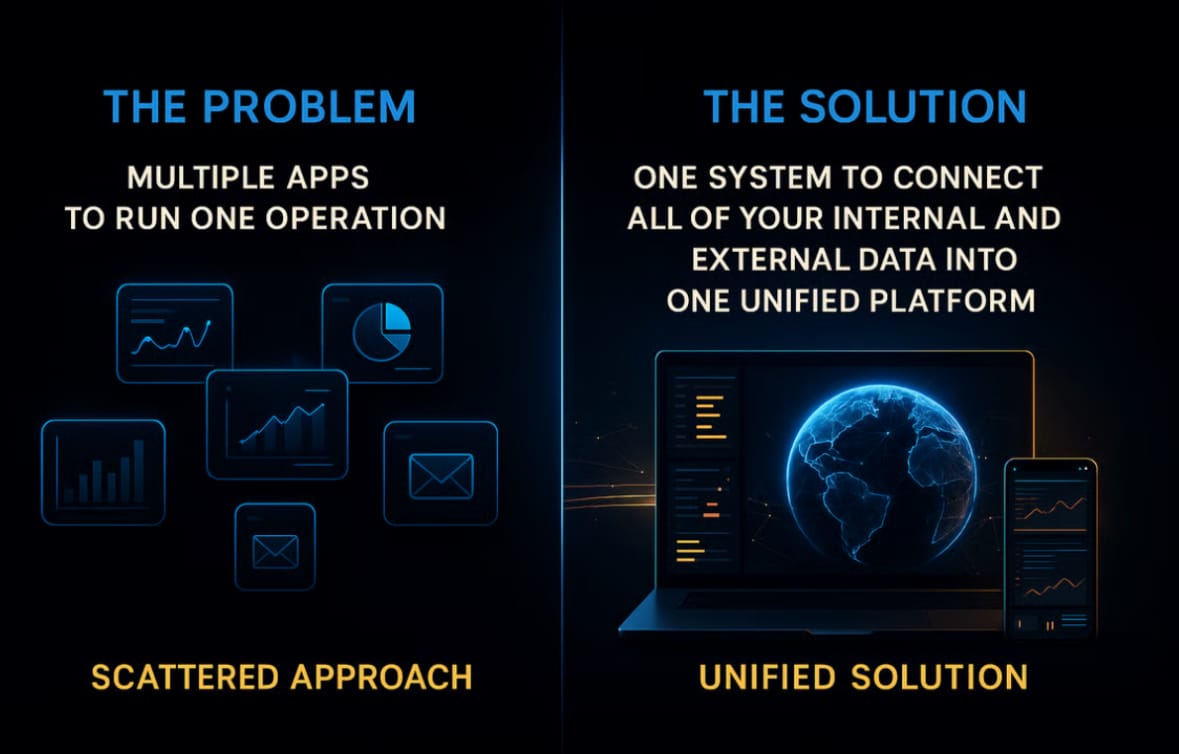

- Click below if you’d like to view our free EARTH WATCH globe:
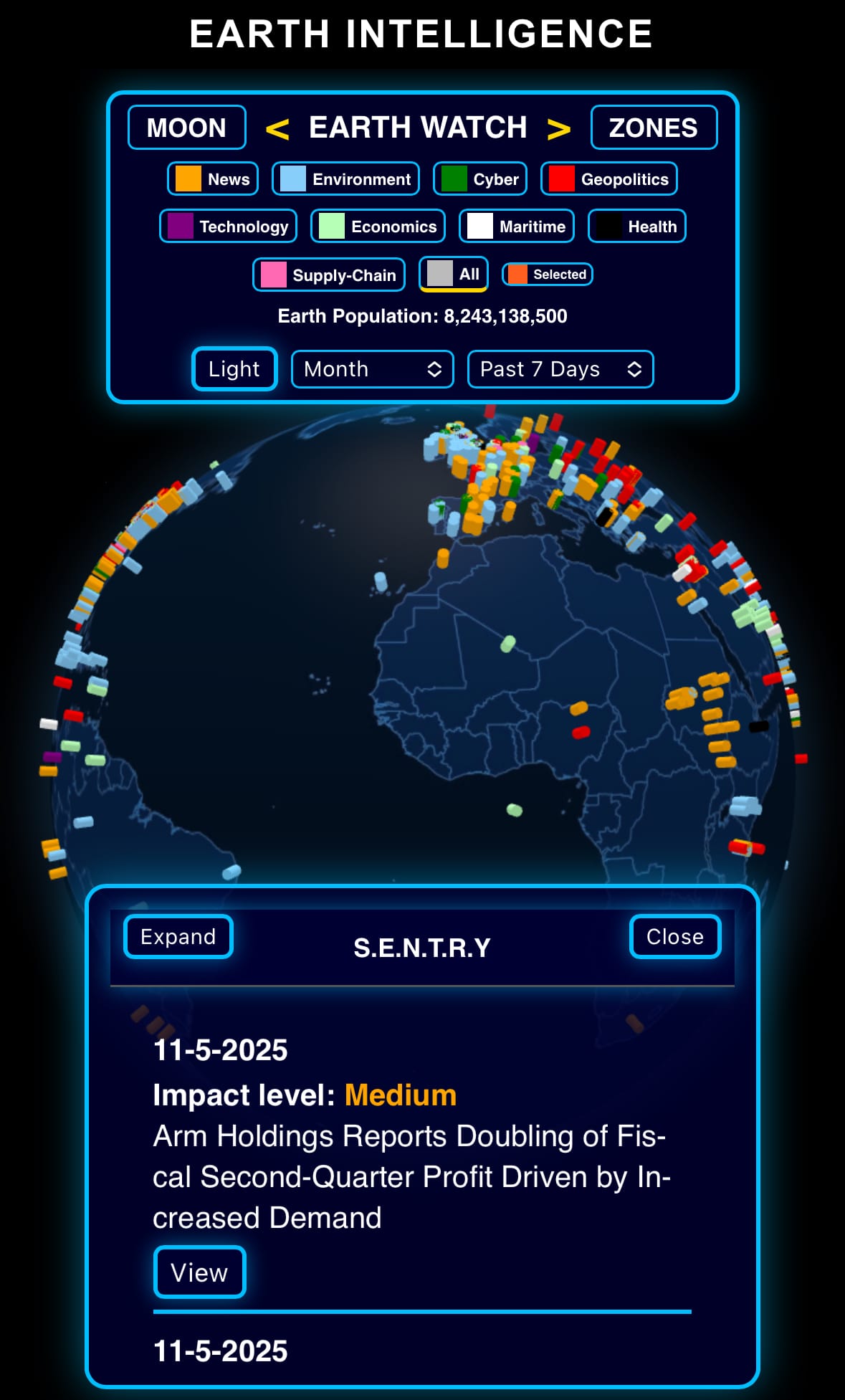
- Download our mobile app on the Apple App Store (Android coming soon):

Click below to view our previous newsletters:

Support/Suggestions Email:
earthintelligence@earthintel.news