Wednesday☕️

Trending:
- On November 26, 2025, a major fire broke out at 2:51 p.m. local time in Hong Kong's Wang Fuk Court housing estate in the densely populated Tai Po district, affecting a complex of eight high-rise blocks with nearly 2,000 residential units. The blaze, which started in one building and rapidly spread to others via highly flammable bamboo scaffolding used for ongoing renovations, was upgraded to a No. 4 alarm—the second-highest level—by 3:34 p.m., prompting the deployment of over 200 firefighters and 40 fire engines. Strong winds exacerbated the spread, producing thick smoke and flames that engulfed multiple structures, trapping residents on upper floors amid extreme heat and visibility issues.
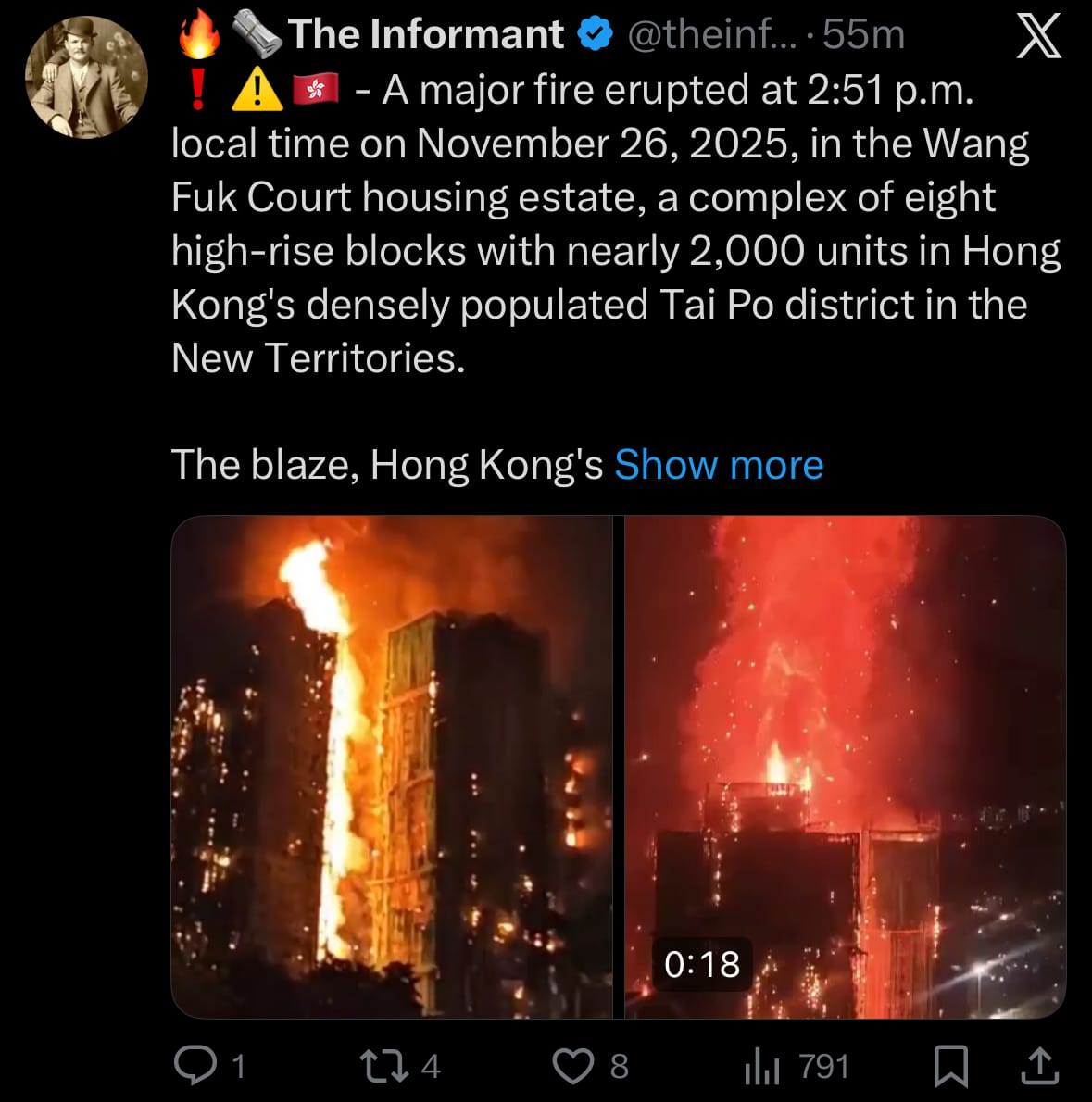
- The fire, described as Hong Kong's deadliest residential incident in decades, resulted in at least 14 deaths—including one firefighter—and 28 injuries, with three people in critical condition, according to the Fire Services Department. Authorities established emergency shelters at nearby schools, parks, and community halls, though some filled quickly, and set up a police hotline for missing persons. Firefighting efforts continued into the evening to extinguish lingering flames and smoke, while investigations into the exact cause—potentially linked to renovation work—remain ongoing amid a citywide red fire danger warning.
Economics & Markets:
- Yesterday’s U.S. stock market:

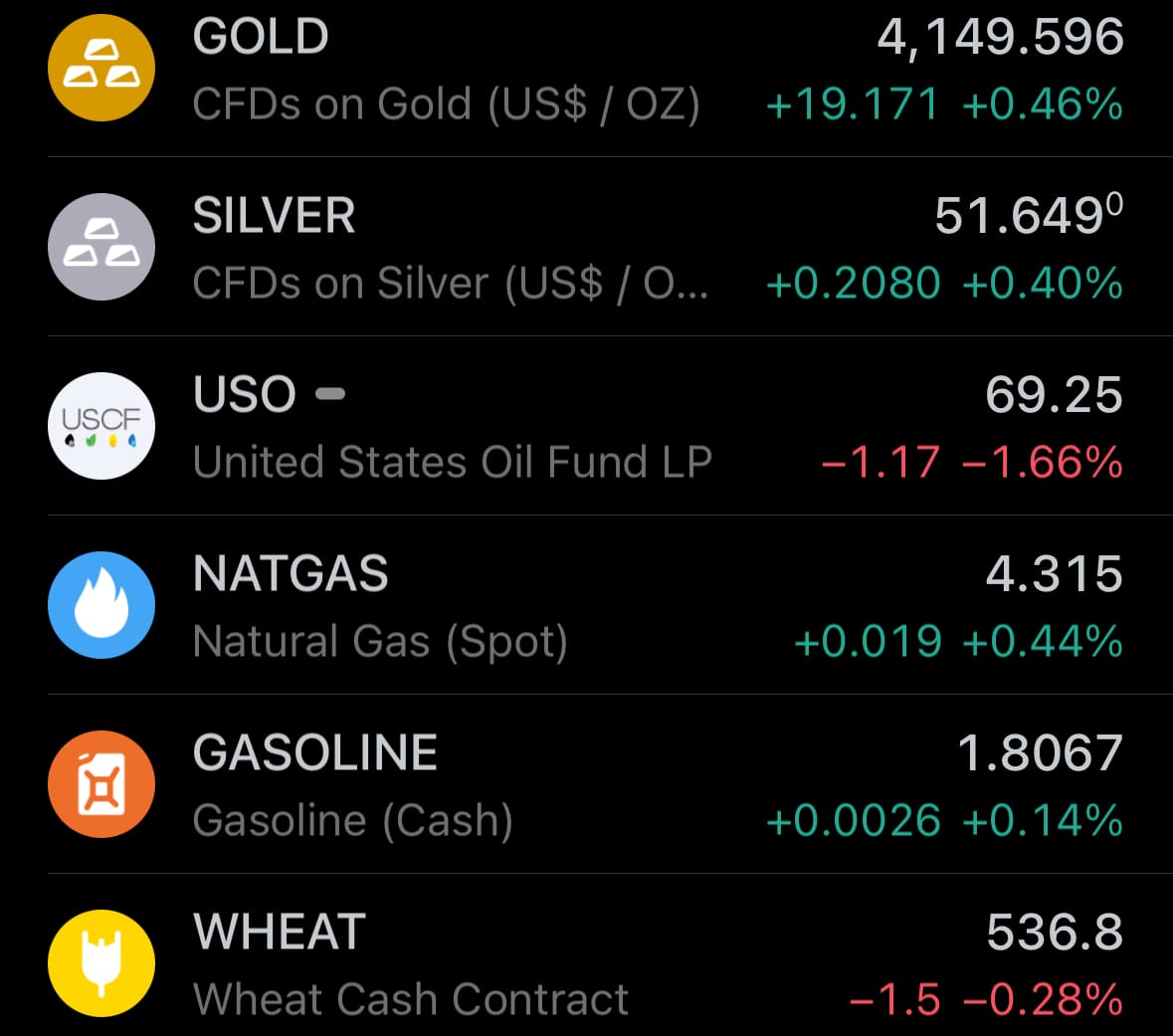
- Yesterday’s commodity market:
- Yesterday’s crypto market:

Geopolitics & Military Activity:
- On November 24, 2025, a U.S. Air Force MQ-9 Reaper drone, valued at approximately $30 million, crashed into the Yellow Sea about 15 miles off South Korea's west coast near Maldo-ri Island during a routine reconnaissance mission. The incident occurred around 4:35 a.m. local time on November 24, with the unmanned aircraft operated by the 431st Expeditionary Reconnaissance Squadron from Kunsan Air Base, marking the first such loss since the unit's permanent deployment to the Korean Peninsula in September. No personnel were injured, and the U.S. military has initiated an investigation into the cause, which remains undetermined, while continuing other MQ-9 operations under enhanced safety protocols.
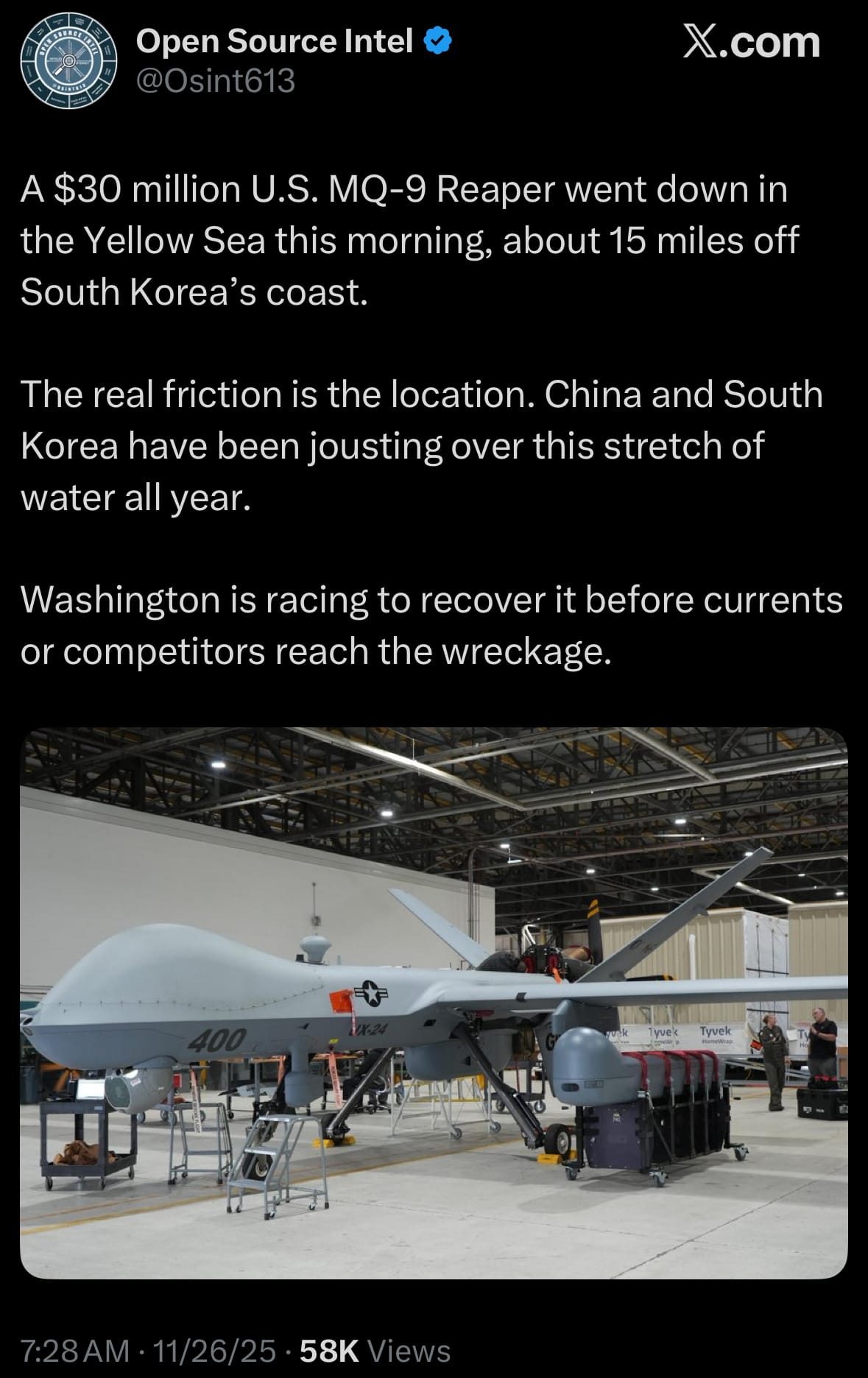
- The crash site's location in contested Yellow Sea waters—where China and South Korea have disputed exclusive economic zones and engaged in repeated maritime incidents throughout 2025, including Chinese deployments of surveillance buoys and "no-sail" zones—has heightened concerns over potential foreign access to sensitive wreckage containing advanced surveillance technology. U.S. forces, assisted by the South Korean Navy and Coast Guard, are conducting urgent recovery efforts using ships, underwater drones, and divers to retrieve the debris from the seafloor before ocean currents disperse it or rival actors intervene, amid broader regional tensions involving North Korea and China's expanding military footprint in the area.
Environment & Weather:
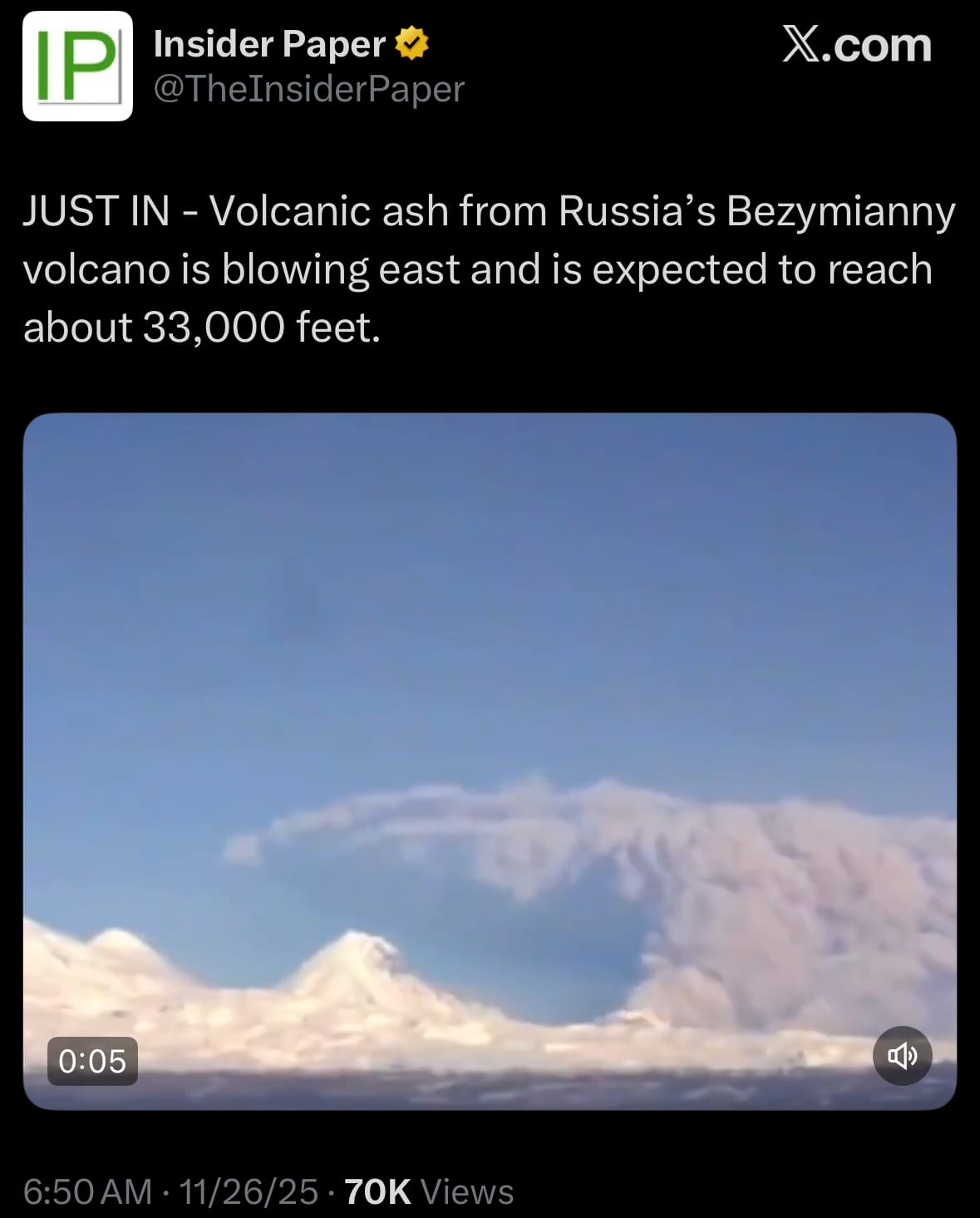
Space:
- On November 26, 2025, South Korea's Korea Aerospace Research Institute successfully launched the CAS500-3 satellite aboard the nation's Nuri rocket from Naro Space Center's Launch Complex 2 at 3:54 p.m. UTC (11:13 a.m. EST), marking the fourth flight of the domestically developed three-stage vehicle and its first operational mission dedicated to a primary payload. The 47.5-meter-tall Nuri, capable of delivering up to 1,500 kg to low Earth orbit, also carried 12 small CubeSats as secondary payloads for various research purposes. The launch proceeded nominally, with all stages performing as planned, deploying the satellite into a sun-synchronous orbit approximately 600 kilometers above Earth, as confirmed by ground tracking and initial orbital data.
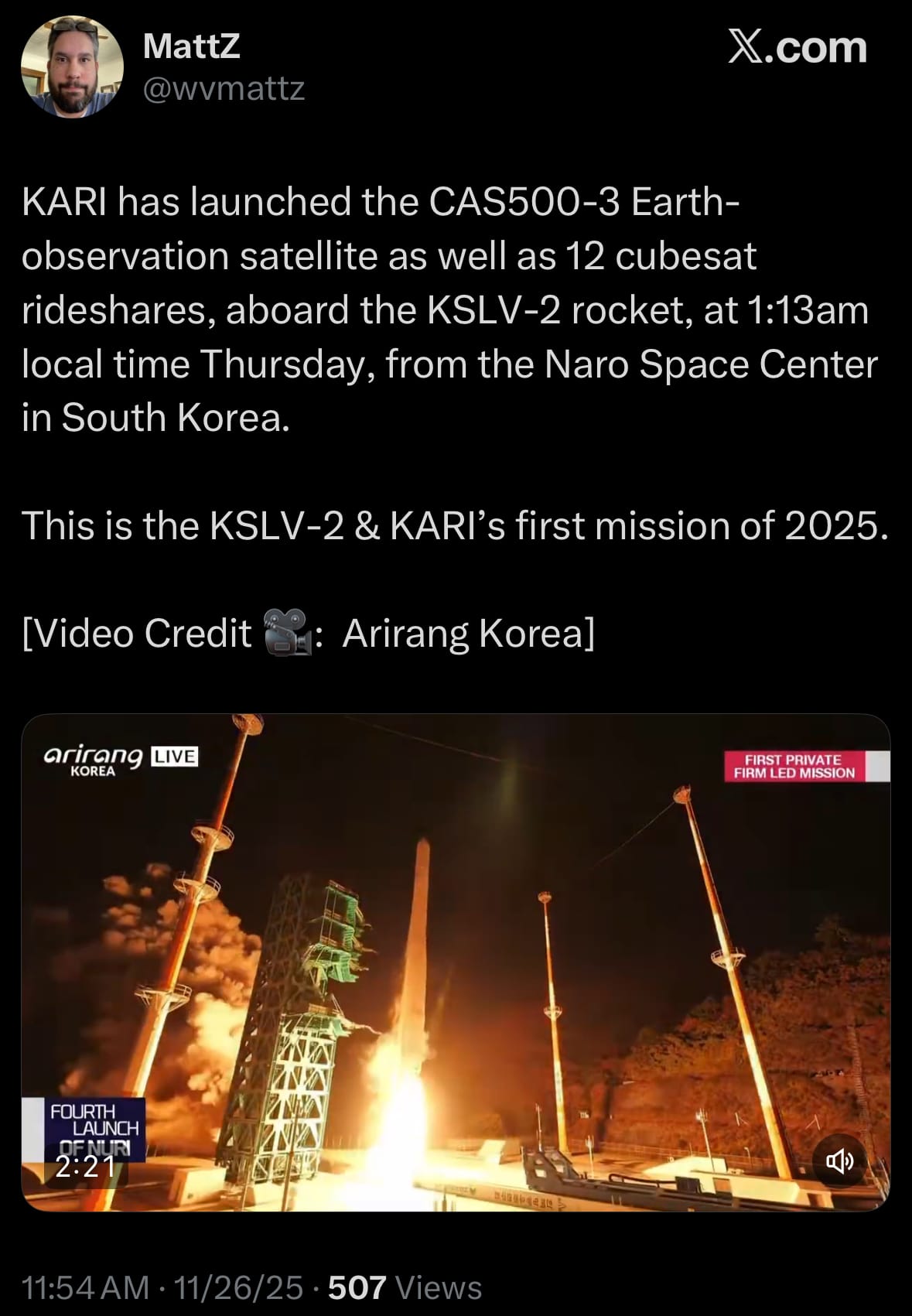
- The CAS500-3, or Compact Advanced Satellite 500-3, is a 500-kilogram-class Earth-observation platform developed under South Korea's national space program to verify advanced satellite technologies and support space science research, primarily for the Ministry of Science and ICT. Equipped with the Advanced Earth Imaging Sensor System-Compact (AEISS-C), an optical instrument for panchromatic and multispectral imaging, it enables high-resolution observations for environmental monitoring, disaster response, and resource management, while testing integrated systems like power, propulsion, and data handling for future missions. This satellite advances South Korea's goals of self-reliant space access and international competitiveness, building on prior CAS500 prototypes and contributing to a planned series of optical-radar hybrid platforms, with an expected operational lifespan of at least three years.
Statistic:
- Largest public automakers by market capitalization:
- 🇺🇸 Tesla: $1.401T
- 🇯🇵 Toyota: $263.72B
- 🇨🇳 Xiaomi: $135.31B
- 🇨🇳 BYD: $125.12B
- 🇺🇸 General Motors: $69.84B
- 🇮🇹 Ferrari: $68.26B
- 🇩🇪 Mercedes-Benz: $64.17B
- 🇩🇪 BMW: $61.74B
- 🇩🇪 Volkswagen: $57.34B
- 🇮🇳 Maruti Suzuki India: $56.95B
- 🇺🇸 Ford: $52.75B
- 🇮🇳 Mahindra & Mahindra: $49.59B
- 🇩🇪 Porsche: $46.58B
- 🇰🇷 Hyundai: $46.26B
- 🇯🇵 Honda: $39.30B
- 🇨🇳 Seres Group: $30.79B
- 🇯🇵 Suzuki Motor: $30.20B
- 🇰🇷 Kia: $29.98B
- 🇳🇱 Stellantis: $29.98B
- 🇨🇳 Great Wall Motors: $26.33B
- 🇨🇳 SAIC Motor: $24.13B
- 🇨🇳 Chery Automobile: $22.76B
- 🇨🇳 Geely: $21.88B
- 🇮🇳 Hyundai Motor India: $21.01B
- 🇨🇳 XPeng: $20.65B
History:
- Toyota begins in the 1930s as a bold industrial gamble. Sakichi Toyoda, an inventor who revolutionized textile manufacturing with automatic looms, built a company culture obsessed with precision engineering and relentless improvement. His son, Kiichiro Toyoda, believed Japan needed a domestic automobile industry to avoid dependence on foreign vehicles. Using profits from the family’s loom business, he established Toyota Motor Corporation in 1937 and released its first passenger car, the Model AA, that same year. Early production was difficult—Japan lacked the sprawling supply chains of America—but Toyota adopted a philosophy that would define its future: constant refinement, elimination of waste, and disciplined simplicity. After World War II, Toyota nearly collapsed, but rebuilding Japan created enormous demand for small, efficient vehicles like the Toyopet SA and later the Crown. By the 1960s, Toyota’s Corolla had become a global phenomenon, pairing reliability and affordability in a market hungry for dependable transportation. The company entered the U.S. market in 1957 with skepticism from American consumers, yet its careful engineering and superior fuel economy won converts quickly. By the 1980s, Toyota had established a reputation for unmatched quality control and launched Lexus in 1989, its luxury brand built to compete directly with Mercedes and BMW. The Toyota Production System—rooted in just-in-time manufacturing, kaizen (continuous improvement), and respect for workers—became a universal benchmark. It didn’t simply make Toyota efficient; it redefined how factories around the world thought about performance and reliability.
- In the late 1990s, Toyota again reshaped the global auto landscape with the Prius, the world’s first mass-market hybrid vehicle, proving the company’s ability to anticipate long-term technological shifts. Throughout the 2000s and 2010s, Toyota expanded its presence in every major automotive segment—sedans, trucks, SUVs, and hybrids—while maintaining a strategic caution on full electrification. The Land Cruiser and Hilux earned near-mythical reputations for durability, the Camry became one of the best-selling sedans in North America, and Lexus cemented dominance in luxury reliability. Toyota’s scale grew to tens of millions of vehicles per year, supported by manufacturing hubs across Asia, North America, and Europe, making it the world’s largest automaker by volume for many years. Today, Toyota remains a giant of global industry, and although Tesla surpassed it in market capitalization—marking a shift in how markets value software-centric EV companies—Toyota still sits as the second largest automaker on Earth by market cap, and it continues to generate more annual revenue and produce far more vehicles than any competitor. Its strategy now blends hybrid dominance, hydrogen fuel cell development, next-generation solid-state battery research, and a long-term vision of scalable, diversified propulsion rather than a single technological bet. The arc from a loom-maker’s side project in 1937 to a trillion-dollar industrial powerhouse reflects Toyota’s core identity: disciplined engineering, patient strategy, and a global reputation for building machines that work everywhere humanity drives.
Image of the day:

Thanks for reading! Earth is complicated, we make it simple.
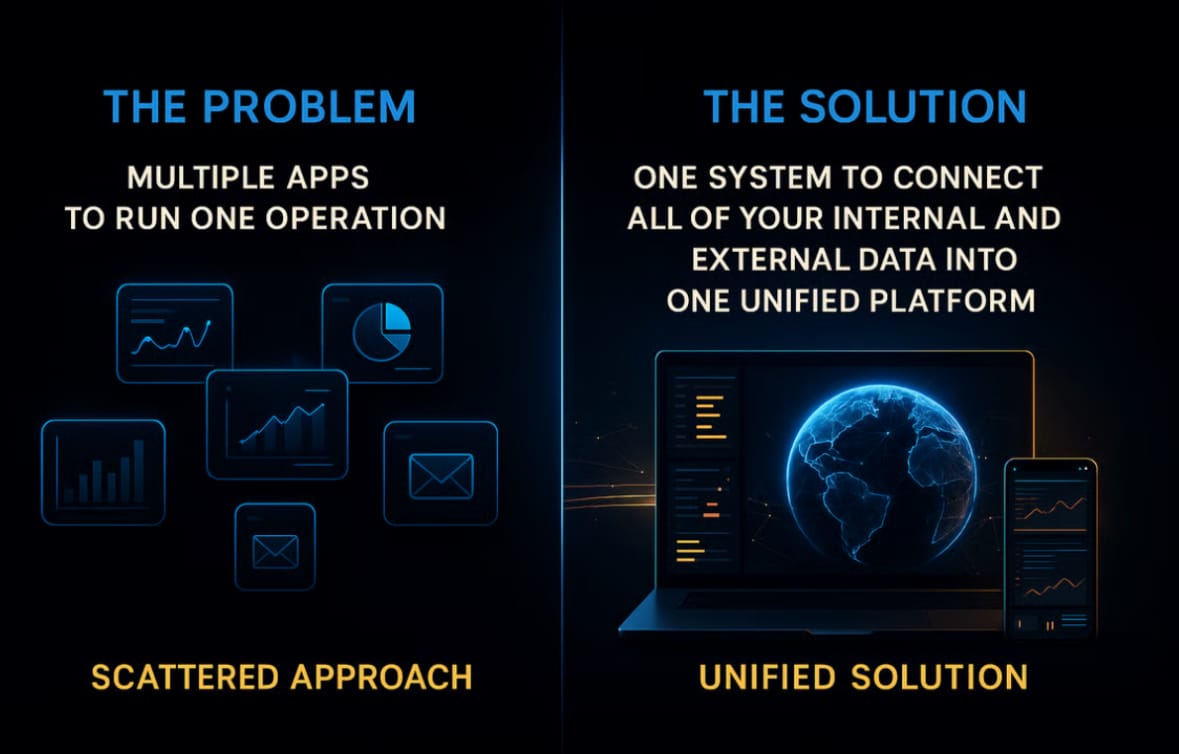

- Click below if you’d like to view our free EARTH WATCH globe:
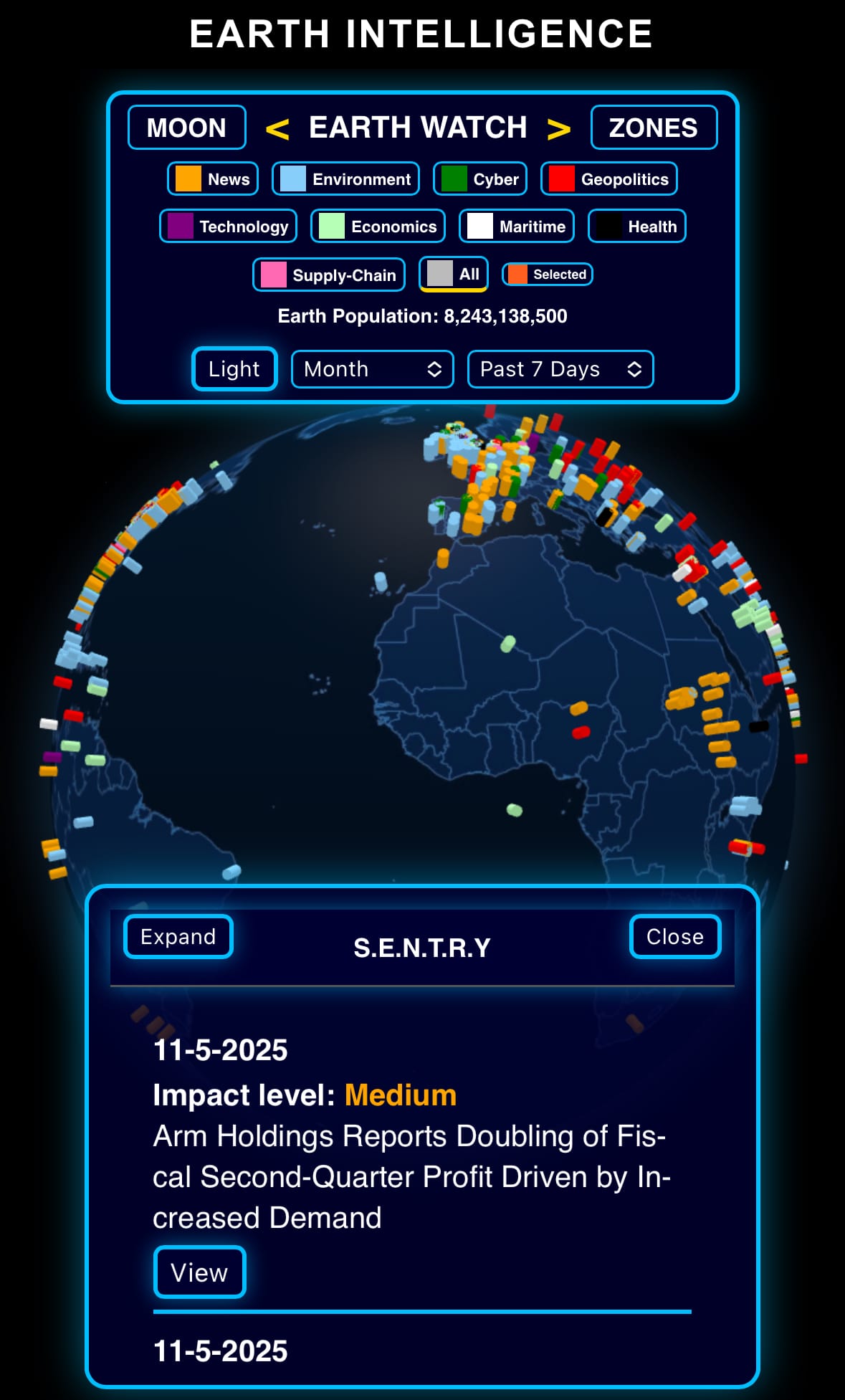
- Download our mobile app on the Apple App Store (Android coming soon):

Click below to view our previous newsletters:

Support/Suggestions Email:
earthintelligence@earthintel.news