Wednesday☕️

Trending:
- Yesterday, December 2, 2025, Michael and Susan Dell announced a $6.25 billion donation from their family foundations to seed $250 investment accounts for 25 million U.S. children aged 10 and younger who are not covered by the new federal Invest America program. The announcement took place at a White House event attended by President Donald Trump, Senator Ted Cruz, and Treasury Secretary Scott Bessent. The federal program, enacted as part of the One Big Beautiful Bill Act, automatically provides a $1,000 deposit into tax-advantaged accounts for every U.S. child born between January 1, 2025, and December 31, 2028; the Dells’ contribution targets the roughly 25 million children born before 2025, with priority given to those living in ZIP codes where median household income is below $150,000 (covering approximately 75% of U.S. ZIP codes).

- The accounts are created automatically for children with Social Security numbers, invest in low-cost broad-market index funds (primarily tracking the S&P 500), and allow additional family contributions. Funds are restricted until age 18, at which point they may be used for qualified expenses such as higher education, first-home purchase, or starting a business, and the accounts then convert to standard Roth IRAs. The Dell donation, described by the couple as an effort to promote long-term financial security and literacy, supplements the federal initiative and is administered through the same Treasury-managed platform.
Economics & Markets:
- Today’s U.S. stock market:

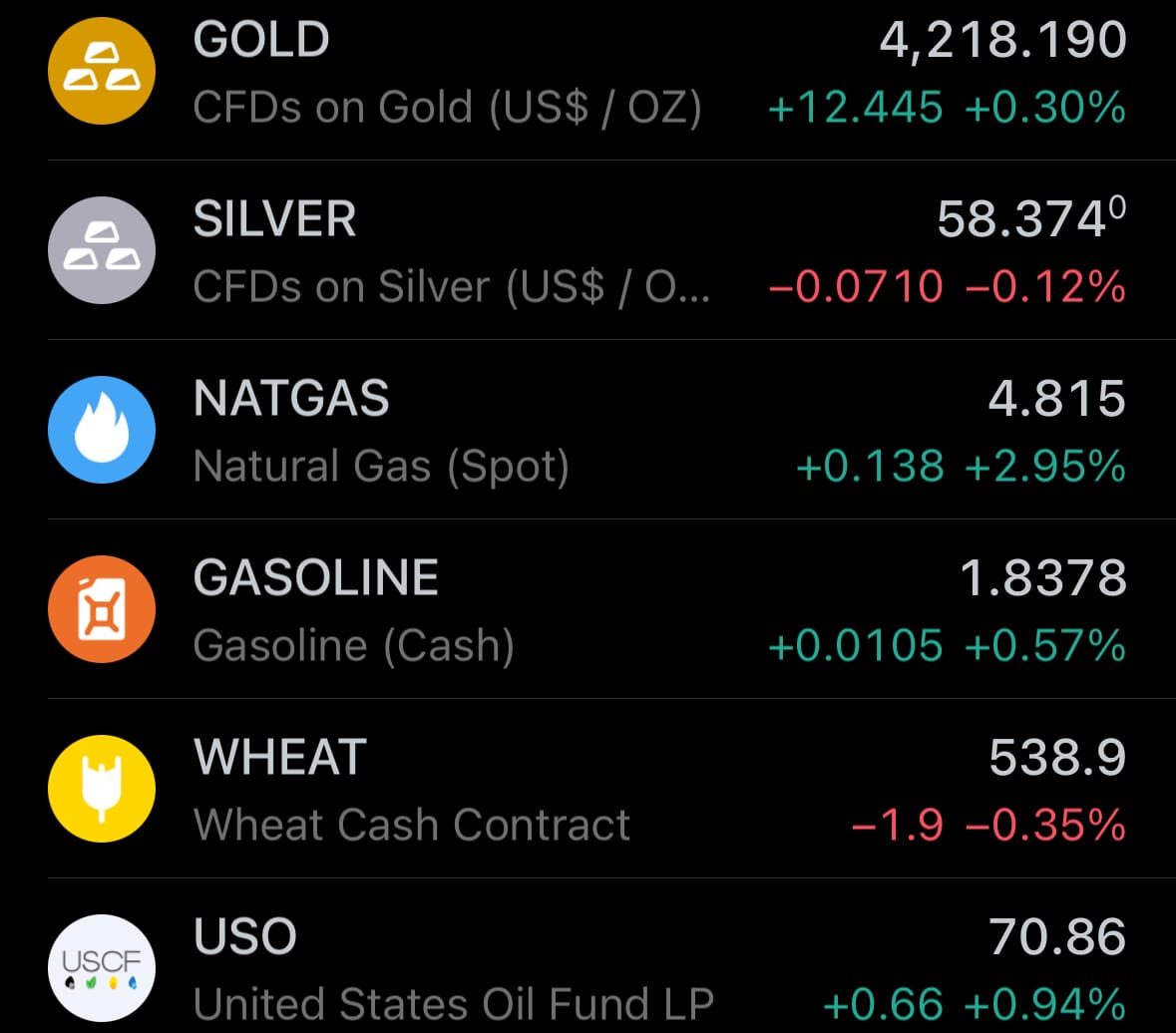
- Today’s commodity market:
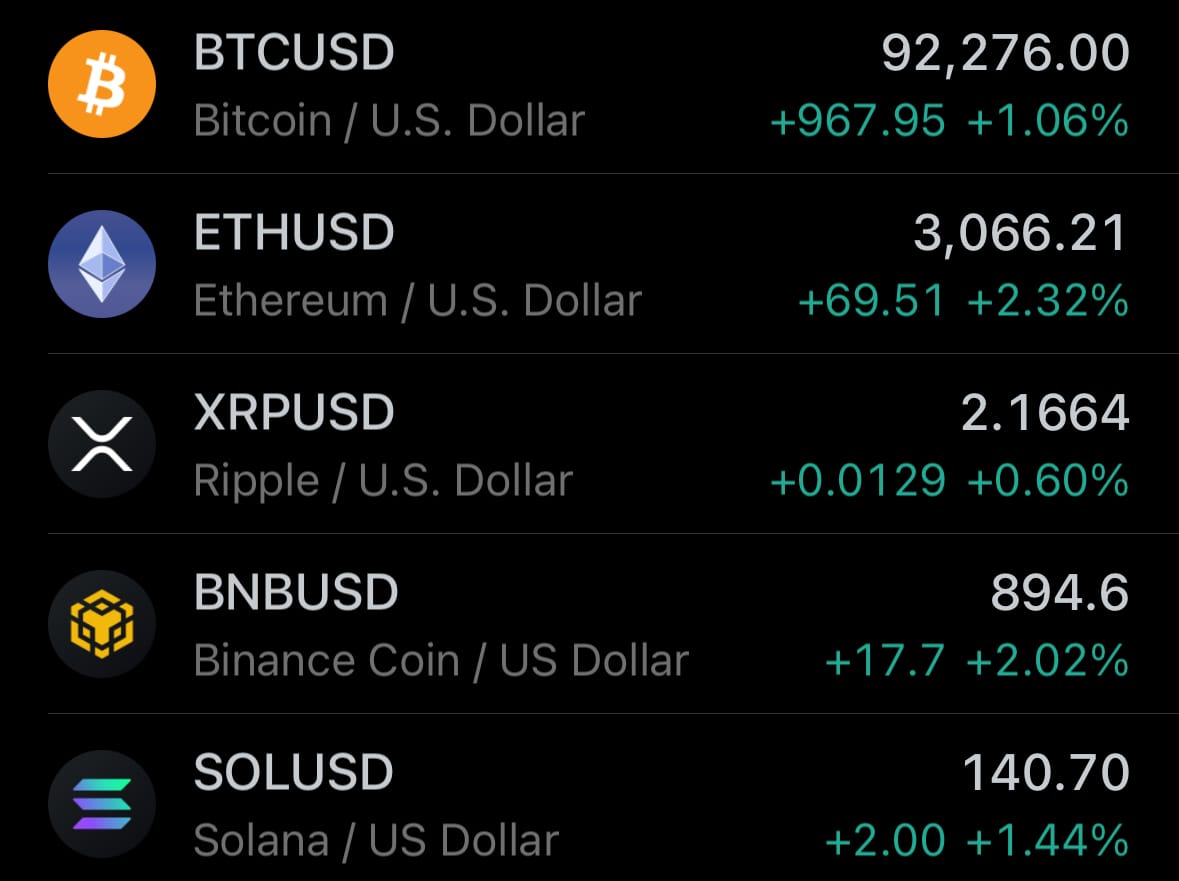
- Today’s crypto market:
Geopolitics & Military Activity:
- On December 3, 2025, Kremlin aide Yuri Ushakov briefed media on a five-hour meeting the previous evening between President Putin and U.S. envoys Steve Witkoff (Trump’s special envoy for Ukraine) and Jared Kushner. The talks focused on a revised U.S. peace proposal for Ukraine, now reduced from the original 28-point plan leaked in November to about 19 points after U.S. consultations with Kyiv and European partners. Russia received four additional documents alongside the main text.

- Discussions covered broad issues including territory, security guarantees, and military limits; Putin said some U.S. ideas are discussable but others remain unacceptable because they ignore Russia’s control of parts of Donbas. No agreements were reached, but both sides described the meeting as constructive and agreed to continue negotiations through aides and foreign ministries. Personal greetings were exchanged between Putin and Trump. The conversation also touched on possible U.S.–Russia economic cooperation. Witkoff and Kushner are scheduled to brief Ukrainian President Zelenskyy in the coming days ahead.
Environment & Weather:
- On December 3, 2025, Indonesia's National Disaster Management Agency reported that the death toll from devastating floods and landslides on Sumatra island has surpassed 800, with over 500 people still missing and approximately 2,600 injured. The disaster, triggered by Cyclone Senyar's torrential rains starting late November, has affected around 3.2 million residents across North Sumatra, West Sumatra, and Aceh provinces, displacing over 1 million to emergency shelters.
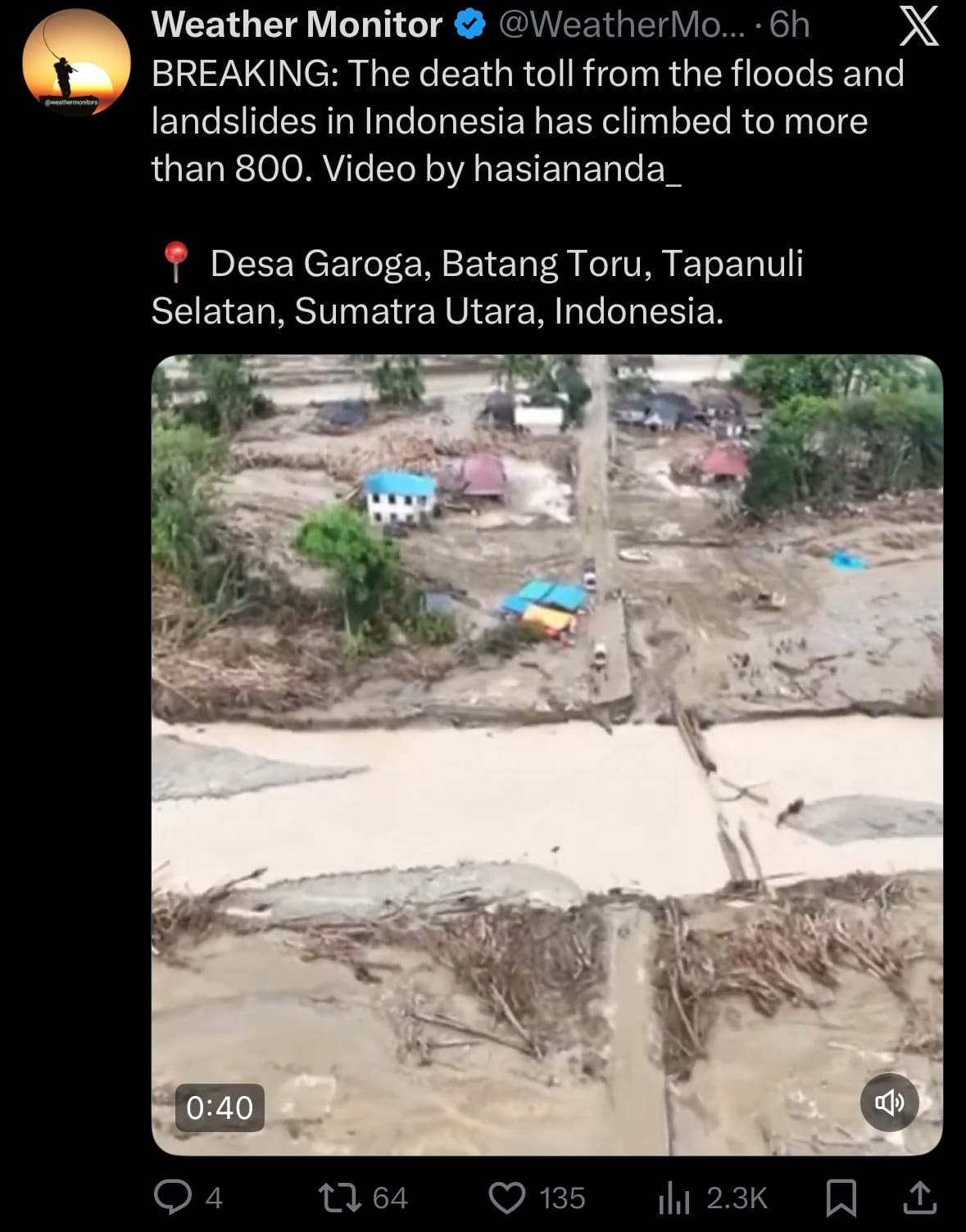
- The crisis, one of Indonesia's deadliest natural disasters since the 2018 Sulawesi tsunami, has been exacerbated by deforestation from logging and palm oil plantations, reducing natural flood barriers and intensifying soil erosion. Rescue operations continue amid blocked roads, collapsed bridges, and communication blackouts, with the government deploying helicopters, C-130 aircraft, and 34,000 tons of aid including rice and oil, while international organizations like UNICEF assist in hard-to-reach areas. Forecasts predict more heavy rain through the week, raising fears of further landslides, though over 90% of telecom towers in affected zones have been restored.
Space:
- On December 2, 2025, SpaceX conducted two Falcon 9 launches deploying Starlink satellites, the first from Vandenberg Space Force Base in California at approximately 2:10 a.m. PST (10:10 UTC) as part of the Starlink 6-87 mission. The rocket carried 27 V2 Mini satellites into low Earth orbit at around 530 kilometers altitude, with the first stage booster B1067—on its 32nd flight—landing successfully on the droneship Just Read the Instructions in the Pacific Ocean about eight minutes after liftoff. This mission marked SpaceX's 154th Falcon 9 launch of the year and contributed to the constellation's expansion for global broadband coverage, amid favorable weather conditions despite minor coastal fog.

- Later that evening, at 5:18 p.m. EST (22:18 UTC), SpaceX launched the Starlink 6-95 mission from Space Launch Complex 40 at Cape Canaveral Space Force Station in Florida, deploying another 29 V2 Mini satellites following a three-hour delay due to strong winds from a cold front. Booster B1077, on its 25th flight, separated and landed on the droneship A Shortfall of Gravitas in the Atlantic Ocean, while the second stage achieved orbit insertion after a southeasterly trajectory. This back-to-back operation, the 155th Falcon 9 flight of 2025, highlighted the company's rapid cadence—now exceeding prior annual records—though it drew attention to ongoing concerns over orbital debris and regulatory approvals for further constellation growth.
LandSpace Launch:
- On December 3, 2025, LandSpace Technology Corporation conducted the maiden flight of its Zhuque-3 (ZQ-3) rocket from Site 96B at the Jiuquan Satellite Launch Center in China's Inner Mongolia Autonomous Region. Liftoff occurred at 04:02 UTC (12:02 Beijing time), carrying a dummy payload to simulate orbital insertion. The two-stage, stainless-steel vehicle, standing 66.1 meters tall with a diameter of 4.5 meters and a fueled mass of about 570 metric tons, was powered by nine TQ-12A methane-liquid oxygen engines on the first stage and a single TQ-15A on the second. The mission successfully achieved orbit, validating the rocket's ascent performance, stage separation, and payload deployment systems, as confirmed by LandSpace and state media.
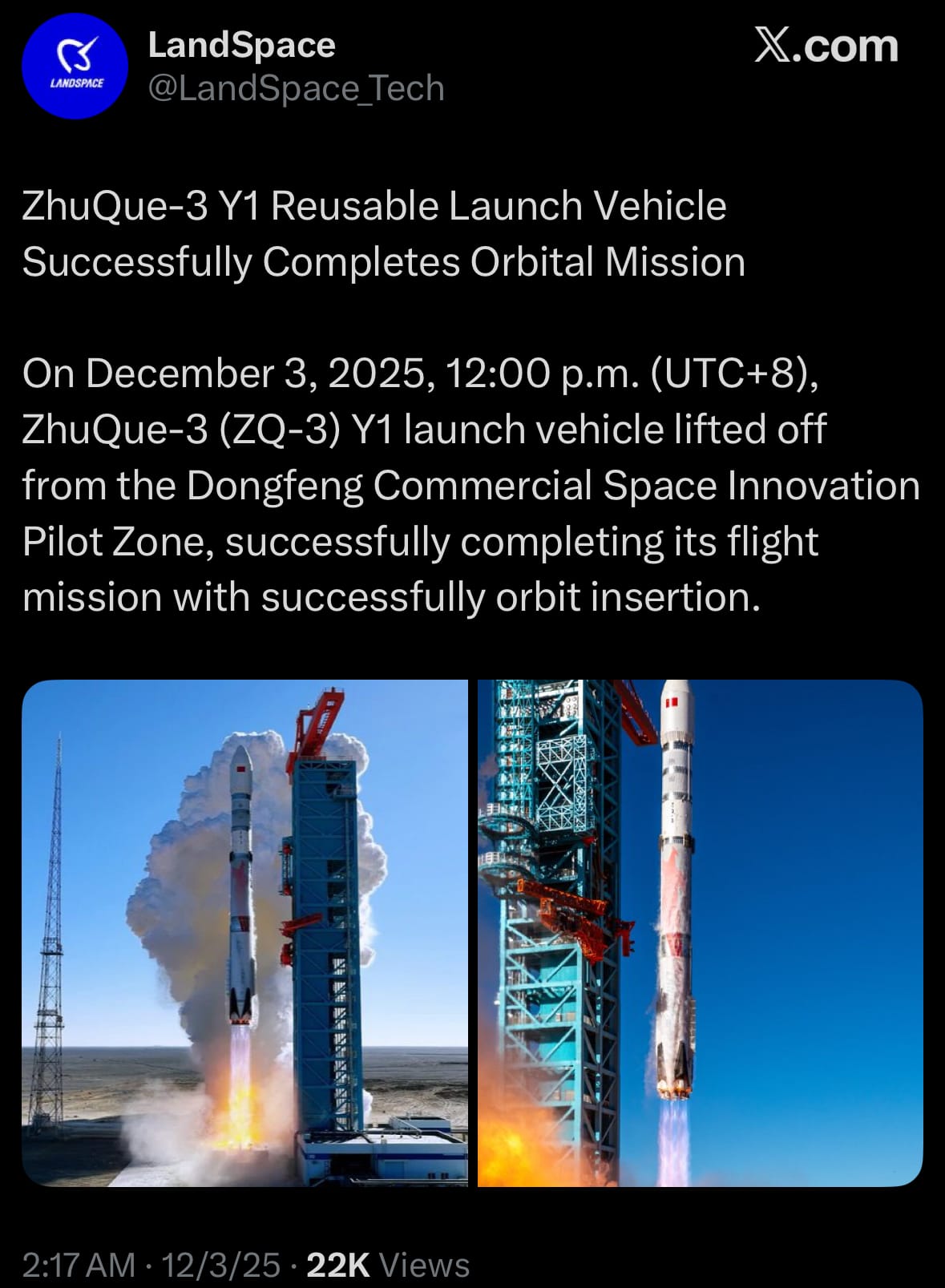
- The first-stage booster executed a re-entry burn nominally but experienced an anomaly during the landing burn, resulting in a crash and explosion near the downrange landing pad approximately 300 km from the launch site in Minqin County, Gansu Province. No injuries were reported, and the failure did not affect the orbital objectives. This test marks China's first attempt at reusable first-stage recovery on an orbital-class rocket, building on prior suborbital VTVL tests and static fires in 2024–2025. LandSpace described the flight as 90% successful, providing key data to refine reusability for future missions, with full operational capability targeted for 2026 to support China's satellite internet constellation.
Statistic:
- Largest public insurance companies on Earth by market capitalization:
- 🇺🇸 UnitedHealth: $293.98B
- 🇨🇳 China Life Insurance: $172.31B
- 🇩🇪 Allianz SE: $166.04B
- 🇨🇳 Ping An Insurance: $149.59B
- 🇺🇸 Progressive: $134.14B
- 🇨🇭 Chubb: $117.41B
- 🇭🇰 AIA: $107.17B
- 🇨🇭 Zurich Insurance Group: $103.47B
- 🇫🇷 AXA: $95.09B
- 🇺🇸 Marsh & McLennan Companies: $90.14B
- 🇩🇪 Munich RE (Münchener Rück): $81.91B
- 🇬🇧 Aon: $74.54B
- 🇺🇸 Elevance Health: $74.51B
- 🇺🇸 The Cigna Group: $73.21B
- 🇯🇵 Tokio Marine: $67.03B
- 🇺🇸 The Travelers Companies: $64.95B
- 🇺🇸 Arthur J. Gallagher & Co.: $62.71B
- 🇮🇳 Life Insurance Corporation of India (LIC): $61.27B
- 🇮🇹 Generali: $60.45B
- 🇨🇦 Manulife Financial: $58.87B
- 🇺🇸 Allstate: $55.04B
- 🇨🇳 The People’s Insurance Company (PICC): $51.96B
- 🇨🇭 Swiss Re: $51.36B
- 🇺🇸 MetLife: $50.72B
- 🇧🇪 KBC: $48.17B
History:
- The idea of a canal through Panama begins the moment Europeans see how thin the isthmus is. After Vasco Núñez de Balboa crossed Panama in 1513, Spain realized the Atlantic and Pacific were separated by only a few dozen miles. By the 1520s, King Charles V ordered formal studies on a canal, though the engineering of the era made the idea impossible. For the next 300 years, the isthmus functioned as a human-powered trade route—mules, carts, and porters shuttling goods across the jungle. In the 1850s, during the California Gold Rush, the U.S.–owned Panama Railroad opened in 1855, becoming the most profitable railroad in the world and proving the economic value of a trans-isthmus shortcut. When the Suez Canal opened in 1869, global engineering confidence soared, inspiring France to attempt a Panama canal. Ferdinand de Lesseps’ French project launched in 1881, but the team underestimated Panama’s geology and climate. Between 1881 and 1889, tens of thousands of laborers—mostly from the Caribbean—died from malaria, yellow fever, and landslides in the Culebra Cut. Financial collapse hit France in 1889, ending the attempt in scandal. The United States entered the scene after supporting Panama’s independence from Colombia in November 1903. Immediately after the revolution, the Hay–Bunau-Varilla Treaty (1903) granted the U.S. rights to the Canal Zone. American engineers arrived in 1904, scrapped the French sea-level design, and began constructing a lock-based system. The Gatun Dam, which created Gatun Lake—completed between 1907–1913—was a monumental engineering achievement. Under chief engineers John F. Stevens (1905–1907) and George Washington Goethals (1907–1914), excavation surged forward. Meanwhile, Dr. William Gorgas, using lessons from the Cuban campaigns of the 1890s, launched a sweeping anti-mosquito program starting in 1904 that finally controlled yellow fever by 1906 and drastically reduced malaria by 1908. After ten intense years of U.S. construction, the Panama Canal officially opened on August 15, 1914, reshaping global trade and military strategy.
- Throughout the 20th century, the canal became a strategic artery. During World War II (1939–1945), the U.S. fortified Panama heavily, fearing Axis sabotage. In 1964, tensions over sovereignty erupted in protests that eventually pushed the United States into negotiations. In 1977, Presidents Jimmy Carter and Omar Torrijos signed the Torrijos–Carter Treaties, which promised a gradual transfer of control. Full sovereignty passed to Panama on December 31, 1999, ending nearly a century of U.S. administration. Once Panama took control, the Panama Canal Authority (ACP) modernized the entire system and prepared for rising ship sizes. The $5.4 billion expansion, approved by referendum in 2006, began construction in 2007, and opened on June 26, 2016, adding the Agua Clara (Atlantic) and Cocolí (Pacific) locks. These locks accommodate “New Panamax” ships—vessels up to three times larger than the original 1914 dimensions. Today the canal handles roughly 5% of global maritime trade, serving ships from more than 140 nations, and linking over 1,700 ports worldwide. Its daily operations depend on precise digital scheduling, computerized tug coordination, and constant dredging to maintain depth in the Culebra Cut and Gatun Lake. Climate shocks such as the 2019–2020 and 2023–2024 El Niño droughts forced transit reductions due to falling lake levels, revealing the canal’s dependence on rainfall. Even so, Panama continues developing new reservoirs, water-conservation lock cycles, and long-term expansion plans to stabilize capacity. More than 500 years after the first dream of a canal, and 110 years after its opening, the Panama Canal remains one of the most strategically vital, technically demanding, and intensely managed pieces of infrastructure on Earth—a narrow strip of engineering that continues to shape global commerce every single day.
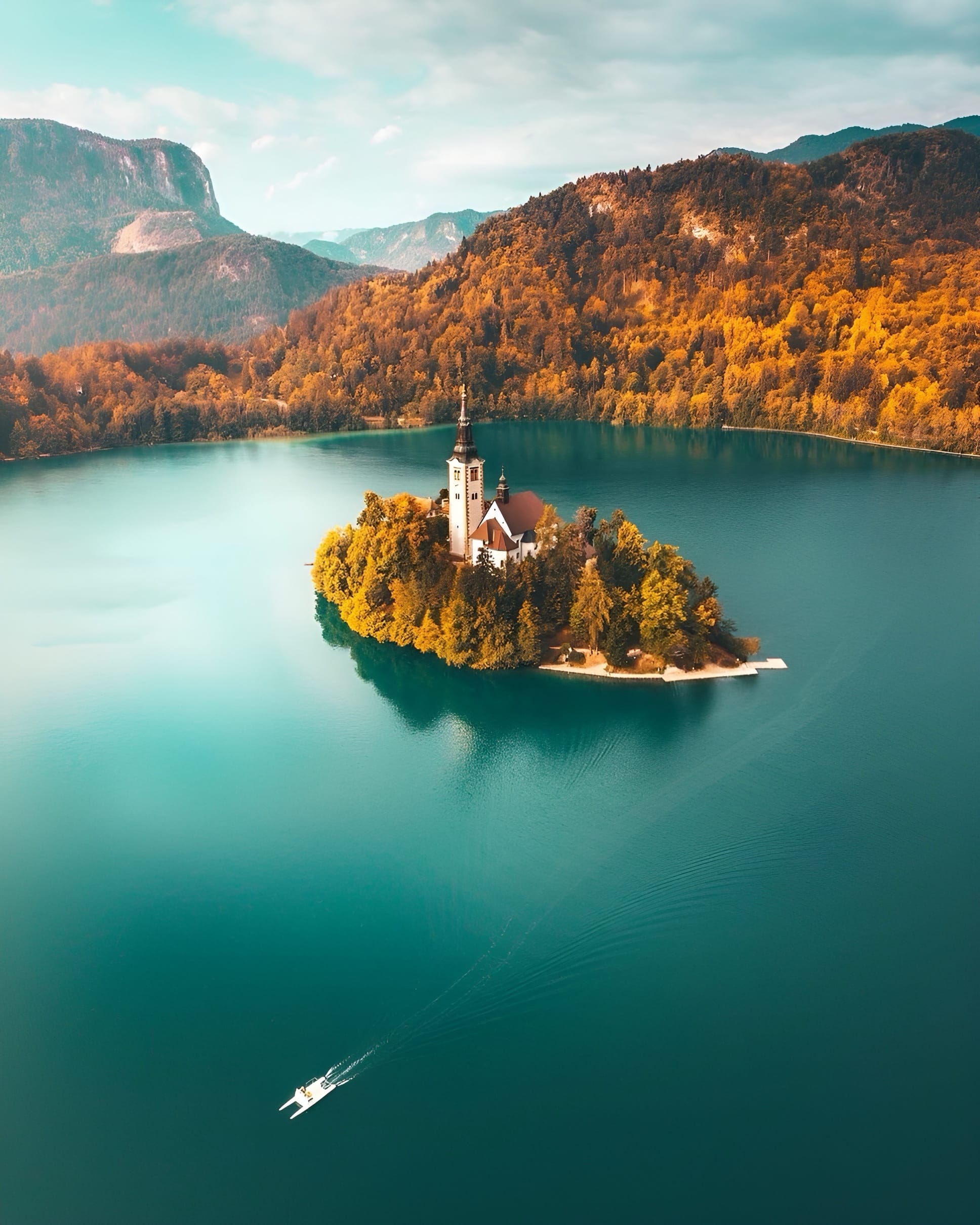
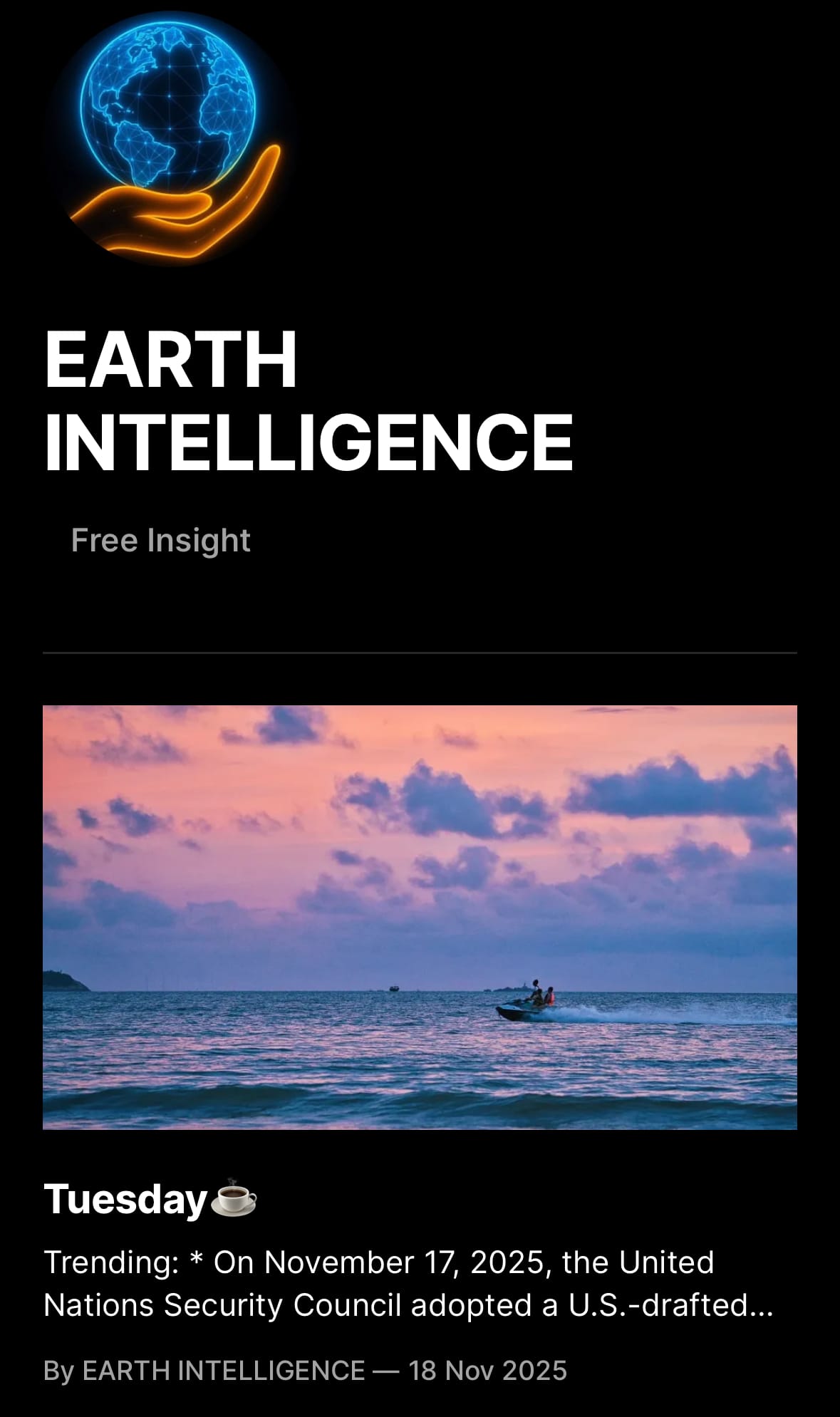
Image of the day:
Thanks for reading! Earth is complicated, we make it simple.
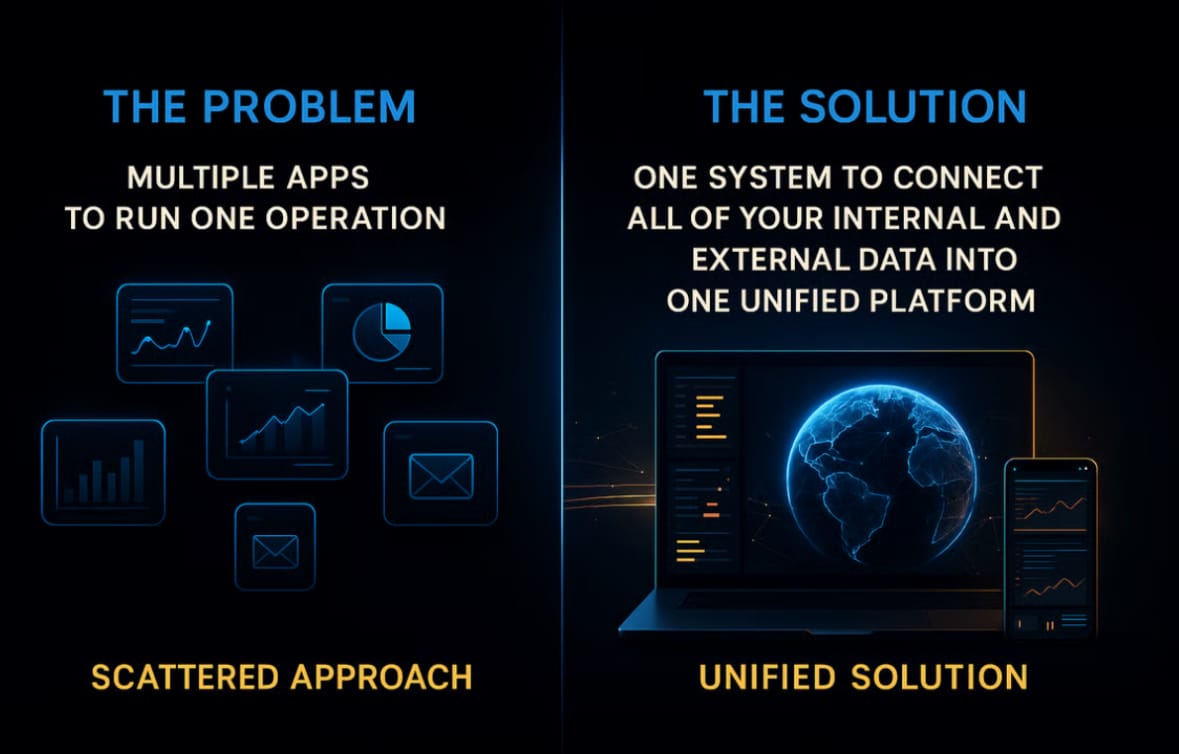

- Click below if you’d like to view our free EARTH WATCH globe:
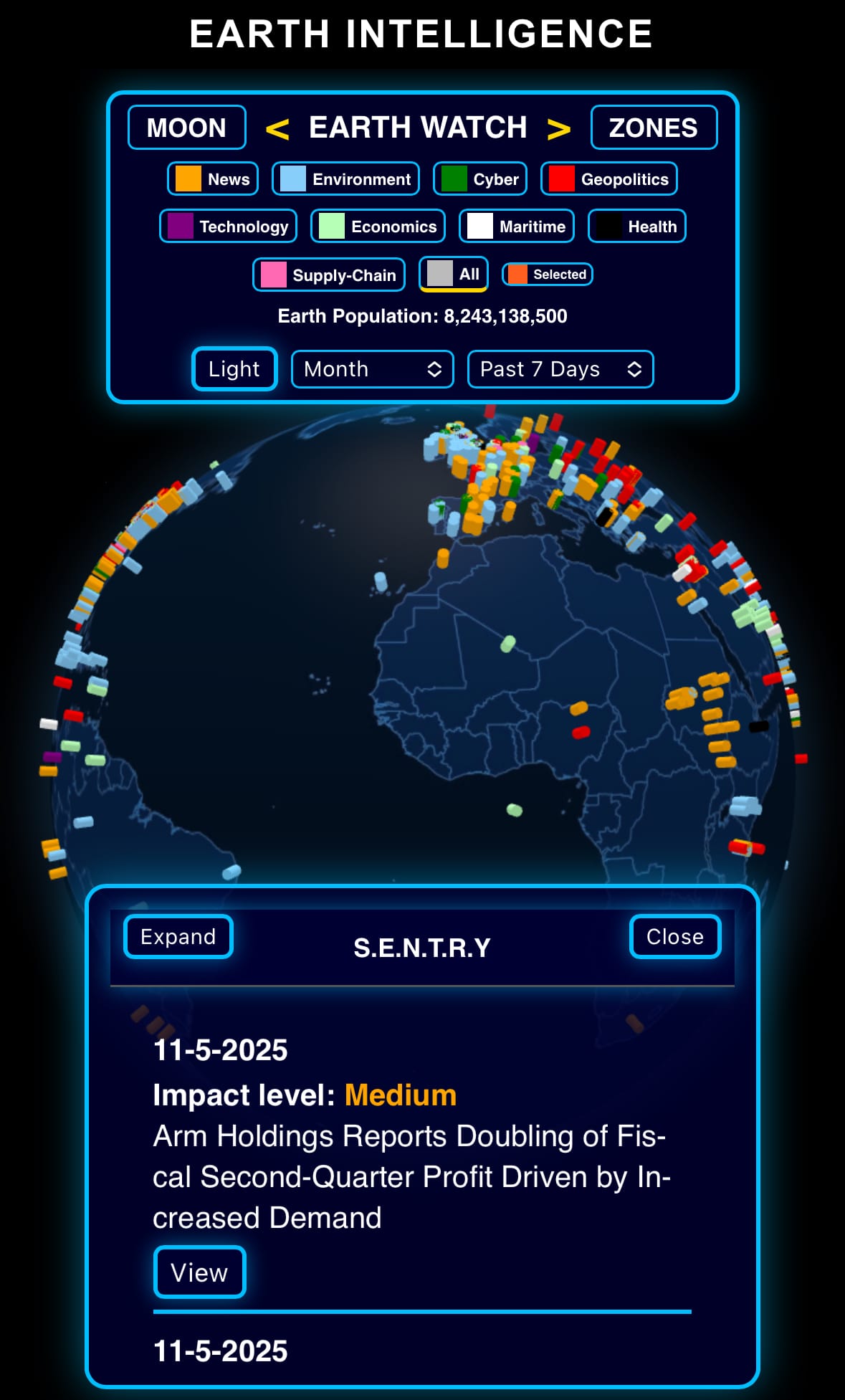
- Download our mobile app on the Apple App Store (Android coming soon):

Click below to view our previous newsletters:
Support/Suggestions Email:
earthintelligence@earthintel.news