Wednesday☕️


Trending:
- On December 23, 2025, a Dassault Falcon 50 business jet (registration 9H-DFJ) crashed near Kesikkavak village in the Haymana district south of Ankara, Turkey, killing all five people on board. The passengers included Lieutenant General Mohammed Ali Ahmed al-Haddad, Chief of General Staff for Libya's UN-recognized Government of National Unity in Tripoli, along with four other senior Libyan military officials whose names have not yet been publicly released. The Maltese-registered aircraft, operated by Harmony Jets, was returning the delegation to Tripoli after an official visit to Ankara.
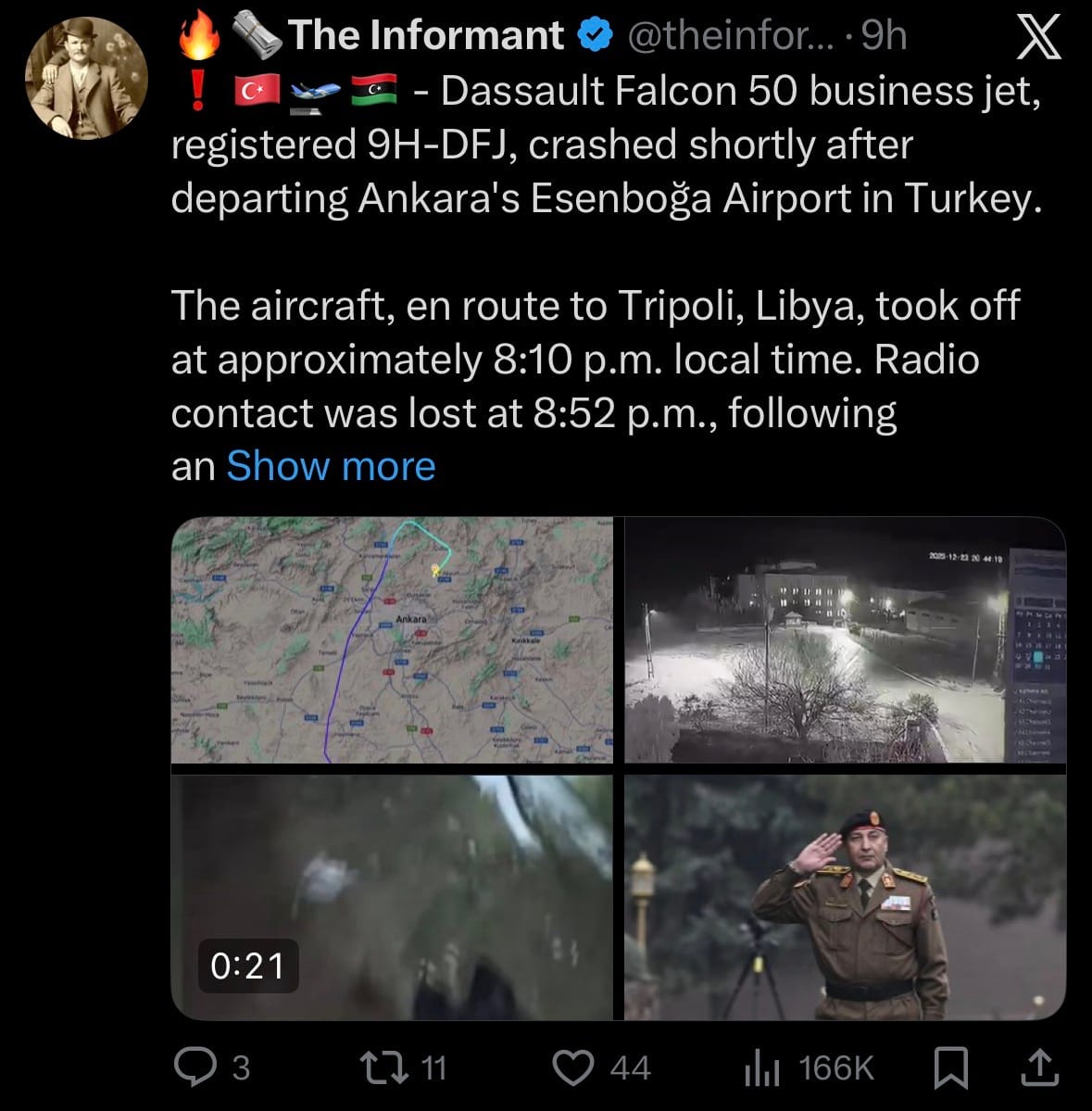
- The jet took off from Esenboğa Airport at around 8:10 p.m. local time (17:10 UTC). The crew reported an electrical failure and requested an emergency landing while over Haymana, but radio contact was lost at 8:52 p.m. Wreckage was located shortly afterward, with no survivors confirmed. Al-Haddad had met that day with Turkish Defense Minister Yaşar Güler and Chief of General Staff Selçuk Bayraktaroğlu to discuss military cooperation. Libya declared three days of national mourning, and Turkish authorities are investigating the technical malfunction believed to have caused the crash.
Economics & Markets:
- Yesterday’s U.S. stock market:

- Yesterday’s commodity market:

- Yesterday’s crypto market:

Environment & Weather:
- On December 23, 2025 (evening into December 24), heavy rainfall triggered significant flooding across multiple areas in Cirebon Regency and City, West Java, Indonesia. Floodwaters inundated residential neighborhoods, major roads (including intersections in Talun district causing long traffic jams and stalled vehicles), and commercial sites, with reports of a supermarket warehouse wall collapsing under the force of rushing water, sweeping away goods. Police and military personnel assisted with traffic control and evacuations, while no casualties were immediately reported amid disrupted access in low-lying districts.

- The flooding resulted from prolonged high-intensity rain since the afternoon, combined with runoff from upstream areas in Kuningan Regency overflowing rivers like the Cipager. This event follows similar flooding in mid-December that affected thousands, highlighting ongoing vulnerabilities during Indonesia's rainy season, with local authorities monitoring for further rises and deploying pumps for drainage.
Space:
- On December 24, 2025, India's ISRO successfully launched its LVM3 heavy-lift rocket from the Satish Dhawan Space Centre in Sriharikota. The rocket lifted off at about 08:55 Indian time (03:25 UTC) and deployed the BlueBird Block 2 FM1 satellite—also called BlueBird-6—for the U.S. company AST SpaceMobile. The ~6,500 kg satellite was placed into a 520 km low Earth orbit. This mission set two records for ISRO: the heaviest single payload ever sent to low Earth orbit by an LVM3, and the deployment of the largest commercial satellite communications array in space (223 square meters).
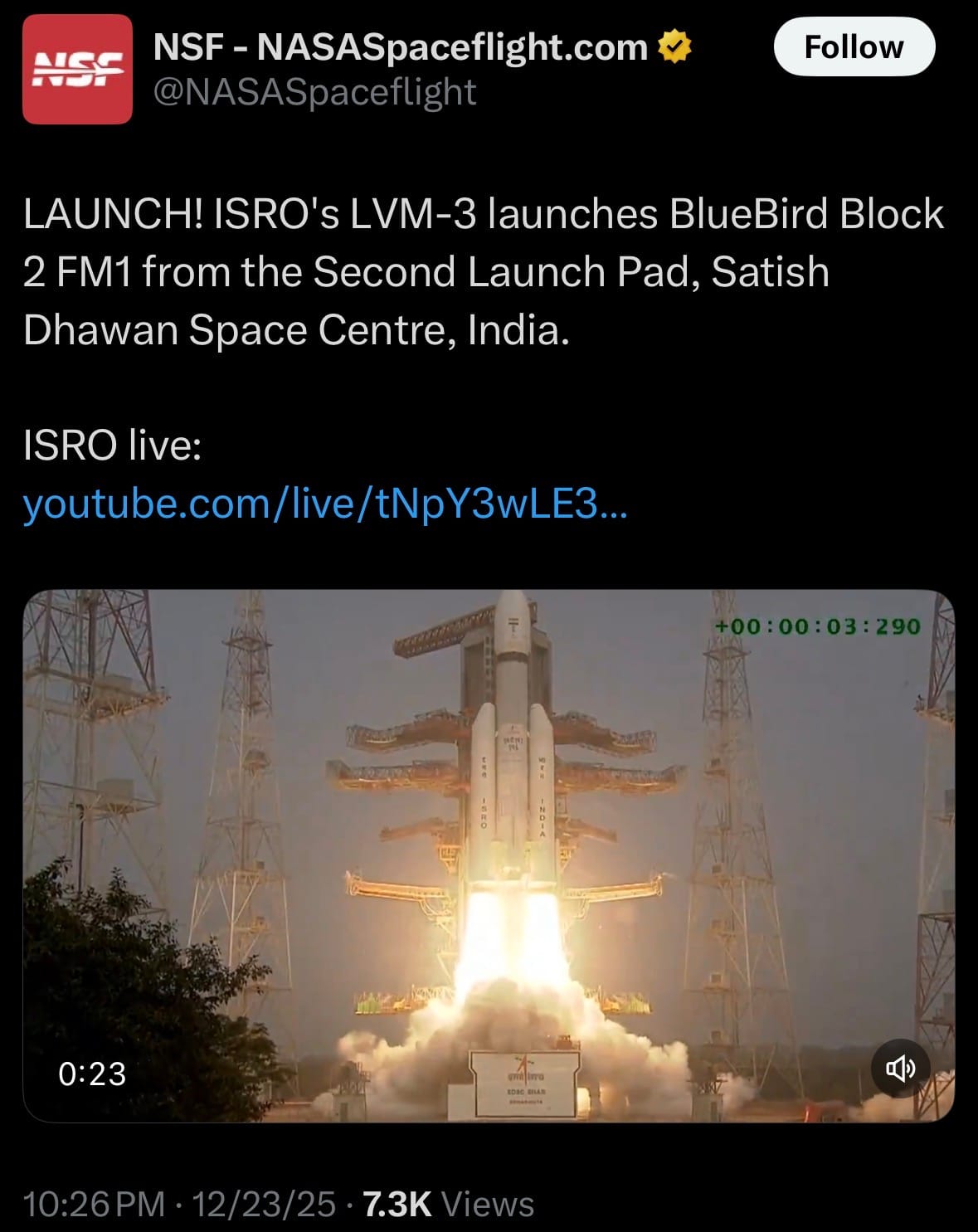
- The new Block 2 satellite provides up to 10 times more bandwidth than AST's earlier five Block 1 satellites (launched in 2024), allowing direct 4G/5G cellular broadband to unmodified smartphones at speeds up to 120 Mbps. It advances AST SpaceMobile's goal of global coverage through partnerships with over 50 mobile network operators. The fully commercial flight, arranged through NewSpace India Ltd (NSIL), underscores ISRO's growing strength in large-scale commercial launches amid a busy global space year.
Statistic:
- Largest assets on Earth by market capitalization:
- Gold: $31.450T
- 🇺🇸 NVIDIA: $4.606T
- Silver: $4.069T
- 🇺🇸 Apple: $4.041T
- 🇺🇸 Alphabet (Google): $3.810T
- 🇺🇸 Microsoft: $3.618T
- 🇺🇸 Amazon: $2.481T
- Bitcoin: $1.743T
- 🇺🇸 Meta Platforms: $1.675T
- 🇺🇸 Broadcom: $1.656T
- 🇺🇸 Tesla: $1.614T
- 🇹🇼 TSMC: $1.540T
- 🇸🇦 Saudi Aramco: $1.532T
- 🇺🇸 Berkshire Hathaway: $1.079T
- 🇺🇸 Eli Lilly: $960.67B
- 🇺🇸 JPMorgan Chase: $896.22B
- 🇺🇸 Walmart: $884.18B
- 🇺🇸 Vanguard S&P 500 ETF: $829.25B
- 🇺🇸 iShares Core S&P 500 ETF: $766.14B
- 🇺🇸 SPDR S&P 500 ETF: $704.25B
- 🇨🇳 Tencent: $701.21B
- 🇺🇸 Visa: $681.98B
- Platinum: $592.40B
- 🇺🇸 Vanguard Total Stock Market ETF: $571.41B
- 🇺🇸 Oracle: $561.23B
History:
- Electronic Warfare begins the moment militaries understand that war is not only fought with weapons, but with signals. Its origins lie in World War I, when radio communications became essential for coordinating forces and were quickly intercepted by adversaries. Early Electronic Warfare focused on listening and interference—radio interception, direction finding, and crude jamming. By World War II, it had evolved into a decisive battlefield domain. Radar systems transformed air defense and naval warfare, and Electronic Warfare emerged as the counterbalance. Britain’s early-warning radar network gave it survival-level advantage during the Battle of Britain, while both Axis and Allied forces raced to blind each other’s sensors. Techniques such as radar jamming, signal spoofing, and chaff—thin strips of metal dropped from aircraft to confuse radar—became standard tools by 1943. Radio deception operations misled enemy navigation and command networks, and signals intelligence units intercepted vast volumes of enemy communications. The lesson was permanent: if you control the electromagnetic spectrum, you control what the enemy can see, hear, and coordinate. During the Cold War, Electronic Warfare expanded dramatically alongside guided missiles, jet aircraft, and global surveillance systems. The United States and the Soviet Union built massive radar networks and electronic intelligence infrastructures, while aircraft and ships were equipped with increasingly sophisticated jammers, receivers, and warning systems. Conflicts such as Vietnam revealed how lethal modern air defenses could be without effective Electronic Warfare, driving the development of dedicated suppression of enemy air defense systems, electronic attack aircraft, and anti-radiation missiles designed to home in on hostile radar emissions.
- From the 1990s to today, Electronic Warfare has transformed from a specialized support function into a central pillar of modern military power. The 1991 Gulf War demonstrated how the United States could dominate an adversary by combining stealth aircraft, precision weapons, intelligence fusion, and Electronic Warfare to dismantle command-and-control systems before ground forces ever engaged. As warfare became networked, Electronic Warfare expanded beyond radar and radios to include GPS disruption, data-link interference, satellite denial, and cyber-electromagnetic operations, where digital networks and the electromagnetic spectrum are treated as a single battlespace. In the 2010s and 2020s, artificial intelligence began reshaping the field. Modern Electronic Warfare systems now use machine learning to detect, classify, and respond to signals in real time across dense, contested environments—far faster than human operators can react. The United States leads this domain through unmatched integration across air, sea, land, space, and cyber forces, and through a powerful industrial base. Legacy defense primes such as Lockheed Martin, Northrop Grumman, Raytheon (RTX), Boeing, and L3Harris design advanced jammers, sensors, electronic attack aircraft, and spectrum-management systems embedded into platforms like stealth fighters, naval fleets, and missile defenses. At the same time, new defense technology companies such as Anduril are pushing Electronic Warfare into a software-driven era, building autonomous sensing systems, adaptive jamming platforms, and artificial-intelligence-powered spectrum awareness tools that can evolve rapidly against emerging threats. Today, Electronic Warfare determines whether sensors function, weapons guide accurately, communications survive, and forces remain coordinated. It is largely invisible, often classified, and decisive long before shots are fired—making it one of the most strategically dominant and technologically advanced arenas of modern conflict, and one where U.S. capabilities remain globally preeminent.
Image of the day:

Thanks for reading! Earth is complicated, we make it simple.
- Click below if you’d like to view our free EARTH WATCH globe:
- Download our mobile app:



Click below to view our previous newsletters:

Support/Suggestions Email:
earthintelligence@earthintel.news