Wednesday☕️


Trending:
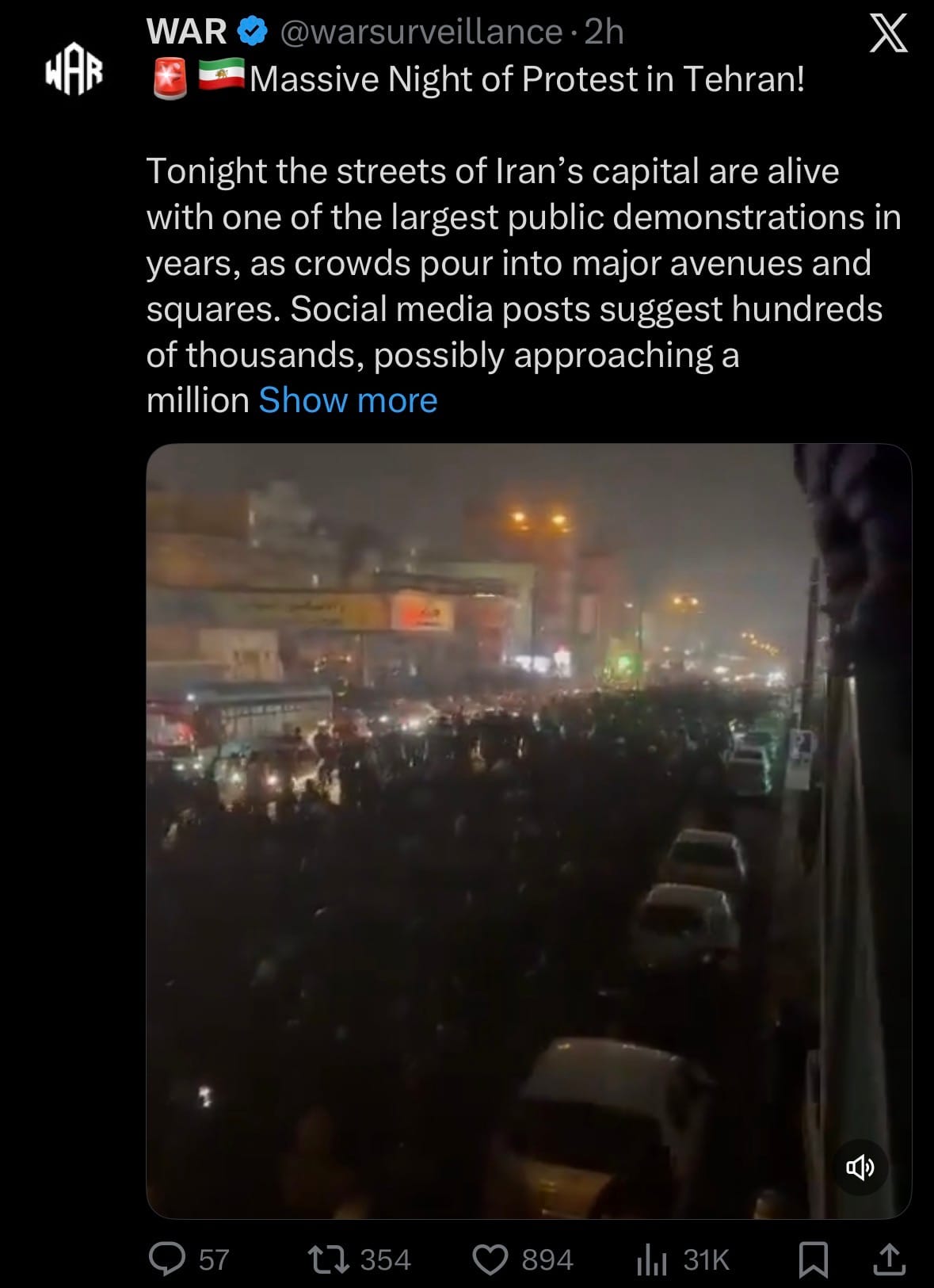
- As of January 13, 2026, Iranian anti-government protests continued with widespread demonstrations reported in Tehran and dozens of other cities across nearly all provinces. Social media footage and eyewitness accounts from activists show large crowds filling major avenues and squares in the capital tonight, with chants including "Death to the Dictator" (targeting Supreme Leader Ali Khamenei) and calls for regime change. Estimates of turnout vary widely due to the ongoing blackout—ranging from tens of thousands to claims of hundreds of thousands in Tehran alone—but images and videos depict significant gatherings despite severe repression. Protests remain fueled by economic grievances (rial collapse, inflation over 40%) and have evolved into explicit political demands, including support for exiled Crown Prince Reza Pahlavi in some areas.
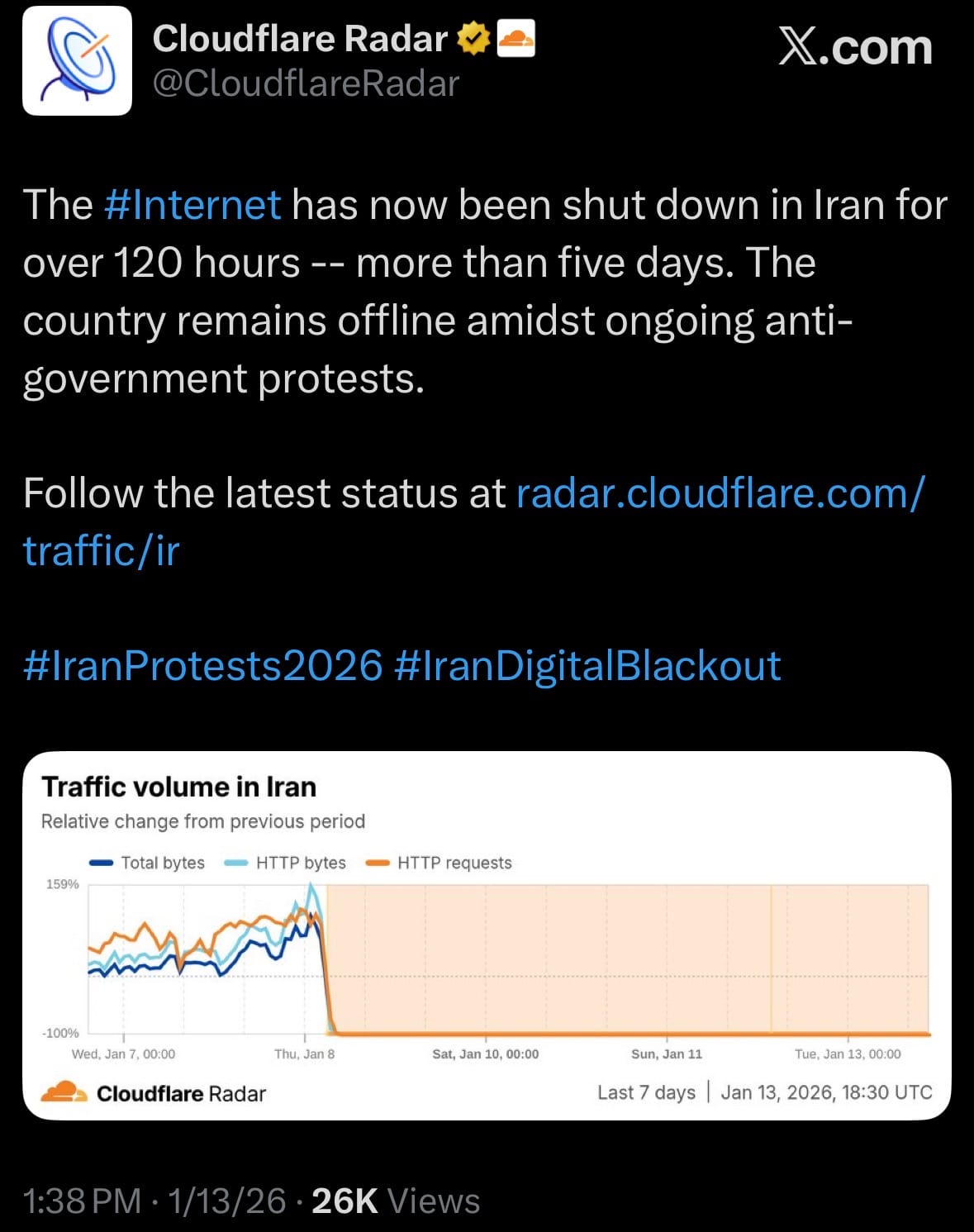
- Iranian authorities have maintained a near-total internet and communications blackout since January 8 (over 120 hours as of yesterday), severely restricting mobile data, social media, international calls, and domestic networks in Tehran and many provinces to disrupt coordination and limit documentation of events. Monitors like NetBlocks confirm the shutdown is among the most extensive on record, with selective jamming of satellite services (including Starlink) and door-to-door seizures of dishes reported. This has hindered real-time verification of crowd sizes and casualties, though rights groups continue estimating hundreds to thousands killed overall (disputed figures range from regime-reported low numbers to opposition claims exceeding 2,000 in recent days amid crackdowns). Security forces have used live fire, tear gas, and mass arrests, while pro-regime rallies were staged in Tehran to counter the narrative. The blackout and violence have intensified international concern, with calls for access restoration and restraint.
Economics & Markets:
- Yesterday’s U.S. stock market:

- Yesterday’s commodity market:

- Yesterday’s crypto market:

Geopolitics & Military Activity:
- On January 12, 2026, U.S. Central Command (CENTCOM) and regional partner nations established the Middle Eastern Air Defense – Combined Defense Operations Cell (MEAD-CDOC) at Al Udeid Air Base in Qatar. The new cell is integrated into the existing Combined Air Operations Center (CAOC), a multinational hub that has coordinated air operations across the Middle East for over 20 years and already includes representatives from 17 nations. MEAD-CDOC brings together U.S. and partner personnel to focus specifically on air and missile defense, enhancing real-time coordination, information sharing, and system integration without creating a separate facility.
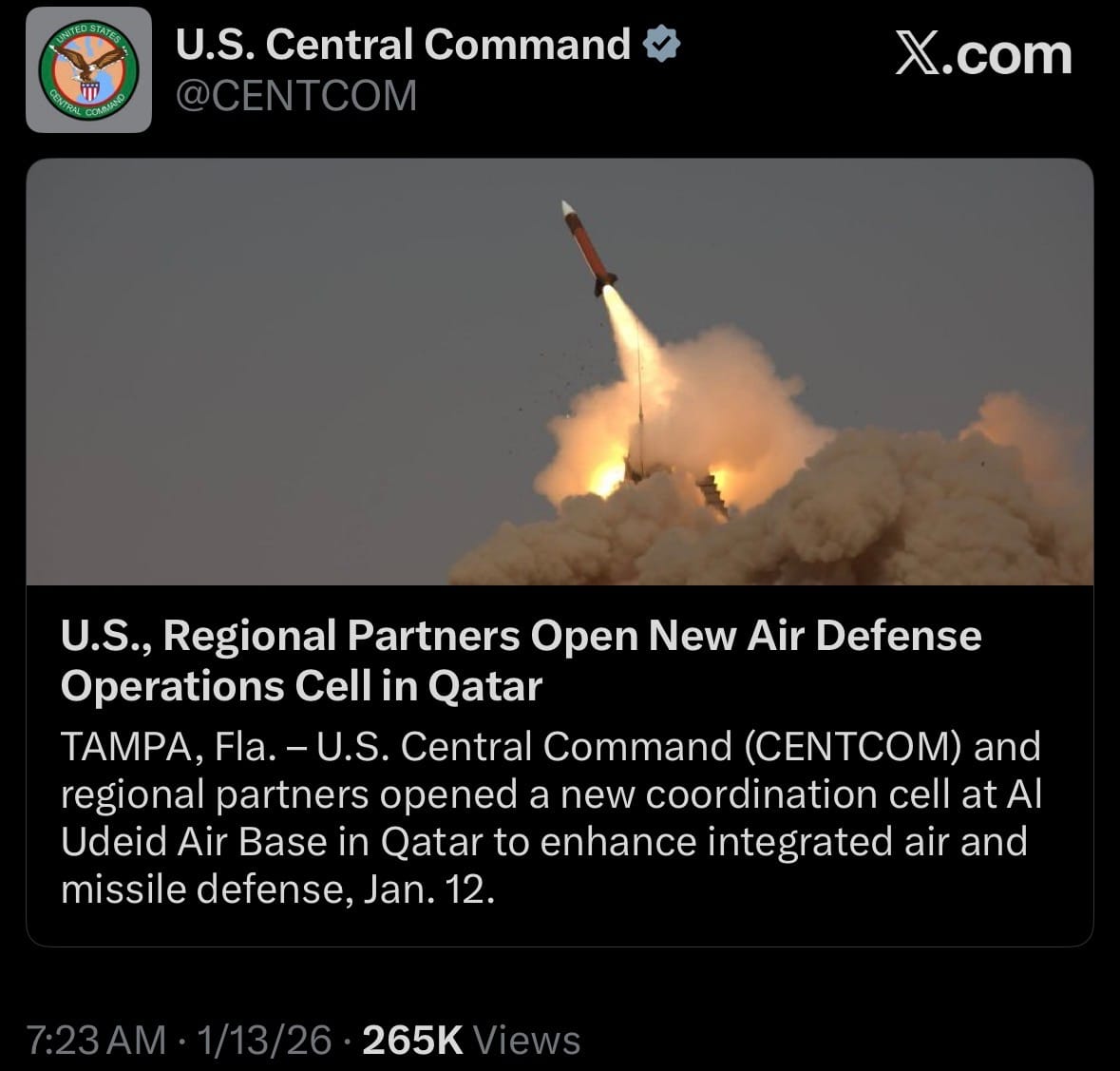
- The cell aims to strengthen collective defenses against aerial threats such as ballistic missiles, cruise missiles, and drones by improving situational awareness and joint decision-making. This initiative reflects ongoing efforts to deepen regional security cooperation amid persistent challenges from Iran-backed militias, ISIS remnants, and other actors. While specific partner nations beyond the United States were not named in the initial announcement, the MEAD-CDOC became operational immediately and builds directly on the CAOC's established multinational framework.
Environment & Weather:
- On January 13, 2026, heavy rainfall triggered flash flooding in Pengantap Village (Desa Persiapan Pengantap), Sekotong District, West Lombok Regency, West Nusa Tenggara Province, Indonesia. Water levels reached chest height in some areas, sweeping away household items, furniture, and parts of homes (one house in Bengkang was reportedly carried away by the current), while roads and access were disrupted.

- The flooding resulted from intense downpours overwhelming local rivers and drainage in the hilly/coastal area, a recurring issue in Sekotong during the rainy season. No fatalities were immediately reported, though some residents sustained minor injuries; emergency response from BPBD (local disaster agency), village authorities, and social services coordinated evacuations to higher ground, distributed emergency aid, and conducted assessments. Warnings remain for potential further inundation or landslides amid continued wet weather forecasts for the region.
Space:
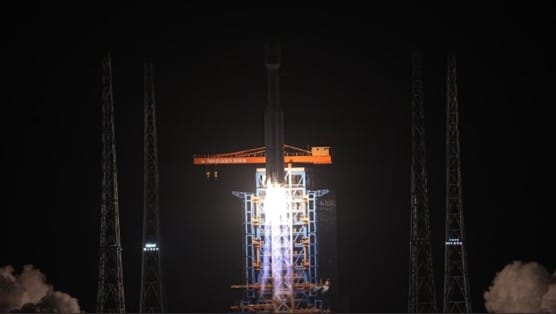
- On January 13, 2026, China successfully launched the SatNet LEO Group 18 mission using a Long March 8A rocket from Commercial Launch Complex 1 at the Wenchang Space Launch Site in Hainan Province. The rocket deployed a batch of 9 Low Earth Orbit communication satellites for the state-owned SatNet (GuoWang) constellation, operated by the China Satellite Network Group. State media and tracking data confirmed successful orbital insertion into a polar low Earth orbit with no anomalies reported during ascent or deployment.
- These satellites expand the GuoWang megaconstellation, which is planned to eventually consist of 13,000 satellites to provide global high-speed broadband internet, directly competing with systems like Starlink. Group 18 enhances coverage in polar and mid-latitude regions, supporting both commercial connectivity and strategic objectives.
Chinese Military Satellite Launch:
- On January 13, 2026, China successfully launched the Yaogan-50 01 remote sensing satellite aboard a modified Long March-6 rocket from the Taiyuan Satellite Launch Center in Shanxi Province. The rocket lifted off and placed the satellite into its planned orbit, marking China's first successful orbital launch of 2026 and the 624th flight of the Long March series. State media confirmed the mission proceeded without anomalies.
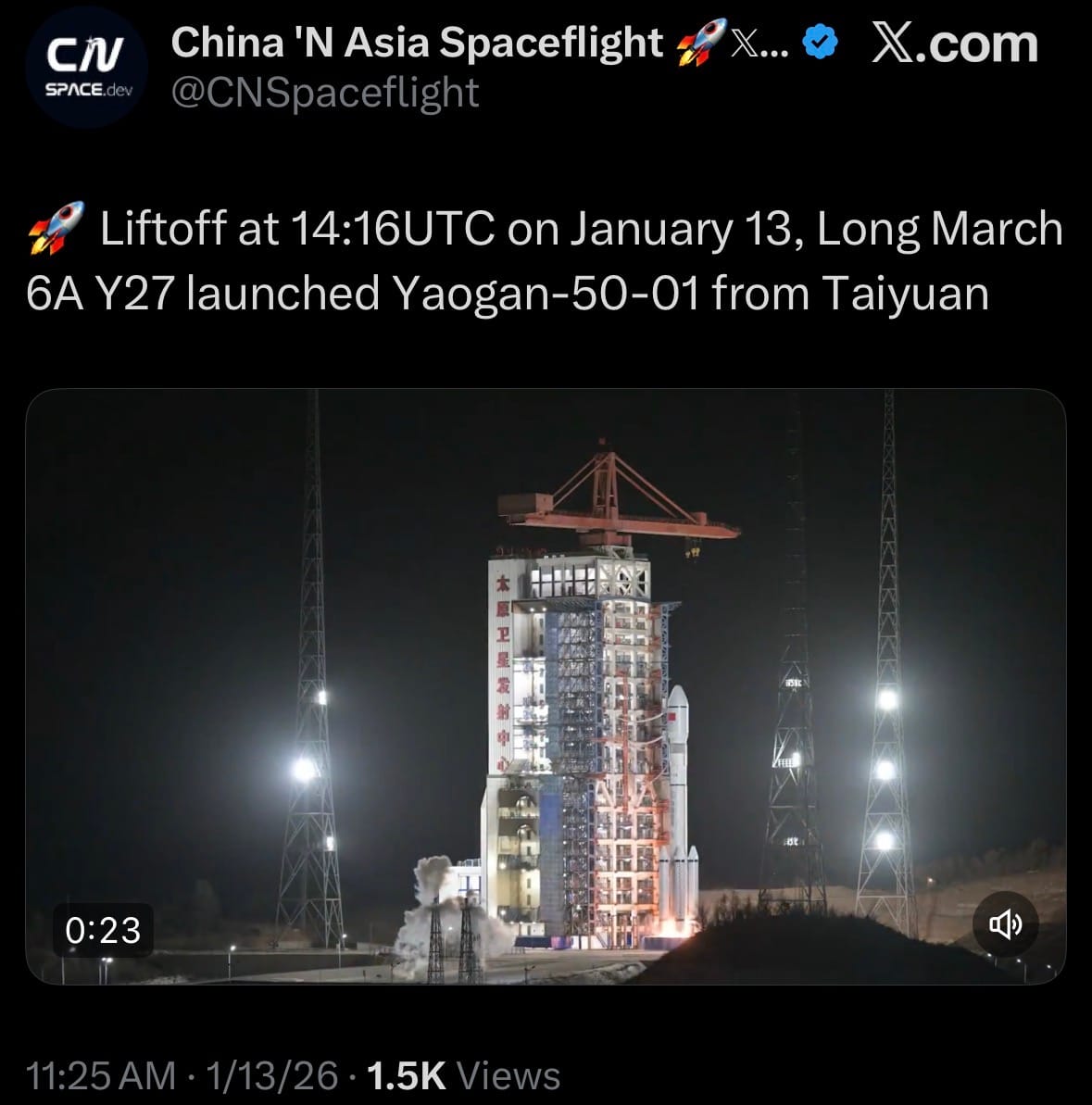
- Yaogan satellites are a Chinese military reconnaissance program, with the Yaogan series primarily supporting the People's Liberation Army through various remote sensing capabilities, including optical, synthetic-aperture radar (SAR), and electronic intelligence (ELINT) for applications such as maritime surveillance and battlefield monitoring. Specific details on Yaogan-50 01's configuration and exact mission remain classified, consistent with the program's opaque nature.
Statistic:
- Largest public automakers by market capitalization:
- 🇺🇸 Tesla: $1.487T
- 🇯🇵 Toyota: $298.50B
- 🇨🇳 BYD: $129.72B
- 🇨🇳 Xiaomi: $127.47B
- 🇺🇸 General Motors: $79.25B
- 🇰🇷 Hyundai: $71.54B
- 🇩🇪 Mercedes-Benz: $67.17B
- 🇮🇹 Ferrari: $63.93B
- 🇩🇪 BMW: $62.83B
- 🇩🇪 Volkswagen: $60.57B
- 🇮🇳 Maruti Suzuki India: $57.21B
- 🇺🇸 Ford: $55.70B
- 🇮🇳 Mahindra & Mahindra: $48.68B
- 🇩🇪 Porsche: $46.05B
- 🇯🇵 Honda: $39.71B
- 🇰🇷 Kia: $35.59B
- 🇨🇳 Seres Group: $30.63B
- 🇳🇱 Stellantis: $29.17B
- 🇯🇵 Suzuki Motor: $28.41B
- 🇨🇳 Great Wall Motors: $26.89B
- 🇨🇳 SAIC Motor: $25.52B
- 🇨🇳 Geely: $23.90B
- 🇺🇸 Rivian: $23.10B
- 🇨🇳 Chery Automobile: $22.56B
- 🇮🇳 Hyundai Motor India: $20.76B
History:
- Naval warfare starts the moment humans learn to fight over water—because rivers and seas are highways, borders, and supply lines all at once. The earliest naval battles were essentially land warfare transplanted onto boats: oared vessels ramming, boarding, and fighting hand-to-hand. Egyptian reliefs depict major sea conflict as early as the Battle of the Delta in 1175 BC, when Egypt fought the Sea Peoples with archers and grappling tactics. By 500–300 BC, Mediterranean powers turned naval war into a science. Greek city-states and Persia relied on triremes—fast oared warships built for ramming—and the Battle of Salamis (480 BC) showed how disciplined maneuver and geography could destroy a larger fleet. Rome then industrialized naval power during the Punic Wars: after 260 BC, it built fleets quickly and used boarding devices (like the corvus) to turn sea fights into infantry fights, culminating in decisive actions such as Actium (31 BC) that decided empires. For centuries, the dominant naval weapons were oars, sails, rams, archers, and fire—until chemistry changed the sea. The first major revolution in naval warfare is gunpowder. By the 1300s–1500s AD, cannon transformed ships into floating artillery platforms, and by the 1500s–1700s, the “ship of the line” era emerged—massive sailing warships optimized to fight in formation. Battles like Lepanto (1571) and the great fleet wars of the 1700s proved that naval warfare now hinged on gunnery, discipline, and logistics. The second revolution is steam and steel. In the 1800s, steam engines freed fleets from wind, explosive shells and rifled guns shredded wooden hulls, and ironclads appeared—most famously in 1862 with Monitor vs. Virginia—marking the transition to armored naval combat. This era also birthed the modern mine and the torpedo: early naval mines were used at scale in the Crimean War (1853–1856), and in 1866 Robert Whitehead created the first practical self-propelled torpedo, which forced navies to invent new ship classes to defend against small fast attackers. Then the battleship age peaked with HMS Dreadnought (1906), a single design that reset global naval balance by combining big-gun uniform batteries with turbine propulsion and high speed.
- The 20th century is naval warfare’s acceleration into multi-domain combat—surface, subsurface, and air. Submarines began as experimental machines, but by 1914–1918 they became strategic commerce raiders; German U-boats turned the Atlantic into a choke point, and anti-submarine warfare (convoys, sonar, depth charges) became a core naval discipline. Between the wars, aircraft changed the geometry of sea power. Carriers evolved from modified ships into purpose-built strike platforms, and by 1941–1945, battleships were no longer the capital weapon—carriers were. The Japanese attack on Pearl Harbor (1941) and decisive carrier battles like Midway (1942) proved that whoever controlled the air over the fleet controlled the sea. Meanwhile, mines and torpedoes devastated logistics: submarine campaigns strangled shipping, and large-scale mining operations crippled ports. After 1945, the Cold War created the modern navy: nuclear propulsion made submarines capable of months underwater (USS Nautilus, 1955), ballistic missile submarines turned oceans into hidden nuclear deterrent zones (SSBNs from 1959 onward), and carrier strike groups became the main instrument of U.S. global power projection. Missile technology replaced many gun-era assumptions—anti-ship missiles, air defense systems, and electronic warfare created layered kill chains where detection and targeting mattered as much as firepower. In the 21st century, naval war is shifting again. Unmanned systems—surface drones, aerial drones, and increasingly underwater drones—extend sensing and strike reach. Mines remain the cheap strategic weapon that can freeze shipping lanes. Cyber and electronic warfare now shape whether ships can see, communicate, and target. Modern naval power is no longer just fleets trading broadsides; it’s a networked system of satellites, submarines, carriers, destroyers, missiles, drones, sensors, and undersea cables. The core logic has stayed constant since 480 BC: control the sea lanes and you control trade, war logistics, and strategic mobility. The tools evolved from rams and oars to nuclear submarines and autonomous swarms, but the strategic stakes—access, denial, and dominance—have only intensified.
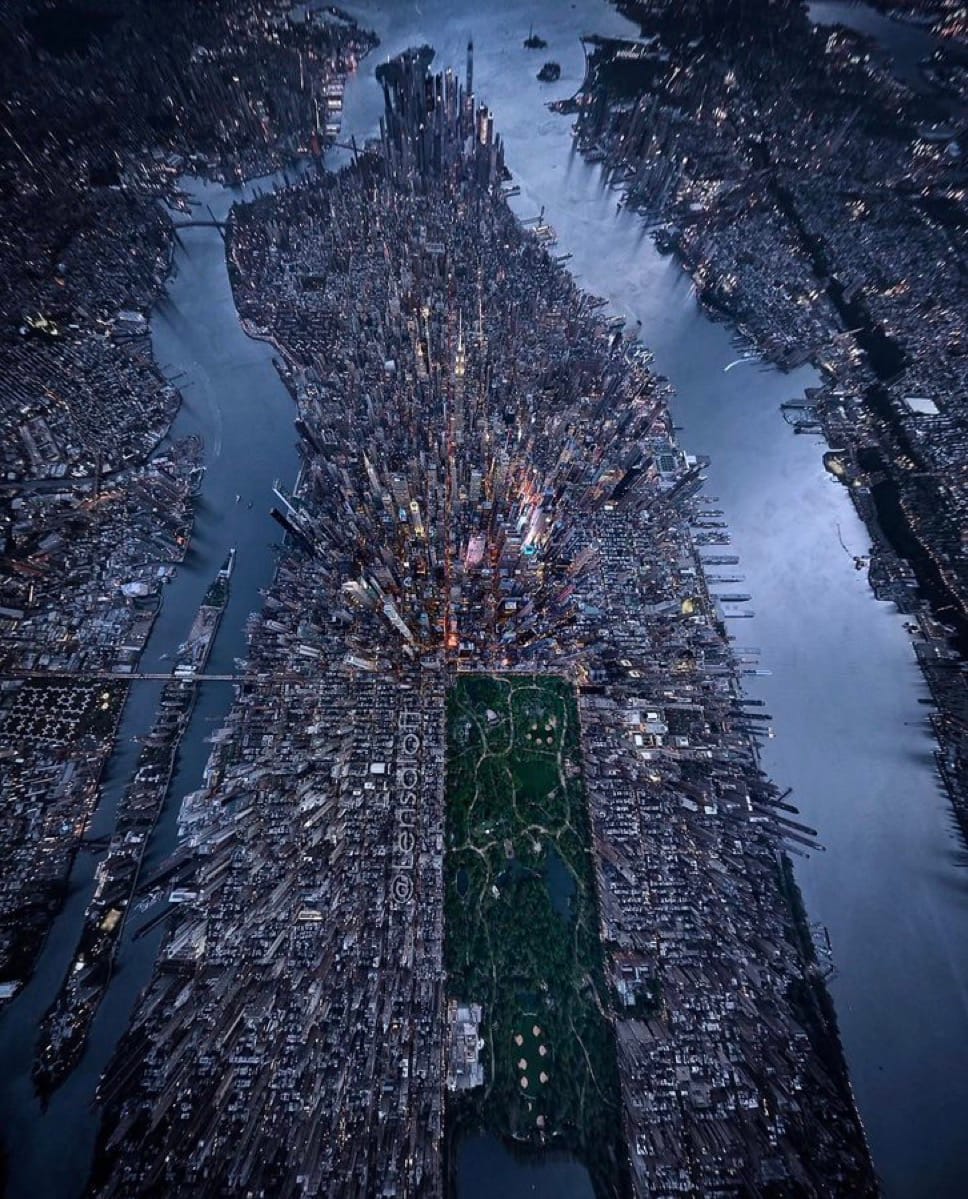
Image of the day:
Thanks for reading! Earth is complicated, we make it simple.
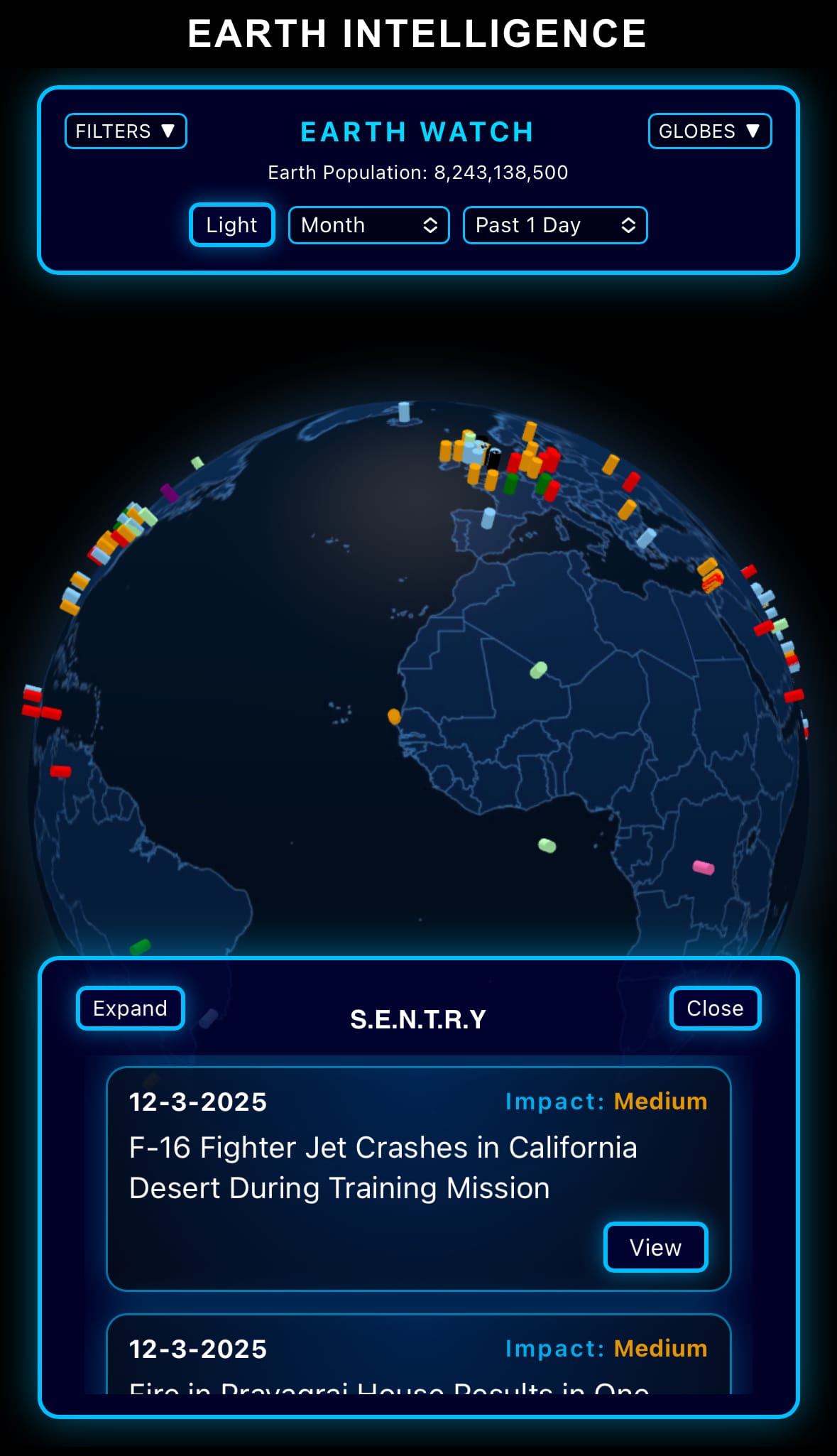
- Click below if you’d like to view our free EARTH WATCH globe:
- Download our mobile app:



Click below to view our previous newsletters:

Support/Suggestions Email:
earthintelligence@earthintel.news