Wednesday☕️


Economics & Markets:
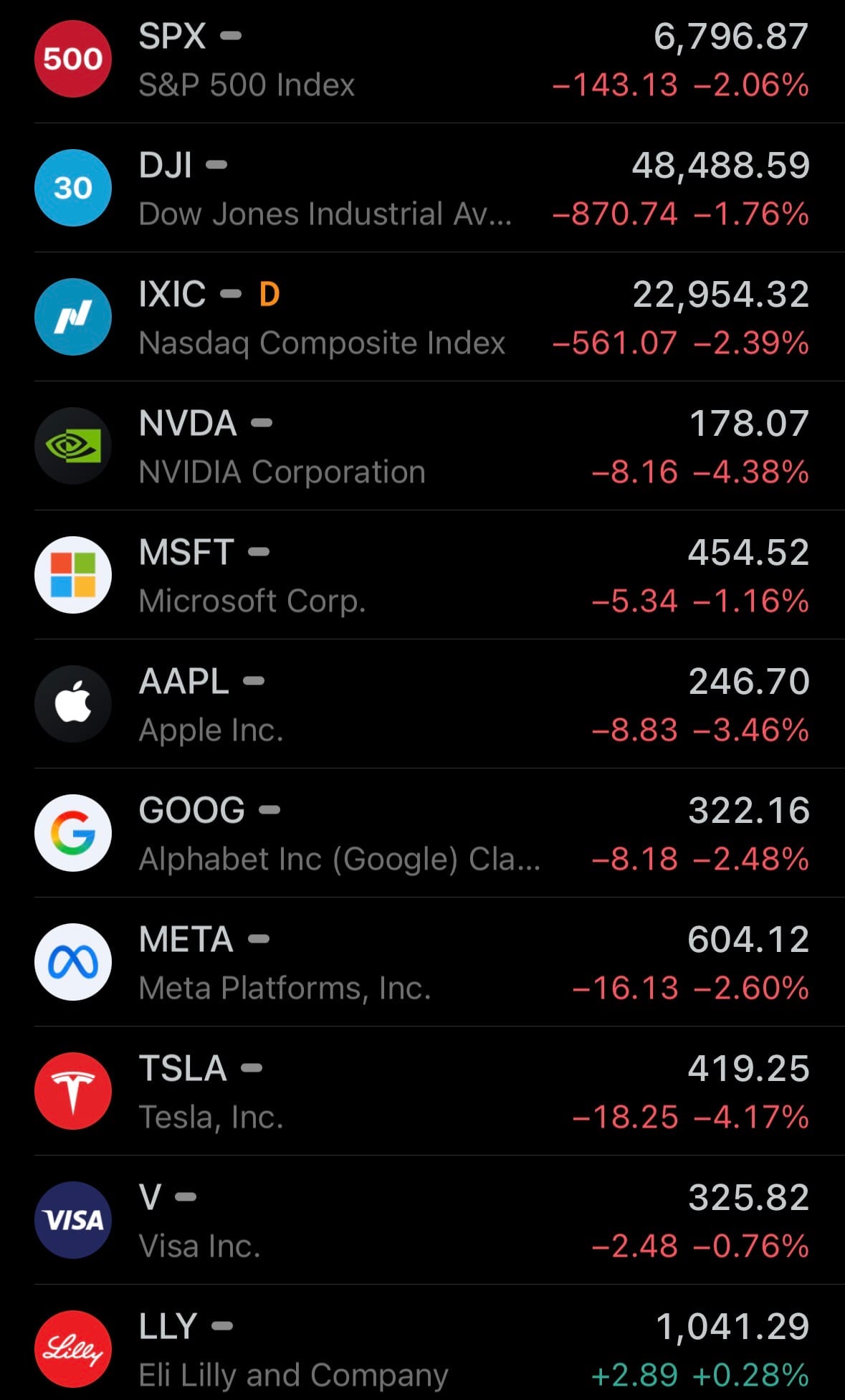
- Yesterday’s U.S. stock market:
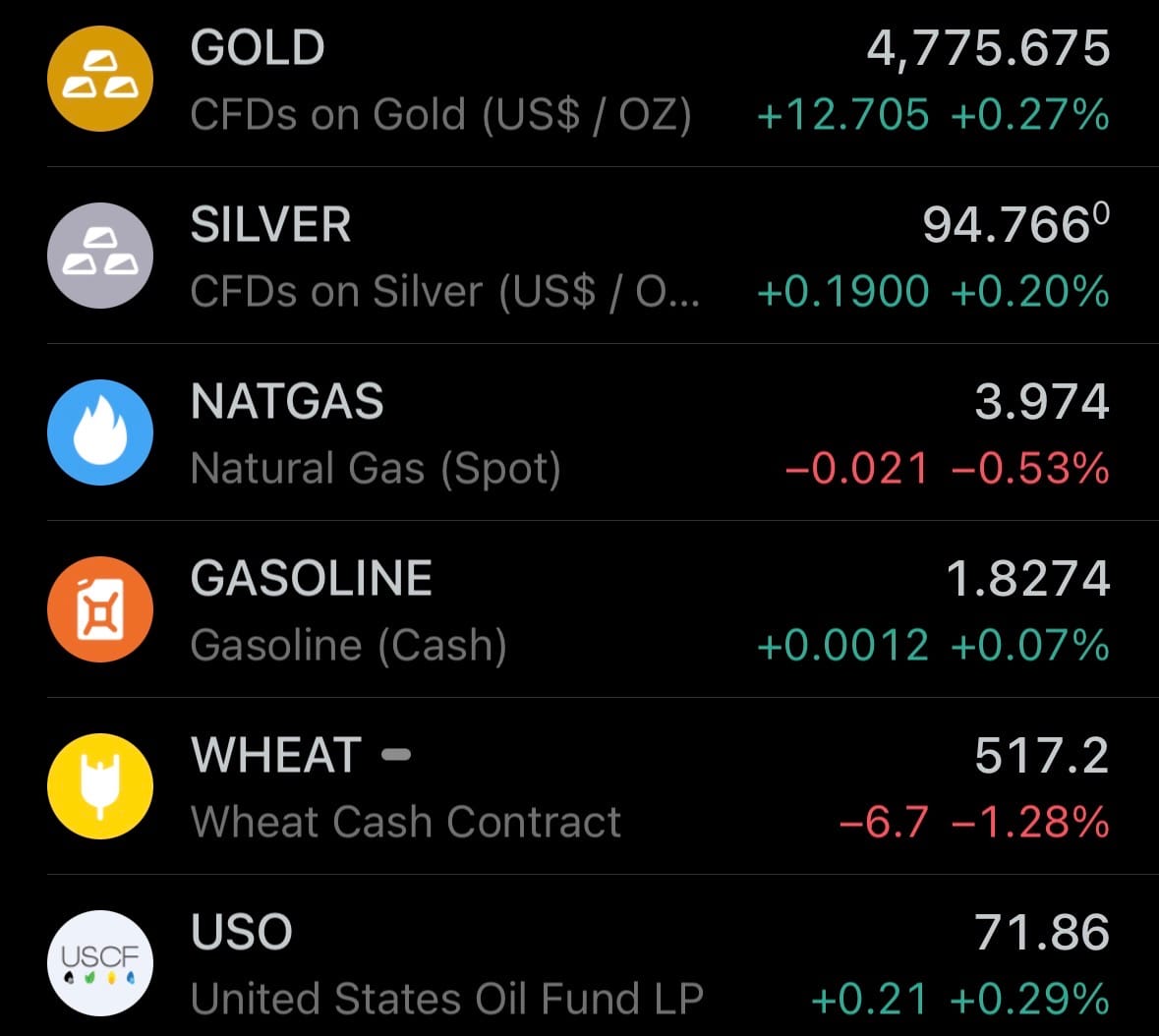
- Yesterday’s commodity market:
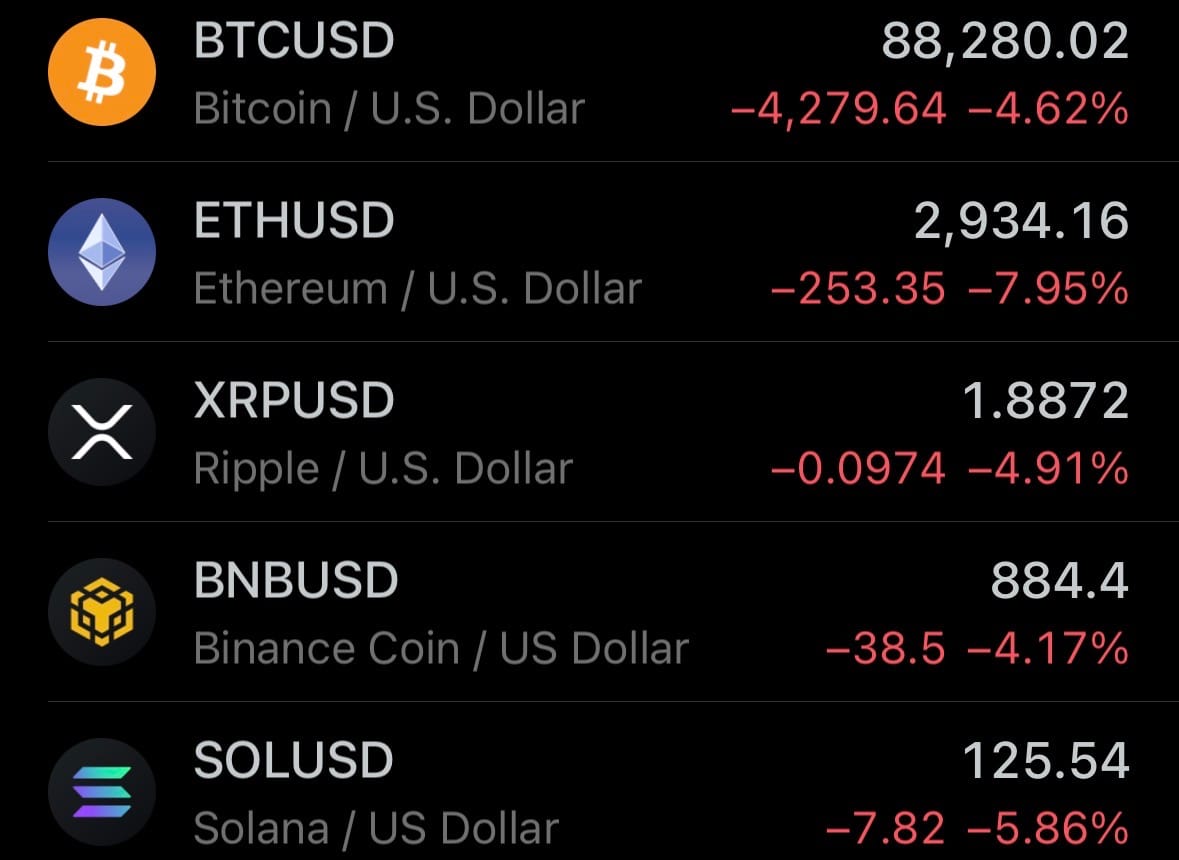
- Yesterday’s crypto market:
Geopolitics & Military Activity:
- On January 20, 2026, U.S. Southern Command announced the seizure of the Motor Vessel Sagitta, a tanker linked to Venezuelan oil exports, in the Caribbean as part of Operation Southern Spear. This was the seventh interception of a sanctioned or shadow-fleet tanker in recent weeks, enforcing President Trump's maritime quarantine policy on vessels violating U.S. sanctions related to Venezuela's oil trade.
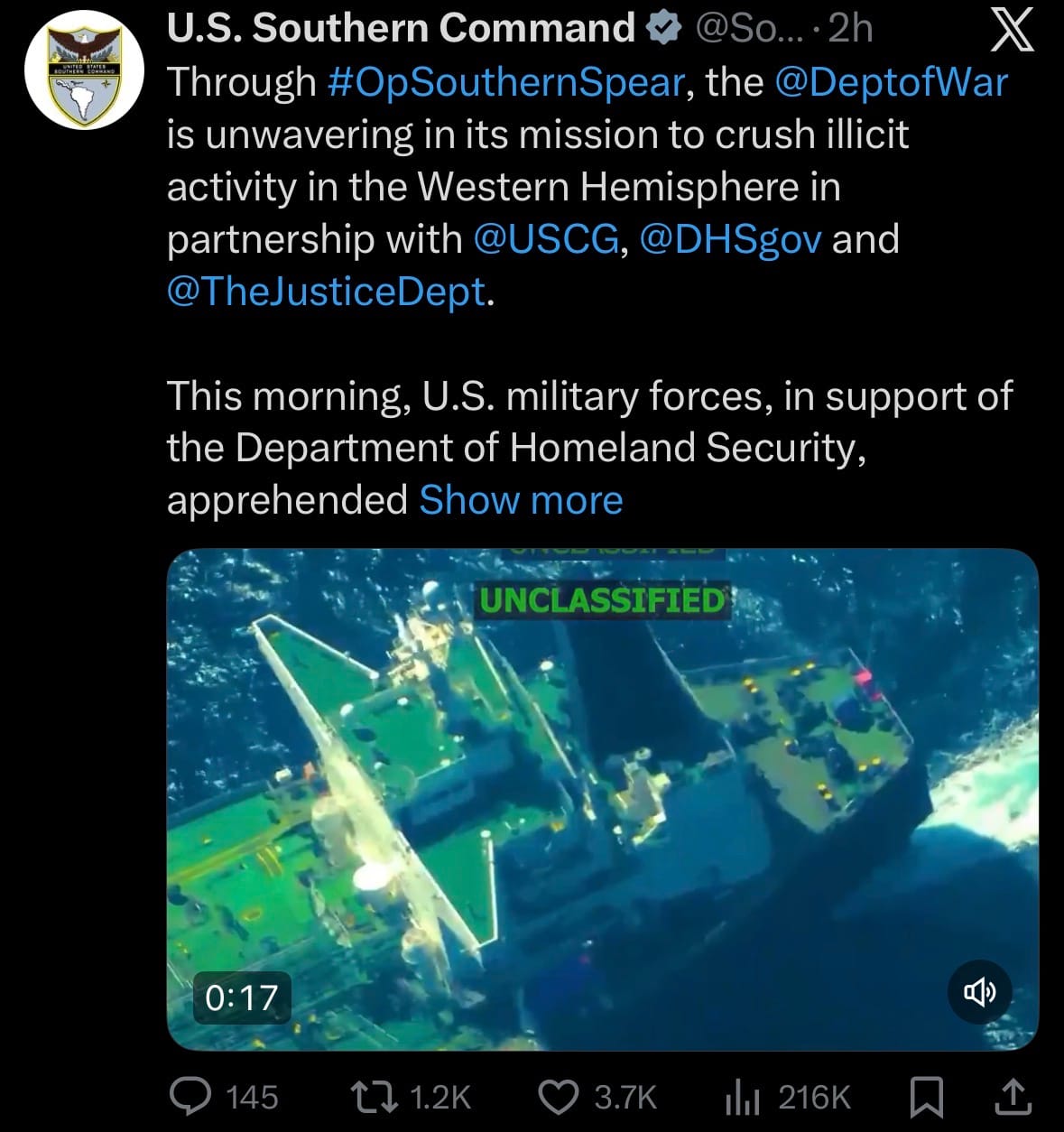
- The operation occurred without resistance or incident and involved coordinated efforts by the U.S. Coast Guard, Navy, Marine Corps, Department of Homeland Security, and Department of Justice. The vessel, flagged in Liberia or Panama (reports vary) and managed by Hong Kong-based entities tied to shadow fleet operations that obscure origins of oil from Venezuela, Iran, Russia, and other sanctioned sources, was detained to ensure only authorized and lawful Venezuelan oil exports proceed. U.S. Southern Command released aerial video footage of the tanker, and the action aligns with ongoing enforcement under Operation Southern Spear (launched late 2025) targeting illicit oil shipments and related activities in the Western Hemisphere, with monitoring and potential further interdictions continuing.
Environment & Weather:
- On January 20, 2026, a strong storm surge affected Letojanni, a coastal town in Messina province on Sicily’s eastern Ionian coast, during an intense Mediterranean low-pressure system named Harry. Large waves, fueled by strong winds and rough seas, overtopped the seafront promenade (lungomare), flooding the coastal road, scattering debris, and causing damage that included the partial collapse of a section of the walkway and a wall in the adjacent Mazzeo area, between Letojanni and Taormina.

- The event formed part of widespread severe weather across eastern Sicily, where authorities issued red alerts for hydrogeological, hydraulic, and coastal risks due to heavy rainfall, waves reaching several meters, and wind gusts of 90–120 km/h in some locations. In response, local officials closed the seaside road in Letojanni, suspended schools, public offices, and non-essential commercial activities in Letojanni and neighboring municipalities including Roccalumera, Giardini Naxos, and Santa Teresa di Riva. Residents were advised to stay away from coastal areas.
Science & Technology:
- On January 20, 2026, Anthropic announced that Claude can now securely connect to users' personal health data through four new beta integrations: Apple Health (via the iOS app), Health Connect (via the Android app), HealthEx, and Function Health. The feature is available to Claude Pro and Max subscribers in the United States and requires explicit opt-in permission, allowing Claude to access only the data users choose to share.

- With these connections, Claude can summarize medical history, explain lab results in plain language, identify patterns in fitness and health metrics, detect trends, and assist in preparing questions for doctors. Anthropic stressed strong privacy protections: users fully control what data is shared and can revoke access at any time, and health data is never used to train models. The release follows similar moves by other leading AI providers, including OpenAI, which earlier introduced health-data integrations and capabilities for summarizing records, interpreting results, and offering personalized insights in ChatGPT. These parallel developments highlight the intensifying competition among frontier AI models to deliver practical, consumer-facing health tools while navigating privacy and regulatory requirements.
Open-Source AI:
- On January 20, 2026, Liquid AI released LFM2.5-1.2B-Thinking, a 1.2 billion parameter AI model that runs fully offline on phones, laptops, or other devices using only ~900 MB of memory. It uses a fast, efficient design to process up to 239 tokens per second on AMD chips and ~82 on Snapdragon phone chips. Trained on 28 trillion tokens with reinforcement learning, it “thinks” in short internal steps before answering, excelling at math, tool use, and following instructions (e.g., math benchmark scores rose from 63 to 88). It outperforms some larger models like Qwen3-1.7B on key tests while using less power. The model is free to download (open-source/open-weight) from Hugging Face under a permissive license, with easy-to-use versions for tools like llama.cpp, MLX, and ONNX, plus support from Qualcomm and AMD.
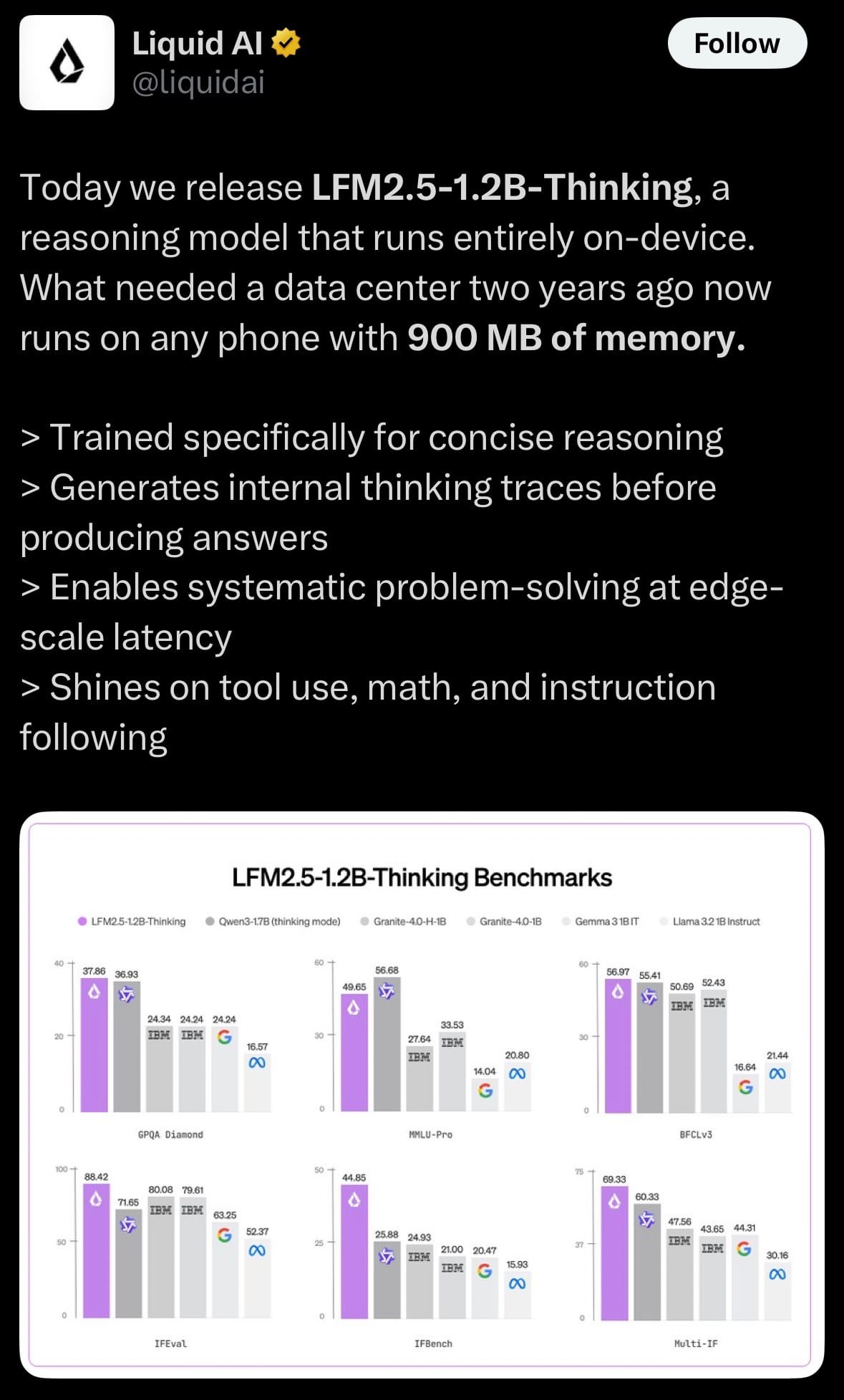
- Because it’s open-weight, anyone can download, copy, modify, or build on it anywhere—no internet or company permission needed—enabling private, offline use on personal devices or in secure setups. The open-source community shares free improvements and new applications, spreading AI access and innovation worldwide far faster than one company could. Closed-source models like ChatGPT, Claude, Grok, and Gemini keep their core code secret: you’re limited to their apps or APIs with usage caps and potential tracking, and can’t run private offline copies or customize deeply. Closed-sourced models like ChatGPT/Grok/Claude are currently stronger overall due to massive scale, but open ones like LFM2.5-1.2B-Thinking, Falcon, DeepSeek, and Llama let developers, students, and teams everywhere run and adapt powerful AI locally. This openness drives quicker industry progress through global experimentation and competition.
Statistic:
- Largest public companies on Earth by market capitalization:
- 🇺🇸 NVIDIA — $4.335T
- 🇺🇸 Alphabet (Google) — $3.889T
- 🇺🇸 Apple — $3.645T
- 🇺🇸 Microsoft — $3.378T
- 🇺🇸 Amazon — $2.469T
- 🇹🇼 TSMC — $1.696T
- 🇸🇦 Saudi Aramco — $1.612T
- 🇺🇸 Broadcom — $1.576T
- 🇺🇸 Meta Platforms — $1.522T
- 🇺🇸 Tesla — $1.394T
- 🇺🇸 Berkshire Hathaway — $1.047T
- 🇺🇸 Walmart — $946.45B
- 🇺🇸 Eli Lilly — $933.47B
- 🇺🇸 JPMorgan Chase — $824.13B
- 🇨🇳 Tencent — $686.24B
- 🇰🇷 Samsung — $661.88B
- 🇺🇸 Visa — $628.79B
- 🇺🇸 Exxon Mobil — $556.18B
- 🇺🇸 Johnson & Johnson — $525.73B
- 🇺🇸 Oracle — $516.93B
- 🇳🇱 ASML — $514.71B
- 🇺🇸 Mastercard — $480.69B
- 🇺🇸 Costco — $428.09B
- 🇺🇸 Micron Technology — $410.81B
- 🇺🇸 Palantir — $401.68B
- 🇨🇳 Alibaba — $387.67B
History:
- Electric vehicles have a longer and more cyclical history than gasoline cars, marked by early promise, long dormancy, and eventual resurgence once technology caught up with ambition. The earliest electric vehicles emerged in the 1830s, when inventors in Europe and the United States built small electric carriages powered by primitive batteries. By the 1880s–1890s, electric cars became practical enough for urban use, and by 1900 they accounted for a substantial share of automobiles in cities like New York and London. They were clean, quiet, and easy to operate—major advantages in an era when gasoline cars were loud, unreliable, and dangerous to start by hand. However, electric vehicles were constrained by battery limitations: low energy density, long charging times, and short range. These weaknesses proved fatal once key gasoline innovations arrived. The invention of the electric starter in 1912, the discovery of vast oil reserves, and Henry Ford’s Model T mass-production methods made internal combustion vehicles cheaper, more reliable, and capable of long-distance travel. By the 1920s, electric cars had nearly vanished from the consumer market, surviving only in industrial roles like forklifts and delivery vehicles.
- Throughout the mid-20th century, electric vehicles reappeared periodically in response to energy crises and environmental concerns, but none broke through at scale. During World War II, fuel shortages briefly revived interest in electric transport in Europe, but these were stopgap measures. In the 1960s–1970s, rising air pollution and oil shocks triggered government-funded research programs and small EV experiments, particularly in the United States and Europe. These vehicles remained slow, expensive, and impractical due to lead-acid and nickel-based batteries. A more serious modern attempt came in the 1990s, driven by regulatory pressure rather than market demand. California’s Zero Emission Vehicle mandate pushed automakers to build electric cars like General Motors’ EV1 (1996–1999). Technically impressive for its time, the EV1 demonstrated that electric cars could work—but limited range, high costs, lack of charging infrastructure, and corporate reluctance doomed the program. Similar efforts by other manufacturers met the same fate. These failures reinforced a widespread belief that electric cars were inherently niche products, unable to compete with gasoline on performance, cost, or convenience.
- The decisive shift occurred when lithium-ion battery technology, developed primarily for consumer electronics in the 1990s, reached automotive viability in the early 2000s. Tesla, founded in 2003, approached the problem differently than previous efforts. Rather than designing an electric car to fit existing automotive assumptions, Tesla built the vehicle around the battery, software, and power electronics from the ground up. The Tesla Roadster (2008) shattered expectations by delivering sports-car performance and meaningful range, while the Model S (2012) proved electric vehicles could outperform luxury sedans while improving through software updates over time. Tesla’s vertical integration—battery packs, drivetrain, software, and charging infrastructure—solved problems earlier attempts treated separately. The company scaled this approach with the Model 3 and Model Y, global gigafactories, and a proprietary fast-charging network, forcing the global auto industry to pivot rapidly toward electrification. By the early 2020s, Tesla became the dominant pure electric automaker and the most valuable car company by market capitalization. The long arc of electric vehicles reveals that the idea was never flawed—the supporting technologies were. Once batteries, manufacturing, and software matured together, electric cars shifted from historical curiosity to a central pillar of modern transportation, with Tesla leading the transformation.
Image of the day:

Thanks for reading! Earth is complicated, we make it simple.
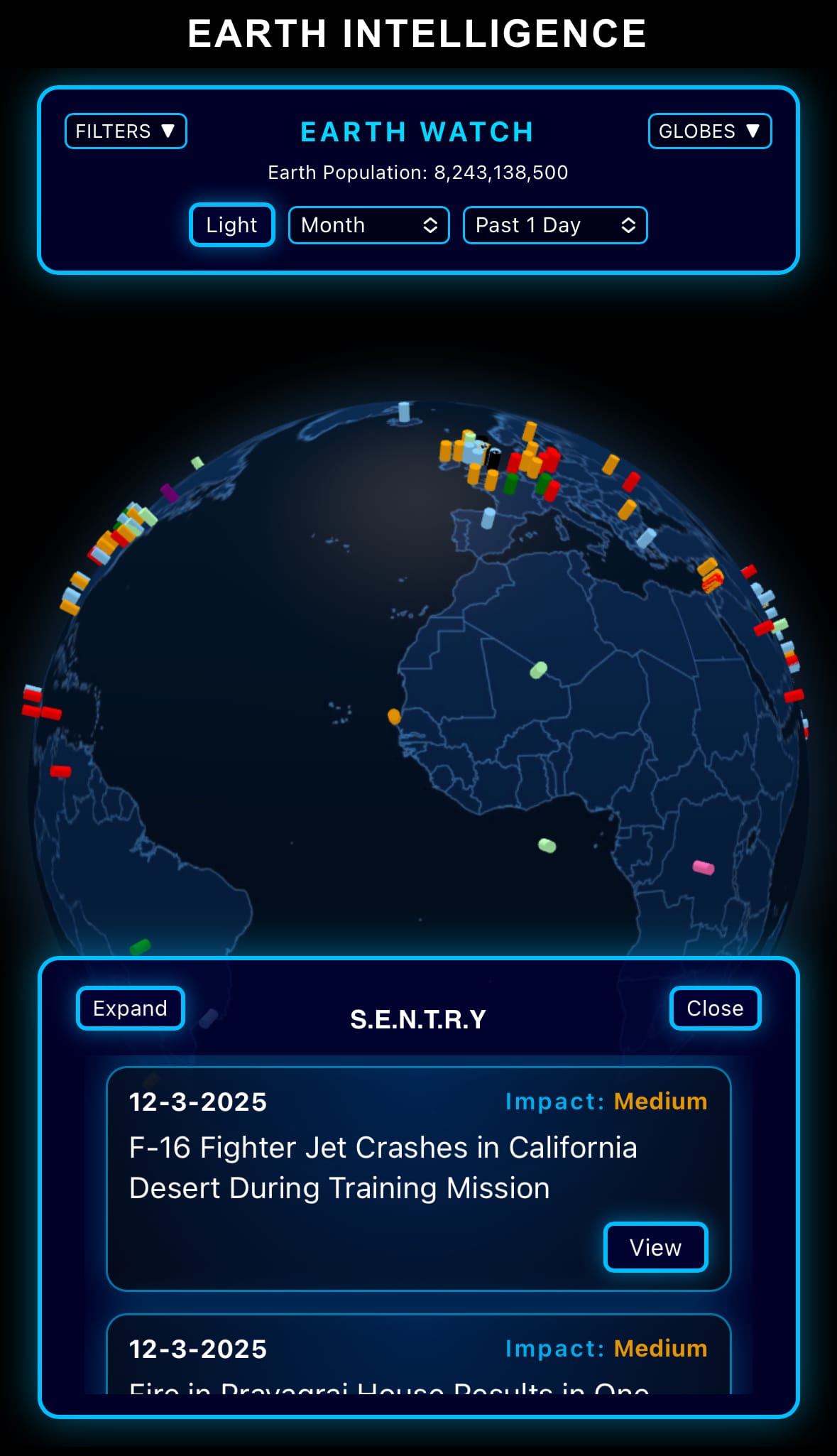
- Click below if you’d like to view our free EARTH WATCH globe:
- Download our mobile app:



Click below to view our previous newsletters:

Support/Suggestions Email:
earthintelligence@earthintel.news