Wednesday☕️


Earth Recap:
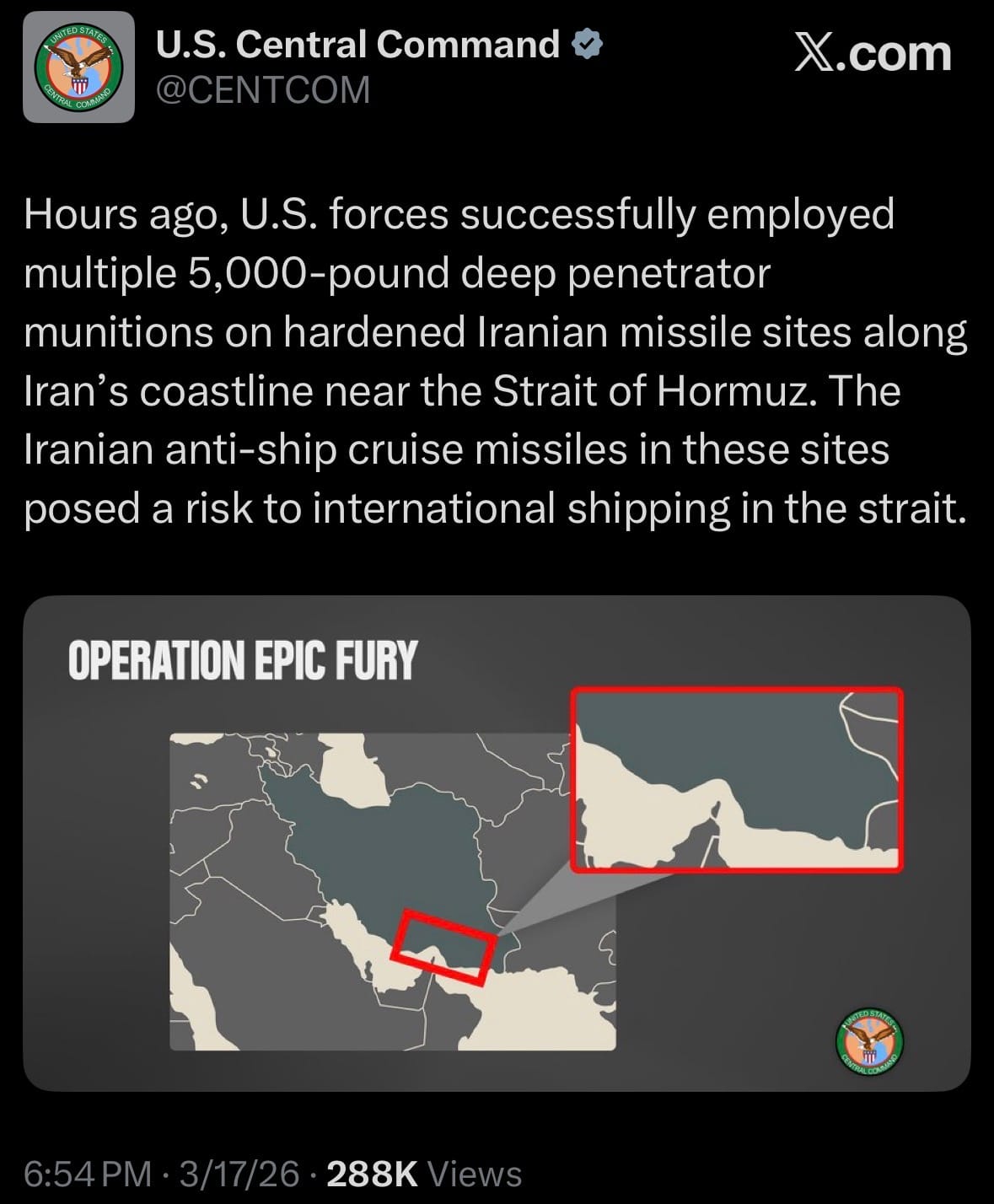
- As of March 17, 2026, the U.S.-Israel-Iran war entered its 18th day with the Strait of Hormuz still blockaded: shipping traffic is down 90–98%, oil and LNG exports through the chokepoint have collapsed, and Brent crude trades above $110 per barrel. Iran has attacked or threatened tankers (some set ablaze), attempted mine-laying (stopped by U.S. forces), and launched fresh drone strikes that forced the UAE to fully close its airspace again; drone attacks also halted operations at the Shah gas field, struck the Fujairah oil zone, and hit a tanker. NATO held an emergency maritime security meeting today to discuss joint naval escorts and reopening plans. Cuba faces widespread blackouts and severe fuel shortages after oil shipments halted due to the crisis.

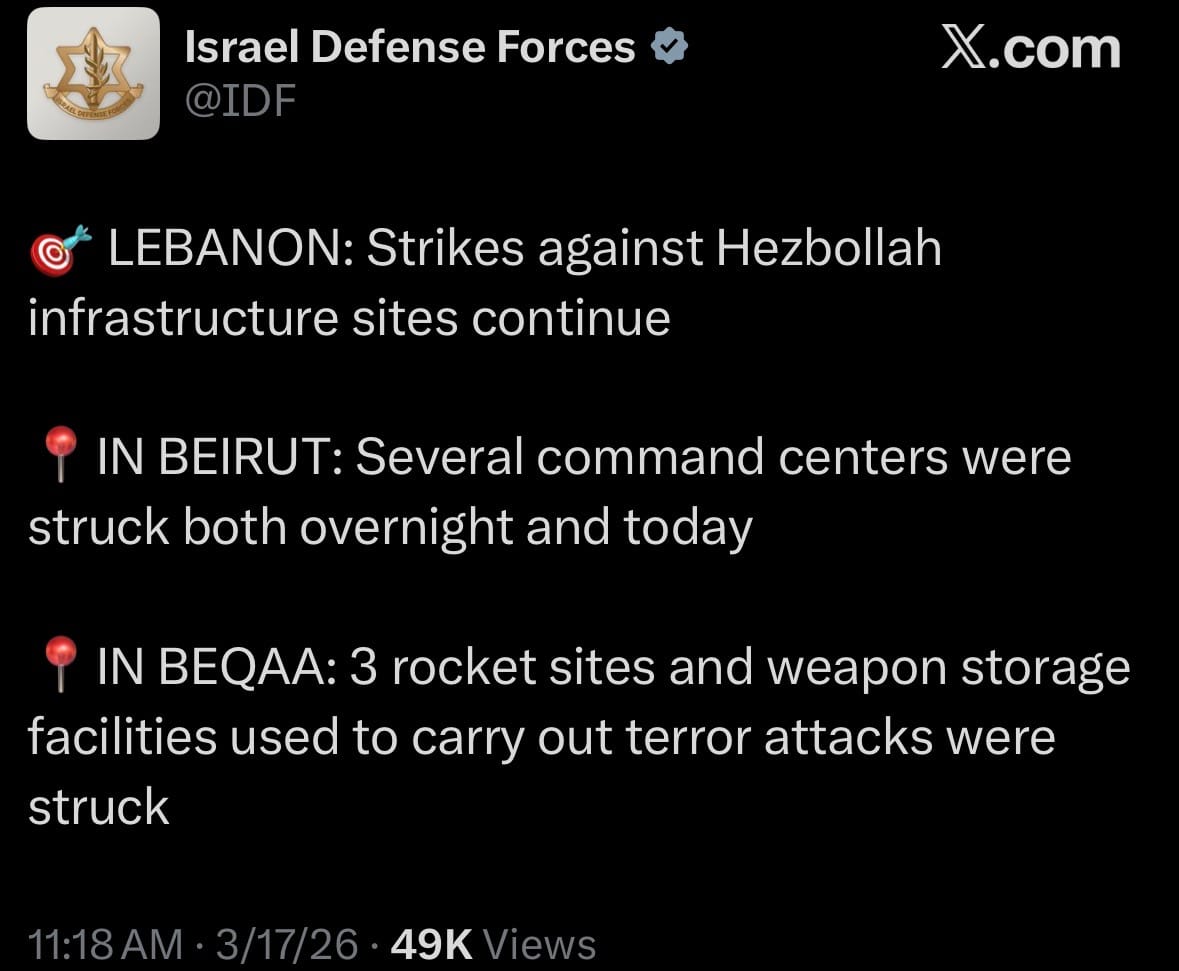
- Israeli forces continued precision strikes in southern Lebanon, eliminating more senior IRGC Quds Force and Hezbollah commanders, while Gaza operations targeted remaining Hamas tunnels and leadership with no ceasefire talks. Israel formally recognized Somaliland’s sovereignty, with Somaliland announcing it will join the Abraham Accords. In Nigeria, suicide bombings in Maiduguri killed 23 and wounded over 100. The U.S. ordered immediate global embassy security reviews after an attack on its embassy compound in Iraq. Significant damage has been reported across multiple areas of Tel Aviv and central Israel following Iran's ballistic missile attack tonight, which involved cluster munitions.
Economics & Markets:
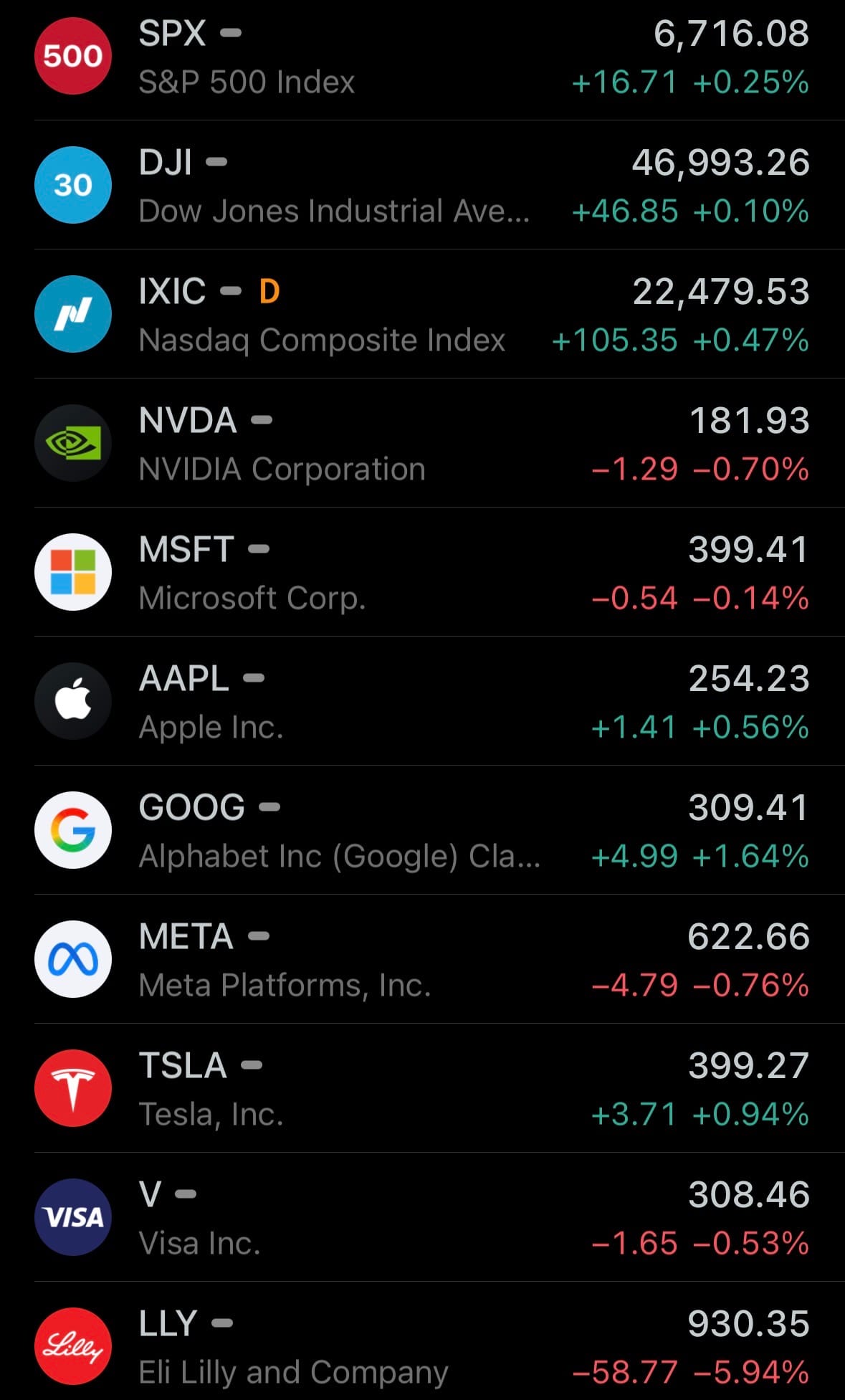
- Yesterday’s U.S. stock market:
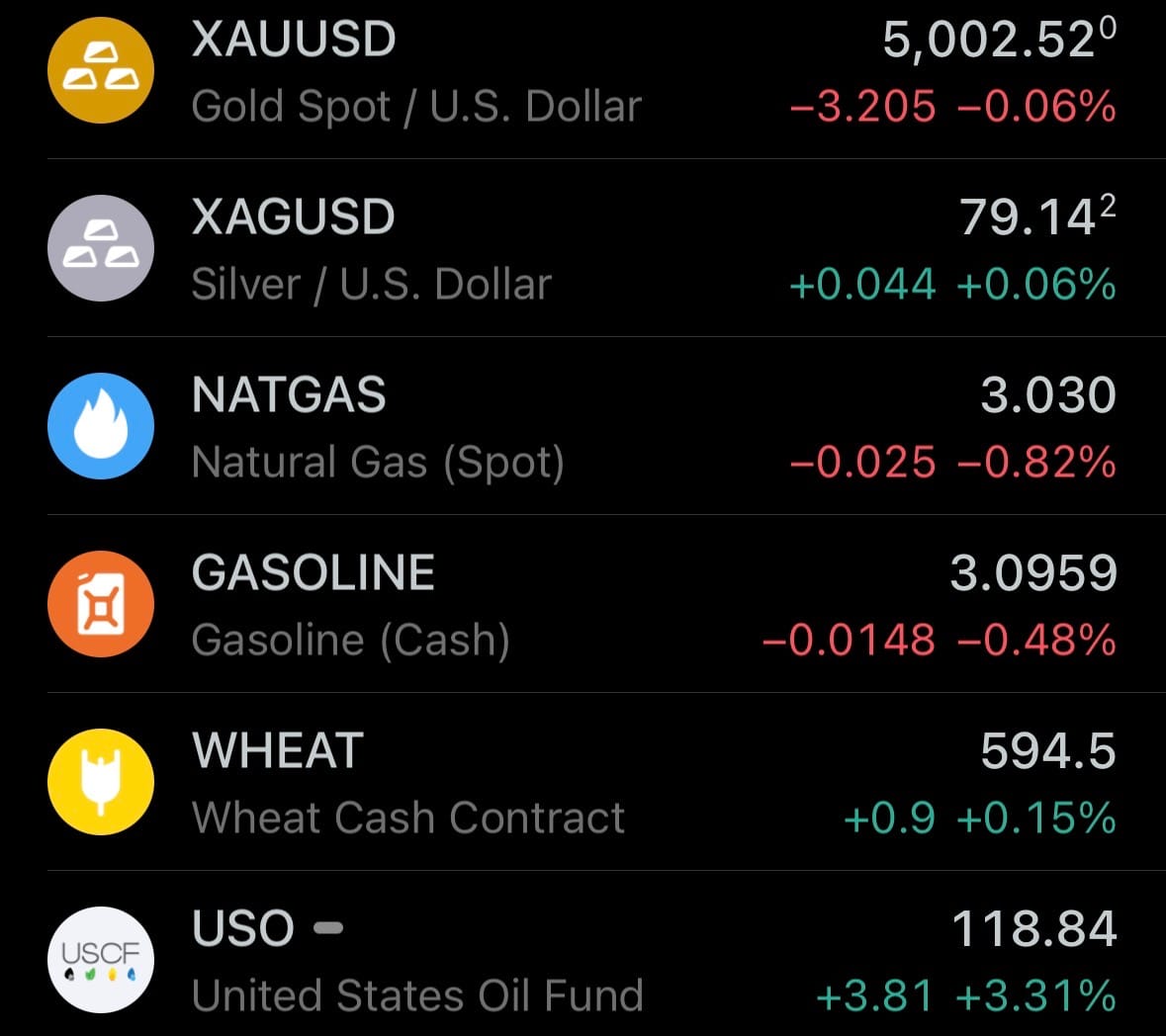
- Yesterday’s commodity market:
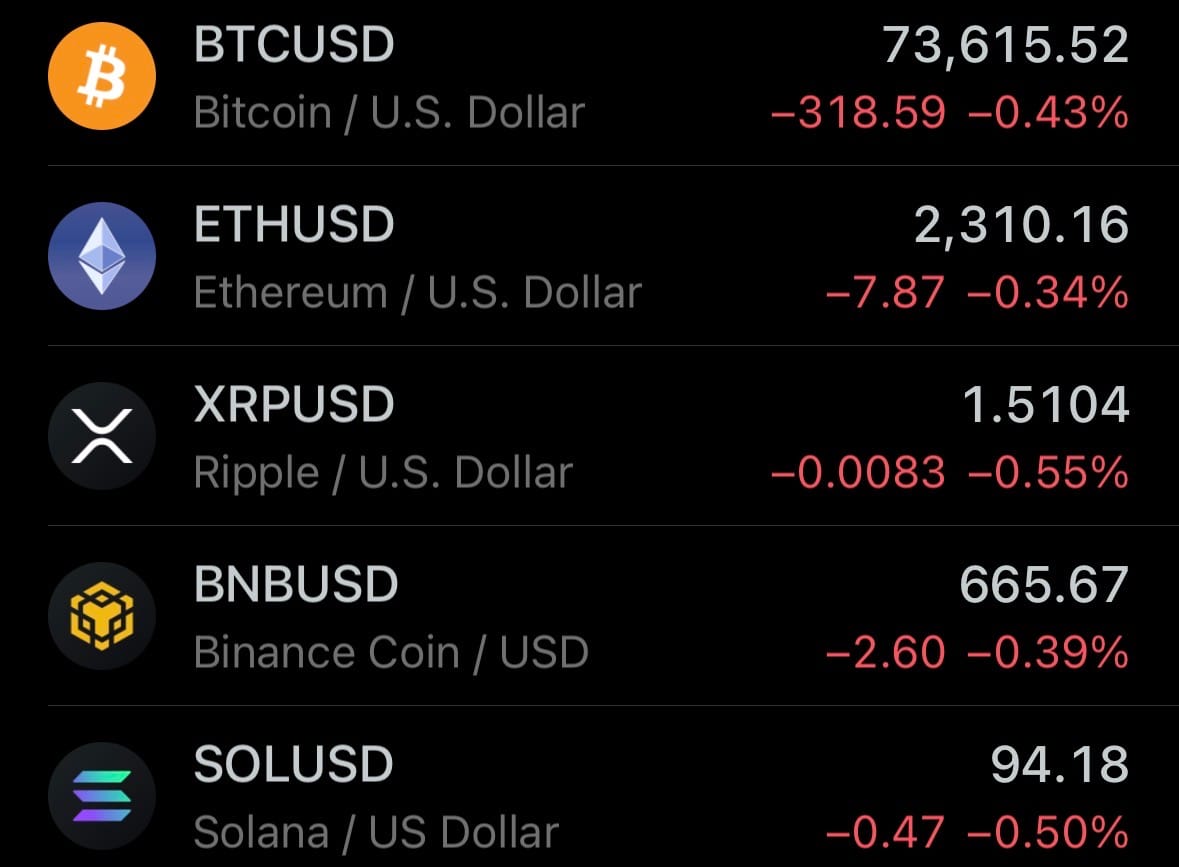
- Yesterday’s crypto market:
Geopolitics & Military Activity:
Science & Technology:
- On March 17, 2026, the U.S. Navy and General Services Administration awarded Gecko Robotics a contract worth up to $71 million (initial value up to $54 million) to use its wall-climbing robots and AI software for inspecting naval ships.
The five-year deal starts with 18 ships in the U.S. Pacific Fleet, including destroyers, amphibious ships, and littoral combat ships.
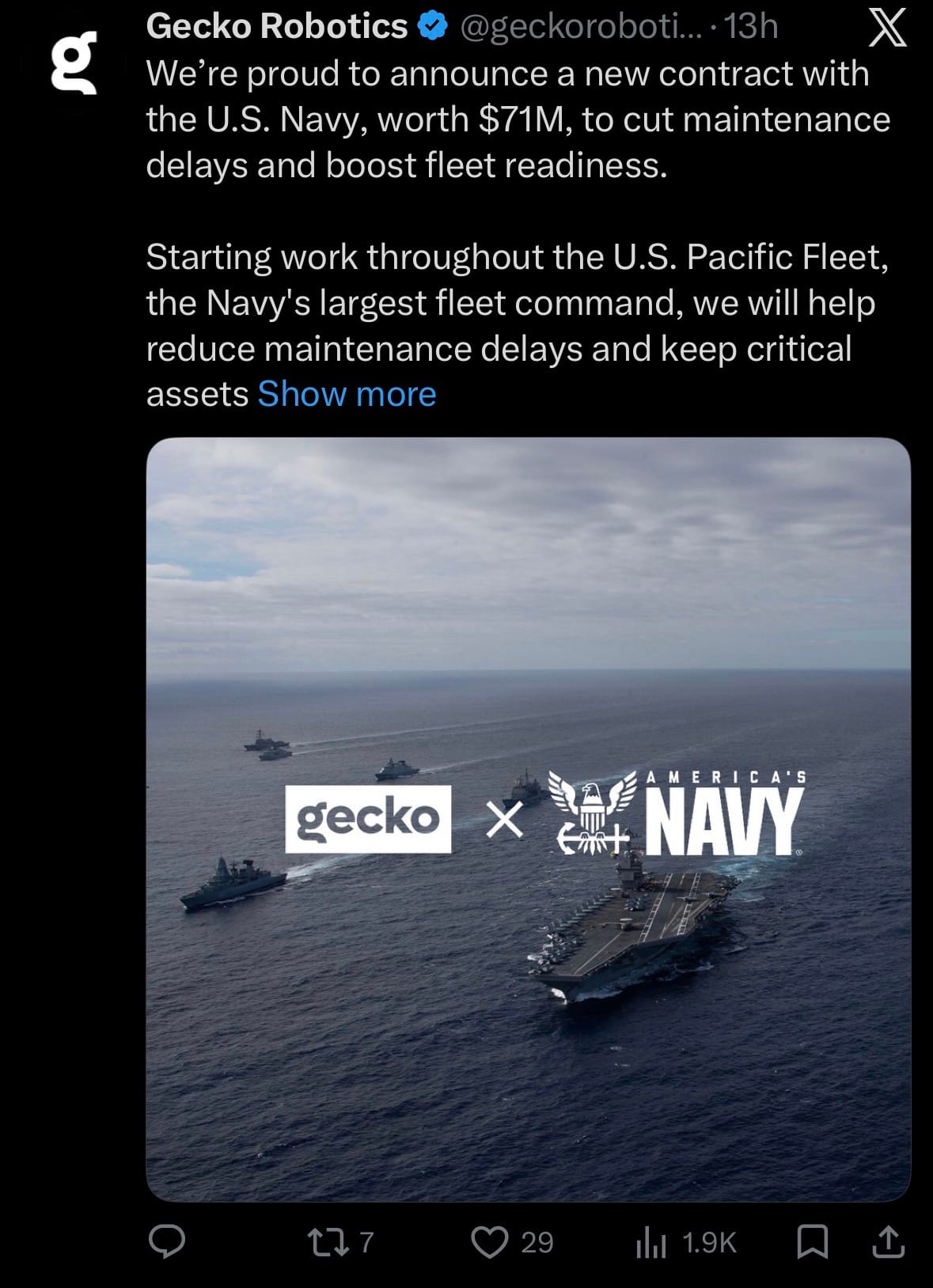
- Gecko’s robots climb hulls, scan confined spaces, collect detailed data 50 times faster than manual methods, and create digital twins to speed up maintenance and improve fleet readiness. This is the Navy’s largest robotics maintenance contract to date, aimed at fixing delays and boosting operational availability toward an 80% goal by 2027.
SpaceX:
- On March 17, 2026, SpaceX successfully launched the Starlink Group 10-46 mission using a Falcon 9 rocket from Space Launch Complex 40 (SLC-40) at Cape Canaveral Space Force Station in Florida. Liftoff occurred at 9:27 a.m. ET (13:27 UTC), deploying 29 Starlink v2 Mini Optimized satellites to low-Earth orbit.
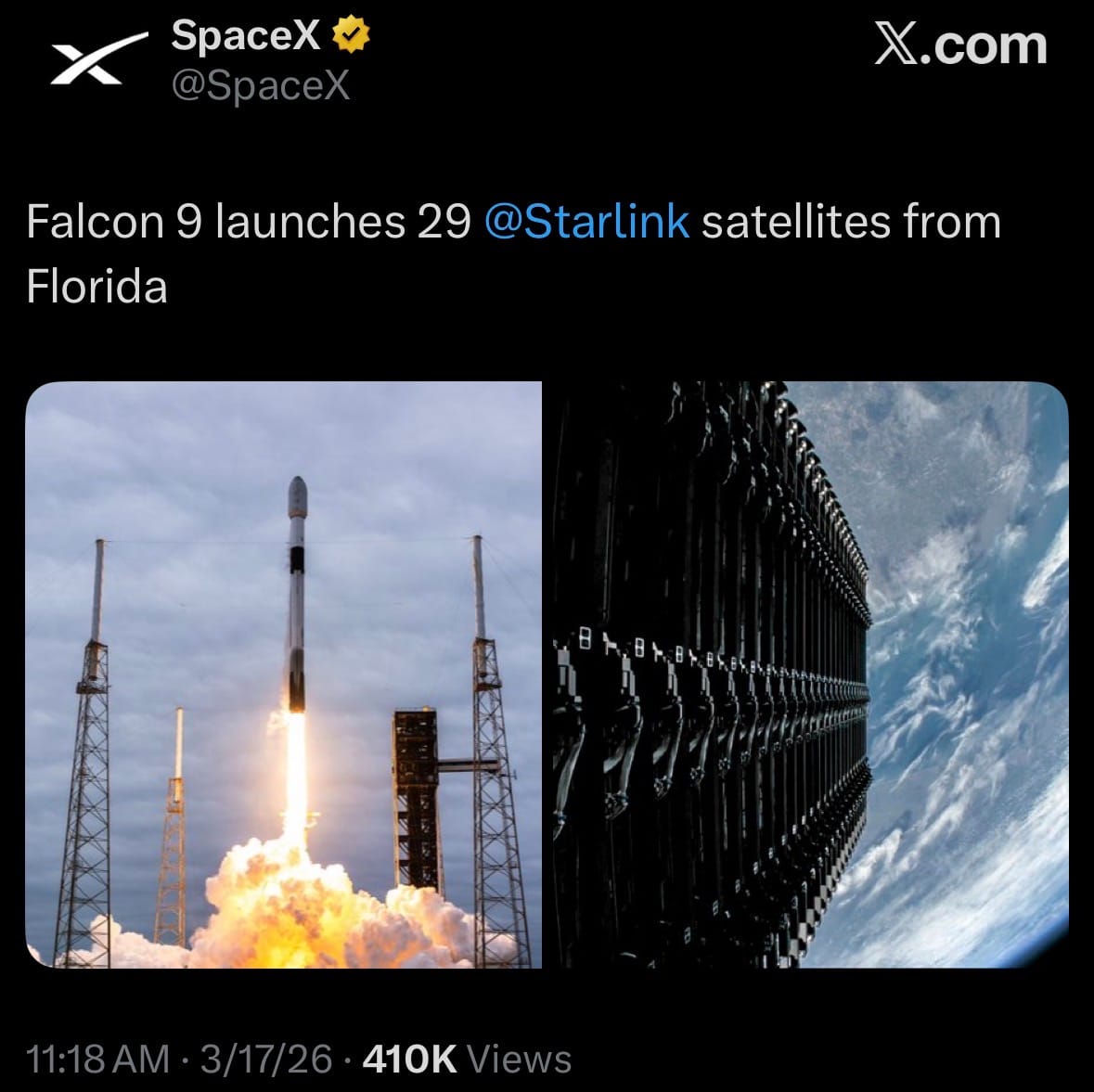
- The first-stage booster (B1090 on its 11th flight) landed successfully on the "A Shortfall of Gravitas" droneship in the Atlantic Ocean. This was SpaceX's 34th Falcon 9 launch of 2026, the 28th Starlink mission this year, and added to the constellation amid ongoing global broadband expansion.
Statistic:
- Largest public telecom companies on Earth by market capitalization:
- 🇺🇸 T-Mobile US: $238.63B
- 🇨🇳 China Mobile: $223.50B
- 🇺🇸 Verizon: $213.07B
- 🇺🇸 AT&T: $197.44B
- 🇩🇪 Deutsche Telekom: $186.78B
- 🇯🇵 SoftBank: $127.10B
- 🇮🇳 Bharti Airtel: $120.52B
- 🇺🇸 Comcast: $109.60B
- 🇺🇸 American Tower: $86.63B
- 🇯🇵 NTT (Nippon Telegraph & Telephone): $80.60B
- 🇨🇳 China Telecom: $78.91B
- 🇲🇽 América Móvil: $71.92B
- 🇸🇬 Singtel: $66.77B
- 🇯🇵 KDDI: $63.75B
- 🇸🇦 Saudi Telecom Company: $56.10B
- 🇫🇷 Orange: $54.34B
- 🇺🇸 Ciena: $52.34B
- 🇨🇭 Swisscom: $47.89B
- 🇦🇪 Emirates Telecom (Etisalat): $43.94B
- 🇦🇺 Telstra: $41.97B
- 🇺🇸 Crown Castle: $38.34B
- 🇺🇸 AST SpaceMobile: $36.56B
- 🇹🇭 Advanced Info Service (AIS): $34.94B
- 🇬🇧 Vodafone: $34.10B
- 🇹🇼 Chunghwa Telecom: $33.77B
History:
- The history of fiber optic cables begins with the discovery that light can carry information. Early experiments in the 1800s showed light could be guided through curved mediums, but the true breakthrough came in 1966, when physicists Charles Kao and George Hockham proved that ultra-pure glass fibers could transmit light signals over long distances with minimal loss. This unlocked the foundation of modern fiber optics. Through the 1970s, rapid advances in glass purity, lasers, and signal amplification made fiber practical for telecommunications. The global turning point came with TAT-8 in 1988, the first transatlantic fiber-optic cable connecting the United States, United Kingdom, and France, replacing older copper cables and massively increasing data capacity. From that point forward, fiber optics became the standard for global communication, enabling the rise of the internet, cloud computing, and real-time global data exchange.
- Today, undersea fiber optic cables carry over 95–99% of all international internet traffic, forming the true backbone of the digital world. The global network consists of 500+ active submarine cables spanning roughly 1.7 million kilometers, connecting continents through key landing hubs and strategic routes. These cables are built and maintained by a small group of specialized companies including SubCom (U.S.), Alcatel Submarine Networks (France), NEC (Japan), and HMN Tech (China), while ownership has shifted heavily toward tech giants like Google, Meta, Microsoft, and Amazon, who now fund and control many of the highest-capacity systems to power cloud infrastructure and AI workloads. Massive projects like 2Africa (~45,000 km) and transatlantic systems like MAREA move enormous volumes of data between regions at near light speed. These cables pass through critical chokepoints such as the Mediterranean, Red Sea, and Southeast Asia, making them both essential and strategically vulnerable. Despite satellites, fiber remains unmatched in capacity and speed, meaning the modern internet—and global finance, military communication, and digital infrastructure—ultimately runs on fragile strands of glass laid across the ocean floor.
Image of the day:

Thanks for reading! Earth is complicated, we make it simple.
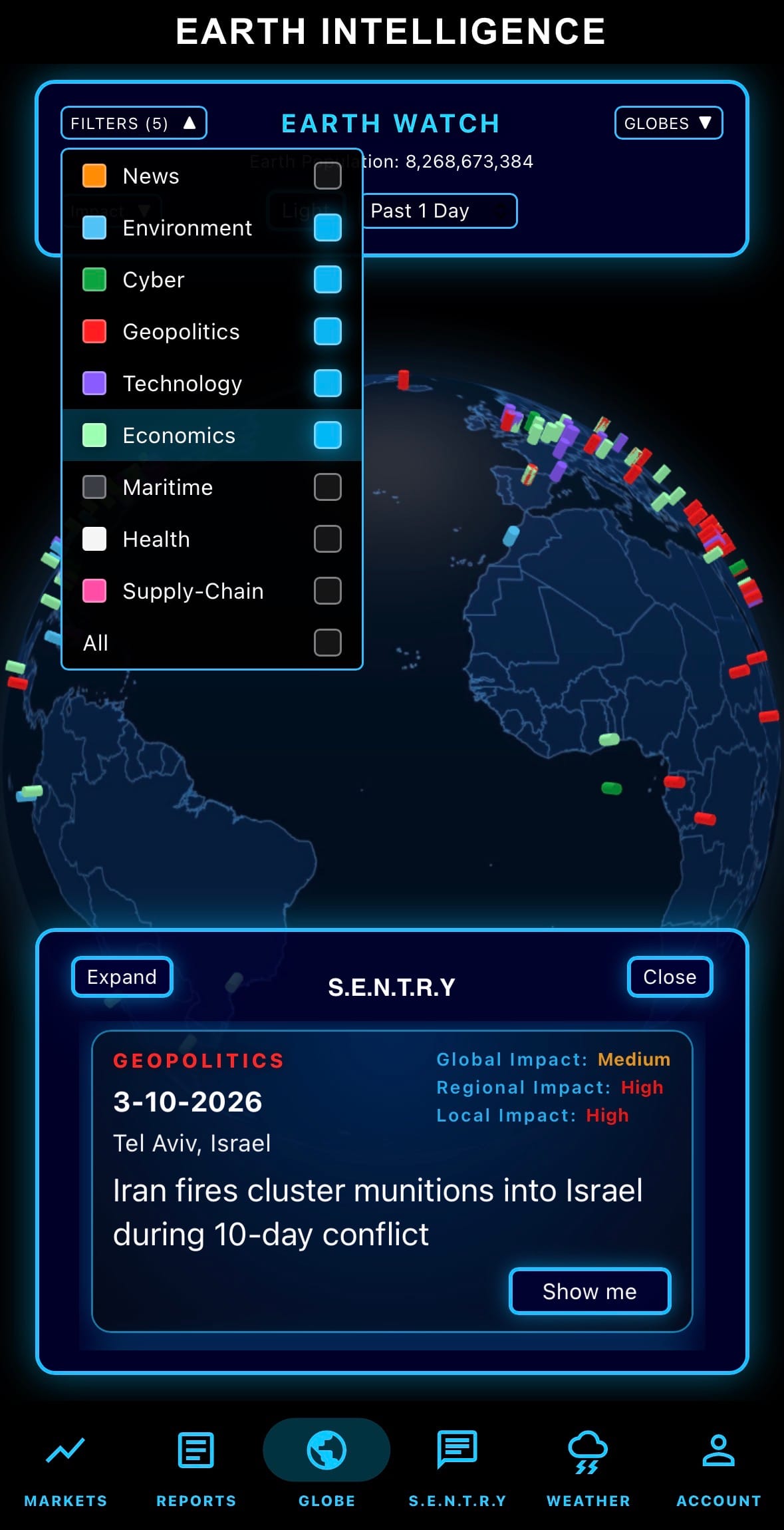
- Click below if you’d like to view our free EARTH WATCH globe:
- Download our mobile app:



Click below to view our previous newsletters:
Support/Suggestions Email:
support@earthintel.io