Friday☕️🌎

Trending:
- September 24, 2026 — The U.S. Coast Guard has now seized more than 262,000 pounds of cocaine through Operation Pacific Viper in the Eastern Pacific.
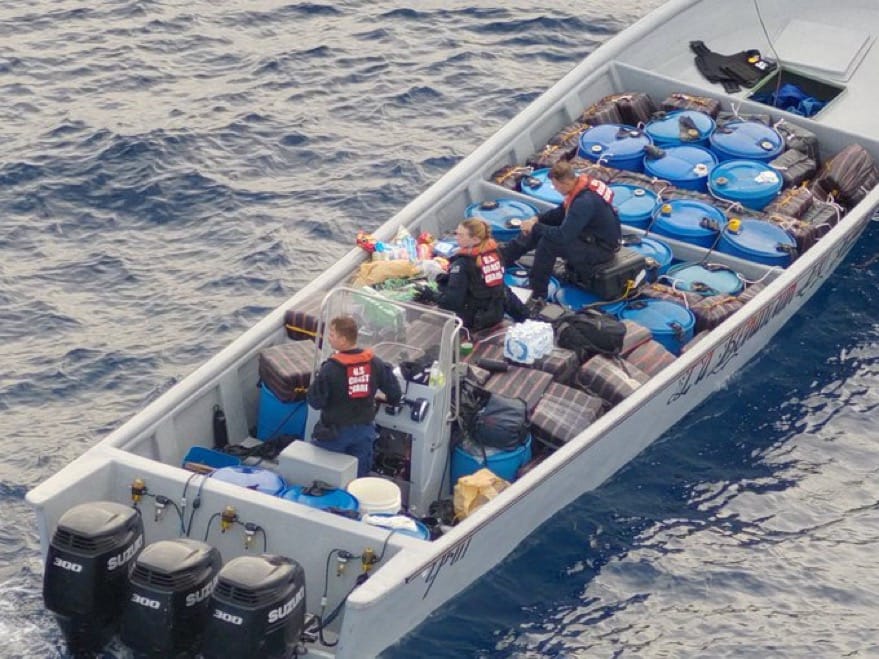
- In just six days, Cutter Tampa seized more than 25,000 pounds across three interdictions and detained 13 suspected smugglers, including hauls of about 6,800 pounds, 15,000 pounds, and 3,456 pounds.
Southcom Joint Drug Seizure:
- September 24, 2026 — U.S. and Honduran forces carried out a coordinated maritime drug interdiction in the Caribbean, seizing 55 bundles containing about 1.6 metric tons of suspected cocaine and detaining four Honduran nationals.
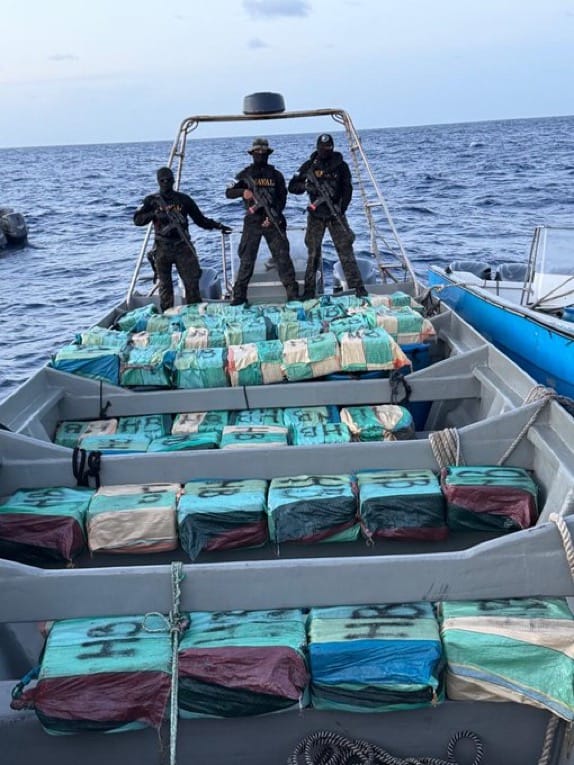
- The operation was supported by Joint Interagency Task Force South as part of broader U.S.-led efforts to disrupt transnational drug-trafficking networks across the Caribbean and Eastern Pacific.
Economics & Markets:
- September 24, 2026 — Cathie Wood’s ARK Invest brought its roughly $1.3 billion ARK Venture Fund onto Ethereum through Securitize, turning ownership in the fund into blockchain-based tokens for eligible investors.

- The fund still invests in companies such as OpenAI, Anthropic, Stripe, and Databricks, but tokenization makes ownership and transfers easier to manage onchain and can support 24/7 trading instead of being limited to normal market hours.
Geopolitics & Military Activity:
- September 24, 2026 — Ukrainian drones reportedly struck Russia’s Perm oil refinery, one of the country’s largest, roughly 1,500 kilometers (930 miles) from Ukraine, causing a major fire at the facility.
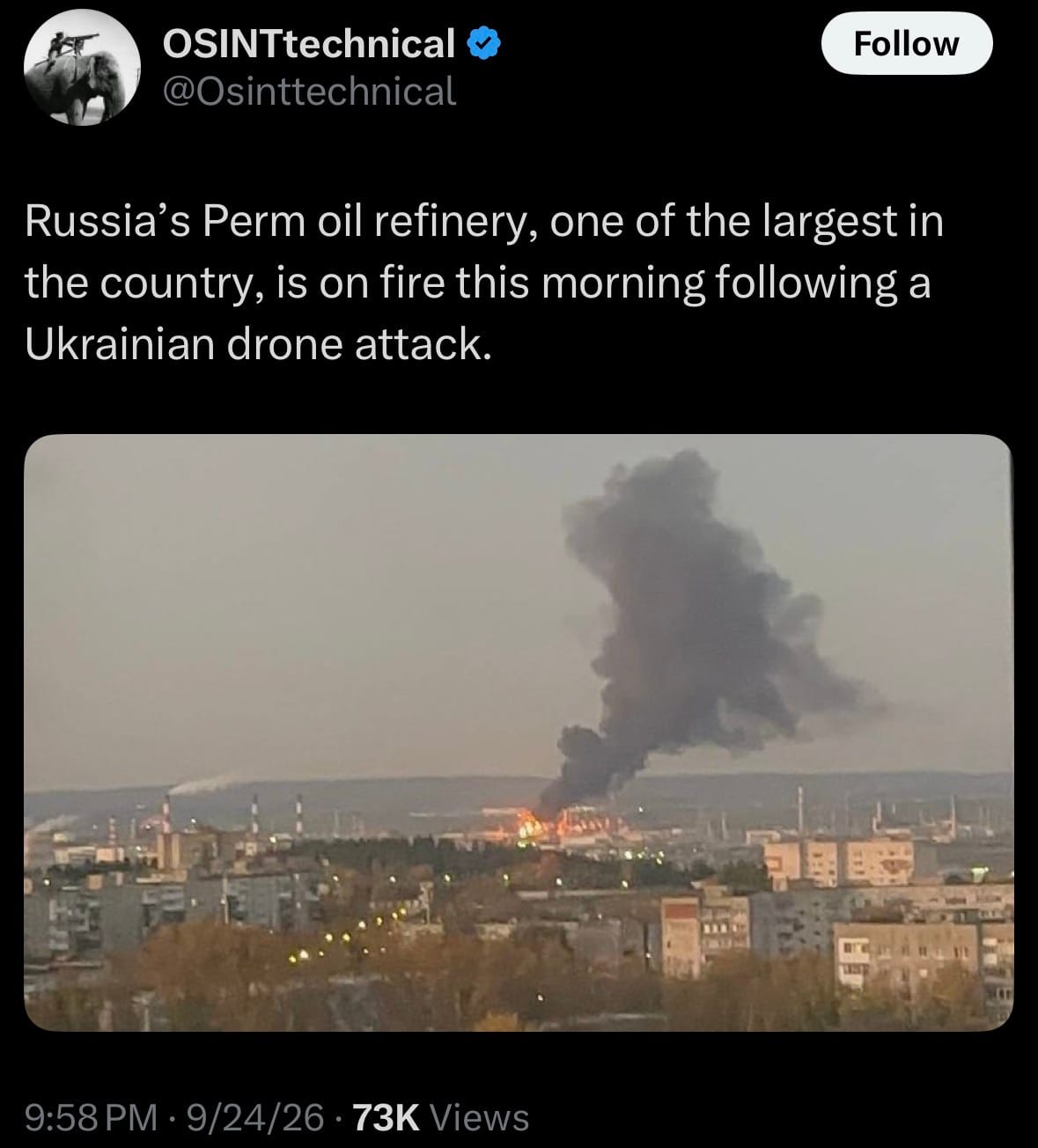
- The strike is part of Ukraine’s ongoing campaign against Russian oil infrastructure, although the full extent of the damage has not yet been independently confirmed.
Space:
- September 24, 2026 — China successfully launched three Yaogan 40 Group 04 satellites at 4:46 p.m. local time from Taiyuan Satellite Launch Center aboard a Long March 6A rocket.

- China says the satellites will be used for electromagnetic-environment monitoring, while outside launch trackers classify them as reconnaissance satellites placed into polar orbit.
Statistic:
- Largest airport companies by market capitalization:
- 🇪🇸 Aena: $44.00B
- 🇹🇭 Airports of Thailand: $26.51B
- 🇲🇽 Grupo Aeroportuario del Pacífico: $12.57B
- 🇫🇷 Aéroports de Paris: $12.16B
- 🇮🇳 GMR Airports: $10.71B
- 🇨🇳 Shanghai Airport (AVINEX): $8.33B
- 🇳🇿 Auckland Airport: $8.32B
- 🇨🇭 Zurich Airport: $7.39B
- 🇲🇽 Grupo Aeroportuario del Sureste (ASUR): $7.15B
- 🇩🇰 Copenhagen Airport: $6.59B
- 🇩🇪 Fraport: $6.47B
- 🇦🇹 Vienna Airport: $5.09B
- 🇲🇽 Grupo Aeroportuario Centro Norte: $4.87B
- 🇬🇷 Athens International Airport: $4.28B
- 🇱🇺 Corporación América Airports: $3.84B
History of the Department of Homeland Security
- The idea of homeland security existed long before the Department of Homeland Security (DHS). For most of U.S. history, protecting the country internally was divided among separate organizations: the U.S. Customs Service (1789) protected borders and collected tariffs, the U.S. Coast Guard’s predecessors protected America’s coastline, the Secret Service (1865) fought counterfeiting and later protected presidents, the Immigration and Naturalization Service (INS) handled immigration, and the FBI handled federal investigations and domestic counterterrorism. FEMA was created in 1979 to coordinate federal disaster response. Airport security, customs, immigration, emergency management, infrastructure protection and counterterrorism therefore existed, but they were spread throughout different departments. The system changed fundamentally after the September 11, 2001 terrorist attacks, when al-Qaeda hijackers seized four commercial aircraft, destroyed the World Trade Center towers, struck the Pentagon and killed nearly 3,000 people. The attacks exposed major weaknesses in aviation security, intelligence sharing, border controls and coordination between federal agencies. President George W. Bush created the White House Office of Homeland Security in October 2001, led by Pennsylvania Governor Tom Ridge. Congress then passed the Homeland Security Act of 2002, which Bush signed on November 25, 2002. The Department of Homeland Security officially began operations on March 1, 2003, bringing 22 federal agencies and programs together in the largest federal government reorganization since the creation of the Department of Defense in 1947.
- DHS reorganized America’s domestic-security system around specialized components. The former Customs Service and parts of INS became U.S. Customs and Border Protection (CBP), responsible for ports of entry and border security, while Immigration and Customs Enforcement (ICE) became responsible for immigration enforcement and investigations inside the country. ICE’s Homeland Security Investigations (HSI) developed into a major investigative organization targeting transnational crime, human trafficking, child exploitation, narcotics, weapons smuggling, financial crimes, cybercrime and other cross-border threats. U.S. Citizenship and Immigration Services (USCIS) took responsibility for immigration benefits and citizenship processing. The newly created Transportation Security Administration (TSA)—established immediately after 9/11 in 2001—moved into DHS and transformed airport security through federal passenger screening, baggage screening, watch-list systems and the Federal Air Marshal Service. FEMA became DHS’s disaster-response organization, while the U.S. Coast Guard moved from the Transportation Department into DHS and continued maritime security, search and rescue, drug interdiction and protection of U.S. waters. The Secret Service also moved from Treasury to DHS while retaining presidential protection and financial investigations. Hurricane Katrina in 2005 exposed serious failures in federal disaster preparedness and coordination, resulting in major FEMA and DHS reforms. Meanwhile, DHS’s mission expanded beyond terrorism toward cybersecurity and critical-infrastructure protection, eventually producing the Cybersecurity and Infrastructure Security Agency (CISA) in 2018.
- Today, DHS is one of the largest and most operationally diverse departments in the U.S. government. Its major components include CBP, ICE/HSI, TSA, FEMA, the Coast Guard, Secret Service, USCIS and CISA, supported by organizations including the Federal Law Enforcement Training Centers, Office of Intelligence and Analysis, Science and Technology Directorate and Countering Weapons of Mass Destruction Office. CBP operates ports of entry, Border Patrol and extensive aircraft, surveillance, sensor and inspection capabilities; ICE handles immigration enforcement while HSI conducts complex domestic and international investigations; TSA protects aviation and transportation; CISA protects federal networks and works with companies operating energy, communications, transportation, financial and other critical infrastructure; FEMA manages major federal disaster response; the Coast Guard protects America’s maritime approaches; and the Secret Service protects national leaders and investigates financial threats. Modern DHS increasingly depends on AI, biometrics, drones, geospatial intelligence, cybersecurity platforms, large databases, automated targeting systems, sensors, communications networks and private government contractors. The evolution is essentially 1789 Customs → Coast Guard/Secret Service/immigration agencies → 1900s federal law-enforcement expansion → 1979 FEMA → 2001 9/11 → Office of Homeland Security/TSA → 2002 Homeland Security Act → 2003 DHS → CBP/ICE/HSI → 2005 Katrina reforms → cybersecurity expansion → 2018 CISA → today’s integrated homeland-security system. The fundamental concept remains the same as after 9/11: instead of treating terrorism, borders, transportation, disasters, cyberattacks, infrastructure and transnational crime as completely separate problems, DHS was designed to coordinate them as interconnected threats to the security of the United States.
Image of the day:

Thanks for reading! Earth is complicated, we make it simple.
- Download our mobile app:

Click below to view our previous newsletters:

Support/Suggestions Email:
support@earthintel.io